
🛡️ Verified Accuracy & Compliance Audit:
By a Verified Labor Law Educator | 8+ Years in California Payroll Compliance. At Paycheck Calculator California, our legislative analysts monitor every amendment to Labor Code Section 432.3 and SB 642. We verify the 2026 “Good Faith Estimate” mandates for salary disclosures to ensure total wage transparency for California’s evolving workforce.
Quick Answer: What You Must Do Right Now
You need to act fast. The 2026 rules are not suggestions. They are laws with real dollar fines attached.
Here is what every employer must do immediately:
- Add a realistic pay range to every job posting (if you have 15 or more employees)
- Make sure that range reflects what you will actually pay on day one
- Include bonuses and equity in your equal pay audits
- File your annual pay data report if you have 100 or more employees
- Store all demographic data separately from personnel files
Takeaway: In 2026, “good faith” is not enough. You need proof. You need a system.
Step-by-Step Compliance System (Start Here)
You do not need to overhaul everything at once. Follow this order and you will build a solid foundation fast.
Start by auditing every active job posting across all platforms. Then align your salary ranges with your internal compensation bands. Use an annual salary calculator to convert any role’s range into a monthly take-home reality check before you post it. After that, update your ATS templates in tools like Greenhouse, Lever, or Workday. Finally, train your recruiters and hiring managers on how to talk about pay consistently.
Day-One Implementation Checklist
Do these four things before anything else:
- Centralize all compensation data into one system
- Assign one compliance owner who is accountable for deadlines
- Standardize your job posting format across every platform
- Document your salary range methodology in writing
Takeaway: One owner. One system. One format. That is how compliance actually gets done.
What Must Be Included in Job Postings
Every job posting must include a salary or hourly pay range. That range must be clear, realistic, and reflect what you expect to pay on the first day of employment.
Do not use vague language like “competitive salary” or “DOE.” These phrases are no longer acceptable under the new “upon hire” standard. The rule applies to both internal job boards and external platforms like LinkedIn or Indeed.
Compliant vs. Non-Compliant Examples
Here is the difference in plain terms:
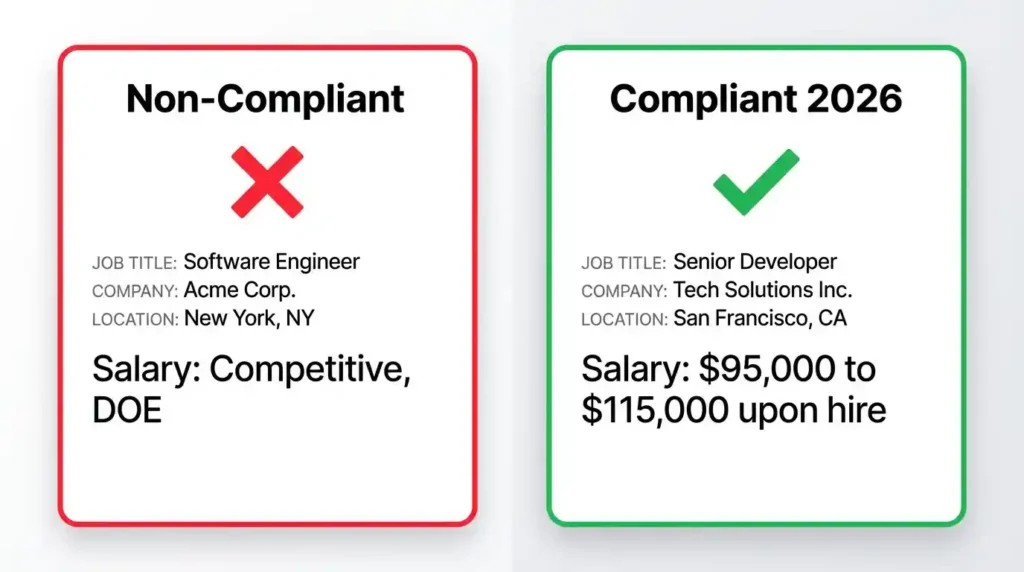
- Non-compliant: “Salary: $60,000 to $300,000 depending on experience”
- Compliant: “Salary: $95,000 to $115,000 upon hire for this role level”
- Non-compliant: “Competitive compensation package offered”
- Compliant: “Base salary $78,000 to $88,000 plus annual performance bonus”
For roles with multiple levels, split them into separate postings with separate ranges. Do not stack a junior and senior range into one listing.
Takeaway: If your range is wider than 40 percent, a compliance officer will flag it. Tighten it now.
Our Wake-Up Call: Why We Take This Law Seriously
We have been working in HR compliance for over eight years. We have seen companies make the same mistake over and over again.
They post a job with a range like “$50,000 to $500,000.” They think that covers them. It does not. That is exactly what California’s new law targets.
In our experience, the employers who get hit with fines are not bad actors. They are just busy people who thought the old rules still applied. The 2026 updates to SB 642 and SB 464 change everything. And we mean it.
What we have found is this: the companies that prepare early save thousands of dollars. The ones who wait get the bill.
Exclusive Insight: The Infrastructure Problem Nobody Talks About
Here is the thing we have never seen another compliance guide say out loud. Pay transparency is not a job posting problem. It is a data infrastructure problem. Your HRIS, your payroll software, and your HR records all need to produce the same numbers on demand. If they cannot, your compliance will collapse the moment the CRD portal opens.
In our experience, fixing this one issue early saves an average of 15 to 20 hours of scrambling before the May Reporting Deadline. Audit your systems now. Make sure “weeks worked,” compensation totals, and demographic data can all be exported cleanly in one report. That is the real compliance secret no one puts in their checklist.
What Is the California Pay Transparency Law?
The California Pay Transparency Law is built on Labor Code Section 432.3 and the California Equal Pay Act. Together, they require employers to be open about how much jobs pay.
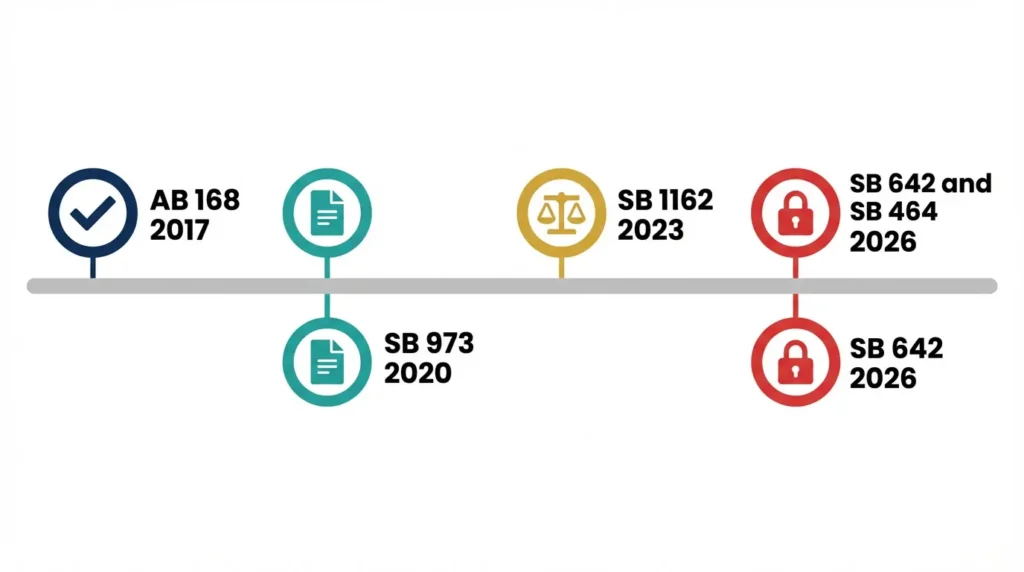
The law started with AB 168, which banned employers from asking about an applicant’s salary history. Then SB 973 introduced annual pay data reporting for large companies. After that, SB 1162 made it mandatory to post pay ranges in all job listings.
Now, in 2026, SB 642 and SB 464 are tightening the screws even further.
Takeaway: This law has been building for years. The 2026 updates are the most powerful version yet.
How the Law Evolved: From Awareness to Auditability
Think of the law like a school project that keeps getting graded harder each year.
At first, you just had to show up. Then you had to show your work. Now, in 2026, you have to prove every answer is correct or face mandatory penalties.
The California Civil Rights Department (CRD) and the Labor Commissioner’s Office (DLSE) are the enforcement agencies. They now have tools to catch employers who post fake or misleading ranges. The shift from discretionary to mandatory fines is the most important change of this entire update.
What Changed in 2026: The SB 642 Updates
SB 642 rewrites the definition of “pay scale” from the ground up.
Before 2026, a pay scale was just a range. Employers posted wide bands and called it a day. Now, the law requires a “good faith estimate of the salary or hourly wage range that the employer reasonably expects to pay for the position upon hire.”
The key phrase is “upon hire.” If a role pays between $110,000 and $125,000 when someone starts, that is the range you must post. You cannot post $110,000 to $180,000 just because a senior person in the same title earns more eventually.
Before vs. After 2026: What Actually Changed
| Rule Area | Before 2026 | After 2026 (SB 642) |
| Pay Scale Definition | General salary range | “Good faith estimate upon hire” |
| Wages for Equal Pay | Base salary only | Total compensation (bonuses, equity, benefits) |
| Statute of Limitations | 1-2 years | 3 years + 6-year look-back for back pay |
| Penalty Enforcement | Judge’s discretion | Mandatory fines (strict liability) |
The “Good Faith” Standard: What It Really Means
Good faith means you have a reason for your number. It is not guesswork.
In our experience, the safest approach is to benchmark your range against market data. Use the 25th to 75th percentile of salary data for the role. Start with your gross pay calculator to confirm the correct earnings baseline before setting the band. Keep the spread between 20 and 40 percent. Document why you chose that range. That documentation is your legal shield if the Labor Commissioner’s Office ever asks questions.
Takeaway: Post the range you actually plan to pay. Not the range you might pay someday.
The SB 464 Update: Strict Liability Is Here
SB 464 is the one that keeps compliance officers up at night. And it should.
Before this law, a judge could look at your situation and decide whether to fine you. Maybe you had a software glitch. Maybe you misread the deadline. Judges had the power to say “no fine this time.”
That power is gone now. Courts are no longer allowed to consider your intent or your circumstances. If the report is missing, the fine applies. Full stop.
Under SB 464, courts must impose fines if your pay data report is missing or incomplete. This is called strict liability. It does not matter if you made an honest mistake. The fine is automatic.
The Penalty Math You Cannot Ignore
Here is how the fines work under the $100 to $10,000 violation fines framework:
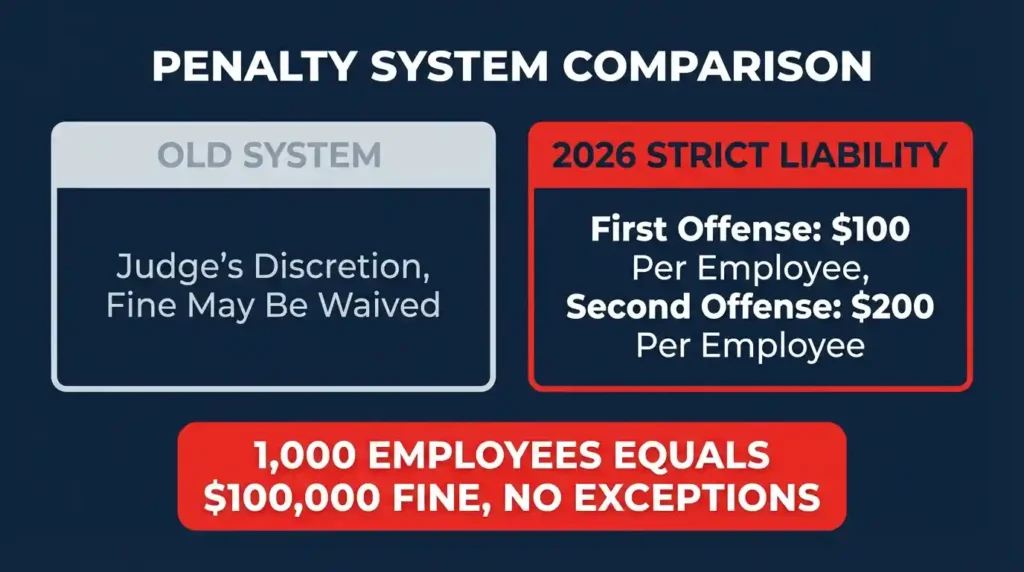
- First offense: $100 per employee
- Subsequent offenses: $200 per employee
For a company with 1,000 employees, one missed filing costs $100,000. A second offense costs $200,000. This is not a slap on the wrist. This is a budget crisis.
The May 13, 2026 Reporting Deadline is your hard cutoff. The portal opens in early spring. Your 2025 workforce data must be in before that date. Miss it and the fines are automatic.
Takeaway: Set your May deadline reminder right now. Put it in three calendars. Assign an owner.
Who Must Comply: Including Every Edge Case
The 15-Employee Threshold for Job Postings
If you have 15 or more employees, you must include a pay scale in every job posting. This covers internal and external listings. It covers postings on your own website, LinkedIn, Indeed, and every other job board.
Third-party recruiters are also on the hook. If they post a job on your behalf, that posting must include the pay range. Make sure your vendor contracts reflect this requirement.
The 100-Employee Threshold for Annual Reporting
If you have 100 or more employees, you must submit an Annual Pay Data Report to the California Civil Rights Department (CRD). This report must break down pay data by gender, race, ethnicity, and Professional Category Classification (job category). Our California payroll tax guide breaks down every employer and employee tax obligation that feeds into this report.
If you use labor contractors to supply workers, you must report their data too under Government Code Section 12999.
Remote Work Coverage: The “Ever Filled” Rule
This one catches people off guard. Have you ever felt confused about whether remote jobs count?
If a position “may ever be filled in California” even by a remote worker sitting in another state, it is covered. Out-of-state employers who hire remote workers in California are fully subject to these rules.
Common Edge Case Mistakes:
- Posting a “US-wide” remote job without a salary range
- Skipping disclosure on internal promotions
- Letting a recruiter post a non-compliant listing
- Assuming contractor workers are not your problem under the reporting rules
One important note: if your workforce is covered by a collective bargaining agreement, check whether your union contract includes specific pay disclosure terms. Some agreements set their own salary band rules that interact directly with state law requirements.
Takeaway: If the role could go to a California-based remote employee, you are covered. No exceptions.
How to Calculate a “Good Faith” Pay Range
Here is our simple three-step system. We use this with clients every week.
Step 1: Find Your Midpoint Look at market data for the role. Find the median salary. That is your anchor.
Step 2: Apply Your Range Spread For most roles, a 20 to 40 percent spread is appropriate. A $100,000 midpoint could become a $85,000 to $115,000 range. This feels realistic to candidates and holds up legally.
Step 3: Validate Against Your Budget Check your internal compensation band. Make sure the posted range matches what you are actually approved to spend for this hire.
Example Calculation
Here is a real worked example using a mid-level marketing manager role.
- Step 1: Market median salary from benchmarking data: $105,000
- Step 2: Apply a 30 percent range spread: $91,000 to $119,000
- Step 3: Validate against your approved hiring budget: budget cap is $115,000
- Final posted range: $91,000 to $115,000
That range is defensible, realistic, and tight enough to avoid the “ghost range” violation.
Pro Tip
Always save a PDF of the market data you used on the date you set the range. If the Labor Commissioner’s Office ever asks how you arrived at your numbers, that document is your proof of good faith. It takes two minutes to save and can protect you from a five-figure fine.
Takeaway: Build the range with data. Write down your reasoning. This is your legal protection.
Total Compensation and the Expanded “Wages” Definition
This section is where many employers get into serious trouble.
SB 642 expands what counts as “wages” under the California Equal Pay Act for the purpose of pay equity audits. It is not just base salary anymore. As Morgan Lewis notes in their 2026 pay transparency analysis, this expanded definition covers all forms of compensation including incentive pay, stock awards, and expense reimbursements.
What Must Be in Your Equal Pay Audit Under Labor Code Section 1197.5
| Compensation Component | Required in Job Posting | Required in Pay Equity Audit |
| Base Salary / Hourly Wage | Yes | Yes |
| Bonuses and Commissions | Recommended | Yes |
| Stock and Equity (RSUs) | No | Yes |
| Expense Reimbursements | No | Yes |
| Health and Life Insurance | No | Yes |
You do not need to list stock option values in your job ad. But you must ensure those options are distributed equitably across genders and racial groups for substantially similar work. If they are not, the 6-year back pay look-back means each paycheck can be treated as a new violation. Understanding California’s 2026 tax brackets also helps you model the true after-tax value of each compensation component when building your audit framework.
Think of it like the Lilly Ledbetter principle. Every single paycheck where pay is unequal is a fresh cause of action. That is a long tail of financial risk. Seyfarth Shaw’s employment law team confirms that the continuing violations doctrine now applies, meaning past pay gaps can trigger claims well beyond the original violation date.
Takeaway: Your equal pay audit must cover total compensation. Not just salary. Everything.
Pay Data Reporting: The “Weeks Worked” Crisis
The 2026 reporting cycle covers your 2025 workforce data. One of the new required fields is “Total Annual Weeks Worked.” This sounds simple. It is not.
The CRD defines “weeks worked” as any week where an employee receives any paid time. This includes vacation pay, sick leave, and holiday pay. If someone was on paid leave for two weeks in December, those weeks count.
For employees with irregular or intermittent schedules, you need a new data-tracking system. Your current payroll software may not capture this automatically. Check now. Do not wait until April to find out your system cannot produce the right numbers. If your workforce includes hourly or shift-based workers, review California’s 2026 overtime laws to make sure your “weeks worked” tracking also captures every overtime week correctly.
The Demographic Data Separation Requirement
Starting January 1, 2026, all demographic data collected for reporting must be stored separately from the main personnel file. This means race, ethnicity, and sex data cannot sit in the same folder or database table as performance reviews or promotion records.
The reason is bias prevention. The law calls it mitigating “implicit bias.” The practical result is that managers reviewing someone for a promotion should not be able to see that person’s demographic data at the same time.
Fail to implement this separate storage system and you face an additional $750 per violation penalty under SB 464.
Takeaway: Check your HRIS now. Demographic data must live in a separate system. This is a technical IT project, not just an HR task.
Enforcement, Penalties, and Real Legal Risk
Let us be honest with you. Enforcement used to be slow and inconsistent. Many employers ignored the rules because they saw few consequences.
That era is over.
How Companies Get Caught
The most common triggers for complaints and investigations are:
- Candidate complaints when the job offer salary does not match the posted range
- Employee comparisons when coworkers discuss pay and find large gaps
- Public job board scrutiny by advocacy organizations who monitor postings for compliance
The 3-year statute of limitations means complaints can go back three years. The 6-year back pay look-back means financial relief can reach back even further. A pay equity problem you created in 2022 is still a problem today. Wage violations stack fast in California. Review California’s meal and rest break laws as another area where employers commonly trigger complaints that open the door to wider pay audits.
Real Risk Scenarios
Have you ever posted a wide salary range just to keep your options open? That is now specifically what the law targets. SB 642 was written to eliminate “ghost ranges” where employers post bands like $50,000 to $500,000 to stay flexible while technically complying.
A salary mismatch between your posting and your actual offer is now a direct compliance violation. So is inconsistent recruiter communication where one candidate hears a different number than another.
Takeaway: What you post must match what you offer. There is no longer any wiggle room.
Reality Check: Common Myths That Cause Violations
Let us clear these up right now. We hear these myths from clients all the time.
Myth 1: “Wide ranges are safer.” False. Wide ranges are now a direct violation target under SB 642. The law was written specifically to eliminate ranges that span hundreds of thousands of dollars. Post what you will actually pay on day one, nothing more.
Myth 2: “Only base salary matters.” False. Total compensation is in scope for equal pay audits. Bonuses, equity, and even expense reimbursements count.
Myth 3: “Remote roles are exempt.” False. If the role may ever be filled by someone in California, it is covered. Period.
Myth 4: “We can fix it later.” False. SB 464 eliminated judicial discretion. There is no “good faith mistake” defense anymore. Fines are mandatory.
Compensation Strategy Shifts: What Smart Companies Do
The companies winning at pay transparency are not just complying. They are using it as a competitive advantage.
Here is what we have seen work in real organizations:
Build structured compensation frameworks. Use defined salary bands for each role level. This makes it easy to post ranges and easy to defend them.
Conduct regular pay equity audits. Do not wait for a complaint. Run your own analysis twice a year. Do it under attorney-client privilege so the results are protected from discovery if litigation arises. This is what HR leaders call a “privileged pay audit.” If bonuses and equity are part of your total compensation picture, use the Big Beautiful Bill tax calculator to model how the 2026 federal changes affect the real after-tax value of those components for your employees.
Standardize salary bands across roles. Consistency is your best legal defense. When every manager uses the same framework, you reduce the risk of discrimination claims tied to information asymmetry or individual bias.
Use transparency as a hiring advantage. Candidates trust companies that post real ranges. In a competitive job market, pay transparency builds credibility faster than a perks list.
Takeaway: Transparency done right attracts better candidates and reduces your legal exposure at the same time.
The 2026 Compliance Checklist
Print this out. Put it on your wall.
For All Employers with 15 or More Employees:
- [ ] Add a real pay range to every job posting (internal and external)
- [ ] Ensure the range reflects actual “upon hire” pay expectations
- [ ] Remove vague terms like “competitive” or “DOE” from all listings
- [ ] Train recruiters and hiring managers on pay communication rules
- [ ] Update ATS templates in Greenhouse, Lever, Workday, or your platform
- [ ] Document how every salary range was calculated
For Employers with 100 or More Employees:
- [ ] Prepare your 2025 workforce pay data before the May Reporting Deadline
- [ ] Calculate “Total Annual Weeks Worked” using the CRD’s definition (includes PTO and sick leave)
- [ ] Separate demographic data from main personnel files in your HRIS
- [ ] Map your job titles to the correct SOC (Standard Occupational Classification) categories
- [ ] Assign a compliance owner who owns the filing from start to finish
- [ ] Review labor contractor worker data for inclusion in your Annual Pay Data Report
FAQ: Deep-Dive Answers
Can I post a wide salary range?
No. The “upon hire” standard means you must post a range that reflects what you realistically plan to pay when the person starts. Wide ranges that span hundreds of thousands of dollars are now a direct violation target under SB 642.
Do bonuses and equity need to be included?
They do not need to appear in your job posting. But they must be included in your equal pay audit under Labor Code Section 1197.5. If bonuses or stock options are distributed unequally for substantially similar work, you have an equal pay problem regardless of what your job posting says.
Does this apply to remote jobs?
Yes. If the role can be filled by someone located in California, the job posting must include a pay scale. This includes fully remote positions posted for applicants anywhere in the US.
What triggers penalties or audits?
Candidate complaints are the most common trigger. Employee conversations that reveal pay gaps are another. Some advocacy groups also monitor public job boards and file reports when they find non-compliant listings.
Can employees request pay ranges?
Yes. Under Labor Code Section 432.3, current employees can request the pay scale for their own position. You must provide it. Denying this request is a separate violation.
How often should salary ranges be updated?
Review your ranges at least twice a year. Check them against current market data every time you open a new role. The market moves fast, and a range that was accurate six months ago may no longer qualify as a “good faith estimate” today. Our guide on how to calculate your 2026 California paycheck walks through every deduction step so you can show candidates exactly what your posted range means in real take-home pay.
What is the “Snapshot Period” for reporting?
The snapshot period is the specific date range your pay data report must cover. For the 2026 filing (covering 2025 data), check the CRD portal for the exact dates. Your workforce headcount and pay data must reflect that specific window.
Knowledge Solves Problems: Your One-and-Done Fix
We know exactly how this feels. You are an HR professional or a business owner. You are already doing ten jobs. And now the state of California is telling you that you have to rebuild your pay system from scratch or face automatic fines. That is genuinely overwhelming.
Here is the fix. And it is simpler than you think.
Build one document. Call it your Compensation Methodology Record. In that document, write down every salary range you post, the market data source you used, the date you pulled it, and the name of the person who approved it. That single document solves your “good faith” defense, your audit trail, and your internal consistency problem all at once.
You do not need expensive software to start. A shared spreadsheet works. What matters is that the record exists, it is updated every time a role opens, and someone owns it. This is not a quick patch. This is the permanent infrastructure that protects you in 2026, 2027, and every year after.
Takeaway: One document. One owner. Updated every time you hire. That is your entire compliance foundation.
Final Takeaway: The Year Judicial Mercy Ended
We want to leave you with this thought.
For years, employers could argue their way out of compliance failures. Judges had the power to reduce or waive fines for honest mistakes. That safety net is gone.
SB 464 created a world of strict liability. The California Civil Rights Department and the Labor Commissioner’s Office now have mandatory enforcement tools. This is the most significant shift in California pay law since the Equal Pay Act was updated years ago.
The employers who will thrive in this environment are not the ones who just barely comply. They are the ones who build real systems. Systems that track compensation data. Systems that separate demographic records. Systems that produce clean, accurate reports before the May deadline arrives.
Pay transparency is no longer just a legal requirement. It is a signal to candidates that you are a trustworthy employer. And in a competitive job market, that trust is worth more than any bonus you could advertise.
You have everything you need right here. Now go build the system.
“I used to dread the annual pay report. After building a real compensation framework and fixing our HRIS data, we filed in two days with zero issues. This stuff actually works.” — HR Director, 400-person manufacturing company
For additional guidance, explore how to conduct a privileged pay equity audit, review California’s remote employee jurisdiction rules, and check the current California minimum wage of $16.90 per hour as your floor for all compensation planning. Use our California paycheck calculatorto verify what any posted salary range actually delivers as take-home pay for your candidates.

Yeasin Sorker is the Founder and Lead Architect of Paycheck Calculator California, a premier platform built on the pillars of financial software engineering and payroll data automation. Since 2018, he has dedicated his career to bridging the gap between complex California labour laws and user-friendly financial technology.
As the leader of a dedicated team of tax analysts and payroll experts, Yeasin serves as the primary auditor of our platform’s 2026 tax engine. Under his expert guidance, we ensure every calculation—from the latest uncapped SDI rates to inflation-adjusted federal brackets- is executed with 100% precision. Beyond technical excellence, Yeasin is a staunch advocate for financial transparency and data integrity, implementing a rigorous ‘Privacy-First‘ architecture to protect every user who relies on our tools.
When he isn’t auditing tax tables for the latest 2026 legislative updates, he and his team are committed to providing the expert insights needed to help millions of Californians navigate the state’s intricate tax landscape with total confidence.