
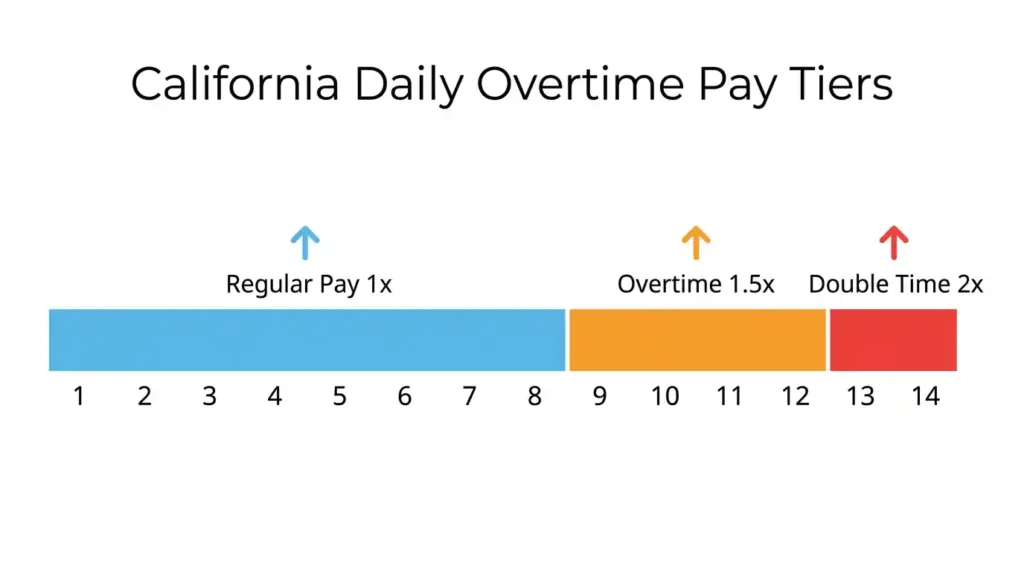
In California, overtime starts after 8 hours in a single workday — not 40 hours like most states. Hours 9 through 12 pay at 1.5x your regular rate. Beyond 12 hours in one day, double time applies. California Labor Code Section 510 makes this a daily protection, not just a weekly one. That said, these rules only apply to non-exempt employees. Salaried workers, independent contractors, and certain exempt classifications are not covered — and the distinction matters more than most workers realize.
Quick Answer: Does California Pay Overtime After 8 Hours?
California Overtime Rules at a Glance
- Daily overtime: You earn 1.5x your regular pay for hours 9 through 12 in a single workday.
- Weekly overtime: You earn 1.5x your regular pay for hours beyond 40 in a workweek, unless daily overtime already covered those hours.
- Daily double time: You earn 2x your regular pay for every hour beyond 12 in a single workday.
- Seventh-day rule: If you work all 7 days in one workweek, the first 8 hours on day seven earn 1.5x pay. Any hours beyond 8 on that seventh day earn 2x pay.
Takeaway: California protects you every single day, not just at the end of the week.
Quick Overtime Rate Chart
| Hours Worked | Pay Rate | When It Applies |
|---|---|---|
| Up to 8 hours/day | Regular pay (1x) | Standard workday |
| Hours 9 to 12/day | Time-and-a-half (1.5x) | Daily overtime |
| Over 12 hours/day | Double time (2x) | Extended daily overtime |
| Over 40 hours/week | Time-and-a-half (1.5x) | Weekly overtime (no double-counting) |
| First 8 hours on 7th day | Time-and-a-half (1.5x) | Seventh-day premium |
| Over 8 hours on 7th day | Double time (2x) | Seventh-day double time |
Understanding California Overtime Law
What Makes California Different From Federal Law?
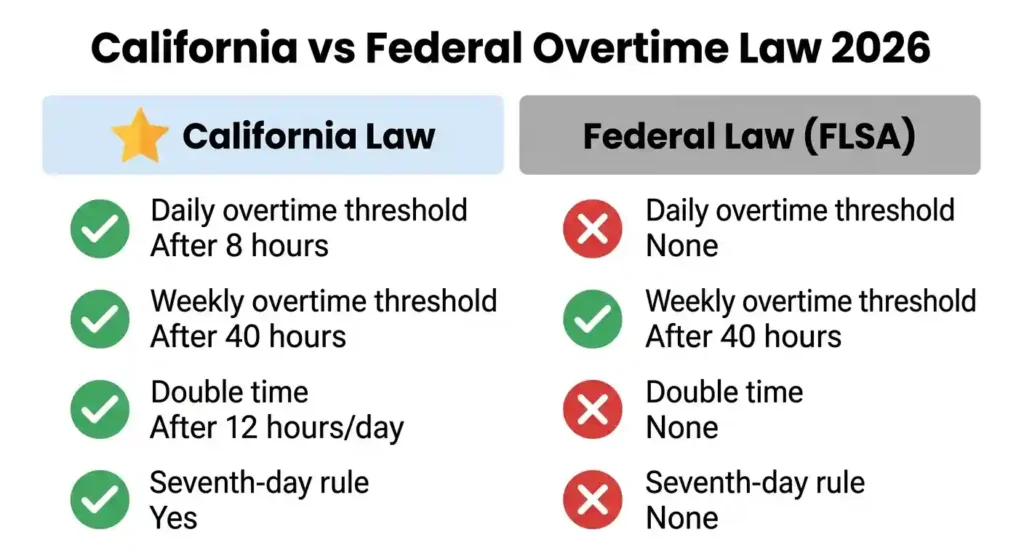
The Fair Labor Standards Act (FLSA) only requires overtime after 40 hours in a week. No daily rule exists at the federal level.
California Labor Code Section 510 gives workers daily overtime protection. The moment you cross 8 hours in a day, the clock ticks at a higher rate. This is the single biggest rule California workers miss.
Takeaway: California’s daily overtime rule is stronger than federal law and exists specifically to protect you.
California Labor Code Section 510 Explained
California Labor Code Section 510 — the full statute is published by the California Legislature — requires 1.5x pay for all hours over 8 in a workday and over 40 in a workweek, 2x pay for all hours over 12, and covers the seventh consecutive day. Violations result in back pay, penalties, and legal action.
Takeaway: Section 510 is your legal shield. It exists to make sure every hard hour you work gets paid at the right rate.
When Does Overtime Start in California?
Overtime After 8 Hours in a Workday
Overtime starts at hour 9 of every workday for non-exempt employees. Under California law, a workday is any consecutive 24-hour period as established by the employer. Employers cannot average hours across days — each day stands on its own.
Takeaway: The daily overtime clock resets every morning. Work more than 8 hours in one day and you earn 1.5x starting at hour nine.
Overtime After 40 Hours in a Workweek
Once you exceed 40 hours in a workweek, every extra hour pays 1.5x. Your employer defines the workweek as a fixed, recurring 7-day period.
California’s anti-pyramiding rule prevents double-counting: hours already paid as daily overtime are not counted again toward the 40-hour weekly threshold.
Takeaway: Both daily and weekly overtime rules apply in California. You get whichever protection pays you more, not both at once.
Overtime on the Seventh Consecutive Day
If you work seven days in a row within a single workweek, the seventh day is treated differently. Your employer must pay you 1.5x your regular rate for the first 8 hours on that seventh day. After 8 hours on day seven, the rate jumps to double time.
This rule applies regardless of how many hours you worked earlier in the week. Even if every prior shift was a standard 8-hour day, day seven still triggers premium pay.
Takeaway: Working all seven days in one workweek earns you premium pay starting from the very first hour on day seven.
When Does Double Time Begin?
Double time applies when you exceed 12 hours in a workday, or after 8 hours on the seventh consecutive day. For a deeper breakdown of how these two rates differ, see California double time vs overtime rules. At $20/hour, double time is $40/hour — two hours past 12 adds $80 that day.
Takeaway: Double time kicks in after 12 hours in a workday or after 8 hours on your seventh consecutive day of work.
California Overtime Pay Rates Explained
Regular Pay vs Time-and-a-Half vs Double Time
Time-and-a-half is 1.5x your regular rate. Double time is 2x. Each applies at a specific hour threshold.
For a worker earning $18/hour, time-and-a-half is $27 and double time is $36. An employer who pays straight time for those hours is shorting your wages.
All three rates apply to non-exempt workers. Exempt employees who meet specific salary and duties tests do not receive overtime.
Takeaway: Regular pay, time-and-a-half, and double time are three distinct legal rates. Each one applies at a specific hour threshold.
What Is the Regular Rate of Pay?
The regular rate is not just your hourly wage. Commissions, non-discretionary bonuses, and shift differentials must all be included. A $200 production bonus earned in a week with overtime means your regular rate is higher — and overtime must be recalculated on that higher rate.
For salaried non-exempt employees, divide the weekly salary by 40 to get the hourly equivalent. A California payroll tax calculator can then show you the net take-home impact of those overtime earnings.
Takeaway: The regular rate of pay includes more than your hourly wage. Bonuses and commissions can raise it and therefore raise your overtime owed.
Piece-rate workers face the same rule. For the full legal framework behind these calculations, the California overtime laws 2026 guide covers all rate scenarios in detail. If you are paid per item produced or per task completed, your employer must calculate a regular hourly rate from your total piece-rate earnings for the week and pay overtime on top of that. The same applies to incentive pay tied to performance. Any non-discretionary compensation earned during the workweek factors into the regular rate calculation.
Overtime Formula and Calculation Method
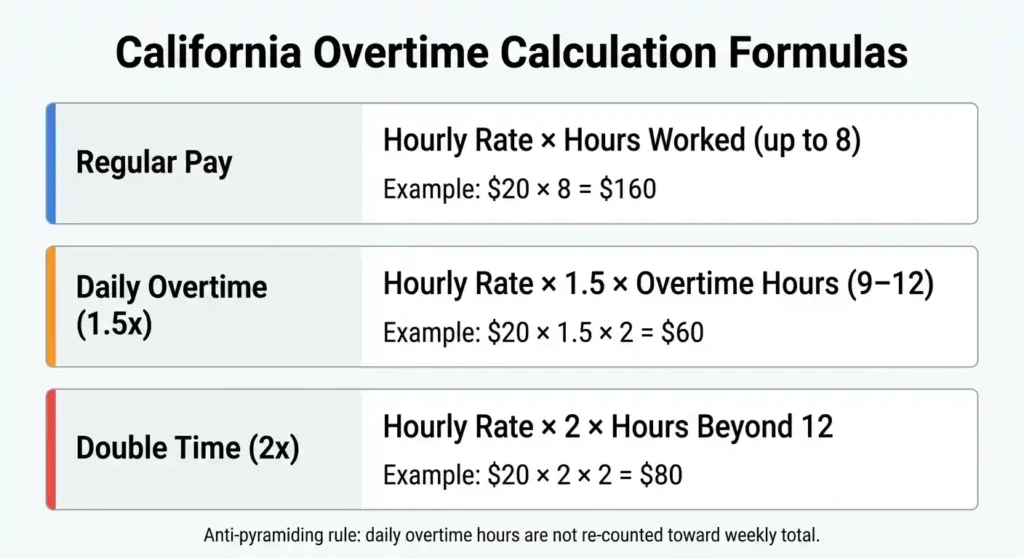
Daily overtime: regular rate x 1.5 x overtime hours. Double time: regular rate x 2 x hours beyond 12.
Example at $20/hour, 10-hour day: 8 hours x $20 = $160 + 2 hours x $30 = $60. Total: $220. Use the gross pay calculator to verify your own figures quickly.
Employers must track daily and weekly hours. Keep your own records — they are critical evidence in any dispute.
Takeaway: California overtime math is consistent and predictable. Track your daily hours carefully and verify every paycheck.
California Overtime Calculation Examples
Example 1: Working 10 Hours in One Day
Say you earn $22 per hour and your employer scheduled you for a 10-hour shift.
- Hours 1 to 8: $22 x 8 = $176 (regular pay)
- Hours 9 and 10: $33 x 2 = $66 (time-and-a-half at 1.5 x $22)
- Total daily pay: $242
At straight time that same shift would pay $220. The $22 daily difference adds up to thousands over a year of 10-hour shifts.
Takeaway: A 10-hour day in California always generates 2 overtime hours at 1.5x, starting at hour nine.
Example 2: Working 12 Hours in One Day
You earn $20 per hour and work a full 12-hour shift.
- Hours 1 to 8: $20 x 8 = $160 (regular pay)
- Hours 9 to 12: $30 x 4 = $120 (time-and-a-half)
- Total daily pay: $280
At exactly 12 hours you are still in the time-and-a-half zone. Double time begins at hour 13. Straight time for the same shift would pay $240. That $40 difference matters.
Takeaway: A full 12-hour day earns 4 overtime hours at 1.5x. Double time does not apply until hour 13.
Here is what changes when you extend that same shift to 14 hours. You earn $20 per hour and work 14 hours in a single day.
- Hours 1 to 8: $20 x 8 = $160 (regular pay)
- Hours 9 to 12: $30 x 4 = $120 (time-and-a-half)
- Hours 13 and 14: $40 x 2 = $80 (double time)
- Total daily pay: $360
At straight time the same 14-hour day pays $280. Double-time protection adds $80 on top of the overtime premium.
Example 3: Working More Than 40 Hours Per Week
You earn $18 per hour and work Monday through Saturday: five 8-hour days plus one 8-hour Saturday shift. To see how consistent overtime affects your annual earnings, use the annual salary calculator. That totals 48 hours for the week.
- Hours 1 to 40: $18 x 40 = $720 (regular pay)
- Hours 41 to 48: $27 x 8 = $216 (time-and-a-half)
- Total weekly pay: $936
No daily overtime triggered here because no single day exceeded 8 hours. The weekly threshold was crossed on Saturday. Hours paid as daily overtime do not count again toward the 40-hour weekly total.
Takeaway: Weekly overtime applies when total hours exceed 40, but only for hours not already covered by daily overtime.
A common schedule worth understanding is five 10-hour days in a single workweek. That totals 50 hours. Each 10-hour day generates 2 hours of daily overtime, giving you 10 hours of daily overtime for the week. The weekly total is 50 hours, but those 10 daily overtime hours are already paid at a premium. After removing them, only 40 straight-time hours remain. No additional weekly overtime is owed. The anti-pyramiding rule does exactly what it is designed to do.
Example 4: Working 7 Days in a Row
You earn $16 per hour and work a standard 8-hour shift every day for seven consecutive days in a single workweek. That totals 56 hours.
- Days 1 to 6 (48 hours): Regular daily pay, no daily overtime. But hours 41 to 48 trigger weekly overtime.
- Day 7 (8 hours): First 8 hours on day seven earn 1.5x, even though no single day exceeded 8 hours.
Weekly overtime for hours 41 to 48: $24 x 8 = $192. Seventh-day premium for all 8 hours of day seven: $24 x 8 = $192. Total weekly pay: $640 regular + $384 premium = $1,024 instead of $896 at straight time.
Takeaway: Day seven of a straight seven-day week earns a premium starting from hour one, regardless of daily hours.
Example 5: Multiple Overtime Triggers in the Same Week
This is the most complex scenario and the one where payroll mistakes happen most often. Say you earn $25 per hour and work the following schedule: Monday 12 hours, Tuesday 10 hours, Wednesday 8 hours, Thursday 8 hours, Friday 8 hours. Total: 46 hours.
- Monday hours 1 to 8: Regular pay. $25 x 8 = $200
- Monday hours 9 to 12: Time-and-a-half. $37.50 x 4 = $150
- Tuesday hours 1 to 8: Regular pay. $25 x 8 = $200
- Tuesday hours 9 and 10: Time-and-a-half. $37.50 x 2 = $75
- Wednesday, Thursday, Friday: Regular pay. $25 x 24 = $600
Now check weekly total. You worked 46 hours. Hours already paid as daily overtime (Monday’s 4 extra hours and Tuesday’s 2 extra hours = 6 hours) are not counted again toward the 40-hour weekly threshold. That means your weekly hours for overtime purposes are 46 minus 6 = 40 hours regular. No additional weekly overtime is owed.
Total weekly pay: $1,225. At straight time, it would have been $1,150. You earned an extra $75 from daily overtime rules alone.
Takeaway: When daily and weekly overtime overlap, daily overtime is calculated first. Weekly overtime only applies to hours not already paid at a premium.
Who Qualifies for Overtime Pay in California?
Non-Exempt Employees
Non-exempt employees get full California overtime protection. This covers most hourly workers in retail, food service, construction, manufacturing, healthcare, transportation, and office roles — and many salaried workers too.
If you clock in and out, follow a set schedule, or have little control over your tasks, you are likely non-exempt.
Takeaway: Non-exempt means overtime rules fully apply to you. Most hourly workers and many salaried workers are non-exempt.
Exempt Employees
Exempt employees do not receive overtime. The main categories are executive, administrative, professional, outside sales, and computer software professionals.
To qualify as exempt in 2026, an employee must earn at least $70,304/year — which is two times California’s minimum wage of $16.90/hour — AND spend more than half their time on exempt duties. Salary alone is not enough — a “manager” title with mostly hourly-level tasks still owes overtime.
Takeaway: Exempt status requires both the right salary level and the right job duties. A title alone does not make someone exempt.
Independent Contractors
Contractors are not covered by overtime rules, but California’s AB5 ABC test — detailed on the California Labor Commissioner’s AB5 page — makes true contractor status hard to prove. All three conditions must be met: (A) free from company control, (B) work is outside the company’s core business, (C) worker has an independently established trade.
Misclassified workers are entitled to back overtime pay. This is one of the most actively enforced areas in California. Workers uncertain about their classification can also review the 1099 vs W-2 comparison for a side-by-side breakdown.
Takeaway: In California, proving true independent contractor status is hard. Misclassified workers are often entitled to back overtime pay.
How to Tell Whether You Are Exempt or Non-Exempt
Here is a quick checklist to guide you:
- Do you earn an hourly rate? You are almost certainly non-exempt.
- Is your salary below $70,304 per year (2026 threshold)? You are likely non-exempt regardless of job title.
- Does your employer control your schedule, tasks, and how you do your job? Non-exempt.
- Do you primarily manage other employees, make major business decisions, or use advanced professional knowledge? You may be exempt.
If you check most of the non-exempt boxes above, California’s Labor Commissioner handles disputes at no cost. The worker classification category covers additional scenarios for gig workers, freelancers, and hybrid roles.
Takeaway: Your actual job duties and compensation level determine your overtime status, not the title on your business card.
California Overtime Exceptions and Special Rules
Alternative Workweek Schedules
A properly adopted alternative workweek schedule (AWS) — like a 4/10 schedule — eliminates daily overtime on extended shifts. Workers comparing schedule types will also find the part-time vs full-time paycheck comparison useful for understanding how fewer hours affect total compensation. Adoption requires a written proposal, a meeting, and a secret ballot vote approved by at least two-thirds of affected workers.
If any step was skipped, the schedule is invalid and daily overtime applies. Workers with personal or medical conflicts must receive an alternative arrangement.
Takeaway: Alternative workweek schedules only eliminate daily overtime if the employer follows every step of California’s strict adoption process.
Union Employees and Collective Bargaining Agreements
Some collective bargaining agreements (CBAs) lawfully modify overtime rules. A CBA must expressly waive the Labor Code provisions and provide equivalent compensation to be valid. A contract that only sets a schedule does not override your overtime rights.
Unsure if your CBA applies? Ask your union steward.
Takeaway: Union contracts can modify overtime rules, but only if the contract explicitly addresses it and meets California’s legal requirements.
Healthcare Workers
Healthcare workers are covered under IWC Wage Order 5. California also has a separate healthcare worker minimum wage structure that directly affects the regular rate calculation for these employees. Any alternative workweek arrangement must go through the proper adoption process, and mandatory overtime for nurses is legally restricted.
Healthcare is one of the most litigated sectors for wage violations. Review your pay stubs every period.
Takeaway: Healthcare workers have strong overtime protections in California, but industry-specific rules mean the details matter. Know your wage order.
Agricultural Workers
Under AB 1066, all California agricultural workers are now fully covered by standard overtime rules. The California DIR overtime FAQ provides official guidance on how these thresholds apply. Farm operations with 26 or more employees have been covered since 2022. As of 2026, all agricultural employers must comply.
If you work in agriculture and are not seeing overtime for days over 8 hours, contact the California Labor Commissioner.
Takeaway: California farmworkers now have full overtime protections. Long days in the field must be paid at overtime rates like any other industry.
Common Payroll Mistakes That Cost Employees Money
Not Paying Daily Overtime
The most frequent violation I see: an employer runs payroll on a 40-hour weekly system and misses California’s daily threshold entirely. Three 10-hour days + two 8-hour days = 46 hours. Six were daily overtime. The employer paid correctly at the weekly level but incorrectly at the daily level.
Red flag: your check shows only 40 regular hours and overtime only above 40, even on weeks with multiple long days. Brushing up on paycheck basics helps you understand exactly what each line on your stub should reflect.
Takeaway: Check your daily hours, not just your weekly total. If you worked more than 8 hours on any day, you should see daily overtime on that paycheck.
Miscalculating the Regular Rate
Non-discretionary bonuses, production incentives, and commissions must be included in the regular rate of pay before calculating overtime. Employers who calculate overtime on base wage only — then pay the bonus separately — are underpaying overtime.
Example: a $150 bonus earned in a week with overtime means your employer likely owes an additional overtime payment on top of what was already paid.
Takeaway: Bonuses and commissions raise your regular rate of pay and must be factored into overtime calculations.
Misclassifying Employees as Exempt
A “manager” title with a salary just above $70,304 does not make someone exempt if they spend most of their time doing hourly-level work. California allows recovery of up to three years of unpaid overtime in a wage claim — plus penalties.
If your title changed but your actual work did not, and overtime disappeared, ask questions.
Takeaway: A title promotion that strips your overtime rights without truly changing your job duties may be misclassification.
Off-the-Clock Work Violations
Any work that benefits your employer counts as compensable time — pre-shift setup, post-shift cleanup, travel between job sites, mandatory meetings, required training, and on-call time at the worksite.
Remote work blurs the line. A 9 pm Slack reply, a pre-shift phone call, or logging into work systems from home all count as work time. If those minutes push you past 8 hours in a day, overtime is owed. Knowing how to read your California pay stub is the fastest way to catch these errors.
Takeaway: Any work you do for your employer, even from home and even for a few minutes, counts as compensable work time.
California Overtime Law vs Federal Overtime Law
Side-by-Side Comparison Table
| Feature | California Law | Federal Law (FLSA) |
|---|---|---|
| Daily overtime threshold | Over 8 hours in a workday | None |
| Weekly overtime threshold | Over 40 hours in a workweek | Over 40 hours in a workweek |
| Daily double time | Over 12 hours in a workday | None |
| Seventh-day rule | Yes, 1.5x first 8 hours, 2x after | None |
| Minimum exempt salary (2026) | $70,304/year | $35,568/year |
| Averaging hours across days | Not allowed | Not applicable |
| Agricultural overtime | Full protections (phased in) | Partial exemptions apply |
Which Law Applies to You?
If you work in California, California law governs. Federal law is the floor; California’s rules are stronger in almost every way. If you moved here from another state, do not assume the rules are the same.
Takeaway: California workers are always covered by California law. Since California’s overtime rules are stronger than federal law, you get California’s protections.
Common Myths and Misconceptions About California Overtime
Myth: Overtime Only Starts After 40 Hours
Federal law sets 40 hours as the weekly overtime threshold. California adds daily overtime on top of that.
In California, a worker who works 10 hours on Monday earns 2 hours of daily overtime, regardless of what happens the rest of the week. A worker who works four 10-hour days earns 8 hours of overtime for the week even if they never exceed 40 hours total. The daily rule operates independently.
Every California worker should have this fact memorized: overtime starts at hour 9 of any workday.
Takeaway: In California, the 40-hour rule is not the whole story. Overtime begins after 8 hours in any single workday.
Myth: Salaried Workers Never Get Overtime
A salary does not mean exempt. The question is whether the employee legally qualifies for an exemption — not how they are paid. A salaried worker at $50,000/year doing routine tasks under close supervision is almost certainly non-exempt and entitled to overtime.
Takeaway: Salary does not equal exempt. Many salaried workers in California are fully entitled to overtime pay.
Myth: Unauthorized Overtime Doesn’t Have to Be Paid
Employers can discipline workers for unauthorized overtime, but must still pay for it. This falls under broader California labor laws that govern employer obligations across all wage situations. Docking overtime because it was not pre-approved is a wage violation — and it is recoverable.
Takeaway: Unauthorized overtime must still be paid. An employer can discipline a worker for it but cannot refuse to pay for it.
Myth: Employers Can Average Hours Across Days
Averaging is not legal in California. A 6-hour day and a 10-hour day do not cancel out. The 10-hour day generates 2 overtime hours. Each workday is evaluated on its own.
Takeaway: California overtime is calculated day by day. Averaging hours across days is not allowed and does not reduce overtime owed.
What to Do If Your Employer Isn’t Paying Overtime
Signs You May Be Owed Back Pay
Key red flags:
- Check shows only regular pay on weeks with days over 8 hours
- Sudden “exempt” reclassification with no real job change
- Flat weekly rate regardless of hours worked
- Time records rounded down in a way that eliminates overtime
If wages were withheld at termination, you may also have a separate claim under the California waiting time penalty rules.
Takeaway: Compare your time records to your pay stub every pay period. Unexplained discrepancies are red flags worth investigating.
Documents to Gather
Start collecting:
- All pay stubs from the period in question
- Any schedule records showing your assigned or actual hours
- Your own notes, texts, or emails about work hours
- Time clock printouts or digital timekeeping records
- Any written communications from your employer about overtime policies
California requires employers to provide wage statements every pay period and keep payroll records for at least three years. If you have not kept yours, request copies from payroll.
Takeaway: Gather all pay stubs, time records, and work communications before filing any claim. Documentation wins wage disputes.
Steps to Resolve an Overtime Dispute
Start with HR or your supervisor. Put your concern in writing.
If unresolved, file a wage claim with the California Labor Commissioner — the Division of Labor Standards Enforcement (DLSE) — free, no lawyer needed. For larger amounts, a California employment attorney on contingency may be more effective.
Statute of limitations: 3 years for a Labor Commissioner wage claim, up to 4 years for a civil lawsuit under California’s Unfair Competition Law (Business & Professions Code § 17200). The clock starts from each underpaid paycheck, not the date you discovered the issue.
Takeaway: Start with HR. If that fails, the California Labor Commissioner handles wage claims for free and can recover your back pay.
Frequently Asked Questions
Do You Automatically Get Overtime After 8 Hours in California?
Yes, for non-exempt employees. The law triggers automatically at hour 9 — 1.5x until 12 hours, then double time. Exempt employees, contractors, and approved AWS workers may not qualify.
Takeaway: Yes. For non-exempt California workers, overtime after 8 hours in a day is automatic and legally required.
Can Salaried Employees Receive Overtime?
Yes, if the employee is non-exempt. Divide the weekly salary by 40 for the hourly equivalent, then apply standard overtime rules. Exemption requires both $70,304/year salary (2026) AND more than half their time in qualifying exempt duties.
Takeaway: Many salaried California employees qualify for overtime. The salary amount and actual job duties determine exemption status.
Is Overtime Based on Hours Worked or Hours Paid?
Overtime is based on hours actually worked. PTO, sick leave, and paid holidays do not count toward the threshold. For how sick leave accrual works in California, see the California sick leave laws 2026 guide. But every minute you physically work — including off-the-clock tasks that benefit your employer — does count.
Takeaway: Count hours you physically work, not hours you are paid for. PTO and holidays do not push you into overtime.
Do Lunch Breaks Count Toward Overtime?
Unpaid 30-minute meal breaks (required for shifts over 5 hours) do not count toward overtime. California’s meal and rest break laws cover the full penalty structure for violations. — as long as you are fully relieved of duties. If you work through the break, it becomes paid time and counts toward your daily total.
Paid 10-minute rest breaks (required for shifts over 3.5 hours) do count as work time.
Takeaway: Unpaid meal breaks do not count toward overtime. Working through a meal period turns it into compensable work time.
Can My Employer Refuse to Pay Overtime If It Wasn’t Approved?
No. Unauthorized overtime must still be paid. The employer can discipline the worker, but withholding wages is a separate violation. The only exception: the employer had absolutely no knowledge the work was done.
Takeaway: Employers must pay for unauthorized overtime. Not paying is a wage violation. Discipline is allowed. Withholding wages is not.
What Happens After 12 Hours in One Day?
After 12 hours in a workday, every additional hour pays 2x your regular rate. At $20/hour, that is $40/hour starting at hour 13. Check your pay stub for double-time line items on long shift days.
Takeaway: Hour 13 and beyond in any workday earns double time (2x your regular rate) in California.
How Does Overtime Work on the Seventh Consecutive Day?
Working all 7 days in a single employer-defined workweek triggers the seventh-day rule: 1.5x for the first 8 hours, 2x after that. The count resets with each new workweek — so Saturday of one week and Sunday of the next do not combine.
Takeaway: The seventh-day rule applies when you work all 7 days in your employer’s defined workweek. Day seven pays 1.5x for first 8 hours and 2x after that.
Does California Overtime Apply to Remote Employees?
Yes. California overtime law applies wherever the work is performed. Remote non-exempt workers have the same rights as office workers. If your employer uses an honor system for time tracking, keep your own daily logs.
Takeaway: Remote workers in California have the same overtime rights as in-office workers. Track your own hours and verify them against your pay stub.
Final Takeaway: How to Know If You’re Entitled to Overtime Pay
Quick summary:
- Daily: Over 8 hours = 1.5x. Over 12 hours = 2x. Resets every day.
- Weekly: Over 40 hours = 1.5x. Daily overtime hours are not double-counted.
- Seventh day: All 7 days worked = 1.5x for first 8 hours, 2x after.
- Exceptions: Exempt employees ($70,304+ salary + qualifying duties), approved AWS workers, and some union CBA employees.
Here is your quick verification checklist:
- Are you a non-exempt employee? Start tracking your daily hours.
- Did you work more than 8 hours in any single day this pay period? You should see daily overtime on your check.
- Did you work more than 40 hours total this week, beyond what daily overtime already covered? Check for weekly overtime.
- Did you work all 7 days this week? Day seven should show a premium rate.
- Are bonuses or commissions included in your regular rate for overtime calculations?
If anything does not match your pay stub, you may be owed back wages. The California Labor Commissioner wage claim process is free to use.
California overtime law exists to make sure every hour you work gets paid at the right rate. Use it.

Yeasin Sorker is the founder of Paycheck Calculator California. He built this tool in 2018 after noticing that most free paycheck calculators missed California-specific rules like daily overtime and the uncapped SDI rate.
He researches California payroll tax updates regularly and keeps this calculator aligned with the latest IRS, FTB, and EDD published rates. All calculations on this site are estimates based on official 2026 government sources. For personalized tax advice, consult a qualified tax professional.