
Los Angeles Paycheck Calculator 2026
Real take-home pay after federal tax, California state tax, SDI & LA city wages — calculated in real time.
Same salary, different LA sub-cities — how minimum wage floors and local rules affect your paycheck.
| City / Zone | Min Wage | Est. Net/Month |
|---|
*Estimates based on your salary above. Highlighted row = your current selection.
| Role / Category | Median LA Salary | Est. Monthly Take-Home | vs. You |
|---|
Source: BLS Occupational Employment Statistics, CA EDD 2026 estimates. Take-home assumes single filer, bi-weekly pay, no extra deductions.
What This Calculator Does
It shows your exact take-home pay after every deduction that hits an LA paycheck: federal tax, California state tax, Social Security, Medicare, SDI, pre-tax benefits, and post-tax deductions.
Enter your salary or hourly rate. Your net pay updates instantly. No submit button. No waiting.
Quick Scenarios: Jump Straight to Your Situation
Pick the scenario that matches you. The calculator is already set up for each one.
- Just got a job offer in LA — enter the offered gross salary, set filing status to Single, leave deductions at zero. This shows your baseline take-home before any benefits enrollment.
- Got a raise and want to see the real difference — enter your old salary, note the net. Enter your new salary. Compare. If the difference is smaller than expected, see why your paycheck feels smaller after a raise.
- Starting freelance or side income — switch to Self-Employed (1099). The calculator adds SE tax (15.3%) and applies the half-SE deduction automatically. For a deeper look at the real cost difference, read the 1099 vs W-2 tax comparison for California workers.
- Evaluating a job with benefits — enter your salary, then open Pre-Tax Deductions and add your 401(k) percentage and health premium. This shows your true net after benefits.
- Moving to LA from another state — enter your current salary to see what LA taxes would look like. Then check the LA vs Other Cities table below to compare with where you are now.
- Working overtime shifts — switch to Hourly mode. Enter your daily hours above 8 in the overtime field. California daily overtime kicks in at 8 hours per day, not just 40 hours per week. Learn exactly how this works in our guide to California overtime laws.
How to Use It
Step 1: Choose your pay type
- Salaried — enter your annual gross salary
- Hourly — enter your rate and hours per week
- Self-Employed (1099) — enter your net business income
Step 2: Select your LA location
Pick the city or zone where you work, not where you live. Minimum wage floors differ across LA. For a full statewide breakdown, see California minimum wage 2026:
- City of Los Angeles: $18.42/hr
- Unincorporated LA County: $18.47/hr
- West Hollywood: $20.25/hr (general) or $20.87/hr (hotel)
- Santa Monica: $18.47/hr
- Malibu: $17.91/hr
- LA City Hotel Worker (60+ room properties): $25.00/hr
- CA Fast Food: $20.00/hr
- CA Healthcare: $24.00/hr (see California healthcare worker minimum wage 2026)
Step 3: Set your filing status
Choose Single, Married Filing Jointly, Married Filing Separately, or Head of Household. Both federal and California brackets change with each status. To understand how CA withholding is calculated from your DE-4, see how to fill out California Form DE-4.
Step 4: Add deductions (optional but important)
Open the Pre-Tax Deductions panel to add:
- 401(k) contribution %
- Health, dental, vision premiums
- HSA or FSA contributions
Open the Post-Tax Deductions panel to add:
- Roth 401(k)
- Union dues (SAG-AFTRA, IATSE, Teamsters, IBEW)
- CalSavers % (see CalSavers mandate 2026)
- Any other after-tax deduction
Step 5: Read your results
Switch between four tabs:
- Breakdown — every deduction line, per check / monthly / annual
- Chart — visual donut showing where your gross pay goes
- LA City Compare — same salary across different LA zones
- LA Context — rent-to-income ratio, commute costs, what is left after essentials
Calculator Features
Pay Type Support
- W-2 salaried employees
- Hourly workers with California daily overtime (1.5x after 8 hrs/day, 2x after 12 hrs/day)
- Self-employed / 1099 with SE tax and half-SE deduction applied automatically
Location Intelligence
- 9 LA sub-city zones with correct minimum wage floors
- Automatic hotel worker rate detection ($25/hr, rising to $30 by 2028)
- Real-time minimum wage violation alert if your hourly rate is below the local floor
Pre-Tax Deductions
- 401(k) / 403(b) slider (0-30%)
- Health, dental, vision premium fields
- HSA with California HSA trap warning — see HSA contribution limits and California rules for full details
- FSA and traditional IRA
Post-Tax Deductions
- Roth 401(k) slider
- Union dues — labeled field for LA entertainment and trades workers
- CalSavers auto-enrollment field with opt-out explanation
- Custom other deduction field
Bonus / Supplemental Pay
- Separate bonus field
- CA flat rate applied correctly: 10.23% on bonuses and RSUs, 6.6% on other supplemental income
- Federal flat rate: 22%
- Full methodology explained in California bonus tax rate guide
W-4 Withholding
- Dependents credit dollar amount (2020+ W-4 format)
- Additional per-period withholding field
Results Display
- Per paycheck / monthly / annual toggle
- Full breakdown table with color-coded deduction lines
- Donut chart with effective tax rate in center
- LA city comparison table
- LA cost-of-living context panel
Salary Benchmarks
Compares your salary to common LA roles: LAUSD teacher, IATSE crew, registered nurse, software engineer, and retail. Shows take-home estimates with a badge indicating whether you are above, below, or near each benchmark. You can also use the annual salary calculator to convert any hourly rate to an annual figure before running these comparisons.
Share Tools
- Copy results as formatted text
- Copy page link
What Makes This Different
Most paycheck calculators are built for a generic American worker. This one is built for Los Angeles. For a broader California-wide view, the California paycheck calculator on our homepage covers all California cities and pay scenarios.
| Feature | This Calculator | SmartAsset | ADP | PaycheckCity |
|---|---|---|---|---|
| CA SDI at correct 1.3% (2026) | Yes | No (shows 1.2%) | No | Partial |
| LA sub-city minimum wages | Yes (9 zones) | No | No | No |
| Hotel worker $25/hr rate | Yes | No | No | No |
| CA daily overtime (not just weekly) | Yes | No | No | No |
| HSA California tax trap warning | Yes | No | No | No |
| Union dues field (LA entertainment) | Yes | No | No | No |
| CalSavers named field | Yes | No | No | No |
| 1099 / self-employed mode | Yes | No | Partial | Yes |
| LA rent-to-income context | Yes | No | No | No |
| Bonus CA flat rate (10.23% / 6.6%) | Yes | Partial | No | Yes |
| Sources cited for every rate used | Yes | Partial | No | No |
We also have dedicated tools for other major California cities: San Francisco paycheck calculator, Oakland paycheck calculator, San Jose paycheck calculator, and Sacramento paycheck calculator.
Real LA Salaries: What You Actually Take Home
These are after-tax estimates for a single filer in the City of Los Angeles, paid bi-weekly, with no additional deductions. Run your exact number in the calculator above.
$40,000 Salary in Los Angeles After Tax
| Amount | |
|---|---|
| Annual gross | $40,000 |
| Federal income tax | ~$3,180 |
| CA state income tax | ~$1,070 |
| Social Security | ~$2,480 |
| Medicare | ~$580 |
| CA SDI | ~$520 |
| Monthly take-home | ~$2,680 |
| Per paycheck (bi-weekly) | ~$1,237 |
| Effective tax rate | ~20% |
At $40,000 in LA, rent takes roughly 88% of monthly take-home at the median 1BR rate of $2,350. This salary is below what most financial advisors consider livable in LA without roommates or subsidized housing.
$65,000 Salary in Los Angeles After Tax
| Amount | |
|---|---|
| Annual gross | $65,000 |
| Federal income tax | ~$7,280 |
| CA state income tax | ~$2,760 |
| Social Security | ~$4,030 |
| Medicare | ~$943 |
| CA SDI | ~$845 |
| Monthly take-home | ~$4,095 |
| Per paycheck (bi-weekly) | ~$1,890 |
| Effective tax rate | ~24% |
Median rent takes about 57% of monthly take-home. Manageable with careful budgeting, but saving is difficult without a second income or roommates.
$75,000 Salary in Los Angeles After Tax
| Amount | |
|---|---|
| Annual gross | $75,000 |
| Federal income tax | ~$9,620 |
| CA state income tax | ~$3,640 |
| Social Security | ~$4,650 |
| Medicare | ~$1,088 |
| CA SDI | ~$975 |
| Monthly take-home | ~$4,669 |
| Per paycheck (bi-weekly) | ~$2,155 |
| Effective tax rate | ~25% |
Rent takes about 50% of take-home. A 401(k) contribution at this salary noticeably reduces taxes while building retirement savings. For a full breakdown at this income level, see $75k after taxes in California.
$100,000 Salary in Los Angeles After Tax
| Amount | |
|---|---|
| Annual gross | $100,000 |
| Federal income tax | ~$15,290 |
| CA state income tax | ~$5,890 |
| Social Security | ~$6,200 |
| Medicare | ~$1,450 |
| CA SDI | ~$1,300 |
| Monthly take-home | ~$5,739 |
| Per paycheck (bi-weekly) | ~$2,649 |
| Effective tax rate | ~31% |
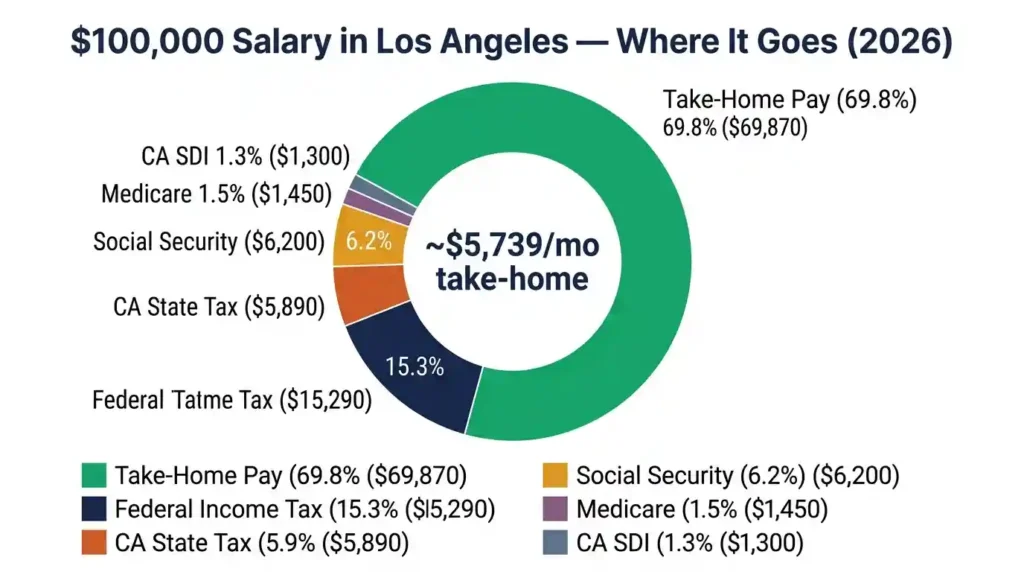
Median rent takes about 41% of take-home. Pre-tax 401(k) contributions have the most impact here, reducing both federal and state tax simultaneously. See the detailed guide for $100k after tax in California.
$120,000 Salary in Los Angeles After Tax
| Amount | |
|---|---|
| Annual gross | $120,000 |
| Federal income tax | ~$19,840 |
| CA state income tax | ~$8,180 |
| Social Security | ~$7,440 |
| Medicare | ~$1,740 |
| CA SDI | ~$1,560 |
| Monthly take-home | ~$6,787 |
| Per paycheck (bi-weekly) | ~$3,132 |
| Effective tax rate | ~32% |
Rent takes about 35% of take-home. This is where LA starts to feel financially manageable as a single person. Full breakdown at $120k after taxes in California.
$150,000 Salary in Los Angeles After Tax
| Amount | |
|---|---|
| Annual gross | $150,000 |
| Federal income tax | ~$27,640 |
| CA state income tax | ~$11,730 |
| Social Security | ~$10,918 |
| Medicare | ~$2,175 |
| CA SDI | ~$1,950 |
| Monthly take-home | ~$7,966 |
| Per paycheck (bi-weekly) | ~$3,676 |
| Effective tax rate | ~36% |
Rent takes about 30% of take-home, right at the recommended limit. See the complete $150k after taxes in California guide for filing status comparisons and 401(k) impact.
$200,000 Salary in Los Angeles After Tax
| Amount | |
|---|---|
| Annual gross | $200,000 |
| Federal income tax | ~$42,840 |
| CA state income tax | ~$18,030 |
| Social Security | ~$10,918 (capped at $176,100) |
| Medicare | ~$2,900 |
| Additional Medicare (0.9%) | ~$0 (kicks in above $200k) |
| CA SDI | ~$2,600 |
| Monthly take-home | ~$10,226 |
| Per paycheck (bi-weekly) | ~$4,719 |
| Effective tax rate | ~38% |
At $200k, you hit the Additional Medicare Tax threshold. The 0.9% surcharge applies to wages above $200,000 for single filers. To understand how California’s 9-bracket system calculates your state tax at this income, see California tax brackets 2026.
LA vs Other Major Cities: Same Salary, Different Take-Home
Same $100,000 gross salary. Single filer. No extra deductions. How much you keep depends entirely on where you work.
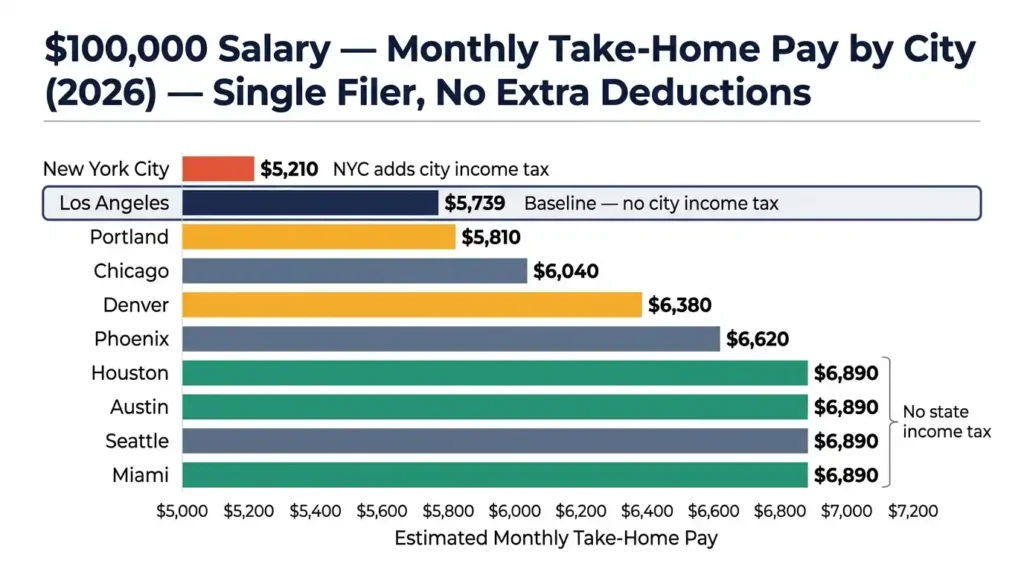
| City | State Income Tax | Local Income Tax | Est. Monthly Take-Home | vs. Los Angeles |
|---|---|---|---|---|
| Los Angeles, CA | 1% – 13.3% | None | ~$5,739 | Baseline |
| New York City, NY | 4% – 10.9% | 3.078% city tax | ~$5,210 | $529 less |
| Chicago, IL | 4.95% flat | None | ~$6,040 | $301 more |
| Houston, TX | None | None | ~$6,890 | $1,151 more |
| Austin, TX | None | None | ~$6,890 | $1,151 more |
| Seattle, WA | None | None | ~$6,890 | $1,151 more |
| Miami, FL | None | None | ~$6,890 | $1,151 more |
| Denver, CO | 4.4% flat | None | ~$6,380 | $641 more |
| Phoenix, AZ | 2.5% flat | None | ~$6,620 | $881 more |
| Portland, OR | 4.75% – 9.9% | 1% Metro tax | ~$5,810 | $71 more |
What this means for LA workers:
- Texas, Florida, Washington, and Nevada workers take home roughly $1,100-$1,200 more per month on the same salary.
- New York City is the only major city where workers take home less than LA, due to the city income tax surcharge. Los Angeles charges no personal city income tax on wages.
- High earners above $1M in CA pay an extra 1% mental health services surcharge, making the top rate 13.3%. No other major state comes close.
If you are considering a move within California, compare using the San Francisco paycheck calculator or Oakland paycheck calculator to see how your take-home changes by city.
Estimates assume single filer, federal brackets only for non-CA states, no pre-tax deductions.
5 Pay Stub Errors LA Workers Should Check Right Now
Pull out your most recent pay stub. Check each of these. If any are wrong, contact your HR or payroll department in writing. For a complete guide to reading every line on your stub, see how to read a California pay stub in 2026.
Error 1: SDI withheld at 1.1% or 1.2% instead of 1.3%
The correct 2026 CA SDI rate is 1.3% with no wage cap. Some payroll systems have not been updated since SB 951 took effect. On a $75,000 salary, being under-withheld by 0.1% means you may owe $75 when you file. Check your pay stub line for “CA SDI” and divide the withheld amount by your gross pay. It should equal 0.013. For full details on how SDI is calculated, see the CA SDI rate 2026 guide.
Error 2: Social Security stops being withheld before you hit $176,100
The 2026 Social Security wage base is $176,100. Per the Social Security Administration, if SS deductions stop on your stub before your year-to-date wages reach that number, your employer’s payroll software has the wrong cap. This is not common but it happens after a delayed system update at the start of a new year.
Error 3: Your hourly overtime is calculated on weekly hours only
California requires overtime at 1.5x after 8 hours in a single workday under California Labor Code Section 510. If you work 10-hour shifts and your stub shows straight-time pay for all hours up to 40 per week, your employer is violating California law. This is one of the most common wage theft patterns in LA hospitality, retail, and construction. Also check whether you are owed California double time pay if any shifts exceeded 12 hours.
Error 4: Your HSA contribution is reducing your CA taxable wages
Some payroll systems incorrectly apply the HSA pre-tax deduction against California wages the same way they apply it against federal wages. CA does not allow the HSA deduction. Your “CA State Wages” box should be higher than your “Federal Wages” box by the amount of your HSA contribution. If both numbers are identical and you contribute to an HSA, check with payroll. The 2026 HSA contribution limits guide explains this in more detail.
Error 5: You are enrolled in CalSavers and did not know
If your employer does not offer a 401(k), they must auto-enroll you in CalSavers at 5%. This shows as a post-tax deduction, often labeled “CalSavers” or “CA Retirement.” If you see a deduction you do not recognize, check whether it is CalSavers. You can opt out at any time through the CalSavers website. Money already contributed can be withdrawn. Employers who fail to enroll workers face penalties — see the CalSavers mandate 2026 guide for full employer obligations.
Tax Rates Used (2026)
All rates sourced from official government publications. See our California payroll taxes category for full documentation on each rate.
| Tax | Rate | Source |
|---|---|---|
| Federal Income Tax | 10% to 37% | IRS Rev. Proc. 2025-32 |
| CA State Income Tax | 1% to 13.3% | CA Franchise Tax Board 2026 |
| Social Security | 6.2% on wages up to $176,100 | SSA 2026 |
| Medicare | 1.45% (no cap) | IRS Publication 15 |
| Additional Medicare | 0.9% above $200k single / $250k MFJ | IRS Topic 751 |
| CA SDI | 1.3% (no wage cap, SB 951) | CA EDD |
Frequently Asked Questions
Does Los Angeles have a city income tax?
No. Los Angeles does not tax workers’ wages at the city level. You pay federal and California state tax only. LA charges a gross receipts tax on businesses, not on employees. This is different from New York City or Philadelphia, which add a city income tax on top of state. All rates used by this calculator are sourced from the IRS, CA Franchise Tax Board, and CA EDD.
What is the minimum wage in Los Angeles in 2026?
It depends on where you work. Confirmed by the LA Office of Wage Standards:
- City of LA: $18.42/hr (effective July 1, 2026)
- Unincorporated LA County: $18.47/hr
- West Hollywood: $20.25/hr (general) / $20.87/hr (hotel)
- Santa Monica: $18.47/hr
- Malibu: $17.91/hr
- LA City Hotel Workers (60+ room properties): $25.00/hr, then $27.50 (2027), then $30.00 (2028)
- CA Fast Food: $20.00/hr statewide
- CA Healthcare: $24.00/hr statewide
For a full statewide wage map, see California minimum wage 2026.
What is California SDI?
SDI (State Disability Insurance) is a mandatory California payroll deduction. In 2026 the rate is 1.3% of all wages with no cap, made permanent by Senate Bill 951. On a $75,000 salary, that is $975/year. SDI pays 60-70% of your wages (up to $1,620/week) if you cannot work due to illness, injury, surgery, or pregnancy. It also funds California Paid Family Leave. See the full CA SDI rate 2026 guide for calculation examples.
Why doesn’t my HSA save me California taxes?
California is one of only two states that does not recognize HSA contributions as a tax deduction. Your HSA reduces federal taxable income but California adds it back and taxes it anyway. At a 6% CA marginal rate, a $3,300 annual HSA contribution costs you roughly $198 more in CA tax than most people expect. Check the 2026 limits and California-specific rules in the HSA contribution limits guide.
How does California overtime work?
California has daily overtime rules beyond the federal 40-hour weekly rule. These are established under California Labor Code Section 510:
- 1.5x pay after 8 hours in a single workday
- 2x pay after 12 hours in a single workday
- 1.5x pay for the first 8 hours on the 7th consecutive workday
- 2x pay beyond 8 hours on the 7th consecutive workday
A worker doing four 10-hour shifts a week earns 2 hours of daily overtime per day. That is 8 hours of 1.5x premium pay per week, even though total weekly hours equal only 40. For a full breakdown of when double time applies, see California double time vs overtime 2026.
Are union dues tax-deductible?
No. Union dues (SAG-AFTRA, IATSE, Teamsters, IBEW, and others) are post-tax deductions. The Tax Cuts and Jobs Act suspended the miscellaneous itemized deduction, and that suspension remains in effect through 2026. Dues reduce your take-home but not your taxable income. This affects how you compare 1099 vs W-2 income if you work as a union contractor.
What is CalSavers?
CalSavers is California’s state-run retirement savings program. If your employer does not offer a 401(k) or similar plan, they must automatically enroll you at a 5% default contribution rate (increasing 1%/year to a maximum of 8%). It works like a Roth IRA: contributions are post-tax and do not reduce your taxable income. You can opt out at any time. Full employer compliance rules are in the CalSavers mandate 2026 guide.
How is my bonus taxed in California?
Two CA flat withholding rates apply to supplemental wages. Full details in the California bonus tax rate guide:
- Bonuses, RSUs, stock options: 10.23% CA flat rate
- Other supplemental pay (commissions, severance): 6.6% CA flat rate
- Federal: 22% flat rate applies to both
These are withholding rates, not your final tax rate. When you file, actual tax is calculated at your marginal rate per California tax brackets 2026.
What is the effective tax rate for LA workers?
Rough effective combined rates for a single filer with no extra deductions. These are estimates; run your exact numbers above. For paycheck scenarios covering other situations, see our full scenario library.
| Annual Salary | Est. Effective Rate | Approx. Monthly Take-Home |
|---|---|---|
| $40,000 | ~20% | ~$2,680 |
| $65,000 | ~24% | ~$4,095 |
| $100,000 | ~31% | ~$5,739 |
| $150,000 | ~36% | ~$7,966 |
| $200,000 | ~38% | ~$10,226 |
How accurate is this calculator?
It uses 2026 tax tables from the IRS, CA FTB, and CA EDD. Estimates are accurate for planning purposes. Actual amounts can vary based on employer payroll software rounding, employer-paid benefits, and mid-year tax changes. See our methodology page for the full calculation approach. For filing or legal decisions, consult a licensed tax professional.
Why is my take-home less than I expected after a raise?
Three common reasons. The why is my paycheck so low guide covers each in detail:
- Bracket creep — your raise pushed more income into a higher marginal bracket
- SDI uncapping — high earners now pay 1.3% on every dollar with no cap (SB 951)
- Pre-tax deduction limits — your 401(k) may be hitting the annual limit ($23,500 in 2026), changing how much reduces your taxable income
Am I classified correctly as an employee or contractor?
This matters because it changes every tax on your stub. California uses the ABC test to determine worker classification under AB 5. Misclassification as a 1099 contractor when you should be a W-2 employee means your employer is avoiding payroll taxes at your expense. Use the 1099 vs W-2 calculator to see the full tax difference between the two statuses.
Who This Calculator Is For
Workers in the paycheck basics category often come here first:
- W-2 employees in LA confused by pay stub deductions
- Hourly workers who want California daily overtime calculated correctly
- Job offer evaluators comparing a gross salary to actual take-home
- Entertainment and union workers who need post-tax union dues accounted for
- Hotel and hospitality workers on the new $25/hr wage schedule
- Self-employed / 1099 contractors who need SE tax and deductions modeled
- New LA residents relocating from a lower-tax state
- Part-time workers comparing schedules — see part-time vs full-time paycheck California
Understanding Your LA Pay Stub
Every California pay stub includes these lines. For a deeper walkthrough of each code and how to spot errors, read how to read a California pay stub 2026.
Federal Income Tax (FIT): Withheld based on your W-4 and 2026 IRS brackets. Ranges from 10% to 37% depending on income and filing status.
California State Income Tax (SIT): Withheld based on your CA DE-4 form and FTB brackets. Ranges from 1% to 13.3%.
Social Security (OASDI): 6.2% on wages up to $176,100. Stops once you hit the annual cap.
Medicare (Med): 1.45% with no cap. An additional 0.9% applies above $200,000 for single filers.
CA SDI: 1.3% of all wages. Funds disability pay and California Paid Family Leave. No wage cap in 2026.
401(k) / 403(b): Pre-tax retirement contribution. Reduces your federal and CA taxable income dollar for dollar.
HSA: Reduces federal taxable income but not California taxable income. CA taxes this contribution. See HSA limits 2026.
Roth 401(k) / CalSavers: Post-tax retirement contributions. Do not reduce taxable income but grow tax-free. See CalSavers mandate 2026.
Union Dues: Post-tax. Shown separately from federal and state tax lines.
Data Sources
All rates are sourced from official government publications. See our California labor laws and payroll compliance reporting categories for supporting material.
- Federal income tax brackets: IRS Rev. Proc. 2025-32
- CA state income tax brackets: California Franchise Tax Board 2026
- CA SDI rate (1.3%): California EDD, following Senate Bill 951
- Social Security wage base ($176,100): Social Security Administration 2026
- LA citywide minimum wage ($18.42): LA Office of Wage Standards, Feb 2026 announcement
- LA hotel worker rate ($25.00): LA Citywide Hotel Worker Minimum Wage Ordinance, July 2026
- Unincorporated LA County minimum wage ($18.47): LA County Chief Executive Office 2026
- West Hollywood rates: City of West Hollywood 2026 wage schedule
- CA fast food minimum wage ($20.00): AB 1228
- CA healthcare worker minimum wage ($24.00): SB 525
Last updated: July 2026