
Your California pay stub shows gross pay, itemized deductions, and net pay. In 2026, California workers lose 25% to 40% of gross earnings to federal taxes, state income tax, SDI at 1.3%, and benefit contributions before a single dollar reaches their bank account.
I have spent eight years helping employees decode wage statements, and the same shock hits every time: a $1,760 expected check arrives as $1,241. Reading one pay stub together, line by line, turns that panic into clarity in under 15 minutes.
The honest truth: California’s tax burden is among the highest in the country, so the gap between gross and net will always feel larger here than in most other states. Use our California paycheck calculator to see your exact take-home pay in seconds.
Why Your California Paycheck Looks Smaller Than Expected
I remember sitting with a warehouse worker in 2017. She earned $22 per hour and expected $1,760 for 80 hours. She got $1,241. She was ready to quit.
We read her wage statement together in 15 minutes. Every dollar had a destination. Taxes. Health insurance. SDI. The confusion turned to relief immediately.
Most paycheck confusion comes from one thing. People focus on their hourly rate but forget the system of deductions underneath it. If you want a deeper look at the most common causes, read our full guide on why your California paycheck is so low.
Takeaway: Your paycheck is smaller because of legal deductions, not errors. Learning each line fixes the confusion permanently.
Quick California Pay Stub Cheat Sheet
The 5 Numbers Most Employees Check First
Before we go line by line, know the five numbers that matter most on every California wage statement.
- Gross Pay: The total you earned before anything is taken out.
- Net Pay: The actual money deposited into your account.
- Taxes Withheld: The combined total of all federal and state taxes removed.
- Hours Worked: Total regular and overtime hours in the pay period.
- Year-to-Date (YTD): The running total of everything since January 1st.
Check them every payday. It takes two minutes and can catch months of undetected payroll errors.
Takeaway: Check these five numbers first. They tell you everything you need to know at a glance.
What Your Pay Stub Is Actually Showing You
Your California pay stub is divided into five clear categories. Think of each one as its own small report.
- Earnings: All the money you made, including overtime and bonuses.
- Taxes: The federal and state amounts legally withheld from your check.
- Benefits: Your share of health insurance, dental, vision, or retirement.
- Employer Deductions: Other amounts removed by agreement or legal order.
- Final Deposit Amount: Your net pay, which is the number that actually moves.
Sort each line into its bucket on your next paycheck. The full picture becomes clear fast.
Gross Pay vs Net Pay: The Big Difference Explained
What Is Gross Pay?
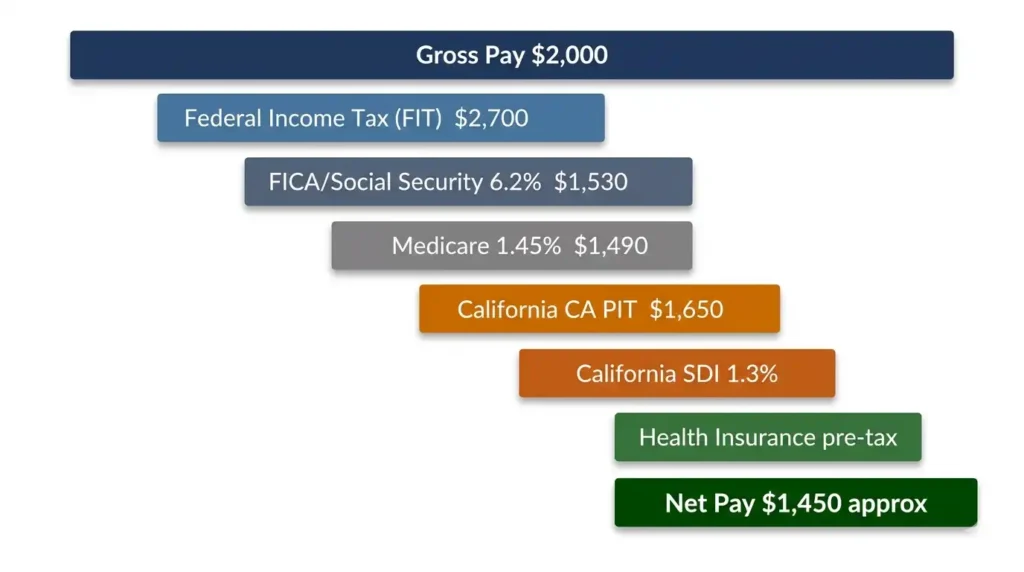
Gross pay is every dollar you earned before any deductions happen. This includes regular wages, overtime, bonuses, and paid time off.
If you earn $25 per hour and worked 80 hours, your gross pay is $2,000. That number will never hit your bank account as-is. Use our California gross pay calculator to run this math instantly for any pay period.
What Is Net Pay?
Net pay is what you actually receive after every deduction. In California, net pay is often 25% to 40% lower than gross pay. Federal taxes, California income tax, SDI, and benefit contributions all take their share before the money reaches you.
Why the Difference Feels So Large in California
California has one of the highest state income tax rates in the country, making the gross-to-net gap larger than most other states. Here is what chips away at your gross pay. For a full breakdown of every layer, see our guide to California payroll taxes:
- Federal Income Tax: Based on your W-4 and filing status.
- Social Security and Medicare (FICA): A fixed percentage on every dollar.
- California State Income Tax (CA PIT): A progressive rate that rises with income.
- California SDI: State Disability Insurance, which funds paid family leave.
- Benefit Contributions: Health insurance, 401(k), FSA, or HSA deductions.
Takeaway: Net pay is always lower than gross pay. California’s state taxes and SDI make the gap especially noticeable.
7 California Paycheck Myths That Confuse Employees
Myth 1: “My Employer Is Taking Too Much Money”
Tax withholding is legally required. Your employer does not keep that money. The IRS and California Franchise Tax Board receive those funds on your behalf. Your W-4 form controls how much federal tax is withheld each period.
Myth 2: “Overtime Is Taxed More”
Overtime pay is not taxed at a higher rate. Earning more in one paycheck temporarily pushes you into a higher withholding bracket. When you file your annual return, everything balances out. Workers with heavy overtime often receive larger refunds because of this.
Myth 3: “Salary Workers Do Not Need Hour Tracking”
Even salaried workers qualify for overtime in California if they are classified as non-exempt. Many employees are misclassified without knowing it. Learn how California’s ABC test determines employee vs contractor classification and whether your status is correct. If you work more than eight hours in a single day, you may be entitled to overtime regardless of salary status.
Myth 4: “Every Paycheck Should Be Identical”
Paychecks vary more than most people expect. Open enrollment changes your benefits deductions. Overtime fluctuates week to week. Bonus payments add to your gross without changing your regular rate.
Some years even have 27 pay periods instead of 26, which spreads your annual salary thinner over one extra check. Variation in your paycheck is normal and expected.
Myth 5: “Direct Deposit Means I Do Not Need Pay Stubs”
Your pay stub is a legal document. It proves income, tracks tax withholdings, and shows benefit contributions. You need it for loan applications, rentals, and tax filing. Always save your stubs digitally or in print.
Myth 6: “A Bigger Refund Means Better Taxes”
A big refund means you gave the government an interest-free loan all year. Adjusting your W-4 to match your actual tax liability means more money in every paycheck. A smaller refund is often the smarter outcome.
Myth 7: “Payroll Errors Are Rare”
In eight years of payroll work, I have seen errors happen far more than people realize. Missing overtime, duplicate deductions, and wrong pay rates are all common. Reviewing your pay stub every payday is your first and best defense.
Takeaway: These myths cause real financial confusion. Knowing the truth puts you in control of your own paycheck.
Understanding the Structure of a California Pay Stub
What Is a California Pay Stub?
A pay stub is an itemized summary of your earnings and deductions for a specific pay period. In California it is also called a wage statement. Your employer is legally required to give you one every time you are paid, and it must be more detailed than what most other states require.
Why California Requires Detailed Wage Statements
California Labor Code Section 226 requires detailed pay stubs to protect workers from wage theft and payroll fraud. It gives every employee the right to see exactly how their wages were calculated and to request payroll records at any time.
Who Receives Pay Stubs in California?
Almost every worker in California receives a wage statement. This includes:
- Hourly employees working full-time or part-time.
- Salaried workers, both exempt and non-exempt.
- Temporary and seasonal workers placed through agencies.
- Remote employees working from California for out-of-state companies.
If you perform work inside California, your employer must follow California wage statement rules, even if the company is headquartered in another state.
The 9 Things California Employers Must Legally Include
If any of these nine items are missing from your wage statement, your employer may be violating the law.
- Your full legal name and the last four digits of your Social Security Number.
- The name and address of your employer.
- The pay period start and end dates.
- Total hours worked during the pay period.
- All applicable hourly rates and the hours worked at each rate.
- All gross wages earned.
- All deductions listed individually and clearly labeled.
- Your net wages for the pay period.
- Piece-rate details, if you are paid per piece or unit.
Takeaway: California law guarantees your right to a detailed, accurate wage statement every payday. Know what must be there.
Line-by-Line Pay Stub Breakdown
Employee Information Section
Check this section every time. Verify your name, the last four digits of your Social Security Number, and the employer name and address. Errors here cause problems with your tax records.
Pay Date vs Pay Period: What Is the Difference?
The pay period is the range of dates you worked. The pay date is when you get paid. They are always different. If you work May 1 to May 15, your pay date might be May 22. That gap is normal payroll processing time.
Earnings Section Explained
Regular Hours
Your regular hours line shows hours worked at your standard pay rate. At $20 per hour for 80 hours, this line shows $1,600. Everything else gets added on top.
Overtime Pay: California Rules Are Unique
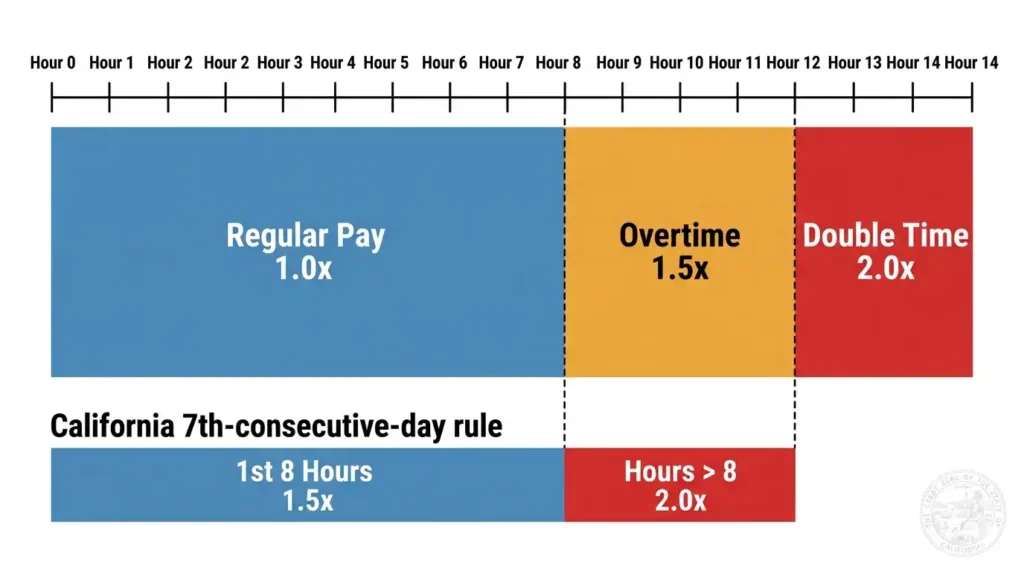
California overtime rules are stricter than federal law. In California, you earn overtime for. See the full California overtime laws for 2026 for every exemption and edge case:
- Any hours over 8 in a single day (not just 40 in a week).
- Any hours over 40 in a workweek.
- The first 8 hours on the seventh consecutive day of a workweek.
Double-time kicks in after 12 hours in a single day, or for all hours on the seventh consecutive day beyond 8 hours. Read our dedicated guide on California double-time vs overtime rules to understand exactly when each rate applies. Your pay stub must list overtime and double-time as separate line items. If you worked overtime and do not see it listed, that is a red flag.
PTO, Sick Leave, Holiday Pay, and Bonuses
Each pay type appears as its own line. PTO uses your regular rate. Sick leave must be paid at your regular rate under California law. See exactly what you are entitled to under California sick leave laws in 2026. Bonuses are listed separately because they are withheld at a higher rate within that pay period, which can temporarily increase the tax withheld on that check.
Takeaway: Every pay type must appear as its own line. Missing lines mean missing pay.
Taxes Section Explained
Federal Income Tax (FIT)
Federal income tax is based on your W-4 form. It tells your employer how much to withhold based on your filing status. That is why a coworker with the same salary may have a different FIT amount. Update your W-4 anytime through HR.
Social Security Tax (OASDI)
OASDI stands for Old Age, Survivors, and Disability Insurance. This is the Social Security deduction. In 2026, the rate is 6.2% of your wages up to the annual wage cap of $184,500. The IRS Topic 751 confirms the current Social Security and Medicare withholding rates.
Once your earnings for the year hit $184,500, Social Security deductions stop. If you hit the cap mid-year and keep seeing OASDI deducted, that is a payroll error you should flag immediately.
Medicare Tax
Medicare is deducted at 1.45% of all your wages. There is no wage cap for Medicare the way there is for Social Security.
Higher earners pay an Additional Medicare Tax of 0.9% on wages above $200,000 (for single filers) or $250,000 (for married filing jointly). This additional amount is withheld automatically once you cross that threshold.
California State Income Tax (CA PIT)
CA PIT stands for California Personal Income Tax. California uses a progressive tax system where higher income is taxed at a higher rate. Your withholding is based on the DE 4 form, California’s version of the federal W-4. See our step-by-step guide on how to fill out the California DE 4 form in 2026 to make sure your withholding is set correctly.
California SDI: What Changed in 2026
SDI funds short-term disability pay and California Paid Family Leave. Starting January 1, 2024, California removed the SDI wage cap entirely. In 2026, all of your wages are subject to SDI, no matter how much you earn. Higher earners will notice a larger deduction than in previous years. Read the complete 2026 CA SDI rate breakdown or verify the current rate directly on the California EDD Contribution Rates page.
Takeaway: SDI now applies to 100% of your wages in 2026. Higher earners will notice this deduction more than before.
Pre-Tax vs Post-Tax Deductions: The Confusion Clarified
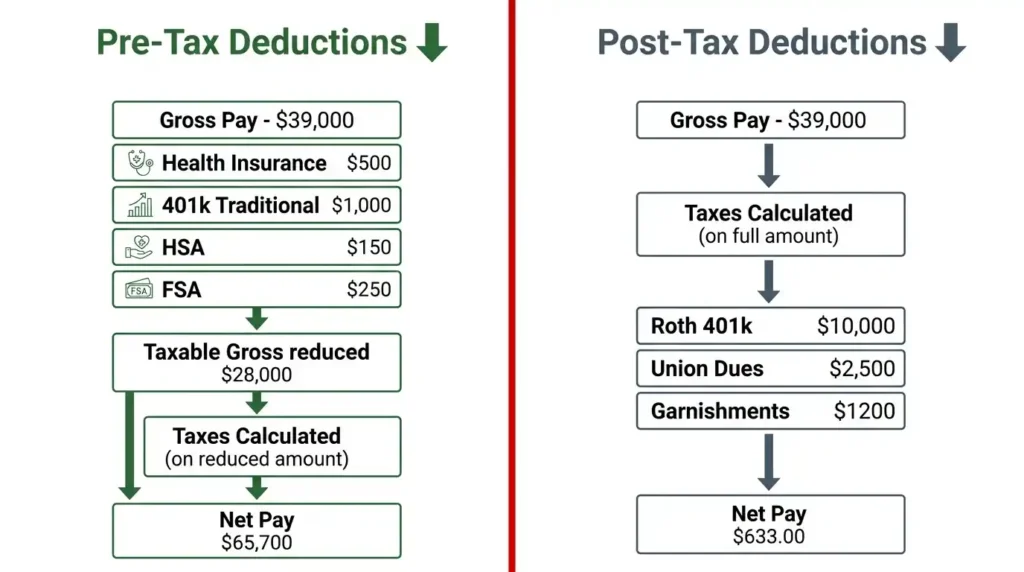
Pre-Tax Deductions
Pre-tax deductions are taken out before your taxable income is calculated. This reduces the amount of income you pay taxes on, which means you pay less tax overall.
Common pre-tax deductions include:
- Health insurance premiums (medical, dental, vision).
- Traditional 401(k) contributions.
- HSA (Health Savings Account) contributions.
- FSA (Flexible Spending Account) contributions.
- Dependent care FSA contributions.
A $200 pre-tax health insurance deduction saves you more than $200 in purchasing power because you avoid paying taxes on that $200.
Post-Tax Deductions
Post-tax deductions come out after your taxes are calculated. They do not reduce your taxable income.
Common post-tax deductions include:
- Roth 401(k) contributions.
- Wage garnishments ordered by a court.
- Union dues.
- Some disability insurance premiums.
- Certain life insurance policies.
Roth contributions are post-tax by design. You pay taxes now so that your withdrawals in retirement are completely tax-free.
Why Your Benefit Deductions Suddenly Change
The most common reason a paycheck shrinks is a benefit change. Open enrollment happens once a year. If your employer reduces its contribution, your share rises automatically.
Also watch for 27-pay-period years. When the calendar produces 27 biweekly periods instead of 26, some employers charge the same benefit amount per check, meaning you pay one extra time that year.
Takeaway: A smaller paycheck is almost always explained by a benefit deduction change. Check this section first.
Pay Stub Codes and Abbreviations Explained
California Payroll Abbreviations You Need to Know
Payroll software uses abbreviations to fit a lot of information into a small space. Here is a plain-English translation of the codes you will see most often. For a complete reference, see our full guide to California pay stub codes in 2026.
| Abbreviation | Full Name | What It Means |
| FIT | Federal Income Tax | Federal tax withheld from your paycheck |
| FICA | Federal Insurance Contributions Act | The combined Social Security and Medicare deduction |
| OASDI | Old Age, Survivors, and Disability Insurance | The Social Security portion of FICA (6.2%) |
| MED | Medicare | The Medicare portion of FICA (1.45%) |
| SDI | State Disability Insurance | California’s disability and paid leave fund |
| CA PIT | California Personal Income Tax | California state income tax withholding |
| YTD | Year-to-Date | Running total from January 1st to current pay date |
| PTO | Paid Time Off | Vacation or personal days used in this pay period |
| OT | Overtime | Hours beyond the daily or weekly threshold |
| DT | Double Time | Hours that qualify for 2x your regular pay rate |
When you see an unfamiliar code, ask your HR or payroll department. You are legally entitled to a full explanation of every item on your wage statement.
Takeaway: Every code on your pay stub has a clear meaning. A simple key unlocks the whole document.
Real California Pay Stub Examples
Example 1: Hourly Worker Pay Stub Walkthrough
Rosa works retail in Los Angeles at $19 per hour. She worked 84 hours this period, including 4 overtime hours, and carries health insurance through her employer.
Earnings Section:
- Regular Pay: 80 hours x $19.00 = $1,520.00
- Overtime Pay: 4 hours x $28.50 (1.5x rate) = $114.00
- Gross Pay: $1,634.00
Tax Deductions:
- Federal Income Tax (FIT): $105.00
- Social Security (OASDI) 6.2%: $101.31
- Medicare (MED) 1.45%: $23.69
- California State Tax (CA PIT): $62.00
- California SDI (1.3%): $21.24
Benefit Deductions (Pre-Tax):
- Health Insurance: $85.00
Total Deductions: $398.24 (approximately)
Net Pay: $1,235.76
Rosa’s net pay is about 75.6% of her gross pay. The roughly 24% difference accounts for taxes and her health insurance contribution.
Example 2: Salaried Employee Pay Stub Walkthrough
Daniel is a marketing manager in San Francisco earning $75,000 per year, paid semi-monthly. He contributes 6% to his 401(k) and carries dental coverage.
Earnings Section:
- Semi-Monthly Salary: $75,000 / 24 = $3,125.00
- Gross Pay: $3,125.00
Pre-Tax Deductions:
- 401(k) Contribution (6%): $187.50
- Dental Insurance: $22.00
- Taxable Gross After Pre-Tax: $2,915.50
Tax Deductions:
- Federal Income Tax (FIT): $312.00
- Social Security (OASDI) 6.2%: $180.76
- Medicare (MED) 1.45%: $42.27
- California State Tax (CA PIT): $196.00
- California SDI (1.3%): $40.63
Total Deductions: $981.16 (approximately)
Net Pay: $2,143.84
Daniel’s pre-tax 401(k) contribution lowers his taxable income, so he effectively earns more by contributing.
Takeaway: Real examples show exactly how deductions stack up. Run these calculations on your own pay stub to verify accuracy.
How to Verify Your Paycheck Is Correct
5-Minute Pay Stub Accuracy Checklist
Do this every payday. Check these five things in order.
- Correct hourly rate: Does your rate match your offer letter or most recent raise paperwork?
- Correct hours: Do your hours match your timecard or schedule for the period?
- Correct overtime: If you worked more than 8 hours in any single day in California, overtime must appear.
- Correct PTO balance: Is your available balance going up when you earn PTO and down when you use it?
- Correct direct deposit amount: Does your net pay match what actually arrived in your bank account?
If any of these five checks fail, act immediately. Payroll corrections become harder to fix the longer you wait.
How to Compare Your Timecard to Your Pay Stub
Count your total hours from your timecard. Then check the hours on your wage statement. If they do not match, write down the specific dates and shifts and bring that documentation to payroll. Most errors are honest mistakes that get fixed quickly.
Real Payroll Errors Employees Miss
These are the most commonly missed payroll errors in California:
- Missing overtime: Hours over 8 in a single day were not paid at 1.5x.
- Wrong pay rate: Last paycheck still shows the old rate after a raise.
- Duplicate deductions: A benefit deduction was charged twice in one period.
- Incorrect overtime multiplier: Overtime paid at 1.25x instead of the required 1.5x.
- Missing bonus: A promised quarterly or performance bonus was left off.
- Incorrect PTO accrual: PTO balance is not growing at the rate stated in your offer letter.
Takeaway: Check your pay stub with a checklist every payday. Most errors are caught within minutes when you know what to look for.
What To Do If Your Pay Stub Is Wrong
Signs Your Employer May Be Violating California Law
Some pay stub problems are honest mistakes. Others are violations of California Labor Code Section 226. Watch for these red flags:
- Your wage statement is missing required information like hours worked or pay rates.
- Overtime appears on your timecard but not on your wage statement.
- Deductions are listed without labels or explanations.
- Your employer refuses to give you a written pay stub at all.
- The wage statement shows fewer hours than you actually worked.
Repeated issues likely go beyond a simple data entry error.
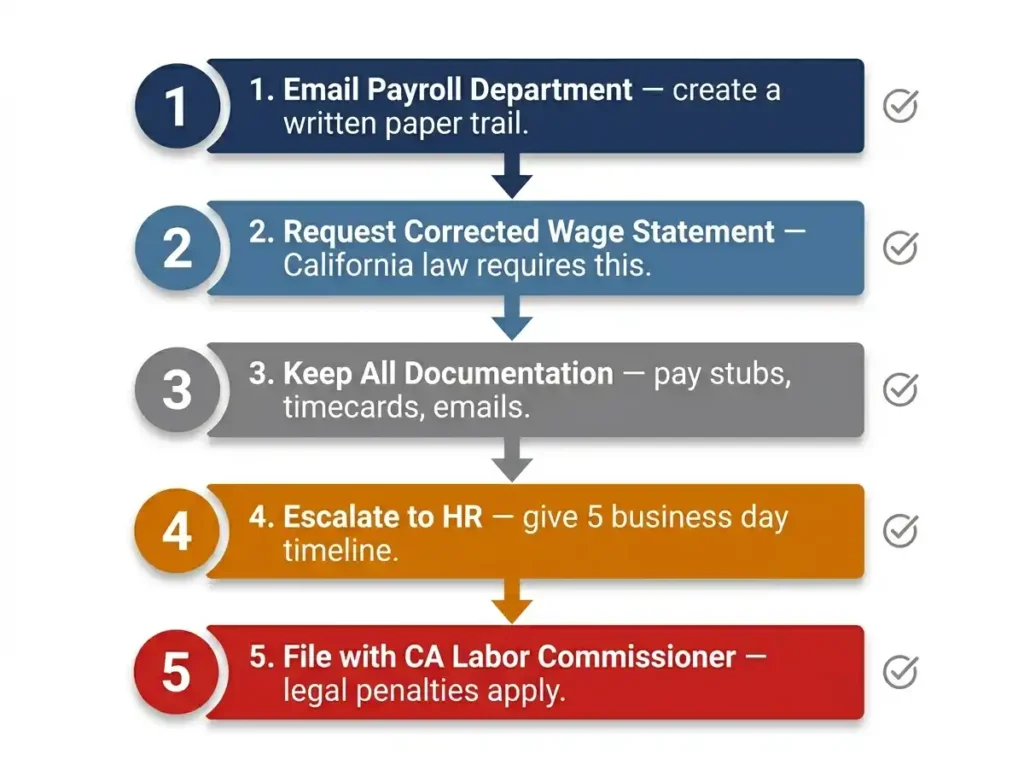
Steps To Fix a Payroll Error
Follow this process in order. Most problems resolve at step one or two.
- Contact your payroll department in writing. Email creates a paper trail. State the error clearly and include the pay period date.
- Request a corrected wage statement. California law requires employers to issue corrected pay stubs when errors are found.
- Keep copies of everything. Save your original pay stub, your timecard, and all written communication.
- Escalate to HR if payroll does not respond. Give them a reasonable timeline, usually five business days.
- File a complaint with the California Labor Commissioner. If the employer refuses to fix a verified error, the Labor Commissioner can investigate and penalize the employer. If your final paycheck was late or withheld, you may also be entitled to a California waiting time penalty.
California Employee Rights Regarding Pay Stubs
California Labor Code Section 226 gives you powerful rights. You have the right to:
- Receive an accurate, itemized wage statement every time you are paid.
- Inspect and copy your payroll records within 21 days of requesting them.
- File a complaint with the California Labor Commissioner if your employer violates wage statement rules.
Employers who knowingly violate these rules face statutory penalties of $50 for the initial pay period and $100 for each subsequent pay period, up to $4,000 per employee. Actual damages and attorney fees may also apply. These are real consequences designed to protect real workers.
Takeaway: California law is on your side. Know your rights and do not hesitate to use them.
Digital Pay Stubs and Direct Deposit
Electronic Pay Stub Rules in California
California allows digital pay stubs, but with conditions. Your employer must make them accessible at any time, printable on demand, and retained for at least three years. If the system goes down, you can request a paper copy. You can never be denied access.
Why Direct Deposit Still Requires Pay Stub Reviews
Many workers glance at their bank balance and never open the wage statement. That habit is expensive. A duplicate deduction of $50 per check costs $1,300 a year. A missing overtime payment of $100 per period costs $2,600 annually. These amounts disappear silently when you skip the review.
Takeaway: Direct deposit does not replace the pay stub review. Always check the itemized statement, not just your bank balance.
Advanced Payroll Understanding
Year-to-Date (YTD) Totals Explained
YTD is the running total of all earnings and deductions since January 1st. Every line on your pay stub usually has a YTD column. Use it to estimate your annual taxable income mid-year, verify income for loans or rentals, and spot payroll anomalies by tracking deduction consistency over time.
How To Audit Your YTD Totals
Pull your last three pay stubs. The YTD increase from one pay stub to the next should match the current period amount exactly. If your health insurance YTD jumped double one period, you were charged twice. This five-minute check catches errors that a single-stub review misses.
How Payroll Software Calculates Taxes
Payroll software uses IRS and California FTB tax tables and applies your W-4 and DE 4 elections to estimate your annual tax liability, then divides it across pay periods. Bonus payments and lump-sum earnings can temporarily spike withholding. Your actual tax owed is finalized when you file your annual return.
Frequently Used Payroll Formulas
Run these yourself to verify every number on your pay stub.
Gross Pay (Hourly Worker): Hours Worked x Hourly Rate = Gross Pay
Overtime Pay (California): Regular Hourly Rate x 1.5 = Overtime Rate Overtime Rate x Overtime Hours = Overtime Earnings
Double Time Pay (California): Regular Hourly Rate x 2.0 = Double-Time Rate Double-Time Rate x Double-Time Hours = Double-Time Earnings
Net Pay: Gross Pay minus Pre-Tax Deductions minus Taxes minus Post-Tax Deductions = Net Pay
Taxable Gross Income: Gross Pay minus Pre-Tax Deductions = Taxable Gross
Takeaway: Run these formulas yourself on your next paycheck. If your numbers match the pay stub, everything is correct.
Pro Payroll Insights Most Employees Never Learn
Insider Insight: Your Pay Stub Is a Financial Planning Tool
Most people treat their pay stub like a receipt. It is actually a budget report. Your mid-year YTD gross gives you an accurate annual income projection. Your YTD tax withholdings show whether you are on pace for a refund or a bill. Your YTD 401(k) tells you how close you are to the annual contribution limit.
I caught in September that I was over-contributing to my FSA. One adjustment before the deadline saved me $400 from the use-it-or-lose-it rule. That came from reading my pay stub like a planning tool, not a receipt.
Insider Insight: Compare Every Pay Stub Monthly
Once a month, put this month’s pay stub next to last month’s. Look for any line that changed. If you cannot explain the change, contact payroll. Most answers are simple. Occasionally you catch an error that would have cost you real money.
Takeaway: Your pay stub is a budgeting tool, an income tracker, and a payroll audit all in one. Use it that way.
Deep-Dive FAQ Section
Why Is My California Paycheck Taxed So Much?
Five separate deductions hit every California paycheck: federal income tax, Social Security, Medicare, CA PIT, and SDI. California’s state income tax rate is among the highest in the country, which pushes the total gap higher than most states. See the full California income tax brackets for 2026 to understand exactly where your income falls.
What Does YTD Mean on My Pay Stub?
YTD means Year-to-Date: the running total of all earnings or deductions from January 1st through your current pay date. Use it to track income, monitor withholdings, and catch payroll errors early.
Why Did My Paycheck Suddenly Get Smaller?
Open enrollment changed your benefit deductions, a new deduction was added, or your overtime hours dropped. Check the deductions section first. The answer is almost always there.
Can My Employer Legally Hide Deductions?
No. California Labor Code Section 226 requires every deduction to be listed individually and labeled. A lump-sum deduction without explanation is a potential violation.
Why Does Overtime Look Heavily Taxed?
The larger paycheck temporarily pushes the withholding formula higher. Your actual rate is settled when you file your annual return, and most heavy-overtime workers receive a refund.
What Happens If My Pay Stub Is Wrong?
Email payroll immediately, request a corrected wage statement, and keep all documentation. If unresolved, escalate to HR, then file a complaint with the California Labor Commissioner.
Can I Receive Only Digital Pay Stubs?
Yes. California permits electronic pay stubs as long as they are always accessible, printable, and retained for at least three years. You can request a paper copy at any time.
How Long Should I Keep Old Pay Stubs?
Keep pay stubs for at least three years. Store them digitally. If a wage dispute or legal matter is open, keep them until it is fully resolved.
What Does CA SDI Mean?
CA SDI is California State Disability Insurance. It funds short-term disability pay and California Paid Family Leave. In 2026, the rate is 1.3% with no wage cap on contributions.
Why Are My Federal Taxes Different Every Paycheck?
Higher gross pay from overtime or bonuses triggers higher withholding. Your W-4 settings also affect the calculation. Final tax owed is settled when you file your annual return.
Can Salaried Employees Receive Overtime in California?
Yes. Being salaried does not mean exempt. Non-exempt salaried workers earn overtime for any hours over 8 in a single day, regardless of salary status. California Labor Code Section 510 defines these rules in full.
How Do I Know If My Paycheck Is Accurate?
Use the five-point checklist in this guide every payday. Verify hours, pay rate, overtime, deductions, and net pay. If the numbers match your timecard and calculations, your check is correct.
Final Thoughts: Your Pay Stub Is More Than Just a Paycheck
Eight years of payroll work taught me one thing. The frustration disappears the moment someone understands what each line means.
Start this payday. Pull up your most recent wage statement. Work through every section with this guide. Check the five-point accuracy list. Look at your YTD totals. Compare it to last month.
Five minutes is all it takes to know whether everything is correct and feel confident about where your money is going.
Your pay stub is not a mystery. It is a map. Now you know how to read it.
California Labor Code Section 226 protects your right to an accurate, itemized wage statement every pay period. If you believe your employer is violating this law, contact the California Labor Commissioner’s Office for assistance.

Yeasin Sorker is the founder of Paycheck Calculator California. He built this tool in 2018 after noticing that most free paycheck calculators missed California-specific rules like daily overtime and the uncapped SDI rate.
He researches California payroll tax updates regularly and keeps this calculator aligned with the latest IRS, FTB, and EDD published rates. All calculations on this site are estimates based on official 2026 government sources. For personalized tax advice, consult a qualified tax professional.