California Double Time vs Overtime: When 2x Pay Starts

In California, overtime pays 1.5x after 8 hours in a day or 40 hours in a week. Double time pays 2x after 12 hours in a day or after 8 hours on the 7th consecutive workday. These are two separate pay tiers, and mixing them up can cost hundreds of dollars a month.

Federal law only uses weekly limits. California adds daily triggers too, which is why a single long shift can change your entire paycheck. One caveat: rules differ for employees covered by a union contract or an approved alternative workweek schedule. For a full breakdown of how all the rules work together, see our guide to California overtime laws in 2026.

Quick Answer: California Overtime vs Double Time

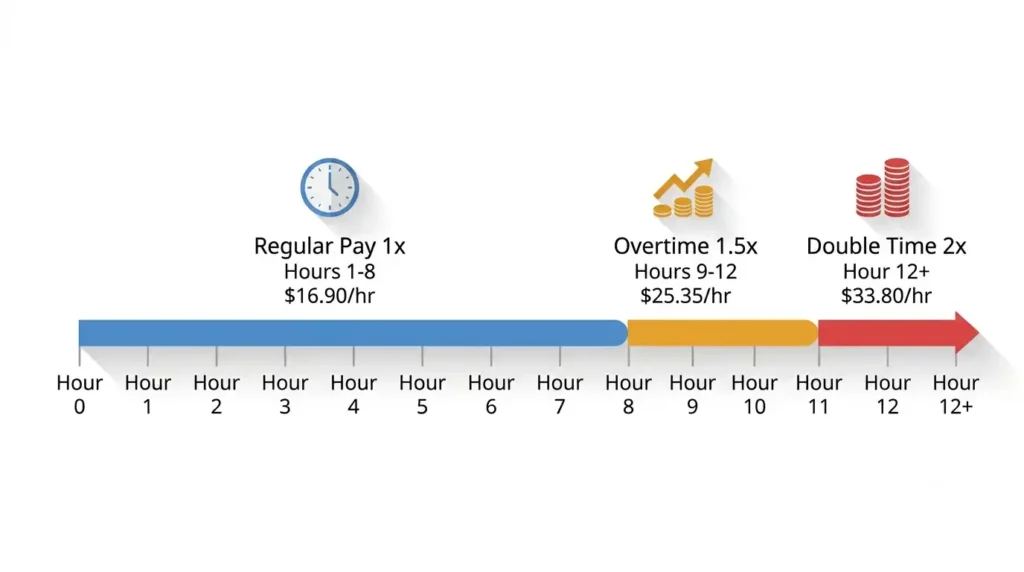
California double time vs overtime pay tiers infographic showing 1x regular pay hours 1-8, 1.5x overtime hours 9-12, and 2x double time after hour 12
California’s three-tier daily pay structure under Labor Code Section 510 — regular, overtime, and double time.

Simple Comparison Table

Pay TypeWhen It StartsRate
OvertimeOver 8 hours/day OR over 40 hours/week1.5x your regular pay
Double TimeOver 12 hours/day OR over 8 hours on the 7th straight workday2x your regular pay

Both rules apply to non-exempt employees — most hourly workers, shift workers, and many salaried employees in California. Federal law only uses weekly limits. California uses both daily and weekly rules. That is what makes it so different.

Fast Visual Timeline

  • Hours 1 to 8: Regular pay (your normal hourly rate)
  • Hours 9 to 12: Overtime pay (1.5x your regular rate)
  • Hour 13 and beyond: Double time pay (2x your regular rate)

Every hour past 12 in a single workday triggers double time. It does not matter what day of the week it is or how many hours you worked earlier. The clock resets each workday.

Takeaway: Your workday clock, not the weekly total, is what triggers double time in California.

Quick Paycheck Example

Say you earn $25 per hour and work a 14-hour shift.

  • Hours 1 to 8 (8 hours at $25.00) = $200.00
  • Hours 9 to 12 (4 hours at $37.50) = $150.00
  • Hours 13 to 14 (2 hours at $50.00) = $100.00

Total for that shift: $450.00

Without knowing double time rules, you might have expected only $350 for the full 14 hours. That is a $100 difference in a single shift. Over a month, that adds up fast. Use our California gross pay calculator to run your own numbers.

Who Qualifies for Overtime and Double Time in California?

Non-Exempt Employees

Most workers in California qualify for overtime and double time. The law calls them “non-exempt” employees. Non-exempt workers include:

  • Hourly workers in any industry
  • Shift-based employees in warehouses, factories, and retail
  • Healthcare workers like nurses, CNAs, and medical techs
  • Hospitality workers including hotel and resort staff
  • Construction workers and tradespeople
  • Restaurant and food service workers

If you punch a clock or track your hours, there is a very good chance you are non-exempt and California’s overtime rules protect you.

Exempt vs Non-Exempt Explained Simply

Here is the big mistake I see employers make all the time. They assume that paying someone a salary removes all overtime rights. That is not true in California.

To be truly exempt, an employee must pass both a salary basis test and a duties test. The salary basis test means a fixed salary above the legal threshold regardless of hours worked. The duties test means their job must qualify as executive, administrative, or professional work. The California DIR publishes an overtime exemptions FAQ that breaks down exactly which job duties qualify. A “manager” who mostly does the same tasks as hourly staff is probably still non-exempt.

In California, the salary threshold for exemption in 2026 is $70,304 per year ($1,352 per week), calculated as twice the California state minimum wage of $16.90 per hour. Even if someone earns above that level, their duties still have to meet the legal standard. Any salaried worker earning below $70,304 annually cannot legally be classified as exempt, regardless of their job title.

Takeaway: Salary alone does not take away your overtime rights in California.

Employees Commonly Misclassified

Some job titles get misclassified as exempt more than others. Watch out if your title is one of these:

  • Assistant manager or shift supervisor
  • IT technician or support specialist
  • Outside sales representative
  • Field service technician or delivery driver

These workers often do hands-on, hourly-style work. That means they likely still qualify for overtime and double time, no matter what their job title says.

Independent contractor misclassification is another serious issue. California uses the ABC test to determine true contractor status. If your work is controlled by the company, performed within its core business, and you do not run your own independent operation, you are likely an employee entitled to every overtime protection in this guide. Workers unsure whether they are a 1099 contractor or W-2 employee should check this carefully before assuming overtime rules do not apply to them.

Industries With Frequent Overtime Violations

Certain industries have a much higher rate of overtime pay errors. These are the ones I see most often:

  • Healthcare: Long shifts, floating staff, and complex scheduling create easy mistakes
  • Warehousing and logistics: High turnover and rushed payroll setups miss double time often
  • Security: 12-hour shifts are common, and double time is frequently missed
  • Delivery and logistics: Route-based pay sometimes hides unpaid overtime
  • Restaurants: Split shifts and combined hours are frequently miscalculated

If you work in any of these fields, check your pay stubs carefully every week.

What Is Overtime in California?

When Overtime Starts

California overtime starts at three trigger points. You only need to hit one to earn the higher rate.

  • You work more than 8 hours in one workday
  • You work more than 40 hours in one workweek
  • You work the first 8 hours on your 7th consecutive workday

The daily rule is the part that surprises most people. Federal law does not have a daily trigger. California does. That is why workers who transfer from other states often find their paychecks look different here.

What “Time-and-a-Half” Actually Means

Time-and-a-half means your regular rate multiplied by 1.5.

Overtime pay = Hourly rate x 1.5

So if you earn $20 per hour, your overtime rate is $30 per hour.

Your “regular rate of pay” is not just your base wage. It includes shift differentials, nondiscretionary bonuses, commissions, and other regular compensation. If you earn $20 per hour plus a consistent $2 shift bonus, your regular rate is $22 and your overtime rate is $33, not $30.

Piece-rate and flat-rate employees calculate differently: divide total weekly earnings by total hours worked to find the regular rate, then apply the overtime premium on qualifying hours.

Takeaway: Always calculate overtime based on your full regular rate, not just your base hourly wage.

California vs Federal Overtime Laws

The federal Fair Labor Standards Act only requires overtime after 40 hours in a week. That is it. No daily limit, no double time at the federal level.

California Labor Code Section 510 goes much further. It adds daily overtime, a separate double time tier, and special rules for the seventh consecutive workday. You can read the full statutory text directly on the California Legislative Information site. The Industrial Welfare Commission (IWC) Wage Orders also layer in industry-specific rules that can affect how overtime is calculated for certain job types.

This is why out-of-state employers get into trouble. A payroll system set up for Texas or Florida will not automatically apply California’s daily rules. Workers here end up underpaid without anyone in the company even realizing it.

What Is Double Time in California?

When Double Time Starts

Double time kicks in at two points under California law.

First trigger: You work more than 12 hours in a single workday.

Second trigger: You work more than 8 hours on your 7th consecutive workday.

Both are hard legal thresholds. Your employer must pay 2x your regular rate the moment you cross them. There is no option to skip it, average it out, or replace it with comp time.

How Double Time Pay Is Calculated

Double time pay = Hourly rate x 2

Three real-world examples:

  • A nurse earning $45/hour who works a 13-hour shift earns double time ($90/hour) for that final hour
  • A warehouse employee at $22/hour working a 14-hour shift earns $44/hour for hours 13 and 14
  • A restaurant worker at $18/hour working 7 days straight earns $27/hour for the first 8 hours on day 7, then $36/hour after that

One extra double-time hour per shift adds up to real money over a year.

Why California Requires Double Time

California created double time rules for one reason: long shifts are exhausting. Double time pay makes employers think twice before scheduling brutal back-to-back long shifts.

The law treats worker fatigue as a public safety issue. An exhausted nurse, forklift operator, or long-haul driver is a danger. Double time is the financial signal that says “this is too long.” California has always taken worker protections more seriously than the federal standard, and double time is one of the clearest examples.

Reality Check: The Biggest California Overtime Myths

“Anything Over 40 Hours Is Double Time”

This is the most common myth I hear. And it is wrong. Working more than 40 hours in a week triggers overtime at 1.5x. That is it.

Double time requires 12+ hours in a single workday, or 8+ hours on the seventh consecutive workday. The weekly total never triggers double time.

“Salary Employees Never Get Overtime”

This myth costs California workers a lot of money every year. Salary does not equal exempt. You also have to meet a specific duties test. If your work does not qualify you as a true executive, administrator, or professional under the law, you are still entitled to overtime and double time.

Many assistant managers, team leads, and office workers are wrongly classified as exempt. If that sounds like your situation, it is worth a closer look.

“Overtime Automatically Resets at Midnight”

Your employer defines what a “workday” is. It is a fixed consecutive 24-hour period that could start at 8 AM, 10 PM, or any other time they set.

If your workday is defined as 10 PM to 10 PM, an overnight shift from 8 PM to 10 AM could span two different workdays. That affects when your overtime and double time clocks start and stop.

Takeaway: The midnight clock does not control overtime. Your employer’s official workday definition does.

“Daily and Weekly Overtime Stack Together”

Some workers think they can add their daily premium on top of their weekly premium. That is not how California law works.

California uses the anti-pyramiding rule. You earn the highest applicable premium for any given hour, not multiple premiums combined. If an hour qualifies under both daily and weekly overtime, you earn the higher rate once, not twice.

“Employers Can Ignore Small Amounts of Overtime”

Every minute of overtime and every penny of double time is legally owed. There is no “de minimis” exception in California for unpaid wages below a certain dollar amount.

Payroll rounding is another issue. Employers can use rounding rules, but only if those rules are neutral and do not consistently undercount employee time. If your employer’s rounding always seems to favor the company, that is a potential violation.

Mandatory overtime is legal in California. Employers can require you to work beyond 8 hours, but they must pay the correct premium for every hour. Refusing can be a fireable offense. Withholding the overtime premium is a wage violation.

Unauthorized overtime is a gray area. If you work it without approval, your employer can discipline you. They still must pay you for every hour, including the premium. Withholding pay for unauthorized overtime is never legal.

Comp time instead of overtime cash is not legal for private-sector employees under California Labor Code Section 204.3. Only certain public-sector employers with valid agreements can offer comp time.

A few more myths to clear up fast. PTO and California sick leave hours do not count toward the 40-hour weekly overtime threshold. Only hours actually worked count. Holiday pay for a day off does not count either. Weekend work earns no premium unless you cross the daily or weekly overtime thresholds. As of 2026, a federal tax deduction allows workers to deduct up to $12,500 in qualifying overtime from federal taxable income. This applies only to FLSA overtime. California’s daily overtime and double time premiums are state-law requirements, so most California-specific overtime pay does not qualify for the federal deduction. The overtime is still fully owed. Only the federal tax treatment differs.

Exactly When 2x Pay Starts (Detailed Breakdown)

Standard Daily Overtime Timeline

  • Hours 1 through 8: Regular hourly rate
  • Hours 9 through 12: Overtime (1.5x your regular rate)
  • Hours 13 and beyond: Double time (2x your regular rate)

Each workday stands on its own.

Seventh Consecutive Day Rule

California has a special rule for the seventh day in a row you work within a workweek.

  • First 8 hours on the 7th consecutive day = overtime (1.5x)
  • Hours 9 and beyond on the 7th consecutive day = double time (2x)

On a regular day, hours 1-8 are straight time. On the seventh consecutive day, overtime starts from hour one. A “workweek” is any fixed, recurring 7-day period. Your employer sets when it starts. It does not have to begin on Monday.

Weekly Overtime vs Daily Overtime

California uses both daily and weekly overtime rules. They run at the same time, but they do not stack.

If you hit daily overtime (over 8 hours in a day), you earn 1.5x for those hours. If you also cross 40 total hours for the week, those same hours cannot earn an extra premium on top. You get the highest rate that applies, not the sum. That is the anti-pyramiding rule.

Pro Tip: Why Employees Often Miscalculate Double Time

Double time is about your single workday clock, not your weekly total. Five 9-hour days (45 total hours) includes overtime but zero double time. Three 13-hour shifts (39 total hours) includes double time on every shift.

The workday definition matters too. If your employer defines the workday as 7 AM to 7 AM, a shift running 6 AM to 8 PM crosses two different workdays. That changes everything about when overtime and double time apply.

Real California Paycheck Examples

These examples show how overtime and double time stack in real situations. If you work variable hours across part-time and full-time schedules, our part-time vs full-time California paycheck guide shows how your weekly total affects overtime eligibility.

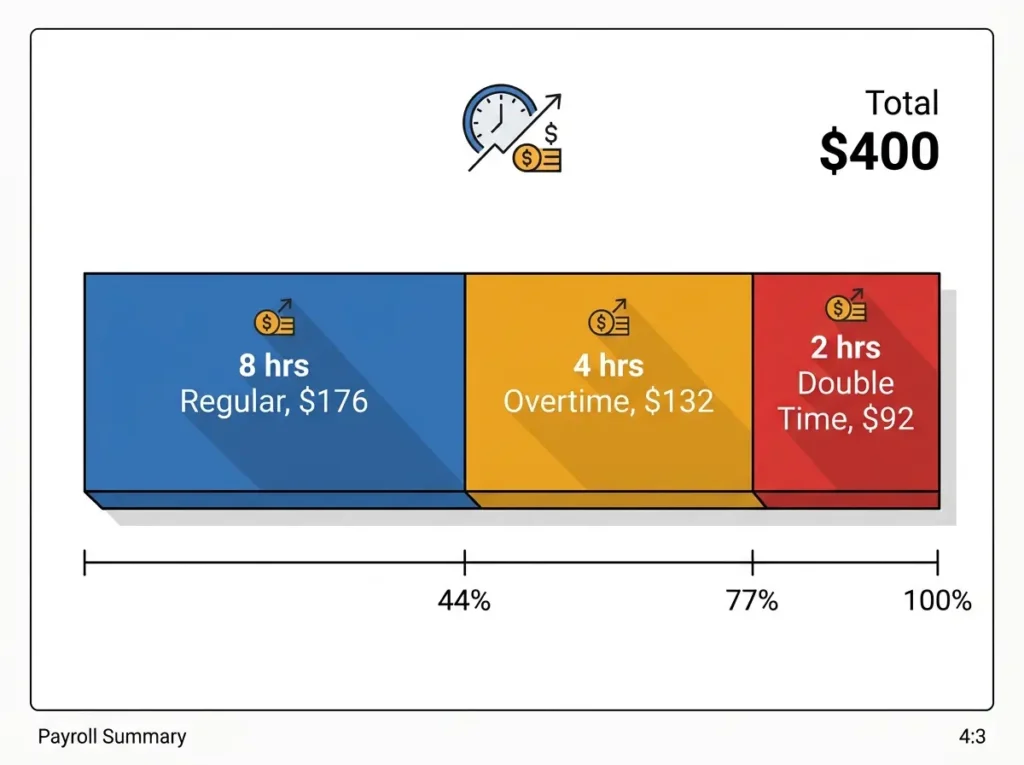
Example #1: 14-Hour Warehouse Shift

Worker earns $22/hour. Works 14 hours in one shift.

Hours WorkedRatePay
Hours 1-8 (regular)$22.00/hr$176.00
Hours 9-12 (overtime)$33.00/hr$132.00
Hours 13-14 (double time)$44.00/hr$88.00
Total$396.00

If the employer paid straight time for all 14 hours, that would be $308. The worker would be owed $88 more for just that one shift.

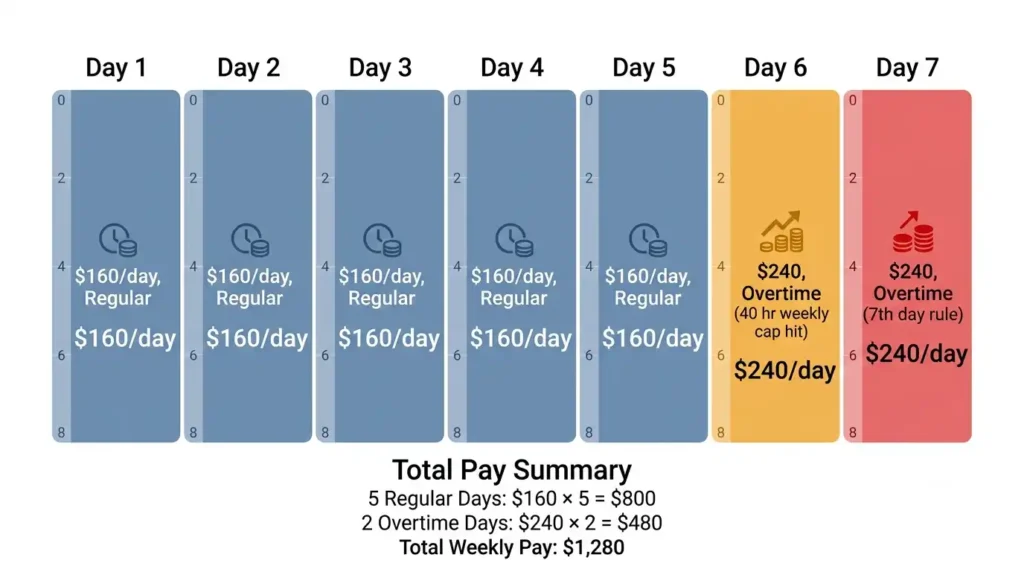
Example #2: Nurse Working 7 Consecutive Days

A nurse earns $45/hour and works 10-hour shifts for 7 days straight.

  • Days 1 through 6: Each day has 10 hours. Hours 1-8 are regular pay. Hours 9-10 are overtime at $67.50/hr.
  • Day 7 (7th consecutive workday): All hours are at premium rates. Hours 1-8 are overtime ($67.50/hr). Hours 9-10 are double time ($90/hr).

The seventh day rule makes day 7 completely different. Every hour earns a premium starting from hour one.

Example #3: Employee Crossing 40 Weekly Hours

A retail worker earns $20/hour and works five 9-hour days in one week. Total hours: 45.

  • Daily overtime applies each day for hour 9 (1 hour at $30/hr per day)
  • Weekly overtime kicks in after 40 hours. But since hours 41-45 were already calculated as daily overtime, there is no additional stacking.

The daily premium already covers those hours. The worker gets the higher of the two rates, not both.

Example #4: Restaurant Worker With Split Shifts

A server earns $18/hour and works a morning shift (7 AM to 11 AM) and an evening shift (5 PM to 11 PM) on the same day. Both shifts count toward the same workday total because they fall within the same employer-defined 24-hour period.

Total hours that day: 10 hours.

  • Hours 1-8 = regular pay ($18/hr)
  • Hours 9-10 = overtime ($27/hr)

Split shifts do not reset the daily overtime clock. All hours within one workday count together.

Example #5: Overnight Security Shift

A security officer earns $21/hour and works from 9 PM to 11 AM. That is 14 hours. The critical question: how does the employer define the workday?

If the workday runs midnight to midnight:

  • 9 PM to midnight = 3 hours in one workday
  • Midnight to 11 AM = 11 hours in the next workday

No single workday exceeds 12 hours. No double time.

But if the workday starts at 6 PM, all 14 hours fall within one workday. Hours 13 and 14 are double time.

Same shift. Completely different pay. This is why overnight workers must know their employer’s workday definition.

How to Check If Your Employer Paid You Correctly

Step-by-Step Pay Stub Audit

You do not need an accountant. Follow these steps every week. If you want a deeper walkthrough of every line item on your paycheck, see our guide on how to read a California pay stub.

  1. Find your employer’s official workday start time. Ask HR if you do not know it.
  2. List your actual daily hours for each workday in the pay period.
  3. For each day, separate hours into three buckets: regular (1-8), overtime (9-12), double time (13+).
  4. Apply the correct rate to each bucket using your regular rate of pay.
  5. Check the 7th consecutive day rule if you worked 7 days in a row.
  6. Add up your expected earnings and compare to your pay stub.

If the numbers do not match, write down the difference and keep a record of it.

Common Payroll Errors

In my experience, these are the most common payroll mistakes:

  • Missing double time: Employer pays 1.5x for all overtime hours, even those past hour 12
  • Wrong workweek setup: Employer shifts the workweek start date to avoid overtime triggers
  • Misclassification: Worker is labeled exempt without meeting the legal duties test
  • Ignoring split shifts: Employer counts each split shift as a separate day
  • Wrong regular rate: Employer uses only base pay and ignores bonuses or differentials
  • Off-the-clock work: Employer expects pre-shift setup or post-shift cleanup without pay
  • Travel time: Required travel between job sites during the workday is compensable time, not personal travel
  • On-call time: If you are required to stay close and respond quickly, that on-call time may count toward your hours
  • Training time: Mandatory training sessions count as work hours and must be included in overtime calculations
  • Remote employee overtime: Working from home does not change any overtime rule. Hours tracked remotely are subject to the exact same daily and weekly thresholds

Any one of these can mean you are being underpaid right now. If your overall take-home looks lower than expected, our guide on why your California paycheck is so low covers the most common causes beyond overtime.

Records Employees Should Keep

Keep these records for at least four years. California’s statute of limitations is three years for DLSE wage claims and up to four years for civil court actions under unfair business practices law. For a broader look at what appears on your pay stub and what each line means, visit our paycheck basics resource section.

  • All pay stubs, whether paper or digital
  • Timecards or time-tracking records
  • Screenshots of clock-in and clock-out logs
  • Schedule records and any written schedule changes
  • Text messages or emails about your hours or pay

If your employer uses a timekeeping app, screenshot your daily logs regularly. Some systems allow employers to edit entries. Your own independent records are your best protection.

The more documentation you have, the stronger your position.

Insider Insight: Why Workers Should Audit Pay Weekly

Audit your pay stub every week, not once a quarter. Payroll errors compound. Catch a mistake in week one and HR can fix it in one conversation. Catch it after six months and you may need to file a formal wage claim.

A weekly audit takes five minutes and can save you thousands of dollars a year.

The Hidden Rule Most Workers Miss: How Employers Define a “Workday”

What a Workday Actually Means

A workday in California is not automatically midnight to midnight. It is a fixed, consecutive 24-hour period your employer officially defines. It could start at 8 AM, 6 PM, or any other hour. Once set, it applies consistently. That definition controls when your daily overtime and double time clocks start ticking.

Most employees never ask about this. That oversight creates real paycheck problems.

Why Overnight Shifts Cause Confusion

Say you work from 8 PM to 10 AM. That is 14 hours.

If your employer’s workday runs midnight to midnight, your shift splits: 4 hours in the first workday, 10 hours in the next. No single workday crosses 12 hours. No double time.

But if the workday starts at 6 PM, all 14 hours fall into one workday. Hours 13 and 14 are double time at 2x your rate. Same shift. Completely different pay.

Can Employers Change Workdays?

Employers can establish workday definitions but cannot change them repeatedly to avoid paying overtime. California law prohibits schedule manipulation designed to cut off earned overtime. If an employer keeps shifting workday start times for that purpose, it is a potential wage violation.

Ask for your workday definition in writing. It should be in your employee handbook or payroll policy.

Insider Insight

Overnight workers are among the most frequently underpaid workers in California. I have seen this pattern consistently. The midnight split issue creates confusion that benefits employers when workers do not know their workday definition.

If you work overnight, find out your official workday start time immediately. That one piece of information can change your entire paycheck calculation.


Alternative Workweek Schedules (AWS): The Rule That Changes Overtime

What an AWS Schedule Is

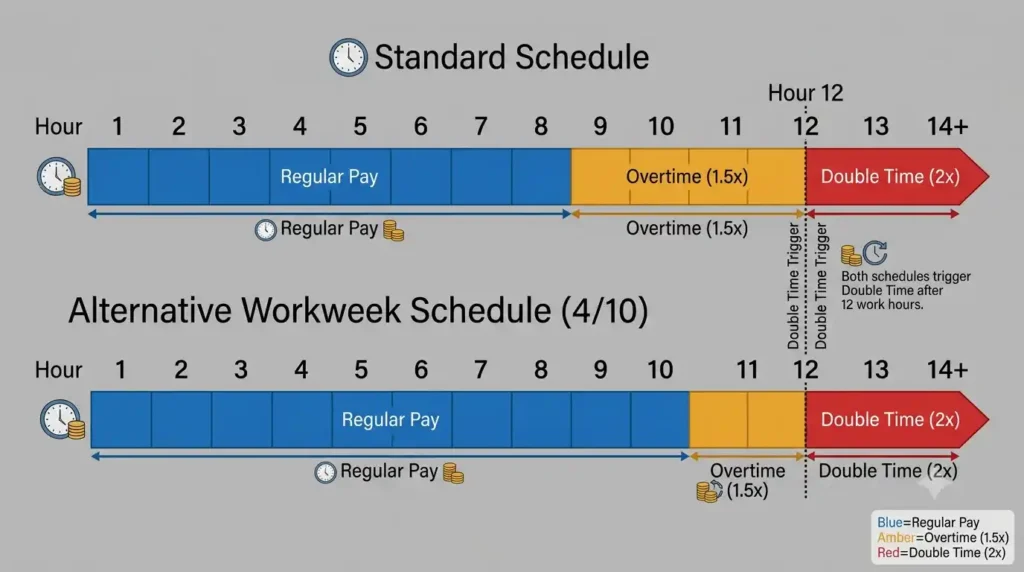
An alternative workweek schedule (AWS) is a formally approved arrangement that lets workers clock longer daily shifts without triggering daily overtime at the normal 8-hour mark.

The most common example is a 4×10 schedule. Workers work four 10-hour days instead of five 8-hour days. Under an approved AWS, those extra 2 hours each day are paid at the regular rate, not overtime.

AWS schedules are common in healthcare, manufacturing, and tech. They benefit both workers (longer weekends) and employers (reduced overtime costs).

Why Some 10-Hour Shifts Do Not Trigger Overtime

Under an approved AWS, overtime does not start until you exceed the schedule’s threshold. For a 4×10 schedule, overtime starts after 10 hours in a workday, not after 8.

Daily overtime still applies past 10 hours under a 4×10 schedule. And double time still applies past 12 hours. Only the starting threshold for overtime changes.

Without AWS approval, a 10-hour day always triggers overtime for hours 9 and 10. There is no shortcut around that.

How Employers Must Legally Adopt AWS

An employer cannot simply announce a new schedule and call it an AWS. The legal process requires:

If any of these steps were skipped, the AWS is invalid. Workers on an improperly adopted AWS are still entitled to regular daily overtime rules.

Warning Signs of Improper AWS Use

Here is what to watch for:

  • Employees were never informed of or asked to vote on an AWS
  • The schedule changed suddenly without any formal process
  • Your employer calls it a “flexible schedule” but not a formal AWS
  • Overtime premiums disappeared after a scheduling change

If any of these sound familiar, your AWS may be legally invalid. That could mean back pay for overtime hours that were never properly compensated.

Special California Overtime Exceptions

Healthcare Worker Exceptions

California allows healthcare workers to enter into voluntary written agreements to work an alternative 14-day work period instead of a standard 7-day workweek. Healthcare workers also operate under a separate California healthcare worker minimum wage structure that affects how their regular rate of pay is calculated for overtime purposes.

Under this arrangement, overtime starts after 8 hours in a day or 80 hours in the 14-day period, whichever produces more overtime pay. Hospital scheduling often uses this model to manage staff across long rotations.

The key word is voluntary. Workers cannot be required to sign these agreements. And double time still applies after 12 hours in a single workday. Healthcare workers should also be aware that California meal and rest break laws interact directly with overtime calculations when breaks are missed.

Union and Collective Bargaining Exceptions

Some union contracts include different overtime rules that are negotiated separately from California’s standard labor code requirements.

A valid collective bargaining agreement (CBA) can modify certain overtime rules if it provides equivalent or better overall compensation. This includes different overtime thresholds, different premium rates in some cases, or different workday definitions.

If you are a union member, your specific overtime rights may be governed by your CBA. Read it carefully, or ask your union representative to walk you through it.

Agricultural and Transportation Exceptions

California’s long phase-in of overtime protections for farmworkers is now complete. As of January 1, 2025, all California agricultural workers, regardless of employer size, are covered by the same standard overtime rules that apply to every other non-exempt worker in the state. That means 8 hours per day triggers overtime and 12 hours per day triggers double time, identical to the rules in this guide.

Transportation workers, including truck drivers governed by federal regulations, may follow different rules depending on their specific employment classification and the nature of their work. Questions about worker classification in California have their own body of law — see our worker classification resources for more.

Live-in employees, such as domestic workers who reside in the home of their employer, also operate under special overtime rules. California provides some overtime protections for live-in domestic workers, but the thresholds and calculations differ from the standard daily and weekly rules that apply to most workers.

Emergency Service & Specialized Roles

Certain emergency service workers, public agency employees, and workers in specialized roles may have different overtime structures under California law or applicable memoranda of understanding.

Firefighters, for example, operate under different daily and weekly standards because of the unique nature of 24-hour shift scheduling. If you work in public safety or emergency services, verify which specific rules apply to your role and employer.

Federal employees follow federal overtime rules under the FLSA rather than California’s Labor Code, since federal agencies are not subject to state wage law. If you work for a private employer but your payroll is processed through software designed for federal contracts or out-of-state operations, ask HR to confirm your pay is calculated under California rules. Payroll software errors are a real and underreported source of missed overtime pay.

What To Do If You Are Missing Overtime or Double Time Pay

First Steps Before Filing a Claim

Go to your payroll department or HR and raise the specific discrepancy. Bring your calculation, your hours, and the pay stub in question. Be factual and direct, not accusatory. Payroll errors are often genuine mistakes.

Request a written response confirming the calculation, including how they defined your workday and applied overtime rules. That confirmation is valuable documentation.

Give them one to two pay periods to correct the error. If nothing changes, move to the next step.

Filing a Wage Claim in California

If your employer does not correct the error, you can file a wage claim with the California Labor Commissioner’s Office, also known as the Division of Labor Standards Enforcement (DLSE).

The process involves:

  • Submitting a formal written claim with your employer’s information and the amount owed
  • Providing documentation including pay stubs, timecards, and any written communications
  • Attending a settlement conference where the Labor Commissioner attempts to resolve the dispute
  • Moving to a formal hearing if the settlement conference does not produce resolution

California allows you to recover unpaid wages, interest, and in some cases penalties. The statute of limitations is three years for DLSE wage claims. If you file a civil lawsuit in court under California’s unfair business practices law, that window extends to four years. Knowing both options matters if you are close to the three-year mark. If your employer also failed to list overtime hours and rates correctly on your pay stub, that is a separate wage statement violation that carries its own penalties under California law. Employers who fail to pay all final wages on time at termination or resignation may also owe California waiting time penalties equal to a full day’s wage for every day the final payment is late, up to 30 days. This penalty applies specifically to final wages, not to routine payroll errors during active employment. In cases where many workers were underpaid the same way, a class action overtime lawsuit may be the most effective path to retroactive overtime recovery.

Can Employers Retaliate?

California law strictly prohibits employer retaliation for filing a wage claim or reporting a labor law violation.

Retaliation includes demotions, schedule reductions, termination, or any other adverse action tied to your claim. If your employer retaliates, that becomes a separate legal violation with its own remedies.

When To Contact an Employment Lawyer

Some situations call for professional legal help. Consider contacting an employment attorney if:

  • The unpaid amount is large, especially back pay spanning many months
  • Your employer has repeated and systematic violations
  • You believe you have been misclassified as exempt
  • Your employer retaliates after you raise the issue
  • You are part of a larger group of workers with the same problem

Many employment lawyers in California work on contingency for wage and hour cases. That means they do not get paid unless you win. An initial consultation is usually free.

California Overtime Laws vs Other States

Why California Is More Employee-Friendly

Two features set California apart from almost every other state.

First is the daily overtime rule. Most states only use the federal weekly standard. California adds a daily trigger at 8 hours. That protects workers who regularly pull long single-day shifts even if their weekly total stays under 40 hours.

Second is the double time requirement. No federal law requires double time. California created it specifically to protect workers from extreme long-shift scheduling. It is a legal requirement here, not a voluntary employer practice.

States That Only Use Federal Overtime

Most U.S. states follow the federal standard. That means overtime only starts after 40 hours in a workweek. There is no daily trigger, and there is no double time requirement.

Workers who move to California from states like Texas, Nevada, Florida, or New York often get confused. They are used to a system where a 12-hour day earns no premium if their weekly total stays under 40 hours.

In California, that same 12-hour day triggers 4 hours of overtime pay. Employers who transfer payroll operations from other states frequently underpay workers here without realizing it.

Industries Most Affected by California Rules

Certain industries feel the impact of California’s stronger protections more than others:

  • Healthcare: Nurses and clinical staff regularly work 12-plus hour shifts where double time is a direct financial reality
  • Warehousing: Distribution centers that run 10 to 14-hour shifts on fulfillment surge days owe double time on every qualifying shift
  • Hospitality: Hotel and resort staff who work extended holiday events hit overtime and double time thresholds frequently
  • Construction: Long job-site days during peak project phases regularly cross the 12-hour mark

If your industry runs long single-day shifts, California’s daily protections make a direct difference in your paycheck.

Frequently Asked Questions

Is double time required after 12 hours in California?

Yes. California Labor Code Section 510 requires employers to pay double time (2x the regular rate) for all hours worked beyond 12 in a single workday. This applies to all non-exempt employees. There are no exceptions for industry, shift type, or employee preference.

Does overtime reset at midnight?

No. Overtime resets at the start of your employer-defined workday, not at midnight. Your employer sets a fixed consecutive 24-hour period as the official workday. That is when the daily overtime clock resets. If your employer’s workday starts at 8 AM, the clock resets at 8 AM, not at midnight.

Can salaried employees get overtime or double time?

Yes, if they are classified as non-exempt. Salary alone does not create an overtime exemption in California. The employee must also pass the legal duties test for executives, administrators, or professionals. Many salaried workers who do hands-on or supervisory-but-not-managerial work are non-exempt and entitled to overtime and double time.

Can employers avoid paying double time legally?

Only in limited situations. Employers can adopt an alternative workweek schedule through a legal employee vote process. They can also enter into valid collective bargaining agreements that modify certain overtime rules. Outside of these specific approved exceptions, double time is legally mandatory and cannot be waived.

What happens on the seventh consecutive workday?

The seventh consecutive workday in a single workweek triggers special overtime rules. The first 8 hours are paid at 1.5x the regular rate. All hours beyond 8 on that seventh day are paid at 2x the regular rate. This is separate from the normal daily overtime rules that apply on days 1 through 6.

Can daily and weekly overtime apply together?

They run simultaneously but do not stack. California’s anti-pyramiding rule prevents double-counting. If an hour qualifies under both daily and weekly overtime rules, the employee earns only the highest applicable premium for that hour, not two separate premiums added together.

Does California require double time after 40 hours?

No. Forty weekly hours only triggers overtime at 1.5x. Double time in California is a daily calculation. It requires more than 12 hours in a single workday, or more than 8 hours on the seventh consecutive workday. Weekly hour totals alone never trigger double time.

Can employers change work schedules to avoid overtime?

They have some flexibility in setting schedules, but they cannot repeatedly shift workday or workweek definitions specifically to avoid paying overtime. California law treats that kind of manipulation as a potential wage violation. Changes must be made in good faith with advance notice, not as a deliberate strategy to cut off earned premiums.

Do split shifts count toward double time?

Yes. All hours worked within the same employer-defined workday count together toward the daily overtime thresholds. If you work a morning and an evening shift on the same workday and the total exceeds 12 hours, double time applies to those extra hours.

What if my employer refuses to fix payroll mistakes?

Start by documenting everything in writing. Then file a wage claim with the California Labor Commissioner’s Office (DLSE). You can recover unpaid wages plus interest and potential penalties. California law also protects you from retaliation for filing a claim. If the amount is significant, consult an employment attorney who handles wage and hour cases.

Can you waive your overtime rights in California?

Generally, no. California overtime rights cannot be waived by an individual employee, even in a signed agreement. An employer cannot ask you to sign away your right to overtime pay and enforce that waiver. The only way overtime rules can be modified is through a properly adopted alternative workweek schedule or a valid collective bargaining agreement. A personal waiver you sign at hiring is not legally enforceable.

Can overtime be averaged across weeks in California?

No. California does not allow overtime to be averaged across multiple workweeks. Each workweek stands alone. If you work 50 hours one week and 30 hours the next, you owe overtime for the first week. You cannot use the light week to offset the heavy one.

Does California require double time on holidays?

There is no California law that automatically requires double time pay on holidays. Holiday premium pay is a matter of your employment contract, company policy, or collective bargaining agreement. What does apply is the standard daily and weekly overtime formula. If you work more than 8 hours on a holiday, you earn overtime. If you cross 12 hours, you earn double time. The holiday itself does not create a separate pay premium under California law.

Final Takeaway: The Simple Rule Workers Should Remember

The Core California Overtime Formula

Everything in this guide comes back to three core rules. Print these out. Put them on your fridge.

  • Work more than 8 hours in a day = overtime (1.5x your regular rate)
  • Work more than 12 hours in a day = double time (2x your regular rate)
  • Work all 7 days in a row = special rules apply starting from hour one on day 7

These are your legal rights in California. They do not disappear because your employer uses a different scheduling system or pays you a salary.

The One Detail That Changes Everything

The most important variable in your overtime calculation is not your hours or your rate. It is your employer’s workday definition.

That single definition controls when your daily overtime clock starts and when double time kicks in. It determines how an overnight shift is divided between two workdays. It decides whether a long day triggers premium pay or gets sliced in two.

Know your workday start time. Ask for it in writing. Put it in your notes. That one piece of information is the key to auditing every paycheck you will ever receive in California.

Final Employee Reminder

Review your pay stub every pay period. Compare your hours against the three-tier daily formula. Keep your timecards and clock records somewhere safe. For more guides on California labor laws that affect your paycheck, browse our full resource library.

You earned every dollar of overtime and double time that California law guarantees you. Make sure you are actually getting it.

Your paycheck is your responsibility to verify. California gives you the rights. You have to use them. Use the California paycheck calculator to see exactly what your take-home should look like after overtime is factored in.

Leave a Comment

Scroll to Top