
California overtime pays 1.5 times your regular rate after 8 hours in a workday or 40 in a week; double time pays 2 times your rate after 12 hours in a single day. Only nonexempt employees qualify.
After more than a decade auditing California payroll, I still see employers apply federal rules and miss these two triggers, using the same review process outlined in our methodology.
Exemptions, alternative workweeks, and industry rules complicate this, so always verify your own paystub.
Overtime vs Double Time at a Glance
Quick Comparison Table
| Pay Type | Multiplier | When It Starts |
|---|---|---|
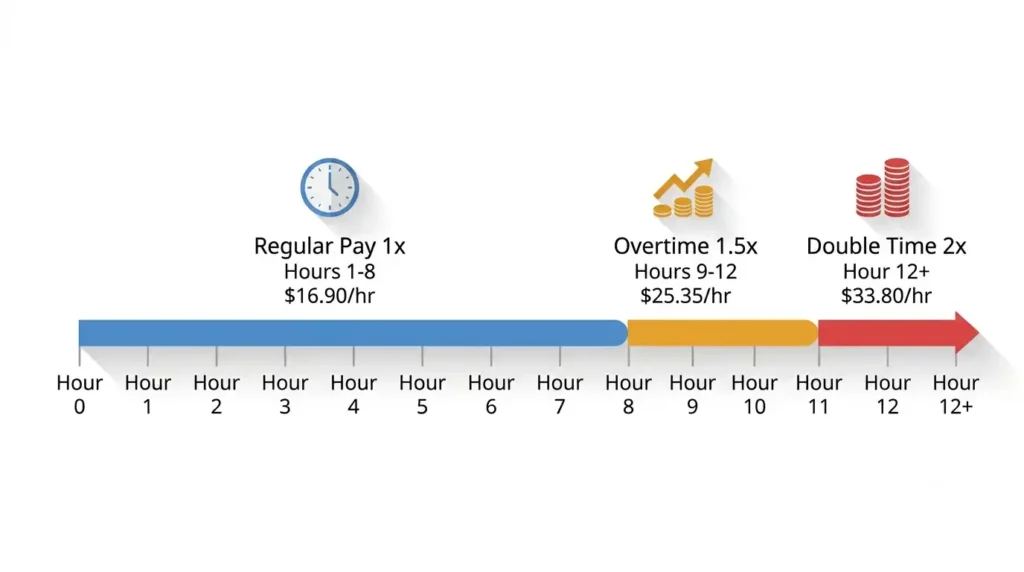
| Regular pay | 1x | Hours 1 to 8 in a day |
| Overtime | 1.5x | Hours 9 to 12 in a day, or over 40 in a week |
| Double time | 2x | Hours 12+ in a day, or hour 9+ on a 7th consecutive workday |
At California’s 2026 minimum wage of $16.90 an hour, overtime is $25.35 and double time is $33.80.
Quick Answer
| Term | Meaning |
|---|---|
| Straight time pay | Your base hourly rate |
| Overtime (time and one-half) | 1.5x rate, starts after 8 hours/day |
| Double time | 2x rate, starts after 12 hours/day |
| Who qualifies | Nonexempt employees |
What Is Overtime in California?
The most common mistake I catch is employers using the federal 40 hour rule and stopping there. California doesn’t work that way.
Definition of Overtime
Overtime starts after 8 hours in a day, or 40 in a week. Work 7 days straight, and the first 8 hours of day 7 pay overtime too. It’s all based on your regular rate of pay. These rules come from California Labor Code Section 510, and you can find the full breakdown in our California overtime laws guide.
Employees Who Qualify
Nonexempt employees qualify, hourly or salaried. To be an exempt employee in 2026, you need at least $70,304 a year ($1,352 a week), a number you can check with our annual salary calculator, and over half your time on real managerial, administrative, or professional duties. Miss either test and you’re still owed overtime. Excluded workers include true executives, licensed professionals, and outside salespeople who meet both tests. No agreement can waive that.
What Is Double Time in California?
Definition of Double Time
Double time starts after 12 hours in a day, or after hour 8 on a 7th consecutive workday. California is one of the only states that requires it at all. Federal law has no double time rule.
When Double Time Does NOT Apply
Over 40 hours a week alone doesn’t trigger double time. Neither does a holiday or a weekend shift, unless you cross the daily or weekly thresholds. Alternative workweek employees follow different triggers, covered below.
Overtime vs Double Time Comparison
Side-by-Side Comparison Table
| Factor | Overtime | Double Time |
|---|---|---|
| Rate | 1.5x regular rate | 2x regular rate |
| Daily trigger | After 8 hours | After 12 hours |
| Weekly trigger | After 40 hours | Not applicable |
| 7th day trigger | First 8 hours worked | Hour 9 and beyond |
| Who qualifies | Nonexempt employees | Nonexempt employees |
Key Differences
Overtime has a daily and weekly trigger. Double time only has the daily 12 hour mark and the 7th day rule. At $25 an hour, that’s $37.50 for overtime and $50 for double time. A 14 hour shift can hit all three pay types in one day.
Exactly When Does 2x Pay Start?
More Than 12 Hours in One Workday
A 14 hour shift: hours 1 to 8 pay regular rate, hours 9 to 12 pay time and one-half, hours 13 and 14 pay double time. Employers often miss splitting off those last two hours.
Seventh Consecutive Workday Rule
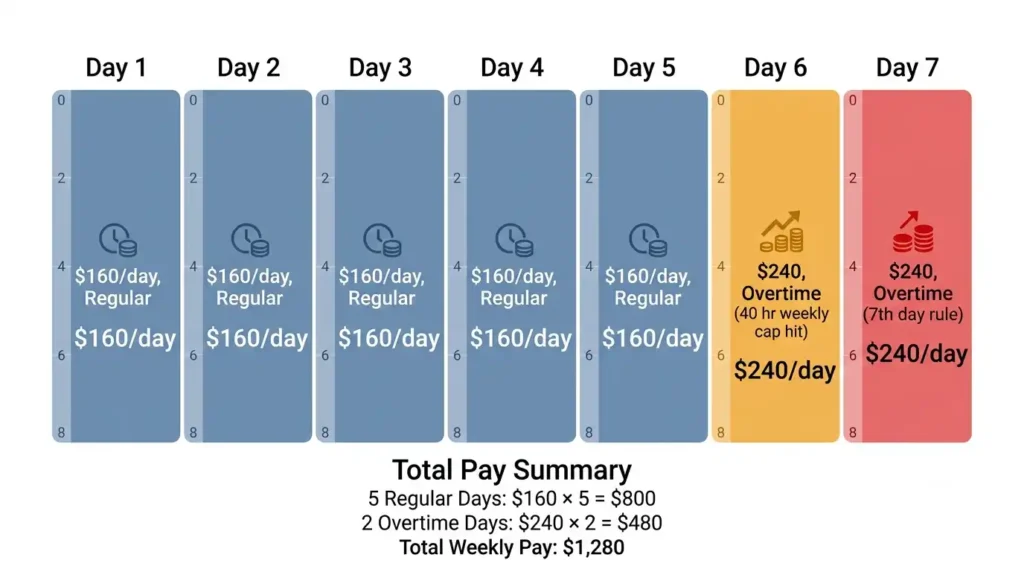
Work all 7 days in a workweek, and day 7’s first 8 hours pay overtime. Anything past 8 that day pays double time.
How to Calculate Overtime and Double Time
Step-by-Step Formula
Find your regular rate of pay. Split hours into regular, overtime, and double time. Multiply each by 1x, 1.5x, or 2x. Add them up and check against your gross pay. Running the numbers through our paycheck calculator can do this split for you in seconds.
Employees with Bonuses or Commissions
Regular Rate Adjustments
Nondiscretionary bonuses and commissions get spread across all hours worked and folded into your regular rate, called your weighted average regular rate. Shift differential pay works the same way. Example: $1,000 earned over 50 hours, including 10 overtime hours, gives a $20 regular rate, so overtime pays 1.5 times that $20. This nondiscretionary bonus overtime math is where small employers most often get it wrong.
Real Paycheck Examples
These match the kind of paycheck scenarios readers ask about most.
13-Hour Shift Example
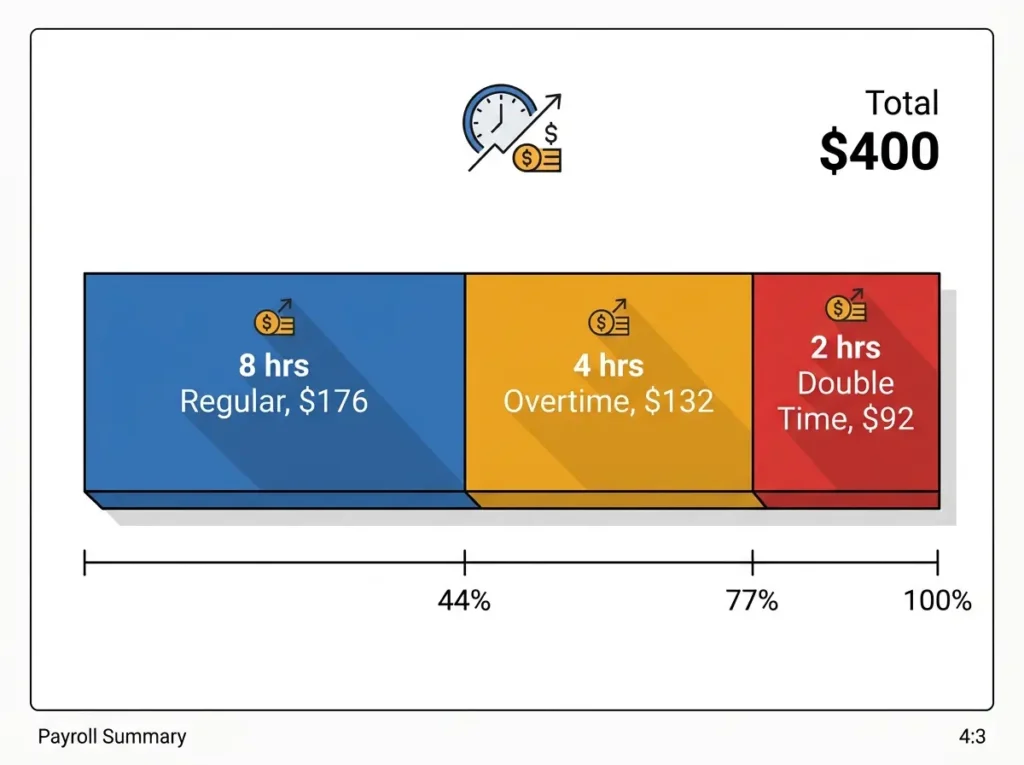
At $22 an hour: 8 regular hours pay $176, 4 overtime hours pay $132, 1 double time hour pays $44. Total: $352.
14-Hour Shift Example
Same $22 an hour: 8 regular hours pay $176, 4 overtime hours pay $132, 2 double time hours pay $88. Total: $396.
Five 10-Hour Shifts
Five 10 hour days at $20 an hour gives 40 regular hours and 10 overtime hours each week. Regular pay: $800. Overtime: $300. Total: $1,100. No extra weekly overtime applies since daily overtime already covered those hours.
Seven Consecutive Days Example
Seven 8 hour days at $20 an hour: days 1 to 5 pay $800 regular. Day 7 pays overtime for all 8 hours, adding $240. A 9th hour that day would pay double time at $40.
Situations That Confuse Most Employees
Working More Than 40 Hours
Crossing 40 hours alone doesn’t mean double time, and daily and weekly overtime don’t stack on the same hours. You get whichever pays more, once.
Overnight Shifts
Your workday is your employer’s set 24 hour period, not always midnight to midnight. Your workweek is a separate, fixed 7 day period set in advance. An employer can’t shift or shorten it just to dodge overtime already earned.
Four 10-Hour Shifts
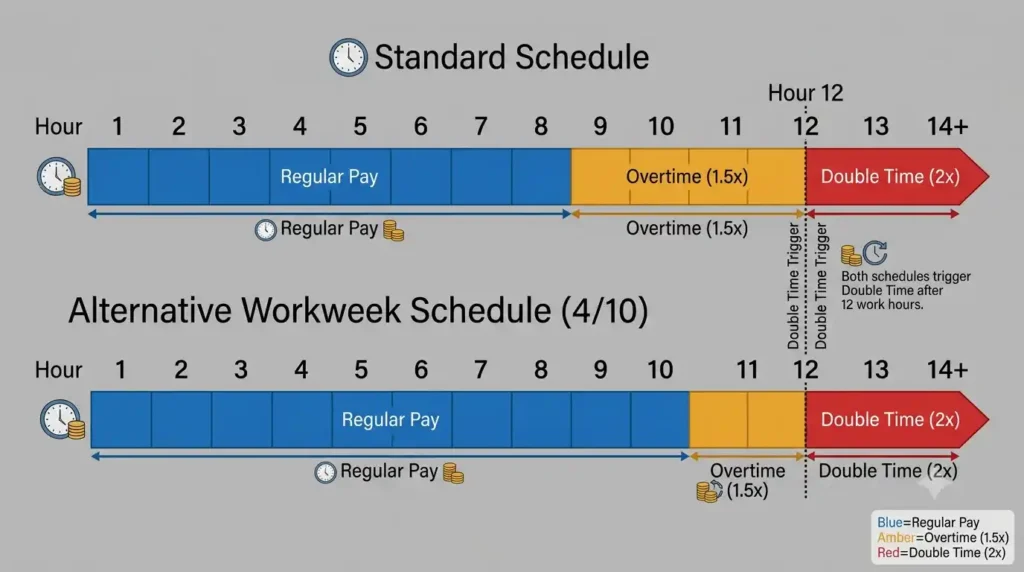
Under a valid alternative workweek schedule, the first 10 hours in a day are regular time, overtime starts at hour 11, and double time still starts at hour 12. This only works if adopted by employee vote.
Unauthorized Overtime
Employers must pay for hours worked even without prior approval, the same principle that applies to off the clock work. They can discipline you for breaking policy, but can’t withhold the pay. You also can’t waive this right by contract.
Special Rules and Exceptions
These sit alongside the broader set of California labor laws covering nonexempt workers.
Alternative Workweek Schedules
Adoption needs a two-thirds vote by secret ballot. This is governed by California Labor Code Section 511, and employers must report results to the DLSE within 30 days. The daily trigger can move to 10 hours, but the 12 hour double time and 40 hour weekly triggers stay the same.
Industry-Specific Rules
Healthcare has its own 12 hour shift scheduling options. Agricultural workers’ phase-in finished January 1, 2022 for large employers and January 1, 2025 for employers with 25 or fewer. Union workers can accept a different structure through a collective bargaining agreement, if it guarantees at least a 30% wage premium above minimum wage. Many of these carve outs come from the Industrial Welfare Commission Wage Orders, or IWC Wage Orders.
Common Myths About Overtime and Double Time
Myth: Every Hour After 40 Is Double Time
False. Hours past 40 pay overtime at 1.5x, not double time.
Myth: Holidays Always Pay Double Time
State law requires no holiday premium at all. Any extra pay comes from employer policy or a union contract.
Myth: Salaried Employees Never Get Overtime
Nonexempt salaried employees get overtime too. Exemption needs both the $70,304 salary threshold and the duties test.
Myth: Employers Can Refuse to Pay Unauthorized Overtime
Wages are still owed for hours worked, approved or not. Discipline and pay are separate issues.
What to Do If Your Paycheck Is Wrong
Signs of Incorrect Overtime Pay
Watch for missing overtime lines, rates that aren’t 1.5x or 2x your true regular rate, or hours misclassified as regular. Our guide on how to read your California pay stub walks through each line.
Steps Before Filing a Claim
Compare your paystub to your actual clock times. Ask payroll or HR for a written explanation. Keep your own copies of schedules and timecards.
Filing a California Wage Claim
Unresolved errors can go to a wage claim DLSE filing with California’s Division of Labor Standards Enforcement, which sits under the California Department of Industrial Relations, or DIR. Pay timing itself falls under California Labor Code Section 204, and late final pay can trigger a waiting time penalty. Claims generally need filing within three years, though written contract or unfair competition claims can stretch to four.
Frequently Asked Questions
This California overtime FAQ covers the most common questions.
Is overtime the same as double time in California?
No. Overtime pays 1.5x, double time pays 2x, at different hour thresholds in the same workday.
Do I get double time after 40 hours?
No. Forty hours triggers overtime, not double time.
Is working on Saturday or Sunday automatically double time?
No, unless it crosses the daily, weekly, or 7th day thresholds.
Does holiday work qualify for double time?
Not under state law. Any premium comes from employer or union policy.
Can salaried employees receive overtime?
Yes, if nonexempt. They need to clear both the $70,304 threshold and the duties test.
Can my employer refuse to pay overtime if it wasn’t approved?
No. Unapproved hours still have to be paid.
What is the fastest way to verify my paycheck?
Check your actual hours against the comparison table, and confirm your rates match 1.5x and 2x your true regular rate.
Final Takeaway
Remember These Four Rules
Daily overtime after 8 hours. Weekly overtime after 40. Double time after 12 hours a day. The 7th consecutive workday adds its own overtime and double time triggers.
Check Your Pay Before Your Next Payday
Compare your hours worked to your paystub. Verify the 1.5x and 2x rates. Keep your own records.

Yeasin Sorker is the founder of Paycheck Calculator California. He built this tool in 2018 after noticing that most free paycheck calculators missed California-specific rules like daily overtime and the uncapped SDI rate.
He researches California payroll tax updates regularly and keeps this calculator aligned with the latest IRS, FTB, and EDD published rates. All calculations on this site are estimates based on official 2026 government sources. For personalized tax advice, consult a qualified tax professional.