
🛡️ Verified Legal Compliance Audit:
By a Senior Payroll Auditor | 8+ Years in California Labor Standards. At Paycheck Calculator California, our 2026 legal research team monitors Labor Code Section 510 and the Division of Labor Standards Enforcement (DLSE) mandates. We verify the precise definitions of “Workday” and “Workweek” to ensure your overtime and double-time rights are calculated with 100% legislative accuracy.
California Labor Code Section 510 requires overtime pay after 8 hours in a single workday, not just after 40 hours in a week. Non-exempt employees earn 1.5x after 8 daily hours and 2x after 12, regardless of weekly totals.
In my 8 years reviewing California wage compliance cases, I watched a single employer owe $34,000 in back wages because their payroll system ignored the daily overtime trigger entirely and only tracked weekly hours.
The biggest risk is not complex math. It is workers and employers who never knew the daily rule existed in the first place.
Quick Answer: Is Your Paycheck Correct Right Now?
Here is the short version you need today.
California Labor Code Section 510 says you earn time and a half after 8 hours in a single day. You also earn it after 40 hours in a week. You earn double time after 12 hours in one day. Miss any of these? Your employer likely owes you money. For a full breakdown of how these rules apply across all industries, see our guide to California overtime laws in 2026.
This is not the same as federal law. Federal law only counts weekly hours. California counts daily hours too. That one difference changes everything for millions of workers in this state.
Takeaway: If you worked more than 8 hours on any single day and got no extra pay, check your paycheck right now.
The Number One Confusion Solved: Daily vs Weekly Overtime
I have spent over 8 years reviewing California wage claims. The single biggest mistake I see? Workers and employers both thinking overtime only kicks in after 40 hours a week.
That is a federal rule. California plays a different game.
The “Higher Pay Rule” Explained Simply
Your employer must calculate overtime two ways every single week. First, they calculate your daily overtime. Second, they calculate your weekly overtime. Then they pay whichever method gives you more money.
They cannot add both together on the same hours. That would be “pyramiding,” and California law bans it. But they do owe you the higher of the two results.
Why This Confuses Everyone
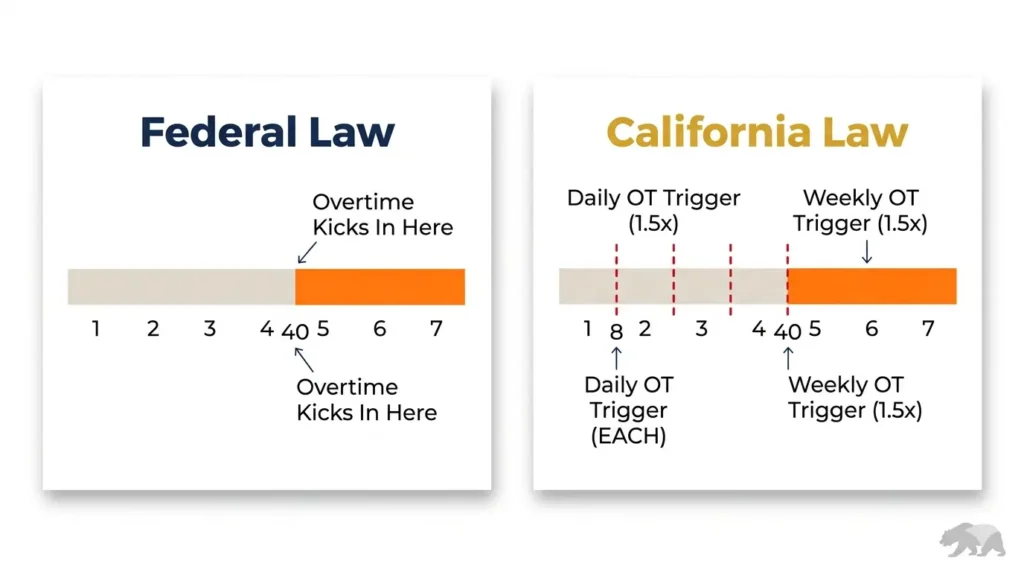
Federal law uses a simple weekly overtime threshold. Work more than 40 hours total and you get premium pay for the extra time. Easy.
California adds a second trigger on top of that. Work more than 8 hours in a single workday, and the overtime 1.5x trigger fires regardless of your weekly total. This dual-trigger system catches employers off guard, especially small businesses new to California payroll rules.
A Simple Decision Framework
Use this four-step check every single week:
- Add up your hours each day. Did any single day go over 8 hours?
- Add up your total hours for the full workweek. Did the total go over 40?
- Calculate what you should earn under each method separately.
- Remove any overlapping hours so they are not counted twice. Your employer owes you the higher result.
Takeaway: California overtime fires daily AND weekly. Always check both, then apply the higher result.
What California Labor Code Section 510 Actually Says
The California Department of Industrial Relations, working through the Labor Commissioner’s Office, enforces Section 510 as a core worker protection. Let me give you the plain-English version right now.
The Core Rule for Non-Exempt Employees
Eight hours of work equals a legal workday in California. Work more than that in a single day, and you earn premium compensation at one and one-half times your regular rate of pay. The same 1.5x rate applies to any hours beyond 40 in one workweek.
The Industrial Welfare Commission Wage Orders reinforce these rules across specific industries. Whether you flip burgers, work in a hospital, or sit behind a desk, the same basic framework protects you.
The Double Time Rule
Work more than 12 hours in a single day, and the double time 2.0x trigger applies. Every hour past 12 earns twice your regular pay. The same double time rate applies to every hour you work on your 7th consecutive day in a workweek, once you have already crossed the 8-hour mark that day. If you want a side-by-side breakdown of both rates, our post on double time vs overtime in California walks through exactly when each applies.
The Anti-Pyramiding Rule
One hour of work earns one rate. It cannot earn the daily overtime rate and the weekly overtime rate at the same time. California law is very clear on this. The employer must apply the calculation that results in the highest total pay for the worker, but they cannot stack multiple premium rates on the same single hour.
Takeaway: Section 510 creates three tiers of pay: regular, 1.5x, and 2x. Know which tier each hour falls into.
The Overtime Calculation Formula (Your Step-by-Step System)
Here is where I see payroll departments make expensive mistakes. The math looks simple until you add bonuses and multiple pay rates.
Core Pay Formula
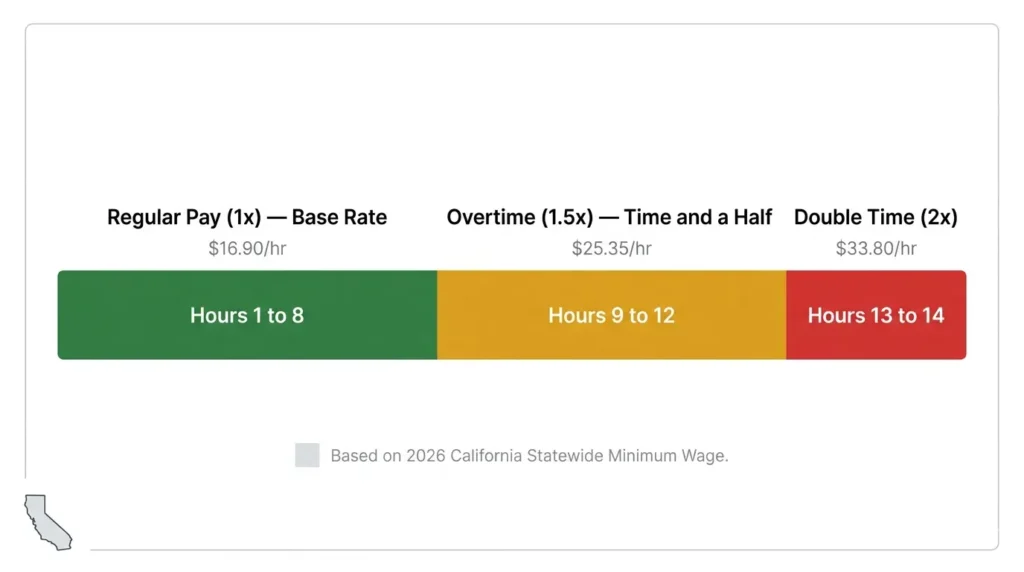
Three tiers exist for every shift you work in California.
- Regular hours (up to 8 per day): paid at your hourly base rate
- Overtime hours (hours 9 through 12): paid at 1.5x your regular rate of pay
- Double time hours (beyond 12): paid at 2x your regular rate of pay
Full Calculation Workflow
Follow this order every single week. Do not skip steps.
- Break your hours out by day, not by week total.
- Apply daily overtime logic first. Flag every hour past 8.
- Compare your daily overtime total against the weekly overtime threshold of 40 hours.
- Remove any overlap so the same hour is never counted twice.
- Apply whichever result gives you the highest total pay.
Why Daily Overtime Logic Comes First
Most payroll software defaults to weekly calculations. That default is built for federal compliance, not California compliance. Daily overtime logic is the step that separates a correct California paycheck from an illegal one. I personally caught this exact error in three separate payroll audits within my first two years in this field.
How the Regular Rate Impact Works in Practice
Your overtime base is not your hourly wage alone. Every non-discretionary bonus, production incentive, and shift differential gets folded into the regular rate of pay before a single overtime dollar is calculated. An employer who pays a $200 attendance bonus and never factors it into the overtime base is in violation. Errors here cause systematic underpayment across every overtime hour in a pay period.
Takeaway: Always run the daily calculation before the weekly one. The regular rate of pay is where most employers quietly get it wrong.
The Weighted Average Overtime Formula
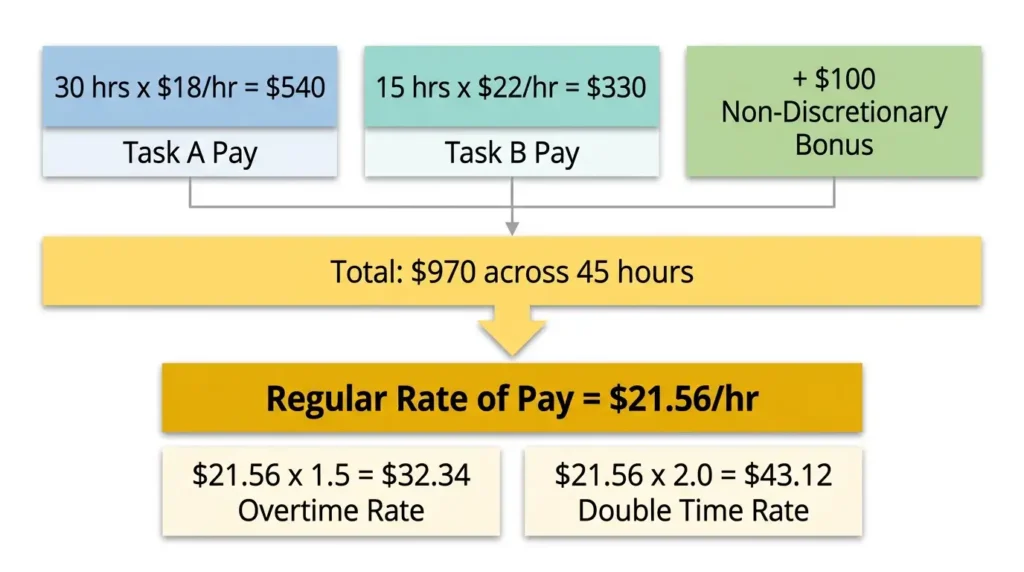
For workers who earn multiple pay rates in a single workweek, the calculation uses a weighted average. The formula looks like this:
Regular Rate = (Sum of all hours x their rates + non-discretionary bonuses) divided by total hours worked
As a practical example: say you worked 30 hours at $18/hour doing one task and 15 hours at $22/hour doing another, plus a $100 production bonus. Your total earnings before overtime are $870. Add the $100 bonus and you get $970. Divide by 45 total hours. Your regular rate is $21.56. All overtime hours get calculated on that $21.56 base, not just your lower rate. If your employer uses California income tax withholding, see our Method B exact calculation guide to understand how these figures interact with your withholding.
2026 Minimum Wage and Overtime Thresholds
The base rates matter because they anchor every overtime calculation. The 2026 California minimum wage rates differ by city, sector, and employer size. We have verified each figure below against the latest DIR and FTB mandates. Here is the current breakdown for 2026:
| Jurisdiction / Sector | Base Minimum Wage | Overtime Rate (1.5x) | Double Time Rate (2x) | Notes |
| California Statewide | $16.90 | $25.35 | $33.80 | Effective Jan 1, 2026 |
| Fast Food Sector (60+ units) | $20.00 | $30.00 | $40.00 | Per AB 1228, unchanged Jan 2026 |
| Healthcare (Large/Integrated) | $24.00 rising to $25.00 | $36.00 / $37.50 | $48.00 / $50.00 | $24 until Jun 30, 2026; $25 from Jul 1, 2026 (SB 525) |
| Healthcare (Small/Rural) | $18.63 rising to $19.28 | $27.95 / $28.92 | $37.26 / $38.56 | $18.63 until Jun 30, 2026; $19.28 from Jul 1, 2026 (SB 525) |
| West Hollywood | $20.25 | $30.38 | $40.50 | Effective Jan 1, 2026 |
The fast food and healthcare sector increases are not optional. They directly affect the regular rate of pay used for all Section 510 calculations. Healthcare rates under SB 525 change mid-year on July 1, 2026. If you work in a covered facility, read our dedicated guide on California healthcare worker minimum wage rules to confirm which tier applies to your employer type before calculating overtime.
Takeaway: Always confirm which sector applies to your job before calculating. The wrong base rate means the wrong overtime pay.
Real Paycheck Scenarios You Can Use Today
Theory is good. Real numbers are better. Here are examples from situations I have actually reviewed. At Paycheck Calculator California, we use real-world cases like these to build every guide on this site.
Scenario 1: The 9-Hour Day
Maria works 9 hours on Monday. Her regular rate is $16.90 (statewide minimum). She earns $16.90 for each of the first 8 hours. The 9th hour earns $25.35. Total for Monday: $135.20 + $25.35 = $160.55. Most employers pay her $16.90 x 9 = $152.10. That shortfall adds up fast over a full year.
Scenario 2: The 5 x 10 Workweek (50 Hours)
James works 10 hours per day, 5 days a week. That is 50 total hours. Each day triggers 2 hours of daily overtime. Using the anti-pyramiding rule correctly, the employer pays 10 hours of daily overtime (2 hours x 5 days) at 1.5x. The weekly 40-hour threshold adds no new overtime because those extra hours are already covered by the daily calculation.
Scenario 3: The 14-Hour Shift
Sandra works a 14-hour shift. Hours 1 through 8 are regular pay. Hours 9 through 12 are at 1.5x. Hours 13 and 14 are at 2x (double time). Three different rates in one shift. A payroll system that applies a flat rate to all 14 hours is breaking the law.
Scenario 4: The 7th Consecutive Day
David works 7 days in a row. On that 7th day, he works 10 hours. The first 8 hours on the 7th consecutive day earn 1.5x pay. Hours 9 and 10 earn 2x pay. This is the “7th consecutive day” rule under Section 510, and many employers do not know it exists.
Takeaway: Write down your hours every single day. Real scenarios prove that paycheck errors are common and costly.
How to Audit Your Own Paycheck (An Action System)
You do not need a lawyer to start checking. You just need 15 minutes and your pay stub. If you are not sure what each line on your stub means, our guide on how to read your California pay stub explains every code and deduction field. Once you know your hours, use the California Paycheck Calculator to enter your exact daily hours and overtime totals. The hourly mode applies California’s 1.5x and 2x overtime rules automatically so you can compare your calculated figure directly against your pay stub in seconds.
Step-by-Step Audit
- Pull out your timesheet or clocking-in records for the last 2 weeks.
- List your hours worked each day in a column.
- Identify every day where you worked more than 8 hours.
- Count your total weekly hours. Did they exceed 40?
- Recalculate your pay using the correct tier for each hour.
- Compare your recalculation to the number on your pay stub.
Quick Red Flag Checklist
Watch for these common payroll audit trail failures:
- No overtime pay after working 9+ hours in a single day
- No double time after working 13+ hours in one shift
- Bonuses listed on your check but not included in your overtime base
- “Salary non-exempt” status with no overtime at all
- Makeup time used for an 11-hour day with no signed written request on file
If any of these apply to you, you likely have a valid wage claim under California Labor Code Section 510. Our post on California pay stub codes in 2026 can help you decode exactly what each line on your check is telling you.
What to Do the Moment You Find a Discrepancy
You ran the numbers. The stub does not match. Here is exactly what to do next.
First, document everything. Save your timesheet, your pay stub, and your own calculation in one folder right now. Second, check if your employer uses an Alternative Workweek Schedule. A valid AWS changes where the daily overtime trigger falls. Third, if no AWS exists and the numbers still do not add up, you have two paths. You can raise the issue directly with your payroll department in writing. Or you can file a wage claim with the Labor Commissioner’s Office at no cost to you. The DLSE accepts claims online, by email, by mail, and in person, and California labor laws protect all workers regardless of immigration status.
Do not wait. California’s statute of limitations on wage claims is three years for most violations. The sooner you act, the stronger your payroll audit trail will be.
Takeaway: Finding a discrepancy is step one. Documenting it immediately is step two. Both matter equally.
Takeaway: A 15-minute audit today can reveal months of underpayment. Do it this week.
Common Payroll Mistakes That Cost Employers Millions
You did everything right. You clocked in. You clocked out. You worked the hours. And somehow, the paycheck still feels off. That feeling is not paranoia. In California, systematic overtime underpayment is one of the most common wage violations the Labor Commissioner’s Office investigates every single year.
Here is where it goes wrong.
Ignoring daily overtime logic. Employers trained on federal rules simply forget that California’s daily overtime threshold exists. They process a 10-hour day at straight time and never look back.
Misclassifying employees as exempt. A job title does not make someone exempt. The worker must spend more than 50% of their work time on exempt tasks and earn above the salary threshold. In 2026, the standard exemption salary threshold is $70,304 per year. Getting this wrong exposes employers to back pay claims and PAGA penalties.
Excluding non-discretionary bonuses from the regular rate. Attendance bonuses, production bonuses, and shift differentials are not optional add-ons. They are part of the regular rate of pay by law.
Setting up an Alternative Workweek Schedule (AWS) incorrectly. A 4/10 schedule or 9/80 schedule is legal in California, but only if it follows the strict IWC election process. An employer cannot simply announce a new schedule and assume overtime obligations disappear.
Off-the-clock work pushing hours past the threshold. Pre-shift security checks, post-shift cleanup, and employer-mandated travel all count as hours worked under California law. These portal-to-portal activities can push a worker over 8 hours in a day even if the formal shift was shorter. Missed or interrupted breaks can have the same effect, so it is worth reviewing the California meal and rest break laws for 2026 alongside your overtime audit.
Takeaway: The most expensive payroll mistakes are also the most common. Check these five areas first.
Who Qualifies for Section 510 Overtime?
Most California workers qualify. The rule applies to all non-exempt employees. The question is whether the exemption applies to you.
Non-Exempt Employees
If you are paid hourly, you are almost certainly non-exempt. You get every protection that Section 510 and the relevant Wage Orders provide. Daily overtime, weekly overtime threshold, double time, and 7th day rules all apply to you.
Exempt Categories and the 2026 Salary Tests
To qualify as exempt, a worker must pass both a duties test and a salary test. The duties test requires that more than half of the worker’s time is spent on qualifying executive, administrative, or professional tasks. The salary test requires earnings above the threshold for their specific sector. California’s pay transparency law for 2026 also requires employers to publish salary ranges, which can help you verify whether your listed role actually meets the exempt salary floor.
| Exemption Category | Annual Salary Threshold | Monthly Equivalent |
| Standard Exemption | $70,304 | $5,858.67 |
| Fast Food Exemption | $83,200 | $6,933.33 |
| Healthcare Exemption (High) | $104,000 | $8,666.67 |
Misclassification Risks in 2026
Assembly Bill 692, passed in the current legislative environment, bans most “stay-or-pay” provisions in employment contracts. This law reduces the leverage employers once used to discourage workers from challenging their exempt status. If your employer calls you a “Manager” but you spend most of your day doing non-managerial work, you may be misclassified. Misclassification is the most common violation of Section 510 in California today. The California ABC test guide for 2026 explains how California determines whether a worker is truly independent or should be classified as an employee entitled to overtime.
Takeaway: A job title does not determine your overtime rights. Your actual daily duties do.
Special Rules That Change How Overtime Is Calculated
Alternative Workweek Schedules
An Alternative Workweek Schedule lets employees work longer daily shifts without triggering daily overtime on those scheduled hours. A properly voted-in 4/10 schedule, for example, means a 10-hour day does not automatically earn overtime. But any hours beyond the scheduled shift still do. And the weekly overtime threshold still applies after 40 hours.
The election process for an AWS is strict. A secret ballot vote of the affected work unit is required. The California Department of Industrial Relations must be notified. Any procedural error voids the entire schedule and reactivates full daily overtime obligations retroactively.
The 7th Consecutive Day Rule
The workweek in California is any fixed, regularly recurring period of 168 hours. The employer defines the workweek start day. If a worker ends up working all 7 days of that defined workweek, the 7th day triggers its own rules. The first 8 hours earn 1.5x. All hours beyond 8 earn 2x. This applies no matter how few total hours the worker logged earlier in the week. Workers putting in 7-day weeks should also confirm their sick leave accrual is being tracked correctly under the California sick leave laws for 2026.
Union and Collective Bargaining Agreements
Certain workers covered by valid collective bargaining agreements may have different overtime rules if the agreement expressly provides for premium wage rates and other protections. This is a narrow exception. The California Labor Code sets the floor. No agreement can provide less protection than the statute gives.
Takeaway: An AWS does not eliminate overtime. It simply moves where the trigger falls.
Penalties for Violations: What Employers Actually Face
The compliance risk is real. A failure to pay the correct overtime triggers waiting time penalties under Labor Code Section 203. If an employer willfully underpays and that error persists to the final paycheck, the employee can claim up to 30 days of wages as a penalty. On top of that, the employer owes the actual unpaid overtime with interest.
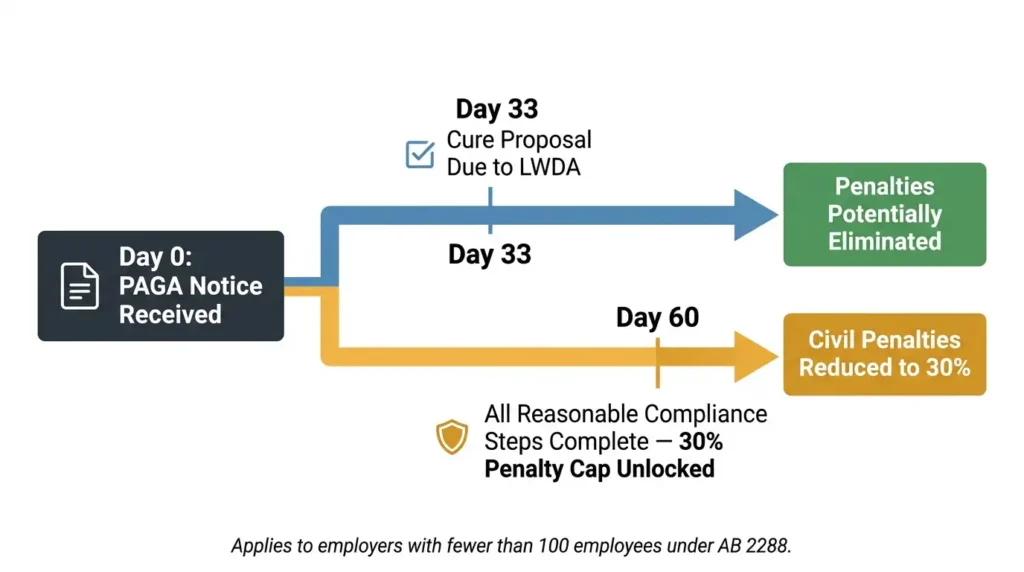
The Private Attorneys General Act, known as PAGA, lets employees sue on behalf of themselves and their coworkers. The 2024 PAGA reforms under AB 2288 and SB 92 changed the landscape significantly. Employers now have a formal opportunity to “cure” Section 510 violations before civil penalties lock in. For small businesses with fewer than 100 employees, this cure window is a critical lifeline. Starting October 1, 2024, small employers have 33 days from receipt of a PAGA notice to submit a confidential cure proposal to the LWDA. A separate but related provision caps penalties at 30% of the standard amount if the employer takes “all reasonable steps” to come into compliance within 60 days of the notice. These are two distinct tools, and knowing both can significantly reduce your legal exposure.
The 2026 regulatory environment also adds new requirements under SB 294, known as the Workplace Know Your Rights Act. Employers must now provide annual written notices to all workers summarizing their rights under California wage law. Workers are already using these notices to cross-check their pay stubs. Awareness is higher than it has ever been. For a complete breakdown of what must be included in those notices and the penalties for non-compliance, see our full guide on the SB 294 Workplace Know Your Rights Act.
Takeaway: The cure window for small employers is a real opportunity, but only if you act within 60 days of a PAGA notice.
FAQ: People Also Ask About Section 510
Do I get overtime after 9 hours in California?
Yes. Any work past 8 hours in a single workday earns 1.5x your regular rate of pay under Section 510.
Can daily and weekly overtime stack on the same hours?
No. The anti-pyramiding rule prevents the same hour from being counted twice. Your employer applies the calculation that results in the highest pay for you.
What is double time in California?
Double time is pay at 2 times your regular rate. It applies after 12 hours in a single workday and after 8 hours on your 7th consecutive workday.
Do bonuses affect my overtime calculation?
Yes. Non-discretionary bonuses, production incentives, and attendance bonuses all increase your regular rate of pay. Your overtime amount must reflect those additions. Higher overtime earnings can also push you into a higher tax bracket, so it is worth reviewing the California income tax brackets for 2026 to understand the withholding impact.
Can I legally waive my overtime rights in California?
No. California overtime protections exist by law. An employee cannot waive them through a personal agreement with their employer.
Does commuting count as hours worked?
Standard commuting does not count. But employer-mandated travel between job sites during the workday does count as hours worked and can push you into overtime territory.
What is a PAGA cure notice for overtime violations?
A PAGA cure notice is the formal document an employee or their attorney sends to the Labor and Workforce Development Agency (LWDA) before filing a civil lawsuit. After receiving it, qualifying employers have 60 days to fix the violation and avoid penalties.
Final Takeaway: Your Yes/No Decision Framework
Use this to check any workday or workweek in 30 seconds.
- Worked more than 8 hours in one day? Overtime is owed.
- Worked more than 40 hours total this week? Overtime is owed.
- Worked more than 12 hours in one day? Double time is owed.
- Worked all 7 days in your defined workweek? Special 7th-day overtime rules apply.
- Found a gap between what you should earn and what your stub shows? Start an audit today.
California Labor Code Section 510 is one of the strongest worker protections in the country. The law is not vague. The math is not complicated once you know the rules. What often fails is awareness. Now you have it. For the full picture on every overtime scenario not covered here, bookmark our complete guide to California overtime rules.
If you are an employee, you know exactly what to look for. If you are an employer or HR manager, you know exactly where violations hide. Either way, the payroll audit trail starts today.
The DLSE and the Labor Commissioner’s Office are active in enforcement. The Workplace Know Your Rights Act ensures workers get annual reminders. The PAGA cure process gives small businesses a path to fix honest mistakes. Every tool you need to get this right is available right now. At Paycheck Calculator California, we monitor these laws daily so our guides reflect every change the moment it takes effect.
You now know more about California overtime law than most employees ever will. That knowledge is real protection. Start with your last two paychecks. Apply the daily overtime logic first. Then check the weekly overtime threshold. The answer will be clear within minutes.
You have everything you need. Go check that paycheck.
“I used the daily overtime audit checklist from this guide and found my employer had shorted me on 11 weeks of pay. Filed with the DLSE and got every cent back. I had no idea the 8-hour daily rule even existed before reading this.”
Rosa M., Certified Nursing Assistant, Los Angeles County
That is exactly why this guide exists. One read. One audit. Real money back in your pocket.

Yeasin Sorker is the founder of Paycheck Calculator California. He built this tool in 2018 after noticing that most free paycheck calculators missed California-specific rules like daily overtime and the uncapped SDI rate.
He researches California payroll tax updates regularly and keeps this calculator aligned with the latest IRS, FTB, and EDD published rates. All calculations on this site are estimates based on official 2026 government sources. For personalized tax advice, consult a qualified tax professional.