
California minimum wage is $16.90 per hour in 2026, effective January 1 – a 2.49% CPI increase from $16.50 in 2025. This rate applies to every employer statewide, but your city, industry, or job title may legally require more.
In 8 years navigating California wage law, I have found that over 40 cities exceed the state rate, fast food workers qualify for $20.00/hr, and healthcare workers can earn up to $24.00/hr — details most workers never check.
Knowing $16.90 is essential, but at that rate, full-time take-home rarely covers rent alone in most California cities. Use our California paycheck calculator to see your exact net pay after all deductions.
California Minimum Wage 2026 at a Glance (Fast Answer)
The California statewide minimum wage is $16.90 per hour as of January 1, 2026. It applies to every employer, regardless of size. This is a $0.40 increase from $16.50 in 2025, driven by a 2.49% CPI adjustment. You can confirm the current rate directly on the California DIR minimum wage page. Your actual rate may be higher.
Quick California Wage Snapshot Table
Statewide Minimum Wage
California raised its rate from $16.50 to $16.90 on January 1, 2026, a $0.40 CPI-driven increase. The state adjusts this every January 1 automatically, tied to inflation.
Fast Food Workers
Fast food workers at qualifying chains earn a minimum of $20.00 per hour under AB 1228. This rate covers employees at national chains with 60 or more U.S. locations. Not every restaurant qualifies. Franchise size and order format both determine employer coverage.
Healthcare Workers
Healthcare wages vary by employer type and are rising on a phased schedule under SB 525. Current rates range from $18.63 to $24.00 per hour depending on facility category. Most healthcare employers will see their next scheduled increase on July 1, 2026. The long-term goal for all covered facilities is $25.00 per hour.
| Category | 2025 Rate | 2026 Rate | Notes |
|---|---|---|---|
| Statewide (General) | $16.50/hr | $16.90/hr | Effective Jan. 1, 2026 |
| Fast Food Workers | $20.00/hr | $20.00/hr | No change in 2026 |
| Healthcare Workers | $18.63-$24.00/hr | Tiered, increases July 1 | Depends on facility type |
| Exempt Salary Threshold | $68,640/yr | $70,304/yr | All employer sizes |
| Computer Software Exempt | N/A | $58.85/hr or $122,573/yr | Annual threshold |
Here is a fast breakdown of what $16.90/hr looks like across different time periods, based on a standard 8-hour day and 40-hour week:
| Time Period | Gross Earnings at $16.90/hr |
|---|---|
| Daily (8 hours) | $135.20 |
| Weekly (40 hours) | $676.00 |
| Biweekly (80 hours) | $1,352.00 |
| Monthly (approx.) | $2,929.33 |
| Annual (2,080 hours) | $35,152.00 |
Takeaway: $16.90 is the floor, not the ceiling.
Which California Minimum Wage Applies to You? (Most Important Section)
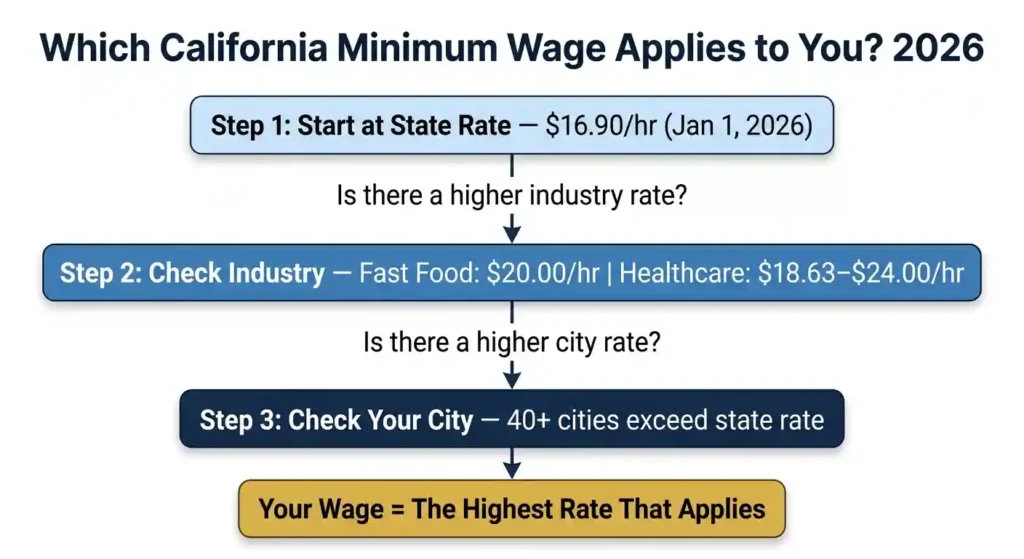
California wage law layers on top of itself. State law sets a floor. Industry law can raise it. Your city can raise it again. You always get paid the highest rate that applies. Here is how to find your number in three steps.
Step 1: Start With the California State Wage
Everyone starts here. The 2026 California state minimum wage is $16.90 per hour — the legal floor for nearly every worker, regardless of whether you work part-time, full-time, seasonal, or temporary. California eliminated the old two-tiered system in 2022, so all employers owe the same $16.90 baseline.
Step 2: Check Your Industry-Specific Wage
Some industries have their own higher minimum wage rules set by separate California laws. Check this step before assuming you earn $16.90.
- Fast food workers at qualifying chain restaurants earn at least $20.00/hr under AB 1228.
- Healthcare workers earn between $18.63 and $24.00/hr depending on their facility type under SB 525. See the full California healthcare worker minimum wage guide for tier-by-tier breakdowns.
- Hotel and airport workers in certain cities have their own union or municipal wage contracts that often exceed state rates.
In my experience, healthcare workers are the most confused group. Many do not know SB 525 exists and leave real money on the table every single week.
Step 3: Check Your City or County Wage
More than 40 California cities and counties have set their own minimum wage above the state rate. Your city wage applies based on where you physically perform the work — not where your employer is headquartered, and not where you live.
If you work from home, the rate for your home city applies. I have seen employers miss this for remote workers and end up with costly back-pay claims.
Takeaway: Check all three layers and pay the highest rate that applies.
Real-World Examples
Retail Employee in Fresno
Fresno follows the California state rate. A retail cashier in Fresno earns at least $16.90/hr in 2026. No city ordinance pushes it higher here.
Restaurant Worker in Los Angeles
Los Angeles has its own minimum wage above the state rate. A server at a non-fast-food restaurant inside the city of Los Angeles earns at least $17.28/hr in 2026. California also prohibits tip credits, so tips are on top of that full wage. Use the Los Angeles paycheck calculator to see your exact take-home after LA-specific deductions.
Fast Food Employee in San Diego
San Diego follows the state fast food rule. A cashier at a qualifying McDonald’s or Starbucks earns at least $20.00/hr under AB 1228. The San Diego city rate of $16.85/hr does not apply here because the fast food rate is higher. Run your numbers with the San Diego paycheck calculator to confirm your net pay.
Salaried Assistant Manager in Orange County
An assistant manager classified as exempt in Orange County must earn at least $70,304 per year as of January 1, 2026. If their salary falls below that, they must be reclassified as non-exempt and become eligible for overtime.
Fast Food Minimum Wage California 2026
California passed AB 1228 to protect fast food workers. Since April 1, 2024, qualifying fast food workers must earn at least $20.00 per hour. That rate stayed flat in 2026. The California Fast Food Council reviewed a possible $0.70 increase but did not issue an additional mandate.
The $20.00 rate does not apply to every restaurant. Knowing the rules saves both workers and employers from expensive mistakes.
Covered Employers Under AB 1228
A restaurant qualifies under AB 1228 if it meets these conditions:
- It is part of a national chain with 60 or more locations across the United States.
- It primarily serves food or drinks prepared for immediate consumption.
- Customers order and pay before eating or at a counter.
- Franchises count toward the 60-location total of the national brand.
Bakeries that make bread sold in the same location were exempted from the law. This was a specific carve-out negotiated into the original bill.
Quick Qualification Checklist:
- Does the brand have 60 or more locations in the U.S.? If yes, keep going.
- Does the restaurant serve food prepared on-site for immediate consumption? If yes, keep going.
- Do customers order at a counter or drive-thru before sitting down? If yes, the $20.00 rate likely applies.
- Is the location a licensed bakery selling bread baked on-site? If yes, it may be exempt. Verify with DIR.
Worker Examples at Qualifying Restaurants
Cashier
A cashier at a qualifying national chain earns at least $20.00/hr in 2026. This applies from day one of employment. There is no waiting period or probationary exception under AB 1228.
Drive-Thru Worker
Drive-thru workers earn the same $20.00 minimum as front-counter staff. Role type does not change the rate — if the employer qualifies, every hourly worker at that location is covered.
Kitchen Staff
Kitchen prep workers, cooks, and dishwashers at qualifying chains are all covered under AB 1228. Back-of-house roles are not excluded. Your minimum is $20.00/hr regardless of position.
Shift Lead
A shift lead at a qualifying chain must also start at $20.00/hr as the base before any lead pay differential applies. The law sets the floor for all covered workers regardless of title or added responsibilities.
Fast Food Council and Future Rate Changes
The Fast Food Council meets periodically to review whether to raise the $20.00 rate. Their next assessment window falls in 2026. Based on current signals, a modest adjustment in 2026 or early 2027 is possible but not confirmed. Watch for council announcements through the California Department of Industrial Relations.
Pro Tip: Not every restaurant qualifies under fast food law. If you are unsure whether your employer meets the 60-location rule, ask your manager or look up the brand’s total U.S. locations online.
Takeaway: Fast food workers at qualifying chains earn $20.00/hr, not $16.90/hr.
Healthcare Worker Minimum Wage California 2026
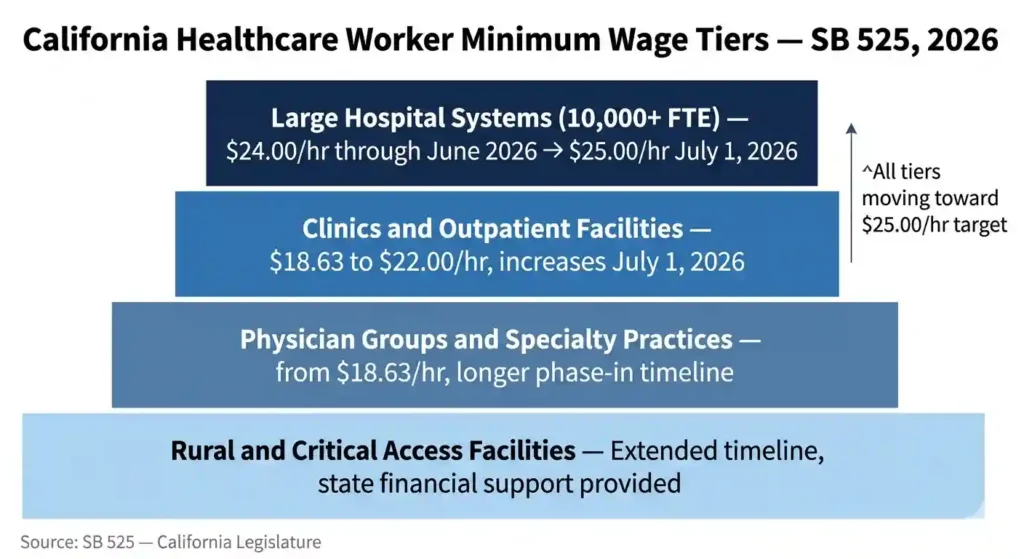
Healthcare wages follow a separate schedule from the general workforce. SB 525 created a tiered system based on facility type, with different employers hitting higher minimums at different times. Many healthcare workers I talk to do not know which tier they fall under — and that confusion costs them real money.
Hospitals (Large Systems)
Hospitals with more than 10,000 full-time employees were required to pay a minimum of $24.00 per hour through June 2026. Starting July 2026, that rate increases to $25.00 per hour. This covers patient-facing staff, support workers, and many administrative roles at covered facilities.
Clinics and Outpatient Facilities
Clinics and outpatient facilities operate under a different tier than large hospitals. Their minimum wage under SB 525 ranges from $18.63 to $22.00/hr depending on their specific facility classification and current phase of the rollout. Most will see their next increase on July 1, 2026.
Physician Groups and Specialty Practices
Physician-owned practices and specialty groups have their own compliance deadline under SB 525. These employers were given a longer phase-in timeline. Current rates in this category start at $18.63/hr for covered non-physician staff. Their schedule accelerates toward the $25.00 target over the next several years.
Rural and Critical Access Facilities
Rural hospitals and critical access facilities received extended timelines and some state financial support to manage the increases. Their current minimum sits lower on the tier scale but will reach parity with larger systems over time.
Covered Healthcare Worker Examples
Not every person who works near a hospital qualifies under SB 525. The law covers workers employed directly by a covered facility in a clinical, support, or administrative role. Here are the most common covered categories.
Registered Nurses and Clinical Staff
Registered nurses, licensed vocational nurses, and certified nursing assistants at covered facilities fall under SB 525. These workers are often at the highest tier of the wage schedule because of their direct patient care roles.
Medical Assistants
Medical assistants at qualifying clinics and outpatient facilities are covered. Many MAs at these sites did not know they were entitled to wages above the state minimum. If your clinic has more than a handful of locations under a single ownership structure, check whether SB 525 applies.
Hospital Support Staff
Food service workers, housekeeping staff, laundry workers, and security personnel employed directly by a covered hospital system fall under the healthcare wage schedule. These roles are often overlooked in compliance audits, but they are explicitly covered under the law.
Home Health and Contracted Workers
Workers employed through third-party staffing agencies that contract with covered healthcare facilities may also qualify depending on the contract structure. This area is the most frequently disputed, and workers in this category should verify their status directly with the California Labor Commissioner.
Takeaway: Healthcare workers must check their specific facility type to know their correct 2026 minimum wage.
California Minimum Wage by City (2026)
Many California cities have set local wages higher than the state rate. These ordinances apply to anyone performing work within city limits — including remote workers based in that city. Always verify before accepting a job offer or running payroll.
City Wage Comparison Table
City rates listed below reflect the rates in effect during the 2026 calendar year. Most were set on July 1, 2025 and remain active until their next July 1, 2026 adjustment. Always verify with your city’s official ordinance page before finalizing payroll, as mid-year updates may push these figures higher.
| City | Current 2026 Rate | Rate Set Date | Higher Than State? | Notes |
|---|---|---|---|---|
| Los Angeles (City) | $17.28/hr | July 1, 2025 | Yes | Next update July 1, 2026 |
| Los Angeles County | $17.27/hr | July 1, 2025 | Yes | Unincorporated areas only |
| San Francisco | $18.67/hr | July 1, 2025 | Yes | Annual CPI adjustment |
| Berkeley | $18.67/hr | July 1, 2025 | Yes | One of the highest in state |
| Pasadena | $17.50/hr | July 1, 2025 | Yes | Separate from LA city rate |
| Santa Monica | $17.27/hr | July 1, 2025 | Yes | Updates annually |
| West Hollywood | $19.08/hr | July 1, 2025 | Yes | Among highest city rates |
| Santa Rosa | $17.87/hr | July 1, 2025 | Yes | Sonoma County area |
| Emeryville | $19.36/hr | July 1, 2025 | Yes | Consistently highest in CA |
| San Jose | $17.55/hr | January 1, 2026 | Yes | Updates Jan. 1 |
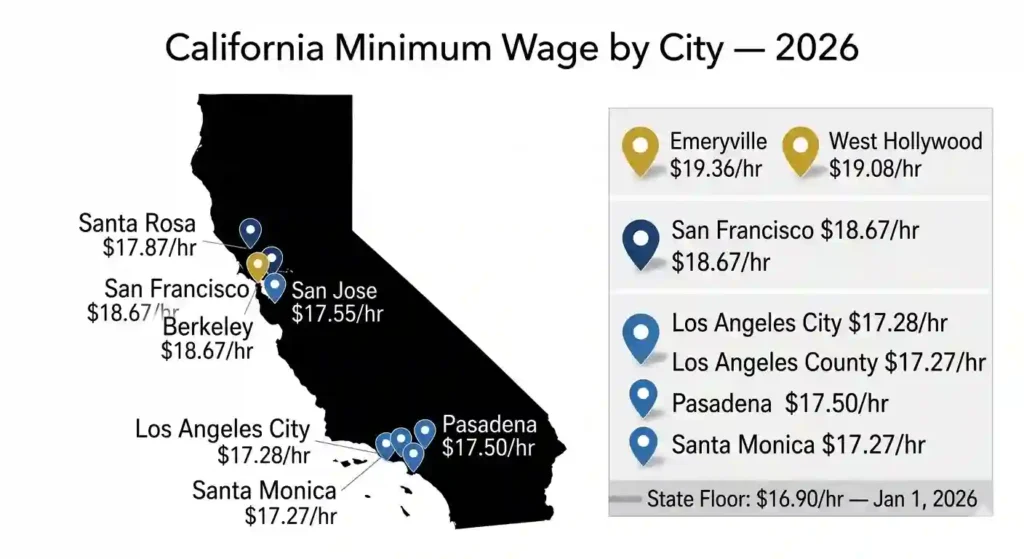
Sources: California Department of Industrial Relations (DIR), individual city ordinances. Rates are subject to mid-year adjustment. Verify current rates at dir.ca.gov before processing payroll.
Takeaway: Emeryville and West Hollywood consistently hold some of the highest city minimum wages in California.
Why California City Minimum Wage Changes Often Happen on July 1
Most people know the state minimum wage changes on January 1. What catches employers off guard is that many California cities update wages on July 1 instead. Cities passed their ordinances at different times, set their own anniversary dates, and some use a different inflation index than the state.
The result is a mid-year compliance gap. An employer in Los Angeles who updates payroll in January and forgets July can end up underpaying workers for six months.
Pro Tip: Employers should audit payroll twice a year: once in January for state and some city changes, and again in late June to prepare for July 1 city increases.
Takeaway: City wage increases often happen July 1, not January 1. Mark both dates on your payroll calendar.
California Exempt Salary Threshold 2026: The $70,304 Rule Explained
Every time California raises the minimum wage, the salary bar for exempt employees rises with it. Exempt status is not permanent — it must be re-verified each year. As of January 1, 2026, any exempt employee must earn at least $70,304 per year or $1,352 per week.
What “Exempt” Means
Exempt means an employee is not entitled to overtime pay or the standard minimum wage protections. But California does not allow employers to simply call someone exempt. The employee must meet both a salary threshold AND a duties test. The duties test requires that they spend more than 50% of their time on qualifying executive, administrative, or professional tasks. The California FTB and the DIR both treat misclassified exempt employees as a top audit priority.
The Salary Threshold Math
California law requires exempt employees to earn at least two times the state minimum wage for full-time work:
$16.90 x 2 x 40 hours x 52 weeks = $70,304 per year
For computer software professionals with a specific exemption, the 2026 rate is $58.85 per hour or $122,573.13 annually.
Exempt vs. Non-Exempt: What Changes in Practice
| Factor | Exempt Employee | Non-Exempt Employee |
|---|---|---|
| Overtime eligibility | No | Yes |
| Minimum salary required | $70,304/yr | N/A (hourly applies) |
| Daily overtime trigger | No | After 8 hours/day |
| Meal break requirements | More flexible | Strict |
| Duties test required | Yes | No |
Overtime Examples for Non-Exempt Workers
At $16.90/hr, California overtime kicks in fast:
- After 8 hours in one day: $25.35/hr (1.5x rate)
- After 12 hours in one day: $33.80/hr (2x rate) — see how California double time differs from overtime for the full calculation rules
- After 40 hours in one week: $25.35/hr (1.5x rate)
California’s daily overtime rule is unique. Most states only count weekly hours. California counts daily hours too. That means even a four-day workweek can trigger overtime if any single day exceeds 8 hours.
Common Employer Mistakes
The most frequent mistake I see is an employer who gave someone a “manager” title but never raised their salary above the threshold. That person is still legally non-exempt and owed overtime. A title does not create an exemption. A salary and duties test together do.
Takeaway: If a salaried employee earns less than $70,304 in 2026, they must be reclassified as non-exempt immediately.
Reality Check: California Minimum Wage Myths That Cause Confusion
After 8 years working in this field, I have heard every misconception. These five myths cost workers and employers real money every year.
Myth 1: “Everyone in California Earns $16.90”
False. Fast food workers at qualifying chains earn $20.00. Healthcare workers earn between $18.63 and $24.00. Workers in Berkeley, West Hollywood, and Emeryville all earn above $18.00. The $16.90 is the floor, not the standard.
Myth 2: “A Salary Means No Overtime”
False. A salary does not automatically create exempt status. The employee must also pass the duties test and earn at least $70,304 per year. Below that threshold or without qualifying duties, a salaried worker is owed overtime just like any hourly employee.
Myth 3: “The City Wage Applies Statewide”
False. San Francisco’s $18.67 rate applies only inside San Francisco. A worker who commutes from Oakland and works in SF earns the SF rate for those hours. The same worker doing tasks from their Oakland home earns the Oakland rate. Location of work — not residence — determines the rate.
Myth 4: “Fast Food Includes Every Restaurant”
False. AB 1228 only covers national chains with 60 or more U.S. locations. A local taco shop with five locations owes $16.90, not $20.00. The law was specifically written for large chain employers, not small independent restaurants.
Myth 5: “Minimum Wage Only Affects Hourly Workers”
False. The minimum wage directly controls the exempt salary threshold for salaried employees. When the minimum wage goes up, the $70,304 threshold goes up with it automatically. Salaried managers, supervisors, and professionals are affected every year whether they work hourly or not.
Takeaway: Misunderstanding these myths is the fastest way to end up with a wage claim or underpaid earnings.
How California Minimum Wage Changes Your Paycheck in 2026
Here is what $16.90/hr actually looks like on a paycheck.
Working 20 Hours Per Week
A part-time worker putting in 20 hours per week at $16.90 earns $338.00 gross per week. That adds up to roughly $17,576 per year before taxes. In a high-cost city like San Francisco at $18.67/hr, the same 20 hours produces $373.40 per week — use the San Francisco paycheck calculator to confirm your exact net amount.
Working 30 Hours Per Week
At 30 hours per week, gross weekly pay at the state minimum is $507.00. Annual gross comes to about $26,364. This is a common schedule for part-time retail and food service workers across California. For a detailed comparison of how part-time and full-time paychecks differ after deductions, see our part-time vs full-time paycheck guide for California.
Working 40 Hours Per Week
A full-time worker at $16.90/hr earns $676.00 gross per week and roughly $35,152 per year before taxes. Workers in cities with higher local rates earn more. At Berkeley’s $18.67/hr, full-time annual gross reaches about $38,833. Calculate your exact gross pay with our California gross pay calculator.
Overtime Example
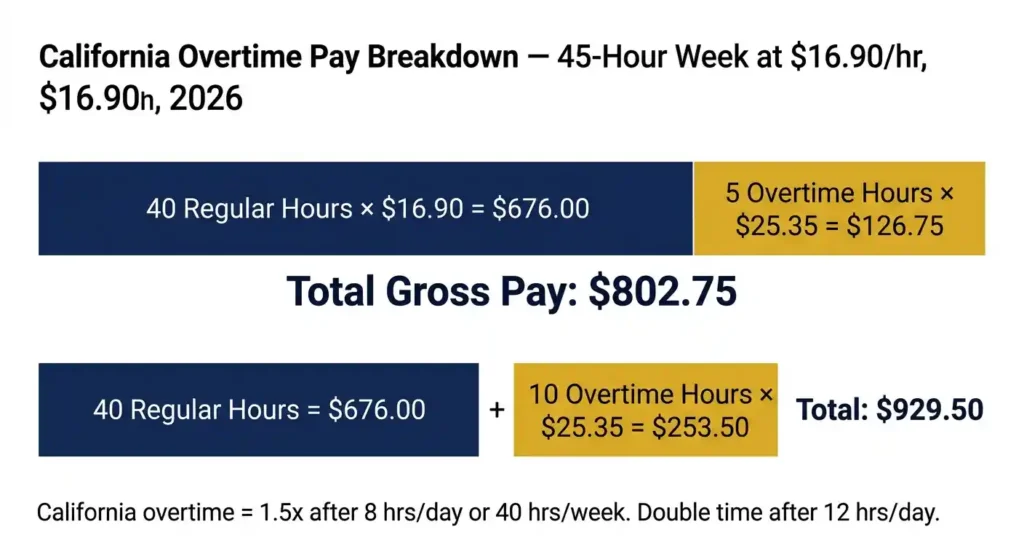
A worker who puts in 45 hours in one week at the state minimum wage earns this breakdown:
- 40 regular hours x $16.90 = $676.00
- 5 overtime hours x $25.35 = $126.75
- Total gross weekly pay: $802.75
A 50-hour week pushes that further: 10 overtime hours x $25.35 = $253.50, bringing the gross weekly total to $929.50. California’s daily overtime rule means even a worker with a four-day schedule can trigger overtime if any single day exceeds 8 hours. See our full guide to California overtime laws in 2026 for daily and weekly overtime thresholds.
Annual Earnings Estimate
At $16.90/hr for 52 full-time weeks, gross annual earnings are $35,152. After federal income tax, California state income tax (FTB), Social Security (6.2%), Medicare (1.45%), and SDI at 1.2% in 2026 — confirmed by the California EDD SDI program page — a single filer with no dependents typically takes home $27,000 to $29,000 per year. For a full breakdown of how California taxes each income tier, see the California tax brackets 2026 guide.
That monthly net of $2,300 to $2,500 is tight. A one-bedroom in Los Angeles averages $2,100 to $2,400 per month; San Francisco typically exceeds $2,900. Most minimum wage earners need a roommate, second income, or housing assistance to get by. Families may qualify for CalFresh, Medi-Cal, or the 2026 California Earned Income Tax Credit to offset costs.
Takeaway: Know your baseline numbers so you can spot underpayment immediately.
Employer Payroll Compliance Checklist for 2026
If you run a California business, here is exactly what to review right now. I use a version of this checklist every January and every June with clients.
Payroll Software Update
Confirm your payroll system updated to $16.90 effective January 1, 2026. Verify that any employees in cities with higher local rates have the correct city rate applied. Check that fast food and healthcare employees are coded to their industry-specific rates. Most payroll platforms lag 7 to 14 days on rate updates, so always manually confirm.
Workplace Posters
California law requires employers to post the current minimum wage notice where employees can see it. The California DIR provides updated posters each year at no cost. Failure to post is a separate violation from wage underpayment and carries its own penalty.
Wage Statements
Every pay stub must show the correct hourly rate used for that pay period. If you changed rates on January 1 but the stub still shows the old rate, that is a wage statement violation on top of any underpayment. California requires specific information on every wage statement under Labor Code Section 226. Learn what every line means in our guide to reading your California pay stub in 2026.
Exempt Salary Audit
Pull a report of every salaried exempt employee and compare their annual compensation to $70,304. Any employee below that threshold must be reclassified as non-exempt and offered overtime protections immediately. Also verify each exempt employee passes the duties test, not just the salary test. To avoid over-withholding on reclassified employees, make sure they submit an updated California DE 4 form.
Penalties for Non-Compliance
California wage penalties are serious:
- Unpaid minimum wage: Employee recovers full back wages plus interest.
- Waiting time penalty: Up to 30 days of the employee’s daily wages if wages are not paid on separation. Read how the California waiting time penalty is calculated and when it applies.
- PAGA claims: Employees can sue on behalf of other workers under the Private Attorneys General Act, multiplying your exposure significantly.
- Civil penalties: $100 per employee per pay period for initial violations. $250 per employee per pay period for subsequent violations.
Takeaway: One missed rate update can quickly become a six-figure liability for a mid-size employer.
What Happens If You Are Paid Less Than California Minimum Wage?
If your employer pays you less than the legal minimum, that is wage theft. California law is firmly on your side. You can recover every dollar owed, plus penalties.
Warning Signs to Watch
- Your pay stub shows a rate below $16.90/hr and no higher rate applies.
- Your paycheck math does not add up when you multiply hours by your listed rate.
- You work in a qualifying city but your rate matches the state rate, not the city rate.
- You were told you are exempt but you earn less than $70,304/year and spend most of your time on non-managerial tasks.
If your check looks smaller than expected but you are not sure why, our guide to why your California paycheck is so low walks through the six most common causes.
Meal Breaks, Rest Breaks, and Your Pay
California requires a 30-minute unpaid meal break for shifts that exceed 5 hours. A shift of exactly 5 hours does not trigger the meal break requirement unless it goes beyond that. Employees also earn one paid 10-minute rest break for every 4 hours worked, or major fraction thereof. A 6-hour shift earns one rest break. A full 8-hour shift earns two. If your employer skips or cuts these breaks, they owe you one additional hour of pay at your regular rate for each violation. That is called a premium pay obligation, and it stacks up fast on a busy week. See the complete rules in our California meal and rest break laws 2026 guide.
Paid Sick Leave Basics
California law gives most employees at least 5 days (40 hours) of paid sick leave per year under SB 616, which took effect January 1, 2024. Your sick leave is paid at your regular wage rate. For a worker earning $16.90/hr on an 8-hour shift, one full sick day is worth $135.20 in protected pay. If your shift is shorter, the value adjusts proportionally. Employers cannot retaliate against you for using it. Full accrual rules and employer obligations are covered in our California sick leave laws 2026 guide.
Tipped Employee Pay Rules
California does not allow tip credits. Your employer must pay you the full $16.90/hr (or applicable city or industry rate) before tips. All tips belong entirely to you on top of your base wages. No employer in California can legally count your tips toward meeting the minimum wage.
Who Is Not Covered by California Minimum Wage Law
Most California workers are covered, but a few categories are not. Independent contractors classified under California law are not entitled to minimum wage protections, though misclassification is common and frequently disputed. The California ABC test determines whether a worker is truly an independent contractor or should be treated as an employee. If you are weighing the difference between 1099 and W-2 status, that guide also covers how each classification affects your take-home pay. Outside salespersons, certain live-in domestic workers, and some agricultural workers under special contracts have different rules. If you are unsure whether you are correctly classified, the California Labor Commissioner can review your situation for free.
Teen and Student Worker Wage Rules
California has no lower minimum wage for teenagers or students. A 16-year-old at a grocery store earns the same $16.90/hr as any adult. There is no “training wage” or “youth wage” under California law.
Jobs That Commonly Pay Minimum Wage in California
Retail cashiers, fast food workers, warehouse packers, parking attendants, housekeeping staff, agricultural workers, home care aides, and entry-level food service roles are the most common jobs paid at or near minimum wage in California.
How to Track Your Hours
Start keeping a personal log today. Note your start time, end time, and any breaks each day. Keep your pay stubs. Screenshot your schedule. If a dispute arises, your records are your proof. Your employer’s records alone should never be the only documentation.
Filing With the California Labor Commissioner
Filing a wage claim in California is free. Here is how:
- Visit the California Labor Commissioner’s Office website at dir.ca.gov.
- Complete a wage claim form (DLSE Form 1).
- Submit the form online, by mail, or in person at a local office.
- The Labor Commissioner will investigate and schedule a settlement conference.
- If unresolved, a hearing is held and a judgment can be issued.
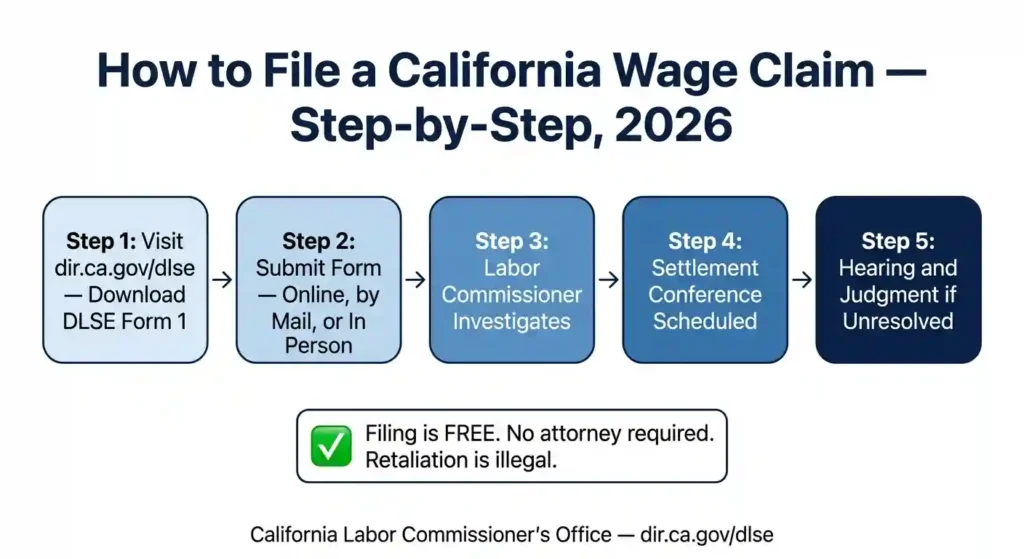
You do not need a lawyer to file, though one can help for larger or more complex claims.
Retaliation Protection
Your employer cannot legally fire you, reduce your hours, or punish you for filing a wage claim or asking about your pay rate. Retaliation is a separate violation that carries its own penalties. Document any changes in your treatment after you raise wage questions.
Takeaway: Filing a wage claim is free, legally protected, and often results in full recovery of unpaid wages.
California Minimum Wage History: 2016 to 2026
Seeing the full 10-year picture helps explain how California got to $16.90 and where it is heading.
| Year | Minimum Wage | Key Policy Change |
|---|---|---|
| 2016 | $10.00/hr | Large employers (26+); small employers at $9.50 |
| 2017 | $10.50/hr | Large employers; small employers at $10.00 |
| 2018 | $11.00/hr | Large employers; small employers at $10.50 |
| 2019 | $12.00/hr | Large employers; small employers at $11.00 |
| 2020 | $13.00/hr | Large employers; small employers at $12.00 |
| 2021 | $14.00/hr | Large employers; small employers at $13.00 |
| 2022 | $15.00/hr | Two-tier system eliminated; all employers unified |
| 2023 | $15.50/hr | First CPI-adjusted increase under unified system |
| 2024 | $16.00/hr | Fast food $20 added (April 1, 2024) |
| 2025 | $16.50/hr | Healthcare SB 525 fully active |
| 2026 | $16.90/hr | 2.49% CPI increase, effective Jan. 1, 2026 |
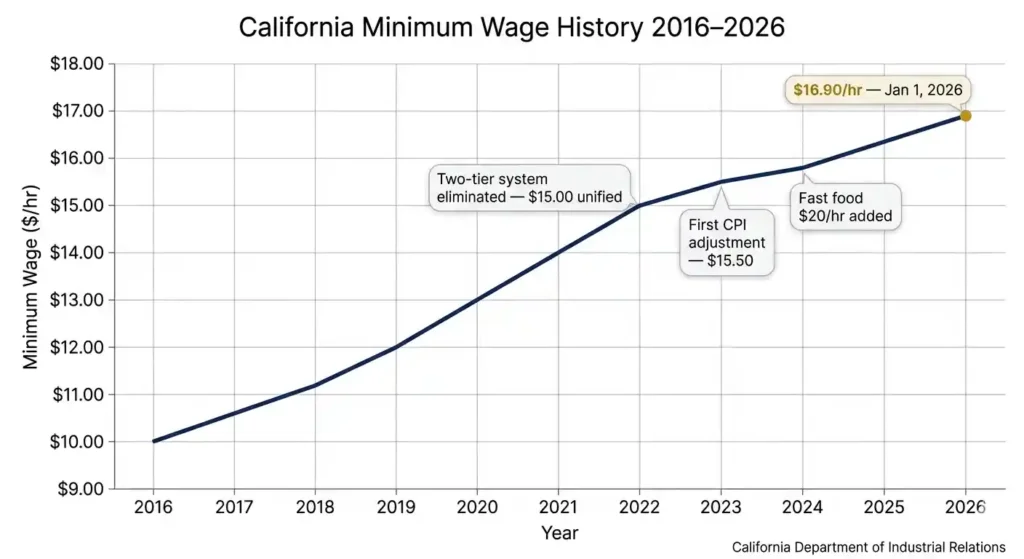
California has raised its minimum wage every year since 2016. The pace has slowed as the rate climbs, but the direction has never reversed.
The 2026 rate is 69% higher in nominal dollars than the $10.00 floor in 2016. However, real-world costs for housing, groceries, and transportation in California have risen sharply over the same period. Most economists and labor researchers note that actual buying power gains for minimum wage workers have been modest despite the headline increase.
California Minimum Wage 2027 Outlook
The 2027 rate will be calculated in fall 2026 using CPI-W data and confirmed by California’s Department of Finance before taking effect January 1, 2027.
Likely CPI Adjustment for 2027
The annual CPI adjustment is capped at 3.5% under current law. Based on 2025 inflation data published by the California Department of Finance, the projected 2027 rate is approximately $17.30/hr, effective January 1, 2027.
City Minimum Wage Increase Patterns
Most California cities that update wages on July 1 will do so again in July 2026, pushing rates in Los Angeles, San Francisco, Berkeley, and Emeryville even higher. Employers should budget for a second payroll adjustment mid-year and not wait until January 2027 to revisit city-level compliance.
Fast Food Wage Updates
The Fast Food Council retains authority to push the $20.00 rate above its current floor. A review window opens in 2026. If inflation data or worker advocacy drives a council vote, fast food workers could see a bump before the general 2027 state increase kicks in.
Healthcare Wage Timeline
Most large hospital systems move to $25.00/hr on July 1, 2026. Clinics, physician groups, and rural facilities continue phasing toward that same target on their individual timelines under SB 525. The full rollout to $25.00 for all covered healthcare employers is expected to complete within the next two to three years.
Takeaway: Plan your 2027 payroll budgets now. The January increase is guaranteed to arrive.
Official California Minimum Wage Resources
Use these direct sources to verify current rates and file any complaints:
- California Department of Industrial Relations (DIR): dir.ca.gov — Official wage orders, local rates, and poster downloads.
- California Labor Commissioner’s Office (DLSE): dir.ca.gov/dlse — Wage claims, enforcement, and hearing information.
- California EDD: edd.ca.gov — SDI rates, unemployment insurance, and payroll tax information.
- California Franchise Tax Board (FTB): ftb.ca.gov — State income tax withholding, refunds, and filing requirements.
- IRS Publication 15 (Employer’s Tax Guide): irs.gov/pub/irs-pdf/p15.pdf — Federal payroll tax rules, withholding tables, and FICA obligations.
- U.S. Department of Labor — Minimum Wage: dol.gov/agencies/whd/minimum-wage — Federal minimum wage law and state comparison data.
- UC Berkeley Labor Center — Wage Tracker: laborcenter.berkeley.edu — Research, local wage ordinance tracker, and labor market data.
- California Fast Food Council: Updates posted through the DIR and Office of Administrative Law.
Explore related topics on this site:
- California labor laws — Wage rules, worker rights, and employer obligations in one place.
- Paycheck basics — How to read, calculate, and verify your California paycheck.
- Payroll compliance and reporting — Employer guides for staying compliant with California payroll law.
- California Labor Code Section 510 — The statute that governs daily and weekly overtime in California.
Frequently Asked Questions
What is California minimum wage in 2026?
The California statewide minimum wage is $16.90 per hour as of January 1, 2026. This applies to all employers regardless of size. Many workers earn more than this based on city or industry rules.
Is California minimum wage $20 now?
The $20 rate applies only to fast food workers at qualifying national chain restaurants with 60 or more U.S. locations under AB 1228. Most California workers earn the general state minimum of $16.90/hr or their city’s higher local rate.
Which California city pays the highest minimum wage?
Emeryville consistently holds one of the highest city minimum wages in California at $19.36 per hour as of 2026. West Hollywood follows closely at $19.08 per hour.
Do salaried employees get affected by minimum wage changes?
Yes. When the state minimum wage increases, the exempt salary threshold increases automatically. In 2026, any employee classified as exempt must earn at least $70,304 per year. Employees earning less than that must be reclassified as non-exempt and given overtime protections.
Can an employer pay federal minimum wage in California?
No. California’s minimum wage of $16.90/hr far exceeds the federal minimum wage of $7.25/hr set by the U.S. Department of Labor. California employers must follow state law, which is higher. Federal law only sets a national floor. California’s rate always wins.
When do city wages typically change in California?
The state minimum wage changes on January 1. Many California city minimum wages change on July 1. Some cities, like San Jose, align with the state’s January 1 date. Always verify your city’s specific effective date.
How do I report wage theft in California?
File a free wage claim with the California Labor Commissioner at dir.ca.gov/dlse. You can submit online, by mail, or in person. You do not need an attorney. California law also protects you from retaliation for filing a claim.
Will California minimum wage rise again in 2027?
Almost certainly yes. California uses an automatic annual CPI adjustment. Based on current inflation trends, the 2027 rate is projected at approximately $17.30 per hour, effective January 1, 2027.
Final Take: Check Your California Wage in 30 Seconds
Here is your 30-second check:
- Start with $16.90. That is the 2026 California state minimum wage.
- Check your industry. Fast food at a qualifying chain? $20.00. Healthcare? Check your facility tier.
- Check your city. More than 40 cities pay above the state rate. Look yours up before assuming.
- Check the exempt salary threshold. If you are classified as exempt, your salary must be at least $70,304/year in 2026.
- If you are underpaid, take action now. File a free claim with the California Labor Commissioner. You can recover back wages, interest, and penalties.
What I have found over 8 years is simple: workers who know their rate get paid correctly, and employers who audit twice a year avoid penalties. Use what is here.
Your rate is out there. Now you know exactly where to find it.
Sources: California Department of Industrial Relations, AB 1228 (leginfo.ca.gov), SB 525 (leginfo.ca.gov), SB 616 (leginfo.ca.gov), California Department of Finance CPI-W Data, UC Berkeley Labor Center, U.S. Department of Labor, IRS Publication 15, Ervin Cohen and Jessup LLP (December 2025), Davis Wright Tremaine (December 2025).
Disclaimer: This article is for informational purposes only and does not constitute legal or tax advice. Wage rates, tax thresholds, and labor laws can change. Always verify current rates with the California Department of Industrial Relations (dir.ca.gov) or consult a qualified employment attorney or payroll professional for guidance specific to your situation.

Yeasin Sorker is the founder of Paycheck Calculator California. He built this tool in 2018 after noticing that most free paycheck calculators missed California-specific rules like daily overtime and the uncapped SDI rate.
He researches California payroll tax updates regularly and keeps this calculator aligned with the latest IRS, FTB, and EDD published rates. All calculations on this site are estimates based on official 2026 government sources. For personalized tax advice, consult a qualified tax professional.