
California’s split shift premium pay adds one extra hour at minimum wage when your employer splits your workday with an unpaid gap longer than a meal period. It kicks in only when your regular pay doesn’t already cover that hour.
That one-line rule sounds simple, but the offset math trips up workers earning just above minimum wage.
The catch: earn enough above minimum wage, and the premium can vanish entirely.
What Is Split Shift Premium Pay?
Split shift? You get one extra hour of pay at minimum wage. That’s the law in California. Why? Because that unpaid gap in your day costs you time you can’t really use. It’s not some obscure rule, either, it’s written into IWC Wage Orders 1-15 Section 4, and the state actually enforces it through the Department of Industrial Relations and the DLSE.
Simple Definition
A split shift happens when your employer breaks your workday into two blocks, with a real gap that isn’t a meal break. When that happens, California law requires an extra hour of pay at the minimum wage rate on top of your regular wages. That unpaid gap still costs you. You can’t relax, and you can’t take a second job, since you have to be back on the clock soon. The rule mainly protects workers whose pay sits close to minimum wage.
What Counts as a Split Shift?
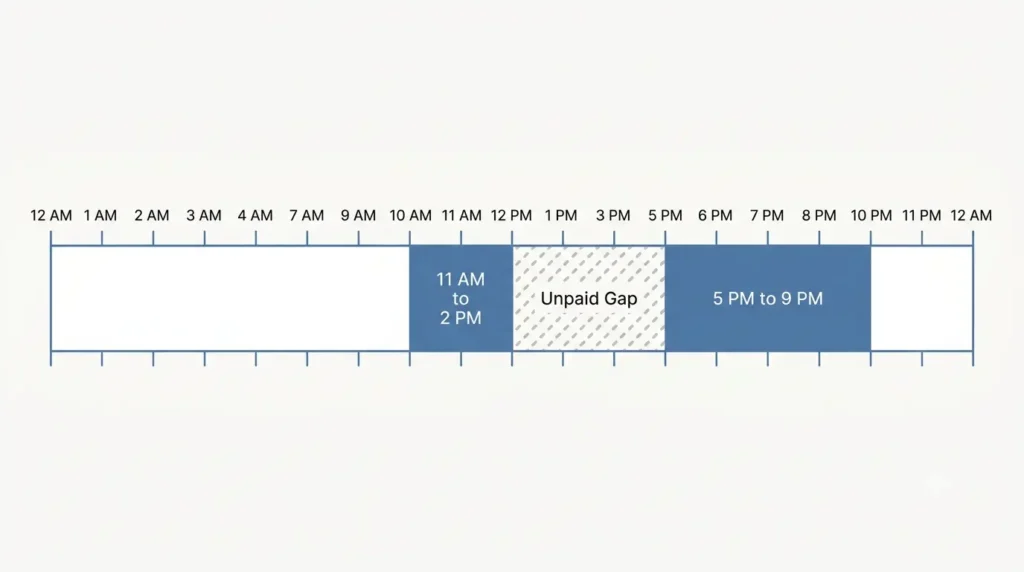
Three things must line up. Your employer built the schedule, not you. Both work periods fall on the same calendar day. The gap is longer than a normal meal period, and you’re fully released from duty, free to leave. A server working 11 a.m. to 2 p.m., then back at 5 p.m. for dinner, is the textbook example. Commuting time doesn’t shrink the gap itself, and if your employer has you wait on-site instead of releasing you, that counts as unpaid hours worked, not a valid split. Remote or hybrid schedules rarely trigger this rule, since it’s built around employer-controlled work locations, not a home office.
What Does NOT Count?
A 30 minute or one hour lunch break is not a split shift. The law treats this as a bona fide meal period, not a rest break or a staffing gap. A schedule you asked for yourself doesn’t count either, since the law only applies when the employer creates the gap. Picking up an extra shift on your own doesn’t count. A regular continuous shift, even a long one, never triggers this premium.
Split Shift Premium vs Other Types of Pay
People mix these up constantly, since they all involve extra money on your check.
Split Shift Premium vs Overtime
Overtime pays you more for working too many hours. Split shift premium pays you for a broken schedule, regardless of total hours. They can both apply on the same day. Work 10 hours split into two blocks, and you could owe overtime past 8 hours under California overtime laws and a split shift premium at the same time. Payroll should show these as two separate line items. Overtime is figured off your regular rate of pay, a calculation explained in California Labor Code Section 510, unrelated to the flat minimum wage math behind the split shift premium.
Split Shift vs Meal Premium
A meal premium kicks in when your employer fails to give you a proper meal break under California’s meal and rest break laws. A split shift premium kicks in when they give you too much break, one long enough to send you home and call you back. One punishes a missed break. The other compensates a broken day. They don’t cancel out. You could be owed both in the same week.
Split Shift vs Spread of Hours
New York uses “spread of hours” pay, a similar idea that calculates differently and applies under different triggers. California doesn’t use that term. Don’t assume rules transfer between states. California’s split shift premium stands alone under the IWC Wage Orders.
Who Qualifies for Split Shift Premium Pay?
Not everyone on a broken schedule gets this premium, and the rules sit alongside other California labor laws that protect hourly workers.
Employees Who Usually Qualify
Hourly, non-exempt workers are the main group. If your employer sets a schedule with two work blocks in one day and a real unpaid gap, you likely qualify. This shows up constantly in retail, restaurants, transportation, and in-home care.
Employees Who Usually Do Not Qualify
Exempt employees, meaning executive, administrative, or professional staff who meet the salary and duties tests, aren’t covered. Live-in employees are exempt too, since they already reside at the workplace. If you picked your own split schedule, or volunteered for a second shift that created a gap, you’re not covered. A valid union contract can also modify or waive this premium, so check your collective bargaining agreement if one covers your job.
Eligibility Checklist
Did your employer set the schedule, not you? Was there a real unpaid gap where you were free to leave? Did both shifts happen the same calendar day? Was the gap clearly longer than a meal period? Four yeses means you’re very likely owed the premium.
How Split Shift Premium Is Calculated
The math isn’t just “one hour of pay, done.”
Basic Formula
Start with one hour at the applicable minimum wage rate. In 2026, California’s state minimum wage is $16.90 an hour, and local rates control where they’re higher. That hour isn’t automatically added on top. Any wages you already earned above the minimum wage rate for that day count against it. Subtract those extra wages from the one hour premium. What’s left is what your employer owes. This rule comes from the Industrial Welfare Commission’s IWC Wage Orders 1-15, Section 4, part of the California Labor Code, and the California Department of Industrial Relations confirms the same formula. The premium applies once per workday, even if your schedule breaks into more than two blocks. If you’re also sent home early without much work, check whether California reporting time pay applies too, since that’s a separate protection for a different kind of scheduling gap.
Example 1: Employee Paid Minimum Wage
Say you earn exactly $16.90 an hour and work a 7 hour split shift, three hours at lunch and four at dinner. You can check the base math yourself with a gross pay calculator before adding the premium on top.
Step-by-Step Math
Your regular pay for the day comes to $118.30. With no offset available, your employer owes the full one hour premium of $16.90 on top. Your total comes to $135.20.
Example 2: Employee Paid Above Minimum Wage
Now say you earn $20 an hour on the same 7 hour split schedule.
Offset Calculation
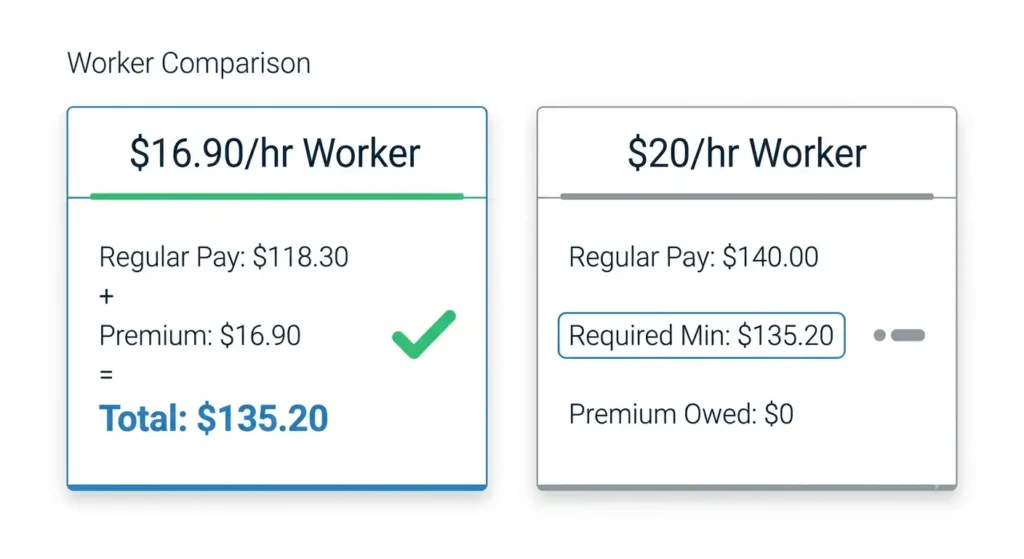
Your regular pay is $140. The law requires 7 hours at minimum wage ($118.30) plus the one hour premium ($16.90), totaling $135.20. Since $140 already beats $135.20, your employer owes nothing extra. Your higher rate already absorbed the premium. That’s exactly how the offset rule works.
Example 3: Higher Local Minimum Wage
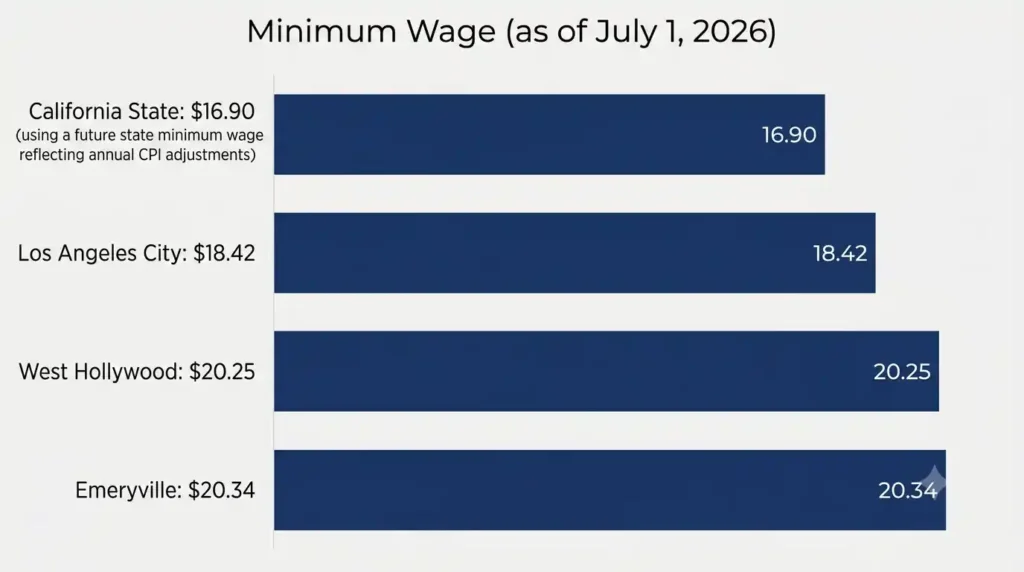
A higher local minimum wage shifts your whole calculation to that number. West Hollywood sits at $20.25 an hour for most workers, Emeryville is at $20.34, and Los Angeles City moved to $18.42 as of July 1, 2026. If you work in LA, the Los Angeles paycheck calculator already builds in the correct city rate. The premium uses whichever local rate applies, and so does the offset comparison. Check your exact local rate, since these figures increase twice a year, once in January and again in July.
Split Shift Examples from Real Jobs
Restaurant Server
A server working 11 a.m. to 2 p.m., then 5 p.m. to 9 p.m., is a classic employer-scheduled split shift. Near minimum wage, she’s very likely owed the premium on top of pay and tips, since tips never offset it.
Retail Employee
Opening at 8 a.m. until noon, then closing from 6 p.m. to 9 p.m., is the same kind of gap. Retail chains build schedules this way around rush hours, and employees rarely notice the missing premium unless they check their pay stub closely.
Healthcare Worker
In-home caregivers often get a morning visit with one client and an evening visit with another, separated by unpaid hours. Hospital staff see similar patterns, and facilities covered by California’s healthcare worker minimum wage rules calculate the premium off that higher facility rate, not the state floor. On-call scheduling, where you’re sent home and called back, follows the same rules whenever it creates a genuine unpaid gap the same day. Healthcare employers get flagged for missing this premium about as often as restaurants do.
Grocery or Hospitality Worker
Grocery stores and hotels staff up hard during morning and evening peaks, with slow hours between. Workers pulled into both windows usually meet every condition for the premium, yet it’s one of the most commonly missed payments in both industries. Coffee shops running an early rush crew and a separate closing crew, and hotels splitting front desk coverage around check-in and check-out, fall into the exact same pattern.
Situations That Confuse Employees Most
Is a Meal Break a Split Shift?
No. A meal break, even a full hour, is a required rest period, not a staffing gap. Confusing the two is the single most common mistake employees make here.
I Picked Up Another Shift
A voluntary second shift is your choice, not your employer’s schedule, so the premium generally doesn’t apply. The same goes for a shift swap you arranged with a coworker.
I Work at Two Different Locations
Same employer, same calendar day, real unpaid gap between two locations still counts as a split shift. The same logic covers being moved between two departments at one location.
I Earn More Than Minimum Wage
Earning above minimum wage doesn’t disqualify you, but it shrinks or erases your premium through the offset rule. The higher your pay climbs, the more likely the premium disappears into wages you already earned.
Common Myths and Misconceptions
Every Split Shift Gets One Extra Hour
False. The offset rule means workers earning well above minimum wage often end up owed nothing. The premium only shows up when your day’s pay doesn’t already cover it.
Any Long Break Qualifies
A long break only counts if your employer created it for staffing reasons on the same workday. A personal errand you scheduled yourself doesn’t qualify.
Overtime Replaces Split Shift Premium
These are independent calculations that can stack. A long, broken workday can trigger overtime pay, split shift premium, or both.
How to Check Your Paycheck
Review Your Schedule
Pull your shift records for the past few weeks and look for days split into two blocks by an employer-created gap. Even one missed day adds up over months.
Review Your Pay Stub
The split shift premium must appear as its own line item on your itemized wage statement, not folded into regular wages or bonuses. Our guide on how to read your California pay stub shows exactly where that line should sit. A missing line is a red flag. This is one of the most common payroll mistakes, usually because the system was never set up to catch the rule.
Calculate What You Should Have Been Paid
Gather your hours worked, confirm the correct minimum wage for your city, and run the formula above. Any gap between that number and what you were paid is money your employer likely owes you.
What to Do If You Were Not Paid Correctly
Speak With Payroll or HR
Bring your schedule and pay stubs, ask why the premium isn’t showing, and request a correction in writing. Most underpayments come from payroll systems never configured to catch this rule, not deliberate wage theft, though both happen. If your employer claims the break was voluntary, ask for the original written schedule.
Keep Evidence
Save your time records, pay stubs, written schedules, and any texts or emails about your shifts. This paper trail proves your case if it becomes a formal claim.
File a California Wage Claim
You can file a wage claim with the California Labor Commissioner, an office under the California Department of Industrial Relations. You generally have three years from the violation to act, though certain related claims can stretch to four years under California’s unfair competition law. Bad faith underpayment can mean liquidated damages on top of missed wages. Since split shift scheduling usually hits entire teams, one missed premium often means coworkers are underpaid too, which is how these cases turn into class actions.
Frequently Asked Questions
How long must the unpaid gap be?
No exact minute count is written into the law, but California’s Division of Labor Standards Enforcement, or DLSE, generally treats any unpaid break well beyond 30 to 60 minutes, longer than a normal meal period, as a split shift, on the same calendar day.
Can I receive overtime and split shift premium together?
Yes, they’re calculated independently. A long, broken workday can trigger both, each as its own line on your pay stub.
Does local minimum wage affect the premium?
Yes. Cities with a higher minimum wage than the state’s $16.90 rate use their own local number for the calculation and the offset. A high minimum wage city means a noticeably larger premium.
Should split shift premium appear on my pay stub?
Yes, always as its own itemized line, separate from wages, bonuses, or tips.
What if I voluntarily accepted the second shift?
If you chose the split for your own convenience rather than your employer assigning it, you generally don’t qualify.
Can salaried employees qualify?
An exempt employee, meaning one who meets the duties and salary threshold tests, does not qualify. Non-exempt employees paid on a salary basis can still qualify, since exemption status depends on duties and pay level, not how you’re paid.
Quick Eligibility Checklist
Five Questions to Answer
Did the split happen on one calendar day? Did your employer build the schedule? Was there a real unpaid gap where you were fully off duty? Was the gap longer than a meal period? Are you a non-exempt employee who doesn’t live at the workplace? Five yeses means you’re very likely owed something.
Five-Minute Premium Calculator Walkthrough
Grab your hours worked, hourly rate, and the correct minimum wage for your city. Compare your actual day’s pay to hours worked at minimum wage plus one extra hour at minimum wage. Our paycheck calculator can help you run the base numbers first. The difference is your premium. Check it against what you were paid, and if there’s a gap, bring it to your employer.
Key Takeaways
What Every California Employee Should Remember
A split shift premium compensates you for an employer-created gap in your workday, not a meal break or a schedule you picked. The math depends on your hourly rate, since the offset rule can shrink or erase the premium once you earn enough above minimum wage. Check your pay stub for a separate line item, and if it’s missing on a genuine split shift day, don’t assume it’s nothing. Bring it up with payroll, keep your records, and remember you have three years to file a claim.

Yeasin Sorker is the founder of Paycheck Calculator California. He built this tool in 2018 after noticing that most free paycheck calculators missed California-specific rules like daily overtime and the uncapped SDI rate.
He researches California payroll tax updates regularly and keeps this calculator aligned with the latest IRS, FTB, and EDD published rates. All calculations on this site are estimates based on official 2026 government sources. For personalized tax advice, consult a qualified tax professional.