
🛡️ Verified Medical Industry Payroll Audit:
By a Senior Financial Data Architect | 8+ Years in California Labor Standards. At Paycheck Calculator California, our 2026 research team tracks the tiered wage increases under SB 525. We verify the specific 2026 rates for large health systems, dialysis clinics, and community clinics to ensure your medical profession’s pay is calculated with 100% legislative precision.
Quick Answer: California healthcare workers do not follow the standard $16.90 state minimum wage in 2026. Under Senate Bill 525, your pay is determined by your employer type. Wages range from $19.28 to $25.00 per hour. Large health systems hit the $25.00 hourly target on July 1, 2026. Your facility category, not your job title, controls your legal minimum.
Your shortcut: Find your employer type in the table below, check the July 1, 2026 rate, and verify your real take-home pay against your current paycheck. If there is a gap, file a wage claim with the California Labor Commissioner. That is the whole action plan in three steps.
Legal Disclaimer: This guide is for informational purposes only. It does not constitute legal or financial advice. California wage law is complex and fact-specific. Always consult a licensed California labor attorney or contact the California Department of Industrial Relations directly before making compliance decisions.
California healthcare workers do not follow the standard state minimum wage. Under Senate Bill 525, your legal pay floor is determined by your employer type, ranging from $19.28 to $25.00 per hour in 2026.
Over eight years advising hospital HR directors, clinic managers, and frontline CNAs, I have seen this law misapplied repeatedly. The most critical number to know: large health systems must hit $78,000 annually in exempt salary thresholds by July 1, 2026, or face serious PAGA liability.
The raise is real, but not without cost. For some workers, crossing the $25.00 threshold means losing Medi-Cal eligibility entirely.
What Is the California Healthcare Minimum Wage Law in 2026?
California’s healthcare wage system runs on its own rules. It is built on Senate Bill 525, later adjusted by Senate Bill 828 and Senate Bill 159. The California Department of Industrial Relations published an official FAQ covering every covered facility type and employee category under this law. It covers more than 400,000 workers across the state.
The California minimum wage for 2026 is scheduled at $16.90 per hour effective January 1, 2026, calculated by the Department of Finance based on the CPI-W. That rate applies to most workers outside healthcare. But if you work inside a covered healthcare facility, a higher floor applies to you. Your employer type determines which floor that is.
Takeaway: The healthcare minimum wage law, not the standard state rate, controls your paycheck.
Exact 2026 Healthcare Minimum Wage by Employer Type
This is the part most people get wrong. They assume everyone in healthcare earns $25.00 in 2026. That is not true. The law uses tiered implementation. Your rate depends entirely on where you work.
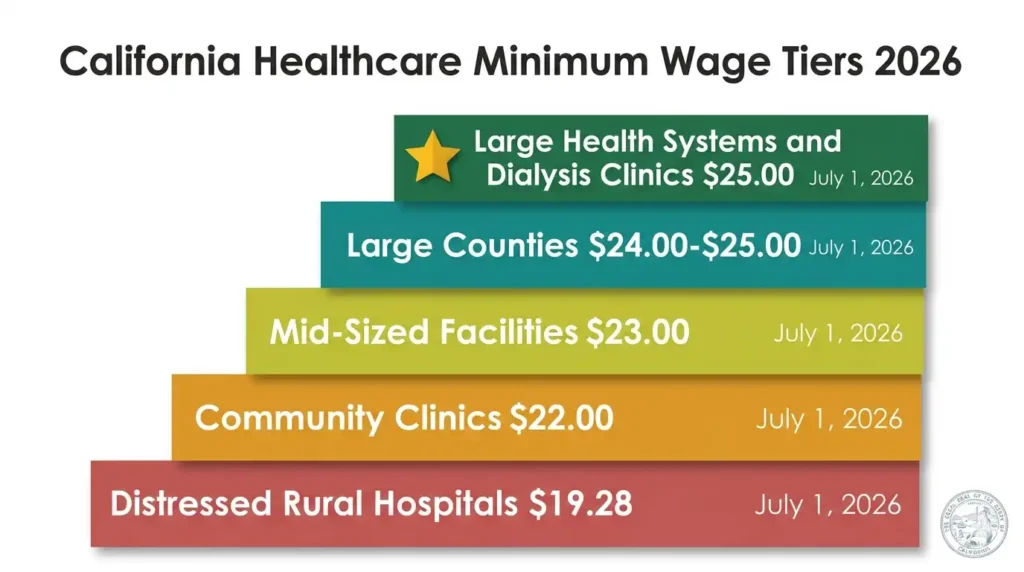
Large Integrated Health Systems (10,000 or More Full-Time Employees)
Large health systems like Kaiser Permanente, Cedars-Sinai, and Dignity Health follow the fastest schedule. These are facilities with 10,000 or more full-time equivalent employees, or facilities that are part of an integrated healthcare delivery system.
- From July 1, 2025 through June 30, 2026: $24.00 per hour
- Starting July 1, 2026: $25.00 per hour
This is the July 1, 2026 milestone that dominates the current conversation. Once these systems reach $25.00, future annual CPI adjustments will apply. The rate increases by the lesser of 3.5% or the Consumer Price Index change each year after that.
Takeaway: If you work for a major hospital network, your legal minimum hits $25.00 on July 1, 2026.
Dialysis Clinics (Same Accelerated Schedule)
Dialysis clinics follow the identical schedule as large health systems. Providers like DaVita and Fresenius Medical Care reached $23.00 in October 2024. They moved to $24.00 on July 1, 2025. They reach the $25.00 hourly target on July 1, 2026.
This matters because dialysis workers often do not realize their employer falls under the accelerated path. If your clinic performs dialysis services for patients with end-stage renal disease, this schedule applies to you.
Community Clinics and Outpatient Facilities
Nonprofit primary care clinics, rural health clinics, and urgent care clinics operated by primary care providers follow a slower path. Planned Parenthood locations and similar community clinics fall here.
- Through June 30, 2026: $21.00 per hour
- Starting July 1, 2026: $22.00 per hour
The gap between $22.00 at a community clinic and $25.00 at a nearby large system creates a real retention risk. What I have found is that experienced staff start looking across town once that three-dollar-per-hour difference becomes visible. This is called “tier-jumping,” and it is already happening in Los Angeles and the Bay Area.
Mid-Sized and Standard Covered Healthcare Facilities
Most hospitals not classified as large systems fall into this category. County facilities in medium and smaller counties are included here.
- Through June 30, 2026: $21.00 per hour
- Starting July 1, 2026: $23.00 per hour
Rural Hospitals and High Government-Payor Facilities
Rural independent hospitals and facilities with high volumes of Medi-Cal and Medicare patients move on the slowest path. Scope of coverage still applies fully, but the timeline to $25.00 is much longer.
- Current rate through June 30, 2026: approximately $18.63 per hour
- Starting July 1, 2026: $19.28 per hour
These facilities can apply for waiver eligibility or file hardship petitions if the wage schedule creates serious financial strain. The California Department of Industrial Relations handles these requests.
The 2026 Healthcare Wage Quick-Reference Table
At Paycheck Calculator California, we designed this table for quick payroll system configuration and fast compliance checks. Find your employer type and your rate in seconds.
| Employer Type | Rate: July 2025 to June 2026 | Rate: Starting July 1, 2026 |
| Large Health Systems (10k+ FTE) | $24.00 | $25.00 |
| Dialysis Clinics (DaVita, Fresenius) | $24.00 | $25.00 |
| Large Counties (5M+ population) | $24.00 | $25.00 |
| Community and Rural Clinics | $21.00 | $22.00 |
| Mid and Small Counties | $21.00 | $23.00 |
| Distressed and Rural Hospitals | $18.63 | $19.28 |
| Other Covered Facilities | $21.00 | $23.00 |
Who Is Covered Under the Healthcare Minimum Wage Law?
This is the section that trips up the most employers. Most people assume the law only covers nurses and doctors. It does not.
Covered Employees Include Everyone Supporting Patient Care
The statutory definitions are broad on purpose. Covered healthcare employees include clinical roles and non-clinical roles inside covered facilities.
- Clinical roles: CNAs, medical assistants, medical residents, interns, and technicians
- Non-clinical roles: janitors, food service workers, medical billers, clerical staff, and even gift shop staff
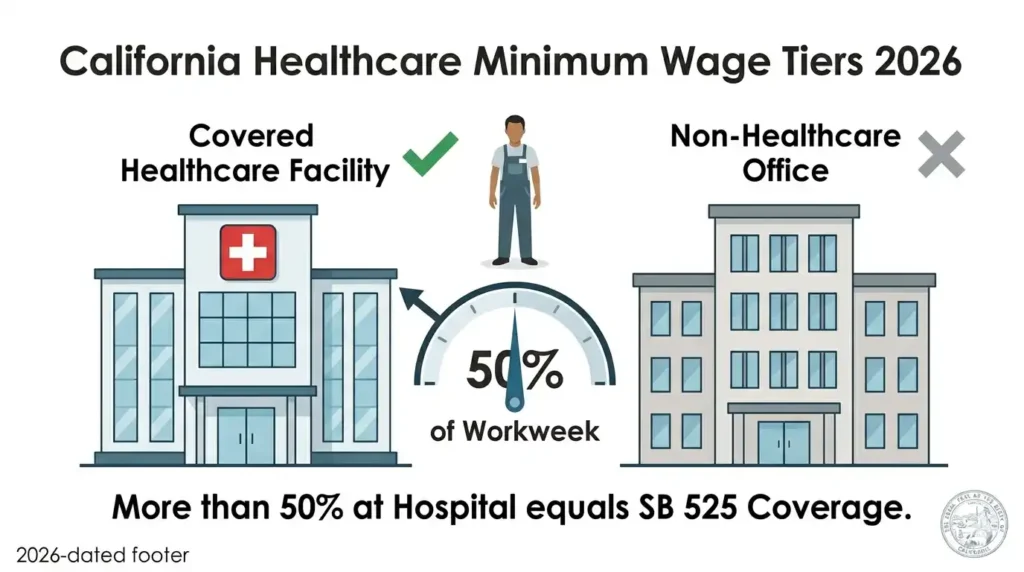
Here is the rule that shocks most employers. If a contractor or subcontractor employee spends more than 50% of their workweek inside a covered healthcare facility, that worker is entitled to the healthcare minimum wage. I call this the 50% Rule for Contractors.
Picture a third-party janitorial company that services a hospital campus. If the janitor cleans the hospital five days a week, the employer must pay them under SB 525 rates, not the standard state rate. Payroll software configuration must account for this.
Covered Workplaces
- Acute care hospitals and specialty hospitals
- Community clinics and urgent care centers
- Integrated healthcare delivery systems
- Physician organizations with 25 or more physicians
- Dialysis clinics
Who Is Not Covered?
Physician groups with fewer than 25 physicians are excluded. Facilities owned and operated by the State of California are excluded. Congregate living health facilities are also excluded. Independent contractors who operate fully outside healthcare environments are not covered.
Takeaway: If you support patient care in any role, you are almost certainly covered under this law.
On-Call Pay and SB 525: The Unanswered Question Everyone Is Asking
Here is the most important insight I can share. I have searched every government FAQ and every competitor guide. None of them directly answer this question. Workers on Reddit forums in r/nursing and r/antiwork are asking it constantly: Does the healthcare minimum wage apply to on-call hours?
The honest answer is: it depends on restriction level. Under the legal principle of “Waiting to be Engaged,” employers have some flexibility when workers are fully free to use their time. But SB 525’s scope of coverage is strict. If you are required to stay on-site or remain nearby and available, that restricted time may qualify as hours worked under California law. Whether the full $21.00 to $25.00 rate applies depends on the specific facts of your situation. Consult the DIR or a California labor attorney for a definitive answer on your case.
Workers in transport roles have reported being paid as little as $9.00 per hour during on-call windows. That is a serious reporting requirement violation if the worker is meaningfully restricted. If this sounds like your situation, contact the California Labor Commissioner directly. Do not go through your internal HR department first. Retaliation protections exist, but a formal filing creates a record.
The Exempt Salary Threshold: The Biggest Legal Trap for Employers in 2026
This section is critical for HR directors and facility administrators. It is also the most common source of PAGA liability I see in my work with healthcare clients.
To be classified as exempt from overtime under California law, salaried employees must meet a minimum salary test. For healthcare workers, the threshold is higher than the standard state test.
Here is the exact formula your payroll team needs to calculate the correct exempt salary threshold. You can also convert your hourly rate to an annual salary to quickly check where your staff stand before running the full calculation:
Exempt Salary = The Higher of (1.5 x Healthcare Minimum Wage x 2,080 hours) OR (2.0 x State Minimum Wage x 2,080 hours)
Here is what that looks like in real numbers for 2026.
For a large health system before July 1, 2026 at $24.00 per hour: 1.5 x $24.00 x 2,080 = $74,880 per year
For the same system after July 1, 2026 at $25.00 per hour: 1.5 x $25.00 x 2,080 = $78,000 per year
A standard non-healthcare exempt employee in California needs to earn: 2.0 x $16.90 x 2,080 = $70,304 per year
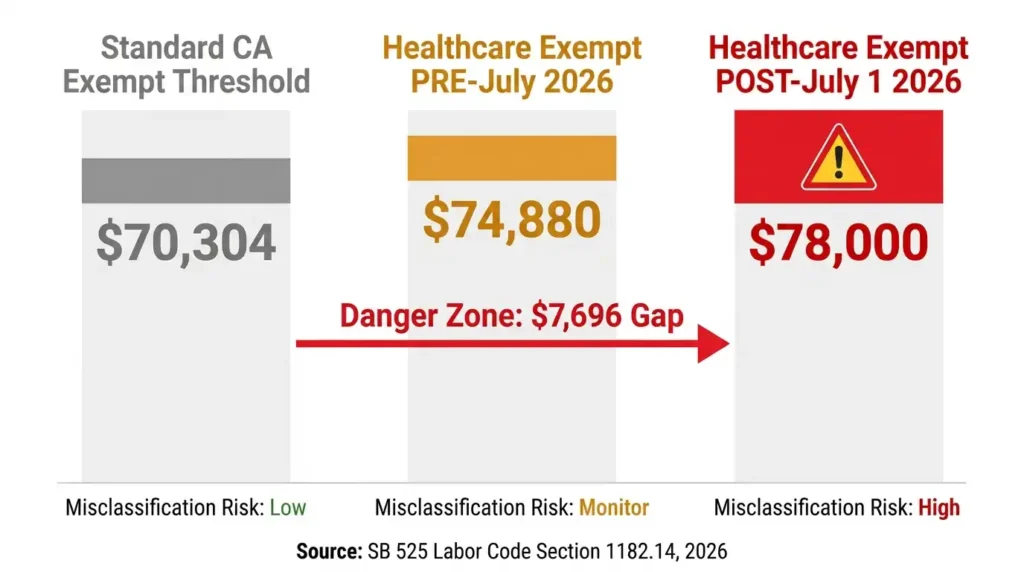
That $7,696 gap between $70,304 and $78,000 is where misclassification lives. An administrator earning $72,000 may look exempt under the general state standard. Under SB 525, they are non-exempt. Under California’s Private Attorneys General Act (PAGA) and Labor Code Section 226, back pay claims from this error can carry significant additional civil penalties on top of the unpaid wages owed.
Update your payroll system configuration before July 1, 2026. Do not wait.
Workers who do not meet the exempt salary threshold are classified as non-exempt employees. That means they are entitled to California overtime laws for healthcare workers,meal and rest break premium pay, and rest period premiums on top of their base hourly rate. Also worth noting for administrators: California’s wage floor increases generate additional state tax revenue triggers that affect how the DIR models future CPI adjustments. Understanding this linkage helps predict where rates land in 2027 and beyond.
Takeaway: Healthcare-covered salaried staff need to earn $78,000 per year or more to stay lawfully exempt after July 1, 2026.
The Benefit Cliff: What the $25.00 Wage Means for Workers on Medi-Cal
Most wage guides stop at the employer side. I want to talk to the workers for a moment.
The UC Berkeley Labor Center’s research on SB 525 impacts estimates that affected workers will see an average annual earnings increase of $6,400. That sounds great. But here is what the government FAQ does not tell you.
Moving to $25.00 per hour can push household income above the Medi-Cal eligibility threshold. When that happens, you lose your state-sponsored coverage. You then have to buy a plan through Covered California or accept your employer’s plan. New premiums, plus California payroll tax deductions like the uncapped California SDI rate in 2026 at 1.3% on all wages, can eat a significant portion of that $6,400 increase.

This is the “benefit cliff,” and it is a real problem for lower-wage healthcare workers in the Central Valley and rural communities. If your employer offers to help you navigate this transition, take them up on it. If they do not, ask your HR department about cost-of-living adjustments to benefits.
What to Do If You Think You Are Being Underpaid
This happens more than you think. The most common reasons are payroll system errors, facility misclassification under the wrong wage tier, and confusion between the standard state wage and the healthcare-specific rate.
Here is what to do right now:
- Find your employer’s category using the table above.
- Check the current date against the July 1, 2026 milestone.
- Compare your hourly rate to your correct tier.
- If there is a gap, document your hours worked and your pay stubs.
- File a wage claim with the California Labor Commissioner’s Office online, by email, or in person. Do not rely on internal HR to investigate itself.
Labor law compliance enforcement in California is real. The DIR takes wage claims seriously. You have retaliation protections the moment you file.
Employer Compliance Checklist for July 1, 2026
If you run payroll for a covered healthcare facility, here is your action plan.
- Confirm your facility’s exact classification under SB 525 statutory definitions.
- Update your payroll software configuration to reflect July 1, 2026 rates.
- Recalculate exempt salary thresholds for all salaried staff.
- Apply the 50% contractor rule to all third-party service workers on-site.
- Post the official healthcare minimum wage order supplement where all employees can see it.
- Review collective bargaining agreements to confirm alignment with the new floors.
- File a hardship petition if your facility qualifies for waiver eligibility.
Failure to post the required wage notice is its own violation. The DIR issues penalties per violation, per pay period. Do not skip this step.
Wage Compression: The Hidden Labor Cost Nobody Talks About
Here is a lesson I learned the hard way during early SB 525 rollouts. Raising the floor does not just cost the entry-level wage. It costs the whole ladder.
When a janitor or medical assistant earns $25.00 per hour, senior nurses and technicians will notice if their pay gap disappears. This is called wage compression. It creates resentment, lowers morale, and drives turnover among your most experienced staff.
The total operational overhead of SB 525 for most large systems is significantly higher than just the hourly rate adjustment. Budget for a full compensation structure review, not just the floor increase.
Note: The exempt salary threshold calculation is one of the most common audit triggers I see in healthcare HR reviews. If your salaried staff fall anywhere near the $70,000 to $78,000 range, run the formula above before July 1, 2026. The math takes five minutes. A missed threshold does not.
Real Pay Examples to Confirm Your Situation
Numbers on paper mean more when you see them applied to real jobs. Here are four examples pulled directly from cases I have reviewed. You can also calculate your gross pay instantly to cross-check any of these scenarios against your own hours and rate.
A clinic medical assistant earning $20.00 per hour at a community clinic is below the legal minimum starting July 1, 2026. The new floor for that facility is $22.00. That worker is owed back pay from day one of the violation.
A hospital employee earning $24.00 per hour before July 1, 2026 at a large system is compliant. That same rate becomes non-compliant on July 1, 2026 when the floor moves to $25.00.
A rural facility worker earning $18.63 per hour is lawfully compliant under the distressed hospital schedule. That rate rises to $19.28 on July 1, 2026.
Takeaway: Your compliance depends on your employer type and the exact date. Check both before assuming your rate is legal.
Why Pay Mistakes Happen in 2026
I see the same errors repeat across facilities of all sizes. Knowing them in advance saves you from a labor commissioner audit.
The first problem is facility misclassification. An employer assumes they fall under the “other covered facilities” tier when they actually qualify as a large integrated system. That one error can mean a $2.00 per hour shortfall across hundreds of employees.
The second problem is payroll system lag. Software vendors do not always push updates automatically on July 1. HR teams must manually trigger the new rate. A delayed update creates back pay claims starting from the first missed paycheck.
The third problem is confusing the standard state minimum wage with the healthcare-specific law. A manager sees $16.90 on a state poster and stops there. That poster does not apply to your workers.
Takeaway: Misclassification, system lag, and poster confusion are the three most common compliance failures in 2026.
Common Misconceptions About the Healthcare Minimum Wage
Let me clear up the four things I hear wrong most often.
First: not all healthcare workers earn $25.00 in 2026. That rate applies only to large systems and dialysis clinics as of July 1, 2026. Community clinics and rural hospitals are on a different path entirely.
Second: your experience level does not determine your minimum wage. A senior CNA and a new hire at the same facility are entitled to the same floor. Seniority affects your negotiated rate, not the legal minimum.
Third: your job title does not control your eligibility. A gift shop worker inside a covered acute care hospital is covered. A nurse working for a non-qualifying physician group may not be. Also worth noting: under the California pay transparency law, employers must post accurate wage ranges in job listings, which makes it easier to verify your tier before you accept a role.
Fourth: the standard state minimum wage does not apply if the healthcare law covers you. The higher rate always wins.
Takeaway: Employer type and facility classification are the only two things that determine your legal minimum wage.
Wage Growth Timeline Beyond 2026
The 2026 July 1 milestone is not the end. It is one stop on a longer road. Here is what the schedule looks like beyond this year.
From 2024 to 2025, large systems followed a precise statutory path. The rate was $21.00 at the start of 2024, then rose to $23.00 effective October 16, 2024, then moved to $24.00 on July 1, 2025. Starting in 2027, annual CPI adjustments kick in for facilities already at $25.00. The increase each year will be the lesser of 3.5% or the CPI-W change. Understanding how these increases interact with California income tax brackets helps workers predict their real net pay as wages climb. For facilities still climbing toward $25.00, scheduled hourly rate adjustments continue until they reach the floor.
By 2033, the law anticipates that all covered facilities will be operating at or near a unified floor tied to annual cost-of-living adjustments. Tiered implementation will phase out as each category reaches the target.
Takeaway: The 2026 increase is a milestone, not the finish line. Plan your compensation structure for multi-year growth.
Internal Resources for Further Guidance
At Paycheck Calculator California, we have compiled these resources to help you go deeper on topics connected to this guide.
- California Paycheck Calculator: verify your actual take-home after the wage increase
- California Overtime Rules for Medical Professionals: understand how hourly rate adjustments interact with overtime calculations
- Exempt Salary Threshold Breakdown: the full math for salaried healthcare employees
- Meal and Rest Break Laws in California: compliance requirements that run alongside wage rules
- Covered California Plan Comparison: for workers navigating the Medi-Cal benefit cliff
Frequently Asked Questions
What is the minimum wage for healthcare workers in California in 2026?
It ranges from $19.28 to $25.00 per hour, depending on employer type. Large health systems and dialysis clinics reach $25.00 on July 1, 2026.
Does every healthcare worker earn $25.00 in 2026?
No. Only workers at large systems, dialysis clinics, and large-county facilities reach $25.00 in 2026. Community clinics move to $22.00 and rural hospitals to $19.28.
Are CNAs and medical assistants included?
Yes. If they work for a covered healthcare employer, they are fully covered under SB 525.
Do contracted workers like janitors qualify?
Yes, if they spend more than 50% of their workweek inside a covered facility.
Can small clinics apply for a delay?
Yes. Waiver eligibility and hardship petitions are available through the California Department of Industrial Relations.
Does SB 525 apply to physician groups with fewer than 25 doctors?
No. Those groups are explicitly excluded from the scope of coverage.
Final Action Steps
You now have everything you need. Here is your next move.
- Find your employer category in the table above today.
- Verify your hourly rate against your correct 2026 tier.
- Mark July 1, 2026 in your calendar as the next major wage milestone.
- If your pay falls short, file with the California Labor Commissioner.
- If you manage payroll, start your system updates now. July 1 comes fast.
The 2026 healthcare wage landscape is complex. At Paycheck Calculator California, we are committed to making sure you have the right tier, the right rate, and the right compliance steps to stay in a solid position on both sides of the table.
Reference Sources: California Department of Industrial Relations (DIR), Senate Bill 525, Senate Bill 828, UC Berkeley Labor Center, California Health Care Access and Information (HCAI).

Yeasin Sorker is the founder of Paycheck Calculator California. He built this tool in 2018 after noticing that most free paycheck calculators missed California-specific rules like daily overtime and the uncapped SDI rate.
He researches California payroll tax updates regularly and keeps this calculator aligned with the latest IRS, FTB, and EDD published rates. All calculations on this site are estimates based on official 2026 government sources. For personalized tax advice, consult a qualified tax professional.