
Working full time at $15 an hour comes out to $31,200 a year before taxes, based on a standard 40 hour week. Take-home pay lands lower once federal, state, and FICA taxes apply.
That $31,200 number is the easy part. In my experience, the real question readers ask is what actually lands in their bank account.
The honest catch: $15 an hour now falls below California’s minimum wage and struggles against high living costs elsewhere.
Quick Answer: $15 an Hour Is How Much a Year?
Here is the full pay breakdown by period, before and after taxes.
Annual Salary at $15 an Hour
The $31,200 figure assumes a full 2,080 hours worked in the year, the standard payroll baseline, with no unpaid weeks off. See the Gross versus net pay breakdown below for what actually reaches your account. This annual figure also matters for loan applications, rental approvals, and comparing job offers. You can run your own numbers with our annual salary calculator.
Quick Pay Breakdown Table
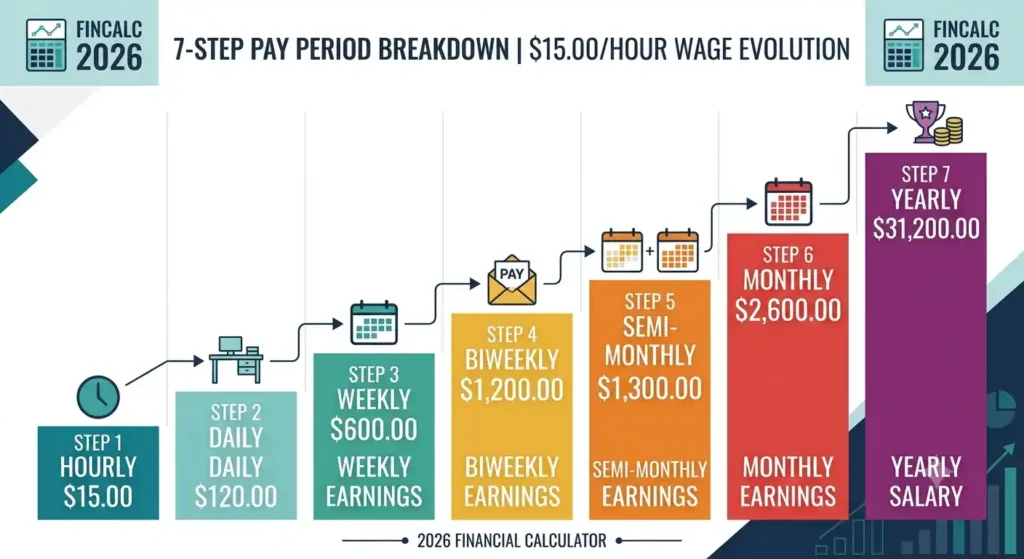
| Pay Period | Gross Pay |
|---|---|
| Hourly | $15.00 |
| Daily (8 hrs) | $120 |
| Weekly | $600 |
| Biweekly | $1,200 |
| Semi-Monthly | $1,300 |
| Monthly | $2,600 |
| Yearly | $31,200 |
How the $15 Per Hour Calculation Works
The Standard Formula
Hourly rate times hours per week, times weeks per year. $15 x 40 = $600 a week. $600 x 52 = $31,200 a year. Payroll calculators use 2,080 hours as the standard full time year, the number every W-2 employer builds payroll around.
Why Your Annual Income May Be Different
Part time work drops your total fast. Variable schedules, unpaid leave, and seasonal swings all cut into it. Two weeks of unpaid vacation brings 50 working weeks and about $30,000 instead of $31,200. Weekends only, two 8 hour shifts a week, comes to about $12,480 a year. Calculate your real average hours, not just scheduled hours, before trusting an annual estimate.
$15 an Hour Before Taxes vs After Taxes
Gross Pay vs Take-Home Pay
Gross income is what you earn before deductions. Net income, or take-home pay, is what actually lands in your account. On $31,200, the gap runs $4,000 to $6,000 a year depending on where you live and how you file.
What Taxes Reduce Your Paycheck?
Federal income tax follows Internal Revenue Service (IRS) brackets and filing status. State income tax varies, Texas and Florida charge none, others take more. Social Security tax takes 6.2%, set by the Social Security Administration (SSA). Medicare tax takes 1.45%. Together, these FICA taxes remove 7.65% before federal or state tax applies. At $31,200, you are far under the Social Security wage base of $184,500, so the full 6.2% applies all year.
Estimated Take-Home Pay
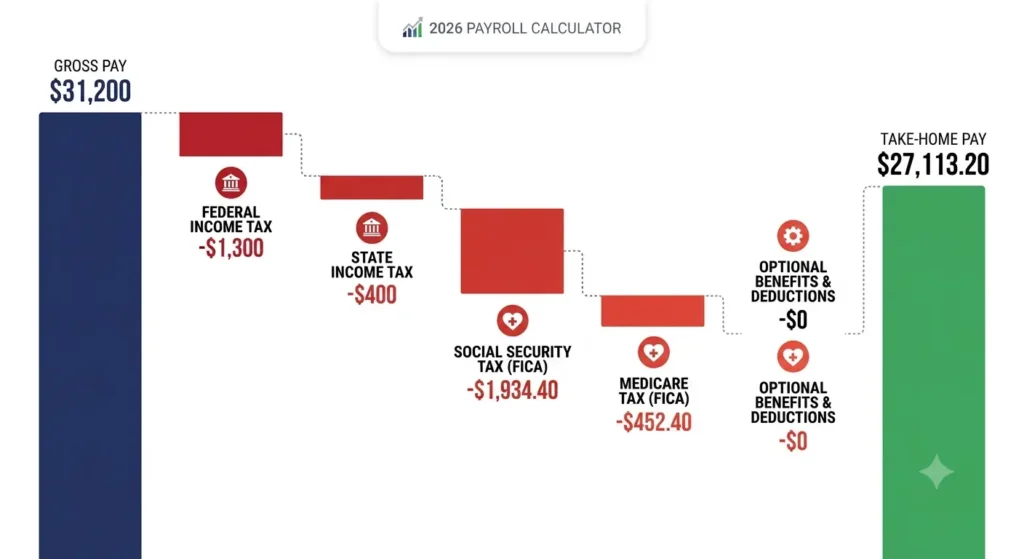
At $31,200 a year, a single filer with no dependents typically keeps $500 to $520 a week after taxes. That is $2,150 to $2,250 a month with no state income tax, less elsewhere. Annually, that is $27,000 to $27,300. W-4 elections mean two people on the same wage can see different totals.
Income Breakdown by Pay Period
Daily Income
8-Hour Workday
An 8 hour shift earns $120 before taxes, about $100 to $102 after. Picture a retail worker clocking a standard Tuesday shift: that $120 covers gas, groceries, or a phone bill, but it goes fast.
Weekly Income
A 40 hour week is $600 gross, $500 to $520 after taxes. Against a $1,400 monthly rent, that is roughly a third covered in one week.
Biweekly Income
Most hourly employers pay every two weeks: $1,200 gross, roughly $1,000 to $1,040 after taxes. This is the number to budget bills against.
Monthly Income
Average monthly gross is $2,600, take-home $2,150 to $2,250. Semi-monthly pay, twice a month on fixed dates, comes to about $1,300 gross per check since it splits the year into 24 checks instead of 26. This monthly figure decides whether fixed costs work, and what is left funds savings.
Is $15 an Hour a Good Salary?
Compared With Federal Minimum Wage
The federal minimum wage has sat at $7.25 an hour since 2009, enforced by the U.S. Department of Labor. $15 an hour is more than double that. But inflation has eaten into the gap: a dollar in 2009 bought roughly 45% more than today.
Compared With State Minimum Wages
As of January 2026, California’s minimum wage is $16.90 an hour, up from $16.50 in 2025, so $15 an hour is below the legal minimum there for most jobs. West Hollywood requires over $20. Several states still sit near the $7.25 federal floor. The same $15 wage can be illegal in one state, above average in another.
Cost of Living Reality
Housing breaks most $15 an hour budgets, sometimes eating half a paycheck in high cost states. Transportation, food, and healthcare add fixed pressure that does not shrink with your hours. Bureau of Labor Statistics (BLS) wage data shows housing costs outpacing pay in most major metros, especially in cities like Los Angeles.
Can You Live on $15 an Hour?
Sample Monthly Budget
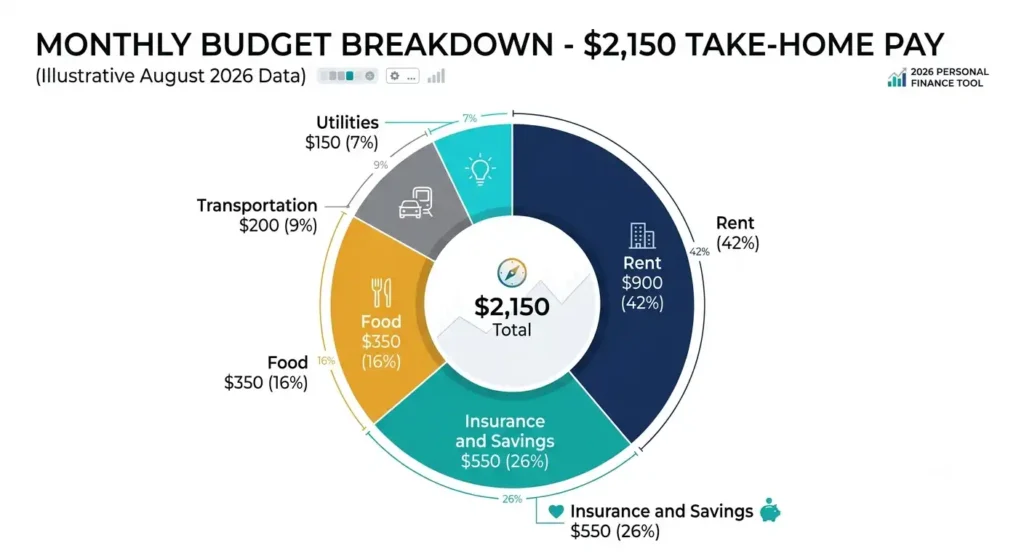
On $2,150 monthly take-home: about $900 rent, $150 utilities, $350 food, $200 transportation, leaving $550 for insurance and savings. This only holds in a lower cost area. Landlords often require income equal to three times the rent, so $15 an hour realistically qualifies for rent around $700 to $750 a month.
Living Alone vs Sharing Housing
Living alone on $15 an hour is tight almost everywhere. A roommate can cut your biggest expense in half, freeing money for savings or debt.
Supporting a Family
One $15 an hour income rarely supports a family, especially with childcare costs. Two incomes at $15 an hour combine for over $62,000 a year before taxes, though childcare can offset much of that.
Real-Life Scenarios
You Received a $15/Hour Job Offer
Compare the offer to your actual monthly bills, not just the headline number. See more real paycheck scenarios like this one. Between two hourly offers, say $15 versus $16.50, that $1.50 difference is about $3,120 more a year.
You’re Planning a Monthly Budget
Start from net monthly income of $2,150 to $2,250. List fixed expenses first: rent, insurance, phone, subscriptions. What remains is flexible spending and savings.
You’re Comparing Hourly and Salaried Jobs
A $31,200 salaried role and $15 an hour hourly role look alike on paper but are not. Salaried roles often skip overtime; hourly roles can pay more in busy seasons. A W-2 employee gets automatic withholding and often benefits. A 1099 independent contractor gets the full $15 with no withholding, then owes self-employment tax. Our 1099 vs W-2 calculator shows the real take-home difference between the two.
What If You Don’t Work 40 Hours a Week?
Working 20 Hours Weekly
20 hours a week is $15,600 a year, half of full time, usually part time status with no benefits.
Working 30 Hours Weekly
30 hours a week is $23,400 a year. 25 hours is $19,500 a year. Both are often still classified as part time, which can mean no health insurance or paid time off.
Working 35 Hours Weekly
35 hours a week is $27,300 a year, just under full time. Many employers use this schedule to avoid the 40 hour overtime threshold.
Working Overtime
Overtime at $15 an hour is $22.50, time and a half under California overtime rules. 5 extra hours a week adds over $5,800 a year. 10 extra hours adds about $11,700 a year. Holiday pay or double-time can push a single day’s earnings well above $120.
Common Mistakes People Make
Assuming Everyone Works 2,080 Hours
That figure assumes a perfect year, no unpaid time off, no reduced weeks. Many hourly jobs, especially retail and food service, do not guarantee 40 hours a week at all.
Confusing Gross Pay With Net Pay
Budgeting around the gross $31,200 salary leads to surprises, a mistake I still see constantly. Always budget from net pay, not gross.
Ignoring Benefits
A $14 an hour job with full health insurance can beat $15 an hour with none, once you factor out of pocket costs. Retirement matching adds real value too.
Frequently Asked Questions
Is $15 an hour $31,200 a year?
Yes, at a standard 40 hour week for 52 weeks, or 2,080 hours a year.
How much is $15 an hour after taxes?
Roughly $27,000 to $27,300 a year for a single filer, depending on state income tax.
How much is $15 an hour per month?
$2,600 before taxes, about $2,150 to $2,250 after.
How much is $15 an hour every two weeks?
$1,200 gross, roughly $1,000 to $1,040 after taxes.
Is $15 an hour considered full-time pay?
Yes, at 40 hours a week. Full time status is based on hours, not wage.
Can you live comfortably on $15 an hour?
Depends on location. Workable in lower cost areas, a real struggle in cities like Los Angeles or San Francisco.
How much more is $16 or $20 an hour per year?
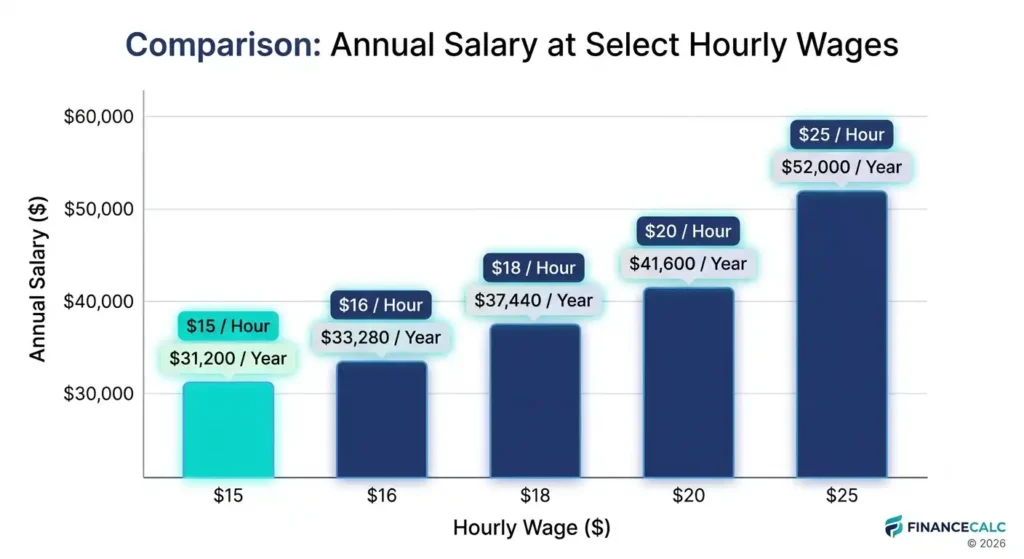
| Hourly Rate | Annual Pay | Difference vs $15 |
|---|---|---|
| $15.00 | $31,200 | Base rate |
| $16.00 | $33,280 | +$2,080 |
| $18.00 | $37,440 | +$6,240 |
| $20.00 | $41,600 | +$10,400 |
| $25.00 | $52,000 | +$20,800 |
Each $1 raise adds about $2,080 a year at full time hours.
Does overtime change yearly income?
Yes. Overtime pays 1.5 times base rate, so regular overtime adds thousands a year.
Final Thoughts: Should You Accept a $15/Hour Job?
When $15 an Hour May Be Enough
It can work in lower cost states, in entry-level roles, or with strong benefits offsetting the wage.
When You May Need Higher Pay
In a high cost city, supporting a family alone, or carrying real debt, $15 an hour likely will not stretch far enough. In states like California, where the legal minimum now exceeds $15 an hour, this wage may not even be legal to offer.

Yeasin Sorker is the founder of Paycheck Calculator California. He built this tool in 2018 after noticing that most free paycheck calculators missed California-specific rules like daily overtime and the uncapped SDI rate.
He researches California payroll tax updates regularly and keeps this calculator aligned with the latest IRS, FTB, and EDD published rates. All calculations on this site are estimates based on official 2026 government sources. For personalized tax advice, consult a qualified tax professional.