
California does not have its own self-employment tax. The 15.3% rate is federal, covering Social Security (12.4%) and Medicare (2.9%), and California adds state income tax on top at rates from 1% to 13.3%. A freelancer in Los Angeles earning $80,000 in profit can easily owe $12,000 or more in combined taxes before federal income tax is even counted. No employer withholds anything for you, so every dollar owed is yours to track and pay. The numbers below are specific to 2026, always verify with a tax professional for your situation.
California Self Employment Tax Rate 2026: Quick Answer
The 15.3% does not apply to your full income. It applies to 92.35% of your net business profit, not gross revenue. That adjustment exists because W-2 employees only pay half of FICA, with their employer covering the rest. The IRS built the 92.35% multiplier to give self-employed workers equivalent treatment. Your total California obligation combines federal SE tax, federal income tax, and California state income tax — all three running at once.
Does California Have a Separate Self Employment Tax?
Understanding California Self Employment Tax Rules
California does not charge a separate self-employment tax. The 15.3% goes to the IRS, not Sacramento. What California charges is state income tax on your net business profit, treated as personal income and taxed at progressive rates. A single filer earning $75,000 in self-employment profit will see a meaningful portion taxed at 9.3%. For a full breakdown of how those brackets work, see the California income tax brackets for 2026.
Federal Self Employment Tax vs California Income Tax
Federal SE tax is 15.3% on 92.35% of net earnings, paid on Schedule SE, with half deductible as an above-the-line deduction. California income tax starts at 1% and reaches 13.3% above $1 million. For most freelancers earning $50,000 to $150,000, the relevant California tax brackets sit between 6% and 9.3%. Combined, many California self-employed workers face a total effective burden of 30% to 40% of net profit. For all the state-level deductions that affect this number, the California standard deduction for 2026 is worth reviewing.
How Much Is the Self Employment Tax Rate in 2026?
Federal Self Employment Tax Rate Breakdown
The 2026 federal SE tax rate is 15.3%: Social Security at 12.4% (on the first $184,500 of combined wages and SE income) and Medicare at 2.9% (no cap). Single filers earning above $200,000 also owe an additional 0.9% Medicare surtax, pushing the Medicare rate to 3.8% on income above that threshold. The 0.9% surtax has no employer-side deduction. The IRS self-employment tax guidance covers these rules in full.
Why You Do Not Pay 15.3% on Your Entire Income
The 15.3% applies to 92.35% of your net profit, not gross revenue. If your business brought in $100,000 but you had $20,000 in expenses, net earnings are $80,000. Multiply by 92.35% to get $73,880 — that is the taxable base. You also deduct half the SE tax from your adjusted gross income. On $80,000 in profit, SE tax is roughly $11,304 and the deduction is about $5,652, which reduces taxable income for both federal and California purposes.
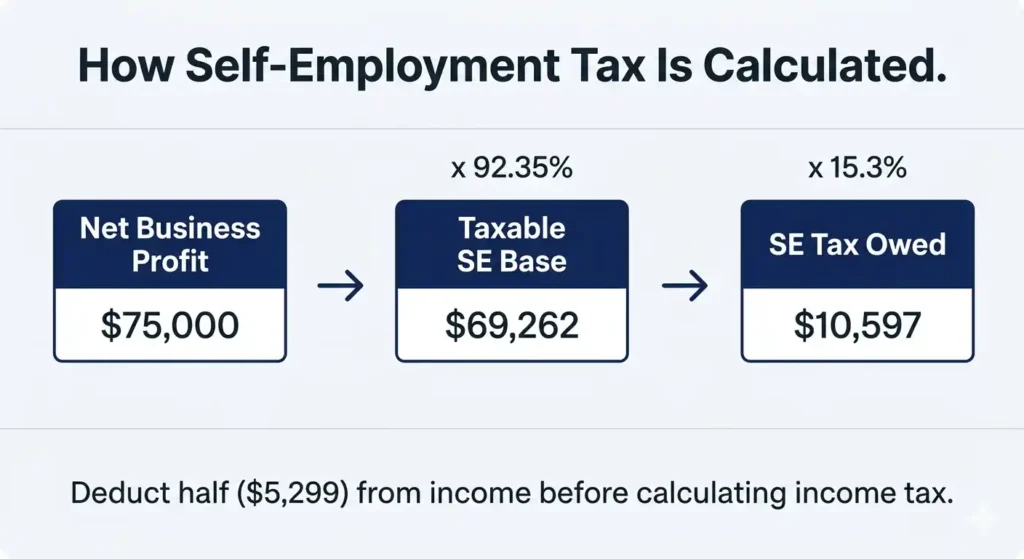
The formula: Net profit x 92.35% x 15.3% = SE tax. Divide by 2 and subtract from income before calculating income taxes.
California Self Employment Tax Calculator: How To Estimate What You’ll Pay
Information Needed To Calculate Your Tax
You need: total self-employment income, deductible business expenses, filing status, and any other income sources (W-2, investments, etc.). Other income can push you into higher brackets and change your total bill significantly. Use the California paycheck calculator to model different income scenarios and see estimated take-home pay.
Self Employment Tax Calculation Formula
Step 1: Calculate Net Business Profit
Revenue minus legitimate business expenses equals net profit. That is the only number that matters for tax purposes. Common deductions include home office costs, software, advertising, equipment, professional development, and travel. The 2026 IRS standard mileage rate is 72.5 cents per mile. On $90,000 in revenue with $15,000 in expenses, net profit is $75,000.
Step 2: Calculate Self Employment Tax
Multiply net profit by 92.35%, then by 15.3%. On $75,000: $75,000 x 0.9235 = $69,262. Then $69,262 x 0.153 = $10,597 in SE tax. Deduct half ($5,299) from income. If your net profit plus W-2 wages exceeds $184,500, the Social Security portion stops at that cap.
Step 3: Add California Income Tax
Subtract the half SE tax deduction and California’s $5,706 standard deduction (single filers) from net profit. On the $75,000 example: $75,000 minus $5,299 minus $5,706 = roughly $64,000 in California taxable income. At that level, California state income tax is approximately $4,500 to $5,500. Add the $10,597 SE tax and the combined obligation exceeds $15,000 before federal income tax. For a deeper look at California’s deduction rules, the California standard deduction guide explains exactly what reduces your state taxable income.
Real California Self Employment Tax Examples for 2026
Example: Freelancer Making $50,000 Per Year
$50,000 x 0.9235 = $46,175. Then $46,175 x 0.153 = $7,065 in SE tax. Half deducted ($3,533) leaves $46,467 for federal income tax. California taxable income: $50,000 minus $3,533 minus $5,706 = roughly $40,761. California income tax: approximately $2,000 to $2,500. Combined SE tax plus state income tax: $9,000 to $10,000. Set aside at least 25% to 30% from the start.
Example: Self Employed Worker Making $100,000 Per Year
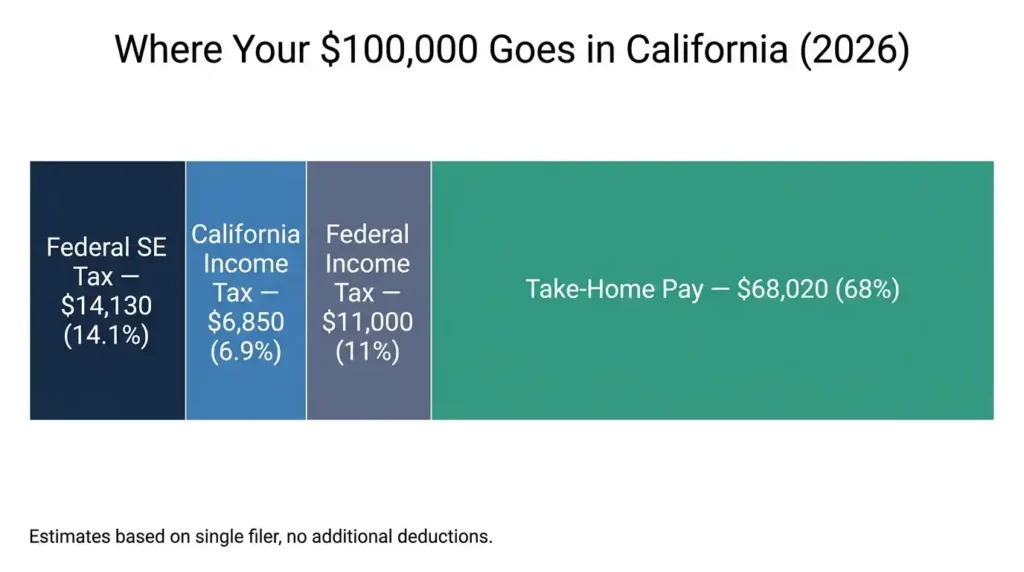
$100,000 x 0.9235 = $92,350. Then $92,350 x 0.153 = $14,130 in SE tax. California taxable income: $100,000 minus $7,065 minus $5,706 = roughly $87,229. California income tax at 9.3%: approximately $6,500 to $7,200. Combined SE tax and state income tax: over $20,000. Add federal income tax of $10,000 to $12,000 and total taxes exceed $30,000. Take-home is closer to $70,000. The 100k after tax in California post breaks this scenario down in full detail for W-2 workers and self-employed earners alike.
Example: High Income Self Employed Worker
At $250,000 in net profit, Social Security tax (12.4%) only applies to the first $184,500 of income (adjusted by 92.35%). Everything above pays 2.9% Medicare, plus the 0.9% Additional Medicare Tax on income above $200,000, pushing that portion’s Medicare rate to 3.8%. California’s 10.3% and higher brackets apply to the full amount.
Self Employment Tax vs W-2 Employee Taxes
Why Self Employed Workers Pay More Payroll Tax
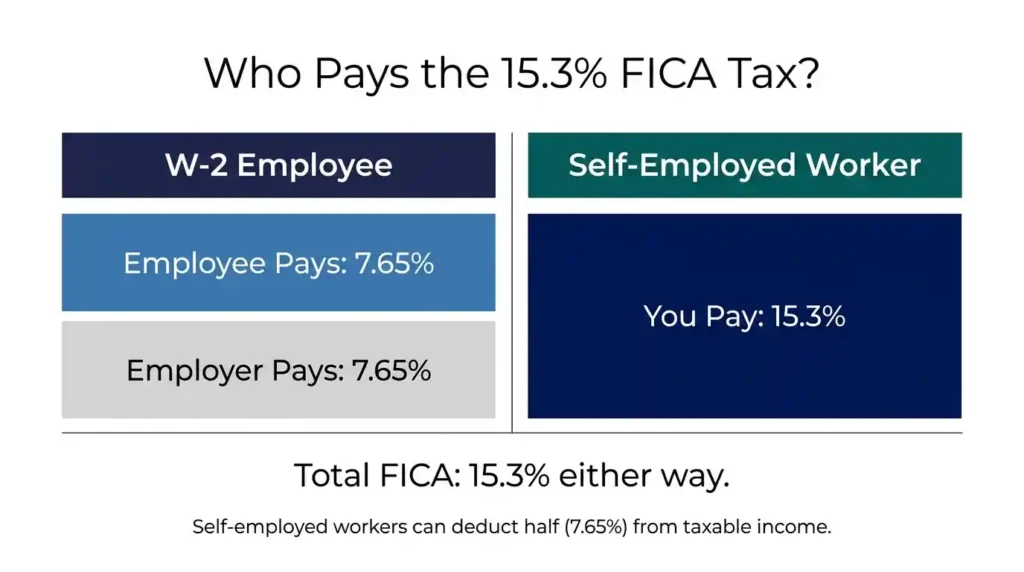
W-2 employees pay 7.65% in FICA, with the employer matching another 7.65%. Self-employed workers pay both halves — the full 15.3%. The SE tax is the FICA equivalent for independent workers, covering the employer portion and employee portion in one payment. The half SE tax deduction softens this but does not close the gap entirely. For a side-by-side look at how paycheck deductions differ between worker types, see how to read a California pay stub.
1099 Worker vs Employee Tax Differences
W-2 employees have taxes withheld automatically all year. A 1099 contractor receives full gross payments with nothing withheld — the entire responsibility shifts to the worker. The trade-off is deductions. Self-employed workers can deduct home office, mileage, equipment, software, health insurance, and retirement contributions. A 1099 worker who tracks expenses can close much of the tax gap. For a full comparison of take-home pay across both arrangements, the 1099 vs W-2 tax guide for California covers the real cost difference in detail.
How Much Should California Freelancers Save for Taxes?
Recommended Tax Savings Strategy
Set aside 30% to 35% of every payment. Above $200,000, save 40%. Open a separate savings account labeled “taxes” and transfer that percentage immediately when income arrives. Treat it like automatic paycheck withholding. If you are unsure what your take-home looks like at your income level, the annual salary calculator can help you model your net income.
Factors That Change Your Tax Amount
Your total income — not just self-employment income — determines your brackets. Other W-2 income, a working spouse, or investment income can push you higher. Filing status matters: a single filer at $100,000 pays more California income tax than a head of household at the same income. Business deductions are the biggest variable of all.
Quarterly Estimated Taxes for California Self Employed Workers
Who Needs To Pay Estimated Taxes?
If you expect to owe $1,000 or more in federal taxes, the IRS requires quarterly estimated payments. California requires them at $500 or more. Most California self-employed workers owe both. Skip them and you face underpayment penalties even if you pay in full by April. The IRS estimated tax page has the official payment thresholds and rules.
Federal and California Estimated Payment Deadlines
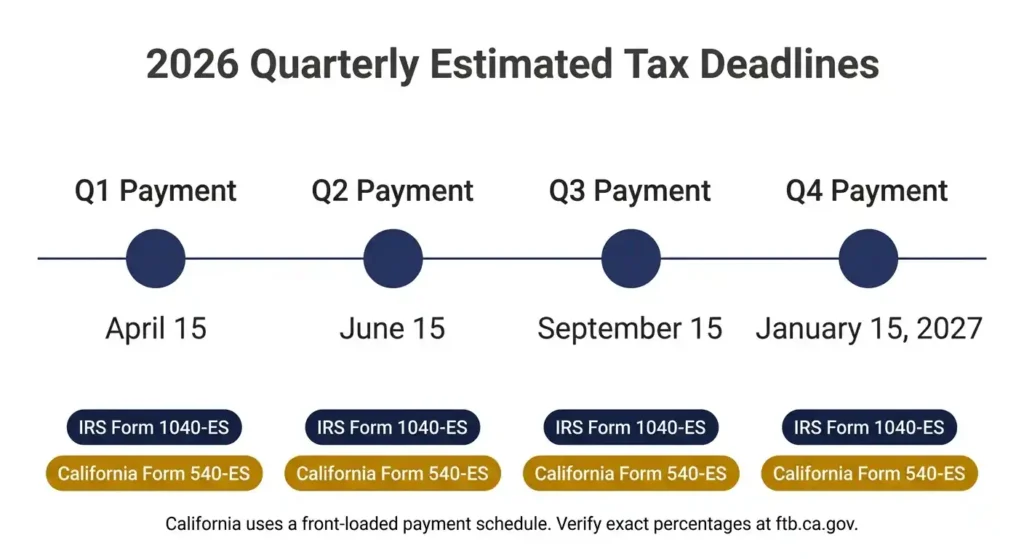
Federal 2026 quarterly deadlines: April 15, June 15, September 15, and January 15, 2027. Use Form 1040-ES for federal payments. California uses Form 540-ES on a similar but front-loaded schedule — the April payment covers a larger share. Check ftb.ca.gov for California’s exact quarterly percentages.
Penalties for Missing Estimated Payments
Both the IRS and California charge underpayment penalties independently. Avoid them by paying either 90% of current year tax or 100% of last year’s tax liability. If your prior year AGI exceeded $150,000, California requires 110% of last year’s tax for the safe harbor.
Self Employment Tax for Different Types of California Workers
Freelancers and Independent Contractors
1099-NEC recipients report all income on Schedule C, subtract business expenses, and pay SE tax on the profit. If net self-employment earnings are under $400 for the year, no SE tax is owed — you still report the income but skip Schedule SE. Above $400, the full 15.3% applies. The worker classification category on this site covers how the IRS and California distinguish contractors from employees.
Gig Workers in California
Uber, Lyft, DoorDash, and Instacart workers are self-employed and owe SE tax on net earnings. The mileage deduction is the biggest write-off available. At 72.5 cents per mile in 2026, 20,000 business miles = $14,500 in deductions, saving roughly $2,200 in SE tax. Platforms issue 1099-K forms showing gross amounts — keep your own mileage log and expense records. California’s AB5 worker classification law directly affects how gig workers are classified; the California ABC test guide explains the three-prong test that determines your status.
Online Business Owners and Consultants
Consultants, coaches, content creators, real estate agents working as independent contractors, YouTube ad revenue, affiliate income, and online course sales all count as self-employment income. Expenses like software, hosting, email tools, and professional development are deductible. On $150,000 in revenue with $30,000 in expenses, SE tax applies to $120,000 in profit, not the gross amount. Keep a running profit and loss statement year-round so there are no surprises at filing time.
Self Employment Tax Forms California Workers Need
IRS Tax Forms
- Form 1040 — standard individual return
- Schedule C — business income and expenses
- Schedule SE — calculates your SE tax
- Schedule 1 — carries the half SE tax deduction and other above-the-line adjustments to Form 1040
- Form 1040-ES — quarterly estimated federal payments
California Tax Requirements
- Form 540 — California individual income tax return
- Form 540-ES — California quarterly estimated payments
The Franchise Tax Board handles all California filing. Manage payments and accounts at ftb.ca.gov through the MyFTB portal. For help understanding what each line of your California return actually means, the California payroll taxes page walks through the key obligations.
How Business Deductions Reduce Your Self Employment Taxes
Common Self Employment Tax Deductions
Every dollar deducted from net profit saves roughly 15.3 cents in SE tax, plus the income tax savings on top. Deductible expenses include: home office (dedicated space only), vehicle expenses at 72.5 cents per mile or actual costs, software subscriptions, professional memberships, client meals at 50%, professional service fees, and recurring business tools like cloud storage and project management software.
Retirement and Health Related Tax Benefits
A SEP-IRA allows contributions up to 25% of eligible compensation, capped at $72,000 in 2026. For self-employed filers, the effective rate is closer to 20% of net SE income after the SE tax deduction adjustment. A Solo 401(k) allows employee contributions up to $24,500 in 2026, plus employer profit-sharing on top, with a combined ceiling of $72,000. A $20,000 retirement contribution saves a California freelancer in the 9.3% bracket about $1,860 in state income tax alone, plus federal savings. California also has the CalSavers retirement mandate for certain businesses, which is worth knowing if you plan to bring on employees.
Self-employed health insurance premiums are fully deductible if you are not eligible for employer coverage through a spouse. This comes off your AGI, reducing both federal and California income tax. If you are also considering an HSA, the HSA contribution limits for 2026 give you the exact numbers to factor into your tax plan.
Special California Self Employment Tax Situations
Self Employed With a W-2 Job
W-2 wages and self-employment income combine to determine your brackets and your position against the $184,500 Social Security wage base cap. If W-2 wages already exceed $184,500, no Social Security tax is owed on self-employment income — only the 2.9% Medicare portion applies. If you are toggling between employed and self-employed work, the 1099 vs W-2 comparison can help you understand the full financial trade-off.
California Remote Workers and Multi-State Income
California taxes all income earned by California residents, regardless of where clients are located. Partial-year residents only owe California income tax on income earned while residing in the state. Nonresidents who work remotely for California clients generally do not owe California income tax — what matters is where the work was physically performed, not where the client is. Workers moving into California mid-year should track their exact residency start date. Workers leaving California should know the state can challenge residency termination if California ties remain strong.
Married and Side Hustle Workers
Side hustle income adds to household AGI and can push both spouses into higher brackets. California’s bracket thresholds for married filers are not always double the single filer thresholds. Filing jointly can help, but the math is worth running for your specific income combination. The California paycheck calculator lets you model married filing jointly scenarios to see how your combined income affects take-home pay.
Common California Self Employment Tax Myths and Mistakes
Myth: California Charges a 15.3% Self Employment Tax
California charges no SE tax. The 15.3% is federal only — 12.4% Social Security and 2.9% Medicare — paid entirely to the IRS. California adds state income tax on top at rates up to 13.3%.
Myth: Business Revenue Is Taxable Income
Taxes are calculated on profit, not revenue. If you invoiced $120,000 but had $30,000 in expenses, taxable SE income is $90,000. Setting aside 30% of revenue instead of profit either overshoots or undershoots what you actually owe.
Myth: 1099 Workers Only Pay Taxes Once a Year
Most self-employed workers owe quarterly estimated payments four times a year. Waiting until April triggers underpayment penalties from both the IRS and California’s FTB. Quarterly payments are the self-employed version of paycheck withholding.
Myth: An LLC Automatically Lowers Taxes
A single-member LLC is taxed exactly like a sole proprietor by default. The SE tax on 100% of net profit still applies. An LLC provides liability protection, not tax reduction. Tax savings require deductions, a different tax election, or both.
How To Lower Your Self Employment Tax Legally
Reduce Taxable Business Profit
Every dollar deducted from net profit saves 15.3 cents in SE tax plus income tax savings. Track all expenses year-round — not just at tax time — using accounting software or a dedicated business account. Deductions must be ordinary and necessary: client meals, equipment, and business software all qualify. The paycheck basics category covers how deductions flow through your overall compensation picture.
Consider Business Structure Options
A sole proprietor or single-member LLC pays SE tax on 100% of net profit. With an S corporation, you pay yourself a reasonable salary and take remaining profit as a distribution — SE tax only applies to the salary portion. At $100,000 in net profit with a $60,000 salary, SE tax applies to $60,000 instead of the full amount, saving $5,000 to $8,000 per year. S corp status makes sense once net profit consistently exceeds $60,000 to $80,000.
The Section 199A QBI deduction allows eligible sole proprietors and pass-through owners to deduct up to 20% of qualified business income from federal taxable income. California does not conform to this deduction — your state taxable income stays higher than your federal taxable income. The 2026 California Earned Income Tax Credit is a separate credit lower-income self-employed workers should also check eligibility for.
Frequently Asked Questions About California Self Employment Tax Rate 2026
Does California have a self employment tax?
No. The 15.3% SE tax is federal only, funding Social Security and Medicare. California taxes self-employment income as regular income at state rates from 1% to 13.3%.
What is the self employment tax rate in California for 2026?
Federal SE tax is 15.3% on 92.35% of net profit. California adds state income tax from 1% to 13.3%. Most California self-employed workers earning $50,000 to $150,000 in profit face a combined SE tax and state income tax burden of 25% to 35%, before federal income tax.
How much should I save for taxes as a freelancer in California?
30% to 35% of every payment. Above $200,000 income, save 40%. Keep it in a separate account and use it only for quarterly estimated payments.
Do 1099 workers pay more taxes in California?
Yes. A 1099 worker pays both the employer and employee portions of Social Security and Medicare — the full 15.3% — while a W-2 employee pays only 7.65%. There is also no withholding on 1099 income, so the bill arrives in a lump sum unless quarterly payments are made.
How do I calculate self employment tax in California?
Net profit x 0.9235 x 0.153 = federal SE tax. Deduct half from income, then apply California’s progressive income tax rates to the remaining taxable income. Add both figures for total SE and state income tax owed.
When are California estimated taxes due?
Federal: April 15, June 15, September 15, January 15, 2027. California follows a similar front-loaded schedule via Form 540-ES. Use Form 1040-ES for federal. Missing either deadline triggers independent penalties from the IRS and FTB.
Final California Self Employment Tax Checklist for 2026
- Calculate net business profit (revenue minus all deductible expenses)
- Estimate SE tax using the 92.35% adjustment and 15.3% rate
- Determine California taxable income after the half SE tax deduction and $5,706 standard deduction
- Track all deductible expenses throughout the year (mileage, home office, software, professional services)
- Confirm quarterly estimated payment dates for both IRS and FTB
- If net profit regularly exceeds $80,000, evaluate S corporation status with a California CPA
- Adjust your pricing to account for your effective tax rate — if you are netting $75 per hour but losing 30% to taxes, your real take-home is closer to $52
Know the numbers, set money aside from the start, and pay quarterly. That is how you stay ahead of it.

Yeasin Sorker is the founder of Paycheck Calculator California. He built this tool in 2018 after noticing that most free paycheck calculators missed California-specific rules like daily overtime and the uncapped SDI rate.
He researches California payroll tax updates regularly and keeps this calculator aligned with the latest IRS, FTB, and EDD published rates. All calculations on this site are estimates based on official 2026 government sources. For personalized tax advice, consult a qualified tax professional.