
Employee misclassification in California happens when a worker who is legally an employee gets labeled and paid as an independent contractor. California presumes employee status under the ABC test, so the burden falls on the employer to prove otherwise. For more on this topic, browse our full worker classification coverage.
In my years covering California payroll law, I have seen this exact mismatch trigger real wage recovery for misclassified workers.
Still, proving misclassification takes solid documentation, and outcomes vary widely case by case.
Are You Being Misclassified as an Independent Contractor?
Start with three quick checks: who controls your daily work, whether your job is core to the company’s business, and whether you run a real independent operation. Fail any one of those, and misclassification is likely.
The fastest way to spot possible misclassification
A 1099 instead of a W-2 is your first flag, not proof. Check who controls your schedule and how you do the job. A delivery driver working for a delivery company is doing the company’s core business, not a side task. Then ask if you run a real, separate business with your own clients, marketing, and equipment.
1099 status does not automatically make you an independent contractor
Whether you get a Form 1099-NEC or a W-2 Form, the paperwork does not decide your legal status. For a side by side breakdown, see our 1099 vs W2 comparison. What matters is the real relationship, not the label. Even a signed independent contractor agreement does not settle it. California courts look past labels to the actual working conditions.
Quick employee-versus-contractor checklist
Compare who controls the work, whether your job matches the company’s normal business, and whether you operate independently.
- Employee signs: fixed schedule, required training, company-owned equipment, one single client
- Contractor signs: multiple paying clients, your own business license, full control over how and when you work
Employee vs. Independent Contractor: What Changes?
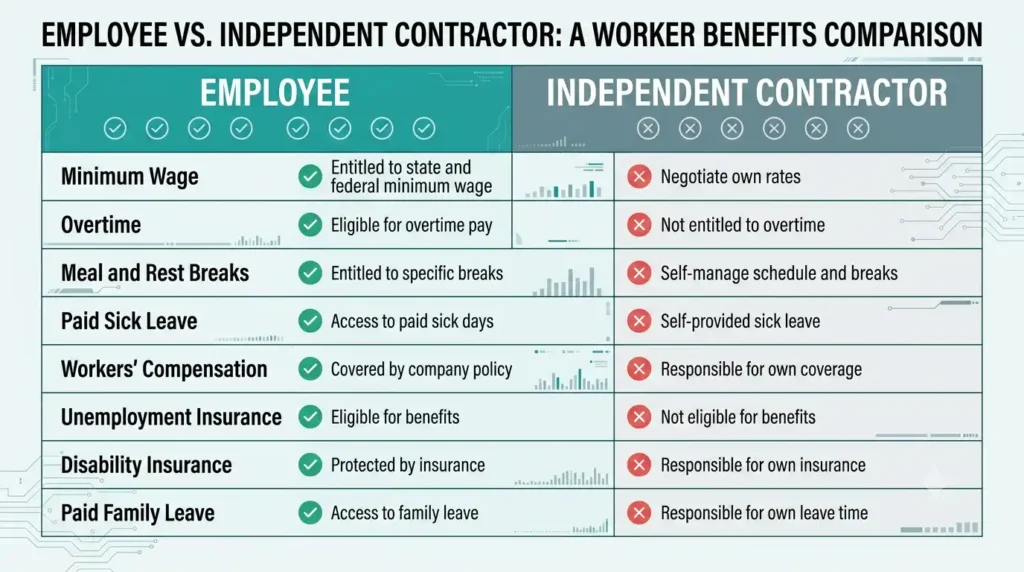
Employees get California minimum wage, overtime, and paid meal and rest breaks. Contractors get none of that. Employees also get paid sick leave, workers’ compensation, unemployment insurance, and access to California Disability Insurance and Paid Family Leave California. Many of these trace back to California’s IWC Wage Orders. Employers must pay payroll taxes and reimburse expenses for employees, while contractors pay their own self-employment taxes, costs some companies dodge by mislabeling workers.
Takeaway: Misclassification is not just a tax issue, it strips away wage protections, insurance, and benefits you are legally owed.
What to do if several warning signs apply
Save pay stubs, invoices, texts, schedules, and emails now. Separate fact from guesswork about your legal status. Never delete messages or old schedules. Plan your next move calmly before confronting your employer.
California Employee Misclassification Laws at a Glance
California presumes you are an employee unless your employer proves otherwise, the opposite of what most workers assume. This sits within our broader California labor laws coverage.
What California law generally presumes
Every worker is presumed an employee under California’s ABC framework. The burden is on the hiring company, not you. A 1099 or contractor agreement does not shift that burden. This affects wage claims, insurance, and unemployment benefits.
How AB 5 changed California worker classification
Assembly Bill 5 made the ABC test California’s standard for nearly all labor and unemployment insurance claims. It lives in Labor Code sections 2775 through 2787. AB 5 followed the 2018 Dynamex Operations West decision, where the California Supreme Court adopted the strict ABC approach. AB 2257 later expanded and clarified exemptions.
Why the classification rules are not identical for every worker
Not every job gets the same test. The California Legislature carved out statutory exceptions for specific occupations and business setups. An exemption from the ABC test does not automatically make you a contractor. It just means the Borello test applies instead.
The California ABC Test Explained Step by Step
Three letters decide your status: A, B, and C. Fail one, and you are legally an employee. Check Part B first. In my experience it kills more contractor claims than the other two combined. For a deeper walkthrough, see our full California ABC test guide.
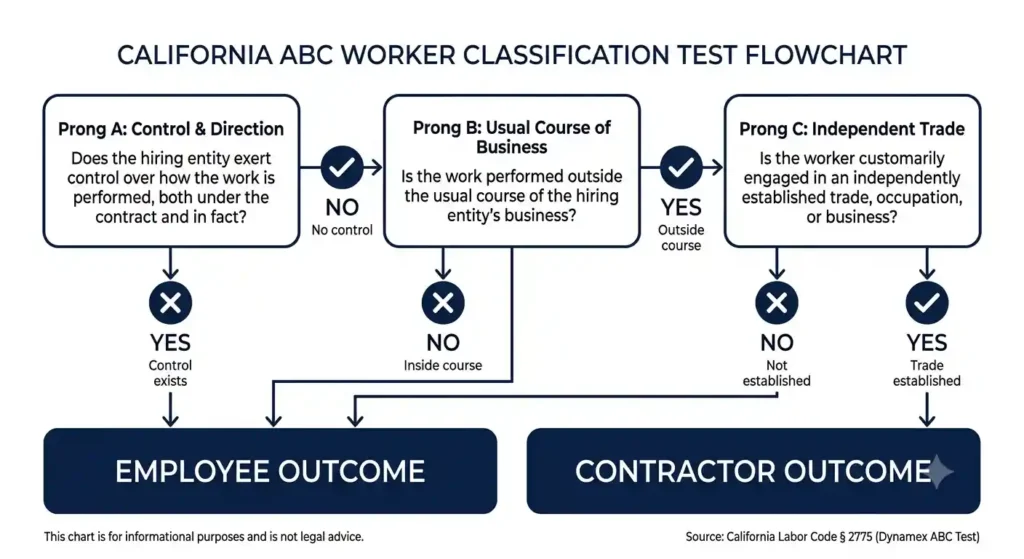
Part A: Are you free from the company’s control and direction?
This looks at real control, not just the contract. Does the company set your schedule, give step by step instructions, or watch how you perform? Required training, uniforms, and mandatory equipment point to employee status. The company can control the result, not the process, for a true contractor.
Part B: Is your work outside the company’s usual business?
This decides most cases. If your daily work matches what the company sells, you fail Part B automatically. A software company hiring engineers as contractors almost always fails here. A tech company hiring a plumber passes, since plumbing is unrelated to software.
Part C: Do you operate an independently established business?
Look for advertising, a business license, multiple clients, and the ability to take new customers anytime. A worker who only ever works for one company, with no outside clients, fails this factor. Ask if you could survive without this one company.
Why failing one ABC factor can change the result
All three parts must be satisfied. Passing two out of three still makes you an employee. That is why it is called a strict test. Always check for a statutory exemption first, since that changes which test applies.
Takeaway: One failed factor is enough to make you an employee, no matter how the other two turn out.
ABC Test vs. Borello Test: Which One Applies to You?
Some workers never get the ABC test. If your occupation qualifies for a statutory exemption, California uses the older, more flexible Borello standard instead.
How the Borello test works
Borello asks first whether the company controls how you do your work. It then weighs factors like who supplies tools, how long the relationship lasted, and whether special skill is required. No single factor decides the outcome, courts weigh the whole relationship, making Borello more flexible and less predictable than ABC.
ABC test vs. Borello comparison
| ABC Test | Borello Test | |
|---|---|---|
| Presumption | Presumes employee status | No presumption either way |
| Structure | All three parts (A, B, C) must be proven | Balances many factors together |
| When it applies | Most workers, most claims today | Only when a statutory exemption removes ABC coverage |
| Predictability | Stricter, more predictable | More flexible, less predictable |
Figuring out which test applies to you has to happen before anything else, since the standards lead to different outcomes.
A simple decision path for identifying the applicable test
Check first for a statutory exemption. Then check for a genuine business to business relationship. If neither applies, ABC governs automatically. Only a valid exemption triggers Borello.
Takeaway: Most workers default to the ABC test, Borello only applies when a specific exemption says so.
Signs Your Employer May Have Misclassified You
Some red flags show up again and again.
Your employer controls your schedule and daily work
Fixed shifts, mandatory availability, and detailed instructions point to employment. Getting evaluated the same way a regular staff member would be is another signal. Restrictions on exactly how you do your tasks push hard against contractor status.
You perform work that is central to the company’s business
If your job matches what the company sells, you are doing its actual business. Ask if customers are paying for the exact service you provide. If the company could not operate without people doing your job, that dependency matters under Part B.
You do not operate a genuine independent business
One-company dependency is the biggest tell. No outside marketing, no separate customer base, no ability to negotiate your own terms, all point to employee status. If you cannot offer services to the public like a real business owner, you are not independent.
Other practical red flags
Employer-provided tools, equipment, or workspace lean toward employment. Mandatory meetings, training, and required reporting look like employee policies. Hourly pay or a recurring paycheck-like schedule resembles wages more than contractor invoicing, and unpaid prep or cleanup time can also count as off the clock work.
Takeaway: The more your daily work looks like a regular job, the more likely you are legally an employee.
What You Could Be Owed After Misclassification
This is where the real money question comes in, and it overlaps closely with wage theft in California.
Unpaid minimum wages and overtime
You may be owed unpaid minimum wage and overtime for hours actually worked under California overtime laws. Contractor invoices do not erase a wage claim if the relationship was really employment. Hypothetical: 50 hours a week at $20 an hour flat as a “contractor” could mean owed overtime for 10 extra hours weekly, adding up fast. Without exact timecards, agencies can rely on your own reasonable records.
Missed meal and rest break premiums
Employee status brings protections under California’s meal and rest break laws. A missed required break can trigger a premium payment on top of regular wages, but only for breaks actually missed. Keep records of your actual hours.
Unreimbursed business expenses
California entitles employees to reimbursement for necessary business expenses, including mileage, work phone bills, and equipment you bought yourself. Save every receipt. This is often the most overlooked recovery category.
Other potential penalties and remedies
You may also be entitled to wage statement penalties and waiting time penalties for delayed final pay under California final paycheck law, plus statutory penalties and interest. What you personally recover is separate from any civil penalty owed to the state.
Takeaway: Back pay, missed breaks, unreimbursed expenses, and penalties can all stack together into one recovery claim.
California Penalties for Willful Employee Misclassification
California does not go easy on employers who knowingly mislabel workers to cut costs.
What Labor Code section 226.8 prohibits
Section 226.8 bans willful misclassification, meaning the employer knew or should have known a worker was really an employee. This differs from an honest, good faith classification dispute. The law targets deliberate cost cutting, not reasonable judgment calls.
What penalties can apply
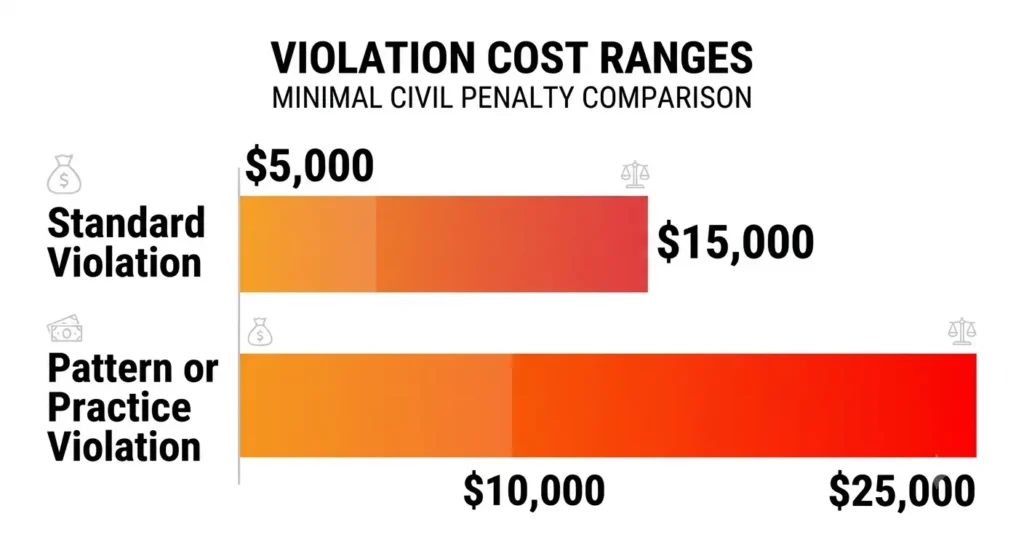
Willful misclassification brings civil penalties of $5,000 to $15,000 per violation. A proven pattern or practice raises that to $10,000 to $25,000 per violation. These penalties are separate from unpaid wages owed directly to you.
Can an employer charge misclassified workers for business costs?
No. Charging fees or deductions connected to employment can violate Labor Code 226.8 if you are really an employee. Watch for improper charges on pay statements. An employer also cannot fix past problems with a retroactive contractor agreement, and reclassifying you going forward does not erase past wage liability.
Takeaway: Willful misclassification starts at $5,000 per violation and can climb to $25,000 for a pattern of violations, separate from any back wages owed.
Real-World California Misclassification Examples
Here are four patterns I see constantly, and in my experience similar patterns show up with truck drivers, home health workers, construction crews, and janitors hired through a subcontractor.
Example: A 1099 worker with a fixed company schedule
A warehouse worker gets a 1099 but clocks in at 8am sharp, follows a supervisor’s task list, and uses company scanners. Part A fails immediately from the direct control. Next step: document the schedule and report it to the Labor Commissioner.
Example: A freelancer serving multiple clients
A graphic designer works for five companies, sets her own hours, and advertises online. She likely passes all three ABC parts. Her 1099 status here actually matches reality.
Example: An LLC worker performing the company’s core service
A developer forms an LLC and writes a startup’s main product code. Part B fails anyway, since that is the startup’s core business. Forming an entity does not fix a failed business to business relationship.
Example: A worker whose classification changed after a complaint
A rideshare-style contractor complains about pay and gets his hours cut the next week. That timing raises a real retaliation concern, separate from classification. He should preserve every message and schedule change from before and after.
When the ABC Test Does Not Apply
Certain jobs and setups skip the ABC test and fall under Borello instead.
California occupations and relationships with statutory exceptions
AB 5 and AB 2257 carve out exemptions for occupations like doctors, lawyers, real estate agents, and certain freelance writers, among others. Check the exact requirements for your specific job.
The business-to-business exception
This applies when a genuinely independent business contracts with another business. It requires a written contract, the ability to set your own rates, and independence from the hiring company. When it legitimately applies, Borello replaces ABC. Forming an LLC alone does not satisfy it.
Professional services and other special exceptions
Licensed professionals like accountants, architects, and insurance agents often fall under professional service exemptions, requiring an active license and a genuinely independent practice. Not every licensed professional automatically qualifies.
Gig workers and special statutory arrangements
App-based rideshare and delivery drivers fall under Proposition 22, a voter-approved framework outside the standard ABC test. Prop 22’s status is not fully settled: the California Supreme Court upheld it in 2024, but a trial court ruled it unconstitutional in April 2026, and that ruling is being appealed. Not every gig arrangement gets this treatment.
Special Cases That Can Change the Answer
Some situations do not fit neatly into the usual pattern.
Remote workers and work-from-home contractors
Working from home does not mean you pass the control test automatically. Set video call hours, screen monitoring, and dictated daily processes still count as control. Remote work does not equal independent contracting on its own.
Workers with an LLC or corporation
Forming a business entity is a paperwork step, not proof of independence. Courts look at actual control and operations. Business-to-business treatment still requires meeting every condition of that exception.
Workers with multiple clients
Multiple clients help your case but are not automatic proof of contractor status. What matters more is whether you can market your services and negotiate terms with each one. One dominant company still controlling your work defeats the classification.
Workers who perform work for multiple companies
Each company gets evaluated separately. Two companies can act as joint employers over the same work, and a staffing agency along with its client company can both share liability. Subcontracting works the same way. Hiring you through a subcontractor does not shield the company above it. Keep separate records for each relationship.
What Evidence Proves Employee Misclassification?
Good documentation wins these cases. Start collecting now, not after a dispute begins.
Employment and contractor documents
Keep these on file:
- Contractor agreement, offer letters, and onboarding paperwork
- Company policies and handbooks, even if not meant for contractors
- Job descriptions, including any changes made over time
Proof of employer control
Schedules and shift assignments are gold. Save:
- Emails, texts, and written instructions about how to do your job
- Training requirements and mandatory meeting records
- Performance reviews, since these count as control evidence even under contractor status on paper
Proof of wages and hours
- Every 1099 form and invoice you submitted, which you can weigh against a 1099 vs W2 tax comparison or run through our 1099 vs W2 calculator
- Bank records and how to read your California pay stub to confirm your actual pay pattern
- Time records, calendars, and notes on overtime or missed breaks, which matter enormously for back pay calculations
Proof of independent business activity
- Business license and professional credentials
- Advertising, website records, and other client contracts
- Business expenses, your own equipment, and business insurance
Common Employee Misclassification Myths
An employer cannot simply choose your classification because it is convenient, and getting paid by the project or paying self-employment taxes does not settle the question either.
“My 1099 proves I am an independent contractor”
It does not. Tax forms report income, they do not determine legal employment status. What matters is the real working relationship and the applicable test. Do not let a tax form talk you out of a legitimate claim.
“I signed a contractor agreement, so I waived employee rights”
You cannot waive certain protections in California just by signing. Core wage and hour rights are non-waivable. The agreement is still relevant evidence though, since it shows original intent.
“Having an LLC automatically makes me a contractor”
Forming an LLC is a business decision, not a legal classification. What counts is actual independence and meeting the business to business requirements in full. Plenty of LLC holders still qualify as employees.
“Flexible hours mean I cannot be an employee”
Schedule flexibility is only one piece of the control analysis. Employers can still control instructions, methods, and performance standards without rigid hours. Partial flexibility does not equal overall independence.
What to Do If You Think You Are Misclassified
Here is your actual game plan, step by step.
Step 1: Document the working relationship
Write down specific examples of control and supervision as they happen. Save every document and message now. Build a simple timeline. Never alter or invent records.
Step 2: Determine which classification test applies
Check for a statutory exemption first. Figure out whether ABC or Borello governs. Compare your actual duties against the applicable test. Identify facts you are unsure about before making accusations.
Step 3: Calculate what employee protections may have been lost
Estimate unpaid wages and overtime using your own records. Add up missed breaks and unreimbursed expenses. Check benefits and insurance you may have lost, including unemployment or disability insurance, and if relevant, maternity leave pay you never had access to.
Step 4: Choose the safest next action
Decide whether to raise the issue internally first. Consider filing with the Labor Commissioner’s Office if internal resolution feels unsafe. The EDD may be the right agency depending on the issue. For complex or high-value claims, legal advice is worth it.
How to File a California Wage Claim for Misclassification
The Labor Commissioner’s Office handles a large share of these disputes without a lawsuit.
When the Labor Commissioner can address misclassification
Wage claims involving alleged misclassification fall within its authority. Related violations, like unpaid overtime or missed breaks, often get included. The agency investigates and can order payment, faster than private litigation for many workers.
Information needed for a wage claim
You will need your employer’s name and contact info, exact employment dates, job duties, pay records, and any classification documents. Strong evidence moves your claim faster.
What happens after filing
The agency conducts a review and may schedule a conference. Your employer responds. If unresolved, a formal hearing may follow, then a decision and possible enforcement.
California wage-claim deadlines
| Claim type | Deadline |
|---|---|
| Most wage violations (minimum wage, overtime, breaks) | 3 years |
| Written contract claims | 4 years |
| Certain specific penalties | Shorter, case-dependent |
Verify the exact deadline for your claim type.
Takeaway: Missing your filing deadline can end your claim before it starts, so check the timeline early.
Should You Report Your Employer or Talk to a Lawyer?
Both paths exist for a reason, and the right one depends on your situation.
When the Labor Commissioner may be a practical option
Straightforward wage and hour violations tied to misclassification often work well through the agency route. It suits solid evidence without a drawn-out legal fight, and is generally faster and cheaper than a lawsuit.
When an employment attorney may be especially useful
Large unpaid wage exposure, complex exemption or Borello questions, multiple employers, joint employer issues, or retaliation after termination usually justify legal help. Successful claims can also recover attorney fees or litigation costs on top of back wages.
When another California agency may be involved
The EDD handles unemployment insurance disputes specifically. A wrong Notice of Unemployment Insurance Award generally gives you 30 days to challenge it. A DE 429Z request asks a former employer to confirm wage details, and an Affidavit of Wages, form DE 23A, lets you establish actual pay with 1099s or pay stubs when EDD records are missing. Inside the Labor Commissioner’s Office, the Division of Labor Standards Enforcement, or DLSE, handles wage claims, while the Bureau of Field Enforcement, or BOFE, investigates violations, both under the Labor and Workforce Development Agency. Cal OSHA handles safety concerns, workers’ compensation runs through its own system.
Can Your Employer Fire You for Challenging Misclassification?
California protects workers who raise these concerns, and retaliation carries its own consequences.
What retaliation can look like
Outright termination is the most obvious form, but reduced hours, fewer assignments, pay changes, or sudden write-ups after a complaint all signal retaliation too.
What records to preserve if retaliation occurs
Save your schedule from before and after the complaint. Keep written complaints and any response, plus texts and emails around the timing. Document every pay or assignment change.
What to do if retaliation happens
Keep retaliation evidence separate from classification evidence, since they are different claims. Identify the applicable California protection. Consider reporting to the right agency. Legal advice is worthwhile when the stakes are significant.
Employee Misclassification California FAQ
Can my employer call me an independent contractor if I work like an employee?
No. Your actual working relationship controls your status, not the label in a contract. California’s ABC test or Borello, depending on your occupation, decides the real answer.
What is the ABC test in California?
A three-part test presuming every worker is an employee unless the company proves independence from control, work outside its usual business, and an independently established trade. All three parts must be satisfied. Exempt occupations fall under Borello.
How do I know if I am misclassified as a 1099 worker?
Check who controls your schedule and tasks, whether your work matches the company’s core business, and whether you run a genuine independent operation. High control plus low independence means misclassification is likely.
Can I get back pay if I was misclassified?
Yes, potentially, including unpaid minimum wage, overtime, missed break premiums, and unreimbursed expenses. Exact recovery depends on your specific hours and violations.
Can I sue my employer for misclassification in California?
You can pursue a private lawsuit or file a wage claim through the Labor Commissioner. The right path depends on your facts and stakes. Complex or high-value situations often call for legal advice.
How long do I have to report employee misclassification?
Deadlines vary. Most wage violations carry a three-year window, written contract claims stretch to four years, some penalties have shorter deadlines. Confirm your specific timeline early.
Can I report misclassification while I still work for the company?
Yes. California law protects you from retaliation for doing so. Still, preserve evidence and think through practical risks first.
What happens after I file a misclassification claim?
The agency reviews your claim, your employer responds, and a conference or hearing may follow, leading to a negotiated resolution or formal enforcement.
What if my occupation is exempt from the ABC test?
Exemption means Borello applies instead of ABC, not that you are automatically a contractor. Exemption status still requires meeting real conditions.
Does California classification differ from federal classification?
Yes. State and federal tests can reach different conclusions for the same job. California serves state labor law purposes, while the federal FLSA employee classification standard focuses on different questions, including tax treatment. Public employees, interns, and volunteers can fall under separate rules. Work before January 1, 2020, when AB 5 took effect, is generally evaluated under the older Dynamex and Borello standards. One determination does not settle every question.
Your California Misclassification Action Checklist
Before you contact your employer
- Gather contracts, 1099s, invoices, and pay records
- Preserve every communication, schedule, and shift record
- Write down your job duties and the level of control exercised
- Never delete or alter anything, even records that seem unhelpful
Before filing a claim
- Pin down which classification test applies to your situation
- List every potentially unpaid wage or benefit issue
- Check your filing deadline
- Organize evidence chronologically
Before deciding your next move
- Weigh internal resolution against filing an agency claim
- Think through retaliation risk and job security
- Remember that immigration status does not eliminate your California labor law protections, so do not let that fear alone stop you
- Consider your claim’s realistic value and complexity, and whether it calls for legal advice
Sources and Official California Resources
California Labor Commissioner’s Office
The agency publishes official guidance on independent contractor classification and wage claim filing procedures. It operates under the California Department of Industrial Relations. See how we source and verify figures on our methodology page.
Employment Development Department
The EDD offers its own guidance tied to employment status determinations for unemployment purposes, distinct from Labor Commissioner functions.
California statutes and official legal authorities
The core framework lives in Labor Code sections 2775 through 2787, with willful misclassification penalties in section 226.8. Section 2776 covers the business-to-business exception, section 2778 covers professional services exemptions, section 2782 covers the data aggregator exemption, and section 2783 covers specific occupational exemptions. California Unemployment Insurance Code section 621 defines employment for unemployment purposes, and certain licensed occupations also draw on the California Business and Professions Code. The 2018 Dynamex Operations West, Inc. v. Superior Court decision started this shift, and AB 5 along with AB 2257 built the statutory structure that followed.
Key Takeaways About Employee Misclassification in California
The most important points to remember
A 1099 or signed contract cannot settle your employment status alone. Identify the correct classification test first. Misclassification touches your wages, benefits, insurance, and workplace protections all at once. Solid evidence and quick action can make a real difference in what you recover.

Yeasin Sorker is the founder of Paycheck Calculator California. He built this tool in 2018 after noticing that most free paycheck calculators missed California-specific rules like daily overtime and the uncapped SDI rate.
He researches California payroll tax updates regularly and keeps this calculator aligned with the latest IRS, FTB, and EDD published rates. All calculations on this site are estimates based on official 2026 government sources. For personalized tax advice, consult a qualified tax professional.