
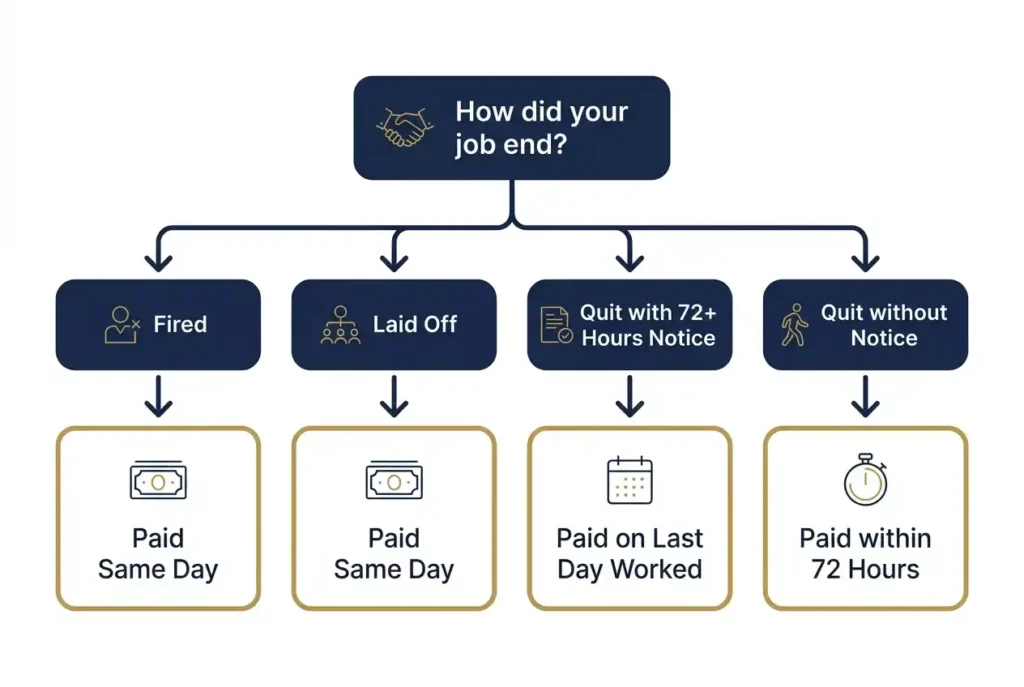
In California, final paycheck timing depends on how the job ends. Get fired or laid off, and the employer must pay everything the same day. Quit with at least 72 hours notice, and the final check is due on the last day worked; quit without notice, and the employer has 72 hours. Miss either deadline, and Labor Code 203 adds a waiting time penalty equal to a full day’s wage for every day late, up to 30 days. That penalty doesn’t apply if a genuine, good faith dispute exists over the amount owed.
Quick Answer: When Must You Receive Your Final Paycheck in California?
Final Paycheck Deadline at a Glance
| Separation Type | Deadline |
|---|---|
| Fired | Same day, at the place of termination |
| Laid off | Same day, treated like a firing |
| Quit with 72+ hours notice | Last day worked |
| Quit with no notice | Within 72 hours of quitting |
Takeaway: Fired means same day, quit with notice means last day, quit without notice means 72 hours. No exceptions hiding in the fine print.
How California Final Paycheck Law Works
Labor Code Sections 201, 202, and 203 say a final paycheck is no longer the company’s money to hold the moment you stop working, and that hasn’t changed for 2026. These rules sit inside California’s broader labor laws framework. For employees, it means you don’t chase money you already earned. For employers, slow payroll isn’t a legal excuse, and repeat delays start looking like wage theft, the kind of issue that often shows up when someone asks why their paycheck looks so low in the first place.
Who Is Covered?
Full-time, part-time, hourly, and salaried employees, all covered the same way, regardless of hours logged. Here’s the part most people miss: remote workers and out-of-state company employees count too, as long as the work was for a California employer. Misclassifying you as a contractor doesn’t erase this right, and our ABC test guide breaks down exactly how California decides who counts as an employee.
Who May Have Different Rules?
Independent contractors aren’t covered, since the line between a 1099 contractor and a W2 employee determines whether this law even applies, an issue that falls under worker classification generally. If you’re genuinely self-employed, this entire law sits outside your situation, though you’ll want to understand your self-employment tax rate instead. A few industries get their own timeline too. Motion picture workers fall under Section 201.5, oil drilling under 201.7, seasonal agricultural workers under 201.8. Union contracts can override the standard rule, so check yours first.
When Must Your Employer Pay You?
If You Are Fired
Paid same day, at the location of termination, regardless of cause. I’ve seen clients fired at 4:55 PM Friday walk out with a check in hand. “We’ll process it Monday” is illegal. Remote employees get paid the same way they normally were, usually mailed to the address on file.
If You Are Laid Off
Same as a firing: same day, no grace period. I’ve handled mass layoff cases where employers tried to stagger checks over a week, which is not legal. A warehouse laying off 40 people in one afternoon still owes all 40 a same-day check, not a staggered rollout.
If You Quit With At Least 72 Hours’ Notice
Final check is due on your last day. Tell your boss Monday that Thursday is your last day, and Thursday is payday. Sandra gave two weeks notice and got her full check, vacation included, on her last day.
If You Quit Without Notice
Employer has 72 hours from the moment you quit, calendar hours, not business days. Quit Friday afternoon, and the weekend still counts toward that clock.
What Must Be Included in Your Final Paycheck?
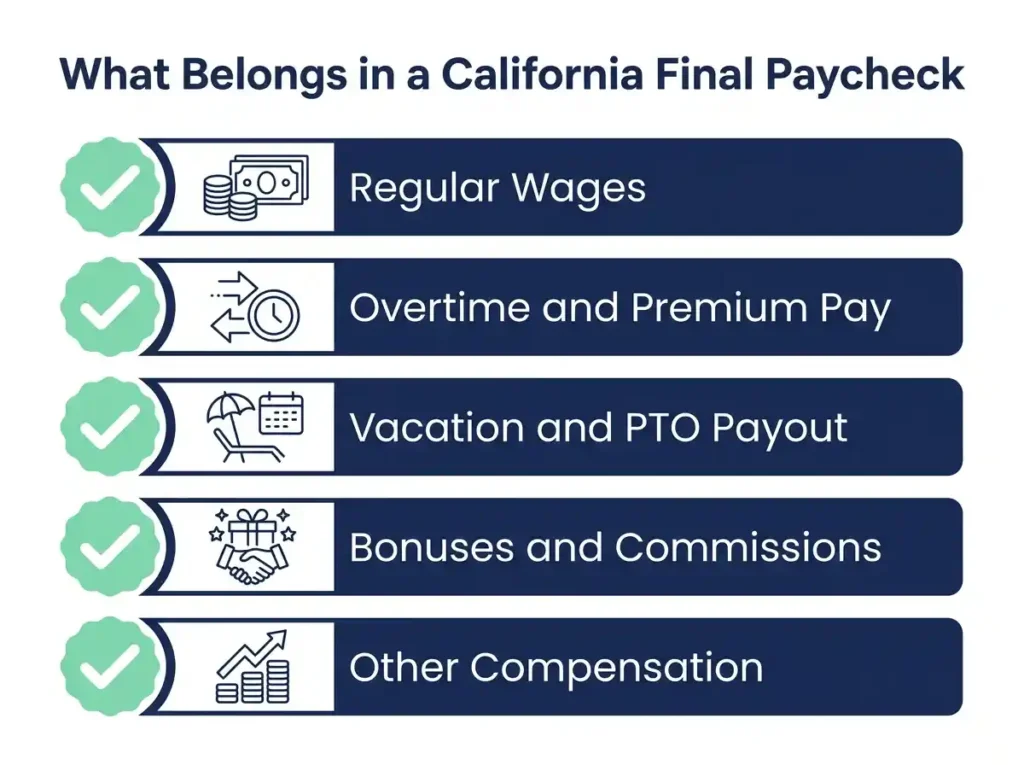
Regular Wages
Every hour worked, hourly or salaried, prorated exactly, no rounding, the same math behind any gross pay calculator. The check must also come with an itemized wage statement showing hours, rate, and deductions, the same format covered in our guide on how to read a California pay stub.
Overtime and Premium Pay
Overtime, double time, and missed meal or rest break premiums all belong in the final check, not “settled later.”
Vacation and PTO
Earned vacation is wages under Labor Code 227.3 and must be paid out. Sick leave doesn’t, unless it’s bundled into one PTO policy. Negative PTO balances are legally murky; employers can’t simply dock pay for it without written authorization, and any deduction still can’t drop pay below minimum wage.
Bonuses and Commissions
Earned commissions and bonuses must be included, even as an estimate, with the rest trued up later. I’ve recovered missed commission payments months after an employee’s last day simply because the employer forgot to fold them in. “Still calculating” doesn’t excuse delaying the whole check.
Other Compensation
Unreimbursed expenses, piece rate, shift differentials, on-call pay, and reporting time pay all count. Severance is separate, an optional payment under its own agreement, not a wage substitute.
Waiting Time Penalties Explained
What Are Waiting Time Penalties?
Labor Code 203’s waiting time penalty rules punish willful late payment. “Willful” just means the employer knew wages were owed and chose not to pay on time.
How Penalties Are Calculated
Formula
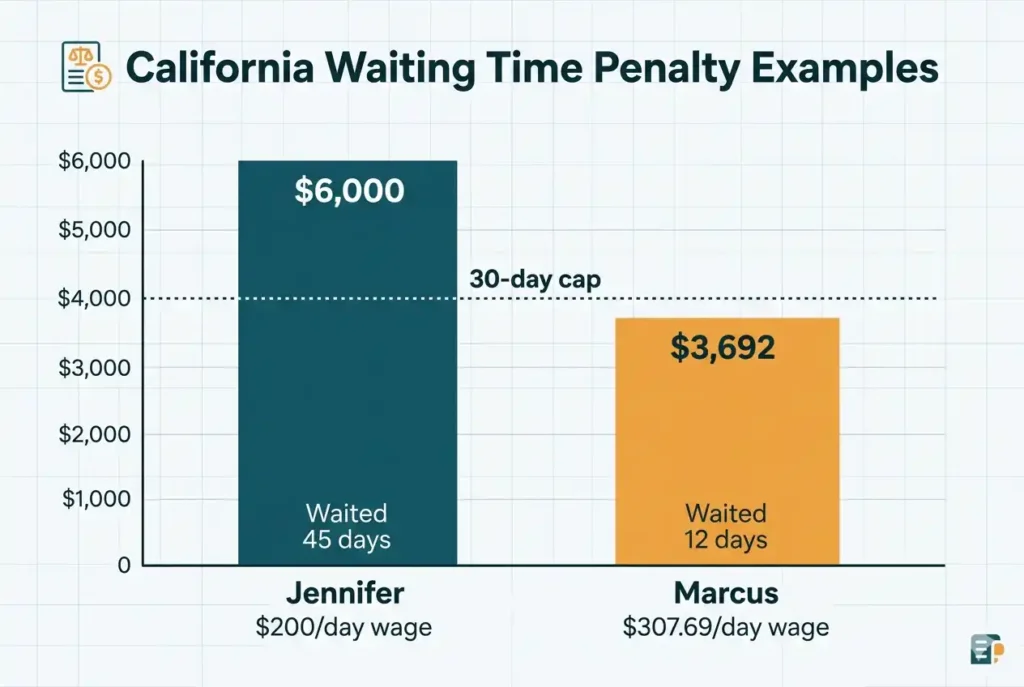
One day’s wage for every calendar day late, capped at 30, weekends and holidays included (Mamika v. Barca, 1998). The penalty stops the moment payment is made, even if late.
Real Examples
Jennifer earns $200/day, waits 45 days, capped at 30: $6,000 owed. Marcus earns $307.69/day, waits 12 days past his 72-hour deadline: about $3,692 owed.
When Penalties Do Not Apply
A genuine, evidence-backed good faith dispute avoids penalties; partial payment doesn’t. Labor Code 206 still requires immediate payment of any undisputed wages. Refusing offered payment also forfeits the penalty for that period.
Real-Life California Final Paycheck Scenarios
Fired Without Warning
I’ve seen this exact pattern repeat across dozens of paycheck scenarios. David, an employee earning $60,000 a year, fired Tuesday, told to wait until Friday. The 3-day delay plus missing vacation pay cost his employer about $700 in penalties on top of $3,300 owed.
Two Weeks’ Notice Given
Last-day check should include final pay period plus PTO payout, delivered the usual way.
Quit Without Notice
Maria, 35 hours a week at $18/hour, quit on the spot. Her 72-hour clock ran through the weekend regardless, and her employer couldn’t use “we’re closed Saturday” as an excuse.
Commission Employee
Earned commissions must be paid on time even if final reconciliation comes later.
California Final Paycheck Law Comparison
Fired vs Quit
Fired or laid off: same day, always. Quit with 72 hours notice: last day. Quit without: 72 hours.
Vacation Pay vs Sick Leave
Vacation is wages and must be cashed out. Sick leave isn’t, unless bundled into PTO.
California Law vs Federal Law
The FLSA sets no specific final-pay deadline; next payday is just common practice. California’s 72-hour and same-day rules are far stricter, and California sits at the strict end compared to most other states.
What Your Employer Cannot Do
Illegal Delays
“Payroll runs on Tuesdays,” manager sign-off, or system delays aren’t valid excuses, and neither are bank or payroll company errors. A bounced check counts as nonpayment and can trigger its own penalty under Labor Code 203.1.
Illegal Withholding
Employers can’t hold your check for an unreturned laptop, badge, or uniform, or unsigned paperwork. Wages get paid in full first; property and release disputes are separate, exempt or nonexempt.
Unauthorized Deductions
Cash shortages, broken equipment, and theft can’t be deducted without your written consent, and even then strict limits apply. Pay first, dispute later, never the other way around.
Common Myths About California Final Paychecks
“I’ll Get Paid on the Next Payday”
Not true. The 72-hour and same-day rules override the regular schedule entirely.
“Unused Vacation Is Lost”
Not even close. Vacation is earned wages and must be paid out dollar for dollar.
“My Employer Can Hold My Check Until I Return Equipment”
Nope. Equipment returns and final wages are separate issues.
“Waiting Time Penalties Are Automatic”
Not quite. They require willful delay with no good faith dispute.
What to Do If Your Final Paycheck Is Late
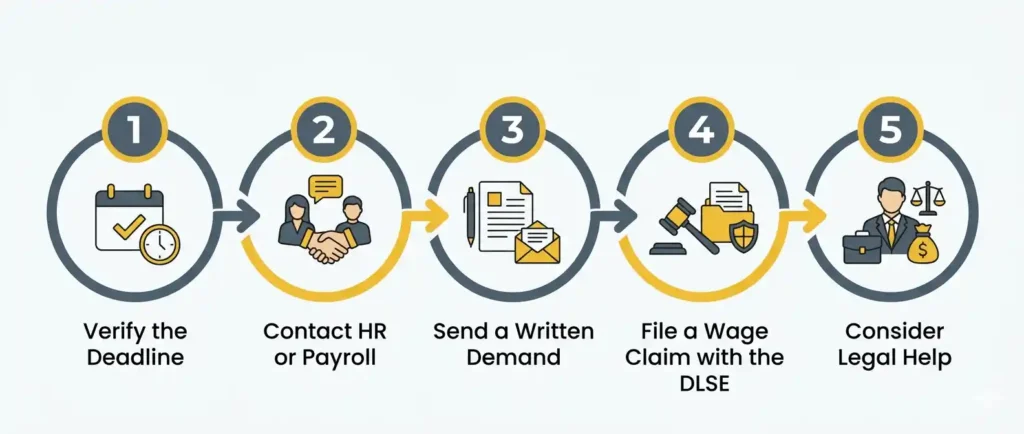
Step 1: Verify the Deadline
Confirm how you separated, fired, laid off, or quit with or without notice, to know your exact deadline.
Step 2: Contact HR or Payroll
Ask when and how the check was issued. Get it in writing.
Step 3: Send a Written Demand
Cite the Labor Code section and keep a copy.
Step 4: File a Wage Claim
File with the DLSE, also known as the Labor Commissioner. Bring pay stubs, timesheets, and written communication.
Step 5: Consider Legal Help
Three-year statute of limitations. An attorney or small claims court can move faster than the DLSE, and you may also recover attorney’s fees.
Frequently Asked Questions
Can my employer mail my final paycheck?
Only if you request it; once mailed, the mailing date itself counts as the payment date, not when it arrives.
Can my employer pay by direct deposit?
Yes, if that’s your normal method and it lands by the deadline.
What if my final paycheck is missing PTO?
A clear violation; vacation pay is wages, and the missing amount can also trigger a waiting time penalty.
Can my employer deduct company equipment?
No, not without your written authorization, and never below minimum wage.
What if my final paycheck is only partially paid?
The unpaid portion still counts as late, and the penalty clock runs on that remaining balance until it’s paid in full.
How long do I have to file a wage claim?
Three years from the violation, whether you go through the DLSE or file in court directly.
What if my employer says payroll wasn’t ready?
Not a valid excuse; the DLSE has rejected this defense consistently.
Do weekends count in the 72-hour rule?
Yes, calendar hours, no pause for closed offices.
Key Takeaways
Fired or laid off: same day. Quit with notice: last day. Quit without: 72 hours. Miss it, and penalties accrue at your daily wage, up to 30 days. “Next payday” excuses and equipment holdups are both illegal. Document everything, and act within three years through the DLSE. Labor Code Sections 200 through 203 cover the legal language behind every rule here.

Yeasin Sorker is the founder of Paycheck Calculator California. He built this tool in 2018 after noticing that most free paycheck calculators missed California-specific rules like daily overtime and the uncapped SDI rate.
He researches California payroll tax updates regularly and keeps this calculator aligned with the latest IRS, FTB, and EDD published rates. All calculations on this site are estimates based on official 2026 government sources. For personalized tax advice, consult a qualified tax professional.