
In 2026, California maternity leave pays 70% to 90% of your wages, up to a maximum of $1,765 per week. Most eligible workers combine State Disability Insurance with Paid Family Leave for a total of 18 to 20 weeks of paid benefits. That $1,765 weekly cap is a hard ceiling — higher earners hit it fast and see a real income gap. California’s leave system is actually five separate programs, each with different rules, and knowing how they stack together determines how much you actually take home. You can also run your numbers any time using our California paycheck calculator to see exactly what your take-home pay looks like before and after leave. For a broader look at all leave and benefit programs in California, explore our paid leaves and benefits resource hub.
Quick Answer — How Much Does California Maternity Leave Pay in 2026?
At-a-Glance Maternity Leave Pay Table
Estimates based on 2026 benefit rates. Your actual benefit depends on your highest-earning quarter in the base period.
| Annual Salary | Estimated Weekly Benefit | Estimated Total (18 weeks) | Wage Replacement |
|---|---|---|---|
| $35,000 | $606 | $10,908 | ~90% |
| $50,000 | $865 | $15,570 | ~90% |
| $75,000 | $1,010–$1,100 | $18,180–$19,800 | 70–90% (near threshold) |
| $100,000 | $1,350 | $24,300 | ~70% |
| $130,000+ | $1,765 (max) | $31,770 | Capped |
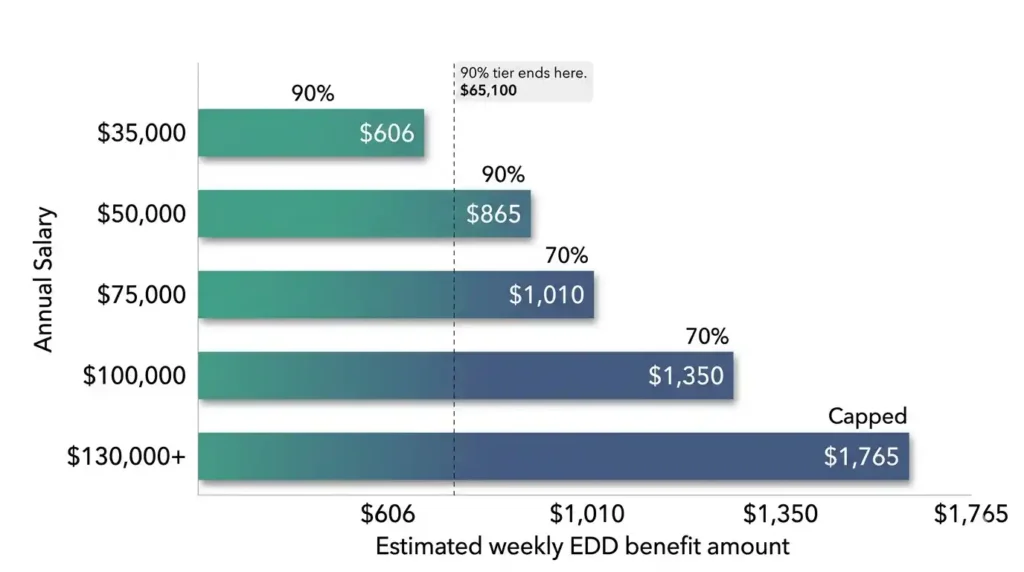
Combined SDI plus PFL. No employer top-off assumed.
How California Maternity Leave Actually Works
Why Maternity Leave Is So Confusing
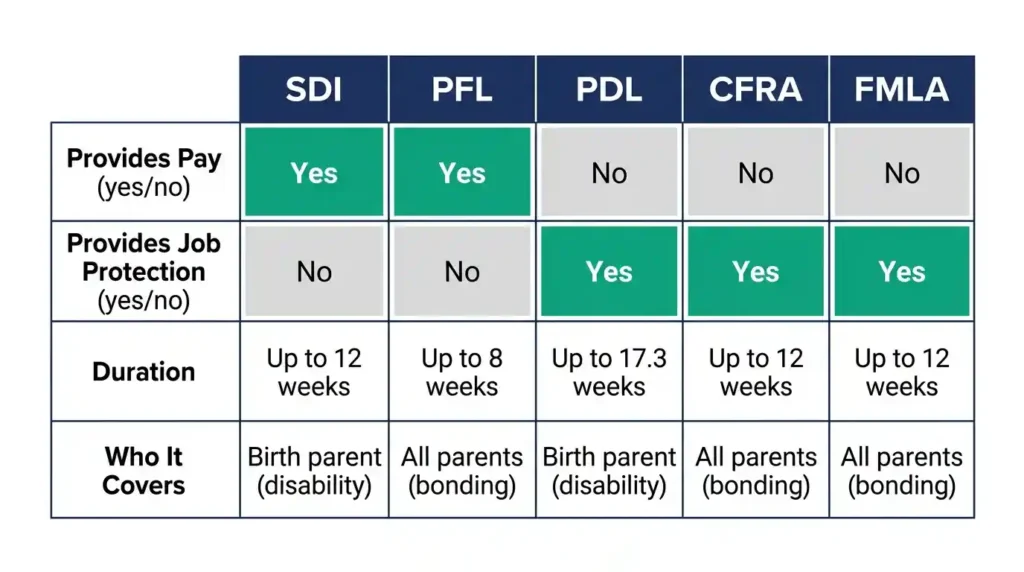
California gives you five programs. Each has a different purpose, funder, and eligibility rules. Some pay you. Some protect your job. Some do both. Some do neither alone. The key distinction: pay and job protection are separate things, handled by different programs.
The Five Programs Every Parent Must Understand
State Disability Insurance (SDI)
SDI replaces your income when pregnancy makes you unable to work. It is funded by the CASDI deductions already coming out of your paycheck. SDI starts up to four weeks before your due date, covers six weeks of recovery after a vaginal birth and eight weeks after a cesarean. In 2026: 70% to 90% wage replacement, maximum $1,765 per week. For a full breakdown of the 2026 SDI contribution rate and how CASDI deductions are calculated, see our guide to the California SDI rate for 2026.
Paid Family Leave (PFL)
PFL picks up when SDI ends. It provides up to eight weeks of paid bonding benefits at the same 70% to 90% rate, same $1,765 maximum. No waiting period — benefits start day one of bonding leave. Fathers, partners, and non-birthing parents qualify. PFL also covers leave to care for a seriously ill family member or support a family member’s military deployment. If both parents work for the same employer, each still receives their own separate PFL benefits from the state. Read our complete guide to California Paid Family Leave for full eligibility details and filing steps, or go directly to the EDD Paid Family Leave page for official program information.
Pregnancy Disability Leave (PDL)
PDL is job protection, not pay. It covers up to four months (17.3 weeks) of protected leave for pregnancy-related disability. Applies to employers with five or more employees. No tenure requirement — doctor certification is all you need. SDI provides the paycheck during PDL.
California Family Rights Act (CFRA)
CFRA is job protection for bonding leave — up to 12 weeks after your disability period ends. Requires 12 months with the employer and 1,250 hours in the prior year, at an employer with five or more employees. Stack PDL and CFRA and you get close to seven months of total job protection. PFL provides the paycheck during CFRA.
Family and Medical Leave Act (FMLA)
FMLA provides 12 weeks of unpaid federal job protection per year. In California, FMLA runs concurrently with PDL during the disability period — so it does not reduce your CFRA bonding leave later. Federal FMLA requires 50 employees; California’s CFRA requires only five. California is more protective.
Who Qualifies for California Maternity Leave Pay?
Basic Eligibility Requirements
Three requirements: (1) CASDI deducted from your paycheck — check your pay stub, it appears in the deductions section alongside taxes. If you are not sure where to find it, our guide on how to read a California pay stub shows you exactly where each deduction appears. (2) At least $300 in wages during your base period — the first four of the last five completed calendar quarters before your leave starts, meaning your most recent quarter is typically excluded. (3) You must be losing income because you are off work. You cannot collect SDI or PFL while receiving your full salary.
Employees Who Usually Qualify
Full-time, part-time, seasonal, and small business employees all qualify as long as they have $300 in base period wages with CASDI withheld. SDI and PFL are state programs — your employer does not fund them.
Situations That Cause Confusion
SDI eligibility is based on your contribution history across any California employer, not your tenure at your current job. Switch jobs recently? You may still qualify. Workers with multiple part-time jobs can combine wages to meet the base period requirement. Remote workers employed by a California employer typically qualify because SDI withholding follows where the work is performed, not where you live.
Who May Not Qualify
Independent contractors and self-employed workers are not subject to CASDI withholding and do not qualify automatically. California offers an opt-in program called Disability Insurance Elective Coverage (DIEC) for self-employed workers and freelancers. Without DIEC enrollment, there is no coverage. Some government workers and public entities are also exempt unless their employer has elected SDI coverage. If you are self-employed or working as a contractor, our guide on California self-employment tax explains how your income is taxed differently, and our 1099 vs W-2 comparison covers how worker classification affects your access to benefits like SDI. For more resources on this topic, see the worker classification category.
Your Complete California Maternity Leave Timeline
Four Weeks Before Due Date
SDI benefits can begin up to four weeks before your due date. Your doctor must certify your disability. File your SDI claim between 9 and 49 days after your leave starts — not before, not after.
Childbirth and Recovery Period
Vaginal Birth Timeline
SDI covers six weeks of postpartum recovery after a vaginal birth, plus the four pre-birth weeks, for ten total weeks of SDI. Your job is protected under PDL during this period if your employer has five or more workers.
C-Section Timeline
A cesarean extends SDI postpartum coverage to eight weeks instead of six, for twelve total weeks with the four pre-birth weeks. At the 2026 maximum rate, the two extra weeks represent up to $3,530 in additional benefits — your actual amount depends on your weekly benefit. Doctor-certified complications can extend SDI further.
Transition From SDI to PFL
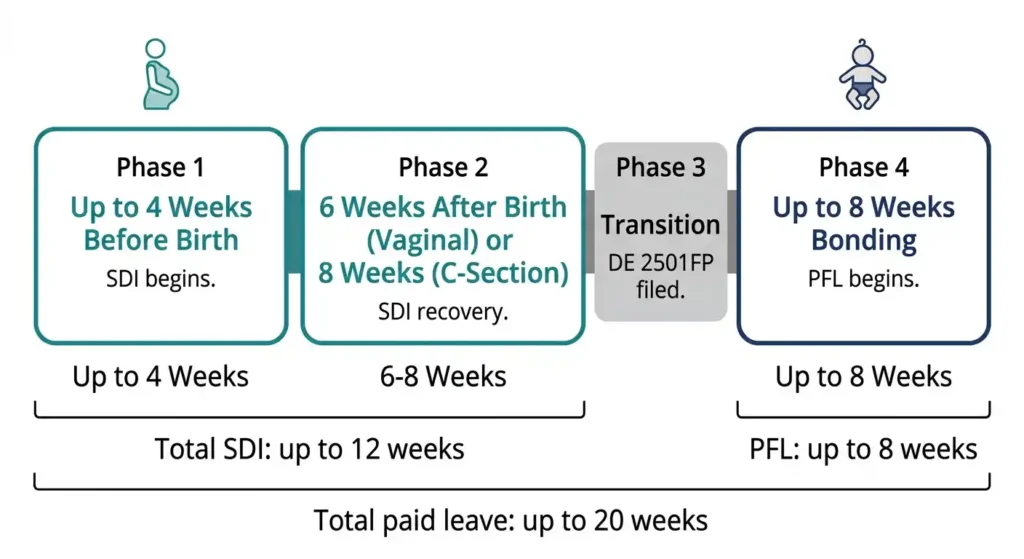
When SDI ends, EDD automatically mails birth mothers a PFL claim form (DE 2501FP). Complete and return it immediately. Expect a gap of a few days between your last SDI payment and first PFL payment. Your PFL weekly benefit may differ slightly from SDI because the calculation is applied differently.
Baby Bonding Period
PFL gives you up to eight weeks of bonding leave. You do not have to take them consecutively — split them across the baby’s first year if needed. PFL can also be taken on a reduced schedule or intermittently, using partial benefits on days you are not working. Both parents get their own eight weeks. A two-parent household can collect up to 16 combined PFL weeks.
Returning to Work
State benefits end when you exhaust your SDI and PFL weeks or 12 months pass since birth, whichever comes first. If your leave was protected under PDL, CFRA, or FMLA, your employer must reinstate you to the same or a comparable position.
How Much Will You Get Paid During Maternity Leave?
Understanding the 70%–90% Wage Replacement Formula
Workers earning up to roughly $65,100 per year (70% of the 2026 state average weekly wage of $1,789) receive 90% wage replacement. Earners above that receive 70%, capped at $1,765 per week regardless of income. Someone earning $40,000 replaces 90% of their income. Someone earning $150,000 replaces far less because the cap applies.
How EDD Calculates Your Benefits
Base Period Rules
The base period is the first four of the last five completed calendar quarters before your leave quarter. Your most recent quarter is excluded. EDD identifies your highest-earning quarter within that window and uses only that quarter to calculate your benefit. Commissions, overtime, and bonuses all count as long as they were subject to SDI withholding — if you received a large bonus during your base period, it can meaningfully boost your weekly benefit amount. A claim starting in April 2026 uses earnings from January 1 through December 31, 2025 — Q1 2026 is excluded. To understand how California taxes bonuses on your regular paycheck, see our guide on the California bonus tax rate.
Weekly Benefit Amount Calculation
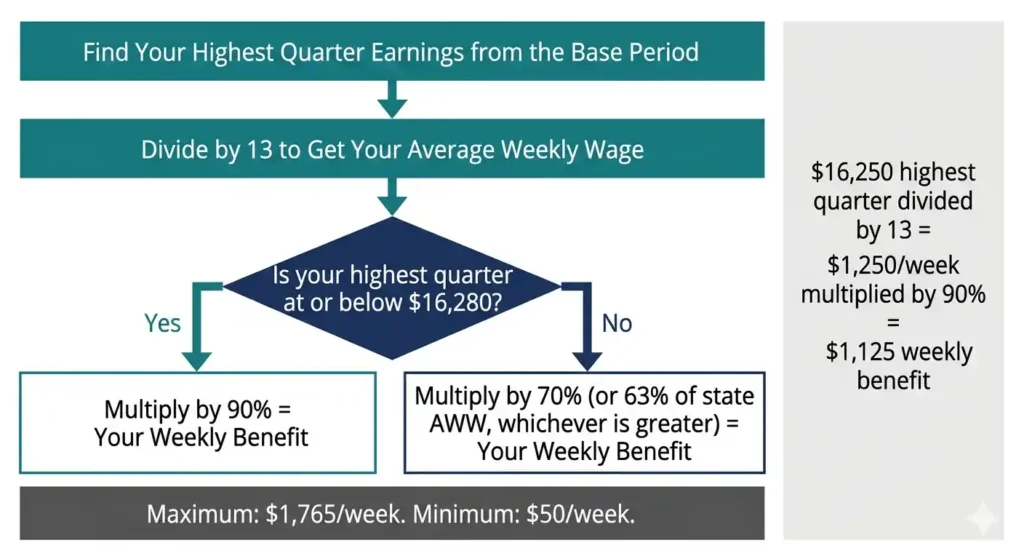
EDD divides your highest quarter earnings by 13 (weeks in a quarter) to get your average weekly wage. Two tiers apply. If your highest quarter is at or below $16,280 (70% of the 2026 state average quarterly wage), you receive 90% of that weekly figure. If above $16,280, you receive 70% — or 63% of the state average weekly wage, whichever is greater. Example: highest quarter of $16,250 ÷ 13 = $1,250/week × 90% = $1,125 weekly benefit. Use the EDD calculator at edd.ca.gov for your actual estimate.
Benefit Limits for 2026
Maximum: $1,765/week. Minimum: $50/week. SDI has a seven-day waiting period — no pay for those first days. If your disability extends beyond 14 days, EDD may retroactively pay you for that first week once your claim is approved. PFL has no waiting period. Most first payments arrive within two weeks of a complete application.
How Employer Benefits Affect Your Maternity Leave Pay
Employer-Paid Maternity Leave
Some employers, especially larger companies, offer additional paid leave on top of state benefits — some pay full salary for six to twelve weeks. Others offer nothing beyond what EDD provides. Check your employee handbook or ask HR directly.
Can You Receive Employer Pay and State Benefits?
Yes, but combined pay cannot exceed 100% of your regular wages. Any employer-paid wages or sick leave must be reported to EDD. Receiving employer pay while collecting SDI without reporting it causes an overpayment you will have to repay.
Using PTO, Sick Leave, and Vacation Time
Under AB 2123 (effective January 1, 2025), employers cannot require you to use vacation time before accessing PFL — that choice is yours. Sick leave used during the SDI waiting period is reported as wages and typically reduces your SDI benefit dollar for dollar. Exception: if your employer allows sick leave and SDI to be combined to reach your full regular pay, EDD will not reduce your benefit. Ask HR if your company offers that arrangement. For a full overview of how California sick leave accrual and usage rights work, see our guide to California sick leave laws in 2026.
San Francisco Paid Parental Leave Ordinance
San Francisco employers must top off PFL benefits to 100% of your normal weekly salary. For 2026, the SF PPLO cap is $2,522 per week. If your weekly salary is below that, your SF employer must bring your total pay to your full weekly amount during PFL bonding leave. Use the San Francisco paycheck calculator to see how your San Francisco take-home pay compares before and during leave.
California Maternity Leave Pay Calculator Examples
Example: $35,000 Annual Salary
Highest quarter: ~$8,750 ÷ 13 = $673/week × 90% = $606/week. Over 18 weeks: ~$10,900 in state benefits. At this income level, California’s 90% replacement rate does most of the work.
Example: $50,000 Annual Salary
Highest quarter: ~$12,500 ÷ 13 = $962/week × 90% = $865/week. Over 18 weeks: ~$15,570 in state benefits. This worker clearly qualifies for the higher replacement tier — the income gap is small and manageable.
Example: $75,000 Annual Salary
Highest quarter: ~$18,750 — above the $16,280 threshold, so 70% tier applies. $18,750 ÷ 13 = $1,442/week × 70% = ~$1,010/week. Over 18 weeks: ~$18,180. Note: a worker at $65,000 receives a higher replacement rate than one at $75,000 due to the tier cutoff — this is where an employer top-off becomes valuable. To see what a $75,000 salary looks like after all California taxes on a regular paycheck, read our $75,000 after taxes in California breakdown.
Example: $100,000+ Annual Salary
Weekly wages of ~$1,923 exceed the $1,765 cap. Effective replacement is ~65%. Over 18 weeks: ~$31,770 maximum. Income gap at $100,000: approximately $2,700 to $3,500 per month. Employer top-off or savings buffer is essential. See our full guide on $100,000 take-home pay in California to understand your full tax picture at this income level.
Example: Hourly Employee
$20/hour × 40 hours = $800/week. Estimated weekly EDD benefit: $700 to $720 (~90%). EDD uses actual base period wages, not an assumed schedule — variable hours are reflected in the calculation. For a full picture of what $20 an hour means for your annual and take-home pay, see our guide on how much $20 an hour is per year in California. Browse more real-world pay examples in the paycheck scenarios category.
Real-Life Maternity Leave Scenarios
First-Time Mother at a Large Employer
Maria earns $72,000 in Los Angeles, paid CASDI for three years. She takes four weeks SDI pre-birth, six weeks SDI recovery after a vaginal delivery. EDD weekly benefit: ~$970. Then eight weeks PFL bonding. Her employer adds two weeks of company leave. Total paid weeks: 20. Total EDD income: ~$17,460.
Employee at a Small Business
Six-employee company? You still get full state SDI and PFL — those come from EDD, not your employer. PDL and CFRA both apply at five or more employees, so job protection is still in place. FMLA requires 50 employees, so federal protection may not apply — but PDL and CFRA cover you even without it. Your state paycheck is unaffected by employer size.
Part-Time Worker
Rosa earns $18/hour at 25 hours/week ($23,400/year). EDD weekly benefit: ~$405, about 90% of her part-time income. Over 18 weeks: ~$7,290 in state benefits.
High-Income Employee
Daniel earns $165,000 in San Jose. EDD pays $1,765/week max — about 55% of his income. Over 18 weeks: $31,770 from EDD. Income gap: ~$25,000 over the leave period. Employer offers four weeks full pay. He uses savings and PTO for the rest.
Low-Income Worker
Carmen earns $28,000 part-time in the Central Valley, ~$538/week. EDD benefit: ~$485/week, 90% replacement. For this income level, California’s tiered formula is genuinely supportive.
California Maternity Leave Pay vs Other Leave Options
PFL vs SDI
SDI covers your personal disability (pregnancy and physical recovery). PFL covers bonding after disability ends. They run back-to-back. Same benefit formula, same weekly maximum. SDI = your body. PFL = your baby.
PFL vs CFRA
PFL pays you. CFRA protects your job. Most people use them simultaneously — this is concurrent leave. PFL covers eight weeks of income. CFRA covers 12 weeks of job protection. When PFL ends at week eight, CFRA continues protecting your job for four more weeks unpaid. Coordinate by notifying your employer and filing your EDD claim separately.
PFL vs FMLA
PFL pays you. FMLA protects your job but provides no pay. FMLA has a 50-employee threshold versus California’s five-employee threshold under CFRA. Most California workers rely more on state programs.
California vs Other States
California’s up-to-90% wage replacement and 18-week combined SDI and PFL paid benefit period is among the most generous in the country. Most states offer no paid leave. New York, New Jersey, and Washington have programs, but California’s replacement rate and weekly cap of $1,765 remain difficult to match.
Special Situations and Edge Cases
Pregnancy Complications
Complications before birth allow SDI to begin earlier than four weeks pre-due-date. Doctor certification required. Conditions including hyperemesis gravidarum, gestational diabetes with hospitalization, preeclampsia, and required bed rest all qualify as pregnancy-related disability under SDI.
Bed Rest Before Delivery
Doctor-ordered bed rest at any point in pregnancy qualifies for SDI immediately — do not wait for the four-week window. File as soon as your disability begins. Keep all medical documentation.
Adoption and Foster Placement
Adoptive and foster parents get up to eight weeks of PFL bonding starting from placement date. File within 41 days of leave start. Benefits must be claimed within 12 months of placement. SDI does not apply — no physical disability — but PFL stands alone. For surrogacy, the intended parent can claim PFL for bonding once the child is placed with them. Twins or multiples do not increase the weekly benefit amount, but each parent still gets their own eight weeks of PFL.
Postpartum Depression and Recovery Extensions
Postpartum depression and mental health conditions qualify as SDI disabilities if your doctor certifies you cannot work. SDI can extend beyond the standard six or eight weeks of physical recovery. Documentation from a licensed healthcare provider is required.
Premature births follow the same SDI rules — postpartum disability runs from delivery, six to eight weeks depending on delivery type. Stillbirth and miscarriage also qualify for SDI physical recovery. EDD does not require a living child for the birth parent to receive SDI.
Your employer must continue group health insurance during any leave protected under PDL, CFRA, or FMLA, on the same terms as if you were actively working. You pay your normal employee premium. Stopping your coverage during protected leave is a California labor law violation. For a broader overview of employee rights under California law, visit our California labor laws resource center. For full details on how SDI disability benefits work, refer to the official EDD State Disability Insurance page.
Common Myths About California Maternity Leave Pay
Myth: Paid Family Leave Protects Your Job
PFL pays you. It does not protect your job. Job protection comes from PDL, CFRA, and FMLA depending on your employer size and tenure. Confirm your protected status in writing with HR before you leave.
Myth: You Must Work for Your Employer for a Year
SDI and PFL eligibility is based on CASDI contribution history across any California employer — not your time at your current job. The one-year requirement applies only to CFRA job protection. You can be two months into a new job and still receive full state pay.
Myth: Only Full-Time Employees Qualify
Part-time, seasonal, and multi-job workers all qualify as long as they earned $300 with CASDI withheld in the base period. The benefit reflects actual earnings at the same 70% to 90% replacement rate.
Myth: Maternity Leave Pays 100% of Your Salary
State benefits replace 70% to 90% of your income, not 100%. The $1,765 weekly cap further limits high earners. Budget for the gap before leave starts.
How to Apply for California Maternity Leave Pay
Documents You Need Before Filing
Gather before you start: Social Security number or ITIN, employer name and address, medical provider information, and 18 months of paystubs or wage records. Your doctor completes the medical certification for SDI.
Filing for SDI
File through myEDD and SDI Online at edd.ca.gov, or by mail. Window: no earlier than 9 days, no later than 49 days after leave starts. The seven-day waiting period is unpaid — use sick leave or PTO to cover it. EDD processes claims within approximately 14 business days.
Filing for PFL
Birth parents transitioning from SDI: EDD automatically mails the DE 2501FP after your last SDI payment. Complete it immediately. Non-birth parents and anyone without a prior SDI claim: file directly through myEDD or by mail, no earlier than the first day of bonding leave and no later than 41 days after.
What Happens After You Apply
EDD sends an approval notice or requests more information. Once approved, certify your claim every two weeks through SDI Online or by mail, reporting wages and confirming you are still on leave. First payments typically arrive within two weeks of a complete application. Payment options: direct deposit or prepaid debit card. Use the maternity pay calculator at edd.ca.gov/en/disability/PFL_Calculator to estimate your benefit before applying.
The Biggest Maternity Leave Pay Mistakes to Avoid
Filing Too Late
SDI: file between 9 and 49 days after leave starts. PFL: file within 41 days of bonding leave start. Missing these windows can permanently forfeit weeks of benefits. Set calendar reminders before you go on leave.
Confusing Pay With Job Protection
PFL pays you. CFRA and PDL protect your job. These are different programs. Confirm your job protection status in writing with HR. If your employer retaliates against you for taking protected leave — demotion, pay cut, or termination — that is illegal under California law. File a complaint with the California Civil Rights Department.
Assuming Full Salary Replacement
At $80,000 per year, expect to lose roughly $1,200 to $1,400 per month in net income during leave. Build a budget before your due date. Know your EDD benefit, what your employer pays, and your fixed monthly expenses.
Ignoring Employer Benefits
Ask HR directly about: company-paid parental leave, sick leave covering the SDI waiting period, voluntary disability insurance (VPDI), and SF PPLO if you work in San Francisco. Many workers leave money on the table simply by not asking.
Creating Your Family Budget Before Leave Starts
Estimating Total Leave Income
Add three sources: EDD state benefits, employer-paid leave, and any PTO or sick leave you choose to use. Start with your EDD estimate, add employer pay, then decide when to use PTO.
Calculating Income Gaps
Subtract your estimated monthly leave income from your normal take-home pay. For workers at or below $75,000, the gap is usually small. Above $90,000, expect a gap of $1,500 to $3,000 or more per month.
Preparing for Reduced Income
Compare fixed monthly expenses (rent, car, insurance, utilities) to your leave income estimate. If income covers expenses, you are in a workable position. If not, build a two-to-three month savings buffer before leave starts.
Step-by-Step Action Plan for Expecting Parents
If You Are 3–6 Months Pregnant
Confirm your SDI eligibility through myEDD or call 1-800-480-3287. Ask HR about employer top-off programs. Pull 18 months of pay stubs. Run your EDD benefit estimate. Start your leave timeline conversation with HR.
If You Are Within 60 Days of Leave
Finalize your leave dates in writing. Prepare SDI claim documents. Line up your doctor for medical certification. Set filing reminders: SDI between 9 and 49 days after leave starts, PFL within 41 days of bonding leave start. Confirm your savings buffer.
After Your Baby Arrives
Finalize or file your SDI claim. When SDI ends, complete the DE 2501FP immediately for PFL transition. Non-birth parents: file PFL within 41 days. Track payments in myEDD. If postpartum health complications arise, contact your doctor about an SDI extension.
FAQ
How much does California maternity leave pay per week?
Between $50 and $1,765 per week in 2026, depending on earnings. Workers earning up to ~$65,000 per year receive 90% wage replacement. Higher earners receive closer to 70%, capped at $1,765.
How many weeks of paid maternity leave do I get in California?
Vaginal birth: 18 weeks total (4 pre-birth SDI + 6 postpartum SDI + 8 PFL bonding). Cesarean: 20 weeks. Non-birth parents: up to 8 weeks of PFL. Bonding weeks do not need to be taken consecutively.
Do I get full pay while on maternity leave?
No. State benefits replace 70% to 90% of wages, not 100%. Some employers top off to full pay, and San Francisco employers may be required to. Without a supplement, most workers see an income reduction.
Can I receive maternity leave pay if I work part-time?
Yes, as long as you paid CASDI and earned $300 in the base period. No minimum-hours requirement. Your benefit reflects actual part-time wages at the same 70% to 90% rate. To understand how part-time and full-time paychecks compare in California more broadly, read our guide on part-time vs full-time paycheck differences in California. For general paycheck concepts, visit our paycheck basics resource center.
Does California maternity leave pay count as taxable income?
PFL benefits are federally taxable. You will receive a 1099-G in January. California state income tax does not apply to SDI or PFL. You can elect voluntary federal withholding in myEDD when filing. If you did not, set aside 10% to 12% of benefit payments for the federal tax bill.
Can fathers receive Paid Family Leave?
Yes. Fathers, partners, and non-birthing parents qualify for up to eight weeks of PFL bonding benefits under the same eligibility rules. Both parents can take PFL simultaneously. A two-parent household can collect up to 16 combined PFL weeks.
What if my claim is denied?
Appeal within 30 calendar days of the mail date on your Notice of Determination. Common denial reasons: missing documentation, base period earnings below $300, or missed filing window. File your appeal through the California Unemployment Insurance Appeals Board with pay stubs and medical certifications.
Can I work while receiving maternity leave benefits?
Yes, part-time — but if your wages plus your weekly benefit exceed your normal pre-leave earnings, your benefit is reduced. Report all earnings, including freelance and gig income, to EDD every two weeks. Failing to report is benefit fraud.
Final Takeaway — How Much Will You Actually Get?
The Three Numbers Every Parent Should Calculate
- Your expected weekly EDD benefit — estimate at edd.ca.gov/en/disability/PFL_Calculator.
- Your total leave income — weekly benefit × number of weeks.
- Your monthly income gap — normal take-home minus leave income.
Under $65,000 per year? The gap is usually small. Above $90,000? Plan for it in advance.
Next Steps Before You File
Verify SDI eligibility through myEDD. Get your benefit estimate. Ask HR about top-off programs. Confirm SF PPLO rights if applicable. Set filing reminders: SDI no earlier than 9 days and no later than 49 days after leave starts, PFL within 41 days of bonding leave start. Build your leave budget.
California gives parents one of the most generous paid leave systems in the country. Use all of it.

Yeasin Sorker is the founder of Paycheck Calculator California. He built this tool in 2018 after noticing that most free paycheck calculators missed California-specific rules like daily overtime and the uncapped SDI rate.
He researches California payroll tax updates regularly and keeps this calculator aligned with the latest IRS, FTB, and EDD published rates. All calculations on this site are estimates based on official 2026 government sources. For personalized tax advice, consult a qualified tax professional.