
An $80,000 salary in California is taxed under federal, state, and payroll rules that vary by filing status, leaving a single filer with no pre-tax deductions roughly $60,707 in take-home pay for 2026.
That $60,707 figure comes from running this exact scenario for dozens of clients moving to or negotiating pay in California.
Actual take-home shifts once you add dependents, retirement contributions, or a different filing status.
Quick Answer: How Much Is $80,000 After Taxes in California?
| Metric | 2026 Estimate |
|---|---|
| Annual Net Pay | $60,707 |
| Monthly Net Pay | $5,059 |
| Total Taxes | $19,293 |
| Effective Tax Rate | 24.1% |
Single filer, no dependents, no pre-tax deductions. Covers federal income tax, California state tax, Social Security, Medicare, and California State Disability Insurance (SDI).
Estimated Annual Take-Home Pay
The $60,707 figure assumes a single filer with the standard deduction, no 401(k), no HSA, and no extra W-4 withholding. Married, dependents, or pre-tax retirement contributions push your real number higher. Treat this as a baseline.
Take-Home Pay by Pay Period
Monthly
About $5,059 hits your account monthly. Use this for budgeting rent, car payments, and subscriptions. Federal tax, state tax, and FICA taxes are already out.
Biweekly
26 paychecks a year, about $2,335 each. Check this against your pay stub to catch payroll errors early.
Semimonthly
24 paychecks a year, about $2,530 each. Same annual total as biweekly, just sliced differently.
Weekly
About $1,167 a week. That’s a $29.19 after-tax hourly rate versus $38.46 gross, a $9 an hour tax bite.
Salary Breakdown Table
Here’s where every dollar of your $80,000 goes.
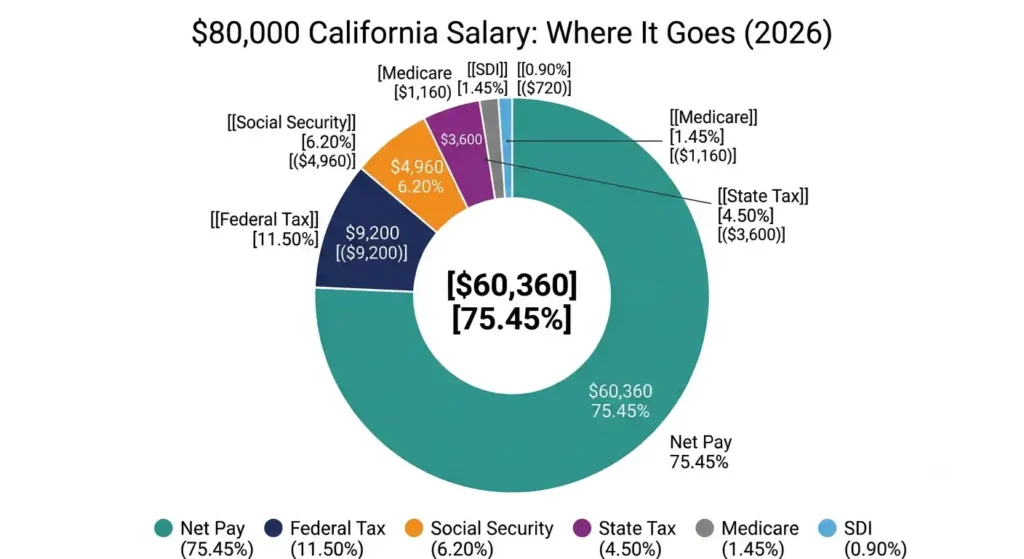
Annual Breakdown
| Category | Amount |
|---|---|
| Gross Salary | $80,000 |
| Total Taxes | $19,293 |
| Net Take-Home Pay | $60,707 |
| Effective Tax Rate | 24.1% |
Deduction Summary
| Tax Type | Amount | Rate |
|---|---|---|
| Federal Income Tax | $8,770 | Progressive |
| California State Tax | $3,363 | Progressive |
| Social Security | $4,960 | 6.2% |
| Medicare | $1,160 | 1.45% |
| California SDI | $1,040 | 1.3% |
SDI stands for California State Disability Insurance (SDI), collected by the California Employment Development Department for short-term disability and paid family leave. The rate rose to 1.3% with no wage cap starting 2024, under SB 951. Calculators still showing a 1.2% rate with a cap are outdated.
How the $80k Take-Home Pay Is Calculated
Five deductions build your tax bill: federal tax, state tax, Social Security, Medicare, and SDI.
Federal Income Tax
Federal tax is progressive, set yearly by the Internal Revenue Service (IRS): 10% on the first chunk, 12% next, and up. The 2026 standard deduction of $16,100 for single filers drops taxable income to $63,900. Itemizing only helps past that $16,100 mark. Tax credits, like the Earned Income Tax Credit, cut your bill dollar for dollar, below these baseline estimates. Your marginal rate hits 22%, but your effective rate lands near 11%.
California State Income Tax
California’s own bracket system tops out at 13.3%, only above $80,000. Your effective state rate here is about 4.2%. California’s standard deduction and lack of a personal exemption mean state taxable income differs from federal. The California Franchise Tax Board sets and updates these brackets yearly; check yours on the Franchise Tax Board (FTB) site.
Payroll Taxes
Social Security and Medicare together are FICA taxes. Social Security takes 6.2% up to $184,500 in 2026, so all of your $80,000 is taxed. Medicare takes 1.45% with no cap, ever. California SDI adds 1.3%, also uncapped. Your employer matches Social Security and Medicare, part of why hiring costs more than your salary. At $80,000, you’re well under the $184,500 cap, so this deduction stays flat all year, unlike higher earners whose paychecks grow once they cross it and the 6.2% stops.
Gross Pay vs Net Pay
Gross pay is your offer letter number. Net pay is what lands in your bank account. Mandatory deductions (federal, state, FICA) plus voluntary pre-tax or after-tax deductions (health insurance, 401(k)) make up the gap. Your Form W-2 shows the year’s full totals for filing.
Why Your Paycheck May Be Higher or Lower
Filing status, benefits, withholding, and outside income all move your final number.
Filing Status
Filing status shifts your brackets and standard deduction. Married filing jointly on the same $80,000 as sole income nets roughly $63,500 a year, using 2026 MFJ brackets and standard deduction, and assuming no other income or deductions. Head of household lands around $62,000 under the same assumptions, using 2026 HOH brackets. Dependents lower taxable income further.
Pre-Tax Benefits
A traditional 401(k) is the lever most people ignore first, and it lowers taxable income now. A Roth 401(k) uses after-tax dollars so retirement withdrawals are tax-free. A Health Savings Account (HSA) works like a traditional 401(k) on a high-deductible plan. Flexible Spending Account (FSA) contributions, health insurance premiums, and dental and vision deductions cut taxable income the same way. A $6,000 401(k) contribution on $80,000 saves roughly $1,300 to $1,500 in tax.
Tax Withholding Choices
Your W-4 (federal) and DE 4 (California) set paycheck withholding. The DE 4 goes to the Employment Development Department (EDD), which manages California withholding. Fewer withholdings grow your paycheck but risk owing later. More withholding shrinks paychecks but favors a refund. Either way, your actual tax bill doesn’t change, only the timing.
Other Income
Bonuses, overtime, a second job, or RSUs stack on your salary and can push part of it into a higher bracket. Bonuses get a flat 22% federal supplemental withholding, reconciled correctly at filing. RSUs are taxed as ordinary income at vesting, based on that day’s stock value. Multiple employers each withhold as if you had one job, a common cause of underwithholding.
Real-Life Examples
Three scenarios show how take-home pay actually moves.
New Job Offer
A $75,000 versus $80,000 offer looks like a $5,000 gap. After taxes, it’s closer to $3,600 to $3,800 a year, about $300 a month. Compare offers on take-home pay, not gross.
Relocating to California
Moving from a no-tax state like Texas or Florida costs you an extra 4% to 5% to California state tax. The same applies working remotely for an out-of-state company while living in California, or living outside California while working for a California employer. Tax follows residency and where the work happens, not company headquarters.
Salary Raise
A $75,000 to $80,000 raise taxes the extra $5,000 at your marginal rate, not your average rate, so it feels smaller than it looks. It’s a good time to raise your 401(k) contribution.
Is $80,000 a Good Salary in California?
Yes. California’s median income is $74,068, so $80,000 sits around the 59th percentile statewide. Whether it feels like enough depends on where you live.
Cost of Living Reality
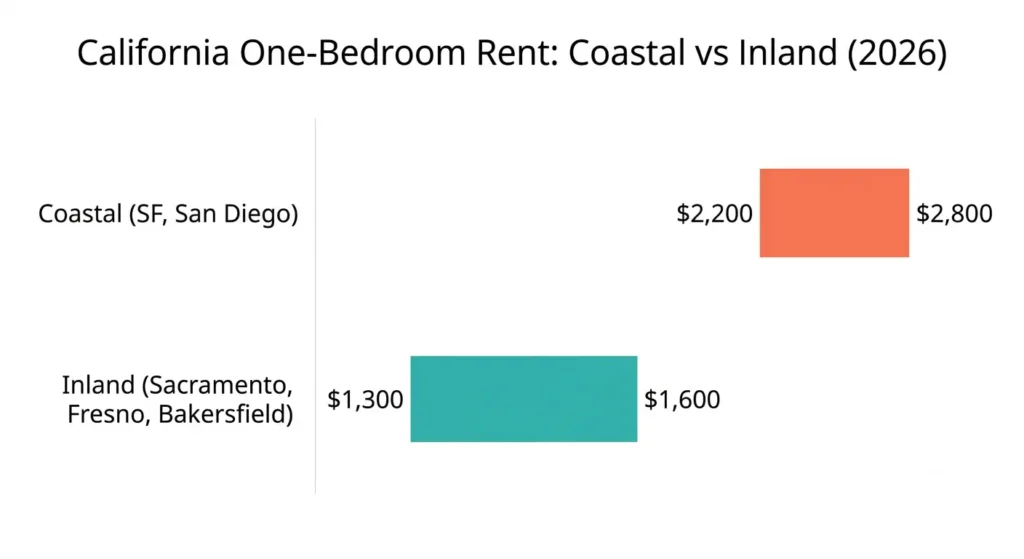
Housing decides everything. A one-bedroom in San Francisco or San Diego runs $2,200 to $2,800 a month. In Sacramento, Fresno, or Bakersfield, expect $1,300 to $1,600. Transportation, utilities, and groceries follow the same coastal-versus-inland pattern.
Example Monthly Budget
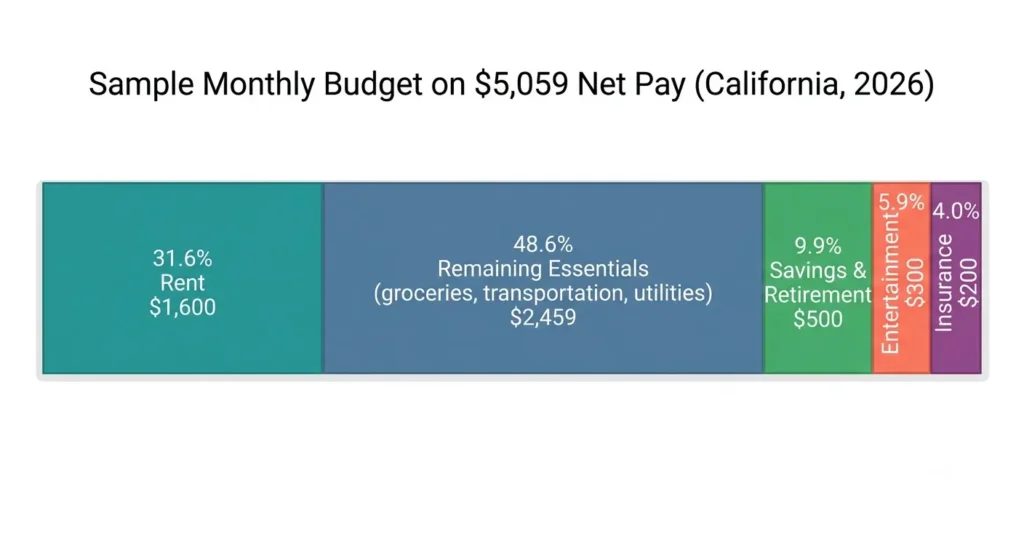
On $5,059 net a month, a mid-cost budget might run $1,600 rent, $500 savings, $200 insurance, $300 entertainment, the rest on essentials. A common rule caps rent at 30% of net income, roughly $1,500 to $1,700 here. In high-cost coastal cities, rent alone can eat half your take-home. Build a three to six month emergency fund before raising discretionary spending.
Lifestyle Expectations
Living alone on $80,000 is comfortable in most of California, especially inland. Supporting a family in a high-cost city gets tight, often needing a second income or a move to a lower-cost region.
Compare $80k With Other California Salaries
These are single-filer estimates using the same 2026 federal and California brackets applied above, no dependents or pre-tax deductions. See more salary scenarios for other income levels.
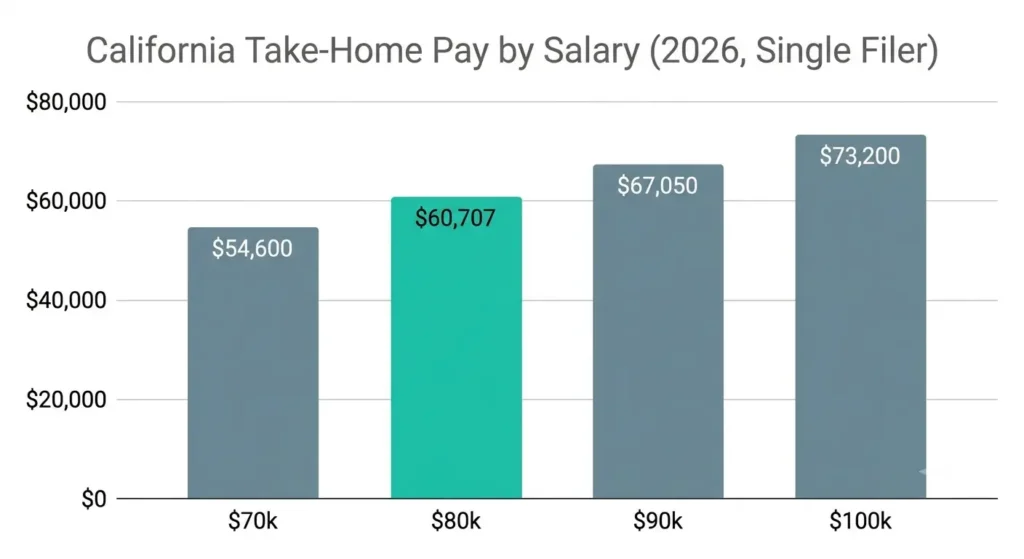
$70k vs $80k
$70,000 nets around $54,600, about $6,100 less than $80,000, even with a $10,000 gross gap. Taxes take a bigger share as income rises.
$80k vs $90k
$90,000 nets roughly $67,050, about $6,300 more than $80,000. Effective tax rate ticks up slightly as more income hits higher brackets.
$80k vs $100k
$100,000 nets around $73,200, about $12,500 more than $80,000 for $20,000 more gross. Purchasing power grows even as the marginal rate climbs.
Common Mistakes People Make
Three assumptions trip people up most.
Assuming Gross Salary Equals Spendable Income
People divide $80,000 by 12 and plan around $6,667 a month. The real number is $5,059, a $1,600 gap that wrecks new budgets. Your first paycheck can look even smaller if it lands mid-cycle or before benefits finish processing.
Confusing Withholding With Taxes Owed
Paycheck withholding is an estimate, not your final bill. Too much withheld means a refund; too little means you owe. Your actual tax rate hasn’t changed, only the timing of payment.
Assuming Every Calculator Gives the Same Answer
Five calculators, five answers, because assumptions differ: filing status, dependents, pre-tax deductions, and tax year. Check a calculator’s assumptions before trusting its number.
Frequently Asked Questions
Quick answers to the most common $80k California questions.
How much is $80k after taxes in California each month?
About $5,059 for a single filer with no pre-tax deductions in 2026. A 401(k), dependents, or a different filing status moves that number.
Is $80k enough to live comfortably in California?
Yes in most inland and mid-cost cities. In San Francisco, Los Angeles, or San Diego, it’s workable single but tight for a family, mainly due to housing.
Why is my paycheck different from online calculators?
Your real paycheck reflects your employer’s payroll system, your exact W-4 and DE 4 elections, and your benefits. A generic calculator only estimates.
Does contributing to a 401(k) increase take-home efficiency?
Yes. Every pre-tax dollar lowers taxable income and your tax bill while building retirement savings.
Does filing status change take-home pay?
Yes. Married filing jointly generally owes less than single on the same income; head of household sits in between.
Can bonuses be taxed differently?
Yes. Bonuses withhold at a flat 22% federal supplemental rate, reconciled correctly when you file.
Do California employees pay local income tax?
No. California doesn’t allow cities or counties to add a local income tax on top of state tax.
Key Takeaways
What to Remember Before Accepting an $80k Salary
An $80,000 salary in California nets about $60,707 a year, or $5,059 a month, for a single filer with no pre-tax deductions in 2026. Filing status, dependents, and pre-tax benefits like a 401(k) or HSA shift your real number. Run your own numbers with a paycheck calculator using your actual filing status and deductions, then adjust your W-4 or DE 4 if you’re over- or underpaying.

Yeasin Sorker is the founder of Paycheck Calculator California. He built this tool in 2018 after noticing that most free paycheck calculators missed California-specific rules like daily overtime and the uncapped SDI rate.
He researches California payroll tax updates regularly and keeps this calculator aligned with the latest IRS, FTB, and EDD published rates. All calculations on this site are estimates based on official 2026 government sources. For personalized tax advice, consult a qualified tax professional.