
California’s underpayment penalty is interest the Franchise Tax Board (FTB) charges when your quarterly payments miss its required schedule, not just your year-end tax bill. Meeting a safe harbor test avoids it entirely.
That schedule trips up more taxpayers than any dollar figure does, since California times payments differently from the IRS.
The rules are navigable, but California’s 30/40/0/30 split rewards careful timing more than federal habits do.
Quick Answer: Do You Actually Owe the California Underpayment Penalty?
Total 2026 California tax under $500 means no penalty. Paying 100% of last year’s tax (110% if your prior-year AGI topped $150,000) protects you no matter what you owe now.
The 60-Second Decision Checklist
Four quick checks:
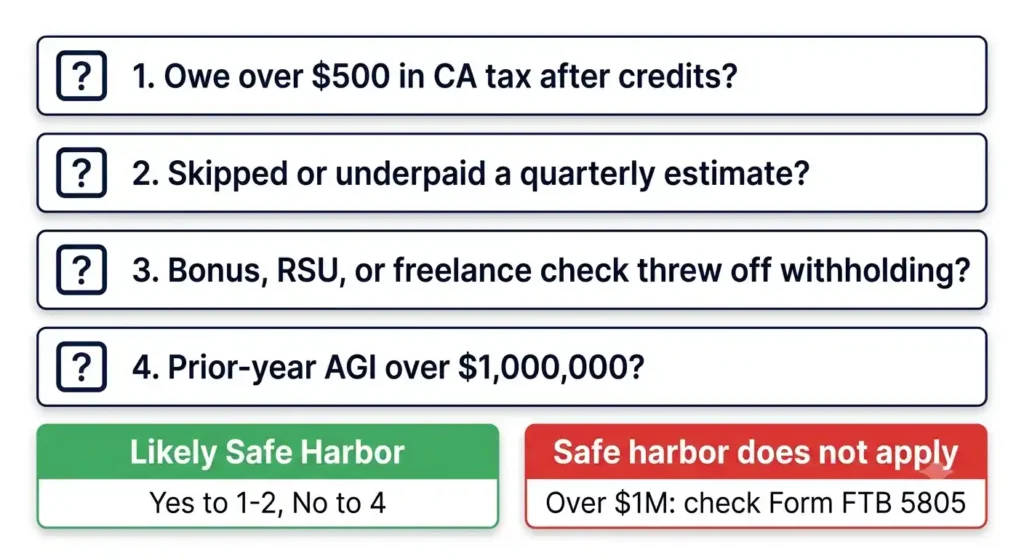
- Did you owe over $500 in California tax after credits?
- Did you skip or underpay a quarterly estimate?
- Did a bonus, RSU sale, or freelance check throw off withholding?
- Did your prior-year AGI cross $1,000,000?
Yes to the first two and no to the last means you likely qualify for safe harbor. Over $1 million means safe harbor does not apply, check Form FTB 5805 directly, and see more California payroll tax breakdowns while you’re at it.
Quick Summary Table
| Situation | Likely Outcome |
|---|---|
| Total CA tax under $500 | No penalty, automatically exempt |
| Paid 100% of last year’s tax (AGI under $150k) | Safe harbor protects you |
| Paid 110% of last year’s tax (AGI over $150k) | Safe harbor protects you |
| AGI over $1 million last year | Must pay 90% of current year, no prior-year safe harbor |
| Missed the June 15 payment | FTB calculates the penalty automatically on your return |
What Is the California Underpayment Penalty?
It is interest, charged under Revenue and Taxation Code Section 19136, on tax California expected earlier. The state runs pay-as-you-go: a slice by April 15, another by June 15, nothing in September, the rest by January 15 the following year.
Why California Charges This Penalty
If everyone paid their full bill the next April, California would be lending cash all year for free. So it charges interest on any gap between expected and actual payments, calculated quarter by quarter, before you even file. That is different from a late filing penalty, which punishes a missed return deadline, and from ordinary interest, which starts after filing. Nobody mails you a warning in June.
Who Is Most Likely to Be Affected?
Freelancers and consultants get hit hardest since nothing is withheld from their income, especially once California’s self-employment tax enters the picture. Investors selling stock or collecting big dividends in one quarter trip the same wire. Business owners paying themselves through distributions face it too. Even W-2 employees aren’t immune: a big bonus, a stock vest, or a second job with no extra withholding can quietly create a shortfall. Landlords face the same trap once rental income starts flowing partway through the year.
Why You May Have Received This Penalty
Most people fall into one of two camps: they owed more than expected, or they assumed withholding alone would cover everything.
The Most Common Triggers
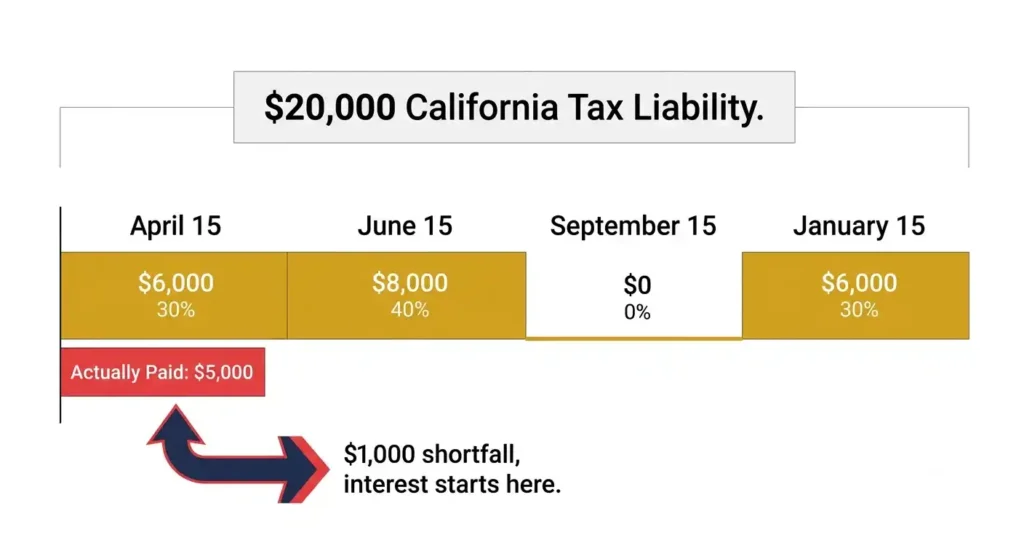
A large balance due at filing is the biggest red flag. Missed or partial estimated payments are next. Say your 2026 California liability is $20,000. California expects $6,000 (30%) by April 15, then $8,000 (40%) by June 15. Sending only $5,000 in April leaves a $1,000 gap that starts collecting interest right away. Unexpected income, like a bonus check or property sale, also throws off calculations built around a normal paycheck, and so does incorrect withholding after a job change. Side hustle income with no withholding, or selling a business or real estate mid-year, causes the same problem by dropping a lump of taxable income into one quarter.
Why Tax Software Suddenly Shows the Penalty
You didn’t do anything wrong. The software waits until it has your full income picture, then runs its own version of Form FTB 5805 to compare required installments against what you actually paid. A late, missed, or mistyped estimated payment gets flagged. It’s usually a calculation issue, not your mistake.
Do You Meet California’s Underpayment Rules?
The rules are simple once you see them next to your own numbers.
Estimated Tax Requirements
Expecting to owe California more than $500 after withholding and credits, or $250 if married filing separately, means quarterly estimated payments are required, regardless of filing status otherwise. This hits 1099 and self-employed workers more often than W-2 employees, since nothing gets withheld automatically. California’s rule mirrors the federal $1,000 threshold, just set lower. Nonresidents and part-year residents follow the same requirement, based only on income California taxed. Payments go on Form 540-ES vouchers, and Form 540 is the annual return that reconciles everything.
Safe Harbor Rules Explained
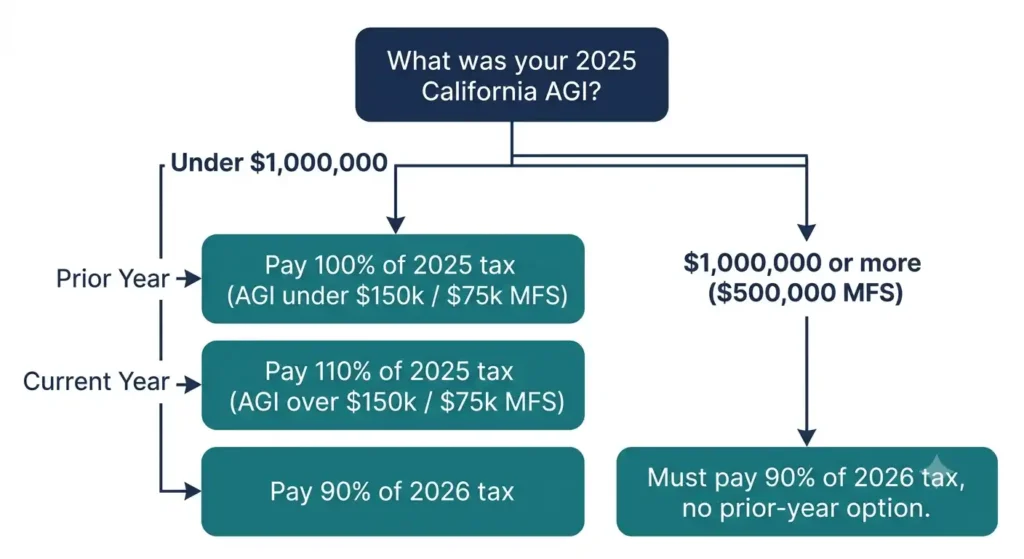
Two doors:
- Door one: pay at least 90% of your actual 2026 California tax.
- Door two: pay 100% of your 2025 tax bill, or 110% if your 2025 AGI topped $150,000 ($75,000 if married filing separately).
Most people use door two since it’s easier to calculate early in the year. High earners with 2025 AGI at or above $1,000,000 ($500,000 if married filing separately) lose door two entirely and must hit 90% of current-year tax, which includes the 1% Behavioral Health Services Act surcharge on income over $1,000,000.
How California Calculates the Underpayment Penalty
Four steps, no mystery.
Step-by-Step Calculation
Figure the required payment per installment period, starting from your actual liability, which begins with your California standard deduction before rates apply. Compare it to what you actually paid by that date. The gap is your underpayment. Interest accrues on that gap for every day unpaid, from the due date until paid or filed. The FTB set that rate at 7% annually for January through June 2026, down from 8% in 2025, resetting every six months at the federal short-term rate plus 3 percentage points.
California’s Unique Payment Schedule
No four equal chunks like the IRS. California runs 30% by April 15, 40% by June 15, 0% by September 15, 30% by January 15 the next year. That 40% June payment trips up the most people, since it’s the largest of the year and lands just two months after the first. The September skip just means that quarter’s share got folded into the earlier two payments.
Factors That Increase or Reduce the Penalty
Every unpaid day adds more interest, so 60 days late costs double 30 days late. Extra withholding added late in the year, even in a year-end paycheck, counts as paid evenly across all four periods and can retroactively erase an earlier shortfall. Paying early only avoids new interest on that period. Uneven income can be handled through the annualized income method instead of the flat 30/40/0/30 split.
California vs Federal Underpayment Penalties
Two separate systems that look similar.
Major Differences
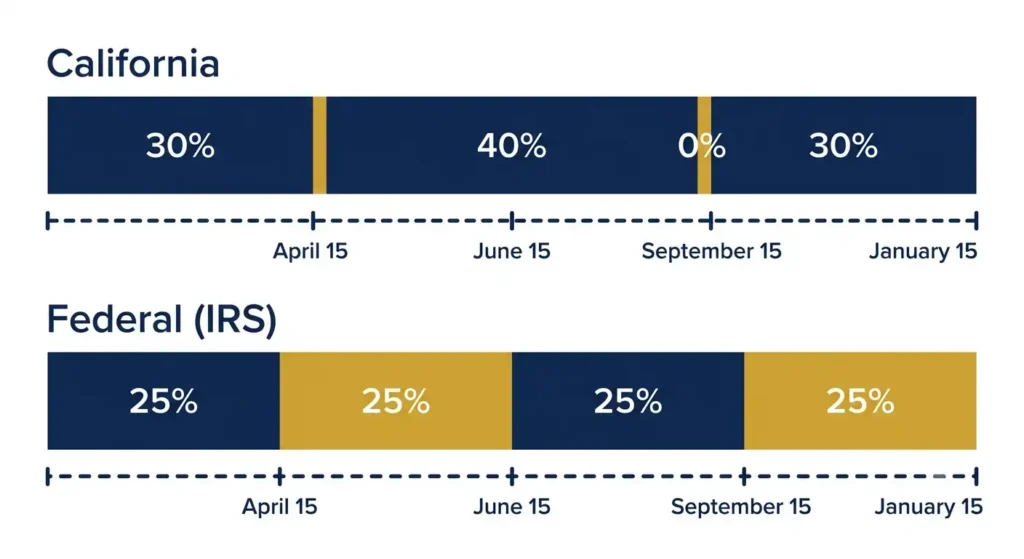
Federal splits 25/25/25/25. California uses 30/40/0/30. Both use the same $150,000 AGI cliff for the 100%/110% safe harbor rule. California’s separate $1,000,000 cutoff for losing prior-year safe harbor entirely has no federal match. Federal underpayment is reported on Form 2210, California on Form FTB 5805. For a quick IRS Form 2210 comparison, the federal version splits everything into four equal installments, while California never does.
Which Rules Apply First?
Neither waits for the other. The IRS calculates off your federal return, the FTB off your California return, independently. You can owe one, both, or neither. A federal safe payment schedule doesn’t automatically cover California, so run both calculations separately rather than assuming one clean bill covers everywhere.
Examples: Do These Real-Life Situations Owe a Penalty?
Numbers make this clearer than explanation.
Freelancer With Uneven Income
A graphic designer earns almost nothing in Q1 and Q3 but lands big contracts in Q2 and Q4, ending the year at $90,000 net. A flat 30/40/0/30 schedule would demand a large April payment before most income arrives. The annualized income method matches the penalty to income actually earned each period, usually shrinking or erasing it for this kind of lumpy cash flow.
W-2 Employee With Stock Sales
Someone earns $110,000 in salary with normal withholding, then sells $40,000 in vested RSUs in November. That extra income creates a bigger tax bill than salary withholding covers. Bumping up December paycheck withholding to cover the gap gets treated as spread evenly across the year, which can satisfy the requirement retroactively.
Self-Employed Consultant
A consultant misses the June 15 payment, then catches up in August. That two month gap accrues interest on the missed 40% installment for every day between June 15 and the August payment. The fix: a calendar reminder for June 1, the payment most people forget.
Retiree With Investment Income
A retiree pulling $60,000 from an IRA plus $15,000 in dividends often assumes no withholding means no obligation. Requesting withholding directly from the IRA custodian, which counts as paid evenly across the year, or making quarterly estimates, avoids the penalty on income that felt passive.
When You May Not Owe the Penalty
Plenty of people qualify for an exception without realizing it.
Safe Harbor Protection
The 100%/110% prior-year rule protects you even if this year’s bill is much higher. Someone who paid $8,000 in California tax last year and prepays that same $8,000 this year through estimates is safe, even if the actual 2026 bill hits $15,000.
Annualized Income Method
Built for income that wasn’t steady across the year. Filing Schedule P with Form FTB 5805 matches each installment to income actually earned in that period rather than a flat quarter of the annual total. Seasonal business owners and commission-based salespeople benefit most.
Waiver Situations
California waives the penalty for specific hardships:
- A federally declared disaster
- A documented disability
- Retiring after age 62 within the last two years
- A law change that created or increased the underpayment mid-year
None are automatic, you request the waiver and attach an explanation. There’s no blanket first-time pass, every request must fit one of these categories. Farmers and fishermen follow a different version of this code section (Form FTB 5805-F), with a single annual due date of March 1 instead of the quarterly schedule.
Common Mistakes That Cause Unnecessary Penalties
Most of these penalties were avoidable.
Estimated Payment Mistakes
Common ones:
- Applying a payment to the wrong tax year, especially in January
- Sending the wrong amount off old numbers
- Missing a deadline by confusing California and IRS schedules
- Duplicating a payment
Withholding Mistakes
Top ones:
- Assuming regular paycheck withholding covers a big bonus, since bonuses are often withheld at a flat rate below your real California tax bracket
- Retirement withdrawals with no withholding unless requested
- Multiple jobs or income sources where only one job’s withholding gets checked, not the combined total, a common reason your paycheck runs lower than expected
Filing Mistakes
These all generate penalties that never needed to exist:
- Entering estimated payments incorrectly
- Ignoring an FTB notice
- Forgetting to attach Form FTB 5805 when required
- Assuming a filing extension pushes back payment deadlines
Frequently Believed Myths About California Underpayment Penalties
Bad advice floats around on this topic.
Myth vs Reality
Paying in full by April 15 doesn’t erase a penalty already accrued from an earlier missed quarter, since it’s calculated period by period. A filing extension buys more time to file, not to pay, so estimated payments stay due on the original dates. A refund doesn’t mean no penalty either, since a refund reflects year-end position while the penalty tracks whether payments arrived on schedule. And this isn’t just a freelancer problem. W-2 employees with stock compensation or side income get hit just as often.
How to Reduce or Avoid Future California Underpayment Penalties
The fix is almost always cheaper than the penalty.
Adjust Your Withholding
Update your W-4 through payroll whenever income changes meaningfully: a raise, a bonus, a new job. California also has its own state withholding form, so check whether filling out the DE-4 alongside your W-4 gets you closer to accurate. With two jobs, check that combined withholding covers the full California liability, since each employer only sees its own paycheck. A year-end adjustment, even in December, counts as spread evenly across the year.
Make Estimated Payments Correctly
Mark April 15, June 15, and January 15 on your calendar, since September has no California payment due. Use the FTB’s Web Pay system at ftb.ca.gov to schedule payments and get confirmation numbers. Keep those confirmations. Log into MyFTB anytime to pull your full payment history, and check the FTB estimated tax payments page for current due dates and methods.
Plan for Irregular Income
Expecting a large capital gain, bonus, or business payout later in the year? Run an estimate the moment you know about it, and California’s annual salary calculator is a quick way to see how new income shifts your total tax picture. Adjusting withholding or sending an extra estimated payment the same quarter the income arrives is almost always cheaper than paying interest on a shortfall later.
Frequently Asked Questions
Does everyone who owes California tax owe an underpayment penalty?
No. Total 2026 California tax under $500 means automatic exemption regardless of timing. Meeting either safe harbor also removes the penalty even with a large balance due.
Can the penalty be waived?
Yes, for a federally declared disaster, a qualifying disability, retirement after age 62 within the past two years, or a retroactive law change. You must request the waiver and explain your situation when you file.
Does California calculate the penalty automatically?
Yes, in most cases directly on your return. You only need to file Form FTB 5805 yourself for a waiver request, the annualized income method, or if your AGI crossed $1,000,000 last year.
Can increasing withholding later eliminate the penalty?
Often yes. Withholding counts as paid evenly across the year regardless of when it actually happened, so a large November or December increase can retroactively cover an April or June shortfall.
What if my income changed dramatically during the year?
The annualized income installment method, filed with Schedule P and Form FTB 5805, matches required payments to income actually earned each quarter instead of a flat annual split.
What happens if I ignore the penalty notice?
Interest keeps accruing on the unpaid amount, and the FTB can move into collection action if it sits unresolved. Verifying and paying or disputing early is far cheaper than letting it sit.
Can I owe a penalty even if I receive a refund?
Yes. A refund reflects your total year-end position, and checking your California tax refund status won’t tell you whether you missed a quarterly checkpoint. The penalty tracks whether payments arrived on the required schedule throughout the year, so a big April refund can still come with a June underpayment charge.
Does California follow the same rules as the IRS?
Not exactly. Safe harbor percentages are similar, but the payment schedule differs (30/40/0/30 versus four equal federal installments), and California’s $1,000,000 AGI cutoff for losing prior-year safe harbor has no direct federal equivalent.
Final Takeaway: What Should You Do Next?
If You Already Received an FTB Notice
Check the math against your own payment dates. Confirm whether you qualify for safe harbor or a waiver exception. Decide whether to pay now or dispute, and keep every confirmation number and notice in one place.
If You’re Planning Ahead
Review withholding the moment income changes, not at tax time. Run new numbers through our California paycheck calculator whenever a raise, bonus, or new income source shows up. Calendar estimated payments the day you file this year’s return. Watch for any bonus, stock sale, or freelance income the moment it happens. That one habit prevents almost every version of this penalty.

Yeasin Sorker is the founder of Paycheck Calculator California. He built this tool in 2018 after noticing that most free paycheck calculators missed California-specific rules like daily overtime and the uncapped SDI rate.
He researches California payroll tax updates regularly and keeps this calculator aligned with the latest IRS, FTB, and EDD published rates. All calculations on this site are estimates based on official 2026 government sources. For personalized tax advice, consult a qualified tax professional.