
The 401(k) contribution limit is the IRS cap on how much you can defer from your paycheck each year, set at $24,500 for 2026, with catch-up room available if you’re 50 or older.
That $24,500 figure comes straight from IRS Notice 2025-67, the same source behind every catch-up and combined limit covered below.
Still, plan-specific caps and HCE testing can limit how close you actually get to the max.
2026 401(k) Contribution Limits at a Glance
Ages 60-63 get a bigger $11,250 catch-up instead of $8,000. Combined with employer contributions, the total plan cap is $72,000, or $80,000 with the standard catch-up. Full breakdown below.
2026 IRS contribution limits table
| Category | 2026 Limit | 2025 Limit |
|---|---|---|
| Employee elective deferral | $24,500 | $23,500 |
| Catch-up (age 50-59, 64+) | $8,000 | $7,500 |
| Catch-up (age 60-63) | $11,250 | $11,250 |
| Combined employee + employer | $72,000 | $70,000 |
| Combined with age 50-59 catch-up | $80,000 | $77,500 |
| Combined with age 60-63 catch-up | $83,250 | $81,250 |
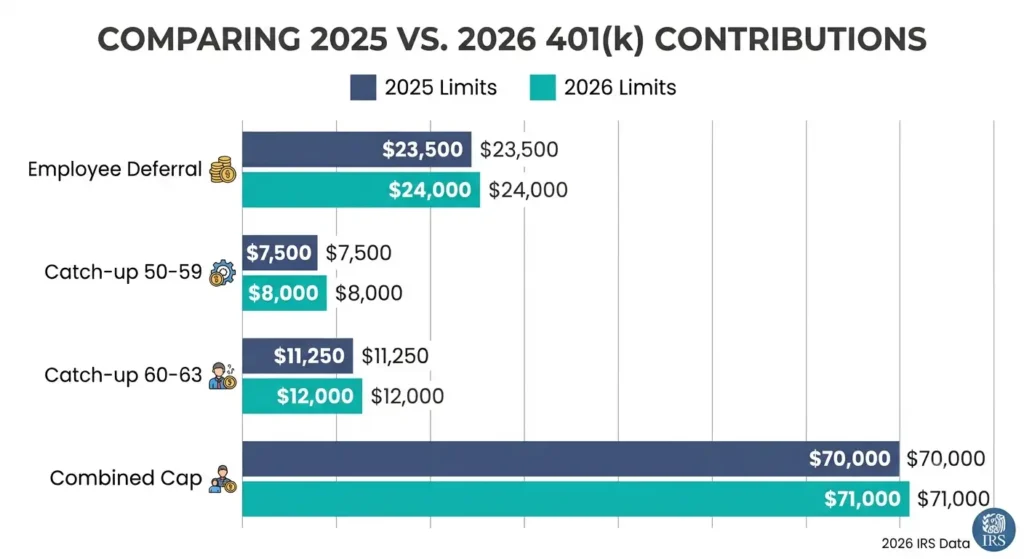
Every number comes straight from IRS Notice 2025-67. If your take-home pay has felt tighter than expected lately, our why is my paycheck so low guide walks through the other common culprits beyond 401(k) deferrals.
Quick answers to the most common questions
Your personal max for 2026 is $24,500, regardless of income. Employer match doesn’t count against that, but it does count toward the $72,000 combined cap. Roth and traditional contributions share the same $24,500 limit. Catch-up eligibility is based on the age you turn during the year, not your age on a specific paycheck date.
What Is the 401(k) Contribution Limit?
It’s the most you can defer from your paycheck into your 401(k) in one calendar year, separate from the gross pay versus net pay split you see on every stub. It resets every January 1st, and unused room never carries forward. Go over it, and the IRS taxes the extra money twice, once now and again at withdrawal. For a refresher on how paycheck deductions work in general, our paycheck basics hub covers the fundamentals.
What the IRS contribution limit actually means
This only tracks what you personally defer, known as an elective deferral. It has nothing to do with your total account balance, which can grow uncapped through investment returns (a $400,000 balance breaks no rule). A 401(k) loan doesn’t free up contribution room, and an early withdrawal doesn’t restore space already used. Required minimum distributions, which start later in retirement, are a separate rule entirely and don’t affect how much you can contribute while working.
Why the IRS changes contribution limits
The IRS adjusts limits yearly for inflation, tied to the Consumer Price Index for Urban Wage Earners. As prices rise, you get to shelter more income from taxes. That’s why 2026 is $1,000 higher than 2025, per IRS Notice 2025-67. This ties into broader California payroll tax planning too.
2026 IRS Contribution Limits Explained
Three numbers matter: what you can contribute, what you can add if you’re older, and what the total plan allows with your employer’s help.
Employee contribution limit
Your 2026 cap is $24,500 across all pretax and Roth 401(k) contributions combined, under Internal Revenue Code Section 402(g). It applies to traditional 401(k), 403(b), most 457(b) plans, and the federal Thrift Savings Plan. Two jobs, two plans: the $24,500 still applies across both, not per employer. Part-time employees fall under the same ceiling, though some plans require a minimum hours threshold to join, and some plans cap deferrals below the IRS max, so check your plan summary. Our part-time vs full-time paycheck breakdown covers how eligibility rules can differ between the two.
Catch-up contribution limits
Age 50+ adds $8,000, for a personal max of $32,500. Ages 60-63 get an enhanced SECURE 2.0 catch-up of $11,250 instead, for $35,750 total, under Internal Revenue Code Section 414(v). At 64, you drop back to the standard $8,000. New for 2026: earn over $150,000 in FICA wages last year, and catch-up contributions must go into a designated Roth account. Check Box 3 on last year’s W-2, or use our guide on how to read a California pay stub if you’re not sure where to look.
Combined contribution limit
The $72,000 combined limit, under Internal Revenue Code Section 415(c), covers your contributions, employer match, profit sharing, and after-tax contributions together. Add standard catch-up for $80,000, or the 60-63 catch-up for $83,250. This is separate from IRA limits: 2026 allows up to $7,500 into a Traditional IRA or Roth IRA on top of your 401(k). Roth IRA eligibility phases out at higher incomes, unlike the 401(k) limit. If your employer offers a high-deductible health plan, your HSA has its own separate contribution limits worth stacking on top of your 401(k).
Traditional vs Roth 401(k) Contribution Limits
Traditional versus Roth changes your tax bill, not your contribution room.
Same limit, different tax treatment
Traditional, Roth, or split between both, the $24,500 cap applies to the total. Traditional lowers taxable income now and gets taxed at withdrawal. Roth gets taxed now and grows tax free after.
Which option fits different situations?
Lower tax bracket now than expected later favors Roth. Peak earning years favor traditional, to shrink this year’s bill. Someone earning $60,000 in Sacramento today, expecting much more later, fits Roth. Someone earning $180,000 today, planning to retire in a lower-tax state, gets more from traditional. Check our California tax brackets to see exactly where your income lands before deciding.
2026 Contribution Limits Comparison Table
2025 vs 2026 limits
Employee deferral rose from $23,500 to $24,500. The 50-plus catch-up rose from $7,500 to $8,000. The combined cap moved from $70,000 to $72,000. All from the same annual CPI-W inflation adjustment.
By age comparison
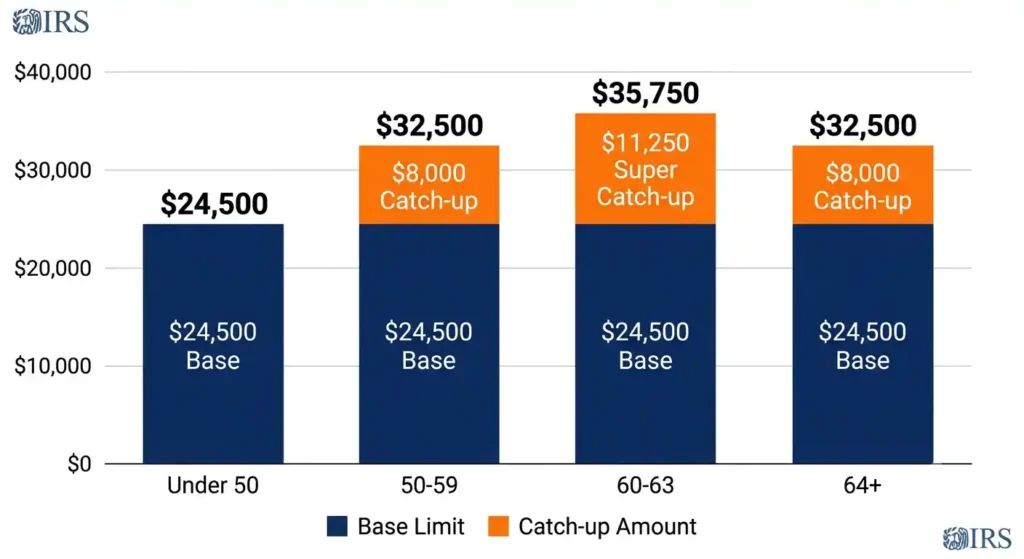
Under age 50
Standard $24,500 deferral, no catch-up. The baseline every other bracket builds on.
Age 50-59
Standard catch-up of $8,000, for a $32,500 max. Many people ramp up savings here once major expenses ease (mortgage, college).
Age 60-63
Enhanced catch-up of $11,250, for a $35,750 max. The largest catch-up room under current law.
Age 64+
Back to the standard $8,000 catch-up, for $32,500 total. The enhanced amount only applies to ages 60-63.
Employer Match vs IRS Contribution Limits
Does employer matching count toward your limit?
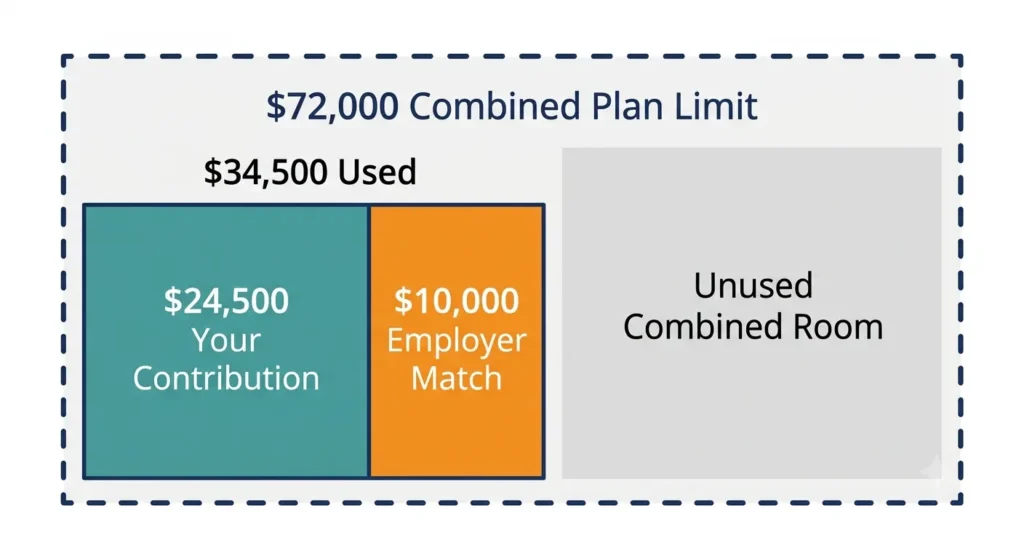
Employer match never counts against your $24,500 personal limit, but it does count against the $72,000 combined limit. Defer $24,500 with a $10,000 match, and you’re at $34,500 of the combined cap, nowhere near your personal one. The confusion comes from assuming one limit covers everything.
How to maximize employer matching
Check your match formula first. A common setup is 50 cents per dollar up to 6% of salary, worth about $4,200 a year on a $70,000 California salary. Spread contributions evenly across pay periods rather than front-loading, since some plans only match per paycheck and don’t true up at year end. Also check your vesting schedule, since matched dollars aren’t always fully yours right away.
How Much Should You Contribute Per Paycheck?
Calculate your payroll deduction
Divide $24,500 by your pay periods, or run the math with our gross pay calculator:
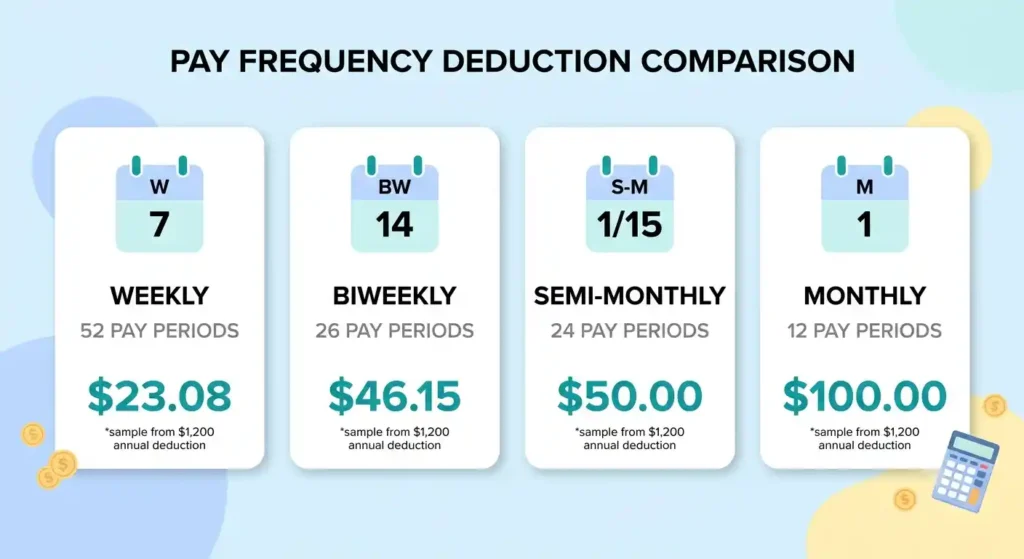
- Weekly (52 periods): about $471 per paycheck
- Biweekly (26 periods): about $942 per paycheck
- Semi-monthly (24 periods): about $1,021 per paycheck
- Monthly (12 periods): about $2,042 per paycheck
A flat dollar amount hits the max more reliably than a percentage.
Salary examples
$50,000 salary
Maxing out means deferring 49% of gross pay, unrealistic for most. A more common target is 10-15%, roughly $500 to $625 a month.
$75,000 salary
A 15% rate is $11,250 a year. Add a 4% employer match and you’re near $14,250 annually. See our $75k after taxes California breakdown for the full picture at this income.
$100,000 salary
Maxing out is just under 25% of gross pay, a stretch for many. A typical target is 15-18%. See our $90k after taxes California breakdown for how contribution rates shift take-home pay at nearby income levels.
$150,000+ salary
Maxing out is realistic here and cuts taxable income in a high California bracket. Age 50+ adds the $8,000 catch-up on top. Our $150k after taxes California guide breaks down the full tax picture at this level.
Real-Life Scenarios That Affect Your Contribution Limit
These situations come up often, and you can browse more paycheck scenarios if yours isn’t covered below.
You changed jobs during the year
Your $24,500 limit follows you, not your employer. Contribute $15,000 before switching jobs in July, and only $9,500 of room remains elsewhere. Track this yourself since payroll systems can’t see across employers.
You received a bonus
Bonuses often get the same deferral percentage as regular pay unless you say otherwise. A 15% rate on a $10,000 bonus means $1,500 goes straight into your 401(k). Ask payroll to exclude bonuses if you’d rather keep the cash, though check our California bonus tax rate guide first since bonus withholding works differently than regular pay.
You got a raise
A raise is the easiest time to raise your contribution percentage without feeling it in take-home pay. Moving from 8% to 10% barely changes your paycheck since the raise absorbs most of it.
You started contributing late
Starting in July with six monthly pay periods left means deferring about $4,083 per check to hit $24,500. Most people aim for a partial-year target instead, like capturing the full employer match.
You want to front-load contributions
Maxing out early in the year means more time invested and compounding. But if match formulas run per paycheck instead of annually, hitting your limit early can cost you matching dollars later in the year. Ask HR if your plan offers a true-up feature first.
Special Rules and Edge Cases
Contributing to two different 401(k) plans
Two jobs, two plans: your $24,500 employee limit is shared, not doubled. Track your combined total yourself. Going over means requesting a corrective distribution by April 15 of the following year.
Highly compensated employees
Earn more than $160,000 in 2025, or own over 5% of the business, and you’re a highly compensated employee (HCE). Plans may run an Actual Deferral Percentage (ADP) test and Actual Contribution Percentage (ACP) test to check HCE contributions aren’t disproportionate. Fail it, and part of your contribution gets refunded and taxed. This is a main reason some employees can’t hit the full IRS max. The IRS also caps salary counted for plan calculations at $360,000 for 2026.
After-tax 401(k) contributions
Some plans allow after-tax contributions beyond $24,500, up to the full $72,000 cap. This enables the mega backdoor Roth strategy, converting after-tax dollars to Roth for extra tax-free growth. Not every plan offers it.
Solo 401(k) contributions
Self-employed with no employees: you’re both employee and employer. As employee, you’re capped at $24,500. As employer, add up to 25% of net self-employment income, combined total capped at $72,000, or $80,000 with catch-up. Check our California self-employment tax rate guide first, since that 15.3% hit affects how much net income you actually have to contribute from. If you’re unsure whether you count as self-employed for plan purposes, our worker classification resources cover the distinction.
A SEP IRA caps at 25% of net earnings or $72,000, whichever is less, with no employee deferral piece, meaning less capacity than a Solo 401(k). A SIMPLE 401(k) drops the employee limit to $17,000, with a $4,000 catch-up at 50+. Some smaller employers offer an $18,100 enhanced tier, paired with a lower $3,850 catch-up. If your employer doesn’t offer any of these, California’s CalSavers mandate may apply instead.
Common Myths About 401(k) Contribution Limits
Myth: Employer match counts toward my employee limit
It doesn’t. Your employee limit stays $24,500 no matter the match. Defer $24,500 with a $5,000 match, and you’ve only used $24,500 of your personal limit. The mix-up usually starts with pay stubs that lump employee and employer amounts into one running total.
Myth: Each employer gives a separate contribution limit
The $24,500 limit is per person per year, not per employer. A new payroll system starts at zero, but the IRS still expects you to track your combined total. Keep your final pay stub from each job this year, since that’s the fastest way to add up what you’ve already deferred.
Myth: Roth and Traditional have separate limits
They share one limit. $12,000 traditional plus $12,500 Roth still totals the same $24,500 cap. The confusion comes from seeing two separate account types on your statement and assuming two separate limits go with them.
Myth: You should always contribute the maximum
Max out only after capturing the full employer match and covering short-term needs. Locking up $24,500 isn’t right if it means high-interest debt or no cash cushion. You can lower or pause contributions anytime without penalty.
Best Practices to Maximize Your 401(k) in 2026
Annual planning checklist
Review your percentage every January when new limits start. Recalculate your per-paycheck amount to hit $24,500 if that’s your goal. Check progress quarterly. Ask HR about internal caps, vesting requirements, or true-up provisions, since those don’t show up in IRS numbers. While you’re at it, revisit your DE-4 withholding form too, since a higher deferral rate changes your taxable wages.
Avoid common mistakes
The costliest mistake is contributing below the match threshold, leaving free money behind. The second is forgetting to track contributions after switching jobs. Set a reminder for open enrollment so you don’t default into last year’s rate.
Tools that make planning easier
A contribution calculator shows the percentage needed to hit your target, or use our annual salary calculator to see the take-home impact first. Payroll providers like ADP and Paychex often include built-in estimators. The IRS retirement topics pages cover the rules straight from the source, including SECURE 2.0 Act changes.
What Happens If You Contribute Too Much?
Excess contribution rules
Overcontributing usually happens after a mid-year job change when no one tracked the combined total. The IRS requires the excess, plus earnings, removed by April 15 of the following year. Miss it, and the excess gets taxed twice.
How to fix excess contributions
Contact your plan administrator right away and request a corrective distribution. You’ll get a 1099-R reporting the excess as taxable income. Acting before April 15 keeps this a minor fix instead of a double tax hit.
Frequently Asked Questions
What is the 401(k) contribution limit for 2026?
$24,500. Add $8,000 if you’re 50-59 or 64+, or $11,250 if you’re 60-63. The combined employee-employer cap is $72,000, higher with catch-up.
Does employer matching count toward my limit?
No. It counts toward the separate $72,000 combined limit, not your personal $24,500 limit.
Can I contribute to two 401(k) plans?
Yes, but your $24,500 limit is shared, not doubled. Tracking the combined total is on you.
What happens if I exceed the IRS limit?
Request a corrective distribution from your plan by April 15 of the following year, or the excess gets taxed twice.
Can I contribute to both a Roth 401(k) and Traditional 401(k)?
Yes, but $24,500 is your combined total across both, not per account.
How do I calculate the right contribution percentage?
Divide your target amount by your gross salary. $24,500 on a $100,000 salary is about 24.5%.
Can I change my contribution during the year?
Most employers allow changes anytime through payroll, not just at open enrollment. Check your plan’s specific rules.
Does rolling over an old 401(k) count toward my annual limit?
No. Rollovers into an IRA or new 401(k) aren’t new contributions and don’t affect your $24,500 limit.
Final Takeaway
What to remember before updating your payroll deductions
Your 2026 personal limit is $24,500, up to $35,750 with catch-up at ages 60-63. The combined plan cap tops out at $83,250. Capture your full employer match before chasing the max, since that’s money you can’t get back. Review your rate every January, since these numbers almost always move with inflation.

Yeasin Sorker is the founder of Paycheck Calculator California. He built this tool in 2018 after noticing that most free paycheck calculators missed California-specific rules like daily overtime and the uncapped SDI rate.
He researches California payroll tax updates regularly and keeps this calculator aligned with the latest IRS, FTB, and EDD published rates. All calculations on this site are estimates based on official 2026 government sources. For personalized tax advice, consult a qualified tax professional.