
A $50,000 salary in California nets about $40,424 after federal income tax, California state income tax, Social Security tax, Medicare tax, and California SDI for a single filer, close to a 19% effective tax rate.
That $40,424 baseline applies only when no 401(k), HSA, FSA, or health insurance deductions reduce your paycheck further.
Real take-home shifts with filing status, city, and pre-tax benefits, so use this as a starting point.
Quick Answer: What Is $50,000 After Taxes in California?
Estimated Take-Home Pay at a Glance
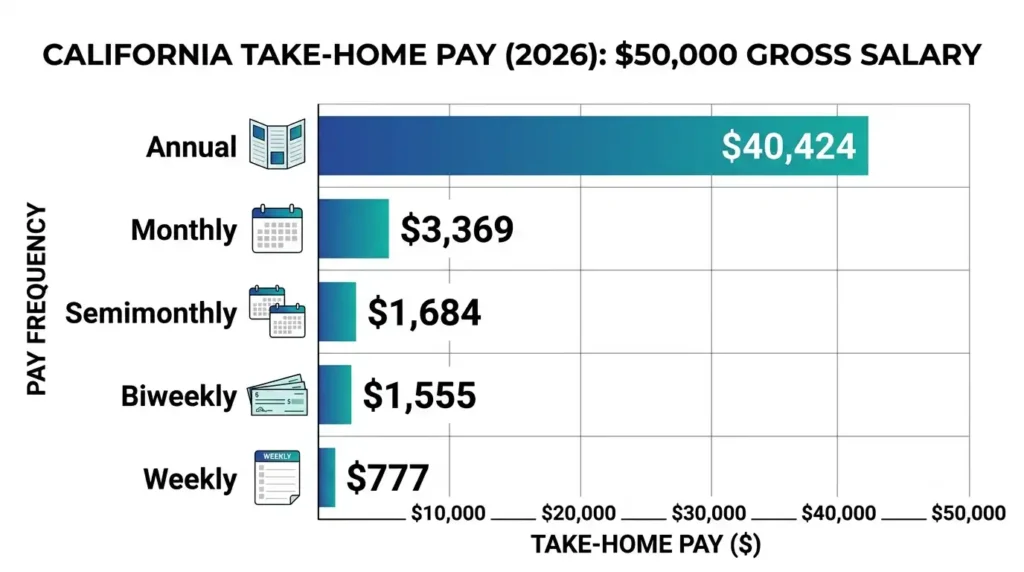
- Annual net income: about $40,424
- Monthly net income: about $3,369
- Biweekly paycheck: about $1,555
- Weekly paycheck: about $777
Quick Tax Breakdown
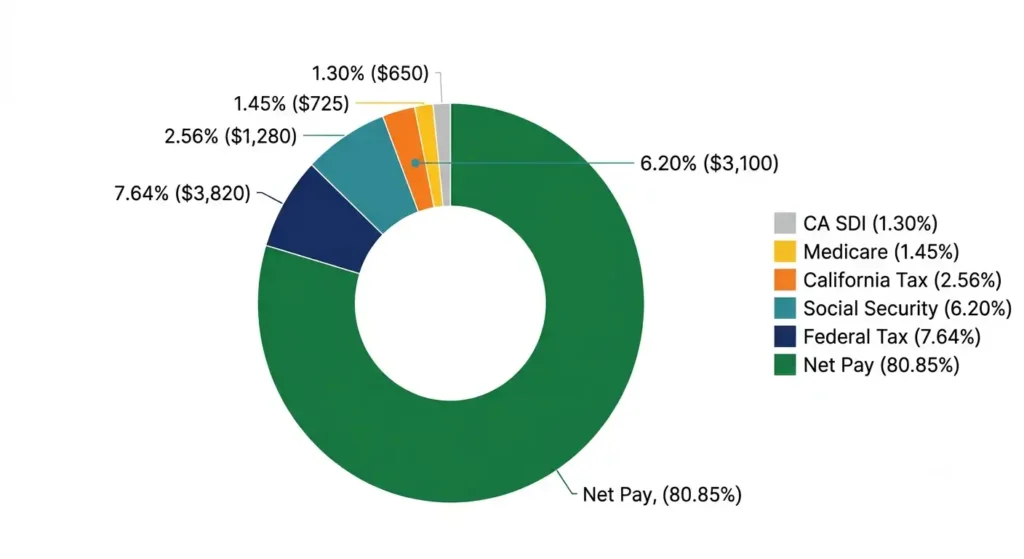
- Federal income tax: about $3,820
- California income tax: about $1,281
- Social Security: $3,100 (6.2%)
- Medicare: $725 (1.45%)
- California SDI: about $650 (1.3%), check the CA SDI calculator for other salaries
Free California Tax Tool
See How Much of Your $50K You Actually Keep
$50K in California doesn’t stretch as far as it sounds — after federal tax, state tax, and SDI, every dollar counts. See your exact take-home now.
🧮 See What $50K Really Pays You After TaxesUsed by thousands of California workers · FTB-verified 2026 rates
Use the $50k California Take-Home Pay Calculator
A calculator is only as good as its inputs: salary, filing status, pay frequency, and pre-tax deductions. Try our free California paycheck calculator for any salary, or our annual salary calculator for other income levels the same way.
Calculator Inputs
You need four inputs: gross salary (our gross pay calculator helps if you only know your hourly rate), filing status (single, married, or head of household), pay frequency, and pre-tax deductions like a 401(k) or health insurance premium. Skip one and the result is a guess.
Calculator Results
A good calculator returns gross pay, net pay, tax totals by category, and your effective tax rate, which is almost always lower than your top bracket. Switch to head of household on the same $50,000 and net pay rises a few hundred dollars, from the bigger standard deduction.
How Is a $50,000 Salary Taxed in California?
Three things tax your paycheck: the federal government, California, and FICA. For the fundamentals, see our paycheck basics guide and how California payroll taxes work overall.
Federal Income Tax
The 2026 standard deduction for a single filer is $16,100, dropping taxable income to $33,900. Run through the federal tax brackets (10% to 37%) and the bill is about $3,820, mostly in the 10% and 12% brackets. The Internal Revenue Service (IRS) sets these brackets yearly; employers use IRS Publication 15-T to figure withholding. Gross wages minus adjustments equal your adjusted gross income (AGI), then the standard deduction cuts taxable income further. Most W-2 workers take it over itemized deductions, which only win if expenses like mortgage interest exceed that flat amount.
California State Income Tax
California runs its own progressive brackets, using a much smaller standard deduction than the federal one. On $50,000, state tax is roughly $1,281. Rates start at 1% and hit the 6% to 8% range well before six figures; the steepest brackets start past $350,000. The Franchise Tax Board (FTB) oversees these California tax brackets.
FICA Taxes
FICA stands for the Federal Insurance Contributions Act. It covers Social Security and Medicare, on every dollar you earn, regardless of filing status.
Social Security
Social Security takes 6.2% of gross pay, $3,100 on $50,000. Your employer matches that 6.2%.
Medicare
Medicare takes 1.45% with no income cap, $725 on $50,000. The Additional Medicare Tax (0.9%) only starts above $200,000.
California SDI
California State Disability Insurance (SDI) is run by the California Employment Development Department (EDD). It appears on your check as CASDI and funds paid leave for illness, injury, or bonding with a new child. At 1.3% in 2026, the highest CA SDI rate since the program’s wage cap was removed, it costs about $650 on a $50,000 salary. It is a real benefit you can use later, not an error.
Annual, Monthly, and Per-Paycheck Breakdown
Same pay, different timeframes for budgeting.
Annual Take-Home Pay
$50,000 gross becomes about $40,424 net, roughly 81 cents of every dollar earned.
Monthly Budget Income
About $3,369 a month. Example: $1,400 rent, $400 groceries, $200 transportation, $200 utilities and phone leaves about $1,169 for savings, or roughly $14,000 a year.
Biweekly vs Semimonthly Pay
Biweekly (26 pay periods): about $1,555 per check. Semimonthly (24 pay periods): about $1,684 per check. Same annual total, different rhythm.
Weekly and Hourly Equivalent
About $777 a week. On a 40-hour week, that is roughly $19.40 an hour after tax, versus a $24 gross hourly rate.
Real-Life $50k Salary Scenarios
Circumstances change the number. Browse more salary scenarios for other situations.
Single Employee With No Pre-Tax Deductions
The baseline: no 401(k), no extra withholding, standard deduction only. Net pay: about $40,424 a year, or $3,369 a month.
Employee Contributing to a 401(k)
Put 5% ($2,500) into a traditional 401(k), within the 401(k) contribution limits for 2026, and taxable income drops by that amount. Take-home shrinks about $150 to $180 a month, but you lower your tax bill and build savings at once.
Married Employee
Married filing jointly with a non-earning spouse roughly doubles the standard deduction and widens the brackets. Net pay on the same $50,000 climbs to about $43,000 to $43,300 a year.
Employee Paying Health Insurance
A $200 monthly premium is $2,400 a year off taxable income before federal, state, and FICA calculations. Smaller paycheck, slightly lower effective tax rate.
Why Your Take-Home Pay May Be Different
A few variables move your real number.
Filing Status Changes Everything
Single, married filing jointly, and head of household each carry different standard deductions and bracket widths. Head of household gets a bigger deduction than single, raising take-home on the same salary.
Pre-Tax Benefits
A 401(k), Health Savings Account (HSA), Flexible Spending Account (FSA), or employer health insurance all cut taxable income before tax applies, skipping federal, state, and usually FICA too. HSA and FSA cover medical costs, including dental and vision, within the 2026 HSA contribution limits. 401(k) contributions do the same for retirement. Vision and dental premiums get the same pre-tax treatment as main health coverage.
W-4 Withholding Choices
IRS Form W-4 tells your employer how much to hold back (our step-by-step W-4 guide walks through it). California also has its own DE-4 form for state withholding, separate from the federal one. Claim more dependents and less is withheld; request extra withholding and more comes out now for a bigger refund later. Either way, what you owe for the year does not change, only how it shows up per check versus your refund. That owed amount comes from your effective tax rate, the real average across all income, not your marginal tax rate, the rate on your last dollar earned.
The IRS Tax Withholding Estimator helps in trickier cases:
- Bonus: taxed at a flat 22% federal supplemental rate (see the full California bonus tax rate breakdown)
- Overtime: can bump withholding on that check
- Two jobs: each employer withholds as if it’s your only income
- Pay frequency: weekly, biweekly, semimonthly, or monthly changes check size
- Part-year work: pays out on an annualized, partial basis
- Independent contractors: skip the W-4, pay self-employment tax quarterly instead of a W-2 employee setup
A refund means you overpaid through withholding; owing means you underpaid. Neither changes your actual tax bill.
California vs Other States
California income tax is the main reason your paycheck differs from someone doing the same job elsewhere.
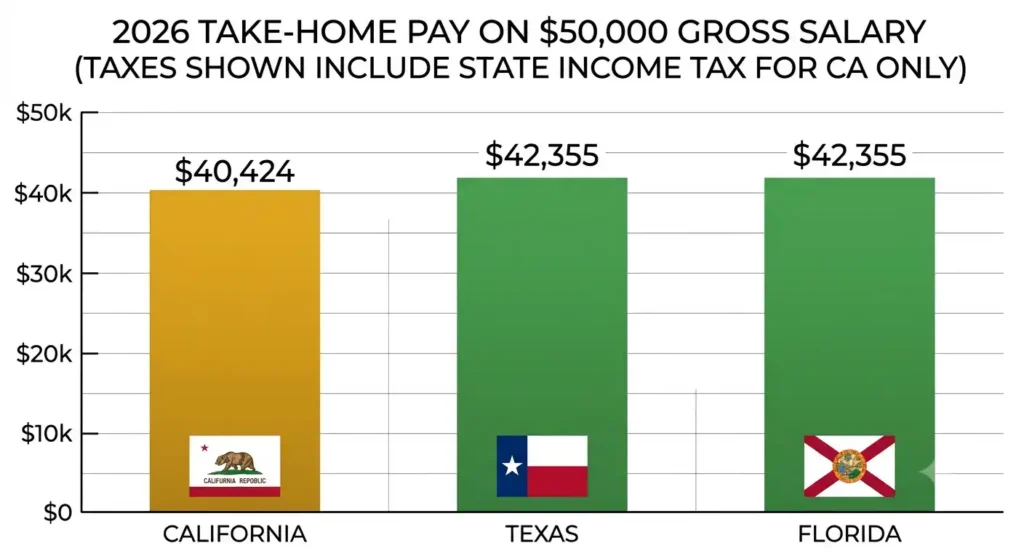
| State | State Income Tax | Net Pay on $50k |
|---|---|---|
| California | ~$1,281 | ~$40,424 |
| Texas | $0 | ~$42,355 |
| Florida | $0 | ~$42,355 |
| New York | Similar to CA | Similar to CA |
California vs Texas
Texas has no state income tax or state disability insurance, so a Texas worker keeps roughly $1,931 more a year than a California worker on the same $50,000, about $1,281 from the missing state tax and $650 from skipped SDI. Federal tax and FICA are identical in both states, so anyone relocating from Texas feels that gap the moment their first California paycheck lands.
California vs Florida
Florida also has no state income tax. The real gap between California and Florida shows up in cost of living, not the tax line.
California vs New York
New York’s state tax rates run close to or above California’s at this income, and New York City adds a local income tax that California does not have. Take-home pay lands in a similar range between the two.
Is $50k a Good Salary in California?
Depends entirely on the city.
Cost of Living Reality
In San Francisco or San Jose, $3,369 a month gets eaten fast by rent, often $2,500 or more for a one-bedroom. Lower-cost inland areas leave real room after rent, food, and utilities.
Living Alone vs Roommates
Alone in an expensive metro means a tight budget. One roommate can cut housing cost roughly in half, freeing up $600 to $900 a month. For most people at $50,000 in a high-cost city, a roommate is what makes the math work.
High-Cost vs Affordable California Cities
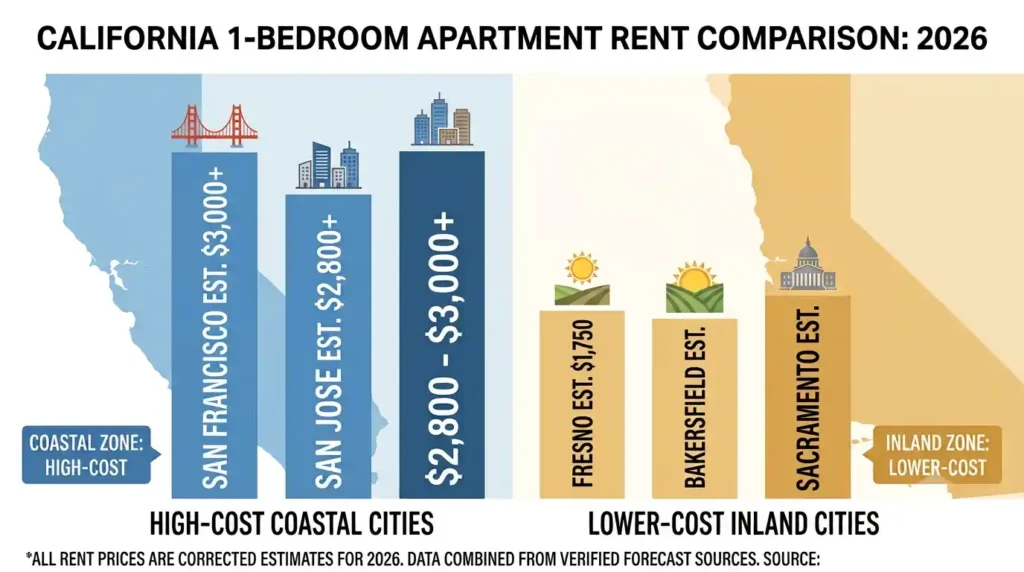
Fresno, Bakersfield, and Sacramento run 30% to 40% cheaper than the Bay Area or coastal Los Angeles, the difference between struggling to save and building an emergency fund.
Common Mistakes People Make
A few mix-ups cause most confusion at this salary.
Confusing Gross Pay With Net Pay
Offers list gross salary. Budgeting off $50,000 instead of the roughly $40,424 you actually keep is the most common mistake when starting a job. Our full gross pay vs net pay breakdown covers this in more detail.
Assuming Every Calculator Gives the Same Result
Calculators vary in their assumed standard deductions, filing status defaults, and whether CASDI is included, so results can differ by a few thousand dollars. Check the assumptions before trusting the number.
Forgetting Payroll Deductions
Health insurance, retirement contributions, and CASDI all come out before your check, on top of taxes (our guide on reading your pay stub shows where each one lands). Union dues do too, as a flat amount or a percentage of gross pay. None of this involves the California Department of Tax and Fee Administration (CDTFA), which handles sales and use tax, not payroll. For the employer side of this, see our payroll compliance and reporting category.
Frequently Asked Questions
How much is $50k after taxes in California?
About $40,424 a year for a single filer, or about $3,369 a month.
How much is each biweekly paycheck?
About $1,555, across 26 pay periods a year.
Is $50k enough to live comfortably in California?
Yes in lower-cost inland cities; in San Francisco or coastal Los Angeles it usually takes a roommate or a tight budget.
Why is my paycheck lower than the calculator estimate?
Health insurance, retirement contributions, and other voluntary deductions reduce pay below tax-only estimates. For more causes, see why your paycheck is lower than expected.
Does contributing to a 401(k) increase take-home pay?
No, it lowers your check now but also lowers taxable income, cutting your tax bill while building savings.
How accurate are California paycheck calculators?
Accurate for the inputs given; results shift with different filing status assumptions or missing CASDI.
Does filing status change my paycheck?
Yes. Married filing jointly and head of household carry bigger standard deductions than single, raising take-home on the same salary.
What taxes are automatically deducted from my salary?
Federal income tax, California state income tax, Social Security, Medicare, and California SDI.
Key Takeaways Before Accepting a $50k Job Offer
A $50,000 offer is not a $50,000 lifestyle. Know your real number first.
Questions to Ask Yourself
Does $3,369 a month cover rent, bills, and savings where you live? Are health benefits included, and what do they cost from your check? Is there a 401(k) match worth capturing? Is $50,000 actually competitive, or is there room to negotiate?
Next Steps
Run your own numbers by filing status and city, not just this single-filer baseline. Compare against similar roles. Budget off the $3,369 net figure, not the $50,000 gross. Review your W-4 as soon as you start. Weighing $55,000 or $60,000 instead: each extra $5,000 typically adds back about $3,600 to $3,700 in real take-home, not the full amount, since more gets taxed at higher brackets. See how the math changes at other salary levels.

Yeasin Sorker is the founder of Paycheck Calculator California. He built this tool in 2018 after noticing that most free paycheck calculators missed California-specific rules like daily overtime and the uncapped SDI rate.
He researches California payroll tax updates regularly and keeps this calculator aligned with the latest IRS, FTB, and EDD published rates. All calculations on this site are estimates based on official 2026 government sources. For personalized tax advice, consult a qualified tax professional.