
🧮 California SDI Calculator 2026
See exactly how much State Disability Insurance comes out of your paycheck — and what you’d get back if you ever needed to file a claim.
📊 SDI Deduction by Income Level (2026)
| Annual Salary | Monthly SDI | Annual SDI |
|---|---|---|
| $31,200 ($15/hr) | $33.80 | $405.60 |
| $50,000 | $54.17 | $650.00 |
| $75,000 | $81.25 | $975.00 |
| $100,000 | $108.33 | $1,300.00 |
| $150,000 | $162.50 | $1,950.00 |
| $250,000 | $270.83 | $3,250.00 |
The rate rose from 1.2% to 1.3%, and there’s no wage cap — so a raise means more SDI too. Nothing is broken on your pay stub.
No. SDI is a flat 1.3% for everyone, funding Disability and Paid Family Leave. State income tax is separate and based on your tax bracket.
You need at least $300 in covered CA wages during your base period, plus a certified medical or qualifying family-leave reason.
This tool provides estimates based on 2026 EDD rates and is for planning purposes only. It is not tax or legal advice. Verify your exact deduction on your pay stub and consult a payroll professional for your specific situation.
Calculator Tool embedded here
2026 Rate: 1.3%|No Wage Cap|Max Weekly Benefit: $1,765
How to Use the California SDI Calculator
Pick a tab, enter your numbers, and get your answer instantly. No submit button needed. If you want to see your full paycheck breakdown beyond just SDI, use the main California paycheck calculator on this site.
Key Features
| Feature | What It Does |
|---|---|
| Paycheck Deduction Calculator | Shows SDI withheld per paycheck, monthly, and annually based on your salary or hourly rate |
| Benefit Estimator | Estimates your weekly EDD payment using the official 2026 formula and your base period wages |
| Year-to-Date SDI Tracker | Shows how much SDI you have already paid this year and how much remains |
| Pay Stub Diagnostic Tool | Checks whether the SDI amount on your stub matches 2026 rules |
| Claim Filing Deadline Calculator | Shows your exact 49-day deadline based on your first day off work |
| WBA Sensitivity Slider | Shows how your weekly benefit changes across different quarterly wage amounts |
| Alternate Base Period Calculator | Checks if your most recent quarter improves your benefit over the standard base period |
| Eligibility Checker | Tells you whether you qualify to file a DI or PFL claim before you start |
| DI vs PFL Explainer | Compares both programs side by side on duration, waiting period, and filing deadline |
| SDI vs SSDI Table | Shows the key differences between California SDI and federal Social Security disability |
| Year-Over-Year Comparison | Shows your personal SDI cost from 2022 through 2026 using your actual salary |
| Voluntary Plan Toggle | Surfaces the correct rate note for workers whose employer uses a private SDI plan |
| Self-Employed Detection | Hides irrelevant fields and shows the DIEC opt-in link for 1099 workers |
| Print or Save Summary | Opens a clean printable version of your results |
| Multi-Job SDI Cost | Adds a second employer’s wages to show your combined annual SDI deduction |
| Supplemental Wages Field | Adds bonus, commission, or tip income to your total SDI cost calculation |
| Partial Wage Offset Calculator | Shows whether sick or vacation pay during leave will reduce your SDI benefit |
| ROI Coverage Card | Shows your maximum potential annual benefit versus what you actually pay in |
Step-by-Step Guide
To find your paycheck deduction:
- Step 1: Click the Paycheck Deduction tab
- Step 2: Select your pay type: salary, hourly, or gross per check
- Step 3: Select your pay frequency: biweekly, semi-monthly, monthly, or weekly
- Step 4: Enter your income amount
- Step 5: Your SDI per paycheck, monthly total, and annual cost appear immediately
Not sure what your gross pay is before deductions? The gross pay calculator can help you work backward from your net amount.
To estimate your disability or PFL benefit:
- Step 1: Click the Benefit Estimator tab
- Step 2: Select the month and year your claim starts
- Step 3: The calculator shows your 4-quarter base period with exact date ranges
- Step 4: Enter gross wages for each quarter from your pay stubs or W-2
- Step 5: Your weekly benefit, tier, and total payout by leave type appear immediately
Understanding Your Results
| Output | What It Means |
|---|---|
| SDI Per Paycheck | The dollar amount withheld each pay period at 1.3% of gross pay |
| Annual SDI Cost | Total SDI withheld over a full year on all wages |
| Monthly SDI | Annual cost divided by 12 |
| Formula Line | The exact math behind your result |
| Year-Over-Year Table | Your SDI cost from 2022 to 2026 based on your salary |
| ROI Coverage Card | Your annual contribution versus the $91,780 maximum annual benefit |
| Weekly Benefit Amount | Your estimated EDD payment per week |
| Tier Badge | 90% tier means your highest quarter is below $16,280. 70% tier means it is above |
| Duration Cards | Total payout for 4-week DI, 52-week DI, and 8-week PFL |
| Base Period Dates | The 4 calendar quarters EDD will use, auto-calculated from your claim start month |
Not sure how to read the deduction lines on your paycheck? The guide on how to read a California pay stub in 2026 walks through every line item including SDI, FICA, and state withholding.
How California SDI Tax Is Calculated in 2026
Formula:
Gross Wages x 1.3% = SDI Deduction
SDI Deduction by Pay Scenario
| Gross Pay | Pay Frequency | SDI Per Check | Annual SDI |
|---|---|---|---|
| $2,500 | Biweekly | $32.50 | $845 |
| $3,000 | Biweekly | $39.00 | $1,014 |
| $5,000 | Semi-monthly | $65.00 | $1,560 |
| $6,000 | Semi-monthly | $78.00 | $1,872 |
| $7,500 | Monthly | $97.50 | $1,170 |
| $10,000 | Monthly | $130.00 | $1,560 |
| $15,000 | Monthly | $195.00 | $2,340 |
| $20,833 | Monthly | $270.83 | $3,250 |
Bonuses, overtime, commissions, and tips are all subject to the same 1.3% rate. For a full breakdown of California payroll taxes including SDI, UI, and state income tax withholding, see the dedicated guide.
How the Benefit Amount Is Calculated
EDD uses your highest-earning quarter from the base period, not your current paycheck. The full formula is documented on the EDD Disability Insurance benefit calculation page.
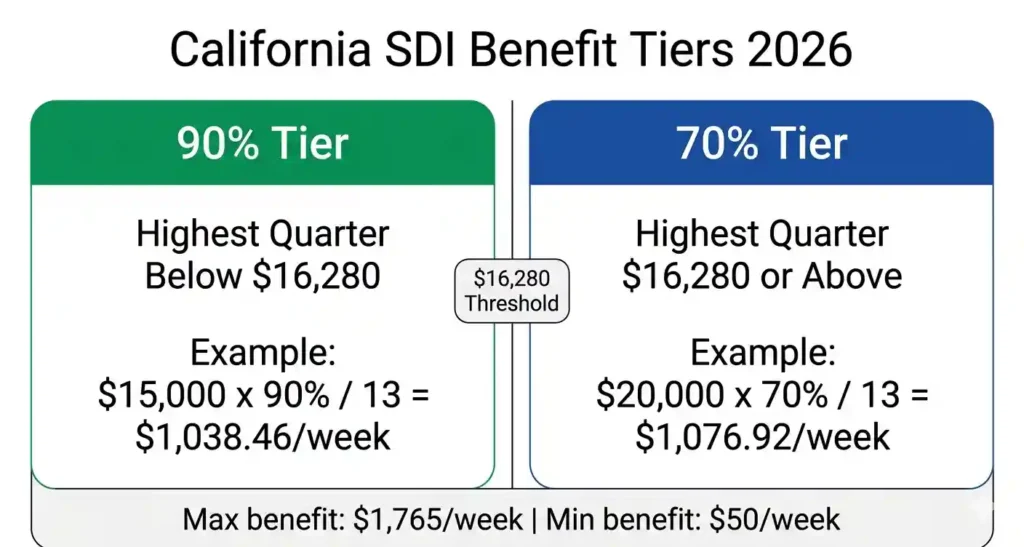
(Highest Quarter Wages x Replacement Rate) / 13 = Weekly Benefit
| Highest Quarter Wages | Replacement Rate |
|---|---|
| Below $16,280 | 90% |
| $16,280 or above | 70% |
Maximum benefit: $1,765 per week Minimum benefit: $50 per week
Example for a $60,000 salary:
Quarterly wages: $15,000
Tier: 90% (below $16,280)
Calculation: ($15,000 x 90%) / 13 = $1,038.46 per week
To see what a $75,000 salary actually takes home after SDI, state income tax, and federal tax combined, see 75k after taxes in California.
2026 SDI Rate Update
2025 vs 2026
| 2025 | 2026 | |
|---|---|---|
| SDI Rate | 1.2% | 1.3% |
| Maximum Weekly Benefit | $1,681 | $1,765 |
| Wage Cap | None | None |
| State Average Weekly Wage | $1,704 | $1,789 |
| Tier Threshold | $15,537 | $16,280 |
| Minimum Weekly Benefit | $50 | $50 |
Rate History: 2022 to 2026
| Year | Rate | Wage Cap |
|---|---|---|
| 2022 | 1.1% | $145,600 |
| 2023 | 0.9% | $153,164 |
| 2024 | 0.9% | None |
| 2025 | 1.2% | None |
| 2026 | 1.3% | None |
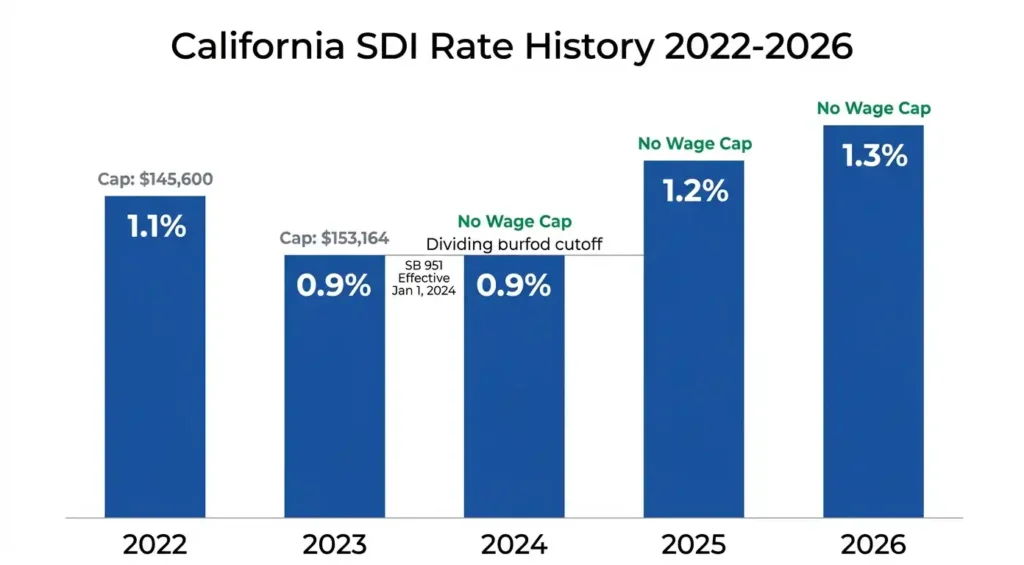
The wage cap was removed on January 1, 2024 under SB 951. It has not returned. The rate adjusts each year based on the SDI Fund balance, as published in the EDD employer rate notice. For a deeper look at the full CA SDI rate history and 2026 changes, including how SB 951 affects high earners, see the dedicated post.
If you want to understand how the SDI increase affects your total take-home on a higher salary, the 120k after taxes California breakdown shows the full picture including the post-SB 951 SDI cost.
SDI vs Paid Family Leave
Both are funded by the same 1.3% deduction. The difference is why you are on leave.
| Disability Insurance (DI) | Paid Family Leave (PFL) | |
|---|---|---|
| For | Your own illness, injury, or pregnancy | Bonding with a new child or caring for a sick family member |
| Duration | Up to 52 weeks | Up to 8 weeks per year |
| Waiting Period | 7 days unpaid | None |
| Filing Deadline | 49 days from first day off | 41 days from leave start |
| Doctor Certification | Required | Required for care claims only |
| Federal Taxable | Yes | Yes |
| CA State Taxable | No | Yes |
New parents often use both sequentially. The birthing parent typically claims DI for recovery, then PFL for bonding. EDD’s official Paid Family Leave program page covers eligibility rules and how to file. For a complete guide on how California Paid Family Leave works, including how to file and what the benefit covers, see the full PFL guide.
Who Pays California SDI?
SDI is an employee-only deduction. Employers do not contribute.
Covered workers:
- All private-sector W-2 employees in California
- Part-time workers, from the first dollar earned
- New hires, starting with the first paycheck
For a side-by-side view of how part-time vs full-time paychecks compare in California, including SDI and all other deductions, see the paycheck comparison guide.
Exempt workers:
- Certain government and railroad employees
- Workers under an approved Voluntary Plan (covered privately, not through EDD)
Self-employed and 1099 workers:
You are not automatically covered. You can opt in through the EDD DIEC program (Disability Insurance Elective Coverage). Without DIEC, you have no SDI or PFL coverage. If you are weighing 1099 vs W-2 employment in California, the difference in SDI coverage is one of the biggest factors to consider.
Voluntary Plan employers:
Some employers run a private SDI plan approved by EDD. If yours does, your rate may differ from 1.3%. The state assessment rate for VP employers is 0.182% in 2026. Check with HR if your stub shows “VP SDI.”
SDI on Your W-2 and Tax Return
On your pay stub, SDI appears under one of these labels: CASDI, CA SDI, CA State DI, State DI, SDI, CA Disability, EE SDI
On your W-2, SDI is reported in Box 14 as “CASDI.” It is informational only.
Federal Tax Return
- SDI you paid is deductible on IRS Schedule A, but only if you itemize
- SDI benefits you received are federally taxable. EDD sends a Form 1099-G
To understand where SDI sits relative to the full California standard deduction and whether itemizing makes sense for you, see that guide.
California State Return
- SDI you paid is not deductible on the CA return
- DI benefits are not taxable in California
- PFL benefits are taxable in California, as confirmed by the California Franchise Tax Board
Understanding your California withholding starts with the DE-4 form. If you have not reviewed yours recently, the guide on how to fill out California Form DE–4 in 2026 shows exactly how to adjust your state withholding to avoid surprises at tax time.
Frequently Asked Questions
What is the CA SDI rate for 2026?
1.3% on all wages. No annual cap.
Is there a maximum SDI withholding in 2026?
No. The wage cap was removed in 2024 and has not returned. Every dollar you earn is subject to 1.3%. If you are wondering why your paycheck feels smaller than expected, see why is my paycheck so low for a breakdown of all the deductions that reduce take-home pay in California.
Is California SDI tax deductible?
On your federal return, yes, but only if you itemize. On your California return, no. For more context on how California taxes interact with your federal return, see the guide on California tax brackets 2026.
Can I get an SDI refund?
Rarely. With no wage cap in 2026, over-withholding is uncommon. If SDI was withheld at the wrong rate, contact your employer’s payroll department. If you are expecting a state tax refund for other reasons, you can check its status through the California tax refund status guide.
Does my employer pay SDI?
No. SDI is withheld entirely from your wages. Your employer pays UI and ETT separately but does not contribute to SDI.
What is the difference between SDI and SSDI?
| CA SDI | Federal SSDI | |
|---|---|---|
| Run by | California EDD | Social Security Administration |
| Funded by | Employee deduction at 1.3% | FICA tax, shared by employer and employee |
| Max duration | 52 weeks | Indefinite |
| Approval time | About 14 days | 3 months to 2 years |
| 2026 max benefit | $1,765 per week | About $1,537 per month on average |
| CA state taxable | No (DI) / Yes (PFL) | No |
How long can I receive SDI benefits?
DI pays for up to 52 weeks. PFL pays for up to 8 weeks per year. Payments start on day 8 for DI (7-day waiting period) and day 1 for PFL. To start a claim, visit the EDD SDI Online portal.
Does SDI apply to self-employed workers?
Not automatically. To get SDI and PFL coverage as a self-employed worker, you must enroll in EDD’s DIEC program and pay contributions based on your net self-employment income. Before deciding, it is worth comparing the full cost difference between 1099 and W-2 worker classification in California including taxes, SDI, and benefits.
Browse More California Payroll and Tax Resources
Looking for more tools and guides? Browse all content in the California payroll taxes and California labor laws categories, or visit the paycheck basics section for foundational guides on how California paychecks work.
Rates and benefit amounts reflect EDD published figures for 2026. Updated January 2026. For advice specific to your situation, consult a tax professional.