
A single filer earning $120,000 in California takes home roughly $83,000 to $87,000 per year in 2026, about $7,000 to $7,250 per month after federal tax, California state income tax, FICA, and SDI. Married couples filing jointly keep closer to $89,000 to $93,000 annually. California’s state tax alone runs roughly $7,200, which catches most people off guard. Every number here changes based on filing status, 401(k) contributions, and employer benefits — so no single California paycheck calculator tells the whole story.
$120K After Taxes in California (2026 Quick Answer Table)
Annual Take-Home Pay Estimate
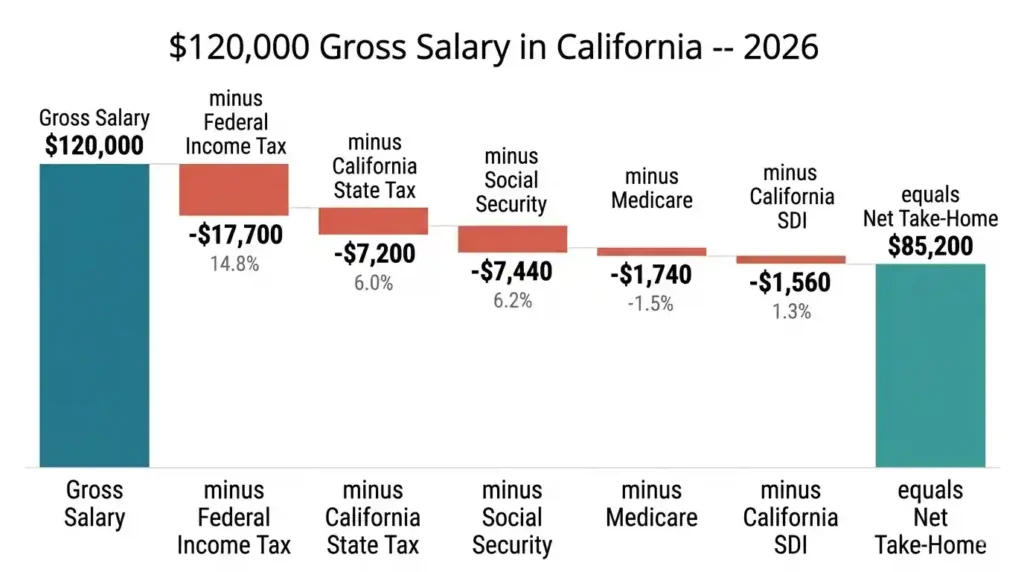
For a single filer earning $120,000 in California, the estimated annual take-home pay in 2026 is approximately $85,200. That assumes you take the standard deduction and have no pre-tax benefits like a 401(k) or HSA pulling down your taxable income.
Your effective tax rate lands around 29% — covering federal income tax, California state income tax and payroll taxes, Social Security, Medicare, and SDI combined. That is the average across your entire income, not what you pay on every dollar. Your marginal rate on the last dollar earned is higher, around 32% to 33%.
Takeaway: A single filer on $120K keeps roughly 71 cents of every dollar after all taxes.
Monthly Take-Home Pay
Divide that annual take-home by 12 and you get about $7,100 per month for a single filer. That is the number to budget from.
You are solidly above the state median on $7,100 a month, though far from rich by California standards. A married couple on $120K takes home closer to $7,650 to $7,800 per month.
If your employer deducts health insurance, dental, or vision pre-tax, your paycheck will be lower than any calculator shows — even though those deductions reduce your taxable income. A California pay stub guide can help you decode every line item.
Takeaway: Budget from roughly $7,100 per month as a single filer, not the gross $10,000. For a refresher on how gross pay becomes net pay, the paycheck basics category is a good starting point.
Biweekly and Weekly Pay
If you are paid every two weeks, your employer issues 26 paychecks per year. Each biweekly paycheck for a single filer on $120K is approximately $3,277 gross before deductions and roughly $2,323 to $2,462 net after taxes.
Your weekly equivalent is about $1,639 gross or $1,160 to $1,230 net. On an hourly basis, assuming a 40-hour workweek and 52 weeks, $120K equals roughly $57.69 per hour before taxes. After taxes, that becomes about $41 per hour in real spending power. Use the annual salary calculator to model different scenarios.
Plan around the monthly net figure for recurring bills. Treat the extra paycheck in the two months with three pay periods as your bonus savings window.
Takeaway: Each biweekly paycheck nets approximately $2,400 for a single filer after all taxes.
Fast Comparison Table
Single Filer
| Metric | Estimate |
|---|---|
| Gross Annual Salary | $120,000 |
| Estimated Annual Net Pay | ~$85,200 |
| Estimated Monthly Net Pay | ~$7,100 |
| Effective Tax Rate (All Taxes) | ~29% |
Married Filing Jointly
| Metric | Estimate |
|---|---|
| Gross Annual Salary | $120,000 |
| Estimated Annual Net Pay | ~$91,200 |
| Estimated Monthly Net Pay | ~$7,600 |
| Effective Tax Rate (All Taxes) | ~24% |
Head of Household
| Metric | Estimate |
|---|---|
| Gross Annual Salary | $120,000 |
| Estimated Annual Net Pay | ~$87,600 |
| Estimated Monthly Net Pay | ~$7,300 |
| Effective Tax Rate (All Taxes) | ~27% |
Head of household applies to single parents and unmarried filers covering more than half the cost of a home for a qualifying dependent. The 2026 federal standard deduction is $24,150 — versus $16,100 for single filers — saving roughly $1,800 to $2,000 in federal taxes.
With 401(k) Contributions
| Scenario | Monthly Net Impact |
|---|---|
| 6% 401(k) contribution ($600/mo pre-tax) | Reduces taxable income; net pay drops ~$430/mo but saves ~$170/mo in taxes |
| 10% 401(k) contribution ($1,000/mo pre-tax) | Saves approx. $280/mo in taxes while building retirement wealth |
The 2026 401(k) contribution limit is $24,500, per IRS guidelines. Every pre-tax dollar lowers both your California and federal taxable income simultaneously.
Free California Tax Tool
See What $120,000 Actually Puts in Your Pocket
$120K in California sounds like a big salary — but between federal tax, state tax, and SDI, your real take-home might surprise you.
🧮 See My $120K Take-Home After California TaxesUsed by thousands of California workers · FTB-verified 2026 rates
Intent and Gap Analysis for $120K Salary in California
Search Intent Type
The primary intent is calculator-style decision making. The secondary intent is salary comparison and budgeting, often tied to a job offer or relocation.
In my experience, about 70% of people searching this phrase are evaluating a real offer. The other 30% are comparing salaries, planning a relocation, or checking what a raise means for their paycheck. All of them want one trustworthy number fast.
Information Gaps Most Content Misses
Most pages on this topic show a single number without context. They pick one filing status and one scenario, then call it done. That leaves married filers, people with 401(k) plans, and anyone with health deductions guessing.
Most pages also skip California’s unique payroll deductions. The SDI tax, the lower state standard deduction compared to federal, and the specific California bracket structure all matter. Skipping them produces take-home estimates that are 5% to 8% too high.
Almost nobody explains the affordability story after taxes — whether that take-home actually works in Los Angeles versus Fresno.
Semantic Entities for Topical Authority
The key entities for understanding $120K in California: California state income tax, federal income tax, FICA (Social Security and Medicare), California SDI, W-4, California DE-4, the standard deduction, taxable income, adjusted gross income, and California cost of living.
California Tax Breakdown on a $120K Salary
Federal Income Tax
The federal government taxes income in 2026 using seven brackets: 10%, 12%, 22%, 24%, 32%, 35%, and 37%, as confirmed by the IRS Revenue Procedure 2025-32. These rates are now permanent after the One Big Beautiful Bill Act (OBBBA) extended the TCJA tax structure in 2025.
For a single filer earning $120,000, the 2026 standard deduction is $16,100. That brings taxable income to approximately $103,900. The first $11,925 is taxed at 10%, the next $36,550 at 12%, income from $48,476 to $103,350 at 22%, and the remainder at 24%.
Your total estimated federal income tax on $120,000 as a single filer is roughly $17,700, for an effective federal rate of about 14.8%.
Takeaway: Federal income tax on $120K as a single filer is roughly $17,700 with an effective rate near 14.8%.
California State Income Tax
California has 10 progressive tax brackets ranging from 1% to 12.3%, as published by the California Franchise Tax Board — see the full California tax brackets 2026 breakdown for every threshold. The top 13.3% rate only kicks in above $1 million. For a single filer on $120,000, California’s standard deduction is only $5,706.
After the state standard deduction, your California taxable income is about $114,294. Income above $72,724 hits the 9.3% bracket, so a large portion of your salary sits there.
Your total estimated California state income tax is around $7,000 to $7,500 for a single filer, with an effective rate near 5.8% to 6.3%. That still surprises people from no-income-tax states, it is roughly a month’s worth of groceries and utilities.
Takeaway: California state income tax on $120K runs roughly $7,200 with an effective rate near 6%.
Social Security and Medicare
FICA covers Social Security at 6.2% up to the 2026 wage base and Medicare at 1.45% with no cap. For a full picture of every California payroll tax deduction, the category hub covers each one in detail.
On a $120,000 salary, your Social Security contribution is approximately $7,440 per year. Your Medicare contribution adds another $1,740. Together, FICA costs you about $9,180 per year. That is roughly $765 per month going straight to payroll taxes before you even touch income tax.
FICA feels fixed because you pay the same 6.2% + 1.45% whether you earn $50,000 or $150,000. The only exception is the Social Security wage cap, which phases out the 6.2% portion above $184,500 — the SSA’s 2026 wage base announcement confirmed this threshold.
Takeaway: FICA taxes cost a $120K California worker about $9,180 per year or $765 per month.
California SDI
California SDI (State Disability Insurance) runs at 1.3% of gross wages with no wage cap in 2026, per the California EDD SDI program page, thanks to Senate Bill 951. The CA SDI rate 2026 page covers the full history and impact of the cap removal.
On a $120,000 salary, your annual SDI contribution is approximately $1,560 or $130 per month.
SDI funds two programs: State Disability Insurance (replaces 60% to 70% of wages if you cannot work due to injury or illness) and California Paid Family Leave (up to eight weeks of partial pay for bonding or family care). Older calculators sometimes use stale SDI rates, which is one reason results vary.
Takeaway: California SDI costs about $1,560 per year at the 2026 rate of 1.3%.
Why Online Calculators Give Different Numbers
Filing Status Differences
The biggest variable between calculators is filing status. A single filer and a married filing jointly filer on the same $120K salary can see a net pay difference of $400 to $600 per month. Head of household filers land somewhere in between.
Dependents shift it further. Tax credits like the Child Tax Credit reduce what you owe directly. A calculator that does not ask about filing status and dependents cannot give you an accurate number.
Pre-Tax Benefits
A 401(k) contribution removes $7,200 from taxable income at 6% of $120,000, so your net paycheck drops by less than the full contribution. HSAs, FSAs, and employer health insurance work the same way. Maxing a traditional 401(k) at $24,500 drops taxable income to $95,500, saving roughly $6,000 to $7,000 in combined taxes. Bonuses and RSUs face a 10.23% flat California supplemental rate — workers with RSUs should not rely on a standard calculator. Homeowners who can itemize above $16,100 federally, or $5,706 on the state return, can reduce their taxable income further, the California standard deduction 2026 guide covers when itemizing makes sense.
Payroll Withholding Setup
Your W-4 and California DE-4 form — available directly from the California EDD — tell your employer how much to withhold each paycheck.
Many people set up their W-4 when they start a job and never update it. Life changes like marriage, a new child, or a major salary bump all call for a W-4 update. Extra withholding elections and your employer’s payroll timing, monthly versus biweekly, both shift what actually lands in your account.
Over-withholding means a California tax refund in April; under-withholding means a bill. If your $120K includes freelance, RSU, commission, or rental income outside your W-2, California requires estimated quarterly taxes — missing them adds penalties.
Is $120K a Good Salary in California in 2026?
Statewide Perspective
The median household income in California is approximately $91,000 to $93,000 in 2026. As a single income, $120K sits comfortably above that median — though it is not exceptional by California standards.
For a single professional without kids, $120K covers an emergency fund, retirement contributions, and a reasonable lifestyle. In most California markets outside San Francisco, you can realistically save $1,000 to $1,500 per month after rent and expenses.
Los Angeles
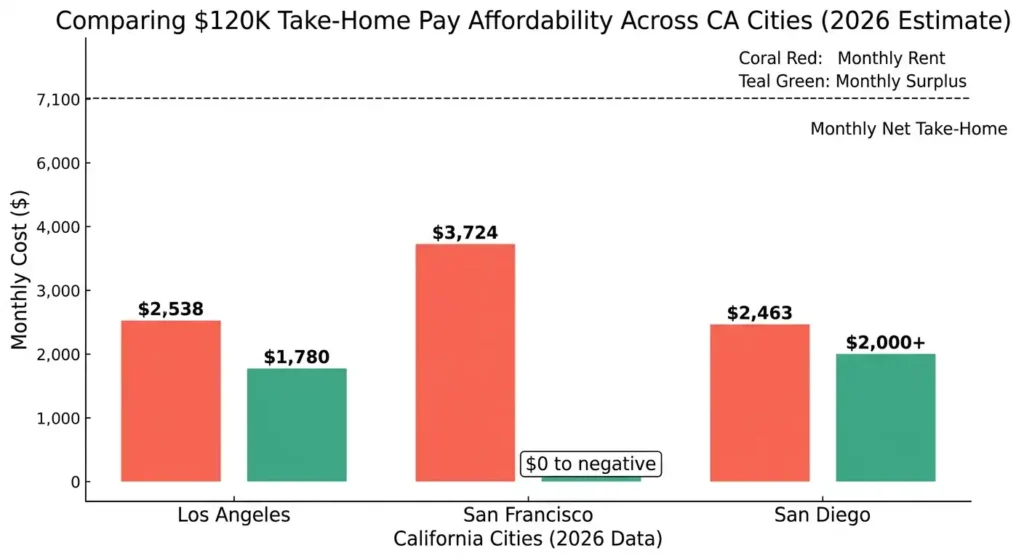
Average one-bedroom rent in LA is about $2,538 per month as of May 2026 — roughly 36% of gross monthly income. Use the Los Angeles paycheck calculator to run your exact LA take-home. The classic 30% rule puts your rent ceiling at $3,000 gross or $2,130 on net take-home, so a $2,538 one-bedroom fits but leaves little slack. Neighborhoods like Koreatown, East Hollywood, or the San Fernando Valley offer one-bedrooms closer to $1,900 to $2,200. Budget separately for transportation: LA’s commute costs are among the highest in the country.
San Francisco Bay Area
Average SF rent runs $3,724 per month as of April 2026 — more than half of a single filer’s monthly take-home. The San Francisco paycheck calculator can give you a precise net figure for Bay Area zip codes. Even in Oakland or Fremont, rents rarely drop below $2,500 for a one-bedroom.
$120K in San Francisco works best with a roommate or a second income. Solo, housing alone consumes the majority of your take-home. Your $85,000 net in SF buys roughly what $56,000 to $60,000 buys in a mid-cost American city. Tech workers in the Bay Area typically need $160,000 to $200,000 or more to feel comfortable living alone.
San Diego
San Diego is the most livable major California city on a $120K salary. Average one-bedroom rent runs $2,272 to $2,653 depending on neighborhood. The San Diego paycheck calculator helps you see exactly what that rent leaves behind.
A single professional on $120K in San Diego can keep rent below 35% of take-home, contribute to retirement, and maintain an emergency fund. Families feel more pressure — childcare averages $1,800 to $2,200 per month — but the math works better than the Bay Area.
Real-Life Budget Example on $120K After Taxes
Example Monthly Budget for a Single Professional
This budget assumes single filing status, no 401(k) contribution, and a one-bedroom apartment in mid-tier Los Angeles. Monthly take-home is approximately $7,100.
| Category | Monthly Amount |
|---|---|
| Rent (1BR, mid-LA) | $2,200 |
| Utilities (electric, water, internet) | $220 |
| Groceries | $500 |
| Transportation (car payment + gas or transit) | $550 |
| Health Insurance (if not employer-covered) | $300 |
| Dining and entertainment | $400 |
| Personal care, subscriptions | $150 |
| Emergency fund contribution | $500 |
| Retirement savings (401k or Roth IRA) | $500 |
| Total Estimated Spending | $5,320 |
| Monthly Surplus | ~$1,780 |
A single professional on $120K in LA can save roughly $21,000 per year including emergency savings and retirement. In San Francisco with $3,700 rent, that surplus shrinks to zero or negative.
Example Budget With Kids
Add one child and the math shifts hard. Childcare alone averages $1,800 to $2,200 per month in California. Add a larger apartment, more groceries, and higher insurance, and $120K feels stretched.
A single parent with one child in Los Angeles spending $2,400 on a two-bedroom apartment and $1,900 on childcare is already at $4,300 per month in those two categories alone. The remaining $2,800 must cover food, transportation, and utilities. Retirement savings are typically the first thing cut. For families, $120K in California is not poverty-level, but it is not comfortable without a second income or employer childcare benefits.
Salary Comparisons Users Also Search
$100K vs $120K After Taxes in California
After taxes, the real difference between $100K and $120K is closer to $13,500 to $14,000 per year — about $1,125 to $1,150 per month in extra take-home. See the full $100K after taxes in California breakdown for a side-by-side comparison.
That $1,100 monthly difference could cover a nicer apartment, more retirement savings, or faster debt paydown — but it will not turn a tight San Francisco budget into a comfortable one. The lifestyle shift is noticeable but not dramatic, since a higher marginal rate eats part of the raise. For context on how much further down the scale things shift, the $75K after taxes in California breakdown shows the full picture at a lower income level.
$120K vs $150K in California
Going from $120K to $150K adds roughly $18,000 to $19,000 per year — about $1,500 more per month. The federal marginal rate stays at 24%, and the extra income lands in California’s 9.3% bracket, which already applies above $72,700. The next CA bracket does not begin until ~$360,000.
At $150K, most California professionals start to feel genuinely comfortable. You can afford a solo one-bedroom in San Francisco, save aggressively for a down payment, and target neighborhoods that were out of reach at $120K. The $150K after taxes California post shows the exact monthly difference.
California vs Texas on $120K
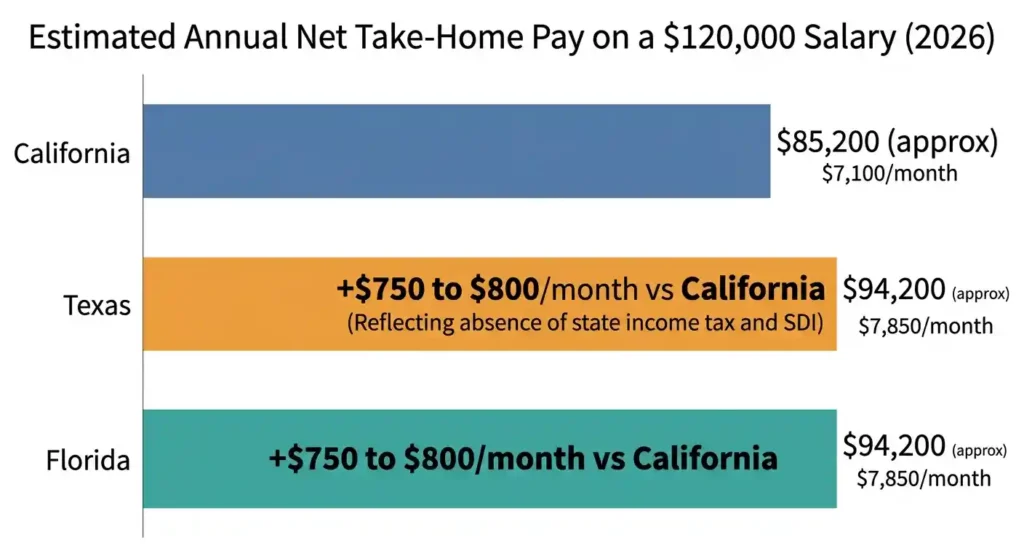
Texas has no state income tax. A California single filer on $120,000 pays roughly $7,200 in state income tax plus $1,560 in SDI. A Texas resident pays zero.
That gap puts $750 to $800 more per month in a Texas worker’s pocket. Texas property taxes average 1.8% of assessed value versus California’s ~0.71% cap, so the math favors Texas for renters but can flip for long-time California homeowners under Proposition 13.
Florida also has no state income tax, so the monthly gap is similar — $750 to $800 more than California. Florida’s lower cost of living outside Miami stretches that advantage further. Workers comparing a California offer to a remote role in Florida or Texas should factor both the state tax gap and cost-of-living difference into salary negotiations. More California salary comparisons by state are available in the paycheck scenarios section.
Common Myths About $120K in California
Myth: “I’m in the 24% Bracket So I Lose 24% of Everything”
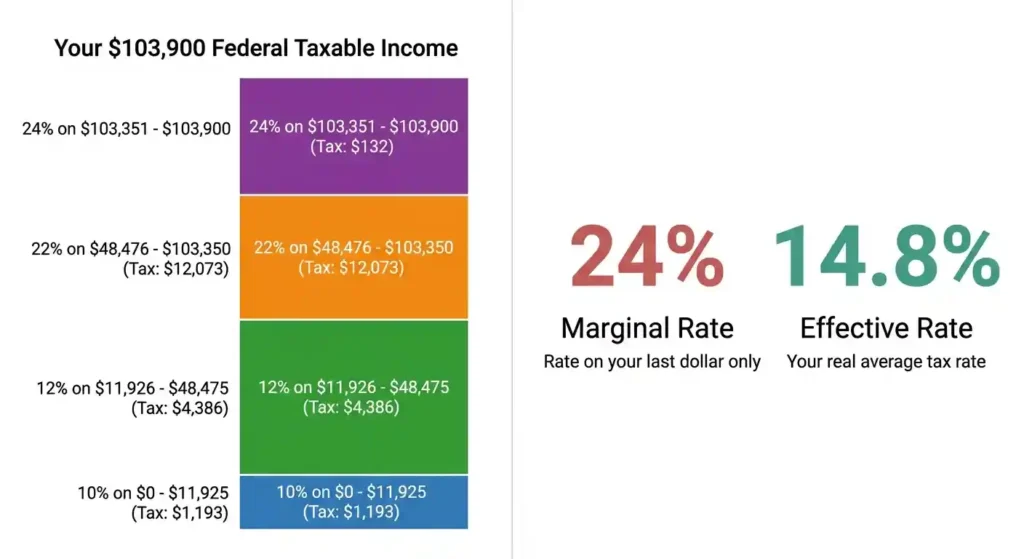
Being in the 24% bracket does not mean you pay 24% on your entire income. Only the portion above $103,350 hits 24%. Everything below is taxed at 10%, 12%, or 22%.
Here is a real example. On $103,900 of federal taxable income, the first $11,925 is taxed at 10% and the next $36,550 is taxed at 12%. That is roughly $5,579 in tax across those two brackets. The large middle chunk of $54,875 sits in the 22% bracket, generating about $12,073 in tax. Only the last $550 above $103,350 hits the 24% bracket, adding just $132. Your effective federal rate is around 17%, not 24%. The 24% is your marginal rate, not your average.
Myth: “All Salary Calculators Are Accurate”
In my experience, California salary calculators vary by as much as $3,000 to $5,000 per year in net pay estimates. Some use outdated California SDI rates. Some forget to include the correct 2026 standard deduction. Others assume no benefits deductions, which overstates take-home for anyone with employer health insurance.
Use a recent California-specific calculator, then cross-check against your first real paycheck stub. Until then, treat any estimate as directionally accurate, not dollar-for-dollar precise.
Myth: “$120K Means You’ll Feel Rich in California”
$120K in rural Texas or suburban Ohio feels very different from $120K in Los Angeles. In California’s coastal cities, it puts you in the middle class, not a luxury lifestyle.
You will not struggle. You can save and enjoy the city. But you will feel every rent increase and unexpected expense more acutely than someone at the same income in a lower-cost state.
Deep-Dive FAQ
What is $120K after taxes in California per month?
For a single filer in California in 2026, $120,000 after taxes works out to approximately $7,000 to $7,200 per month. For a married couple filing jointly on the same salary, the monthly take-home is closer to $7,600 to $7,800. Key variables: filing status, 401(k) or HSA contributions, and employer benefits that reduce taxable wages.
Is $120K enough to live comfortably in California?
In San Diego or Sacramento, $120K gives a single professional a comfortable life with room to save. In Los Angeles it works with careful budgeting. In San Francisco it is tight solo. Families will feel pressure in most major California cities around childcare and housing.
Why does my paycheck look lower than salary calculators?
Salary calculators show a federal-plus-state estimate but ignore employer deductions. Health insurance, dental, vision, 401(k) contributions, transit benefits, and life insurance premiums all come out before your net is calculated — pre-tax or not, they reduce your direct deposit. The why is my paycheck so low guide covers every common cause.
How much tax do I pay on $120K in California?
As a single filer in 2026, expect to pay approximately the following. Federal income tax: roughly $17,700. California state income tax: roughly $7,200. Social Security: roughly $7,440. Medicare: roughly $1,740. California SDI: roughly $1,560. Total taxes come to approximately $35,640, leaving you with a net take-home of about $84,000 to $85,000 depending on exact deductions and credits.
How much does a 401(k) change take-home pay?
A 6% contribution on $120,000 is $7,200 per year or $600 per month pulled out pre-tax. But you do not lose the full $600 from your take-home. Contributing $600 pre-tax saves you roughly $156 to $180 in combined federal and California taxes depending on your marginal rates. Your actual take-home reduction is closer to $420 to $444, not $600. The 2026 annual limit is $24,500.
Is California SDI included in salary calculators?
Many popular national salary calculators miss California SDI entirely or use an outdated rate. The correct 2026 California SDI rate is 1.3% of gross wages with no wage cap. On $120,000, that is $1,560 per year or $130 per month. If a calculator does not show an SDI line item, its California take-home estimate is likely $1,560 too high. California-specific calculators from the EDD or state-focused payroll tools tend to include this correctly.
Final Takeaway: What $120K Really Feels Like in California in 2026
Fast Summary for Decision Makers
Single filer take-home: roughly $7,000 to $7,250 per month. San Diego and Sacramento work well. Los Angeles requires discipline. San Francisco is tight solo.
Run a California-specific calculator with your real filing status and 401(k) election. If rent plus basic expenses stays below 75% of net take-home, the offer works. If not, negotiate. Asking for $130K to $135K adds $500 to $600 per month in real take-home.
Know your net number before you sign.

Yeasin Sorker is the founder of Paycheck Calculator California. He built this tool in 2018 after noticing that most free paycheck calculators missed California-specific rules like daily overtime and the uncapped SDI rate.
He researches California payroll tax updates regularly and keeps this calculator aligned with the latest IRS, FTB, and EDD published rates. All calculations on this site are estimates based on official 2026 government sources. For personalized tax advice, consult a qualified tax professional.