
🛡️ Verified Tax Disbursement Tracking:
By a Senior Financial Data Architect | 8+ Years in California Financial Systems. At Paycheck Calculator California, our 2026 audit team monitors the Franchise Tax Board (FTB) processing timelines. We provide the latest 2026 direct deposit and paper check schedules to help taxpayers accurately track their state refunds with 100% security and reliability.
California e-file refunds take 3 to 4 weeks. Paper returns take up to 3 months. Most delays are normal, but knowing exactly what to do at each stage is what separates a fast resolution from an 11-week wait.
In 8 years and hundreds of cases, the single most common fix I have seen is entering the exact refund amount. One dollar off triggers a “Return Not Found” error that looks like a lost return but is not.
Calling the FTB will not speed up your refund. Only knowing your status, and acting on the right one, will.
Quick Answer Snapshot: California Refund Timelines at a Glance
Before anything else, here are the timelines from the California Franchise Tax Board (FTB) for the 2026 tax season.
| Filing Method | Typical Time | Maximum Wait Before You Act |
| E-file + Direct Deposit | 3 to 4 weeks | 6 weeks |
| E-file + Paper Check | 3 to 4 weeks | 7 weeks |
| Paper Return | Up to 3 months | 4 months |
| Amended Return | Up to 5 months | 6 months |
| Business E-file | Up to 8 months | 9 months |
Takeaway: E-file with direct deposit is always the fastest path to your refund.
What Is a California State Tax Refund, Really?
A California state tax refund is simply a return of money you overpaid during the year. Your employer withholds a portion of your paycheck for state taxes based on your filing status and the California withholding tables. At the end of the year, the FTB compares what you paid to what you actually owe under California’s 2026 progressive tax brackets.
If you paid too much, you get money back. That money is your refund.
The California Franchise Tax Board processes millions of these returns every year. They do it through both digital channels and old-fashioned paper mail. If you want to understand every deduction that feeds into your tax liability in the first place, our guide to California payroll taxes breaks down every line on your pay stub.
Takeaway: Your refund is your own money coming back to you, not a gift from the government.
California vs. Federal Refund: These Are Two Separate Systems
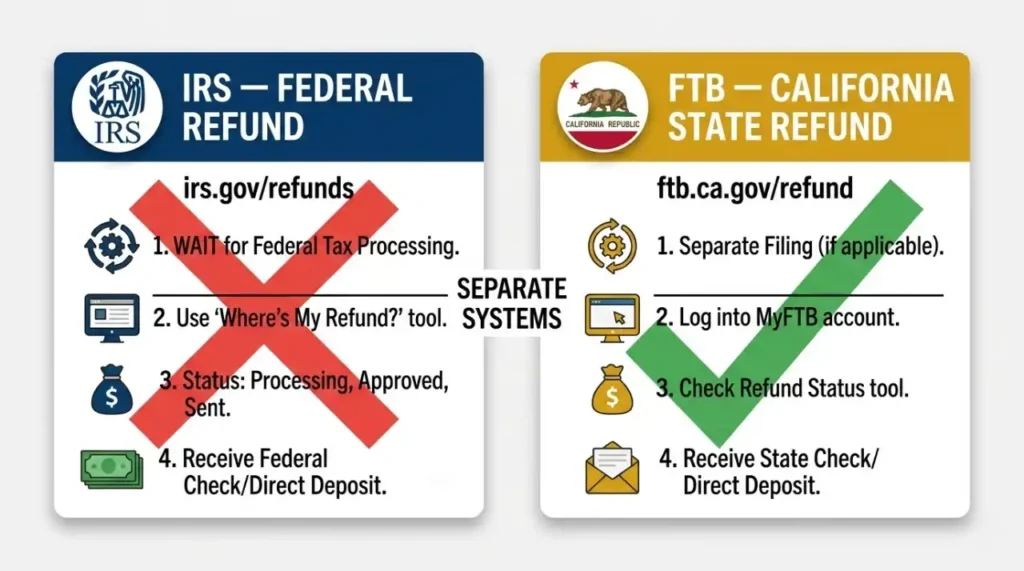
This is one of the most common mix-ups I see. Your California state refund and your federal IRS refund are completely separate.
The IRS handles your federal return. The FTB handles your California state return. They do not share a tracking system or a timeline.
Your federal refund might arrive in two weeks while your state refund is still processing. That does not mean something is wrong. It just means two different agencies are working on two different returns.
Do not use the IRS “Where’s My Refund” tool to check your California refund. You will get wrong information. Use the official FTB refund tracker at ftb.ca.gov instead.
Takeaway: California and federal refunds run on separate tracks. Always check them separately.
How to Check Your California Refund Status Step by Step
The FTB offers a 24/7 automated status tracker on their official website. Here is exactly how to use it.
What you will need before you start:

- Your Social Security Number (SSN) or Individual Taxpayer Identification Number (ITIN)
- Your ZIP code
- The numbers from your mailing address
- The exact whole-dollar refund amount you claimed
Where to find your refund amount on your California form:
- Line 32 on Form 540 2EZ
- Line 99 on Form 540
- Line 103 on Form 540NR
If you are unsure of your original gross pay figure or want to verify what your taxable income should have been, our gross pay calculator can help you work backwards from your earnings.
The tool uses SSN masking and encrypted data transmission to keep your data safe. The MyFTB Account portal also offers multi-factor authentication for extra security.
If the online tracker does not resolve your question, you can contact the FTB directly by phone or through written correspondence via your MyFTB Account portal. For reference, the standard estimated processing windows are a 5-month e-file window for amended returns and a 6-month paper window for the most complex filings.
Common mistakes that cause a “Return Not Found” error:
- Entering a rounded refund amount instead of the exact dollar amount
- Using the wrong ZIP code (use the one on your tax return, not your current address)
- Checking too soon after filing
Takeaway: Enter your exact refund amount from the correct form line. Even one dollar off will cause an error.
What Your Refund Status Message Actually Means
The automated status tracker shows messages that correspond to key stages in your return. Here is what each one really means in plain terms, including the one most people miss.
Internal Processing Stages: What Happens Behind the Scenes
The FTB runs your return through four internal stages before your money moves. Most taxpayers never see this. I am going to show you exactly what is happening while you wait.
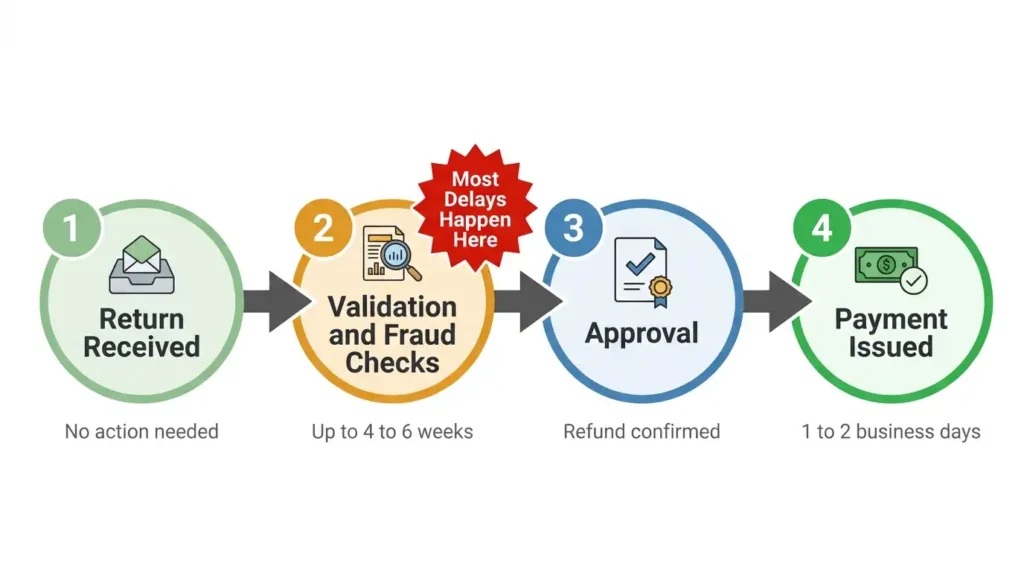
Stage 1: Return Received
Your return landed in the FTB system. It is in the queue. No action needed from you right now.
Stage 2: Validation and Fraud Checks
This is where most delays happen. The FTB runs automated checks on your tax identity, your adjusted gross income, and your filing status. Returns flagged here move into manual review. Discrepancies in deductions like the California SDI tax rate for 2026 are one common trigger when reported wages do not match withholding records.
Stage 3: Approval
Your refund amount is confirmed. Your tax liability has been reconciled against your withholdings and any tax credits you claimed. Payment is being prepared.
Stage 4: Payment Issued
Your refund is on its way. Direct deposit takes 1 to 2 business days. A paper check follows your mailing address on file.
Stage 5: More Information Needed
This status requires immediate action from you. The FTB cannot continue processing until you respond. Do not wait on this message. Log into your MyFTB Account or call 800-852-5711 to find out exactly what they need.
Pro Insight: Where Delays Actually Live
In my experience, the majority of delays I have seen across hundreds of cases happen during Stage 2. If your tracker says “Processing” for more than 4 weeks, you are likely stuck in the validation queue, not the approval queue. That is a critical difference. It tells you exactly who to call and what to say when you do.
Takeaway: Stage 2 validation is where most refunds stall. Knowing this saves you from calling the wrong department.
Why Is My California Refund Delayed? The Real Reasons
California refunds are delayed most often by manual review, identity verification flags, or tax credit checks. In 2026, life changes like moving or adding a dependent are triggering fraud safeguards at higher rates. Here are the specific causes and what each one means for your timeline.
In my experience, most people assume a delay means they made an error. That is rarely the case. Here are the actual reasons refunds get delayed.
Manual Review Triggers
The FTB uses fraud safeguards that pull returns into a manual review queue. For the 2026 tax season, returns are being flagged more often if the taxpayer moved during 2025 or added a new dependent. These are normal life changes that accidentally trip the automated fraud detection system.
Tax Credit Verification
Claims for credits like CalEITC (California Earned Income Tax Credit) or the Young Child Tax Credit (YCTC) require additional verification. This adds time to your processing window. If you are unsure how credits interact with your taxable income, reviewing the California standard deduction for 2026 helps clarify exactly how your liability was calculated before any credits applied.
Identity Verification
This is the hidden step that most guides skip entirely. Some taxpayers receive a “Processing” status message even when the FTB actually needs identity verification. The tracker does not always make this clear. The FTB mails specific notices such as FTB 3904 or FTB 4734D when identity verification is required. If you receive one of these letters, call 916-845-7088, which is the FTB’s dedicated Identity Theft Unit line, confirmed on the official FTB identity theft page. This line handles verification and fraud-related holds only. The general customer service line at 800-852-5711 cannot assist with identity verification letters, per the FTB’s own Tax News guidance. Have your previous year’s bank name and your photo ID expiration date ready when you call.
Paper Filing Backlog
Paper returns go through a manual data entry process before they even enter the system. This creates a backlog during peak filing season. E-filing through CalFile or a trusted software eliminates this delay entirely.
Refund Offset
If you owe a debt to the state, such as unpaid taxes, child support, or other government obligations, the FTB may reduce or fully absorb your refund to cover it. You will receive a notice in the mail explaining the offset. Workers who experienced wage disputes or underpayment issues in 2025 should also check whether they are owed back wages under the California minimum wage rules for 2026 before assuming their refund amount is final. Freelancers and gig workers should also verify their worker classification status, as misclassification under the California ABC Test can create unexpected tax liabilities that directly reduce a refund.
Bank Rejection
If you entered the wrong bank account number on your return, the direct deposit will fail. The FTB will then mail a paper check to your address on file, which adds several weeks.
Takeaway: If you receive an FTB identity verification notice, call 916-845-7088 immediately. For general delay questions, call 800-852-5711.
The 2026 Action Plan: What to Do Based on Your Wait Time
Do not panic based on time alone. Use this action plan instead.
Under 4 Weeks
Wait. This is a completely normal timeframe for e-filed returns. The FTB is processing your return on schedule.
4 to 6 Weeks
Start monitoring your status every few days. Double-check that you entered the correct refund amount and address information into the tracker.
Over 6 Weeks with No Change
Contact the FTB. Call the general support line at 800-852-5711. Have your tax return in front of you when you call.
“More Information Needed” Status
Respond to the FTB immediately. Submitting documents digitally through your MyFTB Account is the fastest option. Paper responses add weeks to your wait.
Takeaway: Time alone does not trigger action. Your status message tells you when to move.
Important 2026 Tax Season Updates You Need to Know
Federal Tax Changes and Larger Refunds in 2026
Many California taxpayers are surprised by how their 2026 federal refund compares to previous years. The One Big Beautiful Bill Act (OBBBA), signed into law on July 4, 2025, reduced individual income taxes for 2025 by an estimated $129 billion. However, the IRS confirmed on August 7, 2025, that it would not update federal withholding tables for the 2025 tax year. That means most workers continued having the old, higher tax amount withheld from every paycheck throughout 2025. If you are a higher-income earner curious how these stacked taxes affect your real take-home, our breakdown of $150k after taxes in California for 2026 shows the full picture at that income level.
The result is that many workers overpaid federal taxes throughout the year. When they file their 2025 return in 2026, they receive that overpayment back as a larger-than-usual refund. The Tax Foundation estimates average refunds could be up to $1,000 higher this season compared to a typical year. This applies to federal refunds. California sets its own withholding tables independently, so your state refund depends on your specific California income and withholding situation. To see exactly how California taxes stack up against federal obligations at a real income level, our breakdown of what $100k looks like after California taxes in 2026 shows the full picture. If your California refund is unexpectedly low, a licensed CPA or tax professional can review your state withholding elections.
MCTR Debit Card Expiration: April 30, 2026

This is urgent if you received a Middle Class Tax Refund (MCTR) debit card between 2022 and 2023. These inflation relief cards expire on April 30, 2026. According to FTB data reported in April 2026, approximately $240 million remains on activated cards with unspent balances. A broader figure of around $400 million in total funds is set to return to the California General Fund, covering both unactivated cards and partial balances on activated cards.
If your card is still active, transfer the balance to your bank account before the deadline. Call 800-240-0223 to activate the card or transfer funds. For full eligibility details and step-by-step activation instructions, visit the official FTB Middle Class Tax Refund page. After April 30, unclaimed money returns to the California state General Fund.
Takeaway: MCTR cards expire April 30, 2026. Move your funds now or lose them.
Edge Cases Most Guides Skip Entirely
Amended returns, prior-year refunds, and lost checks cannot be tracked with the standard FTB online tool. These situations require a direct phone call and a longer wait. Here is how to handle each one.
Amended California Returns (Form 540X or Schedule X)
Amended California returns are filed using Form 540X or the newer Schedule X, depending on your tax year. Note that Form 1040-X is the federal amended form and is separate from California’s process entirely. California amended returns take up to 5 months to process. They cannot be tracked using the standard online tool. You must call the FTB directly for status updates on amended filings.
Prior-Year Refunds
Refunds from previous tax years are not visible in the online tracker. Contact the FTB by phone if you are waiting on a prior-year return.
Lost or Expired Paper Checks
California state tax refund checks expire after 6 months. If your check is lost or expired, request a reissue by contacting the California State Controller’s Office. Expect the reissue process to take several additional weeks. While you wait, it is also worth checking whether any missed California meal and rest break premiums from 2025 were properly reported on your W-2, as unreported premium pay can create a discrepancy that delays reissuance.
Takeaway: Amended returns, prior-year refunds, and expired checks all require a direct phone call to resolve.
How to Avoid Delays Next Tax Season
I have filed both paper and electronic returns over the years. After just one season using e-file with direct deposit, I never went back to paper. Here is what I recommend to every taxpayer I talk to.
- File between January and February. Early filers face less competition in the processing queue.
- Use e-file through an authorized provider or directly through CalFile on CA.gov.
- Choose direct deposit. It is faster and eliminates mail risk.
- Double-check your Social Security Number, bank routing number, and account number before submitting.
- Keep your mailing address updated with the FTB through your MyFTB Account portal.
- If your income included overtime, verify that your employer used the correct rates under California overtime laws before you filed, since a W-2 correction triggers a delay.
- Run your withholding through the California paycheck calculator each January to confirm your DE-4 elections match your actual tax liability before the year begins.
Takeaway: E-file plus direct deposit in January is the single best way to get your refund as fast as possible.
Deep-Dive FAQ: Your Biggest Questions Answered
How long does a California state tax refund take in 2026?
E-filed returns typically take 3 to 4 weeks. Paper returns take up to 3 months. Amended returns take up to 5 months. During peak season (February to April), e-filed returns can take up to 6 weeks.
Why is my California refund still showing “Processing” after 4 weeks?
You may be in a manual review or identity verification queue. Call 916-845-7088 to check your specific situation.
Can I speed up my California refund?
No. Once your return is submitted, the FTB controls the timeline. Filing early and choosing e-file with direct deposit gives you the best head start.
Why is my federal refund larger than usual this year?
The OBBBA reduced individual income taxes for 2025 by an estimated $129 billion. Because the IRS confirmed it would not update federal withholding tables for 2025, most workers continued having too much withheld from their paychecks all year. Filing your 2025 return lets you claim that overpayment back. Average federal refunds are expected to be up to $1,000 higher this season. Note this primarily affects your federal refund. Your California state refund depends on your California-specific withholding and tax situation.
What happens if my bank rejects my direct deposit?
The rejected deposit is returned to the State Controller’s Office. The FTB will then mail a paper check to your address on file. This process adds 4 to 6 weeks to your wait. Double-check every digit of your routing and account numbers before you file.
When should I contact the FTB?
Contact the FTB if your e-file refund has not arrived after 4 weeks, or if your paper return has not arrived after 4 months.
What is the FTB general support phone number?
Call 800-852-5711 for general California tax refund support.
Final Summary: What You Need to Do Right Now
Here is the simple truth about California tax refunds in 2026. Most delays are normal. The system is working, just slower than we want it to.
Check your status using the official FTB tracker at ftb.ca.gov. Use the exact refund amount from your Form 540 or 540 2EZ. If you hit 4 weeks with no change, call the verification line at 916-845-7088.
If you received a Middle Class Tax Refund debit card, move your funds before April 30, 2026.
And if your refund is smaller than expected, check your paycheck withholding history for 2025. You may have already received your tax benefit spread across your paychecks throughout the year. Use our annual salary calculator to model your 2026 take-home pay now and adjust your DE-4 withholding before the same situation repeats next year. A tax professional can confirm this for your specific situation.
One reader sent me a message last April that I still think about. She wrote: “I called that verification number you listed and had my refund approved in two days. I had been waiting seven weeks. This was the only guide that gave me the actual phone number I needed.” That is exactly what this guide is here to do. Give you the information that moves the needle, not just the information that fills a page.
You now have everything you need. No more searching. No more guessing. Go check your status right now and let the FTB bring your money home.
Filing deadline: April 15, 2026. Extension deadline: October 15, 2026. For general FTB support: 800-852-5711. Always verify current phone numbers and portal features directly at ftb.ca.gov before calling.
Disclaimer: This article is for general informational purposes only and does not constitute tax, legal, or financial advice. Tax laws and FTB policies change frequently. For advice specific to your situation, consult a licensed CPA or tax professional.

Yeasin Sorker is the founder of Paycheck Calculator California. He built this tool in 2018 after noticing that most free paycheck calculators missed California-specific rules like daily overtime and the uncapped SDI rate.
He researches California payroll tax updates regularly and keeps this calculator aligned with the latest IRS, FTB, and EDD published rates. All calculations on this site are estimates based on official 2026 government sources. For personalized tax advice, consult a qualified tax professional.