
If your employer sends you home before you have worked half your scheduled shift, California law requires them to pay you for at least two hours, even if you worked zero. The maximum they owe is four hours, paid at your regular rate. Sixteen of California’s seventeen IWC Wage Orders include this guarantee, covering most hourly workers across retail, food service, warehousing, and beyond. That said, exceptions do exist, including emergencies, voluntary early departures, and discipline-based dismissals, so the circumstances of each situation matter.
Quick Answer — Are You Owed Money If You Were Sent Home Early?
Simple rule every California worker should know
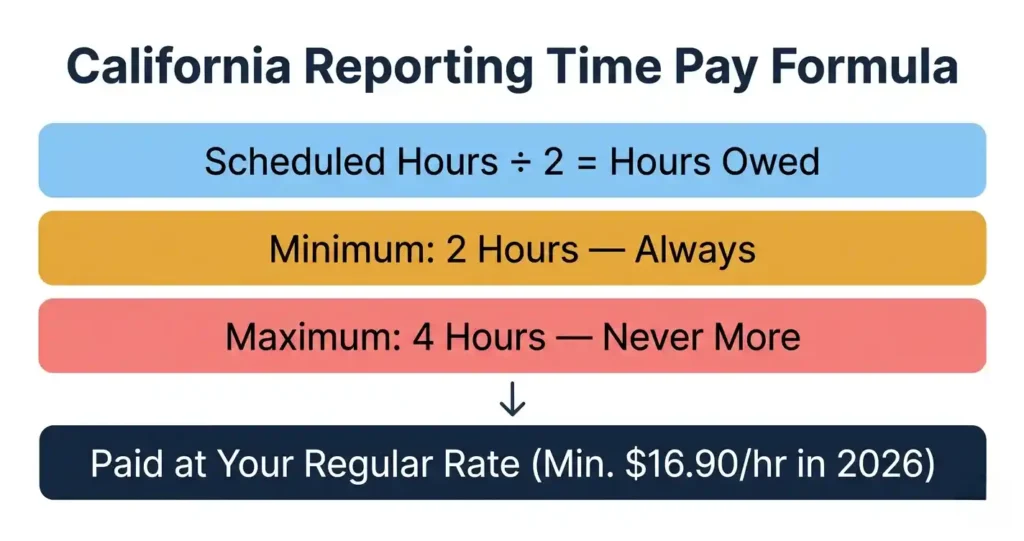
If you reported for a scheduled shift and worked less than half of it, your employer owes you pay for half your scheduled hours. Minimum: two hours. Maximum: four hours. This applies to non-exempt hourly workers under California’s IWC Wage Orders, at your regular rate of pay, which cannot fall below the 2026 statewide minimum wage of $16.90 per hour.
Real-life “yes or no” examples
Scheduled 8 hours, sent home after 1 hour: you are owed 4 hours total. You worked 1, so your employer owes you 3 more at your regular rate.
Scheduled 2 hours, sent home immediately: the two-hour minimum applies. Your employer owes you 2 full hours even though you worked zero.
Show up and there is nothing to do: same result. Walking through the door and being told “we do not need you today” still triggers the law.
What Is Reporting Time Pay in California?
Legal definition under California wage law
Reporting time pay, sometimes called “show-up pay,” comes from Section 5 of the IWC Wage Orders. Sixteen of California’s seventeen wage orders contain it. The rule: if you report as required but receive less than half your scheduled shift, your employer must pay you half your scheduled hours, with a floor of two hours and a ceiling of four. The full text of the wage orders is published by the California Department of Industrial Relations.
The DLSE enforces this rule. In Ward v. Tilly’s Inc. (2019), the California Court of Appeal ruled that Tilly’s call-in policy for on-call shifts counted as “reporting” under Wage Order 7, even when employees never set foot in the store. The court defined “reporting for work” as presenting oneself as ordered, whether in person, by phone, or by logging on remotely. That ruling significantly expanded employer liability for on-call scheduling.
Why this law exists
Without this rule, employers could overstaff every shift, send workers home unpaid after thirty minutes, and bear zero cost. California put that risk on the employer, not the employee. If business is slow, that is a business problem.
Who qualifies for reporting time pay
Non-exempt hourly workers covered by the sixteen IWC Wage Orders qualify. That includes retail, food service, hospitality, warehousing, manufacturing, healthcare support, and agriculture, among others. If you are unsure whether your W-2 or 1099 status affects your eligibility for these protections, the breakdown of 1099 vs W-2 tax treatment in California explains the key differences.
Salaried exempt employees and independent contractors are excluded. However, misclassification is common. If your employer controls your schedule, sets your hours, and tells you when to show up, you may qualify as an employee under California’s ABC test, which the California EDD outlines here, regardless of what your contract says. For a deeper look at how employee vs. contractor status affects your paycheck, see the worker classification section of this site.
How Reporting Time Pay Works (Simple Calculation)
The official formula explained
You are owed half your scheduled hours, with a minimum of two hours and a maximum of four, paid at your regular rate. That rate cannot drop below $16.90 per hour in 2026.
Step-by-step calculation method
- Identify your scheduled hours.
- Note how many hours you actually worked.
- If actual hours are less than half of scheduled, reporting time pay applies.
- Calculate half your scheduled hours, then apply the two-hour floor and four-hour ceiling.
- Subtract what you have already been paid for hours worked. The remainder is what your employer owes.
Reporting time pay is paid at your regular rate. If you earn $20 per hour, the additional hours are also at $20.
Easy examples from real workplaces
Retail, 8-hour shift, sent home after 1 hour: half of 8 is 4, which is also the maximum. Employer owes 3 additional hours on top of the 1 already worked.
Restaurant, 5-hour shift, sent home after 2 hours: half of 5 is 2.5. Employer owes 30 additional minutes at the regular rate.
Warehouse, 6-hour shift, sent home after 90 minutes: half of 6 is 3. Employer owes 1.5 additional hours.
Mandatory meeting or training lasting 45 minutes counts as reporting for work. You are owed the two-hour minimum, even if it was not a regular shift.
Reporting Time Pay vs Other Pay Types (Important Confusions)
Reporting time pay vs regular wages
Regular wages cover hours actually worked. Reporting time pay is a separate guarantee on top of that. Both appear as distinct line items on a properly prepared pay stub.
Reporting time pay vs split shift pay
A split shift involves two separate work periods in one day with a significant unpaid gap. California requires a one-hour split shift premium at minimum wage for that situation, with a credit for earnings above minimum wage. Reporting time pay covers short-shifting, not split scheduling. Both can apply in the same workday. For related premium pay rules, see the guide on California double time vs overtime.
Reporting time pay vs overtime
Overtime in California starts after 8 hours in a day or 40 in a week. Reporting time pay is not overtime. The DLSE’s general position is that reporting time pay hours do not count toward the overtime threshold since they compensate for partial shift, not hours actually worked. This area is not fully settled. For a full breakdown of how California overtime laws interact with other wage rules, that guide covers daily and weekly thresholds in detail. If both issues apply to your situation, consult an employment attorney.
Reporting time pay vs on-call pay
On-call pay compensates availability. Reporting time pay is triggered when you present yourself as ordered, whether in person, by phone, or by logging on. If your employer had no reporting requirement and simply canceled your shift before you took any required action, reporting time pay does not apply. If you completed the required step and then were told there was no work, it likely does.
Real Examples (Step-by-Step Breakdown)
8-hour shift, worked 1 hour, sent home
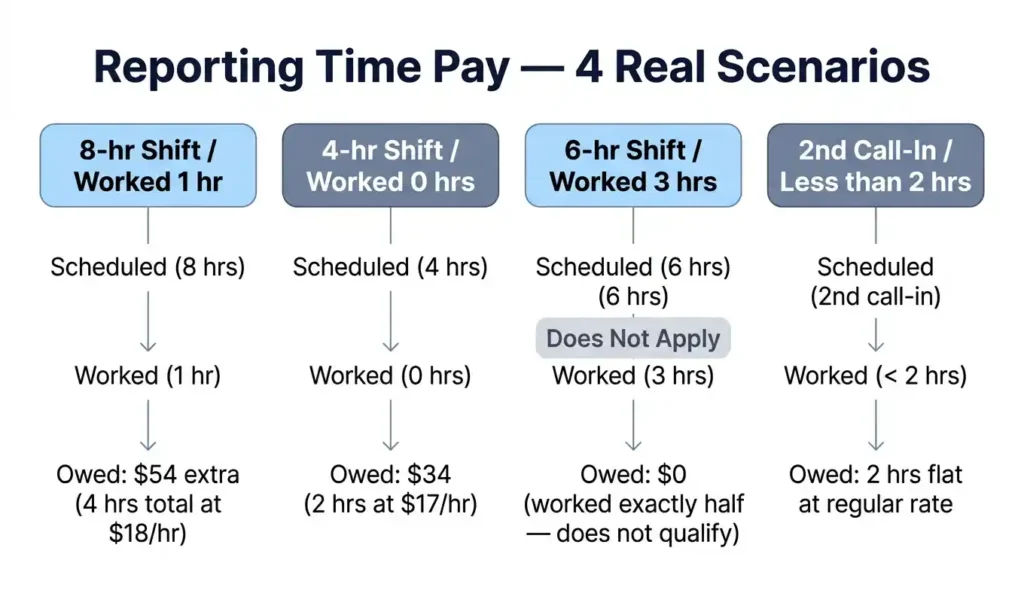
Scheduled: 8 hours at $18/hr. Worked: 1 hour. Half of 8 is 4 (the maximum). Total owed: 4 hours x $18 = $72. Already earned: $18. Employer owes: $54 in additional reporting time pay.
4-hour shift, sent home immediately
Scheduled: 4 hours at $17/hr. Worked: 0 hours. Half of 4 is 2, which equals the minimum. Employer owes: 2 hours x $17 = $34.
6-hour shift, worked 3 hours
Scheduled: 6 hours at $20/hr. Worked: 3 hours. Half of 6 is 3. You received exactly half your scheduled shift. Reporting time pay does not apply. The protection only triggers below the halfway mark.
Multiple call-ins in one day
If your employer requires you to report a second time in the same workday and gives you less than 2 hours of work, they owe you 2 hours at your regular rate. Flat guarantee, no half-shift calculation. Worked a 4-hour morning shift, called back in the evening for 45 minutes? Employer owes 2 full hours for that second reporting.
Common Situations Where You ARE Entitled to Pay
Sent home due to slow business
The most common trigger. When the store is overstaffed and you are cut early, the reporting time pay obligation falls on the employer, not you.
Shift canceled after you arrive
Showing up and then being told to leave triggers the law, even if you only clocked in for five minutes.
Only a few minutes or hours of work given
You do not need to have worked zero hours to qualify. Any amount below half your scheduled shift counts.
Second reporting in same day
Being called back for a second short stint in the same workday triggers its own two-hour flat guarantee if you receive less than two hours of work on that second reporting. Workers dealing with repeated scheduling issues may also want to review their rights under California sick leave laws, which offer separate protections when you cannot make a shift due to illness.
Situations Where Reporting Time Pay Does NOT Apply
Emergency or “Acts of God”
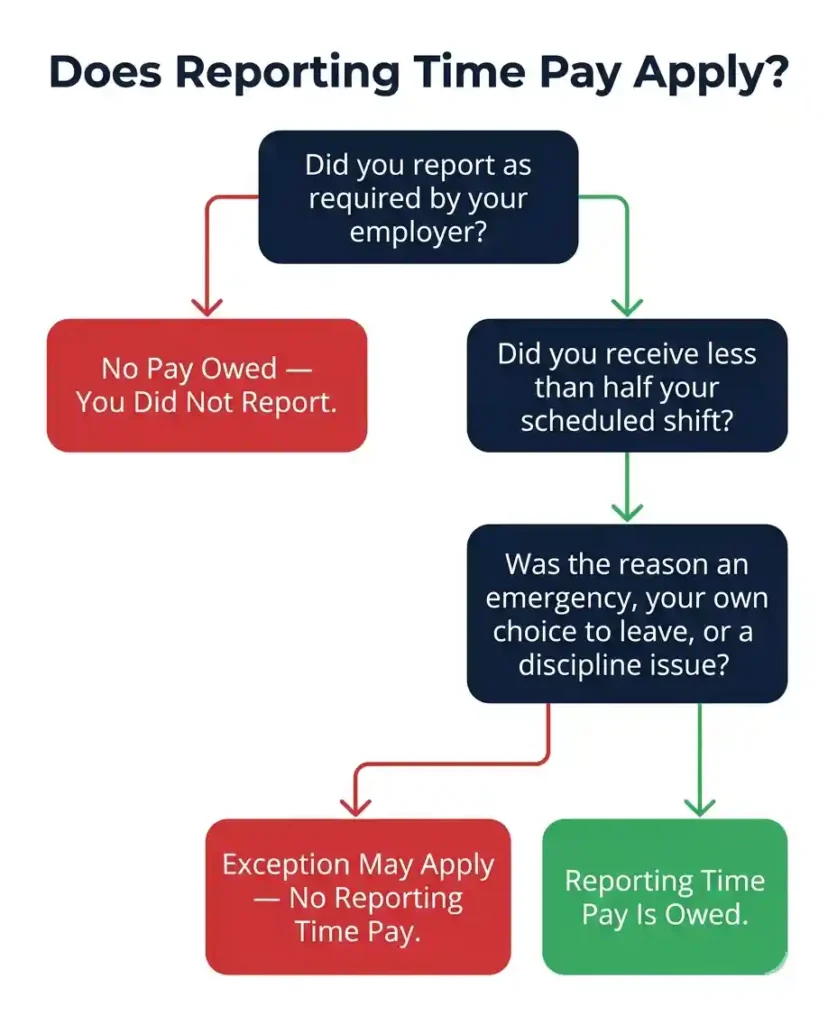
Employers are exempt when operations cannot continue due to threats to employees or property, or when civil authorities recommend closure. This covers earthquakes, wildfires, utility failures, and active threats. A slow Tuesday does not qualify.
Employee voluntarily leaving early
If you choose to leave early or are sent home for a disciplinary reason, reporting time pay does not apply. Courts have generally held that discipline-based dismissals do not trigger the obligation since the cause is the employee’s conduct, not the employer’s scheduling failure.
Paid standby or on-call arrangements
Workers already compensated for availability under a standby arrangement are in a different position and are not owed additional reporting time pay.
Scheduled short shifts under 2 hours
If you were scheduled for a short shift and worked the full scheduled time, no reporting time pay is owed. But if you were scheduled for 90 minutes and sent home after 15, the two-hour minimum still applies. The exception covers completed short shifts only.
Common Myths About Reporting Time Pay
“I only get paid if I do zero work”
Wrong. The protection applies any time you work less than half your scheduled shift, whether that is zero hours or three hours of an eight-hour shift.
“If I work even 1 hour, I lose the benefit”
Wrong. One hour of an eight-hour shift is far below the halfway threshold. You keep wages for hours worked and receive reporting time pay on top.
“It only applies in restaurants”
Sixteen of California’s seventeen IWC Wage Orders include this protection, covering retail, warehouses, hotels, offices, healthcare, agriculture, and more. The DLSE’s reporting time pay FAQ confirms coverage across industries.
“Employer can cancel it by policy”
No company policy overrides the IWC Wage Orders. Handbook clauses and signed acknowledgments cannot waive your right to reporting time pay. Employers looking to stay on the right side of California’s payroll compliance rules should also review SB 294 workplace notice requirements, which impose separate posting and disclosure obligations.
“It doesn’t apply if I agreed to the schedule”
Agreeing to a schedule does not waive reporting time pay if the employer fails to provide that work. You agreed to work. The employer failed to deliver. That is exactly what this law covers.
What Should Be On Your Pay Stub
How reporting time pay appears
Your pay stub should show reporting time pay as a separate line item under Labor Code Section 226, labeled distinctly from regular wages and showing the additional hours and rate. Common payroll codes include “RTP” or “show-up pay.” If you are not sure what the line items on your check mean, this guide on how to read a California pay stub walks through every code and field. For a broader look at your rights, browse the California labor laws category.
Common payroll mistakes employers make
The most common error is omitting reporting time pay entirely. Others include undercounting hours owed and mislabeling it as a different wage type, which causes problems during audits and wage claims. Employers who short-shift workers often violate other rules at the same time, including California meal and rest break laws, which carry their own separate penalties per violation.
Why documentation matters
Your pay stubs, schedule screenshots, manager messages, and timekeeping records from scheduling platforms like Workday or Kronos are your evidence. If a dispute arises, documented proof of a fixed scheduled shift beats a verbal argument. Not sure what the codes on your stub mean? The guide to California pay stub codes explains common payroll abbreviations employers use. Also note: some California cities, like San Francisco with its Formula Retail Employee Rights Ordinance, have predictive scheduling rules that add protections beyond the state baseline. Check your city’s local ordinances if you work in a major metro area.
What To Do If You Were Not Paid Correctly
Step 1 — Check your shift records
Pull your schedule from any source: scheduling apps like When I Work, Homebase, Workday, or Kronos, written postings, or manager messages. Compare against your time records and pay stub. Employers often dispute what the “scheduled shift” was, so your best defense is written evidence showing a fixed schedule was communicated before you reported.
Step 2 — Talk to employer/payroll
Contact HR or payroll and frame it as a possible payroll error. Many violations are mistakes. A written message creates a paper trail and gives the employer a chance to correct it before you escalate.
Step 3 — File a wage claim
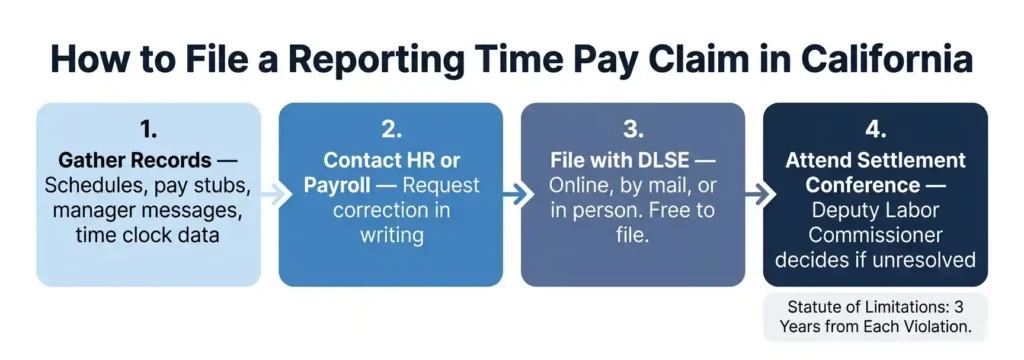
If they do not fix it, file with the California Labor Commissioner’s Office (DLSE) online, by mail, or in person. Submit schedules, time records, pay stubs, and written communications. No filing fee. The process is free.
Step 4 — What happens after filing
The DLSE notifies your employer and schedules a settlement conference. If no agreement is reached, a Deputy Labor Commissioner holds a formal hearing. You can recover unpaid wages and penalties. If the violation occurred at your final paycheck, you may also be owed waiting time penalties under Labor Code Section 203, up to 30 days of your regular daily wage rate. The statute itself is published at the California Legislative Information site. For someone earning $20 per hour on an 8-hour schedule, that is up to $4,800 on top of the unpaid wages. The Labor Code enforcement process is designed to be accessible without requiring a lawyer.
Protection from retaliation
Retaliation for filing a wage claim is illegal. Termination, demotion, reduced hours, and hostile treatment are all covered violations. File a separate retaliation complaint with the DLSE’s retaliation complaint unit if this happens.
Frequently Asked Questions (People Also Ask)
How many hours is reporting time pay in California?
Half your scheduled hours, minimum two, maximum four. An 8-hour shift triggers 4 hours. A 4-hour shift triggers 2 hours. Anything in between gives you half.
Does reporting time pay apply if I work remotely?
Not settled. Ward v. Tilly’s Inc. (2019) defined “reporting” as presenting oneself as ordered, including logging on remotely or calling in. If your employer requires you to log on at a set time and then gives you nothing to do, there is a reasonable reporting time pay argument. The DLSE has not issued definitive guidance on all remote scenarios. Consult an employment attorney if this applies to you. For the foundational overtime rules that often come up alongside this question, see the guide to California Labor Code Section 510.
Do I still get paid if I was told not to come in?
It depends. If your employer simply canceled with no required action on your part, you did not report and no obligation is triggered. But if their policy required you to call in, check an app, or log on first, and you did that, you may have already “reported” under Ward v. Tilly’s. Being told not to come in after completing that required step can still trigger the two-hour minimum.
Is reporting time pay taxable?
Yes. It is treated as regular wages and subject to federal income tax, Social Security, Medicare, and California state income tax. It is included on your W-2.
Can my employer refuse to pay reporting time pay?
No. When the conditions are met and no valid exemption applies, it is legally required. Refusing it through policy or practice is a wage violation. Your options: request a payroll correction, file a DLSE wage claim, or consult an employment attorney.
How long do I have to file a wage claim?
Three years from the date of each violation. The clock starts on each individual payday, not the day you quit. Older violations fall outside the window if you wait too long.
Final Takeaway — What You Should Remember Today
The 3 key rules every worker should remember
- Work less than half your scheduled shift: you are owed pay for the difference.
- Minimum: two hours. Maximum: four hours per reporting.
- The law applies automatically. You do not need to ask for it or prove damages.
When you should take action immediately
If you are regularly being sent home early with no reporting time pay on your stub, act now. The three-year window sounds long, but older violations become harder to document. One DLSE claim can cover multiple pay periods within the lookback window. That is how California workers recover hundreds or thousands in back wages they never knew they were owed. To estimate what your paycheck should look like under California law, use the California paycheck calculator or explore more guides in the paycheck basics section.

Yeasin Sorker is the founder of Paycheck Calculator California. He built this tool in 2018 after noticing that most free paycheck calculators missed California-specific rules like daily overtime and the uncapped SDI rate.
He researches California payroll tax updates regularly and keeps this calculator aligned with the latest IRS, FTB, and EDD published rates. All calculations on this site are estimates based on official 2026 government sources. For personalized tax advice, consult a qualified tax professional.