
California Prop 22 classifies app-based rideshare and delivery drivers, like those on Uber, Lyft, and DoorDash, as independent contractors instead of employees, guaranteeing 120% of minimum wage plus per-mile pay, but only for engaged time on an active trip.
That 120% floor and per-mile add-on come directly from the statute’s engaged-time formula, verified against 2026 rate updates from the state treasurer.
The catch: unpaid waiting time between trips can quietly shrink your real hourly earnings.
California Prop 22 Explained in Plain English
Here’s what that classification actually means for your pay, section by section.
What Is Proposition 22?
California Proposition 22, officially the Protect App-Based Drivers and Services Act, is the law behind that classification. It’s codified under the Business and Professions Code, with the annual per-mile rate adjustment governed by section 7453(d)(4)(i). Voters passed it in November 2020 after the California Secretary of State certified it for the ballot, and Uber, Lyft, DoorDash, and Instacart spent over $200 million campaigning for it, the most expensive ballot measure in California history. It traces back to the 2018 Dynamex decision and the 2019 AB 5 law, which would have forced these companies to hire drivers as employees. The California Supreme Court upheld Prop 22 as constitutional on July 25, 2024, in Castellanos v. State of California. It remains active law in 2026.
Which Drivers Are Covered?
Prop 22 covers drivers on Uber, Lyft, DoorDash, Uber Eats, and Instacart, plus similar platforms like Spark Driver and Shipt. Instacart shoppers qualify too, since the law covers the delivery function, not the app brand.
Who Is Not Covered?
W-2 employees, non-driving freelancers, and contractors in other industries like construction aren’t covered. Prop 22 exists for one purpose: keep app-based drivers classified as contractors.
Quick Summary: How Prop 22 Affects Your Pay
You get a wage floor, mileage pay, and a possible healthcare stipend. You don’t get sick days, overtime, or unemployment.
What You Receive
You’re guaranteed 120% of the applicable minimum wage for engaged time, plus per-mile pay. Enough hours can also qualify you for a healthcare stipend and occupational accident coverage.
What You Do Not Receive
There’s no paid sick leave, no overtime pay, and no unemployment insurance if you’re deactivated or business slows. You also miss the standard W-2 package, like employer-paid payroll taxes or retirement matching.
Prop 22 vs Employee Status
Independent Contractor vs Employee
Employees get a set hourly rate, overtime, sick leave, and unemployment protection under standard worker classification rules. Contractors under Prop 22 only get paid guarantees during engaged time, not while waiting for a request, which is the core tradeoff behind every number in this law. In exchange, you control your schedule and can drive for multiple apps at once.
Prop 22 vs AB 5
AB 5 used the ABC test to push rideshare and delivery drivers into employee status. Prop 22 exempted app-based drivers from AB 5. AB 5 still governs most other gig industries in California. If you want a deeper breakdown of how contractor pay differs from employee pay, see our guide on 1099 vs W-2 taxes in California.
Pros and Cons
Flexibility is real: you choose your hours and switch apps anytime. But effective hourly pay often lands lower than a standard job once gas, maintenance, and unpaid waiting time are counted. A driver netting $20 an hour on paper might really earn $13 to $14. Supporters argue most drivers value flexibility over a fixed schedule. Critics say the 120% formula, based only on engaged time, understates true hourly earnings.
How Prop 22 Pay Is Calculated
Understanding Engaged Time
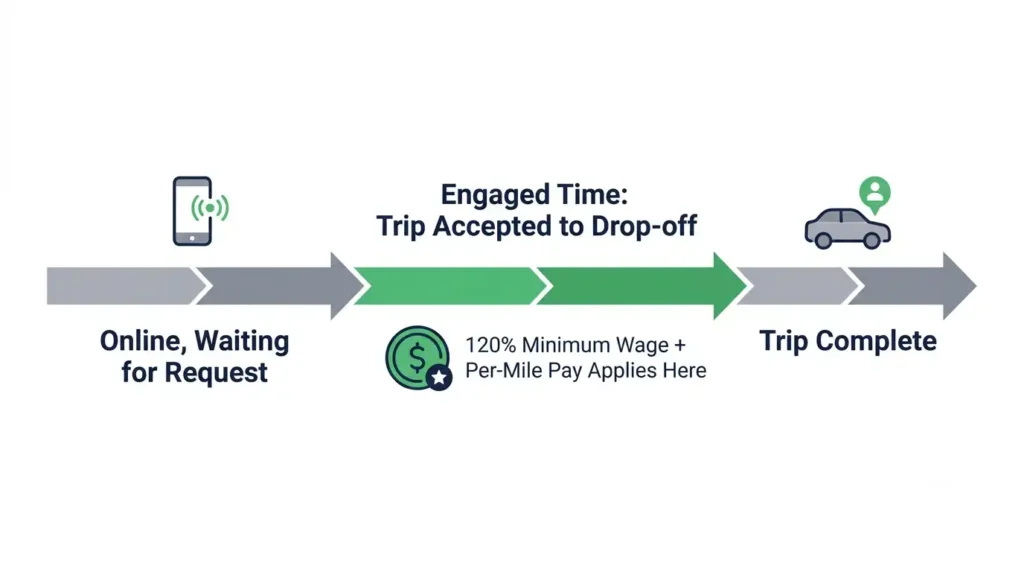
Engaged time runs from trip acceptance to drop-off. Time spent waiting for your next request doesn’t count, even with your car running.
The Guaranteed Earnings Formula
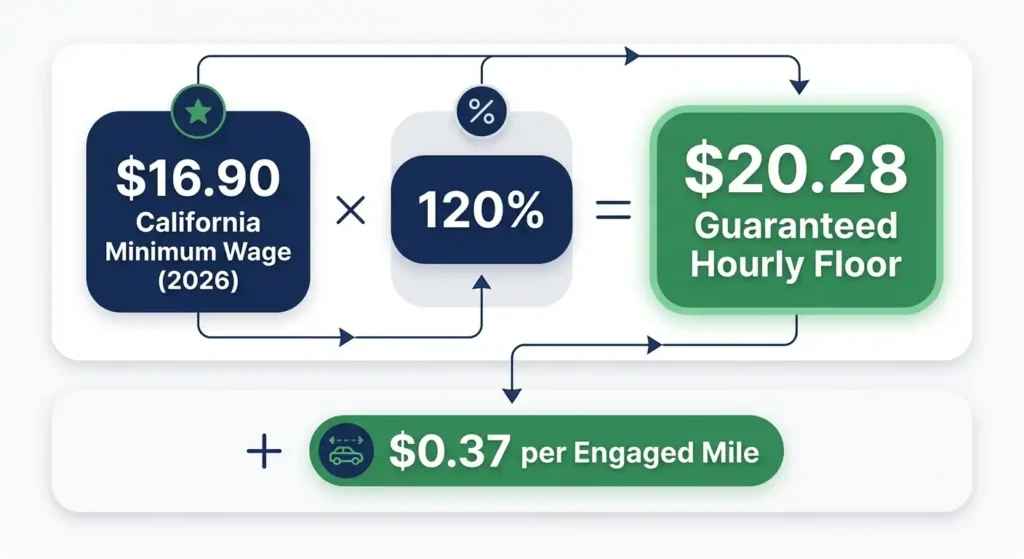
Over a pay period, engaged-time earnings must average at least 120% of the highest local minimum wage, plus per-mile pay. California’s statewide minimum wage rose to $16.90 on January 1, 2026, putting the floor at $20.28 an hour. Local rates push it higher, like West Hollywood at $20.25 or Los Angeles at $18.42. Shortfalls get topped up by the app. Tips don’t count toward this guarantee, but bonuses and promotions like peak pay do.
Mileage Reimbursement
You also get per-mile compensation for engaged miles only. The Office of the State Treasurer adjusts this rate yearly using the CPI-U. Want to see how engaged hours and miles add up for you? Try our gross pay calculator.
| Year | Per-Mile Rate |
|---|---|
| 2021 | $0.30 |
| 2023 | $0.34 |
| 2025 | $0.36 |
| 2026 | $0.37 |
Prop 22 Benefits Beyond Pay
Healthcare Stipend
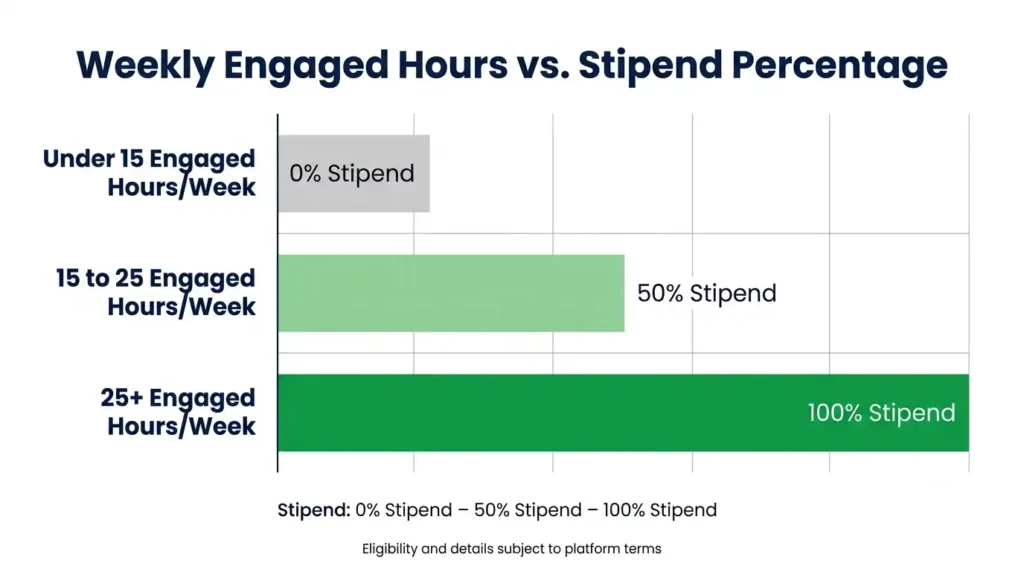
Average 25 engaged hours a week over a quarter and you qualify for an 82% stipend toward your health insurance premium. Average 15 to 25 hours and you get 41%. You must already carry your own insurance and prove it.
Occupational Accident Insurance
Prop 22 requires at least $1 million in occupational accident coverage for injuries during engaged time. It covers medical costs, disability payments equal to 66% of your average weekly earnings for up to 104 weeks, and accidental death insurance benefits for your family.
What Benefits Drivers Still Don’t Get
No vacation pay, no sick leave, and no employer retirement contributions. Your occupational accident coverage is also narrower than full workers’ compensation and only applies during engaged time.
Real-World Driver Scenarios
Example Calculations
Uber Driver Example
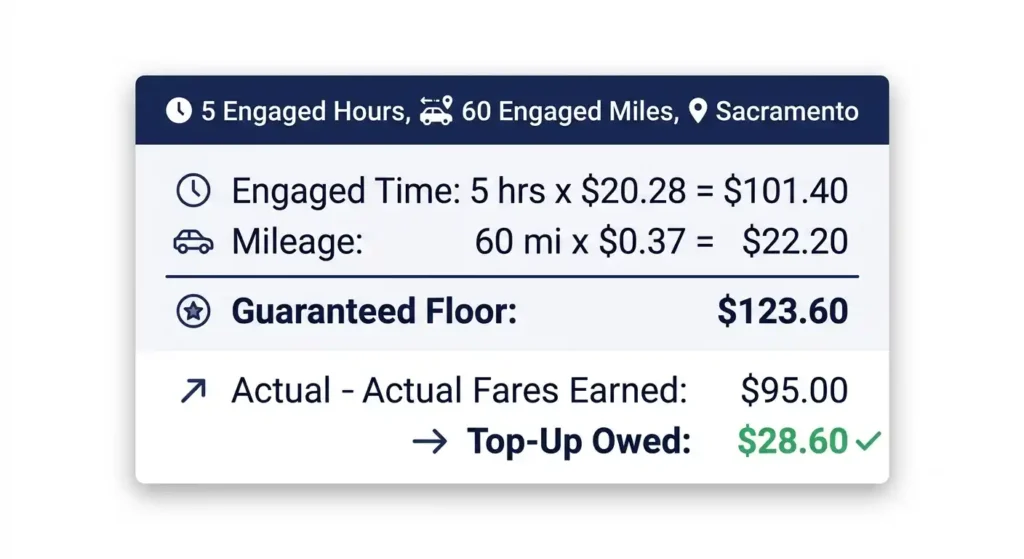
Log 5 engaged hours in Sacramento plus 60 engaged miles: that’s 5 times $20.28 ($101.40) plus 60 times $0.37 ($22.20), a $123.60 floor before tips. Earn only $95 in fares and Uber owes you $28.60 more.
DoorDash Driver Example
3 engaged hours and 25 engaged miles equal 3 times $20.28 ($60.84) plus 25 times $0.37 ($9.25), a $70.09 floor. Peak pay and tips add on top, since neither counts against the guarantee.
Multi-App Driver Example
Uber and DoorDash calculate guarantees separately. There’s no combined formula. Add each platform’s earnings for your daily total.
Part-Time Driver
The same logic behind a part-time vs full-time paycheck applies here. 10 to 15 weekend hours means lower total pay and usually no shot at the full healthcare stipend, though 15-plus hours can qualify you for the 41% tier. Falling under 15 hours drops the stipend entirely, and missing 25 hours by even a couple hours a week bumps you down from 82% to 41%.
Full-Time Driver
30-plus engaged hours a week clears the stipend threshold and delivers steadier weekly income.
Slow Market Example
In a slow market, up to 40% of online time can go unpaid while waiting for a trip, pulling down your effective hourly rate even though the engaged-time rate stays the same.
Busy Market Example
In a busy market like downtown LA on a Friday night, more of your online time becomes engaged time, so the guarantee and mileage pay cover a bigger share of your shift.
Taxes Under Prop 22
Self-Employment Taxes
As a contractor, no taxes get withheld. You owe federal self-employment tax for Social Security and Medicare, plus income tax. See our breakdown of the California self-employment tax rate for the full math. Report this income on Schedule C and pay quarterly using Form 1040-ES. Per-mile payments and healthcare stipends both count as taxable income.
Expense Tracking
Your biggest tax break is the mileage deduction. The 2026 IRS standard mileage rate is 72.5 cents per mile, covering all business miles, not just engaged ones. A driver logging 20,000 miles a year could deduct thousands, so keep a detailed mileage log. Pairing that log with California’s standard deduction rules can lower your taxable income further.
Recent Court Decisions and Current Status
Timeline of Prop 22
AB 5 passed in 2019. Voters approved Prop 22 in November 2020. Labor groups challenged it in court almost immediately. The California Supreme Court upheld it unanimously on July 25, 2024.
What the Latest Ruling Means
The 2024 ruling settled the constitutional question, not the enforcement fight. CalMatters reported in April 2026 that no state agency enforces Prop 22, leaving drivers to sue individually, including a pending case against Uber over deactivation appeals. A new law took effect January 1, 2026, letting rideshare drivers unionize while keeping contractor status. A few other states have passed their own gig worker deals, but California’s 120% engaged-time formula remains one of the more driver-favorable models nationally.
Common Misunderstandings About Prop 22
Myth: Every Hour Online Is Paid
Being logged in and available doesn’t trigger pay. Only engaged time, from acceptance to drop-off, counts. This differs from standard California minimum wage law, which pays for every hour on the clock.
Myth: Tips Count Toward Guaranteed Pay
Tips are yours free and clear and never count against your minimum earnings guarantee.
Myth: Prop 22 Makes Drivers Employees
Prop 22 locks in contractor status while adding limited protections. You’re still not an employee.
Myth: Every Gig Worker Gets Prop 22
Only app-based transportation and delivery drivers are covered. A freelance designer or contract nurse booking jobs through an app gets none of these protections.
Frequently Asked Questions
Is Prop 22 still in effect?
Yes. The California Supreme Court upheld it in July 2024, and a January 2026 law now lets drivers unionize while keeping contractor status.
Does waiting for orders count as work time?
No. Only engaged time, from acceptance to completion, counts toward pay and mileage reimbursement.
How often are Prop 22 adjustments paid?
Each pay period, usually weekly or biweekly. Shortfalls get paid as a top-up. Check your earnings statement for engaged hours, engaged miles, and any top-up, listed separately from tips and promotions. For a full walkthrough, see our guide on how to read a California pay stub.
Can I receive benefits from multiple apps?
Yes, but each platform calculates its own guarantee, mileage pay, and stipend separately.
Do tips reduce my guaranteed earnings?
No. Tips are paid on top and never subtracted.
How do I qualify for the healthcare stipend?
Average 15 engaged hours a week over a quarter for the 41% stipend, or 25 hours for the 82% stipend. You must already carry your own insurance.
Does Prop 22 affect my taxes?
Yes. Per-mile payments and stipends are taxable, and nothing gets withheld, so you owe quarterly estimated payments.
Can Prop 22 change in the future?
Yes. Its constitutionality is settled, but enforcement and driver rights, like the 2026 unionization law, keep evolving.
Key Takeaways for California Gig Drivers
What Every Driver Should Remember
Your guarantee only covers engaged time: 120% of your local minimum wage plus 37 cents per engaged mile, or $20.28 an hour in most of California before mileage, for 2026. Track all miles, since the 72.5 cents federal deduction often beats the Prop 22 reimbursement. Clear 25 engaged hours weekly and carry your own insurance for the full healthcare stipend. Use our annual salary calculator to project what consistent engaged hours could mean for your yearly income, and browse our paid leaves and benefits hub to see how contractor status compares to employee benefits. No single agency enforces this law, so check the California Legislative Analyst’s Office and the State Treasurer’s Office for updates.

Yeasin Sorker is the founder of Paycheck Calculator California. He built this tool in 2018 after noticing that most free paycheck calculators missed California-specific rules like daily overtime and the uncapped SDI rate.
He researches California payroll tax updates regularly and keeps this calculator aligned with the latest IRS, FTB, and EDD published rates. All calculations on this site are estimates based on official 2026 government sources. For personalized tax advice, consult a qualified tax professional.