
The California ABC Test is a three-prong legal standard under AB5 that determines whether a worker is an employee or independent contractor. All three prongs must pass. Failing even one means the worker is legally your employee, regardless of any contract or 1099 form.
After years of helping California businesses navigate AB5 classifications, I have found that Prong B trips up the most businesses. Companies consistently hire workers who perform their core services, which is the exact scenario the ABC Test is designed to catch and penalize.
The hard truth: signed contracts and 1099 forms offer zero legal protection if the working relationship fails the test. Courts look at operational reality, not paperwork.
What Is the California ABC Test? (Quick Answer First)
The California ABC Test is the legal tool courts and agencies use to decide if a worker is an employee or an independent contractor, established by Assembly Bill 5 (AB5), effective January 1, 2020.
California law assumes every worker is an employee by default. The business must prove otherwise by satisfying all three prongs. Fail even one and that worker is legally your employee.
The Simplest Explanation of the ABC Test
Think of the ABC Test like a three-lock door. You need all three keys. If one does not fit, that worker is your employee.
- Prong A (Freedom from Control): The worker operates freely without your direction or control.
- Prong B (Outside Usual Business): Their work falls outside your company’s regular business activities.
- Prong C (Independent Business): The worker genuinely runs their own separate business.
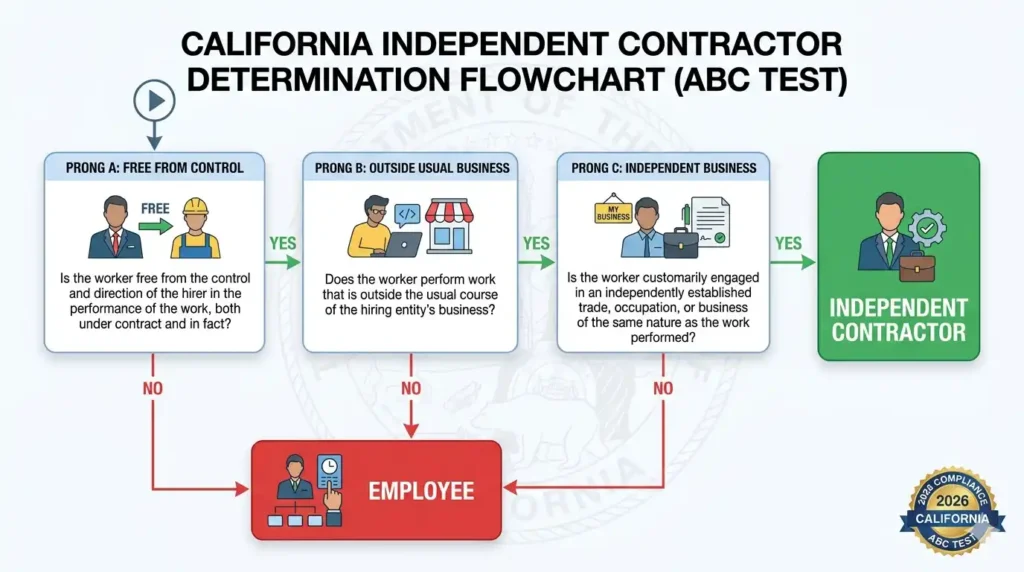
Takeaway: All three prongs must be satisfied. One failure equals employee status.
Why So Many Businesses and Freelancers Panic About This Law
Frankly, the fear is justified. California’s ABC Test is one of the strictest worker classification standards in the country. Most states use a looser “economic realities” test. California presumes employee status first. You must prove contractor status. That is the opposite of how most people think it works.
The financial stakes are real. Back wages, unpaid payroll taxes, and legal fees add up fast. PAGA lets workers sue on behalf of all affected employees, with penalties of $100 to $200 per worker per pay period.
Takeaway: California’s ABC Test is stricter than most states, and misclassification can cost you far more than you expect.
Quick Risk Check: Does the ABC Test Likely Affect You?
Run this self-check before anything else. It is the first thing I do with every new client.
You Likely FAIL the ABC Test If…
Watch out if any of these describe your situation.
- The worker does the same core work your business sells to clients.
- You set or heavily influence their schedule, process, or methods.
- The worker depends almost entirely on your company for income.
- The relationship has been ongoing for months or years with no real endpoint.
- The worker uses your tools, software, or workspace.
If two or more apply, you likely have an employee, not a contractor.
You MAY Qualify as an Independent Contractor If…
You have a stronger case if the following are true.
- The worker runs a real business with multiple clients.
- Their work is project-based with a defined beginning and end.
- They set their own hours, rates, and methods without your input.
- They bring specialized skills outside your company’s main service.
- They have their own licenses, insurance, and business infrastructure.
These are positive signs. But all three prongs still must be fully satisfied.
Fast Real-World Examples
| Scenario | Likely Contractor | Likely Employee |
| Bakery hiring a plumber to fix pipes | Yes | No |
| Marketing agency hiring a freelance marketer | No | Yes |
| Law firm hiring an outside IT repair specialist | Yes | No |
| Delivery app hiring drivers for regular routes | No | Yes |
| Ecommerce brand hiring an outside CPA firm | Yes | No |
| Software company hiring a freelance coder | No | Yes |
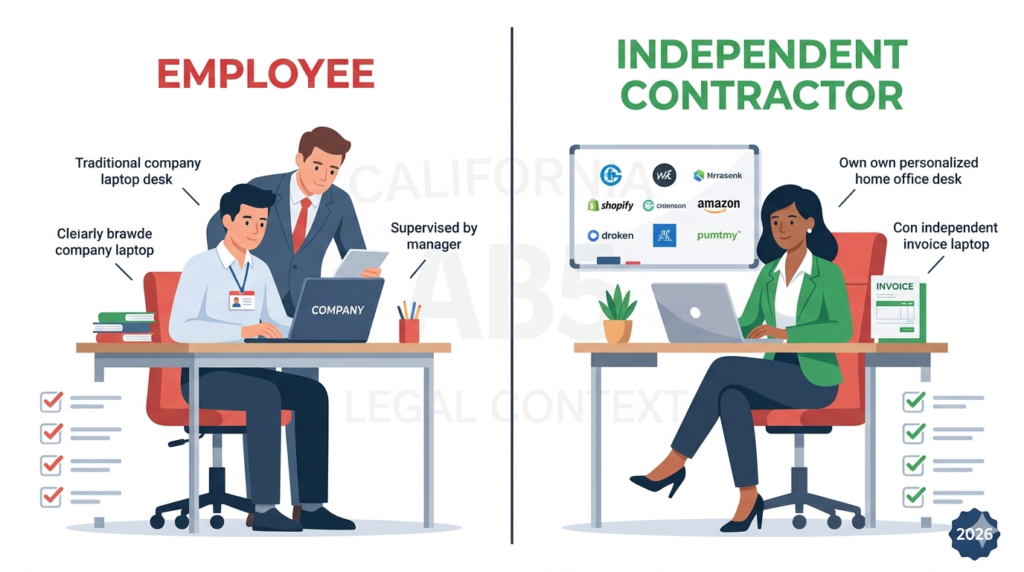
Takeaway: If the work is central to what your business does, the worker is almost certainly an employee under California law.
Breaking Down the California ABC Test Step-by-Step
Let me walk you through each prong in plain language. I want you to understand not just what each one says, but why courts apply it the way they do.
Prong A: Freedom From Control and Direction
Prong A asks one question: does the hiring entity control how the work gets done? This covers both what your contract says and what actually happens in real life.
If you set hours, assign daily tasks, require check-ins, or train the worker on your methods, a court sees control. The contract becomes almost irrelevant.
Examples That Usually PASS Prong A
- An independent consultant who sets their own timeline and delivers final results without supervision.
- A specialized vendor who uses their own methods and tools without instruction from you.
- A professional working for multiple clients simultaneously who schedules their own workflow.
Examples That Usually FAIL Prong A
- A worker required to be available during specific company hours or shifts.
- Someone who receives daily task assignments or reports to a supervisor regularly.
- A worker trained on your internal systems who follows your step-by-step processes.
Takeaway: If you tell someone when, where, or how to work, you likely fail Prong A.
Prong B: Outside the Usual Course of Business
In my experience, Prong B is where most businesses lose. It asks whether the work is part of what your business normally does. If your company sells marketing services and you hire a freelance marketer, that person does your core work. Courts see them as an employee.
Examples That PASS Prong B
- A restaurant hiring a licensed plumber to fix a broken pipe.
- A law firm hiring an outside tech vendor to repair computers.
- A retail store hiring a security company to manage loss prevention.
Examples That FAIL Prong B
- A content marketing agency hiring freelance writers for client blog posts.
- A software company bringing in contract coders for product builds.
- A food delivery platform relying on drivers to complete the service they sell.
Insider Insight: The “Could Your Business Operate Without This Work?” Test
Here is a practical test I developed after years of doing classification assessments. Ask yourself one question: Could my business serve clients if this person stopped working tomorrow?
If the answer is no, or even “not very well,” the work is inside your usual course of business. That means Prong B fails. This is not in any textbook. It is something I built from watching how California EDD auditors think when they investigate companies. Use it before you sign any contractor agreement.
- If removing the worker would delay or break client deliverables, Prong B likely fails.
- If their absence would go unnoticed by clients, you may have a stronger case.
- Run this test for every contractor before the first invoice is signed.
Takeaway: If your business cannot function without the work, that worker is almost certainly an employee.
Prong C: Independently Established Trade or Business
Prong C asks whether the worker genuinely operates their own independent business. Courts want real evidence, not just a claim.
“Independently established” means the worker built their business before you hired them. You did not create it by bringing them on.
Evidence Courts Look For
- A registered LLC, sole proprietorship, or other formal business entity.
- A business website, social media presence, or professional advertising.
- Separate invoicing and payment systems not tied to the hiring company.
- Active business licenses, professional certifications, or trade insurance.
- Demonstrable income from multiple clients over time.
What Weakens Prong C
- The worker only earns income from one company.
- No visible business identity outside of the working relationship.
- All tools or equipment are provided by the hiring entity.
- No marketing efforts, branding, or outside client relationships.
Takeaway: A true contractor operates a real business that exists independent of any single client.
One thing most guides miss: reclassified employees become eligible for California SDI (State Disability Insurance) contributions, which adds to retroactive liability. This is a cost businesses rarely factor in upfront.
California ABC Test Examples by Industry
Here are the industries where I have seen the most confusion and the costliest mistakes.
Gig Economy and App-Based Workers
Uber, Lyft, and DoorDash built their models around contractor classification. AB5 challenged all of it. Proposition 22 passed in 2020, creating a carve-out classifying app-based drivers as contractors with limited benefits. After years of legal challenges, the California Supreme Court unanimously upheld Prop 22 as constitutional in July 2024 (Castellanos v. State of California). App-based drivers remain classified as contractors under Prop 22. However, the core ABC Test issue remains: without Prop 22’s protection, most drivers would fail Prong B because driving is the core service the platform sells.
Small Business Hiring Scenarios
I have seen salon owners get hit hard here. They rent chairs to stylists and call them contractors. But the salon controls bookings, products, hours, and the client experience. That is an employment relationship dressed in contractor language. The same trap catches ecommerce brands using “contractors” for daily customer service, fulfillment, or marketing.
Remote Work and Freelancers
Remote work does not make someone a contractor. Location is irrelevant to the ABC Test. A remote designer hired exclusively by one company, following its brand guidelines, is an employee whether they work from Sacramento or San Diego. Virtual assistants, online marketers, and freelance developers fall into this trap constantly.
Startup and Tech Company Risks
Startups are among the highest-risk businesses for misclassification. Early-stage companies use contractors to save on payroll taxes, which makes short-term sense but creates long-term exposure. I have worked with founders who gave equity to workers classified as contractors. Courts can treat that equity as evidence of employment. The longer core team members stay on contractor status, the bigger the liability becomes as the company scales. Startups that grow past 100 employees also trigger California pay data reporting obligations that expose misclassification further.
Takeaway: Industry, location, and business stage do not change the ABC Test. The three prongs apply universally.
What Happens If You Fail the California ABC Test?
Misclassification consequences in California are serious and reach back years. This is not a fine-and-move-on situation.
Potential Financial Penalties
- Back wages for unpaid overtime and minimum wage violations.
- Unpaid payroll taxes including Social Security, Medicare, and state unemployment.
- Interest on all unpaid amounts from the date of misclassification.
- Civil penalties under California Labor Code.
- PAGA penalties of $100 per worker per pay period for initial violations and $200 for subsequent violations. Note: 2024 PAGA reform (AB 2288) capped penalties at 15% for proactively compliant employers and 30% for those who cure within 60 days of receiving a PAGA notice. Without proactive steps, full exposure applies.
- Legal defense costs that can reach tens of thousands even if you win.
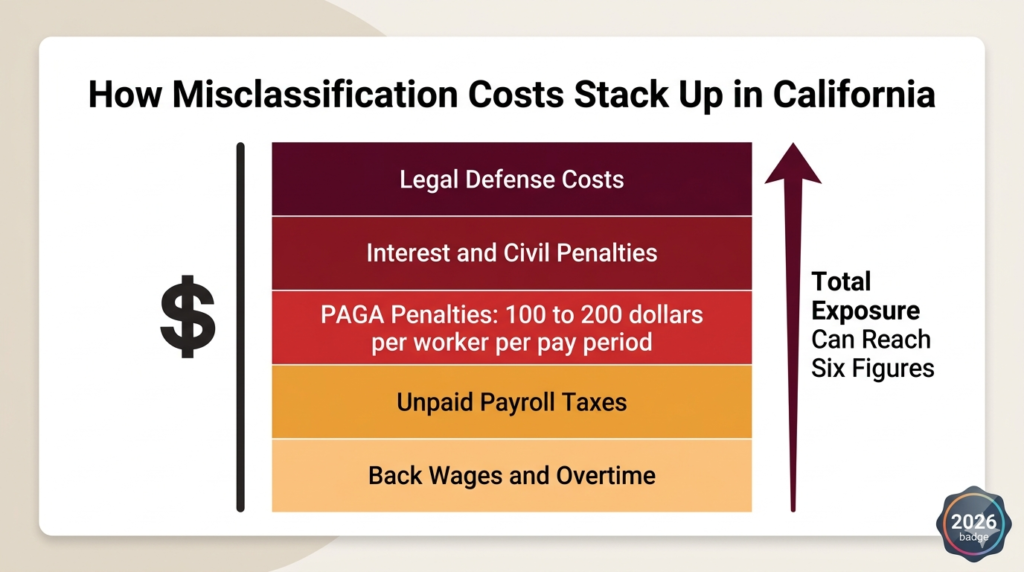
Employee Benefits Workers Can Claim Retroactively
Reclassified workers can claim benefits they were denied.
- Meal and rest break premiums for every missed break.
- Paid sick leave they never received.
- Workers’ compensation for any injuries during the work period.
- Unemployment insurance eligibility retroactively.
- Expense reimbursements for personal tools or equipment used for work.
What Usually Triggers Audits or Lawsuits
Most misclassification cases start in one of three ways. First, a worker files for unemployment insurance after the relationship ends. The EDD then investigates whether they were truly a contractor. Second, a disgruntled worker files a wage claim or a PAGA lawsuit. Third, an IRS or EDD audit uncovers payroll inconsistencies. The most dangerous trigger is a terminated contractor. Someone who felt underpaid or mistreated has every incentive to file a complaint, and may also be owed a California waiting time penalty on top of back wages. California law gives them powerful tools to collect.
Takeaway: Misclassification in California is not a paperwork mistake. It is a financial emergency waiting to happen.
California AB5 Explained Without Legal Jargon
What AB5 Actually Changed
Before AB5, California courts used various tests inconsistently. AB5 codified the ABC Test into state law effective January 1, 2020, making employee status the presumed default and placing the full burden of proof on businesses. The California Department of Industrial Relations maintains the official guidance on how the test is applied.
Dynamex vs AB5 vs Borello Explained Simply
Think of Dynamex as the blueprint, AB5 as the building, and Borello as the side door. The 2018 Dynamex decision created the ABC Test framework. AB5 turned it into law in 2020. AB 2257 added specific exemptions. The Borello test is the older multi-factor standard that still applies for exempt occupations. It is more flexible and easier to satisfy, which is why many businesses prefer it. Keep in mind that reclassification also changes how state income tax is withheld, which directly affects where a worker lands in the California tax brackets.
Timeline of California Worker Classification Laws
| Year | Event |
| Pre-2018 | California courts used the Borello multi-factor test. Businesses had far more flexibility to classify workers as contractors. |
| 2018 | California Supreme Court issued the Dynamex Operations West decision. This created the ABC Test framework and shifted the full burden of proof onto businesses. |
| January 2020 | AB5 made the ABC Test the formal law of California. Nearly all workers became presumed employees from that date forward. |
| Late 2020 | AB 2257 passed to add and refine dozens of occupational exemptions that AB5 had unintentionally eliminated. |
| November 2020 | Proposition 22 passed, classifying app-based drivers as contractors with limited benefits. Legal challenges began immediately. |
| 2021 | An Alameda County trial court ruled Prop 22 unconstitutional. This ruling was later reversed on appeal. |
| 2023 | California Court of Appeal reversed the 2021 ruling and found Prop 22 constitutional. |
| July 2024 | California Supreme Court unanimously upheld Prop 22 as fully constitutional (Castellanos v. State of California). All legal challenges ended. |
| June 2024 | PAGA reform (AB 2288 / SB 92) introduced penalty caps: 15% if the employer proactively complied before notice, 30% if complied within 60 days. Employee share of penalties increased from 25% to 35%. |
| January 2026 | AB 1514 extended Borello-test exemptions for licensed manicurists through January 1, 2029, and for commercial fishers through January 1, 2031. |
| 2026 (federal) | The U.S. Department of Labor proposed rolling back the 2024 federal independent contractor rule. California’s ABC Test remains completely unaffected. |
Takeaway: California’s ABC Test has only tightened since 2018. No federal rule change loosens your state-level obligations.
Who Is Exempt From the California ABC Test?
California created specific exemptions for certain professions and business relationships. Exempt workers are evaluated under the Borello test instead.
Professions Commonly Exempt
- Licensed lawyers and attorneys.
- Medical doctors, surgeons, dentists, and veterinarians.
- Certified public accountants and financial professionals.
- Licensed real estate agents and brokers.
- Architects and engineers in many circumstances.
- Licensed insurance agents and underwriters.
Business-to-Business (B2B) Exemption
The B2B exemption is one of the most useful tools for legitimate contractor relationships. All of these conditions must be met.
- The worker has a formal business entity such as an LLC or corporation.
- Both parties have a written contract defining the work and payment terms.
- The contractor can negotiate their own rates and terms independently.
- The contractor provides the same services to other clients in the market.
- The contractor has all necessary business licenses and operates a real independent business.
Missing even one condition collapses the exemption. Also worth noting: if a B2B exemption fails and the worker is reclassified as an employee, you may also face retroactive obligations under the CalSavers retirement mandate if you have five or more employees.
Freelancer and Creative Professional Exemptions
AB 2257 added protections for creative professionals who work independently. These may include freelance writers and editors, graphic designers and visual artists, photographers and videographers, and marketing or PR consultants in certain arrangements. Exemption does not mean automatic contractor status. The Borello test still applies.
Construction and Trucking Complications
Construction and trucking have unique carve-outs but remain legally tangled areas. For construction, subcontractors must hold a valid California contractor’s license to qualify for the B2B exemption and still must satisfy every B2B condition. General contractors who hire unlicensed workers as contractors face liability under both AB5 and contractor licensing law.
For trucking, a federal court blocked California from enforcing AB5 against independent owner-operators for years. As of 2026, the classification of owner-operators remains actively contested. The 2026 federal DOL proposal to roll back the 2024 independent contractor rule changes nothing for California. The ABC Test fully governs all California work regardless of any federal shift.
Takeaway: Exemptions exist, but every one has strict conditions. Do not assume you qualify without verifying each requirement carefully.
Reality Check: Common Myths About the California ABC Test
“A 1099 Automatically Makes Someone a Contractor”
A 1099 is a tax document, not a legal classification. Courts look at the actual working relationship, not the paperwork. I have seen businesses with stacks of 1099 forms lose misclassification cases because the real-world relationship looked like employment. If you are weighing the true cost difference, our 1099 vs W-2 calculator can show you exactly what each classification costs in taxes.
“A Written Contract Fully Protects the Business”
California courts care about how the relationship actually functioned, not what the contract says. If you controlled the schedule, the work was core to your business, and the worker had no other clients, a contract cannot save you.
“Remote Workers Are Automatically Contractors”
Location is irrelevant to the ABC Test. A remote worker is evaluated on the same three prongs as an in-person worker. Geography changes nothing.
“Small Businesses Rarely Get Audited”
Small businesses are frequently targeted. A single unemployment claim from a former contractor can trigger a full EDD audit. One PAGA lawsuit can expand to cover every worker in a similar role.
Takeaway: The most common myths about contractor classification are also the most expensive to believe.
How Businesses Can Reduce Misclassification Risk
Best Practices for Hiring Contractors Properly
Focus on outcomes, not processes. Care about the final deliverable, not how the person gets there. Give workers full flexibility over their methods, timing, and tools. Keep relationships project-based with clear start and end dates. Contractors should not attend internal team meetings, use company email addresses, or appear on your company roster. Also note that California’s pay transparency law requires salary ranges in job postings, which applies differently to employees versus contractors.
Documentation Businesses Should Maintain
Keep the following on file for every contractor relationship.
- A written contract specifying deliverables, not job duties.
- Proof the contractor has their own business registration or license.
- Evidence the contractor has other clients and markets independently.
- Copies of the contractor’s business insurance.
- Invoices paid to the contractor’s business entity, not to an individual.
Knowing how to read a California pay stub also helps you spot classification red flags early, especially if contractors and employees appear on the same payroll records.
Insider Insight: Why Operational Independence Matters More Than Contracts
Courts rank operational reality above contractual claims every time. The businesses I have seen lose were almost always ones where the day-to-day relationship looked like employment, regardless of what the contract said. Build independence into the relationship from day one. Do not provide company equipment unless necessary. Do not integrate contractors into your team systems. Those habits are worth more than any contract clause.
Takeaway: Behavior and operational reality protect you in court. Paperwork alone does not.
When the Borello Test Applies Instead
Key Differences Between ABC and Borello
The ABC Test is strict and binary. All three prongs must pass. No balancing. The Borello test weighs multiple factors together: control over work details, the nature of the occupation, skill required, who supplies tools, duration of work, and whether the work is part of the regular business. No single factor is decisive. This makes Borello more flexible but also less predictable.
Why Certain Industries Prefer Borello
Exempt industries benefit from Borello because it is easier to satisfy. Medical professionals, lawyers, accountants, and real estate agents have long operated as contractors. Borello fits those professional relationships better than the rigid three-prong ABC framework.
Takeaway: Borello applies to exempt occupations and gives more flexibility, but it is less predictable than the ABC Test.
FAQ: California ABC Test Questions People Also Ask
Does the ABC Test apply to freelancers?
Yes. Most freelancers in California are subject to the ABC Test unless they fall into a specific exempt category under AB 2257. Even exempt freelancers must satisfy the Borello test to maintain contractor status.
Can an LLC still fail the ABC Test?
Absolutely. Having an LLC does not automatically satisfy the ABC Test. Courts look past the business structure to the actual working relationship. An LLC owner who works exclusively for one company and performs that company’s core services will still likely be classified as an employee.
Is a 1099 worker automatically a contractor?
No. A 1099 is a tax filing document, not a legal classification. California courts determine classification based on the ABC Test, not on how a worker is paid or what tax forms are filed.
What is the hardest ABC Test prong to satisfy?
In my experience, Prong B is the hardest and the most commonly failed. Businesses almost always try to use workers who perform the same services the business provides. That is the exact scenario Prong B is designed to catch.
Does the ABC Test apply to remote workers?
Yes. Work location has no effect on the ABC Test. A remote worker is evaluated using the exact same three prongs as an in-person worker.
Can workers sue years later for misclassification?
Yes. The statute of limitations for most wage and hour claims in California is three years from the date of the violation. That window extends to four years when a worker also files an Unfair Competition Law (UCL) claim under Business and Professions Code 17200, or when the claim is based on a written contract. Workers can file retroactive claims for back wages, unpaid benefits, and penalties within those windows. PAGA claims carry a separate one-year statute of limitations from the date of violation.
Which industries are most affected by AB5?
Gig economy companies, construction, trucking, entertainment, staffing agencies, and any service business that relies heavily on contract labor are among the most affected. Marketing and creative agencies also face significant exposure. Healthcare staffing is a growing area of concern too, particularly since changes to the California healthcare worker minimum wage have blurred employment lines further.
Does having multiple clients help pass the ABC Test?
Yes, significantly. Having multiple clients is one of the strongest pieces of evidence for Prong C. It demonstrates that the worker operates a genuinely independent business rather than depending on a single employer.
Are gig workers employees in California?
Under the standard ABC Test, most gig workers would be classified as employees. Proposition 22 created a lawful exemption for app-based transportation and delivery workers, and the California Supreme Court unanimously upheld it as constitutional in July 2024 (Castellanos v. State of California). App-based drivers currently remain classified as contractors under Prop 22.
What happens if only one prong fails?
If any single prong fails, the worker is classified as an employee. The ABC Test requires all three prongs to be satisfied. There is no partial credit.
Final Verdict: Who Should Be Most Concerned About the California ABC Test?
You are most at risk if you regularly hire people who do the same work your business sells to clients, those workers have been with you long-term, or they are integrated into daily operations. Startups building core teams on contractor budgets, small service businesses relying on contract labor daily, and any company without a classification audit in the last two to three years all carry real exposure.
The businesses I have seen handle this well learn the rules early, restructure relationships proactively, and document everything. Start with the three prongs. Ask the honest questions. If something feels uncomfortable, that discomfort is telling you something important. Get ahead of it now before a letter from the EDD forces your hand. If you want to see exactly how reclassification would change someone’s take-home pay, use our California paycheck calculator to run the numbers before you make any decisions.
Takeaway: The ABC Test is strict, but it is not impossible to navigate. Start your compliance review today, before a problem finds you.
If you want to review your rights or file a wage claim, the California Labor Commissioner’s Office is the official starting point.
This content is intended for informational purposes only and does not constitute legal or tax advice. For guidance specific to your situation, consult a qualified California employment attorney or tax professional.

Yeasin Sorker is the founder of Paycheck Calculator California. He built this tool in 2018 after noticing that most free paycheck calculators missed California-specific rules like daily overtime and the uncapped SDI rate.
He researches California payroll tax updates regularly and keeps this calculator aligned with the latest IRS, FTB, and EDD published rates. All calculations on this site are estimates based on official 2026 government sources. For personalized tax advice, consult a qualified tax professional.