
A $95,000 salary in California, filed as a single taxpayer with the standard deduction, nets about $69,600 a year in 2026, after federal, state, and payroll taxes, though your exact number shifts with filing status and benefits.
I calculate paychecks like this weekly for California filers, and the $69,600 figure holds steady across most standard single-filer scenarios.
That estimate assumes no dependents or pre-tax deductions, so real paychecks often land lower.
Quick Answer: How Much Is $95k After Taxes in California?
Estimated Take-Home Pay at a Glance
- Annual net pay: $69,607
- Monthly net pay: $5,801
- Biweekly paycheck: $2,677
- Weekly paycheck: $1,339
- Hourly equivalent (2,080 hrs/year): $33.47
Quick Salary Summary Table
| Item | Amount |
|---|---|
| Gross annual pay | $95,000 |
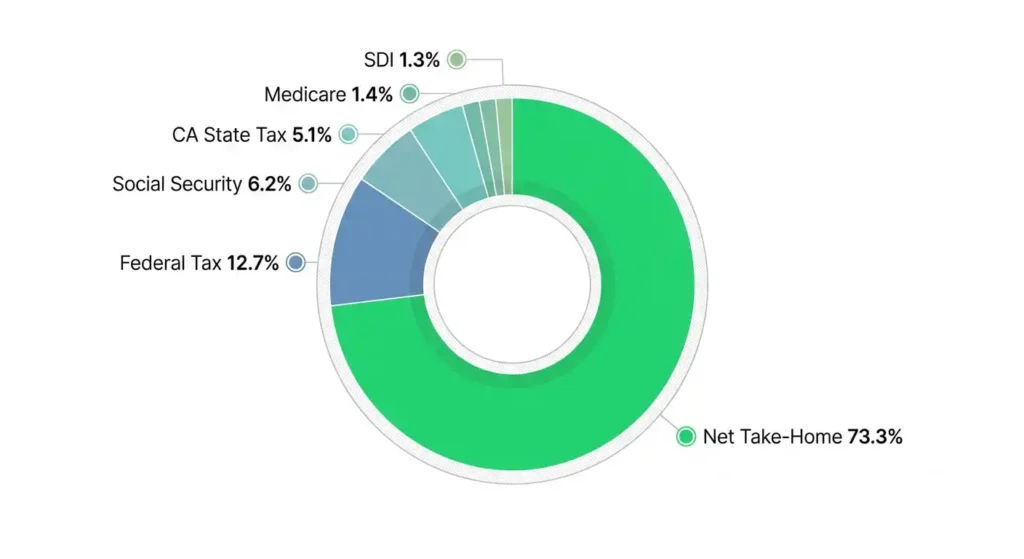
| Federal income tax | $12,070 |
| California state income tax | $4,820 |
| Social Security tax (6.2%) | $5,890 |
| Medicare tax (1.45%) | $1,378 |
| California State Disability Insurance (SDI) (1.3%) | $1,235 |
| Total taxes withheld | $25,393 |
| Net take-home pay | $69,607 |
| Effective tax rate | 26.7% |
Free California Tax Tool
See What $95,000 Actually Puts in Your Pocket
$95K sounds like a solid salary — but after federal tax, California state tax, and SDI, your real take-home is lower than you think. See the exact number.
🧮 See My Exact $95K Take-Home After TaxesUsed by thousands of California workers · FTB-verified 2026 rates
$95k After Taxes Comparison Table
$5,000 more or less barely moves your paycheck. Here is $90k and $100k next to $95k, plus other states.
Salary Comparisons
| Gross Salary | Net Pay (Annual) | Net Pay (Monthly) | Effective Tax Rate |
|---|---|---|---|
| $90,000 | $66,475 | $5,540 | 26.1% |
| $95,000 | $69,607 | $5,801 | 26.7% |
| $100,000 | $72,451 | $6,038 | 27.5% |
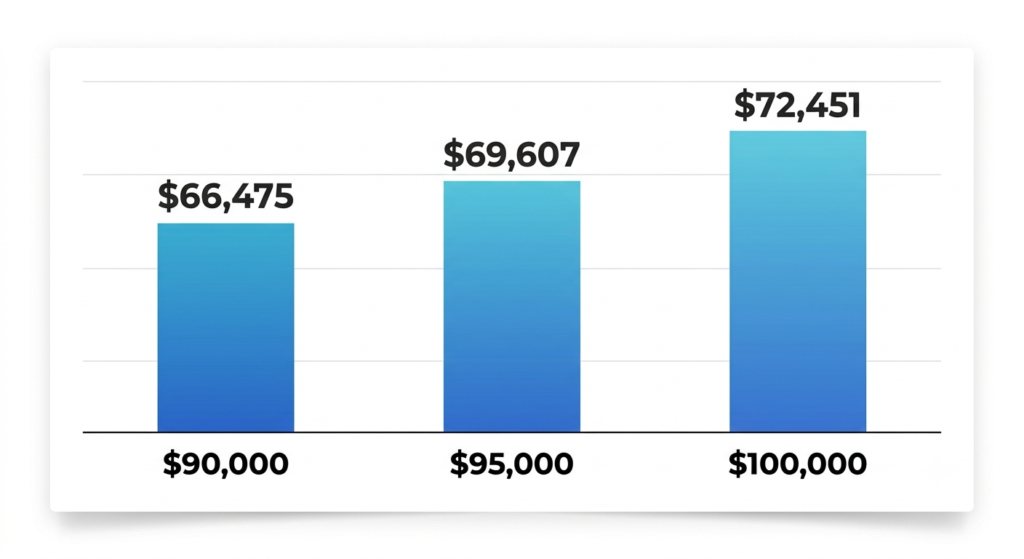
$90k to $95k adds $5,000 gross but only $3,132 net, since you hit heavier federal and 9.3% California brackets. $95k to $100k keeps 56.9% of the extra $5,000.
State Comparisons
California takes more than most states at this income.
| State | State Income Tax | Net Take-Home (Approx.) |
|---|---|---|
| California | $4,820 | $69,607 |
| Texas | $0 | $75,663 |
| Florida | $0 | $75,663 |
| Washington | $0 | $75,663 |
| New York | ~$4,900 | ~$69,500 |
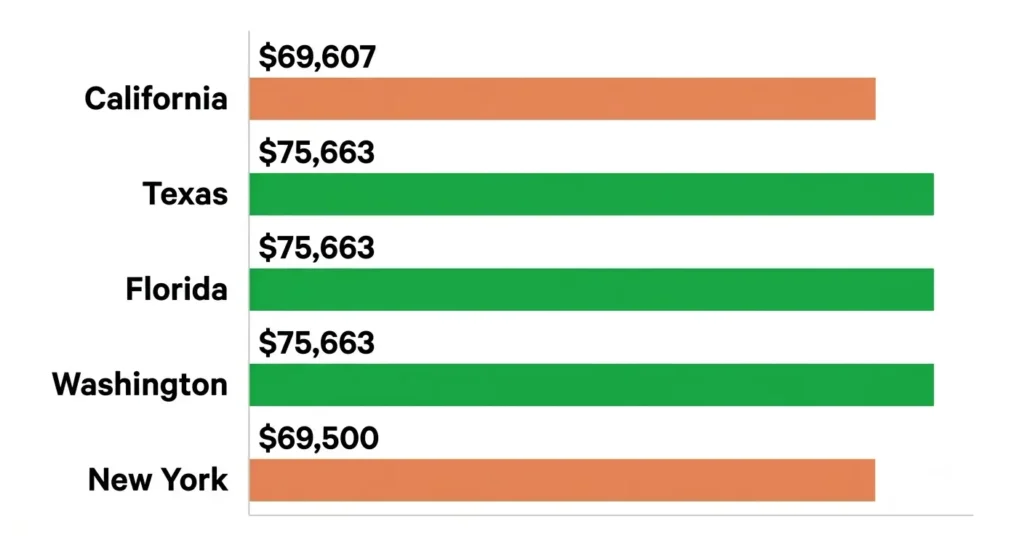
Texas, Florida, and Washington have no state income tax, so a $95k earner there keeps about $6,000 more than in California. New York taxes close to California, sometimes more with NYC local tax added.
How the Take-Home Pay Is Calculated
Gross pay minus five deductions equals net pay, the core of paycheck basics.
Gross Pay to Net Pay
Pre-tax items like 401(k) contributions lower your gross pay first. Federal and state brackets apply to what’s left, then payroll taxes come out, leaving your net pay. Weekly versus biweekly pay just splits the same annual total into more or fewer checks. Hourly and salaried are the same here too, since $95,000 a year is about $45.67 an hour before tax, as shown on our annual salary calculator.
Assumptions Used
This uses single filing, the 2026 federal standard deduction of $16,100, and the California standard deduction of $5,706, with no extra withholding, dependents, or pre-tax benefits. Two people earning $95,000 can still net different amounts based on adjusted gross income (AGI), dependents, or filing status.
2026 $95k Salary Tax Breakdown
Here is where each dollar goes.
Federal Income Tax
Federal income tax on $95,000 is about $12,070 per 2026 Internal Revenue Service (IRS) tables. Taxable income after the $16,100 standard deduction is $78,900, taxed across the 2026 tax brackets in slices: 10%, then 12%, then 22% only on the top portion.
California State Income Tax
California state income tax on $95,000 is about $4,820, per California Franchise Tax Board (FTB) rates. California’s brackets run 1% to 12.3%; at this income, most of it falls in the 8% and 9.3% bands. Its $5,706 standard deduction is far smaller than the federal $16,100, so more income gets taxed.
Payroll Taxes
Payroll taxes are fixed rates that don’t change with your W-4. Social Security tax and Medicare tax together form the Federal Insurance Contributions Act (FICA).
Social Security
Social Security tax takes 6.2%, or $5,890, and applies to all wages up to the 2026 cap of $184,500. Your employer matches this amount.
Medicare
Medicare tax takes 1.45%, or $1,378, with no wage cap. The extra 0.9% Additional Medicare Tax only starts above $200,000 for single filers, so it doesn’t apply here.
California SDI
California State Disability Insurance (SDI) takes 1.3%, per the 2026 CA SDI rate set by the EDD, or $1,235. It’s the deduction most people forget, and since 2024 it applies to every dollar of wages, with no cap.
Real-Life Paycheck Examples
Your paycheck scenario changes your number.
Single Employee Example
A single filer with no dependents nets about $69,607 a year, or $5,801 a month. In cities like Los Angeles or San Jose, that mostly covers rent, transportation, food, and savings.
Married Employee Example
Filing jointly with one income raises the federal standard deduction to $32,200. Federal tax drops to about $7,040. Payroll taxes stay the same, and California’s joint deduction lowers the state bill too. Net pay lands near $77,200 a year.
Employee With 401(k)
A $10,000 401(k) contribution lowers taxable income before federal and state tax, not FICA or SDI. It saves about $2,200 federal and $930 state, for $3,130 total. Take-home pay drops less than the full contribution.
What Can Change Your Take-Home Pay?
Filing status, deductions, and W-4 choices move this number most.
Filing Status
Single, married filing jointly, married filing separately, and head of household use different brackets and deductions. Head of household fits if you support a dependent and cover over half the household costs; married filing separately uses California’s single brackets but usually costs more federally than filing jointly. A dependent can also unlock the Child Tax Credit, cutting tax owed directly.
Pre-Tax Deductions
A 401(k) contribution, Health Savings Account (HSA), Flexible Spending Account (FSA), pension contribution, or health insurance premium all lower taxable income before federal and state tax. None of them reduce Social Security tax, Medicare tax, or SDI.
W-4 Withholding Choices
Your Form W-4 sets how much comes out per paycheck, not your actual tax owed; California pairs it with its own DE-4 form for state withholding. Variable pay works differently too: a bonus or commission usually withholds at a flat 22% federal rate, overtime just adds to that paycheck’s total, and RSUs count as income the moment they vest.
Is $95k a Good Salary in California?
It depends on the city: comfortable inland, tight on the coast.
Monthly Budget Example
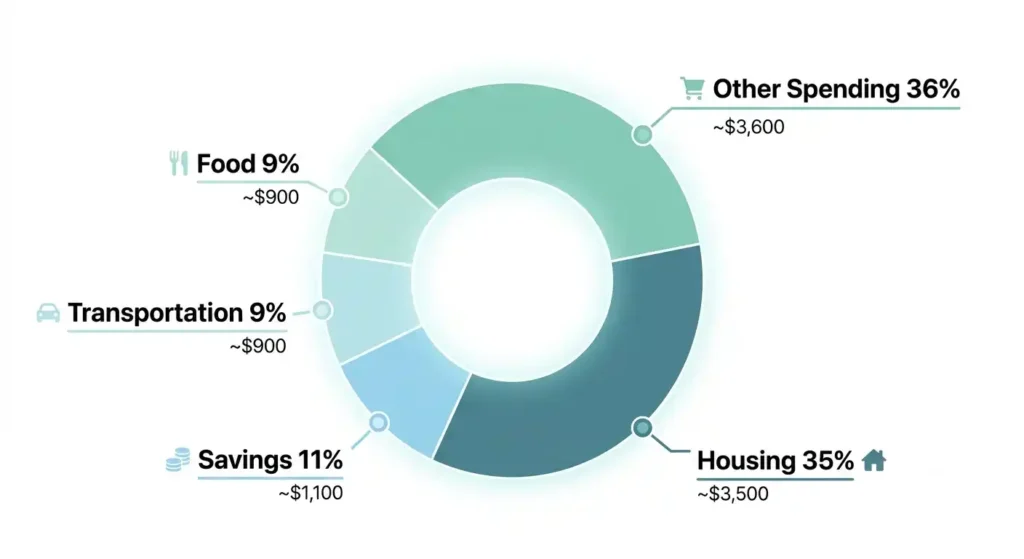
On $5,801 a month, a typical split is $1,900 to $2,200 housing, $400 to $600 transportation, $500 food, and $500 to $800 savings. This works in inland cities and gets tight in the Bay Area or coastal Southern California.
Cost of Living Considerations
In San Francisco or Santa Monica, $95k covers basics with little extra. In Sacramento, Bakersfield, or Riverside, it supports a comfortable lifestyle.
Common Financial Goals
Renting comfortably works almost anywhere if rent stays near 30% of take-home pay. Buying a home is easier inland than on the coast. Emergency savings and retirement stay achievable if housing doesn’t eat the budget.
Common Myths About a $95k Salary
Two big misunderstandings trip people up.
Tax Bracket Myths
Your whole $95,000 is never taxed at one rate; each dollar moves through the brackets in order. A raise never shrinks your paycheck. “Tax bracket” means your marginal rate, always higher than your effective rate.
Paycheck Misconceptions
Withholding, shown on your pay stub, is an estimate, not your final bill. A refund just means you overpaid during the year, not that you paid less overall, and claiming more allowances for a bigger paycheck usually means a smaller refund later, a common reason people ask why their paycheck looks low.
Frequently Asked Questions
Is $95k after taxes enough to live comfortably in California?
Yes, outside the priciest coastal metros. Expect about $69,607 a year, enough for comfortable renting and steady savings in cities like Sacramento or inland San Diego.
How much will I take home every month?
About $5,801 a month before any 401(k), health insurance, or other pre-tax deductions.
Why is my paycheck different from this estimate?
Your W-4 settings, insurance premiums, retirement contributions, and extra withholding all shift the real number. This estimate assumes none of those.
Does California have local income tax?
No. California has state income tax only, no city or county layer like New York or Ohio. Your bill depends on income and filing status, not city.
Will contributing to a 401(k) increase my take-home pay?
No, but it lowers what taxes take. A $10,000 401(k) contribution here saves about $3,130 combined federal and state tax, so take-home drops by less than $10,000.
Can I calculate my exact paycheck?
Yes. Enter your real pay frequency, filing status, and deductions into our California paycheck calculator for a precise number.
Key Takeaways
What to Remember
A $95,000 California salary nets about $69,607 a year after federal income tax, California state income tax, Social Security tax, Medicare tax, and SDI. Filing status, pre-tax deductions, and state matter most, Texas or Florida would net about $6,000 more. Take-home pay grows slower than gross pay as raises push into higher brackets, so compare job offers on net pay, not just the gross number. If your salary sits closer to $75k or $150k, run that number through our California paycheck calculator for your exact figure.

Yeasin Sorker is the founder of Paycheck Calculator California. He built this tool in 2018 after noticing that most free paycheck calculators missed California-specific rules like daily overtime and the uncapped SDI rate.
He researches California payroll tax updates regularly and keeps this calculator aligned with the latest IRS, FTB, and EDD published rates. All calculations on this site are estimates based on official 2026 government sources. For personalized tax advice, consult a qualified tax professional.