
You stayed fifteen minutes late to lock up, or you answered one more email after dinner. It felt small at the time, and nobody offered to pay you for it.
In California, that time still counts. The law tracks any minute your employer benefits from your labor, and the small stuff adds up fast, five minutes a day turns into more than 20 hours a year.
Most workers are covered by this rule. A narrower group, exempt employees, are not, and that one distinction shapes everything below.
Can Your Employer Make You Work Off the Clock?
Quick Answer
No. If you’re a non-exempt employee in California, every minute you work belongs on your paycheck, approved or not. It doesn’t matter if the task was “quick” or unasked for. The legal test is simple: if your employer knew or should have known the work was happening, they owe you. This covers hourly workers in retail, restaurants, warehouses, healthcare, and offices. Exempt employees are the one exception, and even that has limits.
Quick Comparison Table
| Situation | Legal or Illegal | Paid or Unpaid |
|---|---|---|
| Clocking out, then finishing a task | Illegal if unpaid | Must be paid |
| Answering a work text at 8 PM | Illegal if unpaid | Must be paid |
| Arriving 15 minutes early to set up | Illegal if unpaid | Must be paid |
| Genuinely exempt salaried manager working late | Legal | No overtime owed |
| Waiting on-site for a shift to start | Illegal if unpaid | Must be paid |
| Taking a real, uninterrupted lunch break | Legal | Unpaid is fine |
What Counts as Off-the-Clock Work?
Definition
California’s idea of “hours worked” is broad. It’s not just clock-in to clock-out, it’s any time your employer controls you or benefits from your labor, even silently. Lawyers call this being suffered or permitted to work: if your employer let it happen and gained from it, they owe you, whether they asked for it or not. Courts side with paying you.
Common Examples
Before clocking in
Opening duties, unlocking the store, turning on ovens, prepping a register, count as work. So does booting up a computer or logging into scheduling software before your shift starts. Anything useful to your employer before the clock starts is owed to you, including a mandatory meeting or training session scheduled before your shift.
After clocking out
Cleaning, closing out a register, locking up, or finishing paperwork after clocking out is still work. Five minutes here and there adds up fast over a year. The same goes for a delivery driver finishing paperwork after the last drop-off, or anyone correcting a mistake made earlier in the shift.
Outside scheduled hours
Answering a work email at 9 PM, taking a call about tomorrow’s schedule, replying to a manager’s text, or logging into a remote system after hours all count. If the task benefits your employer, the clock should be running, even from your couch.
California Laws That Protect Employees
California Labor Code
California Labor Code Section 1194 lets you recover unpaid minimum wages and overtime, plus interest and attorney fees. California Labor Code Section 510 sets the overtime rules, and California Labor Code Section 1197 sets the minimum wage owed for every hour, including unpaid off-the-clock time. For a full breakdown of how Section 510 calculates overtime, see our dedicated guide. Together, these are the backbone of every off-the-clock claim.
IWC Wage Orders
The Industrial Welfare Commission publishes Wage Orders covering rest breaks, meal timing, and reporting pay for specific industries. Industrial Welfare Commission Wage Orders exist for 17 different industries and occupations, and whichever one covers your job fills in details the general California labor laws leave out.
Federal Law vs California Law
The Fair Labor Standards Act (FLSA) sets a federal floor, but California builds higher. Federal law only requires overtime past 40 hours a week. California requires overtime after 8 hours a day, and double time after 12. Whichever law pays you more wins, and in California, that’s almost always state law.
Who Is Covered by These Rules?
Nonexempt Employees
If you’re paid hourly, you’re almost certainly nonexempt, and every protection here applies in full. A nonexempt employee is simply anyone whose pay is tied to actual hours worked, not a fixed salary. This covers most retail, restaurant, warehouse, and customer service workers.
Exempt Employees
Exempt status isn’t just about salary. In 2026, an employee generally needs to earn at least $70,304 per year and primarily perform executive, administrative, or professional duties to qualify. A salaried employee spending most of the day on hourly-style tasks may still be misclassified and owed overtime, regardless of salary.
Special Situations
Remote workers get the same protections as in-office employees, and your employer still has to track and pay for hours worked from home. Commission employees usually still get overtime on top of commissions, unless a specific exemption applies. Healthcare workers face extra rules around shift length and meal waivers.
Does Off-the-Clock Work Count Toward Overtime?
Daily Overtime
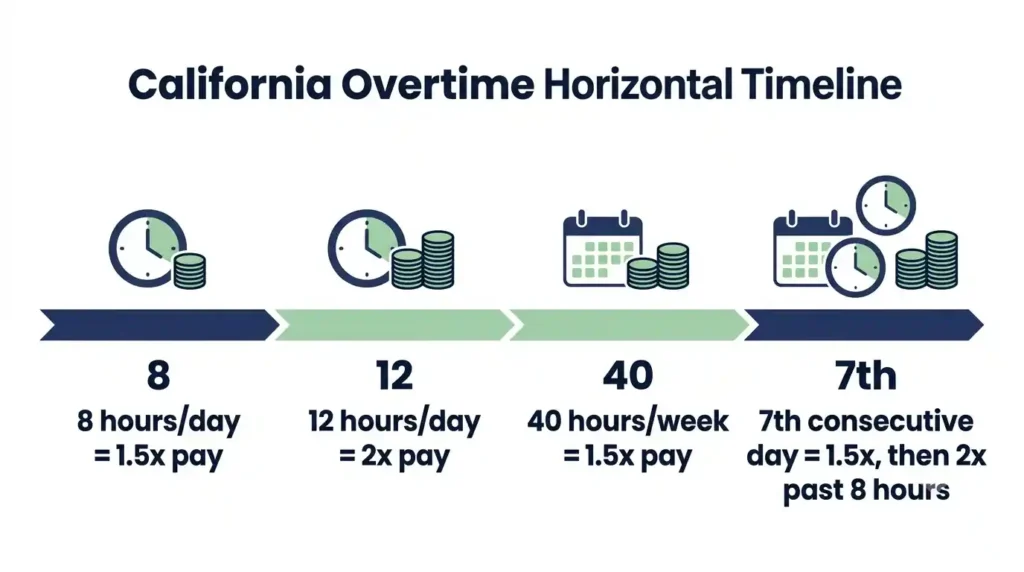
Cross 8 hours in a day, and every extra hour pays 1.5 times your regular rate under California overtime law. Cross 12 hours, and it jumps to double time. Off-the-clock minutes that push you past either line owe you the higher rate, not your regular one.
Weekly Overtime
Cross 40 hours in a week and you’re owed 1.5 times pay on the extra, separate from daily overtime. Work all seven days in one workweek, and the seventh day pays 1.5 times, with double time past 8 hours that day.
Unauthorized Overtime
Your employer can require approval before overtime, and can discipline or even fire you for skipping it. What they can’t do is refuse to pay you for it. Discipline and payment are separate issues under California law.
Real Workplace Scenarios
Retail
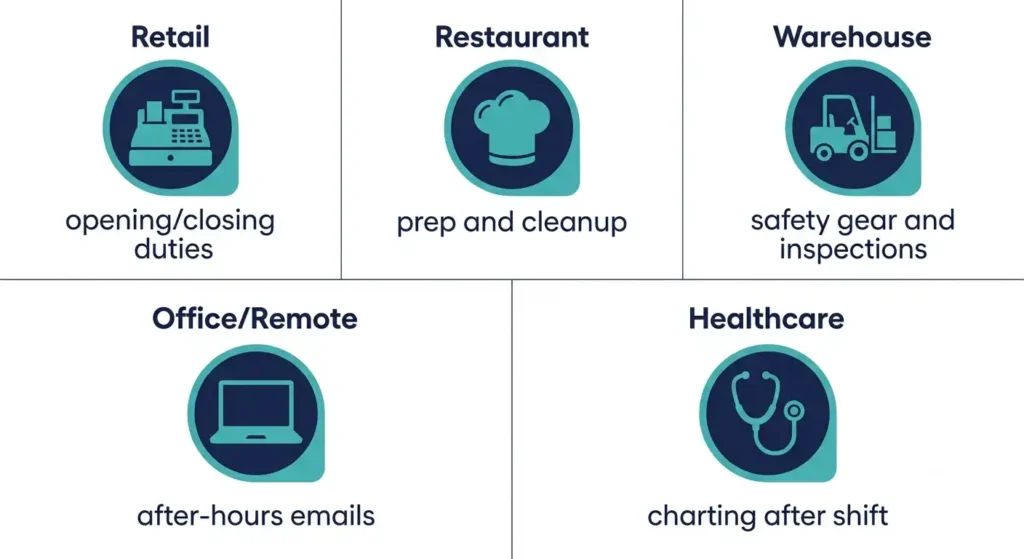
A cashier arriving 15 minutes early to count the drawer, staying late to pull security gates, or doing an end-of-shift loss prevention check, is all compensable work.
Restaurant & Hospitality
Prep cooks chopping vegetables before opening, servers rolling silverware after closing, and staff cleaning the dining room after clock-out all belong on the timesheet.
Warehouse & Manufacturing
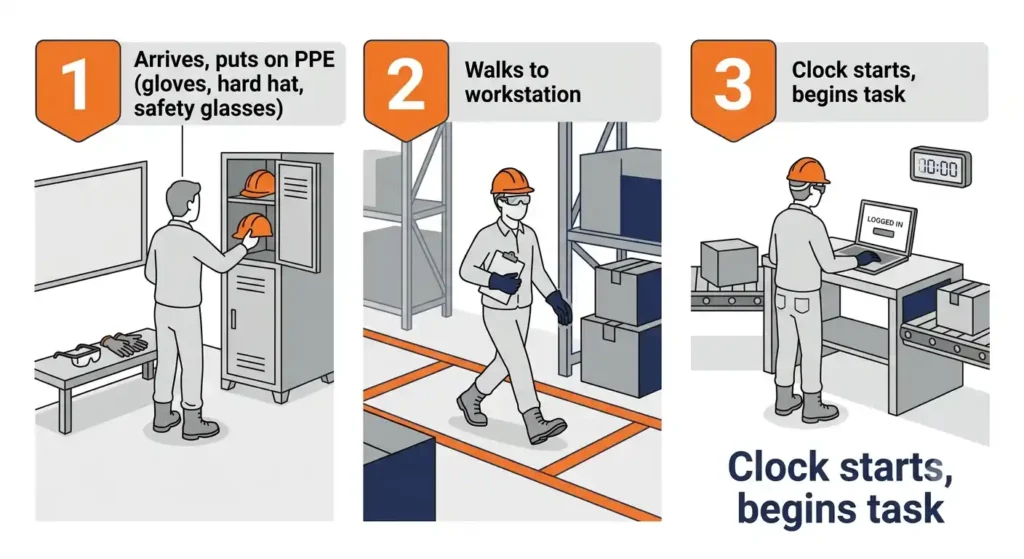
Required safety gear, walking to a workstation, pre-shift equipment checks, and end-of-shift inspections or shutdown procedures are all compensable when the employer requires them. This is called donning and doffing, covering required uniforms and personal protective equipment (PPE) like gloves, hard hats, or safety glasses. Construction crews loading tools before the job starts fall under the same rule.
Office & Remote Jobs
Replying to emails after hours, joining a call outside your shift, or logging into a company system to finish a report at home all count, asked or not. An IT employee pulled into a midnight emergency call is working the moment they pick up the phone, not when they log it the next day.
Healthcare
Charting patient notes after a shift ends, handing off patients to the next nurse, or attending a mandatory staff meeting outside normal hours, is paid time, not a favor to the hospital.
Situations That Surprise Employees
Waiting Time
If your employer tells you to be there and available, waiting for an assignment counts as hours worked. The test is control, not activity. This is why on-call time can be compensable if you must stay nearby and respond fast, and why travel between two job sites in the same shift counts, though the drive from home to your first site usually doesn’t. A related rule, reporting time pay, covers what happens if you show up for a shift and get sent home early.
Meal and Rest Break Issues
Working through a meal period logged as unpaid is a common violation, and so is a manager interrupting your break. If you’re still watching the register or answering calls, it wasn’t a break at all. California also requires a paid rest period every four hours, and getting pulled off it for a task is its own separate violation.
Security Checks
Retail and warehouse workers sometimes go through mandatory bag checks or security screenings before leaving. If your employer requires it, that time belongs to you, even after you’ve clocked out.
Technology-Related Work
Logging into multi-factor authentication, waiting for a computer to boot up, or installing a required update before your actual tasks is compensable time. Employers can’t make the login process a free warm-up before your paid shift begins.
Common Myths About Off-the-Clock Work
Myth vs Reality
There’s no legal minimum: five minutes a day, five days a week, adds up to over 20 hours a year, and the law takes that seriously. California doesn’t recognize a broad de minimis doctrine, a point the California Supreme Court settled in Troester v. Starbucks Corp., ruling that regularly unpaid minutes still have to be paid. Unauthorized work still has to be paid if your employer knew or should have known about it. Misclassified salaried workers can qualify too, and employees can’t legally waive their right to wages. Working through lunch doesn’t “save time,” it creates a violation, and employers can’t average hours across weeks to dodge overtime. Each week stands on its own.
What Employers Cannot Legally Do
Common Illegal Practices
Employers can’t ask you to clock out and keep working, quietly edit your time records, or refuse overtime pay over a missed approval step. Rounding time entries is only legal if it truly averages out and never favors the employer, otherwise it’s a disguised way of shaving your pay.
Common Excuses Employers Use
“Everyone does it” is an admission of a company-wide problem, not a defense. “It’s only a few minutes” ignores that minutes are still wages. “You volunteered” or it’s “part of the job” doesn’t hold up if the employer benefited and let it happen, and working out of fear of discipline still counts, since that pressure shows the same benefit.
How to Prove Off-the-Clock Work
Best Evidence
Your strongest proof is time records showing a pattern, plus texts, emails, and schedules showing you were asked to work outside paid hours. Screenshots sent after clock-out are gold. Payroll records and old pay stubs help too, since mismatched hours support your claim.
Supporting Evidence
Coworkers who saw you working late, security footage, and badge or key card logs can back up your timeline when your own records feel thin.
Personal Documentation
Keep your own daily log: start time, end time, what you did. A notes app entry is enough. Calendars showing after-hours calls help too, and this kind of record has settled more disputes than people expect.
What Compensation Can You Recover?
Unpaid Wages
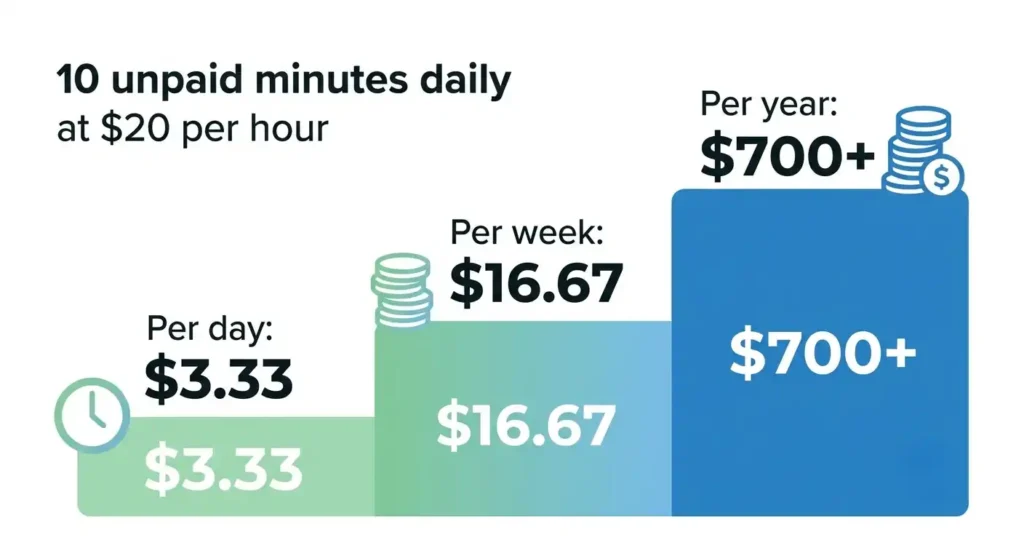
You can recover your regular hourly pay for every unpaid minute, plus any overtime premium it should have triggered. This is based on your regular rate of pay, which factors in commissions and non-discretionary bonuses, not just your base wage. Ten unpaid minutes a day at $20/hour adds up to over $700 a year, before any overtime premium or penalties get added on. You can check your own numbers with a gross pay calculator to see what those minutes are really worth.
Additional Penalties
A short final paycheck can owe you waiting time penalties, up to 30 days of your average daily wage, under California Labor Code Section 203. Inaccurate pay stubs carry wage statement penalties under California Labor Code Section 226, and unpaid wages accrue interest the whole time they sit unpaid.
Potential Legal Remedies
You can file a wage claim with the California Labor Commissioner’s Office, free and without a lawyer. It operates under the California Department of Industrial Relations (DIR), through the Division of Labor Standards Enforcement (DLSE), which reviews your DLSE wage claim. That covers just your own wages, a class action combines many employees’ claims into one case, and a Private Attorneys General Act (PAGA) claim pursues penalties on behalf of the state across the whole company. For a broader look at how these violations add up, see our guide on wage theft in California.
What To Do If Your Employer Isn’t Paying You
Step 1
Start tracking every minute you work outside your scheduled shift today. Save texts and emails as they happen, don’t rely on memory.
Step 2
Raise it with your employer in writing, even a simple email creates a paper trail. Keep your own copy, not just on a company device. Ask HR how off-the-clock time should be reported and whether your records match your actual hours, their answer shows if this is a mistake or a pattern.
Step 3
If nothing changes, file a wage claim with the Labor Commissioner’s Office. This starts a formal process that pressures your employer to fix it.
Step 4
If the amount owed is significant, or your employer pushes back hard, talk to an employment attorney. Many offer free consultations and only get paid if you win.
Can Your Employer Retaliate Against You?
Protected Activities
Reporting unpaid wages, filing a claim, or even just cooperating with a state investigation is legally protected activity in California.
Signs of Retaliation
Getting fired shortly after raising a wage issue is the obvious one. Retaliation also shows up as reduced hours, sudden write-ups, or getting frozen out of the schedule.
What To Do After Retaliation
Document every change in treatment with dates. Retaliation claims can be filed alongside your original wage claim, and California takes them seriously.
Frequently Asked Questions
Is off-the-clock work illegal in California?
Yes, if you’re non-exempt and unpaid for it. Your employer must compensate every minute of work they knew about or should have known about.
Can my boss require me to answer texts after work?
They can ask, but that time must be paid, and if it’s regular, it may trigger daily or weekly overtime.
Do I get paid for putting on required safety gear?
Yes, if your employer requires the gear, putting it on and taking it off is generally compensable.
Can my employer refuse unauthorized overtime?
They can discipline you for skipping approval, but they still owe you for the hours worked.
How long do I have to file a wage claim?
Most wage claims need to be filed within three years, though written-contract claims can reach four. A wage statement violation under California Labor Code Section 226 has a shorter one-year window. Don’t wait.
Can I be fired for reporting unpaid work?
No. Firing someone for reporting a wage violation is illegal retaliation, and it can create a second claim.
What evidence is enough to prove unpaid work?
Time records, messages, and schedules are usually enough on their own. Witness statements and your own daily log strengthen the case.
Does off-the-clock work count toward overtime?
Yes. Unpaid hours that push you past 8 in a day or 40 in a week must be paid at overtime rates.
Key Takeaways
Know your rights
Off-the-clock work hides in small chunks of time, which is why it’s easy to miss. Learn to recognize it, keep your own records, and remember that penalties and interest can turn a small problem into a large one. When something feels off, act on it, because the clock on your right to claim it is running too. And if you just want to see what your hours should actually add up to, run the numbers through our California paycheck calculator.

Yeasin Sorker is the founder of Paycheck Calculator California. He built this tool in 2018 after noticing that most free paycheck calculators missed California-specific rules like daily overtime and the uncapped SDI rate.
He researches California payroll tax updates regularly and keeps this calculator aligned with the latest IRS, FTB, and EDD published rates. All calculations on this site are estimates based on official 2026 government sources. For personalized tax advice, consult a qualified tax professional.