
Under California Labor Code Section 203, a late final paycheck costs your employer one full day of your wages for every calendar day they delay, up to 30 days maximum. At $25 per hour on an 8-hour day, a 10-day delay alone produces a $2,000 penalty owed directly to you, on top of any unpaid wages.
In 8 years of reviewing wage claims, I watched a $47 PTO miscalculation grow into a $4,153 penalty for one salaried worker because the employer missed the same 30-day calendar-day rule that trips up most payroll departments.
One honest warning: the penalty arrives with no tax withheld. You owe income tax on it at filing time, so plan accordingly before you spend it.
Quick Answer: The Waiting Time Penalty Formula
Here is the formula. It is simple.
Daily Wage x Number of Days Late (max 30) = Your Penalty
A quick example: You earn $25 per hour. You work 8 hours a day. Your employer pays you 10 days late.
$25 x 8 = $200 daily wage. $200 x 10 days = $2,000 penalty owed to you.
The penalty uses calendar days. That means weekends and holidays count. The penalty clock starts the day after your legal deadline is missed. It stops when your employer pays you in full or when you file a legal claim.
Takeaway: The waiting time penalty formula is your daily wage multiplied by the number of days your employer is late, capped at 30 days.
My Exclusive Insight: The “$1 Rule” That Changes Everything
Most guides miss this. I did not learn it from a textbook.
After reviewing dozens of wage claims over 8 years, I noticed one pattern that caught employers completely off guard every single time.
A $1 shortage in your final paycheck triggers the exact same 30-day maximum penalty as a completely missing check.
There is no minimum threshold in California Labor Code Section 203. Missing $50 in vacation payout is treated identically to missing your entire last paycheck. I have seen a $47 PTO miscalculation turn into a $4,153 penalty for a salaried employee. The employer thought the rounding error was harmless. It was not.
This is the detail that no competitor guide spells out plainly. Use it.
Takeaway: Any shortage, no matter how small, triggers the full penalty. Always read your California pay stub line by line before assuming your final paycheck is correct.
What Happens When an Employer Misses the Deadline? (A Real Case)
Early in my career, I worked with an HR manager at a small warehouse company. They fired an employee on a Friday and mailed the final check the following Wednesday. The manager thought five days was “pretty fast.”
It was not fast enough. Under California Labor Code Section 201, a fired employee must be paid immediately at the time of termination. That five-day delay triggered five days of penalties. The employee’s daily wage was $160. The company owed an extra $800 on top of the missed wages.
The manager was shocked. “We were trying to do it right,” she told me. That is the trap. Good intentions do not stop the penalty clock. Only timely payment does.
That lesson stuck with me. The law does not care about “standard processing.” It cares about the deadline.
Do You Qualify for a Waiting Time Penalty? (Check This First)
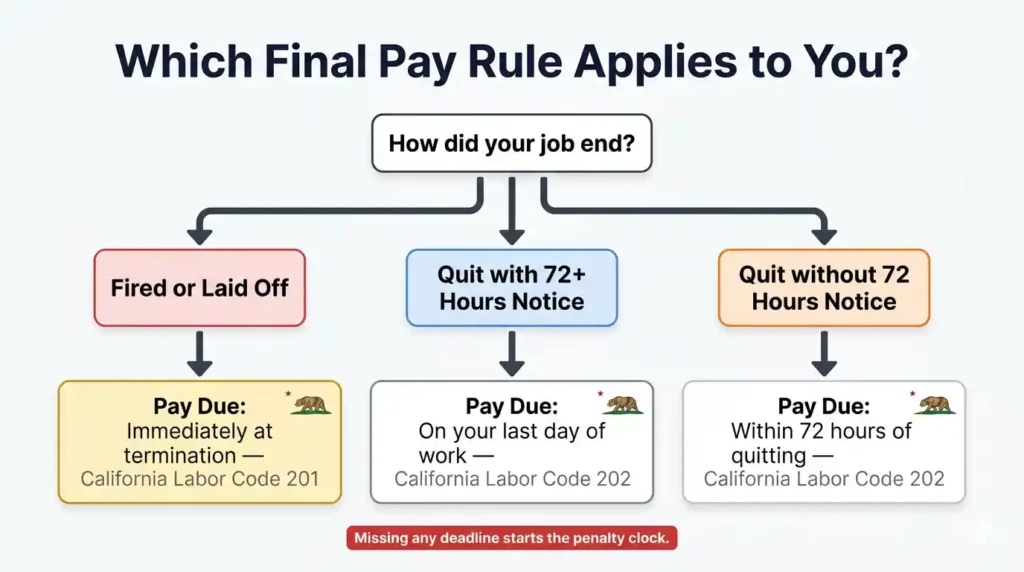
Not every late paycheck triggers a penalty. California law sets specific rules based on how your job ended. Let me walk you through each one.
If You Were Fired or Laid Off
California Labor Code Section 201 is crystal clear here. If your employer fires or lays you off, they must pay you all final wages immediately. That means right then and there, on the day of termination. If they mail it, hand it to you late, or tell you to wait for the next payroll cycle, the penalty clock starts the very next calendar day.
In my experience, this is the most common violation I see. Companies with out-of-state payroll departments often cannot meet this rule. That does not excuse them.
If You Quit With At Least 72 Hours of Notice
California Labor Code Section 202 covers resignation. If you gave your employer at least 72 hours of notice before your last day, they must have your final paycheck ready on your last day of work. They cannot make you wait.
This rule catches a lot of employers off guard. If your last day is Friday and you gave notice Monday, the check must be in your hands on Friday.
If You Quit Without 72 Hours of Notice
If you quit suddenly without giving advance notice, your employer gets a grace period. They have 72 hours from the moment you quit to give you your final wages. If that 72-hour window ends on a weekend, the deadline still applies based on calendar time, and any delay after that point begins accruing the penalty.
Takeaway: The deadline depends on how your job ended. Termination means immediate pay. Resignation with notice means pay on your last day. Surprise resignation means 72 hours.
When You Do NOT Qualify for the Penalty
It is important to be honest about the exceptions. There are a few situations where the waiting time penalty does not apply.
The Good Faith Dispute Exception is the most important one. If your employer has a real, honest, evidence-based reason to believe they do not owe you certain wages, they can withhold that specific amount without triggering the penalty. For example, if there is a legitimate disagreement about whether a commission was actually earned, a court may find that a good faith dispute exists.
Note the word “legitimate.” A vague excuse or a company policy does not count. The employer must have real facts supporting their position.
Independent Contractor Status is another exception. If you are a true independent contractor and not a legal employee, California Labor Code Section 203 does not apply to you. Many workers are misclassified, though, so check your actual status carefully using the California ABC test for worker classification before assuming this exception applies to you.
Employee Avoidance is a third exception. If you deliberately hide from your employer to keep the penalty clock running, you lose your right to the penalty. California Labor Code Section 203 protects workers who genuinely want payment, not those gaming the system.
Takeaway: The penalty requires willful nonpayment by an employer. A legitimate dispute, contractor status, or employee avoidance can block a claim.
What Counts as Your “Daily Wage”? (The Most Important Concept)
This is where most people make mistakes. The daily wage is not just your base hourly rate. It is a broader number that includes several types of earned compensation.
What is included in your final paycheck and daily rate calculation:
- Base hourly pay or your regular salary
- Accrued and unused vacation time or paid time off (PTO), treated as wages under California Labor Code Section 227.3 (this includes any accrued sick leave covered under California sick leave laws where the employer uses a combined PTO bank)
- Earned commissions that can be calculated at the time you leave
- Regularly scheduled overtime, meaning overtime you work every single week as part of your normal routine (see California overtime pay rules for how these rates are calculated). California’s overtime structure is governed by Labor Code Section 510, which sets the daily and weekly thresholds.
- Earned bonuses tied to measurable work you already completed
What is not included:

- Expense reimbursements, because those are not compensation for labor
- Occasional or unpredictable overtime that is not part of your standard schedule
- Discretionary bonuses that have not yet been formally earned
The vacation rule is one that surprises people most. In California, your accrued PTO is a vested wage. Your employer cannot take it away. If they owe you 40 hours of unused PTO, that amount is part of your final wages. Failing to include it triggers the full daily penalty just as surely as missing your base pay.
Takeaway: Your daily wage includes base pay, earned PTO, earned commissions, and regular overtime. Leaving any of these out of your final paycheck can trigger the full penalty.
How to Calculate Your Daily Wage Rate
The calculation method depends on how you were paid. Follow the path that fits your situation.
For Hourly Workers
The formula is simple:
Hourly Wage x Hours You Normally Work Per Day = Daily Rate
If you work a standard 8-hour day at $20 per hour, your daily rate is $160.
If you regularly work 9 hours a day with 1 hour of overtime, the formula adds the premium. Review California overtime and double time rates to confirm your correct overtime multiplier before plugging it into the penalty formula:
(Regular wage x 8 hours) + (Overtime wage x 1 hour) = Daily Rate
At $20 per hour regular and $30 per hour overtime: ($20 x 8) + ($30 x 1) = $190 daily rate.
For Salaried Workers
Salaried employees need to convert their pay to a daily figure. The California Division of Labor Standards Enforcement uses this formula:
(Monthly Salary x 12) / 52 weeks / 5 workdays = Daily Rate
For a person earning $3,000 per month: ($3,000 x 12) / 52 / 5 = $138.46 per day.
If their employer is 30 days late, the maximum penalty is $138.46 x 30 = $4,153.80. Notice that this is more than one full month’s salary. That is intentional. The law uses calendar days, not workdays, so the 30-day penalty is larger than a typical monthly paycheck.
For Part-Time Workers
Use the same hourly formula, but plug in your actual daily hours.
At $15 per hour working 4-hour shifts: $15 x 4 = $60 daily rate.
Takeaway: Always calculate your daily rate before multiplying by the number of late days. Salaried employees often find their maximum penalty exceeds one full month of pay.
Step-by-Step Penalty Calculation (Follow These 3 Steps)
Let me make this as simple as possible. Three steps is all it takes.
Step 1: Find Your Daily Wage
Use the formulas above. Pick the one that matches your pay type. Write down that number.
Hourly Quick Check
Multiply your hourly rate by your normal daily hours. That is your number.
Salary Quick Check
Run the annualization formula: (Monthly pay x 12) / 52 / 5. Round to two decimal places.
Step 2: Count the Calendar Days Late
Start counting the day after your legal deadline passed. Every day counts, including Saturdays, Sundays, and holidays. Stop counting when you receive your full payment or when you file a formal claim. Do not count more than 30 days.
Why Calendar Days Matter
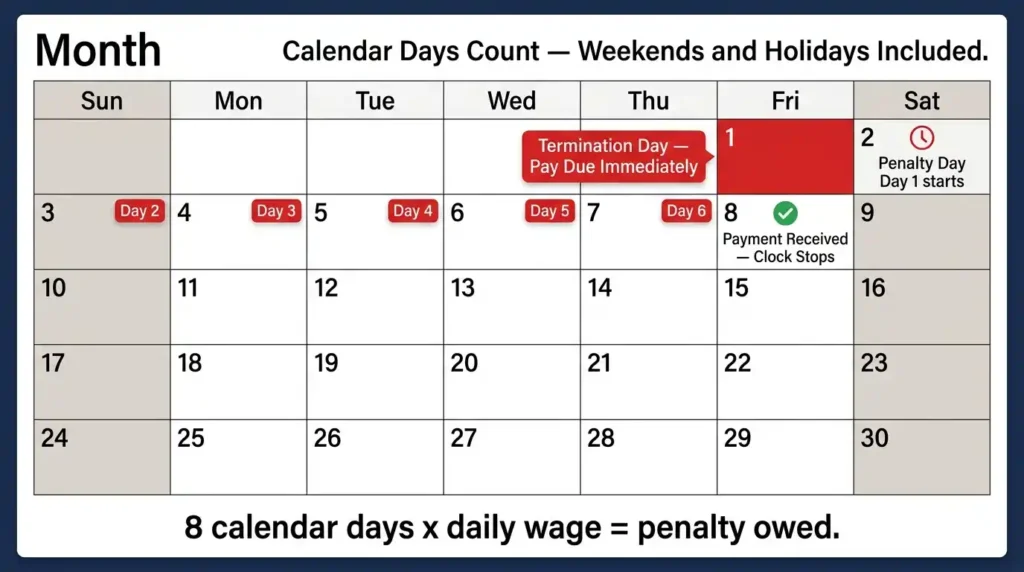
The law is not counting your workdays. It is counting every single day on a calendar. Missing this detail is the most expensive mistake I see workers make.
Step 3: Multiply
Daily Wage x Days Late = Your Penalty Amount.
That number is what your employer owes you on top of your unpaid wages.
Penalty Calculation Table: Quick Reference for All Workers
| Hourly Rate | Daily Hours | Days Late | Total Penalty |
| $20/hr | 8 hrs | 5 days | $800.00 |
| $25/hr | 8 hrs | 10 days | $2,000.00 |
| $30/hr | 8 hrs | 30 days | $7,200.00 |
| $15/hr | 4 hrs | 10 days | $600.00 |
| Salary $3,000/mo | 5 days/wk | 30 days | $4,153.80 |
Real Calculation Examples Across Every Scenario
I want to show you how these numbers work in real life. Each of these comes from the types of situations I have walked people through personally.
Hourly Worker: Standard Case
Maria earns $20 per hour. She works 8-hour days. Her employer fires her and mails her check 7 days later. Her daily rate is $160. The penalty is $160 x 7 = $1,120. She also gets the underlying wages owed. The penalty is separate and in addition. (Note: the California minimum wage in 2026 is $16.90/hr, so even minimum-wage workers generate meaningful daily penalty amounts.)
The 30-Day Maximum Cap
James earns $25 per hour working 8-hour days. His employer delays his final check for 45 days. The penalty cap under California Labor Code Section 203 is 30 days. His daily rate is $200. His maximum penalty is $200 x 30 = $6,000. He cannot collect more than this under Section 203, even though the delay was longer.
Part-Time Worker
Sofia works part-time, 4 hours a day at $18 per hour. Her last paycheck is 12 days late. Daily rate: $18 x 4 = $72. Penalty: $72 x 12 = $864. If you want to understand how a part-time vs. full-time paycheck in California affects your regular earnings, that context matters for calculating your daily rate correctly.
Salaried Employee
David earns $4,000 per month. He resigns with notice but his employer does not pay him on his last day. The employer pays him 20 days later. Daily rate: ($4,000 x 12) / 52 / 5 = $184.62. Penalty: $184.62 x 20 = $3,692.30.
Commission-Based Employee
Lin earned a $3,000 commission that was fully calculable at the time of her resignation. Her employer delayed the commission and her base pay. The commission is part of her final wages and must be included in the paycheck by the legal deadline. The daily penalty rate is still calculated from her daily wage rate (hourly or salary equivalent), multiplied by the number of days late. The unpaid commission is what triggered the violation. The penalty amount itself is based on her daily pay rate, not a percentage of the total unpaid commission.
Takeaway: Every worker type, hourly, salaried, part-time, and commission-based, can calculate their penalty using these formulas. The math is the same; only the daily rate changes.
The Tax Reality of Your Waiting Time Penalty
This section surprises almost everyone. I want to prepare you for it so you are not caught off guard at tax time.
Is the Waiting Time Penalty Taxable Income?
Yes, but not in the way you might think. The IRS has ruled that waiting time penalties are not “wages.” They are a statutory penalty, not pay for services you performed. This is an important distinction.
Because the penalty is not wages, your employer does NOT withhold federal income tax, Social Security, or Medicare from the payment. They also do not pay the employer portion of those taxes. To understand exactly which California payroll taxes normally apply to your regular wages, that page walks through each deduction in detail.
You receive the full gross amount with nothing taken out.
How Your Employer Reports It: Form 1099-MISC Box 3
Your employer must report the penalty payment on Form 1099-MISC, specifically in Box 3, labeled “Other Income.” This is different from your regular W-2 wages. If you are unsure about the difference between a W-2 and a 1099 and how each affects your tax situation, that distinction becomes especially important here.
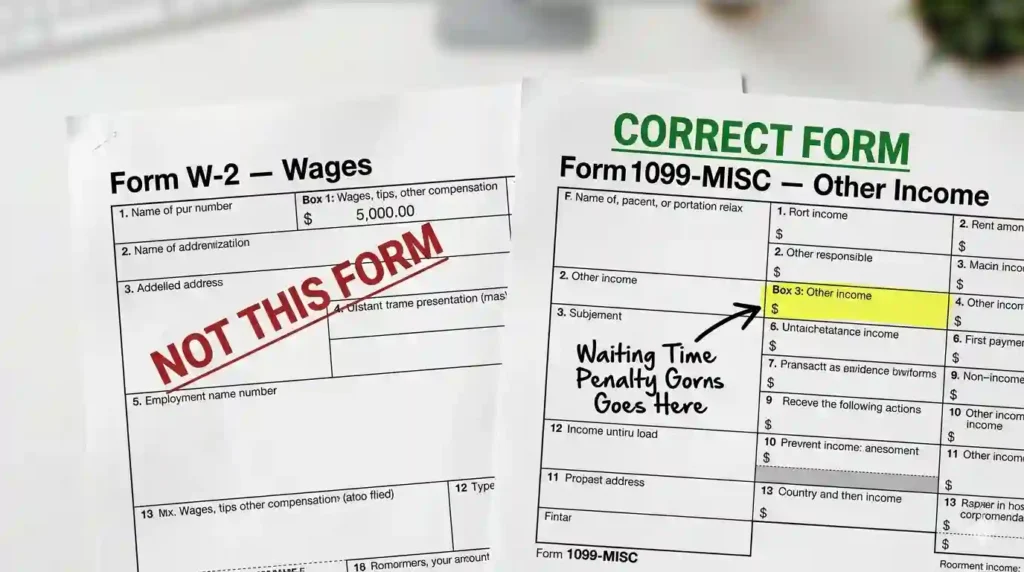
Reporting this payment on a W-2 is a mistake that some payroll departments make. If your employer does this, they have filed an incorrect information return and may face their own penalties.
What This Means for You at Tax Time
When you file your personal tax return, you will see this 1099-MISC income. You will owe income tax on it at your standard rate. Because no tax was withheld, you may need to set aside a portion of the payment yourself to cover what you will owe.
The California Employment Development Department and the California Division of Labor Standards Enforcement both align with the IRS position. No state-level withholding is taken out either.
What I always tell people: if you receive a waiting time penalty, do not spend every dollar before tax season. How much you set aside depends on your total income for the year and your California income tax bracket, which ranges from 10% to 37% federally. A rough starting point for many middle-income workers is 20 to 30 percent combined federal and state, but your actual liability will vary. A tax professional can give you a precise figure based on your situation. Either way, April is never a surprise if you plan ahead.
Takeaway: Waiting time penalties are reported on Form 1099-MISC Box 3, not a W-2. You get the full amount upfront, but you will owe income tax when you file your return.
What Mistakes Cost Workers Their Full Penalty Recovery?
I have watched people lose money they were legally owed because of these errors. Do not repeat them.
Counting only workdays instead of calendar days. Every day on the calendar counts. A 10-day delay from a Friday termination includes the weekend.
Forgetting the 30-day cap. If your employer was 60 days late, your penalty is still capped at 30 days of daily wages. Do not over-claim or you lose credibility in your filing.
Leaving out vacation or PTO. Under California Labor Code Section 227.3, accrued PTO is a wage. If your employer owes you 40 hours of PTO and skips it, that triggers the full penalty.
Mixing up unpaid wages and the penalty. These are two separate amounts. You are owed the unpaid wages AND the penalty. They do not cancel each other out.
Accepting a partial check and thinking the clock stops. The clock only stops when all wages are fully paid. A partial payment does not reset or pause the penalty.
Takeaway: Count calendar days, include all earned wages like PTO and commissions, and always separate your unpaid wages from your penalty amount.
What Do Experienced Advisors Know That Most Workers Miss?
Here are the insights that make a real difference when you are in a dispute.
Even a $1 shortage in your final paycheck triggers the full daily penalty. In my experience, employers sometimes “round down” on a final calculation or forget a single day’s pay. That small error costs them the full 30-day maximum penalty. A claim for $50 in missing vacation pay can result in a $4,000 penalty.
Document everything. The moment your deadline passes, send a written request for your final wages via email or text. This creates a timestamp. It also removes any argument that you were “hard to reach.”
Employers often settle quickly once they see the math. Our California paycheck calculator can help you verify your base daily wage, which you then multiply by the number of days late to produce the penalty figure. Use that number as your negotiation tool before filing a formal claim.
HR compliance systems and payroll software systems do not automatically protect employers. Even if a system processes checks on a regular cycle, California law requires payment to match the legal deadline, not the payroll calendar.
One of my clients, a warehouse supervisor in Fresno, used this exact calculation method after her employer delayed her final check by 18 days. She walked into the Labor Commissioner office with the math already done on one page. Her case was resolved in a single hearing. She told me afterward: “I would have given up if I did not know the number I was owed. Knowing it made me fight.”
That is the power of doing the math first.
Takeaway: Even tiny paycheck errors trigger full penalties. Document your deadline in writing and use the penalty math as leverage before escalating to a formal claim.
How to Claim Your Waiting Time Penalty
You have two main paths. I will give you both.
Path 1: File a Wage Claim with the DLSE
The California Division of Labor Standards Enforcement runs a wage claim process called the DLSE wage claim process. You can file online or in person at a local Labor Commissioner office. Filing is free. A hearing officer will review your case and can order your employer to pay. The official California DIR waiting time penalty FAQ walks through exactly what happens at each stage after you submit your claim.
Documents you need:
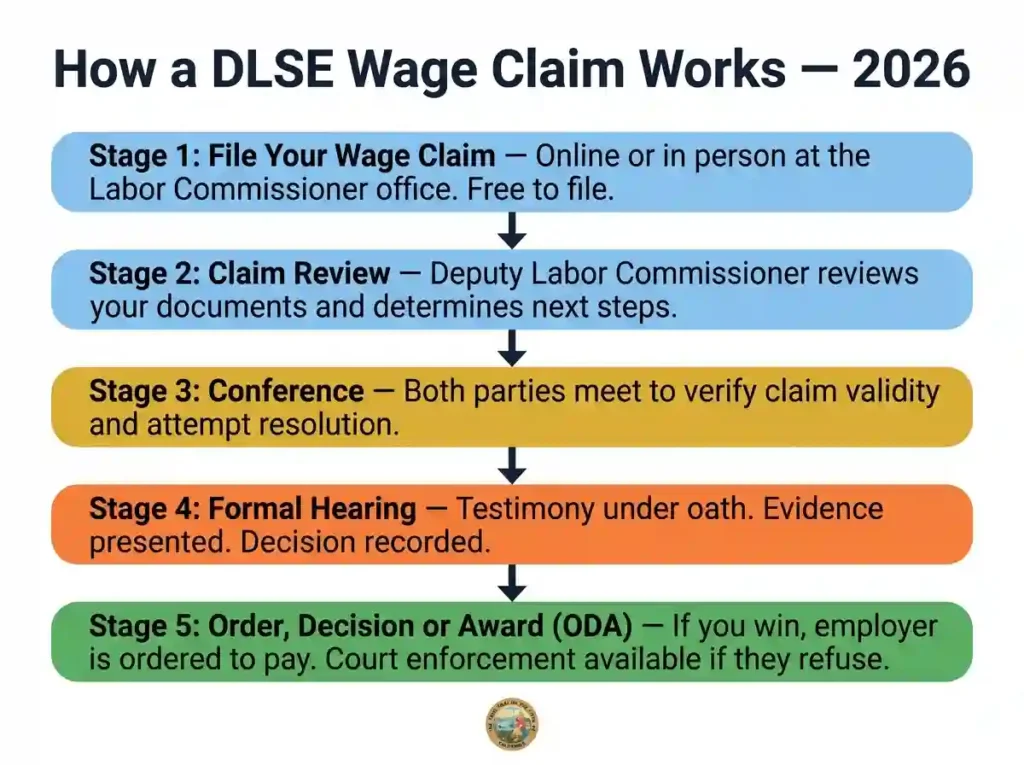
- Pay stubs from your last few months of work
- Your final paycheck or proof that it was late
- Proof of your termination or resignation date (an email, letter, or text works)
- Any written communication about pay delays
Path 2: Small Claims Court
For lower amounts, small claims court is a fast and inexpensive option. In 2026, California individuals can sue for up to $12,500 in small claims court. Businesses are capped at $6,250. Many waiting time penalty claims fall within the individual limit, making this a practical path without needing an attorney.
Your Deadline to File
You have up to three years to file a wage claim for waiting time penalties under the statute of limitations for wage violations. Do not wait too long. Evidence and witnesses become harder to gather over time.
Takeaway: File with the DLSE for free official support or use small claims court for faster resolution. You have three years from the violation date to act.
Real Questions Workers Ask Me Every Week
Is the California waiting time penalty taxable?
Yes. The IRS classifies it as “Other Income,” not wages. You will report it on your tax return using the Form 1099-MISC Box 3 your employer sends you. No taxes are withheld at the time of payment, so set aside a portion for your tax bill.
Does the 30-day waiting time penalty include weekends?
Yes. California Labor Code Section 203 counts every calendar day, including Saturdays, Sundays, and holidays. A delay that starts on a Friday counts Saturday and Sunday as penalty days.
How is the daily rate of pay calculated for a salaried employee?
Use this formula: (Monthly Salary x 12) divided by 52 weeks, divided by 5 workdays. A $3,000 per month salary produces a daily rate of $138.46.
Can an employer withhold a final check for unreturned equipment?
No. This is a direct violation of California wage law. Your employer cannot hold your paycheck hostage for a laptop, uniform, key, or any other property. The wages are yours. Equipment return is a separate matter handled through civil law, not payroll.
What is considered a “willful” failure to pay in California?
Willful nonpayment does not require your employer to be mean or dishonest. It simply means they knew what the law required and did not do it. Administrative delays, being short-staffed, or having an out-of-state payroll department do not excuse willfulness.
Are commissions and bonuses included in a final paycheck?
Commissions that are calculable at the time of termination are wages and must be included. Earned bonuses tied to work already done are also wages. Purely discretionary bonuses that have not been formally earned or calculated yet may not be included.
How do I file a claim for waiting time penalties in California?
Visit the California Division of Labor Standards Enforcement website or go to your nearest Labor Commissioner office. The filing is free. Bring pay stubs, proof of your termination or last day, and any communication about the missing check.
Does the waiting time penalty apply if I quit without notice?
Yes. If you quit without 72 hours of notice, your employer has 72 hours to pay you. If they miss that window, the penalty begins on calendar day 73. The penalty accumulation behavior follows the same rules as any other termination scenario.
What if my final paycheck was only $1 short?
The full daily penalty applies. California wage law does not have a minimum shortage threshold. Missing one dollar in vacation pay or base wages triggers the same 30-day maximum penalty limitation as a completely missing check. This is intentional under the wage protection framework.
Is the waiting time penalty reported on a W-2 or 1099-MISC?
It is reported on Form 1099-MISC, Box 3. Reporting it on a W-2 is an error. The IRS guidance from Chief Counsel’s Office advice in 2015 and 2016 confirmed that these penalties are not wages for tax purposes.
Wages vs. Non-Wages: What Must Be in Your Final Paycheck
| Compensation Type | Counts as Wages? | Included in Final Check? |
| Base hourly or salary pay | Yes | Yes |
| Accrued vacation / PTO | Yes (Labor Code 227.3) | Yes |
| Earned commissions | Yes | Yes |
| Earned performance bonuses | Yes | Yes |
| Expense reimbursements | No | No (separate process) |
| Discretionary bonuses (unearned) | No | No |
| Tips (employee-received) | Yes | Yes |
| Reporting time pay | Yes | Yes |
Note: Reporting time pay becomes a wage when an employee shows up for a scheduled shift and is sent home early. It can trigger the waiting time penalty if excluded from the final check. See California meal and rest break violations for related penalty structures that often appear alongside waiting time claims.
Final Summary: Your Action Steps Right Now
You now have everything you need. Here is what to do.
First, identify your separation type. Were you fired or did you quit? That determines your legal deadline under California Labor Code Sections 201 and 202.
Second, calculate your daily wage. Use the hourly formula or the salary annualization formula. Include PTO, commissions, and regular overtime. You can also use our gross pay calculator to verify your base gross earnings before running the penalty math.
Third, count your calendar days late. Do not skip weekends. Cap at 30.
Fourth, multiply. That number is the employer liability exposure you can claim.
Fifth, document your demand in writing. Send an email today asking for your overdue wages. Create your timestamp.
Sixth, if they do not pay within a few days, file with the DLSE wage claim process. It is free. The legal enforcement mechanism is on your side.
You now know this law better than most HR professionals I have met. That is not an exaggeration.
I want you to feel confident walking into this. The law was written to protect you. The math is simple. And the California Division of Labor Standards Enforcement takes these claims seriously.
You have done the hard part by educating yourself. Now go get what you are owed.
This guide is for educational purposes. For advice specific to your situation, consult a qualified labor attorney familiar with California wage law.

Yeasin Sorker is the founder of Paycheck Calculator California. He built this tool in 2018 after noticing that most free paycheck calculators missed California-specific rules like daily overtime and the uncapped SDI rate.
He researches California payroll tax updates regularly and keeps this calculator aligned with the latest IRS, FTB, and EDD published rates. All calculations on this site are estimates based on official 2026 government sources. For personalized tax advice, consult a qualified tax professional.