
Working full-time at $18 an hour equals $37,440 a year in gross pay, based on a standard 40-hour week across 52 weeks, before any taxes, benefits, or unpaid time off are factored in.
I’ve calculated this exact formula for payroll clients for years, and the $37,440 baseline holds across every full-time hourly job.
That number drops fast once taxes, unpaid leave, or reduced hours enter the picture.
Quick Answer: $18 an Hour Equals How Much a Year?
| Detail | Value |
|---|---|
| Gross Annual Pay | $37,440 |
| Total Hours | 2,080/year |
| Formula | 18 x 40 x 52 |
| Take-Home Pay | Lower, after taxes |
Annual Salary at a Glance
Formula: hourly rate x 40 hours x 52 weeks. 18 x 40 x 52 = $37,440 gross, based on 2,080 work hours a year, no unpaid time off included. This is one of the core paycheck basics worth knowing before you compare any job offer.
Complete Pay Breakdown
At $18 an hour: $144 a day for an 8-hour shift, $720 a week, $1,440 every two weeks.
Monthly Income
Monthly gross averages about $3,120. Months vary since some have five paydays instead of four. This is gross pay, not net, so run your own numbers through a gross pay calculator to see exactly what a five-payday month does to your total.
Paycheck Comparison Table
Use this as a quick lookup table to match against your own pay stub, gross pay by period and by wage.
Gross Income by Pay Period
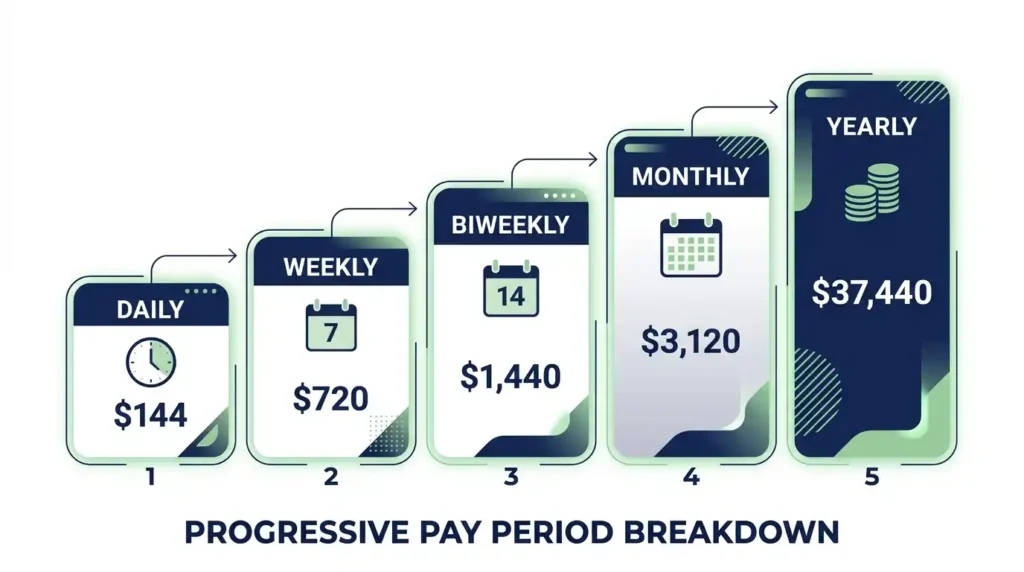
| Pay Period | Gross Amount |
|---|---|
| Daily | $144 |
| Weekly | $720 |
| Biweekly | $1,440 |
| Monthly | $3,120 |
| Yearly | $37,440 |
Different Hourly Wage Comparison
Annual gross at 2,080 hours a year:
| Hourly Rate | Annual Gross |
|---|---|
| $15/hour | $31,200 |
| $17/hour | $35,360 |
| $18/hour | $37,440 |
| $20/hour | $41,600 |
| $25/hour | $52,000 |
Curious how the neighboring wages break down after taxes? See the full picture for $20 an hour or $25 an hour.
How the Math Works
The whole system rests on one assumption: full-time hours.
Standard Full-Time Calculation
Full-time is defined as 40 hours a week for 52 weeks, or 2,080 hours a year, the same benchmark the U.S. Bureau of Labor Statistics uses when it reports standard annual work hours. That’s why job listings almost always quote pay using this exact hour count (18 x 2,080 = $37,440), even when actual schedules vary.
Why Your Annual Income May Be Different
Unpaid time off drops your hours below 2,080, and your pay drops with it. Reduced schedules, rotating shifts, and seasonal layoffs all cut into the full-time number. I’ve seen warehouse workers earn $37,440 one year and $33,000 the next from slow seasons alone. Working 50 paid weeks instead of 52 drops gross pay to around $36,000. Getting sick with no paid leave cuts into that number too, though California sick leave laws guarantee at least some paid days depending on your employer.
$18 an Hour After Taxes
Gross pay looks nice on paper. It’s not what you live on, and the gross pay vs net pay difference is exactly where most paycheck confusion starts.
Estimated Take-Home Pay
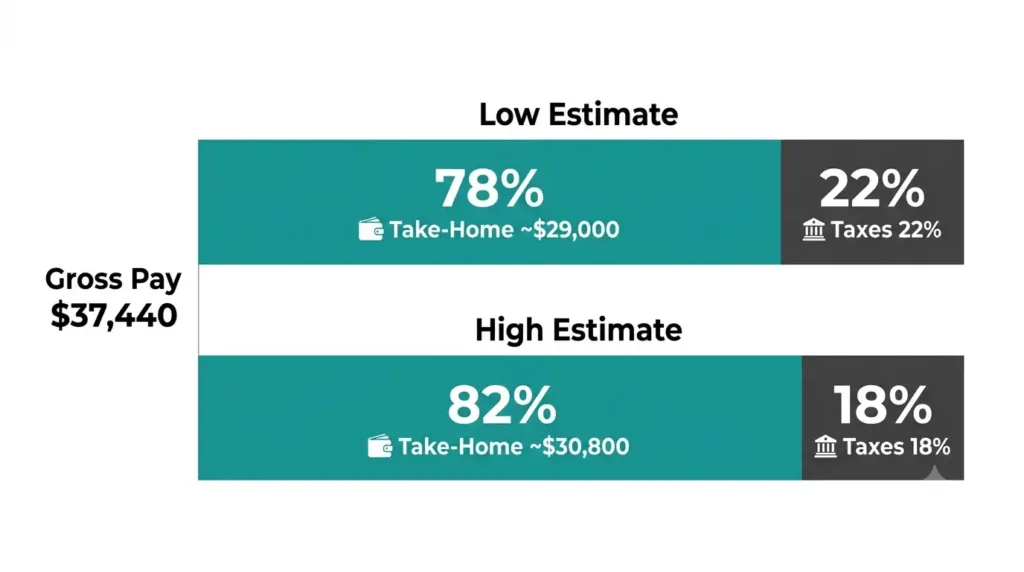
For a single filer with no dependents, expect an estimated 78% to 82% of gross pay after federal, state, and FICA taxes, an effective tax rate of about 18% to 22%. That’s $29,000 to $30,800 a year, $2,400 to $2,570 a month, $560 to $600 a week, $1,120 to $1,200 biweekly.
Taxes That Reduce Your Paycheck
Three main paycheck deductions hit every check. For a full walkthrough of where each line item lands, see how to read your pay stub, or browse our California payroll taxes category for deeper breakdowns.
Federal Income Tax
Federal tax is progressive, higher rates apply only to income above each bracket line, per the official IRS tax bracket schedule. For a single filer in 2026, the standard deduction is $16,100, which brings taxable income on an $18-an-hour salary to about $21,340, landing in the 12% federal bracket. See how California’s own standard deduction compares if you file state taxes too. Tax withholding from each check is just an estimate of what you’ll owe at tax time, and getting it right starts with how to fill out your W-4 form.
FICA Taxes
FICA tax covers Social Security tax and Medicare tax, a flat 7.65% from every paycheck: 6.2% Social Security tax, 1.45% Medicare tax. Your employer matches it, which most workers never notice. California workers also see a separate deduction for state disability, covered in our California SDI rate guide.
State Income Taxes
Texas, Florida, and Washington charge no state income tax. California and New York take a real bite, and California’s own 2026 tax brackets show exactly how much. That’s why two people earning $18 an hour can take home very different amounts.
Is $18 an Hour a Good Salary?
Depends where you live and what your bills look like.
Comparing With Minimum Wage
Federal minimum wage has been $7.25 an hour since 2009, according to the U.S. Department of Labor, so $18 clears it easily. Washington sits at $17.13 and California at $16.90 in 2026, with Connecticut and New York close behind. See the full California minimum wage 2026 rules for city-level rates that run even higher. In those states, $18 is only a small step up.
Comparing With Average Earnings
$18 an hour is entry-level to early-career pay in most fields. Competitive for retail, food service, and warehouse work, behind average pay in skilled trades, healthcare, and tech-adjacent roles, where wages can climb toward $40 an hour with enough experience.
Cost of Living Reality
In lower-cost Midwest or Southern areas, $37,440 covers rent, food, and a car payment, often clearing the local living wage with room to spare. In cities like San Francisco or New York, rent alone can eat half the paycheck. If you’re weighing a move, the Los Angeles paycheck calculator shows how far this wage actually stretches there.
Can You Live on $18 an Hour?
Yes, but your zip code decides how comfortable.
Sample Monthly Budget
On $2,400 to $2,570 take-home a month, a realistic budget looks like:
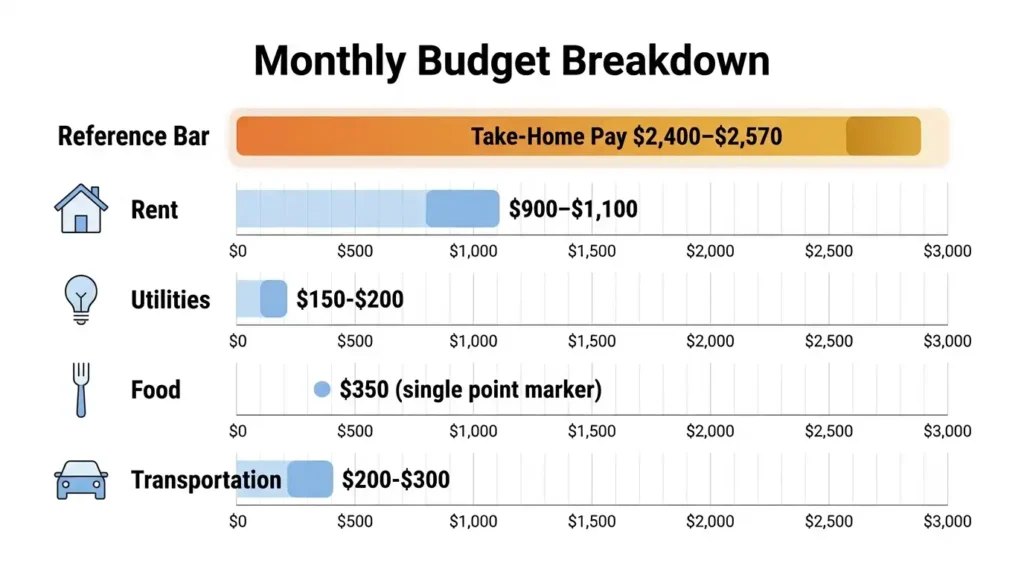
- Rent: $900 to $1,100
- Utilities: $150 to $200
- Food: $350
- Transportation: $200 to $300
That leaves little room for error. Landlords typically want gross income at three times monthly rent, so $37,440 a year qualifies for rent up to about $1,000 a month. A used car payment fits this budget. A mortgage is tougher since many lenders look for a debt-to-income ratio under 43%, and taxes and insurance eat into that room fast.
Common Financial Goals
Saving takes discipline here. Emergency funds, debt payments, and retirement all compete for the same dollars. Automating even $25 a paycheck into savings works well.
Lifestyle Scenarios
Living Alone
Works best in lower-cost areas. In expensive metros, rent can eat 40% to 50% of take-home pay.
Living With Roommates
Fastest way to make this wage comfortable. Splitting a two-bedroom can cut housing costs in half versus a solo studio.
Supporting a Family
Tough on one income once childcare and healthcare enter the picture. Childcare alone can run several hundred dollars a month.
Real-Life Examples
Numbers make more sense attached to a real decision. Browse more paycheck scenarios for other real-world pay situations.
New Job Offer Example
Comparing $18 an hour to a $36,000 salaried offer: the hourly job pays more on paper, $37,440, but check overtime access, benefits, and guaranteed hours. Hourly employees get paid per hour worked and qualify for overtime, while salaried workers earn a fixed amount regardless of hours. At 40 hours a week, $18 an hour counts as full-time income. A lower salary with strong benefits can beat unpredictable hourly scheduling.
Budget Planning Example
Monthly take-home of $2,450 minus $1,800 in fixed expenses leaves $650 for groceries, gas, and savings. Target saving $150 of that monthly to build a cushion within a year.
Income at Different Work Schedules
Full-time is the baseline, but not everyone works it.
Working Less Than Full-Time
At $18 an hour: 20 hours a week = $18,720 a year, 25 hours = $23,400, 30 hours = $28,080, 35 hours = $32,760. See our full part-time vs full-time paycheck comparison for how benefits eligibility shifts at each tier.
Working More Than Full-Time
Overtime Pay
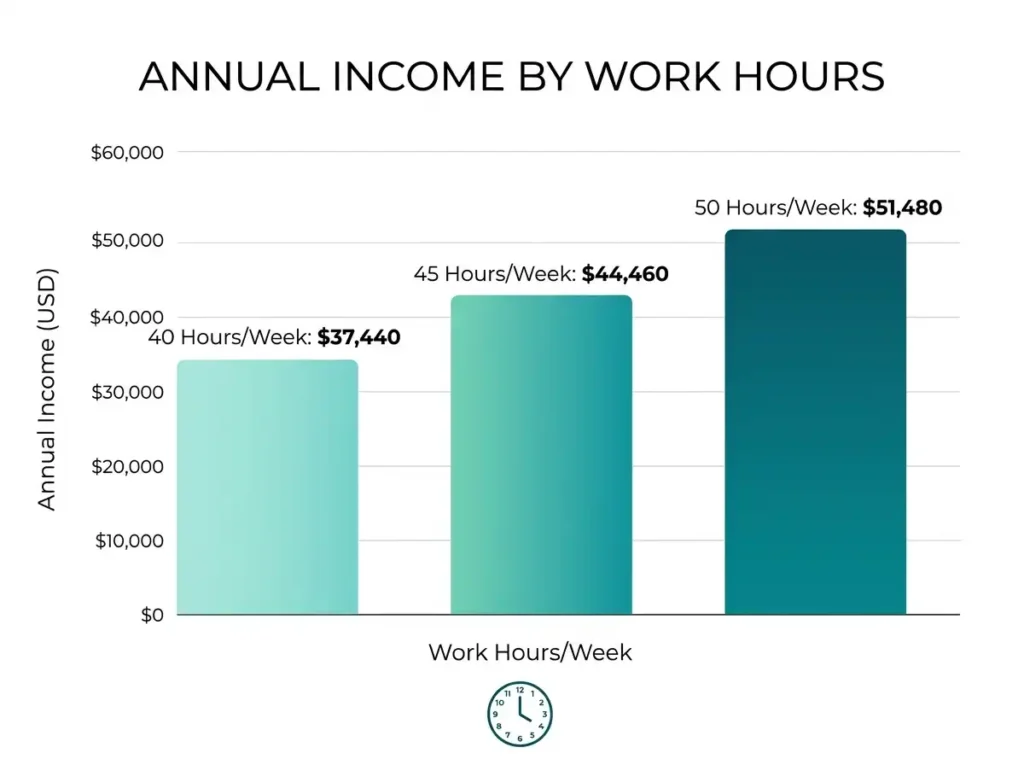
Overtime is time-and-a-half past 40 hours a week, $27 an hour for extra hours. A 45-hour week earns $855, about $44,460 a year. A 50-hour week earns $990, about $51,480 a year. Some employers offer holiday pay or double-time on major holidays, though neither is federally required, and California overtime laws add their own daily triggers on top of the federal weekly rule.
Jobs That Commonly Pay Around $18 an Hour
Shows up constantly in a few specific fields.
Entry-Level Careers
Medical assistants, home health aides, retail management, warehouse and logistics, and customer service roles often start near $18 an hour.
Career Growth Opportunities
Certifications in healthcare, logistics, or IT support can push $18 an hour toward $22 or $25 within a couple years, and sometimes into $30 an hour territory with a few more years of experience. I’ve watched warehouse workers reach $24-an-hour supervisor roles in under 18 months. A single $1 an hour raise adds about $2,080 a year in gross pay at full-time hours.
Common Mistakes People Make
Same errors come up over and over.
Misunderstanding Hourly Pay
- Assuming 40 hours every week, even though unpaid leave and slow weeks reduce actual pay, as explained in why your paycheck dropped
- Confusing gross pay with net pay
Job Offer Mistakes
- Comparing a salaried offer to an hourly one on raw numbers alone, without factoring in benefits and overtime access
- Overlooking that a lower hourly wage with strong benefits can beat a higher one with none
Frequently Asked Questions
Is $18 an hour $37,440 a year?
Yes, at a standard 40-hour week for all 52 weeks, before taxes or unpaid time off.
How much is $18 an hour after taxes?
Roughly $29,000 to $30,800 a year, depending on your state and filing status.
How much is $18 an hour per month?
$3,120 gross. After taxes, $2,400 to $2,570.
How much is $18 an hour every two weeks?
$1,440 gross. After deductions, roughly $1,120 to $1,200.
Is $18 an hour enough to live comfortably?
Depends on your location and household size. Comfortable in lower-cost areas, tight in expensive cities.
What jobs pay around $18 an hour?
Healthcare support, retail, warehousing, and customer service, mostly at entry level.
How can I calculate my own hourly wage into yearly pay?
- Yearly to hourly check: hourly rate x weekly hours x 52. For variable hours, use your average.
- Reverse it: divide an annual salary by 2,080 for its hourly equivalent, or run either direction through our annual salary calculator to check your math instantly.
Final Verdict: Should You Accept an $18/Hour Job?
Key Takeaways
- $18 an hour is $37,440 a year gross
- Real take-home lands closer to $29,000 to $30,800, depending on your state
- Sits well above the federal minimum, but only slightly above the minimum in several high-cost states
Next Steps
- Run the numbers for your own state and filing status before accepting an offer
- Budget on take-home pay, not gross
- Weigh benefits, overtime access, and growth potential alongside the hourly rate

Yeasin Sorker is the founder of Paycheck Calculator California. He built this tool in 2018 after noticing that most free paycheck calculators missed California-specific rules like daily overtime and the uncapped SDI rate.
He researches California payroll tax updates regularly and keeps this calculator aligned with the latest IRS, FTB, and EDD published rates. All calculations on this site are estimates based on official 2026 government sources. For personalized tax advice, consult a qualified tax professional.