
California law does not require private employers to provide paid holidays or extra pay for working one. Holiday compensation depends entirely on employer policy. The one legal guarantee that still applies on any holiday is standard daily and weekly overtime.
That overtime rule, not the calendar date, is what actually changes a paycheck under California’s wage and hour law.
Exact eligibility and rates still vary by employer policy, contract, or union agreement.
Does California Require Employers to Provide Paid Holidays?
No. Your Christmas paycheck can look just like any other workday, legally, since nothing here is guaranteed by state law.
California’s Basic Holiday Pay Requirements
Private employers have no duty to offer paid holidays, close for a holiday, or pay a premium for holiday work. The Division of Labor Standards Enforcement (DLSE) confirms this. A statutory right is guaranteed by law. A company benefit is chosen by the employer, shaped through a handbook, offer letter, or union contract. Once written down, a holiday pay promise becomes enforceable.
What California Law Says About Working on Public Holidays
California Government Code Section 6700 lists legal holidays, mainly for government offices and banks. That doesn’t reach private workplaces. Your employer can schedule you on New Year’s Day or Thanksgiving, and “public holiday” status changes nothing about your pay unless policy says so.
California Holiday Pay at a Glance
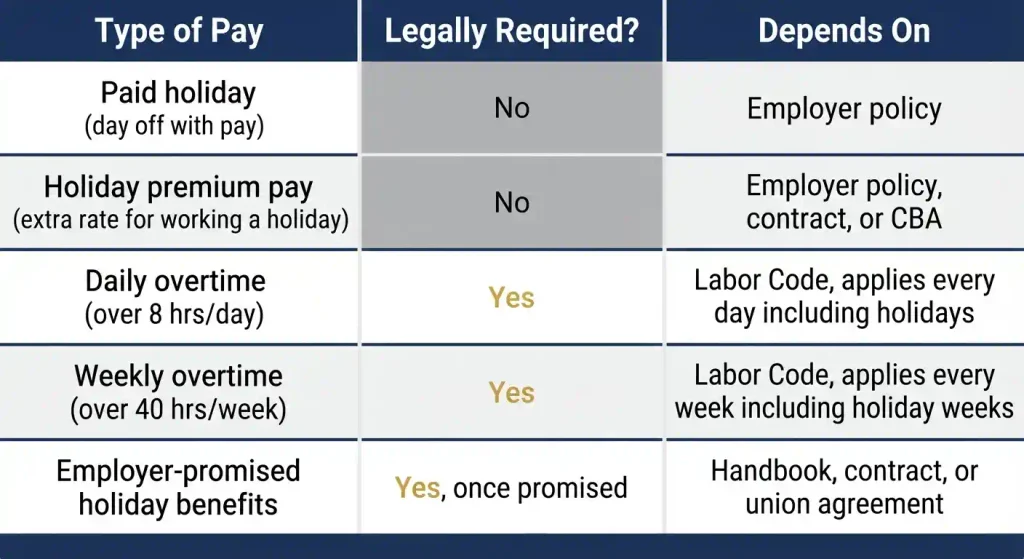
| Type of Pay | Legally Required? | Depends On |
|---|---|---|
| Paid holiday (day off with pay) | No | Employer policy |
| Holiday premium pay (extra rate for working a holiday) | No | Employer policy, contract, or CBA |
| Daily overtime (over 8 hrs/day) | Yes | Labor Code, applies every day including holidays |
| Weekly overtime (over 40 hrs/week) | Yes | Labor Code, applies every week including holiday weeks |
| Employer-promised holiday benefits | Yes, once promised | Handbook, contract, or union agreement |
Takeaway: no single date triggers extra pay. Hours worked and overtime rules do.
Which Holidays Do California Employers Have to Pay Employees For?
None, as a blanket rule. Federal, state, or no recognition at all makes no difference to your private-sector paycheck.
Federal and California State Holidays
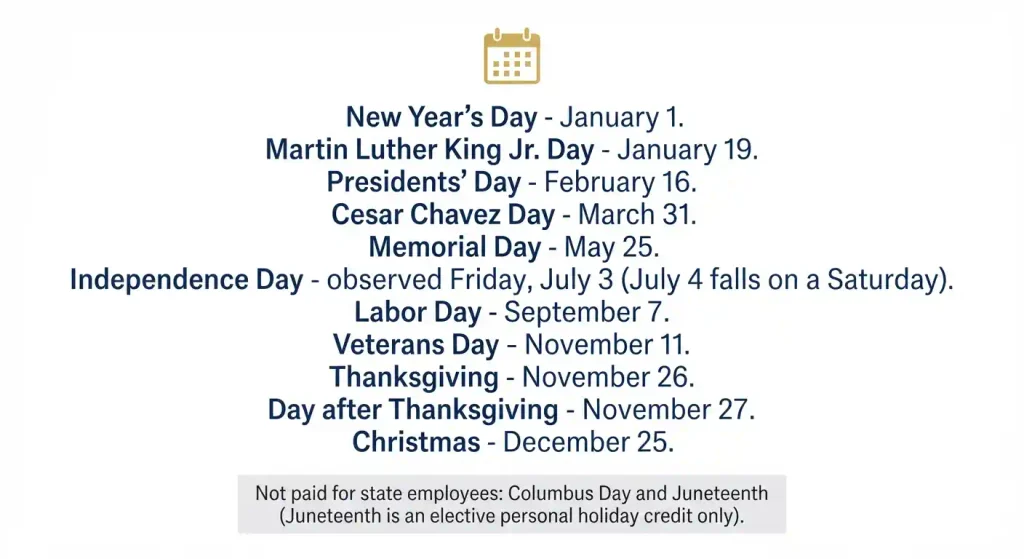
The federal government recognizes 11 holidays a year. California state employees get 11 paid holidays of their own in 2026: New Year’s Day (January 1), Martin Luther King Jr. Day (January 19), Presidents’ Day (February 16), Cesar Chavez Day (March 31), Memorial Day (May 25), Independence Day (observed Friday, July 3, since July 4 falls on a Saturday), Labor Day (September 7), Veterans Day (November 11), Thanksgiving (November 26), the day after Thanksgiving (November 27), and Christmas (December 25). Columbus Day isn’t paid for state employees, and neither is Juneteenth, which is only an elective personal holiday credit. Native American Day works the same way. Private employers never have to match any of this; many set their own employer-observed holidays.
Are Christmas, Thanksgiving, and New Year’s Day Paid Holidays?
Not by law. If your employer closes and still pays you, that’s a company benefit. If you work the day, you earn your regular rate unless policy promises more.
Can Employers Choose Which Holidays to Observe?
Yes. An employer can recognize all 11 state holidays, just 6, or none. Many offer floating holidays or personal holidays, and some add substitute holidays when a date lands on a weekend. Policy must be in writing to govern your entitlement. At termination, accrued vacation wages must be paid out as earned wages in your final paycheck, but a standard unused holiday usually doesn’t carry that same protection unless policy treats it like vacation pay.
Can Employers Close for Holidays Without Paying Employees?
Yes for most hourly employees. For exempt salaried employees, it’s trickier, and mistakes get costly.
Unpaid Holiday Business Closures
If you’re hourly and your employer closes for a holiday, no pay is owed unless policy says otherwise. No work, no pay, is the default. Some employers let staff use vacation or PTO to cover the day instead.
What Happens to Salaried Employees During Holiday Closures?
If you’re exempt and salaried and perform any work during a week with a holiday closure, you’re owed your full weekly salary. The only exception: a closure covering the entire workweek with zero work performed. This protects the salary basis that makes someone exempt.
Can Employers Require Employees to Work on Holidays?
Generally yes. No law lets you refuse a holiday shift just because it’s a holiday. Limits come from religious accommodation requests, which employers with five or more workers must reasonably consider, and from union contracts. If you’re called in and sent home early, reporting-time pay still applies: at least half your scheduled hours, with a minimum of two and a maximum of four hours, at your regular rate.
Do Employees Get Extra Pay for Working on a Holiday?
Only if employer policy says so, or normal overtime rules kick in from the hours worked. The holiday itself triggers nothing extra.
Is Holiday Work Paid at Time-and-a-Half?
Not automatically. You earn your regular rate for holiday hours unless overtime thresholds are crossed, like over 8 hours a day or 40 a week.
Does California Require Double-Time Pay on Holidays?
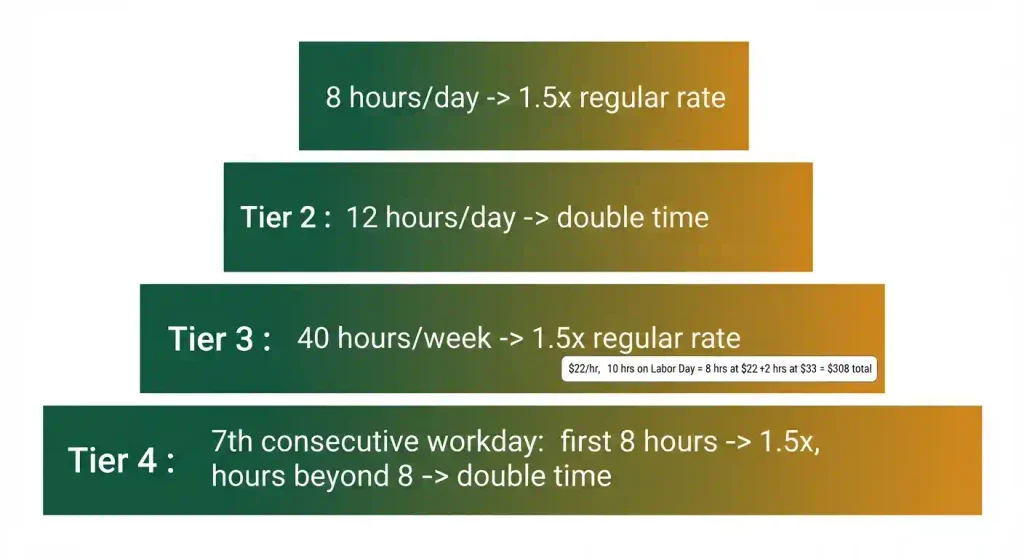
No. Double time applies only under normal overtime rules: after 12 hours in a day, or after 8 hours on the seventh consecutive workday. A 13-hour Thanksgiving shift earns double time for the hour past 12, because of the hours, not the date.
When Employers Must Pay Holiday Premiums
Premiums become mandatory once written into a contract, a collective bargaining agreement (CBA), or a consistently applied policy. Union contracts often set rates like 1.5x or 2x. Once written, it’s enforceable like any wage promise.
California Overtime Rules That Affect Holiday Pay
These rules apply every day of the year, not just holidays. California overtime laws trace back to California Labor Code Section 510, which sets the state’s daily and weekly overtime thresholds.
Daily Overtime After 8 Hours
Non-exempt employees earn 1.5x their regular rate past 8 hours a day. At $22 an hour, 10 hours on Labor Day pays 8 hours at $22 plus 2 hours at $33, for $308 total.
Weekly Overtime After 40 Hours
Past 40 actual hours worked in a week, everything extra pays at 1.5x. A holiday shift can push you over 40 even without a long day. Unauthorized overtime compensation still must be paid if the hours were actually worked; the employer can discipline, not withhold pay.
Double-Time on the Seventh Consecutive Workday
If a holiday falls on your seventh straight workday, the first 8 hours pay at 1.5x and anything beyond pays double time. This comes from the day’s position in the week, not the calendar.
How the Regular Rate of Pay Affects Holiday Overtime
A nondiscretionary bonus or commission gets folded into your regular rate of pay, raising your overtime rate. At $20 an hour plus a $200 bonus that week, the regular rate rises slightly, and so does overtime. Working two jobs for one employer, say $20 and $18 an hour, means overtime comes from a weighted average regular rate blending both.
Does Paid Holiday Leave Count Toward Overtime?
No. Paid hours aren’t the same as hours actually worked for overtime math.
Paid Holiday Hours Versus Hours Actually Worked
Overtime counts hours actually worked, not hours paid. Eight paid holiday hours for a day off sit outside the math entirely.
What Happens When You Work 40 Hours Plus a Paid Holiday?
Work 40 hours Monday through Friday, plus 8 paid holiday hours for a day not worked: your check shows 48 compensated hours, but only 40 were worked. No weekly overtime applies. Daily overtime can still apply separately if any single day topped 8 hours.
Does Holiday Pay Affect the Regular Rate?
Ordinary holiday pay generally isn’t folded into the regular rate the way bonuses are. A true holiday premium tied to actually working can qualify for a premium pay exclusion from the regular rate, but only if it pays at least 1.5x for a genuinely optional assignment.
California Holiday Pay Rules for Different Types of Employees
Rights differ by classification and scheduled hours.
Hourly and Nonexempt Employees
You earn your regular wage for holiday hours, plus any daily or weekly overtime triggered. If a holiday lands on a day you weren’t scheduled anyway, most policies owe nothing extra. Everything else, including holiday pay for weekend shifts, comes from written policy.
Salaried and Exempt Employees
Salaried isn’t the same as exempt, and salaried employees don’t automatically get holiday pay either; both depend on classification and policy. A salaried nonexempt employee still earns overtime past 8 hours a day or 40 a week. Employees who pass the salary-basis test and qualify as exempt keep full pay during a holiday closure if they did any work that week. Employers can require exempt staff to use paid time off (PTO) to cover a closure without violating that test.
Part-Time and Temporary Employees
No separate statutory holiday benefit exists for part-timers or temps. Employers set eligibility rules, like minimum scheduled hours, and can exclude entire classifications, as long as it isn’t discriminatory.
Seasonal, Shift, and Overnight Employees
California Labor Code Section 500 defines the workday and workweek; hours generally count toward the day a shift starts, which matters for daily overtime near a holiday. Working remotely changes nothing; pay follows hours worked, not location. Seasonal workers follow the same rules as anyone else.
When Are Employers Legally Required to Honor Promised Holiday Pay?
Once promised in writing or through consistent practice, holiday pay becomes a legal obligation beyond what the Labor Code requires.
Holiday Pay Promised in an Employee Handbook
A handbook listing paid holidays and eligibility rules, like being employed 90 days, creates a binding policy. A verbal promise can too, though it’s harder to prove. Meeting the conditions and not getting paid is a broken promise.
Holiday Pay Under Employment Contracts
A contract can guarantee paid holidays, premium rates, or substitute days off, and it can be more generous than the standard company policy.
Holiday Pay Under Union Agreements
Collective bargaining agreements (CBAs) often set specific holiday rates and recognized holidays beyond state law. These terms bind the employer, and disputes usually go through the grievance process, not a standard wage claim.
Can Employers Change or Remove Holiday Benefits?
Employers can change policy going forward with reasonable notice, but can’t claw back benefits already earned under the prior policy.
California Holiday Pay Examples and Paycheck Calculations
A few scenarios show how this plays out on a real paycheck. You can run your own numbers with our overtime calculator.
Example 1: Working 8 Hours on Christmas
At $20 an hour, an 8-hour Christmas shift pays $160, same as any other day. No premium applies by law.
Example 2: Working 10 Hours on Thanksgiving
At $20 an hour, 10 hours on Thanksgiving: 8 hours at $20 ($160) plus 2 hours at time-and-a-half, $30 an hour ($60). Total: $220. The extra $60 is daily overtime, not a holiday rule.
Example 3: Working 40 Hours Plus 8 Paid Holiday Hours
A full 40-hour week plus 8 paid holiday hours for a day not worked shows 48 compensated hours, but only 40 worked. No weekly overtime applies to the 8. Daily overtime could still apply separately if a worked day exceeded 8 hours.
Example 4: Working 13 Hours on a Holiday
At $25 an hour, 13 hours on New Year’s Day: 8 hours at $25 ($200), hours 9 through 12 at time-and-a-half, $37.50 ($150), and the 13th hour at double time, $50. Total: $400.
Example 5: Working on the Seventh Consecutive Day
Six straight days worked, then a Saturday holiday as the seventh: the first 8 hours pay at 1.5x the regular rate. At $24 an hour, those 8 hours alone total $288, before anything beyond 8.
Example 6: Employer Promises Holiday Pay but Does Not Pay It
A handbook promises 8 hours of Labor Day holiday pay to anyone employed more than 90 days. The employee qualifies, but the paycheck shows no holiday pay line. Comparing policy to the pay stub exposes the gap.
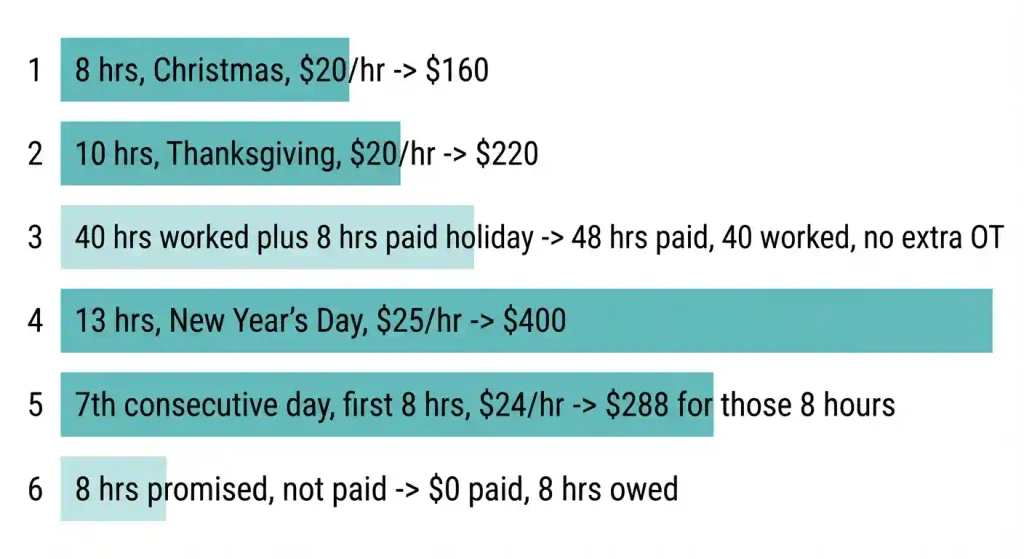
Quick Comparison: Total Pay by Example
| Example | Scenario | Total Pay |
|---|---|---|
| 1 | 8 hrs, Christmas, $20/hr | $160 |
| 2 | 10 hrs, Thanksgiving, $20/hr | $220 |
| 3 | 40 hrs worked plus 8 hrs paid holiday | 48 hrs paid, 40 worked, no extra OT |
| 4 | 13 hrs, New Year’s Day, $25/hr | $400 |
| 5 | 7th consecutive day, first 8 hrs, $24/hr | $288 for those 8 hours |
| 6 | 8 hrs promised, not paid | $0 paid, 8 hrs owed |
Special California Holiday Pay Situations and Exceptions
A few situations change the usual math.
Alternative Workweek Schedules
A valid alternative workweek schedule, like four 10-hour days instead of five 8-hour days, is set through an employee vote. Daily overtime then starts later, changing how holiday overtime gets calculated.
Agricultural and Other Special Overtime Rules
Agriculture used to differ, but not anymore. Since January 1, 2025, every California agricultural employer, including those with 25 or fewer workers, pays the same 8-hour daily and 40-hour weekly overtime as everyone else. The Industrial Welfare Commission (IWC) still sets the Industrial Welfare Commission Wage Orders covering agriculture, but the overtime math now matches the general rule. Healthcare has its own wrinkle: many hospitals use an 8/80 overtime system over a 14-day period, but that federal option doesn’t override California’s own daily 8-hour overtime trigger. A hospital employee working a 12-hour holiday shift still earns daily overtime after 8 hours.
Religious Holidays and Workplace Accommodation
Employers with five or more employees must reasonably accommodate religious holiday requests, unless it creates undue hardship for the business. Accommodation doesn’t guarantee pay unless policy says so.
Government and Public-Sector Employees
Government employees run on a different system, often with paid holidays built into civil service codes or bargaining agreements. California Government Code Section 19853 lets state employees elect a personal holiday credit for days like Juneteenth, which isn’t on the standard paid state holiday list.
Federal Contractors and Special Employment Agreements
Certain federal service contracts carry holiday or premium pay through federal wage determinations from the U.S. Department of Labor (DOL), via its Wage and Hour Division (WHD), the same office that enforces the Fair Labor Standards Act (FLSA) and sets federal overtime requirements. These situations are narrow and tied to the specific contract.
California Holiday Pay Myths and Misconceptions
A few common beliefs about holiday pay aren’t true.
Working on Christmas Automatically Means Double-Time
It doesn’t. Double time applies only past 12 hours in a day. A normal 8-hour Christmas shift earns the regular rate, nothing more, by law.
Federal Holidays Must Be Paid by Private Employers
They don’t. Federal recognition governs federal offices and federal employees only.
Paid Holiday Hours Count Toward 40 Hours of Overtime
They don’t. Overtime counts hours actually worked. 48 total paid hours, 40 worked and 8 holiday, owes no overtime on those 8.
Every Salaried Employee Is Exempt From Overtime
Not true. Exempt status needs a duties test and salary threshold, not just a salary. Many salaried employees are entitled to overtime, holidays included.
Employers Can Ignore Their Written Holiday Pay Policies
They can’t. A written policy met by the employee becomes an obligation; ignoring it is a broken promise that can turn into a wage claim.
What to Do If Your Employer Does Not Pay Promised Holiday Compensation
A few steps get you answers. A miscalculated overtime rate is a wage law issue; a skipped promised holiday bonus is a policy dispute, and they follow different paths.
Check Your Employer’s Holiday Pay Policy
Pull up the handbook, contract, or union agreement. Compare eligibility rules, like length of employment and attendance, to what actually happened on your paycheck.
Review Your Pay Stub and Work Records
Compare scheduled hours, hours actually worked, and holiday hours paid against your pay and overtime rate. California’s wage statement requirements mean your pay stub must itemize hours and rates clearly. Keep copies of schedules, time records, and pay stubs.
Raise the Issue With Payroll or Human Resources
Point to the specific missing payment and the rule behind it. Ask for a written explanation. Save the response and any correction.
Where to Report Unpaid Wages in California
File a wage claim with the California Labor Commissioner’s Office, part of the California Department of Industrial Relations (DIR), which investigates unpaid wages including unpaid overtime. A withheld contractual benefit can also become a Labor Commissioner wage claim; complex cases may need an attorney. California law protects employees from retaliation for raising a wage complaint.
Frequently Asked Questions About California Holiday Pay
Quick, direct answers to the most common questions about holiday pay, overtime, and wage claims in California.
Is holiday pay mandatory in California?
No. It comes from employer policy or contract, not state law.
Do California employers have to pay time-and-a-half on holidays?
No, not automatically. It applies only when overtime rules trigger, or policy promises it.
Is Christmas a paid holiday in California?
Not by law. Employers can choose to pay it as a benefit.
Can my employer make me work on Thanksgiving?
Generally yes, aside from religious accommodation or union contract limits.
Does holiday pay count toward 40 hours for overtime?
No. Eight paid holiday hours not worked won’t push you into weekly overtime.
Do part-time employees get holiday pay in California?
Only if employer policy includes them. No separate statutory rule exists.
Can my employer close for a holiday without paying me?
Yes for most hourly employees, unless policy says otherwise. Exempt salaried employees still get full salary for any week they performed work.
Can I file a wage claim for unpaid holiday pay?
Yes, if a promised policy or contract benefit wasn’t paid, or if statutory overtime went unpaid, through the California Labor Commissioner’s Office.
Key Takeaways: Understanding Your California Holiday Pay Rights
The main point of this entire guide, in one place.
What California Employees Should Remember
California guarantees no paid holidays or holiday premium pay in the private sector. What actually pays extra is ordinary overtime law: past 8 hours daily, past 40 weekly, and double time on a seventh consecutive workday, plus whatever your employer has promised in writing. For more on related rules, browse our California labor laws and paid leaves and benefits guides. Check your handbook or contract, and if your paycheck doesn’t match, pull your records and raise it.

Yeasin Sorker is the founder of Paycheck Calculator California. He built this tool in 2018 after noticing that most free paycheck calculators missed California-specific rules like daily overtime and the uncapped SDI rate.
He researches California payroll tax updates regularly and keeps this calculator aligned with the latest IRS, FTB, and EDD published rates. All calculations on this site are estimates based on official 2026 government sources. For personalized tax advice, consult a qualified tax professional.