
California COBRA continuation coverage lets eligible workers keep their exact employer health plan after job loss, divorce, or reduced hours, for 18 to 36 months, as long as they pay the full group premium themselves.
That 18-to-36-month range comes directly from federal COBRA law and California’s Cal-COBRA statute, cross-checked against 2026 premium and enrollment data below.
The tradeoff: COBRA keeps your same plan, but you’ll pay far more without your employer’s subsidy.
Can You Keep Your Health Insurance After Losing Your Job in California?
Quick Answer: Federal COBRA vs. Cal-COBRA
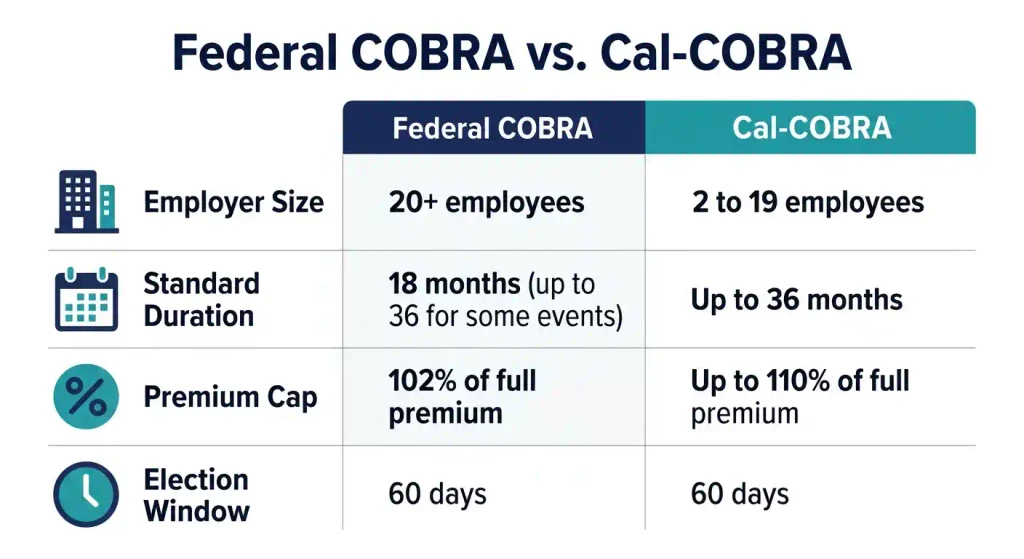
Federal COBRA applies at employers with 20 or more workers; Cal-COBRA applies at employers with 2 to 19 workers and insured plans. Cal-COBRA can also pick up where an 18-month federal COBRA period ends, stretching total coverage to 36 months. Premium caps differ too: 102% under federal law, up to 110% under Cal-COBRA.
Federal COBRA vs. Cal-COBRA Comparison Table
| Factor | Federal COBRA | Cal-COBRA |
|---|---|---|
| Employer size | 20+ employees | 2 to 19 employees |
| Plan type covered | Insured and self-funded | Insured only |
| Standard duration | 18 months (up to 36 for some events) | Up to 36 months |
| Premium cap | 102% of full premium | Up to 110% of full premium |
| Administered by | Employer or COBRA TPA | Insurance carrier directly |
| Election window | 60 days | 60 days |
| First payment due | 45 days after election | 45 days after election |
What Is the Difference Between Federal COBRA and Cal-COBRA?
Federal COBRA, formally the Consolidated Omnibus Budget Reconciliation Act of 1985, draws from the Employee Retirement Income Security Act (ERISA), the Public Health Service Act, and the Internal Revenue Code. ERISA covers most private employers, the Public Health Service Act covers state and local government plans, enforced by the Department of Health and Human Services (HHS) rather than the U.S. Department of Labor (DOL). Cal-COBRA is California’s add-on for people federal law leaves out, mainly small-business employees, sitting alongside other California labor law protections, and it can extend federal COBRA once that runs out. Both keep your group plan active after job-based coverage ends, but under different rules and administrators.
How Federal COBRA Works in California
Federal COBRA applies to private-sector and state or local government employers with 20 or more employees in the prior calendar year. It covers both insured and self-funded plans, unlike Cal-COBRA. Your former employer or its COBRA administrator, often a third-party firm, handles enrollment, billing, and notices, not the insurer.
How California’s Cal-COBRA Law Works
Cal-COBRA covers employees of small California businesses with 2 to 19 workers on an insured HMO, PPO, or indemnity plan. Your insurance carrier runs the process directly, with no outside administrator. It can also extend an exhausted federal COBRA period on a fully-insured California plan from 18 months up to 36.
Why Employer Size and Insurance Type Matter
Employer size is counted using full-time equivalent employees from the prior calendar year, so part-time and full-time workers both count. Insured plans qualify for Cal-COBRA; self-funded plans generally don’t. A brand-new business may also lack a full prior-year headcount to measure against, which can affect when federal COBRA requirements even kick in.
Who Qualifies for COBRA or Cal-COBRA in California?
You qualify if you were enrolled in your employer’s group plan and lost it due to a specific event, like job loss or reduced hours. Eligibility needs both: your employer meeting the size requirement, and you meeting the definition of a qualified beneficiary.
Federal COBRA Employer Eligibility Requirements
An employer must have had 20 or more employees on over half its working days in the prior calendar year to be subject to federal COBRA. Federal government employers and most church plans are excluded, though federal employees have their own similar continuation option under a separate federal program.
Cal-COBRA Eligibility for Small Employers
Cal-COBRA covers employers with 2 to 19 eligible employees, measured by a similar working-day test, on a qualifying HMO, PPO, or indemnity policy from a licensed carrier. Self-funded plans generally don’t qualify, no matter how small the company.
Who Can Receive Continuation Coverage?
Former employees, spouses, former spouses, and dependent children can all qualify as a COBRA qualified beneficiary under COBRA or Cal-COBRA, as long as they were enrolled in the plan the day before the qualifying event. Qualifying and enrolling are different things too, meeting the eligibility rules doesn’t put you on coverage automatically, you still have to elect it within your deadline.
When You May Not Qualify
Gross misconduct terminations disqualify you from both COBRA and Cal-COBRA, though California courts read that term narrowly. Medicare entitlement, or other group coverage without a pre-existing condition limit, can also end eligibility. Your employer can meet the size requirement while you personally still don’t qualify as a beneficiary.
Which Life Events Qualify You for Continuation Coverage?
A handful of events, each called a COBRA qualifying event, trigger your right to continuation coverage, and the event decides how long you’re covered. Job loss gives 18 months. Divorce or death gives dependents up to 36.
- Job loss or layoff, voluntary or involuntary: 18 months
- Reduced work hours dropping you below coverage eligibility: 18 months
- Divorce or legal separation: 36 months
- Death of the covered employee: 36 months
- Child aging out of dependent status: 36 months
- Employee’s Medicare entitlement (for spouse and dependents): 36 months
Losing Your Job or Having Your Hours Reduced
Voluntary resignation and involuntary termination, layoffs included, trigger 18 months of coverage, unless the termination was for gross misconduct, and your former employer still owes you a compliant final paycheck under California law. A reduction in hours that drops you below your employer’s coverage threshold counts too. COBRA also differs from job-protected leave programs like California’s Paid Family Leave and FMLA: those protect your job and keep active coverage running during approved leave, COBRA only starts once that coverage ends. You don’t need the full 18 months either, COBRA works as a short bridge while waiting on a new employer’s plan to begin.
Divorce, Death, and Loss of Dependent Status
When a covered employee dies, divorces, or legally separates, their spouse and dependent children can continue coverage separately for 36 months instead of 18. A child aging out of the plan’s rules, often 26, is its own qualifying event with the same 36-month right.
Medicare Eligibility and Other Special Situations
If a covered employee becomes entitled to Medicare, run by the Centers for Medicare & Medicaid Services (CMS), their spouse and dependents can continue on COBRA for up to 36 months, even as the employee moves to Medicare. Retirement alone isn’t a qualifying event unless it also causes a loss of group coverage, though it often coincides with claiming Social Security retirement benefits. Events tied to the employee usually mean 18 months; events tied to losing dependent status usually mean 36.
How Long Does COBRA Coverage Last in California?
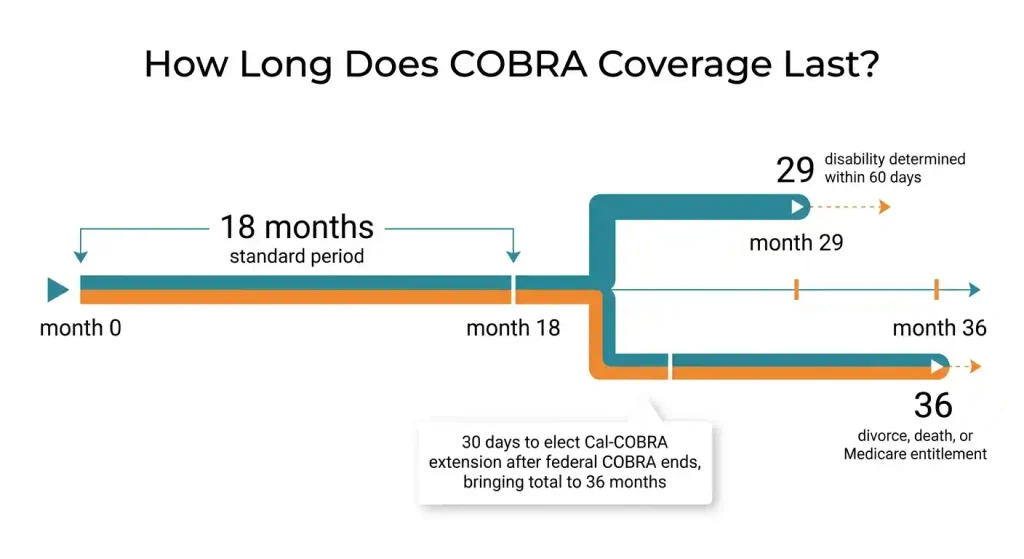
Standard federal COBRA runs 18 months. Disability or family situations stretch that to 29 or 36. Cal-COBRA, alone or as an extension, can carry total coverage to 36 months in California.
Federal COBRA: 18, 29, or 36 Months
The standard period is 18 months. This federal disability test is separate from California’s State Disability Insurance (SDI) program, which pays short-term benefits through the state rather than extending COBRA. If the Social Security Administration (SSA) determines a beneficiary disabled within the first 60 days of COBRA, that stretches to 29, as long as you notify the plan within 60 days of the SSA’s determination and before the original 18 months end. Events involving a spouse or dependent, like divorce, death, or Medicare entitlement, carry a 36-month period instead. A second qualifying event mid-coverage, say a job loss followed by divorce, can extend the affected beneficiary to a full 36 months from the original event.
Cal-COBRA: Up to 36 Months for Eligible Small-Group Members
Employees at small California businesses (2 to 19 workers) with an insured plan get up to 36 months of Cal-COBRA directly, no federal COBRA required first. The clock starts the same date federal COBRA would have, under the same qualifying-event rules.
Extending Federal COBRA Through Cal-COBRA
If your federal COBRA was through a fully-insured California plan and ran less than 36 months, your carrier must offer a Cal-COBRA extension once it ends, bringing your total to 36 months. This doesn’t apply to self-funded plans or if federal COBRA already ran 36 months. Your insurer must notify you before coverage ends, and you then have only 30 days after federal COBRA ends to elect it, a shorter window than the usual 60-day Cal-COBRA election period. If the notice never came, call the carrier directly.
When Your Continuation Coverage Can End Early
Missing a payment past the grace period ends coverage immediately, with no reinstatement. Getting other group coverage, becoming Medicare-entitled, or your former employer dropping its plan can all end coverage early too. If an employer closes entirely and stops the plan, there’s nothing left to continue into COBRA, different from a plan ending mid-coverage.
How Much Does COBRA or Cal-COBRA Cost in California?
You pay the full group premium plus a small fee. In 2026, that’s roughly $779 a month for single coverage and about $2,300 for family coverage in California.
Why COBRA Costs More After Leaving Your Job
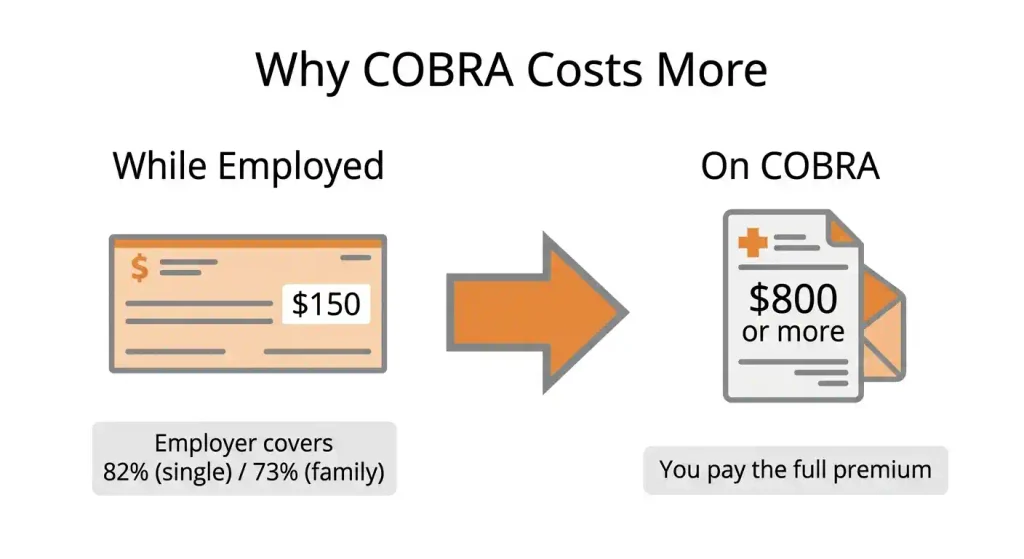
Your employer was covering most of your premium, about 82% for single and 73% for family coverage nationally in 2026. COBRA removes that subsidy, so a $150 paycheck deduction can become $800 or more, a jump similar to the swings explained in why your paycheck changes from month to month. Some severance packages include employer-paid COBRA for a set period, so ask HR.
Federal COBRA Premiums and Administrative Fees
Federal law allows up to 102% of the full premium, the extra 2% covering admin costs. During a disability extension, months 19 through 29, that cap rises to 150% for everyone on the plan.
How Cal-COBRA Premiums Are Calculated
Cal-COBRA allows up to 110% of the group rate, a few points above federal COBRA’s 102%. Some carriers use age-rated premiums instead of a flat group rate. The exact number comes from your former employer’s plan, printed on your election notice.
Individual vs. Family COBRA Premium Examples
Using 2026 California averages, single coverage runs about $779 a month, or roughly $9,350 a year. Family coverage averages $2,300 a month, about $27,600 a year. These premiums can count as deductible medical expenses if you itemize your deductions and your costs pass 7.5% of your adjusted gross income, and self-employed workers in California may deduct eligible premiums directly. Check current Internal Revenue Service (IRS) rules or ask a tax preparer.
Can Your COBRA Premium Increase?
Yes. If your former employer renews at a higher rate or switches carriers at renewal, your COBRA premium changes too, since you’re still on that group plan. You’ll get written notice of any rate change, worth checking against your bill.
What Are the COBRA Enrollment and Payment Deadlines?
You have 60 days to elect coverage and 45 more to make your first payment. Miss either and you lose the right entirely, even with a late employer notice.
The 60-Day Election Period
You have 60 days from losing coverage or receiving your COBRA notice, whichever is later, to elect it, called the COBRA election period. The COBRA general notice comes when you first enroll and explains your rights generally; the COBRA election notice starts your clock after a qualifying event. Your group health plan administrator generally has 14 days to send it, or 44 if the employer runs the plan directly. Cal-COBRA uses the same 60-day structure. A late or incorrect notice restarts your window from the corrected notice date. If an employer never sends one, file a complaint with the Department of Labor’s Employee Benefits Security Administration (EBSA).
When Must You Make Your First Premium Payment?
You have 45 days to send your first payment, covering every month back to your qualifying event date, paid to your COBRA plan administrator. Cal-COBRA follows the same 45-day rule. Your first check can be much larger than your regular premium, so budget for it.
Monthly Premium Due Dates and Grace Periods
After that, you’re on a monthly cycle with a 30-day grace period, billed monthly only, no quarterly option, though you can pay ahead. Pay even one day late past the grace period and coverage terminates, claims processed as if unpaid. A slightly short payment generally gets a required 30-day cure notice instead of outright cancellation. Partial payments are sometimes accepted, but don’t rely on that.
Can You Enroll After Initially Rejecting COBRA?
You can elect by returning the form with your notice, by mail, or through an online portal if offered. Inside your original 60-day window, you can revoke an earlier waiver and elect coverage retroactively. Once that window closes, there’s no second chance.
What Health Benefits Do You Keep Under COBRA?
You keep the exact same plan: same doctors, same prescriptions, same deductible progress, much like other paid leave and benefits programs that preserve your coverage during a transition. COBRA just changes who pays.
Doctors, Hospitals, and Prescription Coverage
Your network, pharmacy benefits, and hospital coverage stay identical to active employees, and existing preauthorizations carry over too. Preexisting condition exclusions aren’t a concern either, the Affordable Care Act (ACA) banned those years ago. Plan changes at renewal, or a carrier switch, apply to you too, since you’re still part of the same group. Moving outside your plan’s service area, especially with an HMO, may require switching to another option your former employer offers there.
Deductibles, Copayments, and Out-of-Pocket Maximums
Deductible and out-of-pocket spending already met this year carries over, you don’t restart at zero. Copayments and out-of-pocket maximums stay the same until the plan’s next renewal.
Can Your Spouse and Children Continue Coverage Separately?
Yes. Each qualified beneficiary has an independent right to elect, so a spouse can choose COBRA even if the employee doesn’t. A child born or adopted during continuation coverage can be added within 30 days.
Real-Life California COBRA Coverage Scenarios
Here’s how federal COBRA and Cal-COBRA play out in four common cases.
You Were Laid Off by a Large Employer
With 20 or more employees, federal COBRA applies for 18 months. At California’s 2026 average, that’s about $779 a month, close to $14,000 over 18 months. Compare that against Covered California, which runs around $450 a month before subsidies or far less with a premium tax credit.
You Left a Small Business With Fewer Than 20 Employees
With an insured plan and 2 to 19 workers, Cal-COBRA applies instead, up to 36 months from day one. Your premium and enrollment run through the insurance carrier directly, so that’s who to call with questions.
Your Federal COBRA Coverage Is About to Expire
If your federal COBRA ran less than 36 months on a fully-insured California plan, you likely qualify for a Cal-COBRA extension. Your carrier should notify you before coverage ends. Compare that extension’s cost against a Covered California plan before deciding.
Your Spouse Lost Coverage After Divorce
A former spouse keeps an independent right to up to 36 months of continuation coverage after divorce. The premium follows the same group rate plus administrative fee as any COBRA beneficiary, worth comparing against individual marketplace coverage.
COBRA vs. Covered California, Medi-Cal, and Other Insurance Options
COBRA keeps your exact plan but is rarely the cheapest option. Check Covered California, Medi-Cal, and a spouse’s employer plan first.
COBRA vs. Covered California
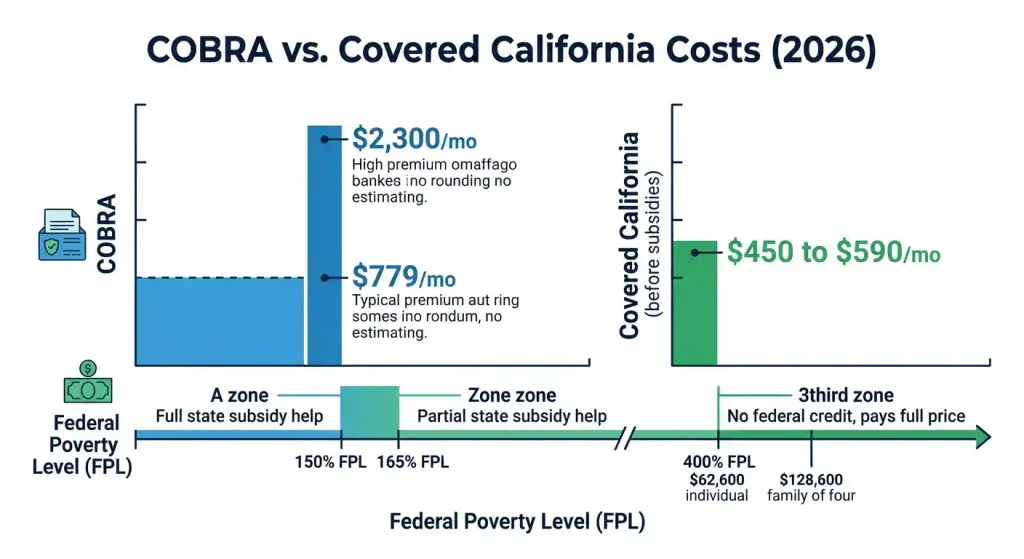
Covered California is simply California’s version of the Affordable Care Act Marketplace, run by the state instead of through HealthCare.gov. Before subsidies, individual plans run about $450 to $590 a month depending on age and plan tier, with family plans scaling up, similar to or above COBRA’s $779 and $2,300 averages. The enhanced federal premium tax credits expired at the end of 2025, so 2026 brought back the rule that anyone earning above 400% of the federal poverty level, about $62,600 for an individual or $128,600 for a family of four, gets no federal credit and pays full price. Below that line, premium tax credits still help, and California layers its own state subsidy on top, keeping premiums close to 2025 levels fully up to 150% of the poverty level, with partial help extending to 165%. So marketplace coverage isn’t automatically cheaper, it depends on income and whether the network matches your doctors, since marketplace plans often use narrower networks. Off-exchange private plans are another option, without Covered California’s subsidies. Losing job coverage triggers a 60-day Special Enrollment Period (SEP) with Covered California.
COBRA vs. Medi-Cal
If your household income dropped significantly, you may qualify for Medi-Cal, California’s name for Medicaid, with little to no premium, so check your Medicaid eligibility directly. Medi-Cal and the Children’s Health Insurance Program (CHIP) enroll year-round, not limited to a 60-day window, worth checking anytime your income changes, especially with kids on the plan.
COBRA vs. a Spouse’s Employer-Sponsored Insurance
Losing job coverage also opens a special enrollment window on a spouse’s plan, typically 30 days. Employer premiums are almost always cheaper than COBRA, but compare actual benefits, not just price.
What Happens If You Voluntarily Cancel COBRA?
Voluntarily dropping COBRA early doesn’t automatically open a new Special Enrollment Period, unlike COBRA simply running out, which does. Line up replacement coverage first if canceling early.
Common COBRA and Cal-COBRA Myths You Should Not Assume Are True
A few wrong assumptions about COBRA cause real financial mistakes.
Every California Employer Must Offer COBRA
Not true. Federal COBRA applies only to employers with 20 or more employees; Cal-COBRA only to insured plans at employers with 2 to 19. A self-funded plan at a small employer can fall into a gap where neither applies.
COBRA Is Automatically Free After Losing Your Job
Not true. You owe the full premium plus the fee, unless severance specifically covers it.
Everyone Automatically Gets 36 Months of Coverage
Not true. Standard federal COBRA is 18 months for job loss. 36 months only applies to specific events like divorce, death, Medicare entitlement, or Cal-COBRA situations.
Dropping COBRA Always Creates a New Marketplace Enrollment Period
Not true. Exhausting COBRA triggers a Special Enrollment Period; voluntarily canceling early generally doesn’t.
What to Do Next: Your California COBRA Coverage Checklist
Three things matter: knowing which law applies, knowing the real cost, and never missing a deadline.
Confirm Which Continuation Law Applies
Find your former employer’s exact headcount and whether the plan was insured or self-funded. That answer tells you whether federal COBRA, Cal-COBRA, or both apply.
Calculate Your Total Coverage Cost
Get the full monthly premium from your election notice and compare it against a Covered California quote for your household size. Run the numbers through our gross pay calculator to see how that premium fits your budget, and check whether severance covers any of it as part of your broader tax savings planning.
Protect Your Enrollment and Coverage Dates
Protect your coverage with four quick actions:
- Mark your 60-day election and 45-day payment deadlines the moment you get your notice
- Get written confirmation of your coverage effective date
- Request your plan’s Summary Plan Description (SPD) if you don’t have one
- Start shopping for replacement insurance 30 to 45 days before coverage expires
For more, the U.S. Department of Labor COBRA guidance covers additional scenarios.
Frequently Asked Questions About California COBRA Coverage
Is Cal-COBRA the Same as Federal COBRA?
No. Cal-COBRA covers small employers (2 to 19 employees) with insured plans; federal COBRA covers employers with 20 or more, insured or self-funded.
Can I Get Cal-COBRA If My Employer Has Fewer Than 20 Employees?
Yes, if your employer has 2 to 19 employees and the plan is insured, not self-funded.
How Much Does Cal-COBRA Cost Per Month?
Up to 110% of the full group premium, typically around $600 to $1,000 a month for individual coverage in 2026, depending on the plan.
Can I Get 36 Months of COBRA Coverage in California?
Yes, through direct Cal-COBRA eligibility, a federal COBRA event that already carries 36 months (like divorce or Medicare entitlement), or a Cal-COBRA extension after an 18-month federal COBRA period.
Can I Keep COBRA After Getting a New Job?
Generally no. Once you’re eligible for another employer’s group plan, often during new-hire onboarding paperwork, without a pre-existing condition limit, your COBRA eligibility ends, even if not yet enrolled.
Can I Switch From COBRA to Covered California?
Yes, anytime. Exhausting COBRA triggers a 60-day Special Enrollment Period; canceling early usually doesn’t.
What Happens If I Miss the COBRA Enrollment Deadline?
You lose the right to continuation coverage entirely. Your options shift to Covered California, Medi-Cal, or a spouse’s employer plan.
Does COBRA Cover Dental and Vision Insurance?
Only if you were enrolled in a separate dental or vision plan before the qualifying event. Each is treated independently.

Yeasin Sorker is the founder of Paycheck Calculator California. He built this tool in 2018 after noticing that most free paycheck calculators missed California-specific rules like daily overtime and the uncapped SDI rate.
He researches California payroll tax updates regularly and keeps this calculator aligned with the latest IRS, FTB, and EDD published rates. All calculations on this site are estimates based on official 2026 government sources. For personalized tax advice, consult a qualified tax professional.