
California Disability Insurance pays $50 to $1,765 a week for up to 52 weeks when a non-work medical condition keeps a worker off the job, if they earned at least $300 in wages with SDI withheld.
That range comes from EDD’s 2026 benefit pages, checked October 2026. Your amount follows your highest-earning quarter in the 12-month base period.
Benefits replace only 70% to 90% of pay, and filing after 49 days can cost you payments.
California Disability Insurance at a Glance
That “CASDI” deduction on your paystub pays you back when illness or injury stops you from working. File no earlier than nine days and no later than 49 days after your disability begins. Benefits are payable from day eight.
What California Disability Insurance Covers
California Disability Insurance is the short-term wage replacement part of State Disability Insurance (SDI), run by the Employment Development Department (EDD), which is part of the California Labor and Workforce Development Agency. The rules come from the California Unemployment Insurance Code (CUIC).
Within SDI, Disability Insurance (DI) pays for your own non-work-related illness, injury, surgery, pregnancy, or childbirth, and a separate benefit covers family care.
The 2026 SDI rate is 1.3% of every dollar you earn, with no wage cap, so someone earning $5,000 a month in gross pay pays $65 a month.
Senate Bill 951 (SB 951) removed the wage cap in 2024 and raised benefit percentages in 2025.
CASDI is the common paystub shorthand for California State Disability Insurance. You will find CASDI on paystub deduction lines, sometimes shown as CA SDI or SDI.
Paying in does not guarantee approval, since your qualifying wages and the program’s other rules decide that.
How Much Can You Receive in 2026?
Weekly benefits run from $50 to $1,765 for up to 52 weeks. Eligible workers get roughly 70% to 90% of their wages, with lower earners getting the higher percentage. Your exact amount depends on your base period earnings and the claim EDD approves. Total payments are capped at 52 times your weekly benefit or your base period wages, whichever is less.
Quick Eligibility Checklist
You need all four:
- A disability that stops your regular work for at least eight days
- Lost wages, and you were working or looking for work when it began
- At least $300 in base-period wages with SDI withheld
- Certification from a licensed health professional
If all four fit, file.
Who Qualifies for California Disability Insurance?
Most California employees qualify if they paid into SDI, cannot do regular work for at least eight days, and have a licensed provider’s certification. Citizenship and immigration status do not affect eligibility, including for undocumented workers, as long as SDI was withheld from their pay.
Basic Eligibility Requirements
You must be unable to do your regular work for at least eight days. The first seven days are an unpaid waiting period, so payable benefits start on day eight. You also need $300 in base-period wages with SDI withheld, care from a licensed provider within the first eight days, and work or a job search when the disability began. You do not have to live in California. Your wages must have been subject to California SDI withholding.
Medical Conditions That Qualify
EDD asks one question: does the condition keep you from your regular work?
These qualify:
- Physical illnesses, injuries, mental health conditions, and elective surgery
- Pregnancy, childbirth, and postpartum recovery
- Chronic conditions, which can count when your provider certifies that a flare-up keeps you from working
- Approved residential rehab, up to 30 days for alcohol and 45 days for drugs, plus extra days if your provider certifies longer treatment is needed
Your provider’s certification and your job duties decide the outcome. A broken wrist may sideline a roofer for weeks and a phone-support worker for much less.
Do Part-Time, Recently Hired, or Unemployed Workers Qualify?
Part-time workers qualify with $300 in base-period wages, though benefits are smaller.
- Temporary workers follow the same rule.
- Seasonal workers can qualify if their disability starts in the off-season and they have not left the labor market.
- School employees on break generally qualify only if they normally work another job or teach summer school during the break.
- Recent hires may not qualify yet: the base period looks back 5 to 18 months, so a job you started two months ago may not count.
- If you were between jobs but looking for work when your disability began, you can still qualify with wages in the base period.
What About Self-Employed Workers, Contractors, and Gig Workers?
Employees are covered through payroll taxes. Self-employed people, business owners, and independent contractors are covered only if they enroll and pay into Disability Insurance Elective Coverage (DIEC).
- Voluntary Plan: If your employer has an approved Voluntary Plan (VP), your claim goes through that plan instead, and EDD sets the 2026 Voluntary Plan employee contribution rate at 1.3%.
- Gig workers: If a gig employer may have misclassified you as a contractor, apply anyway and EDD will decide.
- Public and school employees: They are covered only if their employer or union opted in, so check your paystub or ask HR. State of California employees should check EDD’s State Employees FAQ.
How Much Does California Disability Insurance Pay in 2026?
It pays $50 to $1,765 per week in 2026, based on your highest-earning quarter in the base period, not your current paycheck. For a rough estimate, divide that quarter’s wages by 13 weeks, then apply 70% to 90%.
2026 Weekly Benefit Amounts
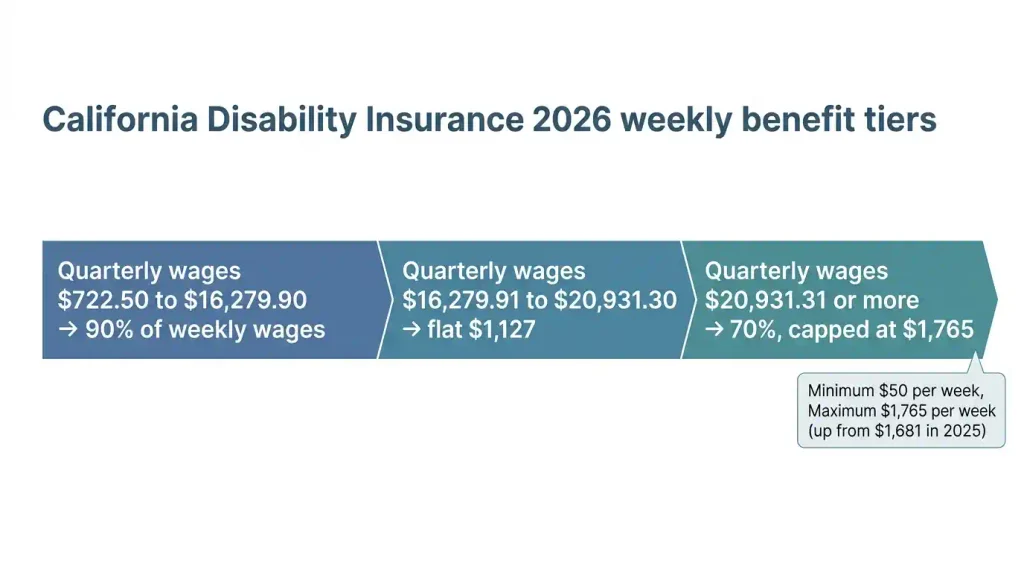
The minimum is $50 and the maximum is $1,765, up from $1,681 in 2025.
Lower earners get closer to 90% of pay and higher earners closer to 70%. In EDD’s chart, highest-quarter wages of $722.50 to $16,279.90 get 90% of weekly wages, $16,279.91 to $20,931.30 pay a flat $1,127, and $20,931.31 or more get 70% up to the maximum. You reach the maximum only at roughly $2,500 a week or more, so most people get less.
EDD’s May 2026 forecast projects a 1.4% SDI rate and a $1,791 maximum for 2027, so check EDD’s final announcement if your claim starts in 2027.
How the EDD Calculates Your Weekly Benefit
EDD uses a 12-month base period split into four three-month quarters, starting 5 to 18 months before your claim begins. The quarter with your highest SDI-covered wages sets your weekly benefit, which EDD calls the Weekly Benefit Amount (WBA). Your current wages, recent raises, and pay cuts do not change it. Once your claim starts, your base period and WBA stay the same.
How Your Claim Start Date Changes Your Benefit
Your disability start date decides which 12 months EDD uses. For 2026 claims:
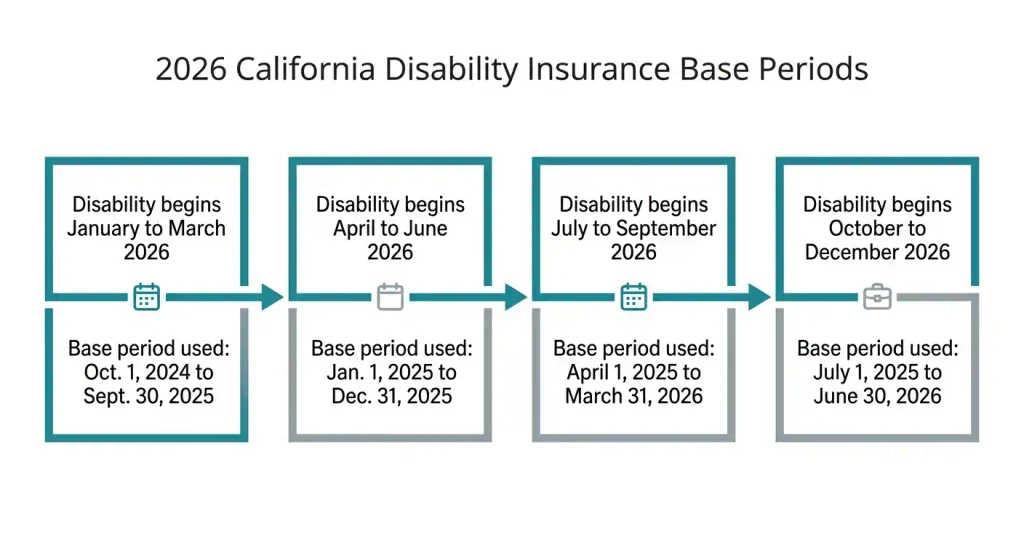
| Disability begins in | Base period used |
|---|---|
| January to March 2026 | Oct. 1, 2024 to Sept. 30, 2025 |
| April to June 2026 | Jan. 1, 2025 to Dec. 31, 2025 |
| July to September 2026 | April 1, 2025 to March 31, 2026 |
| October to December 2026 | July 1, 2025 to June 30, 2026 |
You cannot change your claim start date or base period once your claim is established. If your start date falls near the end of a quarter, or you want your claim to begin later than your disability, call EDD at 1-800-480-3287 before you file.
Real-World Disability Benefit Examples
These are estimates, not EDD results, and assume the weekly wage was steady through your best quarter. Use our annual salary calculator to turn your pay into a weekly wage.
| Weekly wage (yearly) | Likely percentage | Estimated weekly benefit |
|---|---|---|
| $600 ($31,200) | About 90% | About $540 |
| $1,500 ($78,000) | About 75% | $1,127 |
| $3,000 ($156,000) | Capped | $1,765 |
The $1,500 earner, close to an $80k California salary, lands in EDD’s middle band, which pays a flat $1,127, about 75% of pay. The $3,000 earner would get $2,100 at 70%, but the cap holds the payment at $1,765, about 59% of pay. The $600 earner, a full-time $15 an hour worker, gets back most of a normal week. Since benefits replace only part of your pay, budget from your benefit and cover fixed bills like rent first. For your own number, use the official EDD calculator or our CA SDI calculator.
What Can Reduce Your Disability Payments?
Your payment can drop in these cases:
- Part-time wages or reduced hours reduce your payment when your wages plus your benefit exceed your regular weekly wages, and so may certain workers’ compensation payments.
- EDD can recover overpayments from an earlier unemployment, PFL, or DI claim out of your benefits and deduct late court-ordered child or spousal support.
Other pay can overlap with DI:
- After the first seven days, you can receive vacation pay and DI at the same time.
- Full sick pay blocks DI, but partial sick pay may leave you eligible for full or partial benefits.
- Report any other pay, including holiday pay or salary continuation, to EDD.
EDD’s official determination always overrides an online estimate.
How to Apply for California Disability Insurance Step by Step
You gather your information, file the claim, get your provider’s certification, respond to EDD notices, and manage payments. The step people miss most often is the doctor’s part.
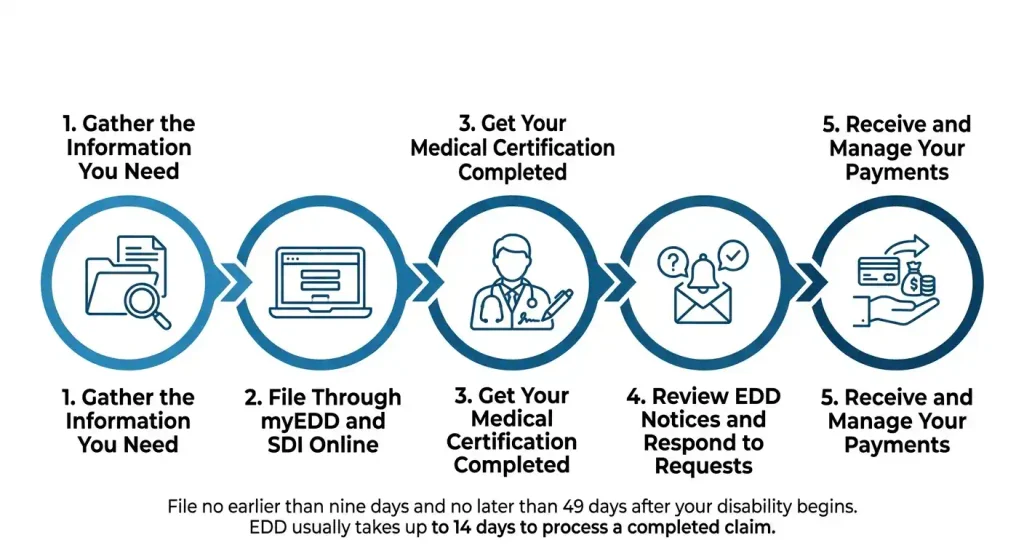
Step 1: Gather the Information You Need
Have these ready:
- Your ID
- Employer names and addresses, and your last day worked
- Your disability start date
- Bank details for direct deposit
- Paystubs from the past 18 months, to check your wages and estimate your benefit
- Your provider’s name, address, phone number, and license number, plus the date you were first treated
Step 2: File Through myEDD and SDI Online
Use SDI Online on the EDD website, signing in with or creating your myEDD account, and complete the Claim for Disability Insurance Benefits (DE 2501).
- Payment: Choose direct deposit (SDI Online claims only), the EDD Debit Card, or a check when you file.
- Paper: Request the form from EDD and mail it within the 49-day window. Online is faster.
- Privacy: EDD notifies your employer that you filed, but your diagnosis stays private.
Step 3: Get Your Medical Certification Completed
A licensed health professional must certify your disability, the condition, and how long it should last. That includes physicians, surgeons, nurse practitioners, and other licensed providers EDD accepts, including accredited religious practitioners in some cases. Your claim is incomplete without this certification.
- You must be examined within the first eight days, and a claim usually cannot begin more than seven days before you were first seen.
- If that is a problem, or your provider stalls or refuses, call EDD before you file.
- Ask when the office will submit the certification, and follow up.
- If you have no final diagnosis yet, ask what your provider can certify now. EDD decides eligibility based on that certification.
Step 4: Review EDD Notices and Respond to Requests
After you file, EDD sends a Notice of Computation (DE 429D) showing your estimated weekly benefit and base period.
- Check your wages carefully. If your benefit looks wrong, call EDD and compare the notice to your paystubs.
- Answer requests for more information, such as wage details or medical records, quickly, because delays stall the claim.
- Check your status in SDI Online or by phone.
- EDD may also order an independent medical examination for a second opinion.
Claims are delayed, reduced, or denied for reasons like too few base-period wages, late filing without good cause, missing certification, or a finding that you can still do your regular work. If EDD denies your claim, it sends a Notice of Determination (DE 2517) and an Appeal Form (DE 1000A). You have 30 days from the date the notice was issued to appeal.
Step 5: Receive and Manage Your Payments
EDD mails its decision, and payments start after the unpaid waiting period.
- Payment: You are paid by direct deposit (SDI Online claims only), the EDD Debit Card, or a check. SDI Online shows your payment history.
- Continuing: Benefit periods run two weeks at a time, and you confirm your disability continues using the Claim for Continued Disability Benefits (DE 2500A) or, on automatic payment, the Disability Claim Continuing Eligibility Certification (DE 2593).
- Longer disability: If your disability outlasts your provider’s estimate, you need updated certification.
- Changes: Report changes in work status, earnings, or address right away, and keep every notice.
When Should You Apply and When Will Payments Start?
File no earlier than nine days and no later than 49 days after your disability begins. EDD usually takes up to 14 days to process a completed claim, and the first seven days are unpaid.
The Disability Insurance Filing Deadline
The 49 days count from the day your disability began, not the day you file. You cannot file ahead of a planned leave, because the claim opens only after the disability begins. If it began March 1, your window closes in mid-April. Filing on day one can cause delays or even a denial, so wait until nine days after your disability begins. If you are past day 49, still file and explain the delay, and the claims analyst will review it.
EDD Processing Times and First Payments
EDD says a properly completed claim takes about 14 days to process, and payment takes longer, since a debit card or check arrives by mail. Most delays come from incomplete forms, missing medical certification, or wrong wage information.
What If Your Claim Is Pending and Bills Are Due?
- Check your status often, answer EDD the same day, and call your provider if certification is missing.
- You can use vacation or sick pay to cover the unpaid first seven days.
- For help while you wait, try county social services, 211 California, and local nonprofits, and ask landlords or lenders about hardship plans.
No one can promise an approval or payment date. Your first payable day is still the eighth day of your claim, even if approval takes longer.
California Disability Insurance vs. Other Benefits
SDI covers your own non-work medical condition for a short time. Other programs cover family care, job injuries, long-term disability, or job protection, and they can overlap.
SDI vs. Paid Family Leave
Disability Insurance pays when you are sick or injured. Paid Family Leave (PFL) pays up to eight weeks to care for a seriously ill family member or bond with a new child. For a birth parent, DI covers doctor-certified pregnancy disability and recovery first, then PFL covers bonding. They are separate claims with separate forms, and PFL has no waiting period.
SDI vs. Workers’ Compensation
Workers’ compensation covers job-caused injuries and illnesses and pays for medical care. California workers’ compensation is funded through your employer’s insurance, not the SDI payroll tax. SDI covers conditions that did not come from work.
If your comp claim is disputed or delayed, ask EDD whether you can file for SDI meanwhile. If comp is later approved for the same period, you may have to repay SDI. You may also qualify for the difference if your comp payment is smaller than your SDI benefit.
SDI vs. SSDI and Private Disability Insurance
SDI is a state program for short-term disabilities, up to 52 weeks. Social Security Disability Insurance (SSDI) is federal, covers long-term disabilities expected to last at least a year or end in death, and has a five-month waiting period. EDD says you can receive both, but Social Security may reduce your DI amount.
Employer short-term and long-term policies are separate, and some reduce payments by what SDI pays you, so read your policy.
Disability Benefits vs. Job-Protected Leave
SDI replaces pay but does not protect your job. Job protection comes from separate California labor laws.
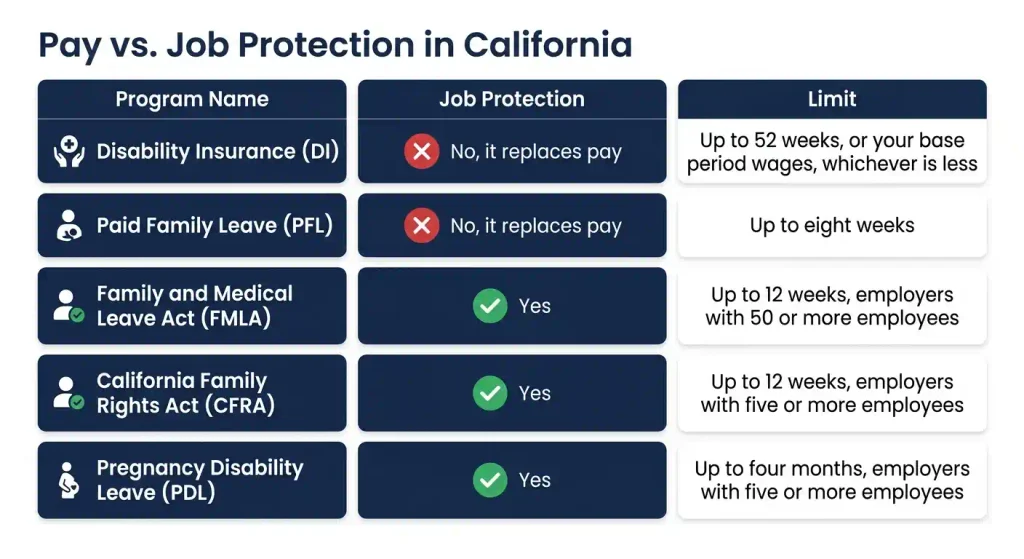
| Program | Protects your job? | Limit |
|---|---|---|
| Disability Insurance (DI) | No, it replaces pay | Up to 52 weeks, or your base period wages, whichever is less |
| Paid Family Leave (PFL) | No, it replaces pay | Up to eight weeks |
| Family and Medical Leave Act (FMLA) | Yes | Up to 12 weeks, employers with 50 or more employees |
| California Family Rights Act (CFRA) | Yes | Up to 12 weeks, employers with five or more employees |
| Pregnancy Disability Leave (PDL) | Yes | Up to four months, employers with five or more employees |
FMLA and CFRA usually require 12 months with your employer and 1,250 hours worked. When they apply, you can generally return to the same or a comparable job. Request leave from your employer separately.
Special Situations That Can Affect Your Claim
Most claims are straightforward. Pregnancy, job changes, thin wage history, part-time work, and extensions need extra care, so call EDD before you file if something looks unusual.
Pregnancy, Childbirth, and Postpartum Recovery
Maternity leave pay comes from two separate claims: pregnancy disability and bonding. DI covers the time your provider certifies you cannot work, typically about four weeks before your due date and six weeks after a vaginal birth or eight after a C-section, longer with complications.
Start the claim when that certified period begins, unless complications force you to stop earlier. After recovery, file for PFL bonding time. Job protection, such as Pregnancy Disability Leave (PDL), is a separate request to your employer.
Changing Jobs, Losing Work, or Having Multiple Employers
Wages from every employer count if SDI was withheld, so changing jobs does not reset your claim. Wages from a new job may still fall outside the base period.
Check each employer’s paystubs for the SDI line, and call EDD if an employer never withheld it, since those wages may still count. If you were laid off or unemployed when your disability began, you can still qualify if you were looking for work and have base-period wages.
Insufficient Wages or an Unusual Work History
The standard rule is $300 in base-period wages with SDI withheld. If your wages fall short or your history is unusual, ask EDD about these options:
- Special base period: Available if military service, a work-related (industrial) disability, a trade dispute, workers’ compensation, or long-term unemployment affected your base period.
- Later start date: If you lack base-period wages, a later start date may give you a valid claim.
- Wage substitution: If you actively looked for work for 60 days or more in a quarter, EDD may substitute wages from other quarters.
Call EDD before you file.
Working Part-Time While Receiving Benefits
If you earn some wages on a claim, EDD pays a partial benefit. Report your earnings and any change in work status. Unreported income can lead to a repayable overpayment, penalties, and a false statement disqualification.
Extending Benefits or Returning to Work
- To extend benefits, have your provider submit updated medical certification with a new end date before the current one ends, to avoid a payment gap.
- If you return gradually, tell EDD, since earnings may reduce your benefit.
- Benefits end on the date your provider certifies you recovered.
- If the same or a related condition stops you from working again within 60 days, EDD can treat it as a continuation of the first claim, with no new waiting period.
California Disability Insurance Myths and Misconceptions
Most costly mistakes start with an assumption. Here are the ones to drop before you file.
Common Assumptions That Can Cost You Benefits
“SDI pays my full salary.” It pays about 70% to 90% of wages, up to $1,765 a week. “CASDI on my paystub means I’m approved.” It only proves you paid in. EDD still checks your base period, wages, and certification. “SDI protects my job.” It does not. Job protection comes from FMLA, CFRA, or PDL.
Misunderstandings About Applications and Eligibility
You do not need to work full time, and $300 in base-period wages is a low bar. A claim stays incomplete until your provider submits the medical certification. Missing the 49-day window can cost you benefits, and unreported earnings can create an overpayment.
Your Next Steps: Check Eligibility and Estimate Your Benefits
Start with the calculator, then check your dates, gather your records, and file in the right window.
Use the Official EDD Benefit Calculator
Use EDD’s Disability Insurance and Paid Family Leave Calculator, with your base-period wage records ready (paystubs or W-2s) and your highest quarter identified. The result is an estimate, not an approval.
EDD also publishes benefit charts that match quarterly wages to weekly benefits: Disability Insurance and Paid Family Leave Weekly Benefit Amounts (DE 2589) lists them in dollar increments, and DE 2588 is the standard chart. EDD updates them each year, so use the edition for claims beginning in 2026.
Apply With Confidence
Three checkpoints decide most claims: eight days of disability and $300 in covered wages, filing inside the nine-to-49-day window, and your provider’s medical certification.
File through SDI Online on the EDD website (edd.ca.gov), where you can also check your claim status. EDD’s forms and publications page lists claim forms and benefit charts, and the claim help line is 1-800-480-3287.
Today:
- Write down the day your disability began.
- Confirm your provider will certify it.
- Set up SDI Online access.
- Save copies of every form, notice, and confirmation.
This is general information, not legal advice (see our disclaimer and methodology), so confirm your details with EDD.
Frequently Asked Questions About California Disability Insurance
Short answers to the most common questions.
How much does California Disability Insurance pay per week in 2026?
Weekly payments range from $50 to $1,765, based on your highest-earning base-period quarter. Lower earners get a higher percentage of their pay.
How long can you collect California Disability Insurance?
Up to 52 weeks, for as long as your provider certifies you are disabled. The 2026 maximum total is $91,780 ($1,765 × 52). Part-time work can stretch a claim past 52 calendar weeks, since reduced payments take longer to use up.
Is there a waiting period for California Disability Insurance?
Yes. The first seven days are unpaid, and payable benefits start on day eight. You can use vacation or sick pay to cover those days if your employer allows it.
Can I receive disability benefits if I quit or lose my job?
Often, yes. You need qualifying base-period wages and must have been working or looking for work when your disability began. If your work history has gaps, contact EDD before you file.
Are California Disability Insurance benefits taxable?
Generally, no. EDD says disability benefits are not reportable for tax purposes in most cases. The exception is when you were receiving unemployment benefits and then became disabled. In that case, part of your disability benefits is reported to the IRS, up to your original unemployment maximum, and EDD sends Form 1099G in January. Paid Family Leave benefits are taxable on your federal return only, not on your California return.
Can I receive disability benefits and unemployment at the same time?
No. You cannot receive Disability Insurance and Unemployment Insurance benefits for the same days. Disability Insurance is for people who cannot work, while unemployment insurance requires you to be able and available to work. You may be able to switch as your health changes, and you must tell EDD to stop your unemployment payments.

Yeasin Sorker is the founder of Paycheck Calculator California. He built this tool in 2018 after noticing that most free paycheck calculators missed California-specific rules like daily overtime and the uncapped SDI rate.
He researches California payroll tax updates regularly and keeps this calculator aligned with the latest IRS, FTB, and EDD published rates. All calculations on this site are estimates based on official 2026 government sources. For personalized tax advice, consult a qualified tax professional.