
California’s healthcare minimum wage isn’t one statewide rate. It’s set by facility type, not job title, with large hospitals and dialysis clinics already paying $25 an hour and other tiers still catching up.
That facility-based structure comes from Senate Bill 525’s multi-tier wage schedule, verified here against California’s official Labor Code and DIR rate tables.
Even so, waivers and shifting facility classifications mean your actual rate can lag the published schedule.
California Healthcare Minimum Wage in July 2027: The Rates at a Glance
| Facility Type | Rate as of July 1, 2027 |
|---|---|
| Large hospital systems (10,000+ FTE) & dialysis clinics | $25.00 |
| Community/rural health clinics & affiliated urgent care | $25.00 |
| Safety net hospitals & small county facilities (under 250,000) | $19.95 |
| All other covered facilities | $23.00 |
California Healthcare Minimum Wage Rates Starting July 1, 2027
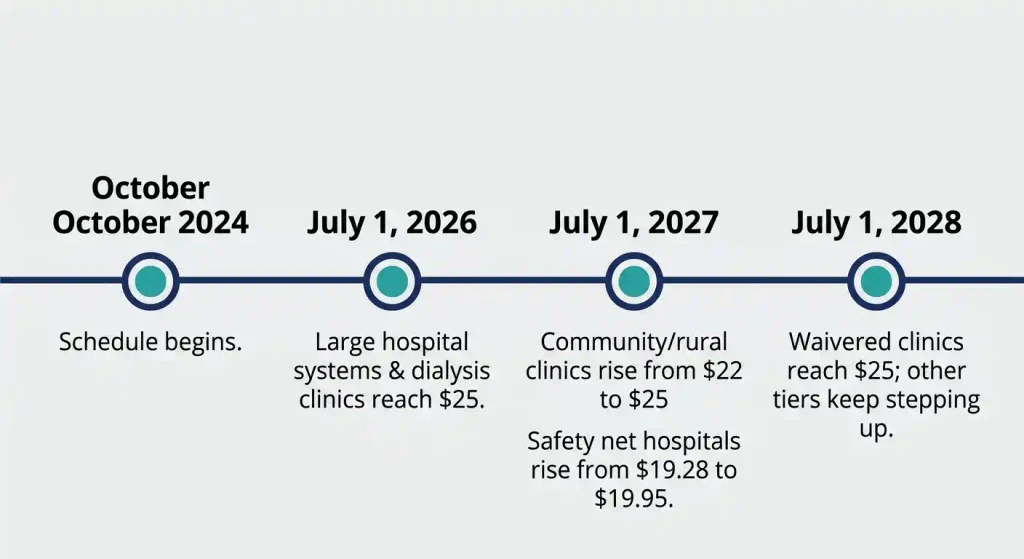
Community clinics, rural health clinics, and affiliated urgent care centers rise from $22 to $25 an hour. Safety net hospitals and small county facilities rise from $19.28 to $19.95. Large hospital systems and dialysis clinics, already at $25 since July 1, 2026, stay there. These rates come from Labor Code 1182.14. The schedule traces back to Senate Bill 525 (SB 525), passed in 2023, amended by SB 828 and SB 159. It started in October 2024 under the original 2026 healthcare worker minimum wage schedule and keeps stepping up through 2028 for facility types not yet at $25. Employers can’t shrink these rates with meal or lodging credits. Once a tier hits $25, future increases shift to annual Consumer Price Index adjustments instead of fixed steps.
Which Healthcare Facilities Reach $25 per Hour in July 2027?
Community clinics, rural health clinics, and their affiliated urgent care centers join the hospitals with 10,000 or more full time equivalent employees and dialysis clinics, which reached $25 a year earlier. Safety net hospitals and small county facilities stay below $25 in 2027. Clinics with an approved waiver have their $25 date pushed back a full year, to July 1, 2028. A waiver explains why your pay stub might still show last year’s rate.
Why Some Healthcare Workers Will Not Get $25 Yet
Most other covered facilities, not large hospital systems, dialysis clinics, or county run operations, stay at $23 through this period, still above California’s general minimum wage of $17.40 for 2027. Working in healthcare doesn’t automatically mean the top tier. Your rate depends on your employer’s classification, not the industry.
Who Qualifies for California’s Healthcare Minimum Wage?
Coverage depends on two things together: your job duties and your employer’s facility classification, not your title or location. The law defines these as covered healthcare employees working for covered healthcare facility employers.
Healthcare Jobs Covered by the Law
The law covers nurses, nursing assistants, medical residents, and caregivers providing direct patient care, plus the staff who keep a facility running: housekeeping, food service, security, clerical workers, and billing staff. If your paycheck comes from a covered facility, your role generally falls under the law whether or not you touch a patient. Your facility’s classification sets the rate; your job tells you if you’re covered. See our California salary guides by industry for role-specific pay data.
Do Nurses, Medical Assistants, and Hospital Support Staff Qualify?
Yes. Registered nurses, licensed vocational nurses, certified nursing assistants, and medical assistants are all covered. Two RNs with the same title can legally earn different minimums, one at $25, one at $23, depending on their employer. The law sets a floor, not a fixed wage; many nurses already earn more through negotiated pay or union contracts; see typical registered nurse salaries in California for comparison.
Do Part-Time, Temporary, Per-Diem, and Contract Workers Qualify?
Staffing agency and contract workers at a covered facility are covered for hours spent there. If more than half your workweek is patient care or support at a covered facility, all your hours that week fall under the healthcare minimum. Public and private employer rules differ slightly, so confirm the schedule for your specific placement. Our guide to part-time vs full-time paycheck rules in California covers how hours affect coverage more broadly.
Which Healthcare Employers and Practices May Be Excluded?
Independent physician practices, independent practice associations, and outpatient physical therapy clinics often fall outside the statutory definition of a covered facility; the general state minimum wage applies instead. State operated facilities, certain public employers, and some nursing facilities have their own provisions. Most state run facilities sit outside this law, but University of California healthcare workers remain covered. Home healthcare services delivered through a covered hospital’s own program generally follow that hospital’s rate, and a licensed home health care agency is independently covered as its own facility type even without hospital ownership. For broader rules on how California sorts employees by role, see our worker classification resources.
How to Identify Your Employer’s Correct Wage Schedule
Your facility’s size, ownership, and funding structure decide your schedule, not your title or department.
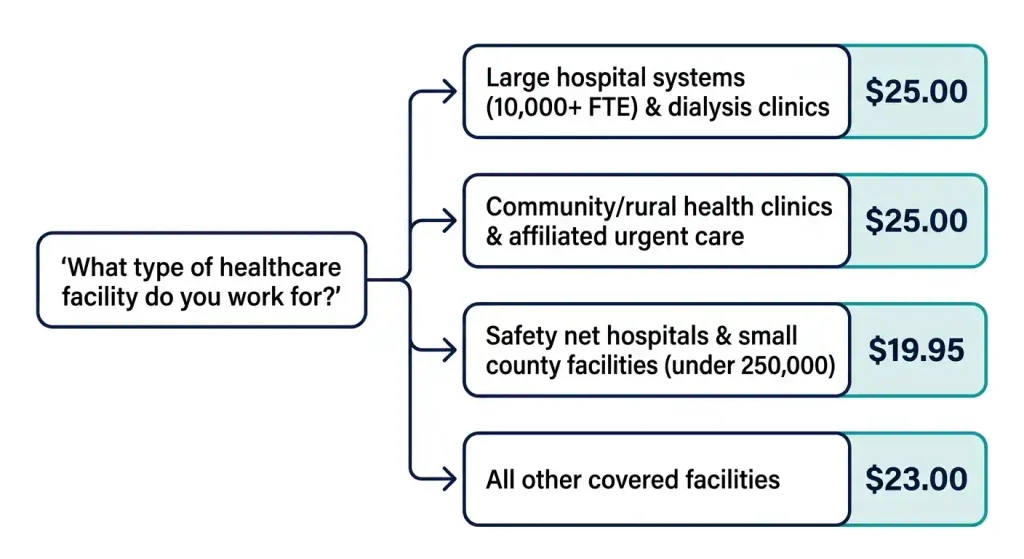
Large Health Systems, Hospitals, and Dialysis Clinics
Hospitals with 10,000 or more full time equivalent employees, including their skilled nursing facilities, reached $25 on July 1, 2026, and so did dialysis clinics. A standalone skilled nursing facility only gets its own schedule once a patient care minimum spending requirement takes effect, which hasn’t happened yet; until then it stays on the $23 catch-all rate, unless it’s owned by a hospital or integrated health care delivery system, in which case it follows that employer’s schedule. An integrated health care delivery system’s employee count is combined across sites, which is how a smaller hospital can still land on the top tier. Check the California Department of Industrial Relations (DIR) and the Department of Health Care Access and Information (HCAI) if you’re unsure your employer qualifies.
Safety-Net Hospitals and Rural Independent Hospitals
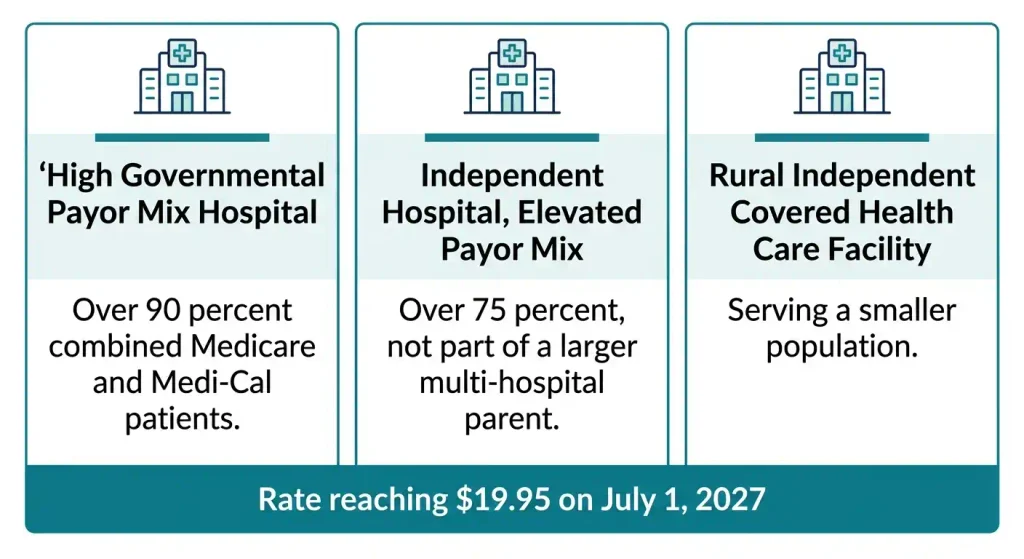
Safety net hospitals and small county facilities under 250,000 residents climb toward $25 through roughly 3.5 percent annual steps, reaching $19.95 on July 1, 2027, and continuing upward for several more years. Safety net status depends on a facility’s share of government payer patients, separate from simply being rural. This tier covers two categories: a hospital with a high governmental payor mix (over 90 percent combined Medicare and Medi-Cal patients) and an independent hospital with an elevated governmental payor mix (over 75 percent, and not part of a larger multi-hospital parent), plus a rural independent covered health care facility serving a smaller population.
County-Run Healthcare Facilities
County facilities split into three tiers by population as of January 1, 2023.
| County Size (as of Jan 1, 2023) | Rate |
|---|---|
| Large (over 5 million residents) | $25.00 |
| Medium (250,000 to 5 million) | $23.00 |
| Small (under 250,000) | Follows safety net schedule ($19.95) |
A county hospital and a nearby private hospital can legally pay different minimums.
Community Clinics, Rural Health Clinics, and Urgent Care Centers
This group reaches $25 on July 1, 2027, including intermittent clinics and affiliated urgent care centers. Ownership matters: a community-based clinic owned by a larger hospital system may follow that system’s schedule instead, so confirm the affiliation rather than assume from the name.
How to Check Whether Your Facility Has a Clinic Waiver
Clinics in this tier could apply to the Department of Industrial Relations for a waiver delaying the increase by 12 months. A facility with a waiver must post it and notify employees. Consecutive waivers are possible, so some clinics stay behind schedule even after July 2027.
How Much More Could You Earn at the July 2027 Rate?
Here’s what the increase looks like in real dollars; plug your own numbers into our California paycheck calculator or annual salary calculator for an exact figure.
Paycheck Comparison at $22, $23, and $25 per Hour
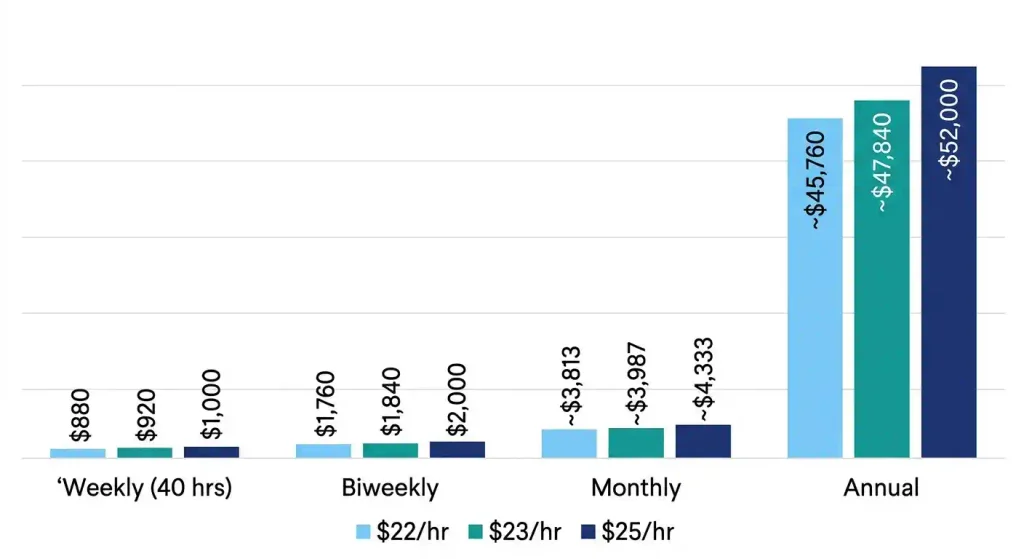
| Rate | Weekly (40 hrs) | Biweekly | Monthly | Annual |
|---|---|---|---|---|
| $22/hr | $880 | $1,760 | ~$3,813 | ~$45,760 |
| $23/hr | $920 | $1,840 | ~$3,987 | ~$47,840 |
| $25/hr | $1,000 | $2,000 | ~$4,333 | ~$52,000 |
All figures are gross, before federal tax, California state tax, and FICA; see gross pay vs net pay for how that gap breaks down.
Example: Your Hourly Rate Increases From $22 to $25
Moving from $22 to $25 adds $3 an hour, $120 a week, about $520 a month, and roughly $6,240 a year before taxes, assuming a standard 40 hour week paid biweekly. After withholding, expect to keep roughly 70 to 75 percent of that gross increase, depending on your filing status.
Does the Healthcare Minimum Wage Increase Your Overtime Pay?
Yes. Overtime is based on your regular rate, so $22 to $25 moves your time-and-a-half rate from $33 to $37.50, under the same rules covered in our guide to California overtime laws. This is separate from exempt status. Salaried workers above the exempt salary threshold, whichever is higher between 1.5 times their tier’s healthcare minimum wage and twice the general state minimum wage, don’t earn overtime; for the $25 tier that threshold is $78,000. If your employer calls your role exempt, ask which exemption applies and confirm your salary clears the threshold. Run your own numbers with our overtime pay calculator.
Will Your Local Minimum Wage or Current Contract Pay More?
Local ordinances above the state floor still apply. Union or individual agreements paying more than the legal minimum don’t drop because the statutory minimum is lower; the law sets a floor, not a ceiling. Knowing your correct legal floor also helps when negotiating a job offer, especially since California’s pay transparency law now requires employers to post pay ranges upfront.
What to Do If Your Healthcare Employer Pays Less Than Required
Work through this before assuming the worst; most underpayment questions trace back to facility misclassification, not an intentional violation.
Check Your Pay Stub and Effective Date
Match your hourly rate to your facility’s correct schedule, factoring in any waiver. Check hours, pay period dates, and deductions. Keep pay stubs, time records, job descriptions, and written notices from your employer; these back up a claim. If any line item is unclear, our guide on how to read your California pay stub breaks down each section.
How to Verify Your Employer’s Classification
Check the DIR’s Health Care Worker Minimum Wage FAQ and the relevant Labor Code sections against your facility. Official facility lists and waiver notices help too. Ask payroll or HR directly before filing anything formal. A lawful classification means your employer matched the correct tier; misclassification means they didn’t, by mistake or otherwise, and our guide on employee misclassification in California covers both scenarios in more depth.
How to Report Unpaid Healthcare Minimum Wages
File a wage claim with the California Labor Commissioner’s Office, which operates through the Division of Labor Standards Enforcement (DLSE). An individual claim goes through its Wage Claim Adjudication Unit; broader violations go to its Bureau of Field Enforcement. A successful claim can recover back wages, wage penalties, and other remedies; see our full breakdown of wage theft in California and our payroll compliance resources for related employer obligations.
Common Myths About California’s Healthcare Minimum Wage
A few misconceptions, especially about who actually reaches $25, cause real confusion.
Myth: Every California Healthcare Worker Must Earn $25 in July 2027
False. The $25 rate applies only to specific tiers. Others remain at $23, and safety net or small county facilities sit at $19.95. Your job title doesn’t decide this; your employer’s classification does.
Myth: Every Hospital or Clinic Automatically Qualifies
False. The statute defines specific facility types, ownership structures, and affiliations. Independent practices and some outpatient clinics fall outside it entirely and follow the general state minimum wage instead.
Myth: A Clinic Waiver Means the Employer Can Choose Any Wage
False. A waiver only delays a scheduled increase by 12 months; employers still must pay the applicable rate for that timeline and notify employees. A claimed exemption without actual DIR approval is different, and worth questioning.
Myth: The $25 Rate Will Never Change
False. Once a tier hits $25, Consumer Price Index-based adjustments raise it over time, just through smaller annual steps instead of big jumps. Check official sources for the current adjusted rate.
California Healthcare Minimum Wage July 2027: FAQs
Quick answers to the most common questions about the July 2027 changes, where rates range from $19.95 to $25 depending on facility type.
What Is California’s Healthcare Minimum Wage on July 1, 2027?
It depends on facility type: $25 for large hospital systems, dialysis clinics, and community, rural, and urgent care clinics; $19.95 for safety net hospitals and small county facilities; $23 for most others.
Which Healthcare Workers Will Earn at Least $25 Per Hour?
Workers at large hospital systems, dialysis clinics, and community or rural clinics without a waiver, by July 2027. Waivered clinics follow a delayed schedule.
Will California Nurses Automatically Get a $25 Minimum Wage?
No. A nurse’s minimum depends on the employer’s facility classification, not license or title.
Why Is My Healthcare Employer Still Paying $23 Per Hour?
Likely correct if your facility isn’t in the top tier, clinic tier, or large county tier. Confirm your facility’s classification to be sure.
Can a Healthcare Clinic Delay the July 2027 Increase?
Yes, with an approved DIR waiver, which delays the increase by 12 months and requires employee notification.
Does California’s General Minimum Wage Apply Instead?
Only if your employer isn’t a covered healthcare facility. Then California’s general minimum wage of $17.40 for 2027 applies.
What Should I Do If My Employer Does Not Pay the Correct Rate?
Verify your facility’s classification, keep records, raise it with payroll or HR, then file a wage claim with the California Labor Commissioner’s Office if needed.
Where Can I Find the Official Healthcare Minimum Wage Schedule?
The California Department of Industrial Relations publishes the Health Care Worker Minimum Wage FAQ, wage order supplement, and waiver program information.
Official Sources for California Healthcare Minimum Wage Rules
Verify every rate and rule directly against these primary sources.
California Department of Industrial Relations
The DIR’s Health Care Worker Minimum Wage FAQ, officially the Health Care Worker Minimum Wage Frequently Asked Questions, sets the official schedule alongside the Minimum Wage Order Supplement for Health Care Facilities and California Code of Regulations, Title 8, Section 11000.2. Waiver guidance comes through the Health Care Worker Minimum Wage Law Clinic Waiver Program, and enforcement runs through the Labor Commissioner’s Office.
California Labor Code and Health Care Access and Information
The rules sit in California Labor Code Section 1182.14, California Labor Code Section 1182.15, and California Labor Code Section 1182.16, covering the wage schedule, exemptions, and clinic waiver process. The community clinic definition traces to California Health and Safety Code Section 1204; the rural health clinic definition comes from Section 1396d(l)(1) of Title 42 of the United States Code. The Department of Health Care Access and Information maintains facility data to confirm classification. For more on related statutes, browse our California labor laws category.

Yeasin Sorker is the founder of Paycheck Calculator California. He built this tool in 2018 after noticing that most free paycheck calculators missed California-specific rules like daily overtime and the uncapped SDI rate.
He researches California payroll tax updates regularly and keeps this calculator aligned with the latest IRS, FTB, and EDD published rates. All calculations on this site are estimates based on official 2026 government sources. For personalized tax advice, consult a qualified tax professional.