
The California minimum wage for 2027 is $17.40 an hour, effective January 1, 2027, for every employer. Higher local or industry rates may apply, so your required rate depends on where and in what job you work.
That $17.40 rate was certified by the California Department of Finance on July 31, 2026; figures below follow official state and city sources where available.
One limit: $17.40 is only a floor, and some 2027 city rates are not yet announced.
What Is California’s Minimum Wage in 2027?
The statewide floor is $17.40 an hour. You are owed the highest of the state, city, and industry rates that cover your job.
California Minimum Wage 2026 vs. 2027
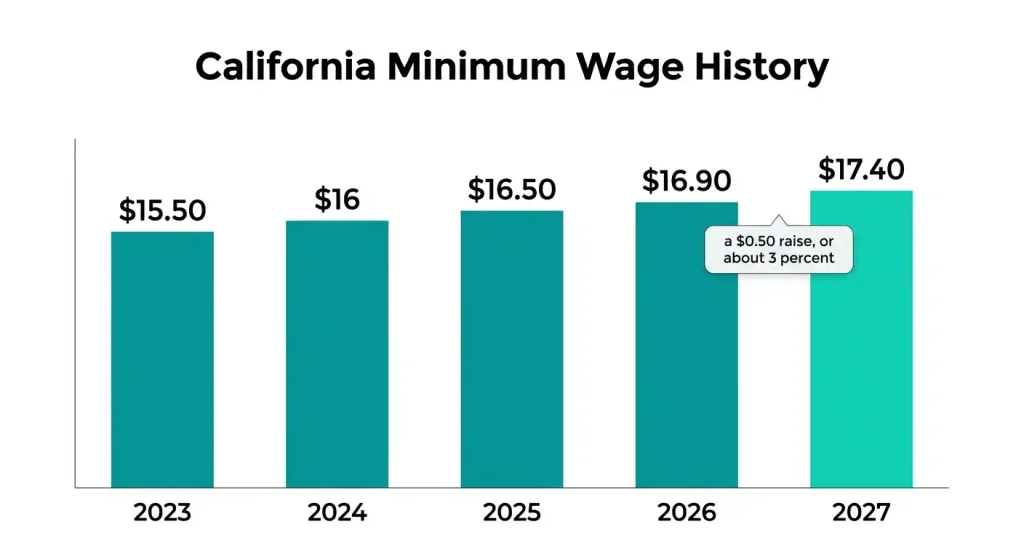 .50 raise from 2026.” class=”wp-image-2138″ style=”width:700px;height:auto”/>
The rate rises from $16.90 in 2026 to $17.40 in 2027, a $0.50 raise, or about 3 percent. Governor Gavin Newsom announced the new California minimum wage effective January 1, 2027 on July 31, 2026, and the Department of Industrial Relations confirmed it. The rate was $15.50 in 2023, $16 in 2024, and $16.50 in 2025. For the current 2026 rules, see our California minimum wage 2026 guide.
The formula is inflation-based. California Labor Code Section 1182.12 requires the Department of Finance director to calculate an adjustment by August 1 each year, using the lesser of 3.5 percent or the rise in consumer prices. The average CPI-W (consumer prices for urban wage earners) for July 2025 to June 2026 ran 2.99 percent above the prior 12 months, which set the new rate. Only a new law could change the 2027 rate. A 2028 raise is likely if prices rise but not guaranteed: Finance recalculates by August 1, 2027, and if prices fall, the rate stays put.
Who Qualifies for More Than $17.40 an Hour?
Workers in certain cities, covered fast-food chains, covered healthcare facilities, and some San Diego hospitality jobs. The table shows the latest confirmed rates as of October 2026.
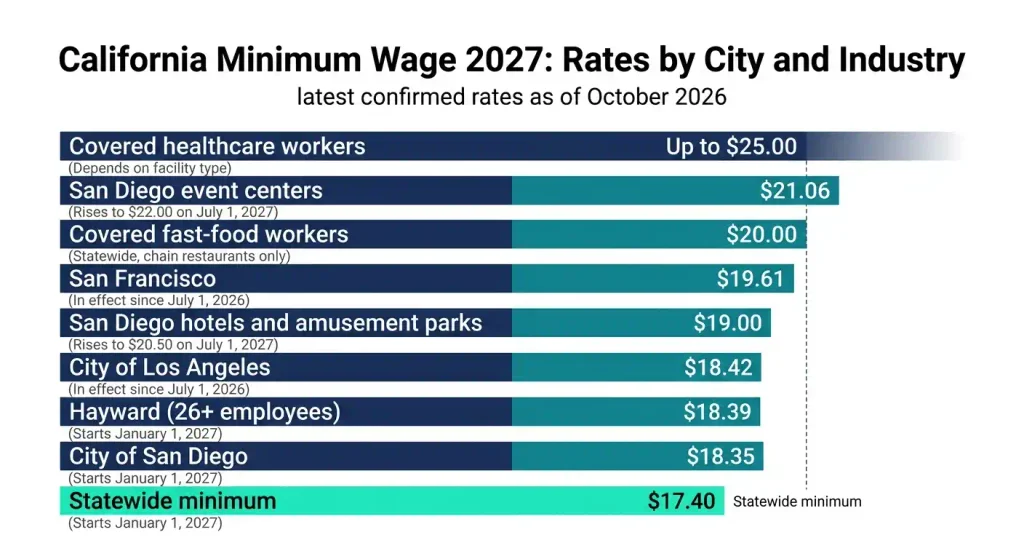
| Who | Rate | What to know |
|---|---|---|
| Statewide minimum | $17.40 | Starts January 1, 2027 |
| City of San Diego | $18.35 | Starts January 1, 2027 |
| City of Los Angeles | $18.42 | In effect since July 1, 2026 |
| San Francisco | $19.61 | In effect since July 1, 2026 |
| Hayward (26+ employees) | $18.39 | Starts January 1, 2027 (2026 rate: $17.79) |
| Covered fast-food workers | $20.00 | Statewide, chain restaurants only |
| Covered healthcare workers | Up to $25.00 | Depends on facility type |
| San Diego hotels and amusement parks | $19.00 | Rises to $20.50 on July 1, 2027 |
| San Diego event centers | $21.06 | Rises to $22.00 on July 1, 2027 |
Federal vs. California Minimum Wage
The federal minimum wage has been $7.25 an hour since 2009 under the Fair Labor Standards Act, which the U.S. Department of Labor enforces. California’s $17.40 is more than double that. The rule that pays more controls, and a local ordinance can go higher. In 2027, Washington ($17.73) and Connecticut ($17.48) will top California, and Washington, D.C. is higher too.
Which California Cities Pay More Than the State Minimum?
About 40 California cities and counties have their own minimum wage ordinance, and most sit above the state rate. A few may not clear $17.40 once the state rate rises. Inside one, the local rate is your floor. Other cities follow the state rate.
California Minimum Wage by City in 2027
San Diego’s official schedule lists $18.35 an hour starting January 1, 2027, up from $17.75 in 2026. Los Angeles ($18.42) and San Francisco ($19.61) raised rates on July 1, 2026 and adjust each July 1, so their next numbers are not out. Hayward adjusts every January 1 and splits by employer size: from January 1, 2027, it is $18.39 for 26 or more employees and $17.40 for 25 or fewer (2026: $17.79 and $16.90).
The UC Berkeley Labor Center keeps a list of every local rate. Berkeley pays $19.61 since July 1, 2026, and San Jose pays $18.45 for 2026. Oakland ($17.34 for 2026) sits below $17.40, so the state floor may govern unless its January 1 adjustment clears it. West Hollywood ($20.25 for 2026) sets its own rate, so check each city’s page for its 2027 figure. Estimate your take-home pay with our San Diego, Los Angeles, San Francisco, Oakland, and San Jose paycheck calculators.
Why Can Two Workers in the Same State Have Different Minimum Wages?
State law lets cities and counties require more, and each ordinance covers only work done inside its borders. A cashier inside San Diego city limits earns at least $18.35, while one in an unincorporated part of the county earns at least $17.40. Employer size can matter too, as Hayward’s two-tier rate shows. So the highest rate in the state is never automatic.
Which Rate Applies If You Work in Multiple Cities?
Where you physically work decides it, not where your employer is based or where you live. Some ordinances apply only after a minimum number of hours worked in the city in a week, so check the city’s own page. A business outside city limits can still owe the city rate for work done inside it. A remote employee working from home in a city with its own ordinance is generally covered by that city’s rate. An out-of-state employer with a remote worker in California generally follows California’s minimum wage for work done here.
Which Industries Have Minimum Wages Above $17.40?
Three groups: fast-food workers, covered healthcare workers, and covered San Diego hospitality workers. These rates apply on top of the statewide minimum for covered jobs. Retail, grocery, warehouse, and office workers get the standard $17.40 unless a city ordinance sets more (see Amazon warehouse pay for one example). Some cities set separate hotel-worker rates from July 1, 2026: $25 in the city of Los Angeles (higher if the employer provides no health benefits) and in Santa Monica, $26.50 in Long Beach, and $20.87 in West Hollywood.
California Fast-Food Minimum Wage in 2027
Covered fast-food workers earn at least $20 an hour, with no 2027 increase scheduled. California Assembly Bill 1228 created the rate, a follow-up bill, AB 610, amended the law, and the coverage rules sit in California Labor Code Section 1474, California Labor Code Section 1475, and the sections that follow.
Covered:
- Limited-service restaurants in a national chain of at least 60 locations
- Restaurants where customers order and pay before they eat
Not covered:
- Sit-down and independent restaurants
- Some bakeries and grocery stores, which are carved out
The Fast Food Council can raise the rate yearly by up to 3.5 percent or the rise in consumer prices, whichever is lower, but it has held no listed meeting since February 2025 and has announced no 2027 increase.
California Healthcare Worker Minimum Wage in 2027
Healthcare workers fall under California Senate Bill 525 (SB 525), and the rate depends on the facility, not your job title. Follow-up bills, California Senate Bill 828 and California Senate Bill 159, delayed the start, so raises began October 16, 2024. The rules live in California Labor Code Section 1182.14 and the two sections after it. Coverage can include janitors, food service staff, clerical workers, and security, not just nurses. Physician groups with 24 or fewer physicians are exempt. For employer types, coverage rules, and exempt salary thresholds, see our healthcare worker minimum wage guide.
Rates by facility type, as of July 1, 2026:
| Facility type | Rate now | Next step |
|---|---|---|
| Large health systems (10,000 or more full-time equivalent employees), dialysis clinics, and facilities run by counties of more than 5 million people | $25 | None, already at $25 |
| Clinics (community, rural, intermittent, and affiliated urgent care) | $22 | $25 on July 1, 2027 |
| Catch-all tier (other covered facilities) | $23 | $25 on July 1, 2028 |
| Safety-net and rural hospitals | $19.28 | $19.95 on July 1, 2027, then steps up yearly |
Clinics that obtained a waiver follow a later schedule: $22 on July 1, 2027 and $25 on July 1, 2028. Check the Department of Industrial Relations chart for your facility type and date.
San Diego Hospitality Minimum Wage in 2027
A separate San Diego law, effective July 1, 2026, covers hotels with 150 or more rooms, amusement parks (75 or more contiguous acres, operated under a City agreement, with permanent amusement rides), and event centers such as Petco Park and the convention center. Hotel and amusement park workers earn $19.00 now and $20.50 from July 1, 2027. Event center workers earn $21.06 now and $22.00 from July 1, 2027. Both reach $25 by 2030. The general city rate rises each January 1, but these change every July 1. A collective bargaining agreement can waive the rate if it clearly says so.
Do Other Workers Have Special Minimum Wage Rules?
Yes, but none remove your basic protection. The minimum applies to almost every pay arrangement:
| Worker or pay type | What applies |
|---|---|
| Tipped workers, including restaurant servers | California has no tip credit, so tips never count toward the minimum wage. See no taxes on tips for the tax side. |
| Commissioned employees | Must still reach minimum wage for every hour worked. |
| Piece-rate workers | Must be paid separately for rest breaks and other nonproductive time. |
| Paid by the day, week, or salary | Pay must equal at least the minimum for every hour. |
| Part-time, temporary, seasonal, and nonprofit workers, students, minors, and new hires | Same minimum as everyone else, apart from the learner rule. |
| Training time | Counts as paid work. |
| Registered apprentices | Follow their approved program’s wage schedule. |
| Independent contractors | Not covered, but California uses the ABC test, so a worker labeled a contractor may really be an employee owed the minimum. See employee misclassification and our worker classification guides. |
| Workers with disabilities | Since January 1, 2025, California bars paying less than the state or local minimum, whichever is higher. |
| Outside salespeople, and work for your own parent, spouse, or child | Narrow exemptions apply. |
The learner rule is the one carve-out, as DIR’s minors guide explains: 85 percent of the minimum for the first 160 hours in an occupation where the worker has no similar experience, about $14.80 at $17.40. Some city ordinances do not allow it.
How Much More Could You Earn in 2027?
A full-time worker at $17.40 grosses $696 a week and $36,192 a year, which is $1,040 more per year than at $16.90.
Weekly, Biweekly, Monthly, and Annual Pay at $17.40
These figures are gross pay, assuming 52 paid weeks, no unpaid time off, and no overtime. Monthly is the annual total divided by 12. Try our gross pay calculator for other hours.
| Hours per week | Weekly | Biweekly | Monthly | Annual |
|---|---|---|---|---|
| 20 | $348 | $696 | $1,508 | $18,096 |
| 30 | $522 | $1,044 | $2,262 | $27,144 |
| 35 | $609 | $1,218 | $2,639 | $31,668 |
| 40 | $696 | $1,392 | $3,016 | $36,192 |
Take-home pay is lower after federal tax, payroll taxes, California state tax, and benefit deductions. Our California paycheck calculator can estimate it, and the annual salary calculator turns any hourly rate into a yearly figure. See how part-time and full-time paychecks compare.
A higher paycheck can also change eligibility for income-based benefits, including the California Earned Income Tax Credit, so ask the program.
How Much Does the Increase Add to Your Paycheck?
The raise is $0.50 an hour, gross: at 20 hours a week, $10 a week and $520 a year; at 30 hours, $15 and $780; at 35 hours, $17.50 and $910; at 40 hours, $20 and $1,040. If you already earn $19 an hour, your employer need not change your pay. A raise is forced only when your rate falls below the applicable minimum, so a worker earning $17 must move up to $17.40, which is $16 more a week at full time. Overtime adds more: a 45-hour week pays $826.50 at $17.40 versus $802.75 at $16.90, a gain of $23.75.
What If Your City or Industry Requires More Than $17.40?
A full-time worker in the city of San Diego at $18.35 earns $734 a week and $38,168 a year, about $38 more a week and $1,976 more a year than at $17.40. A hotel worker covered by San Diego’s hospitality law at $20.50 after July 1, 2027 earns $820 a week and $42,640 a year, $6,448 more than the same hours at $17.40. For a similar hourly rate, see $18 an hour is how much a year, or compare pay for common jobs in our California salary by job and industry guides.
Does the 2027 Minimum Wage Change Overtime or Salary Requirements?
Yes, for salary. The minimum salary for exempt employees rises to $72,384 in 2027. Overtime rules stay the same, but overtime pay grows with the higher hourly rate.
California’s $72,384 Salary Threshold for Certain Overtime Exemptions
To be exempt under the white-collar exemptions (executive, administrative, and professional), an employee must earn at least twice the state minimum wage for full-time work: $17.40 × 2 × 40 × 52 = $72,384 a year, or $6,032 a month, up from $70,304 in 2026. Local minimum wages do not change this. Covered healthcare employers can face a higher figure, up to $78,000 at the $25 tier (1.5 × $25 × 2,080), and covered fast-food managers have their own $83,200 floor. The 2027 figure for computer software employees is not announced. Salary is only one part of the test, and the employee must also pass the duties test.
How California Overtime Pay Works
Under California Labor Code Section 510, nonexempt employees earn overtime at these rates:
| When | Pay rate | At $17.40 |
|---|---|---|
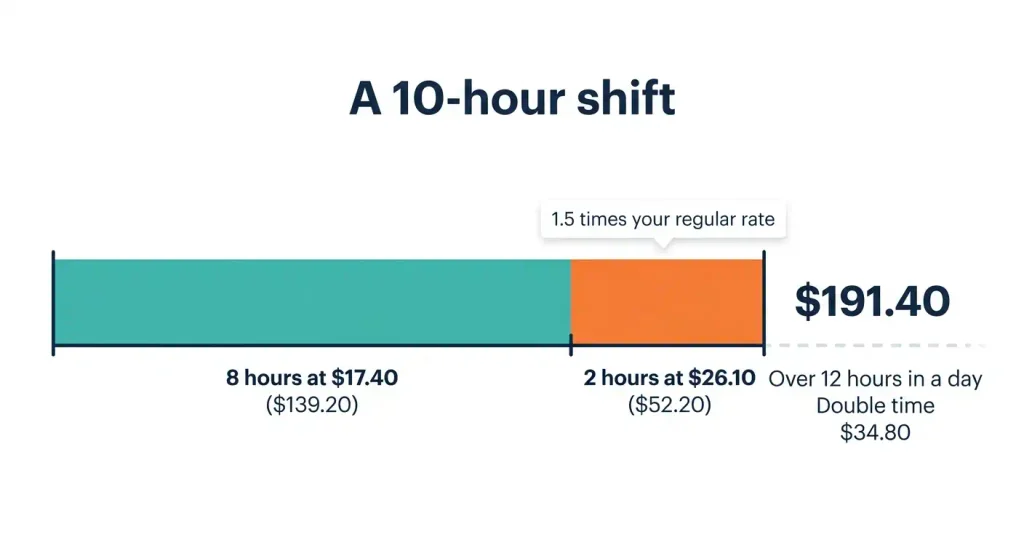
| Over 8 hours in a day, over 40 in a week, or the first 8 hours on the seventh straight workday | 1.5 times your regular rate | $26.10 |
| Over 12 hours in a day, or over 8 on the seventh straight workday | Double time | $34.80 |
A 10-hour shift pays 8 hours at $17.40 ($139.20) plus 2 hours at $26.10 ($52.20), or $191.40. Alternative workweek schedules and some industry rules can change this. Paid rest breaks count as hours worked, and meal breaks are unpaid only if you are fully off duty. If you are sent home early, reporting-time pay covers at least half your scheduled shift, with a floor of two hours and a cap of four. All of these use your actual rate, so the $17.40 floor sets their minimum. Run your own hours through our California overtime calculator. Part of your overtime pay may also qualify for a federal deduction; see no tax on overtime.
Can a Salaried Employee Still Be Entitled to Minimum Wage or Overtime?
Yes. A salary is not the same as being legally exempt. An assistant manager earning $60,000 is below $72,384, so cannot be exempt under the white-collar exemptions and is owed overtime. If the salary covers a 40-hour week, the regular rate is about $28.85 an hour and overtime pays about $43.27. Duties and salary must both qualify, whatever the job title.
When Must Employers Pay the New Rate?
Employers must pay $17.40 for all work performed on or after January 1, 2027. The date worked decides the rate, not the payday.
What Happens to Pay Periods That Cross January 1, 2027?
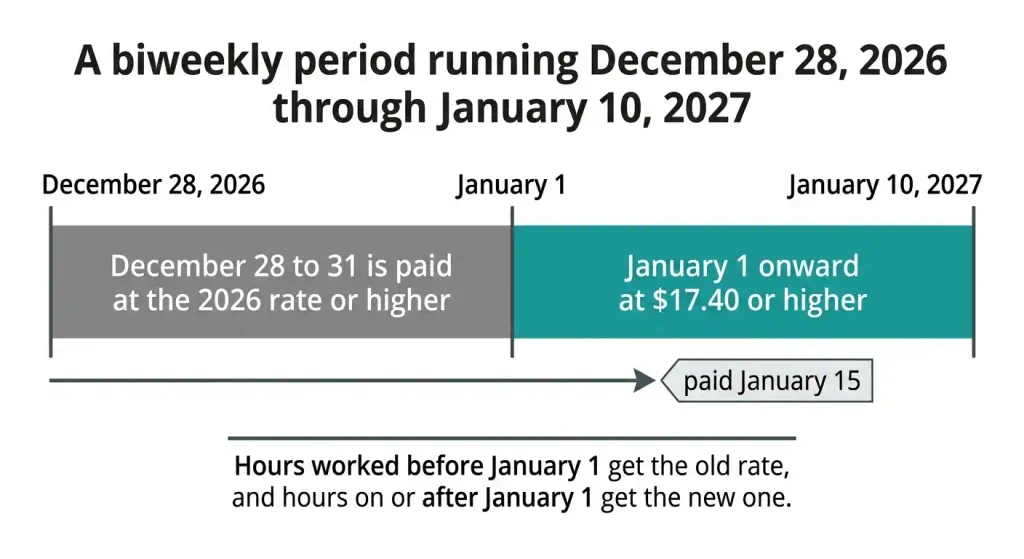
Hours worked before January 1 get the old rate, and hours on or after January 1 get the new one. Take a biweekly period running December 28, 2026 through January 10, 2027, paid January 15: December 28 to 31 is paid at the 2026 rate or higher, and January 1 onward at $17.40 or higher. Employers need daily time records to split the check, and workers should check their stubs for both rates.
What Employers Must Update
Employers must update payroll rates, post the new state minimum wage order and their industry wage order, show the hourly rate on each pay stub, and apply any higher city or industry rate. The Department of Industrial Relations publishes the wage orders. California Labor Code Section 1182.13 requires it to republish them with the new rate, and employers must keep them posted. Until the 2027 order is out, the notice to post is the California minimum wage order MW-2026, and employers should swap in MW-2027 once published. Employers also owe written notice of a pay-rate change within seven days, unless it appears on a timely pay stub or another required written notice.
California Minimum Wage 2027 Myths and Misconceptions
Most confusion comes from assuming one number covers everyone. It does not.
Common Mistakes About Higher Minimum Wage Rates
| Myth | Reality |
|---|---|
| Every California worker earns exactly $17.40. | Local or industry rules can raise it. |
| A higher-rate city gives you every local wage provision. | Not automatically. San Diego’s hospitality rates, for example, cover only certain employers. |
| Everyone gets a raise in January when the state rate rises. | Only workers paid below the new floor must get one. |
| A raise promised for the new year changes December pay. | It does not change pay for December hours. |
| All healthcare workers share one special rate. | The facility sets the rate. |
Common Misconceptions About Pay and Exemptions
| Myth | Reality |
|---|---|
| Tips cover the minimum wage. | Tips do not count toward minimum wage. |
| Commissions cover the minimum wage. | They help only if you still reach minimum wage for every hour worked. |
| Every salaried worker is exempt from overtime. | Duties and the salary threshold both matter. |
| Small employers are excused. | $17.40 applies to all employers, whatever their size. |
What Should You Do If Your Employer Pays Less Than the Required Rate?
Check the math. If your pay is below the highest rate that covers you, you can fix it, and the law protects you while you do.
How to Check Whether You Are Being Underpaid
Compare your hourly rate with the highest state, local, or industry minimum that applies. Divide total pay by hours: $680 for 40 hours is $17.00 an hour, below $17.40. Also check deductions, unpaid time (including off-the-clock work), commissions, and piece-rate pay, and keep pay stubs, time records, schedules, and messages about hours or pay. Not sure what each line means? See how to read a California pay stub. If your check simply looks smaller than expected, see why a paycheck can look so low.
How to Recover Unpaid Minimum Wages
- Raise it with your employer in writing first.
- If that fails, file a wage claim with the California Labor Commissioner’s Office, part of the Department of Industrial Relations. A California Labor Commissioner’s Office wage claim starts with a written claim form, and the office, also called the California Division of Labor Standards Enforcement, then sets a settlement conference and, if needed, a hearing.
- You can seek unpaid wages, interest, and liquidated damages equal to the unpaid minimum wages. Employers can face penalties too, and claims generally reach back up to three years.
If your employer keeps paying the 2026 rate after January 1, the gap is unpaid wages: over 80 hours, $16.90 instead of $17.40 leaves you $40 short. For the full process, see our guide to wage theft in California.
Can You Report Wage Theft Without Fear of Retaliation?
Yes. Employers may not fire you, cut your hours, or threaten you for asking about pay or filing a claim. These protections apply regardless of immigration status, including for undocumented workers, and you need not disclose it when you file a wage claim. The same applies to a retaliation complaint, which you can also file with the Labor Commissioner’s Office.
California Minimum Wage 2027 FAQs
The short answer: $17.40 an hour, or more if a local or industry rate applies.
What is the minimum wage in California in 2027?
It is $17.40 an hour from January 1, 2027, for employers of any size. A higher local or industry rate overrides it.
Which California city has a minimum wage higher than $17.40 in 2027?
San Diego ($18.35 from January 1, 2027), Los Angeles ($18.42), and San Francisco ($19.61) all sit above $17.40. About 40 cities and counties have their own ordinances in total, though not every one will top $17.40 in 2027. Check your city’s official schedule.
What is San Diego’s minimum wage in 2027?
The general city rate is $18.35 an hour starting January 1, 2027. Covered hotels, amusement parks, and event centers have a separate, higher hospitality schedule.
Do California fast-food workers still earn at least $20 an hour in 2027?
Yes. Covered workers earn at least $20 an hour, and no 2027 increase is scheduled. Coverage is limited to chain restaurants with at least 60 locations nationwide, not sit-down or independent restaurants.
Will everyone in California get a raise in January 2027?
No. Only workers paid below the applicable minimum must get an increase. If you earn more than $17.40 and more than your local or industry rate, your employer need not raise your pay.
Can my employer pay less than $17.40 in 2027?
Almost never. Narrow exemptions exist, but most workers must receive at least $17.40, and often more under local or industry rules. You cannot agree to accept less, because a signed agreement does not waive the minimum wage. If you are underpaid, check official wage sources and consider a claim with the Labor Commissioner’s Office.
Where Can You Verify Your Exact Minimum Wage?
Official government pages are the safest place to confirm your rate, because rates and coverage change.
Official California and Local Government Sources
Start with the California Department of Industrial Relations and its Labor Commissioner’s Office. The California DIR minimum wage page lists the statewide rate, and the agency’s DLSE FAQs cover the Fast Food Restaurant Minimum Wage and the healthcare worker minimum wage. Industry rules live in the California Department of Industrial Relations wage orders, which grew out of rules first written by the Industrial Welfare Commission. For now the key one is California Wage Order MW-2026, codified at California Code of Regulations, Title 8, Section 11000.
For city rates, use each city’s own page, such as San Diego’s Office of Labor Standards and Enforcement, San Francisco’s Office of Labor Standards Enforcement, and the City of Los Angeles Office of Wage Standards. Check the effective date before you negotiate pay or accept an offer, since an offer at the state rate may fall short of what your city requires. For more rules like these, browse our California labor laws guides.

Yeasin Sorker is the founder of Paycheck Calculator California. He built this tool in 2018 after noticing that most free paycheck calculators missed California-specific rules like daily overtime and the uncapped SDI rate.
He researches California payroll tax updates regularly and keeps this calculator aligned with the latest IRS, FTB, and EDD published rates. All calculations on this site are estimates based on official 2026 government sources. For personalized tax advice, consult a qualified tax professional.