
General dentists in California earn a median of $165,950 a year, about 3% below the national median of $170,950, according to May 2025 U.S. Bureau of Labor Statistics (BLS) data. Pay varies widely by city, pay formula, and workload.
That median comes from BLS data for general dentists, checked against Indeed postings and older BLS metro averages.
BLS excludes self-employed owners, and city figures are older (May 2023 and May 2024) averages, so treat them as estimates.
How Much Do Dentists Make in California in 2026?
At the BLS median, that is about $79.79 an hour, and the middle half earns $124,470 to $213,260. Job boards report higher averages, from about $187,000 (ZipRecruiter) to $227,355 (Indeed), so a “Dentist salary California” search can show figures more than $60,000 apart.
2026 California Dentist Salary at a Glance
BLS published these numbers in May 2026, covering May 2025 pay data. About 16,770 general dentists work in California. BLS-based wage tables list these percentiles (confirm exact figures in the BLS state table):
| Percentile | Annual wage |
|---|---|
| 10th | $74,510 |
| 25th | $124,470 |
| 50th (median) | $165,950 |
| 75th | $213,260 |
| 90th | $272,730 |
These figures cover general dentists only, and wage and salary workers only, so they exclude self-employed owners. BLS files this job as Dentists, General SOC 29-1021 in the Standard Occupational Classification, and its BLS Occupational Employment and Wage Statistics (OEWS) program collects the data. Wages include production bonuses and commissions but not employer benefits. This May 2025 release is still the newest official benchmark in 2026, and BLS typically releases new data each spring, so the next is likely spring 2027. The median equals about $13,800 a month, $3,190 a week, and $79.79 an hour, before taxes.
California Dentist Salary vs. the U.S. Average
The national median for general dentists is $170,950, so California sits about 3% lower, roughly $5,000 less, despite its high costs. A national number cannot tell you whether your offer is fair. Your city, schedule, and pay formula matter more.
What the Salary Numbers Actually Mean
Salary is fixed pay. Wages are pay for work done, which for dentists can include a share of production. The median is the middle point, and a percentile shows what share earn less. Gross income is pay before taxes, which a gross pay calculator can estimate. The BLS mean for California general dentists is about $170,690, above the median because a few high earners pull it up. Nationally, the mean is $191,350 and the median is $170,950. Sources differ because they use different data. BLS surveys employers. Indeed averages about 2,500 salaries from job postings over 36 months, which lean toward what employers advertise, and its $227,355 average sits about $57,000 above the BLS mean. Salary tools often use models, not surveys.
What Is a Realistic Dentist Salary Range in California?
Most general dentists earn about $124,000 to $213,000, and the top 10% earn above $272,000. Associate dentists average about $178,000 in Indeed postings.
Lower, Middle, and Higher California Dentist Earnings
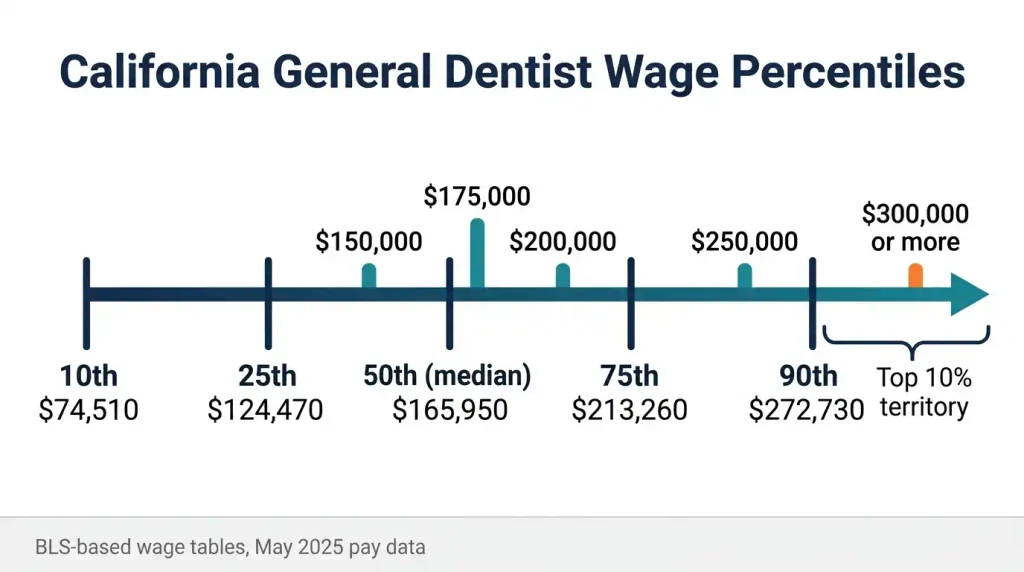
The low end, near $75,000, can reflect part-time schedules (compare part-time vs. full-time paychecks), a short work week, or a slow start. The upper end, above $272,000, can reflect full schedules, strong production, and higher-value procedures. The spread is almost four times, and dentists can land outside the range by working fewer days, carrying heavier patient loads, or doing more complex treatment. $150,000 sits above the 25th percentile but below the median, and $175,000 just above the median. $200,000 falls between the median and the 75th percentile, and $250,000 sits above the 75th and short of the 90th, so it is realistic but not typical. Pay above $272,730 is top 10% territory, and $300,000 or more is possible but far from the norm.
New Dentist vs. Experienced Dentist
A new dentist often starts below the state median, then grows. Indeed’s associate average is about $178,000, and one Los Angeles posting on Indeed, at the time of writing, offered $800 to $900 a day. Experience raises pay through speed, clinical range, a growing patient base, and negotiating power, but not automatically. Experienced associates often negotiate higher percentages or guarantees by showing production history, while the Indeed average blends every experience level. Entry-level figures should not set the bar for an offer, because a strong schedule and good formula can beat them.
General Dentist vs. Dental Specialist
BLS tracks general dentists separately from specialists, who usually earn more. Nationally, BLS puts the median for Dentists, All Other Specialists at $224,990, about 32% above the general-dentist median of $170,950, though that group leaves out oral surgeons, orthodontists, and prosthodontists. Those three specialties each get their own BLS category and typically out-earn general dentists. Mixing groups inflates the benchmark, so compare general dentists to general dentist data only. Dental hygienists, who work beside dentists, have their own pay data in our dental hygienist salary guide.
Dentist Salary by California Location
Location changes pay a lot. The latest BLS metro figures confirmed here are averages, not medians. In May 2024, they were $227,090 in the San Francisco area and $174,180 in Los Angeles, a gap of about $53,000 (May 2023: $256,070 and $165,040).
Highest- and Lower-Paying California Dental Markets
San Francisco leads and Los Angeles sits well below it. The San Francisco figure covers the San Francisco-Oakland metro area, so it includes Oakland. BLS May 2023 averages for Fresno ($205,690) and Bakersfield ($180,160) also top Los Angeles. Indeed postings show even higher advertised pay in Stockton ($332,914), Riverside ($281,182), Bakersfield ($265,306), Long Beach ($243,705), and Fresno ($240,104), but the samples are small and may include high-production roles, so read them as demand signals. The top-paying city is not always best, because rent, commute, and workload can cancel the raise.
Los Angeles, San Diego, San Francisco, San Jose, and Sacramento
BLS average annual wages by area (n/a means that year was not confirmed here):
| Area | May 2023 | May 2024 |
|---|---|---|
| San Francisco | $256,070 | $227,090 |
| San Jose | $198,130 | n/a |
| Sacramento | $173,760 | n/a |
| San Diego | $167,460 | n/a |
| Los Angeles | $165,040 | $174,180 |
Online salary tools show different numbers, so treat all of these as estimates. BLS published May 2025 metro tables in May 2026, so check them for the newest figures. To see take-home pay in each area, use the Los Angeles paycheck calculator, San Francisco paycheck calculator, San Jose paycheck calculator, or San Diego paycheck calculator. San Francisco and San Jose also cost much more to live in than Sacramento, which changes what the pay is worth.
Rural and Underserved California Markets
Smaller towns often have fewer dentists and more patients, so employers can struggle to hire. That can mean higher guarantees, sign-on bonuses, or loan repayment help, such as the National Health Service Corps. Many underserved clinics treat many patients covered by California Medi-Cal Dental, so check how that payer mix affects production-based pay. Housing is usually cheaper, so a smaller salary can stretch further. The trade-off is fewer specialists nearby and a smaller social scene.
What Determines a Dentist’s Salary in California?
Skills and experience, employer type, schedule fullness, and location drive most differences, and your contract’s pay formula ties them together.
Years of Experience and Clinical Skills
Faster dentists who handle more procedures independently usually produce more. Skills like implants, endodontics, and Invisalign raise production when patients need them. Show your numbers and ask for a terms review as production grows, since raises are not automatic.
Practice Type and Employer
Private practices, dental service organizations (DSOs), hospitals, government clinics, community health centers, and schools all pay differently. DSO, hospital, and public-sector terms vary, so check the schedule, benefits, patient volume expectations, and pay structure in writing. Community health centers and government jobs may pay less up front but add pensions, benefits, and loan repayment. A corporate dental practice does not always pay less than a private one, or the reverse, so compare formulas, not labels. Academic jobs usually trade pay for teaching time. The biggest advertised number rarely comes with the best package.
Patient Volume, Procedure Mix, and Practice Economics
Associates on production are paid for what the office books and delivers. Full schedules and higher-value work like crowns and implants raise production, while cleanings and exams raise it less. Contracted PPO plans reduce fees through write-offs, and Medi-Cal (Denti-Cal) reimburses at lower rates. Medi-Cal Dental’s extra Prop 56 supplemental payments were set to end July 1, 2026, but the 2026-27 state budget delayed that to July 1, 2027, so reimbursement may drop then. A busy office with poor payer mix can pay less than a quieter one with better fees. A fee-for-service office, where patients pay full fees without insurance discounts, can produce more per hour than a PPO-heavy one, though it may see fewer patients.
Associate Dentist Compensation: Salary vs. Production vs. Collections
Associates are paid by a daily guarantee, a percentage of production, or a percentage of collections, often whichever is higher. Contract definitions matter as much as the percentage.
Base Salary or Daily Guarantee
A daily guarantee turns into yearly pay over 46 weeks (an annual salary calculator can run other rates):
| Daily rate | 4 days a week (184 days) | 5 days a week (230 days) |
|---|---|---|
| $800 | $147,200 | $184,000 |
| $900 | $165,600 | $207,000 |
Watch for limits: some guarantees last only 90 days, apply only when your schedule is full, or switch to a percentage after a trial period.
Production-Based Compensation
At 30% of adjusted production, $3,000 produced in a day pays $900. Adjusted production usually means the billed amount minus write-offs, so if write-offs cut that day to $2,400, you earn $720. A higher percentage does not always win: 28% of $4,000 pays $1,120, while 32% of $3,200 pays $1,024.
Collections-Based Compensation
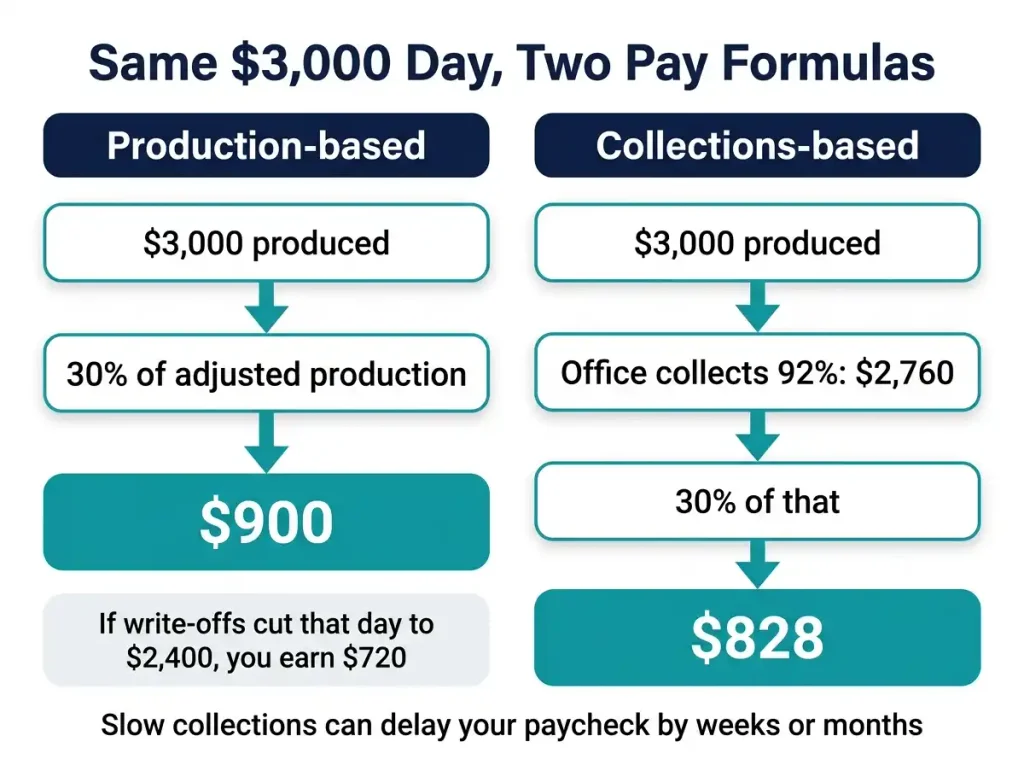
Collections pay is a percentage of money the office actually collects. If you produce $3,000 and the office collects 92%, that is $2,760, and 30% of that is $828. Slow collections delay your paycheck, sometimes by weeks or months, and many contracts split lab fees. Collections pay protects the owner from unpaid bills, while production pay protects you.
How Bonuses and Incentives Change Total Pay
Common extras include production bonuses above a target, collection bonuses, and sign-on bonuses. Keep guaranteed and performance pay on separate lines. A sign-on bonus is one-time, and some contracts require repayment if you leave early. Relocation bonuses often work the same way. Ask what happens if you miss a production target, since some contracts cut the guarantee, lower your percentage, or stop the bonus. Count recurring pay as yearly income and one-time pay as a bonus. Bonus pay is withheld differently from regular wages, so check the California bonus tax rate or the California bonus tax calculator before counting on a sign-on bonus.
How to Compare Two California Dentist Job Offers
Turn each offer into yearly income, pay per hour, and benefit value, then compare them. A bigger headline number can hide longer hours and weaker terms.
The Numbers to Put Side by Side
Line up the guarantee or base pay, production or collections percentage, days, hours per day, and expected patient flow. Add benefits like malpractice coverage, retirement matching, paid time off, paid sick leave, and continuing education money. An advertised dentist salary often covers base pay only, so ask whether health insurance is included and whether the plan offers an HSA. Ask whether the practice offers a 401(k) plan or only CalSavers. Add only bonuses you are likely to earn. California’s pay transparency law also requires employers with 15 or more employees to list a pay range in job postings, so compare the posted range with your offer.
A $180,000 Offer vs. a $220,000 Offer
Compare two offers over 46 weeks a year:
| Offer A | Offer B | |
|---|---|---|
| Pay | $180,000 | $220,000 |
| Schedule | Four 8-hour days a week | Five 8.5-hour days a week |
| Benefits | $15,000 | None |
| Total value | $195,000 | $220,000 |
| Hours per year | 1,472 | 1,955 |
| Pay per hour | About $132 | About $113 |
B pays $25,000 more on paper, but A pays more per hour and gives an extra day off each week.
Questions to Ask Before Signing an Associate Contract
Ask about:
- How long the guarantee lasts and what follows it
- How the contract defines production and collections, and what write-offs and lab fees come out first
- Typical patient volume and your schedule
- Who pays malpractice insurance, including tail coverage if you leave
- Notice periods and pay after you quit (see California’s final paycheck law)
- Your worker classification as a W-2 employee or a 1099 contractor, which changes taxes and benefits
Any of these can shift yearly earnings by thousands of dollars. An offer far below the 25th percentile ($124,470) for a full-time role deserves a hard look. So does one far above the 90th percentile ($272,730), since it may require heavy volume or long hours.
What Does a Dentist Salary Look Like After California Taxes and Living Costs?
Published salaries are gross, so taxes, housing, loans, and work costs reduce what you keep.
Gross Salary vs. Take-Home Pay
Gross pay is before deductions. Federal income tax, Social Security, Medicare, and California income tax and disability insurance all reduce it (see how California payroll taxes work). For a single filer earning about $200,000, taxes often take roughly a third, though that is a rough estimate. California’s disability insurance (SDI) rate is 1.3% of wages in 2026, up from 1.2% in 2025, with no wage cap. Use the CA SDI calculator to see your exact deduction. The California state income tax tops out at 12.3%, plus a 1% surcharge above $1 million that brings the top rate to 13.3%, so most dentists pay far less (check current rates with the Franchise Tax Board). Your real number depends on filing status, retirement contributions, and the standard deduction or itemized deductions.
For worked examples, see $150,000 after taxes in California, $175,000 after taxes in California, and $250,000 after taxes in California, or run your own numbers in our paycheck calculator for California. If a paycheck looks lower than expected, learn how to read a California pay stub.
California Cost of Living and Housing
Housing is the biggest swing. San Francisco and San Jose rank among the costliest places in the country, while inland markets like Stockton, Bakersfield, and Fresno cost far less. Two dentists earning $200,000 can end up in very different spots, one saving for a down payment in three years and the other still renting. The California cost of living does not adjust itself inside a contract, so check every offer against local rent.
Student Loans and Professional Expenses
Class of 2025 dental graduates with debt owed an average of $297,800 in education debt, according to ADEA, and loan payments can take a large share of a new dentist’s income. Add malpractice insurance if your employer does not cover it, license renewal, and continuing education (California requires 50 hours every two years). These costs shrink an employee dentist’s income. Owners face overhead, equipment loans, and business risk, but keep the profit. After rent and loans, saving a commonly cited 15% of gross income for retirement is harder in a high-rent metro.
Is a Dentist Salary in California Worth It in 2026?
For many dentists, yes, but weigh pay against hours, costs, and job quality.
When a California Dentist Offer Looks Competitive
An offer looks strong when total pay meets or beats the local benchmark for your work and the hours are fair. Good benefits, steady patient flow, and room to grow, like mentoring or a partnership option, add value. Compare it with your city’s numbers, not the state’s, and with goals like paying down loans or buying a home.
When a Higher Salary May Not Be the Better Deal
A bigger number can come with too many patients, long hours, no benefits, or a formula that cuts your share through write-offs and lab fees. If a $20,000 raise adds a workday and a long commute, hourly pay may drop. Weigh burnout, autonomy, and clinic quality too.
California vs. Another State
California’s median of $165,950 sits below New York ($183,060) and Washington ($169,730), and just above Nevada ($162,200). Washington and Nevada have no state income tax on wages, so similar pay can leave more in your pocket there. California adds higher taxes and housing prices but has a huge patient base and many jobs. Compare purchasing power, not just the paycheck. To practice here you need a California dental license from the Dental Board of California, which is part of the California Department of Consumer Affairs. Out-of-state dentists cannot start right away, so check the board’s current licensing steps and timeline before moving.
California Dentist Job Outlook and Earning Potential
California employs about 16,770 general dentists, nearly double the next highest state, and demand is steady, with the best opportunities often outside the biggest coastal cities.
Demand for General Dentists in California
The BLS Occupational Outlook Handbook projects national dentist employment to grow 6% from 2025 to 2035, faster than the average for all occupations, with general dentists rising from 141,900 to 150,000 jobs. Its $176,110 median covers all dentists, including specialists, while this article uses general dentists only. The California Employment Development Department (California EDD) publishes state projections through its California Labor Market Information Division, so check it before planning a move. More openings help you negotiate but do not guarantee a raise, since pay depends on skills, contract, and local market.
Where Dentists May Find Stronger Opportunities
As noted above, Indeed postings show the highest advertised pay in inland markets like Stockton, Riverside, Bakersfield, and Fresno. Rural and underserved areas often struggle to hire, which can mean better guarantees and loan help. Relocating or commuting widens your options and leverage. Read postings closely, since high advertised pay can carry high production targets. To compare dentistry with other careers, see our pharmacist salary in California, physical therapist salary in California, and attorney salary in California guides, or browse all California salaries by job and industry.
Real-World California Dentist Salary Scenarios
These examples use made-up numbers. Swap in your own offer.
New Graduate Evaluating a First Associate Offer
A new graduate gets $800 a day or 30% of adjusted production, whichever is higher, four days a week. At 46 weeks, the guarantee equals $147,200, below the $178,000 associate average, so ask how fast the schedule fills. If daily production reaches $3,000, pay rises to $900 a day, or $165,600 a year. Benefits and mentoring could close the rest of the gap.
Experienced Dentist Considering a Better-Paying Opportunity
A dentist earning $190,000 gets an offer for $215,000, but with a 45-minute commute, no malpractice coverage, a heavier patient load, and moving costs. After insurance and lost control over treatment plans, the real gain may be small. Compare pay per hour and total benefits, then decide if the lost freedom is worth the extra $25,000.
Dentist Choosing Between a High-Cost Metro and a Lower-Cost Market
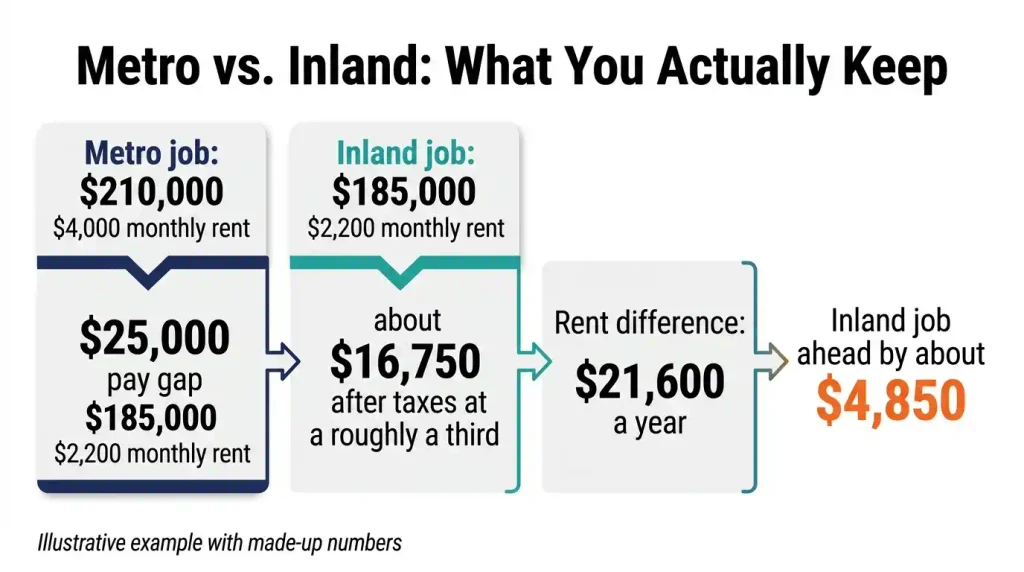
A metro job pays $210,000 with $4,000 monthly rent, and an inland job pays $185,000 with $2,200 monthly rent. The rent difference is $21,600 a year, and the $25,000 pay gap shrinks to about $16,750 after taxes at roughly a third. The inland job comes out about $4,850 ahead and may offer a quicker path to buying a home. The same logic applies to San Francisco versus Los Angeles, where BLS May 2024 averages differ by about $53,000 (about $91,000 in May 2023) but housing costs differ too.
How to Estimate Your Own California Dentist Earning Potential
Pick the right benchmark, apply your pay formula, then count benefits and costs to get one yearly and one hourly number.
Start With the Right Salary Benchmark
Match your benchmark to your work: general dentist or specialist, experience level, city, and pay type (employee, associate on production, or owner). A San Francisco dentist should not use the Los Angeles figure, and a general dentist should not use specialist pay. Your general dentist salary California benchmark starts at the state median of $165,950, and city and employer data sharpen it. Free tools such as O*NET and CareerOneStop list the same wage percentiles by state.
Adjust for Your Compensation Structure
Multiply daily pay by planned days. For production or collections, estimate daily production, apply your percentage, and subtract write-offs and lab fees. Keep guaranteed income separate from performance income. Be honest about workload, since a formula that works at $4,000 in daily production fails if the schedule supports only $2,500.
Calculate the Real Value of the Offer
Take yearly pay, add employer-paid benefits like malpractice, retirement matching, and continuing education, and subtract costs you pay yourself. Divide by hours worked and compare with your target and other offers. If it meets your goal and the job feels sustainable, it is competitive. If it lands below target, ask for a higher guarantee or percentage, anchored to the local median, or the 75th percentile with strong production. If it lands in range with fair terms, accept. If it is far below range with weak terms, keep looking.
Common Misconceptions About Dentist Salaries in California
Most mistakes come from applying one number to everyone. Four come up most.
“The Average Salary Is What Every Dentist Should Earn”
An average or median describes a group, not your skills, city, schedule, or contract. A new associate in Los Angeles and an experienced dentist in San Francisco face different markets, with BLS May 2024 averages of $174,180 and $227,090. Only about half of California dentists earn more than $165,950, and about one in four earns above $213,260, so $200,000 or more is far from universal. Government wage data describes the market, not any single offer.
“A Higher Production Percentage Always Means More Money”
A percentage only matters next to the production it applies to. A 28% share of a busy, high-fee schedule can beat 32% of a slow one. Write-offs, fee schedules, patient flow, and lab fees all shift the result, so run the numbers for each offer.
“Practice Owners and Associates Have the Same Income”
Associates earn an agreed wage or share. Owners earn what is left after rent, staff, supplies, loans, and taxes, and carry the business risk, so they can earn much more or much less. They also build equity, which associates do not. Ownership does not guarantee higher income, since a new practice may take time to turn a profit. Self-employed owners often pay self-employment tax and can save for retirement with a SEP IRA; see more in our tax savings planning guides.
“A $200K Salary Means $200K in Take-Home Pay”
A $200,000 salary is gross. After federal tax, California tax, Social Security, Medicare, and other deductions, a single filer often keeps roughly two-thirds. Retirement contributions and deductions can change that, so budget around take-home pay. See what $200,000 after taxes in California looks like.
Frequently Asked Questions About Dentist Salary in California
The BLS median for California general dentists is $165,950, and the answers below cover pay, location, and offers.
What is the average dentist salary in California in 2026?
The cleanest benchmark is the BLS median for general dentists, $165,950 a year, from May 2025 data published in 2026. Indeed shows $227,355 from job postings through July 2026. They differ because BLS surveys employers, while postings tilt toward what employers advertise.
How much does a new dentist make in California?
Most new dentists start as associates. Indeed’s associate average is about $178,000, and one Los Angeles posting on Indeed, at the time of writing, offered $800 to $900 a day, or $147,200 to $165,600 for four days a week. Pay varies by city, practice type, and whether the formula rests on a guarantee, production, or collections.
What is a good salary for a dentist in California?
A good salary meets or beats the local benchmark for your work, with fair hours and solid benefits. For a general dentist, that often means at or above the $165,950 state median, with higher expectations in costly cities. Judge offers by yearly income, hourly pay, and total benefits together.
Do dentists make more in California than in other states?
Not on paper. California’s median of $165,950 is about 3% below the national median of $170,950, and higher taxes and housing costs can widen the gap. Compare purchasing power, not just salary.
How much do associate dentists make in California?
Indeed lists an average of about $178,000 for associates. Pay usually comes as a daily guarantee, a percentage of production, a percentage of collections, or the higher of two. Owners earn differently, since they keep profit after expenses and make their own estimated tax payments.
Which California cities pay dentists the most?
BLS data from May 2024 shows San Francisco at an average of $227,090 and Los Angeles at $174,180 (May 2023: $256,070 and $165,040). Indeed postings show high advertised pay in Stockton, Riverside, Bakersfield, Long Beach, and Fresno. The top-paying city is not always the best fit, because housing, hours, and patient volume change what you keep.
Bottom Line: What Can You Realistically Earn as a Dentist in California in 2026?
Most general dentists in California can expect about $124,000 to $213,000, with $165,950 as the median. Your number depends on city, pay formula, and workload, so run the math on your actual offer.
The Salary Benchmark to Remember
Remember $165,950, the BLS median for general dentists in California, as a starting point. Specialists, associates, and owners follow different rules. Associates earn contract pay, while owners earn what the practice produces after costs.
The Four Numbers to Check Before Accepting an Offer
Check these four:
- Base salary or daily guarantee
- Production or collections formula and its definitions
- Workload (days, hours, patient volume)
- Total benefits

Yeasin Sorker is the founder of Paycheck Calculator California. He built this tool in 2018 after noticing that most free paycheck calculators missed California-specific rules like daily overtime and the uncapped SDI rate.
He researches California payroll tax updates regularly and keeps this calculator aligned with the latest IRS, FTB, and EDD published rates. All calculations on this site are estimates based on official 2026 government sources. For personalized tax advice, consult a qualified tax professional.