
Most employees find out about California’s PTO protections only after their employer has already violated them. By then, the final paycheck is issued, the PTO balance is gone, and the window to push back feels closed. It is not. California has some of the strongest earned wage protections in the country, and unused PTO sits squarely inside them.
Quick Answer: Can Employers Take Away Unused PTO in California?
No. California law treats accrued PTO as earned wages. Once you earn it, your employer cannot delete it, expire it, or take it away at year-end.
The Rule Against Forfeiting Earned PTO
California Labor Code §227.3 Protections
Labor Code §227.3 requires that when employment ends, all accrued unused vacation must be paid out at your final rate of pay, regardless of whether you quit, were fired, or were laid off.
The moment you earn PTO, those hours become vested wages. Your employer cannot take them back. PTO cannot disappear mid-employment either. If you have 80 hours on December 31st, those hours roll over. Period.
Is “Use It or Lose It” PTO Legal in California?
No. Use-it-or-lose-it PTO policies are illegal in California.
Handbook language like “unused PTO expires at year-end” or “time off must be used within the calendar year” means the same thing: forfeiture of earned wages. The California Division of Labor Standards Enforcement (DLSE) has made clear that any policy resulting in the loss of earned vacation is unenforceable.
California PTO Law Explained: What Employees Need to Know
What PTO Means Under California Employment Law
PTO is a single bank of hours covering vacation, personal days, and sometimes sick leave. California treats accrued vacation and other earned leave as deferred wages, not a perk. Sick leave operates under a separate law. If you see “paid leave” in a contract or separation agreement, check whether it covers vacation, sick time, or both, because payout rules differ. For a full breakdown of what appears on your paycheck and how these deductions work, see our guide on how to read a California pay stub.
Does California Require Employers to Offer PTO?
No. Vacation and PTO are voluntary benefits. Paid sick leave is required, but vacation is not.
Once an employer creates a PTO policy, they are bound by it. They cannot offer PTO and run it like a use-it-or-lose-it system. The protections under §227.3 apply to all California employers regardless of size. For HR compliance, that means consistent policies, accurate PTO tracking, and correct payout at termination. All topics covered under California labor laws apply here as well.
California PTO Accrual Rules: How Employees Earn Time Off
How PTO Accumulates
Most California employers use earned accrual (one hour per 30 hours worked) or front-loading (a set bank of hours given at the start of the year). Front-loaded PTO that is immediately available and usable typically carries the same wage protections as accrued PTO.
Employers can set approval rules, blackout dates, and mandatory PTO use during shutdowns. What they cannot do is use those rules to prevent employees from ever using PTO in a way that functions as forced forfeiture. This principle sits alongside other California meal and rest break laws as part of the state’s broader employee protections.
PTO Accrual Caps Explained
California employers can cap how much PTO you accumulate. Once you hit the cap, accrual stops until you use some hours. You do not lose anything already earned.
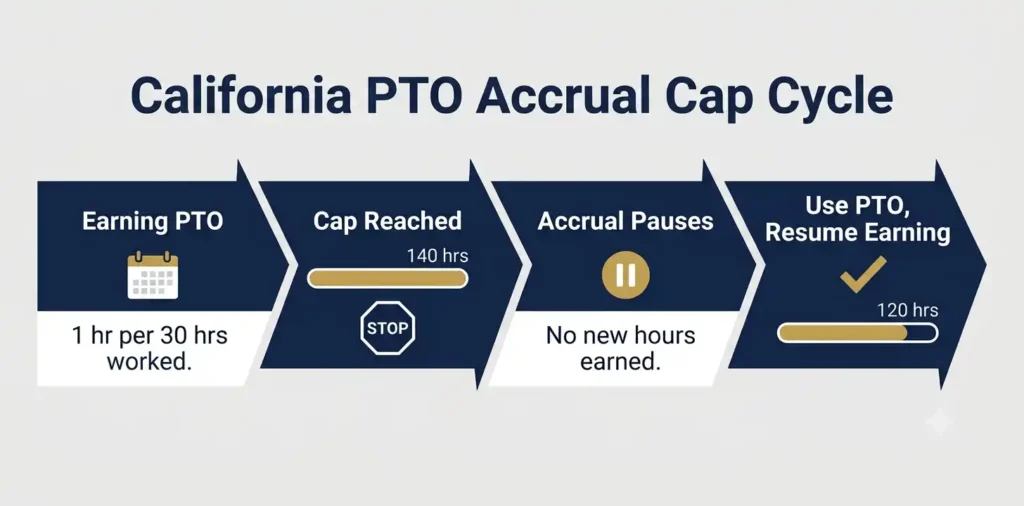
The DLSE previously cited 1.75x the annual accrual rate as its benchmark. It has since withdrawn that bright-line rule, but 1.75x remains the most accepted safe ratio. A 1.5x cap may be acceptable but carries more legal uncertainty. If you earn 80 hours per year, a 140-hour cap (1.75x) is the safest target.
Employers can require a waiting period before PTO begins accruing (30, 60, or 90 days is common). Employees on unpaid CFRA, disability, or personal leave do not automatically accrue PTO during that time unless the employer’s policy says otherwise. If you are also tracking California paid family leave during an absence, confirm separately whether PTO continues to accrue under your specific policy.
How California PTO Payout Works (With Real Examples)
How to Calculate Unused PTO Pay
Unused PTO hours multiplied by your final rate of pay. That is the full formula.
California requires the payout at your final rate, not the rate when the hours were accrued. If you got a raise, the higher rate applies to everything. Salaried employees divide annual salary by 2,080 to get the hourly equivalent. A $78,000 salary equals roughly $37.50 per hour. Use the California paycheck calculator to verify your exact net figures.
Example: Employee Leaves With 80 Hours of PTO
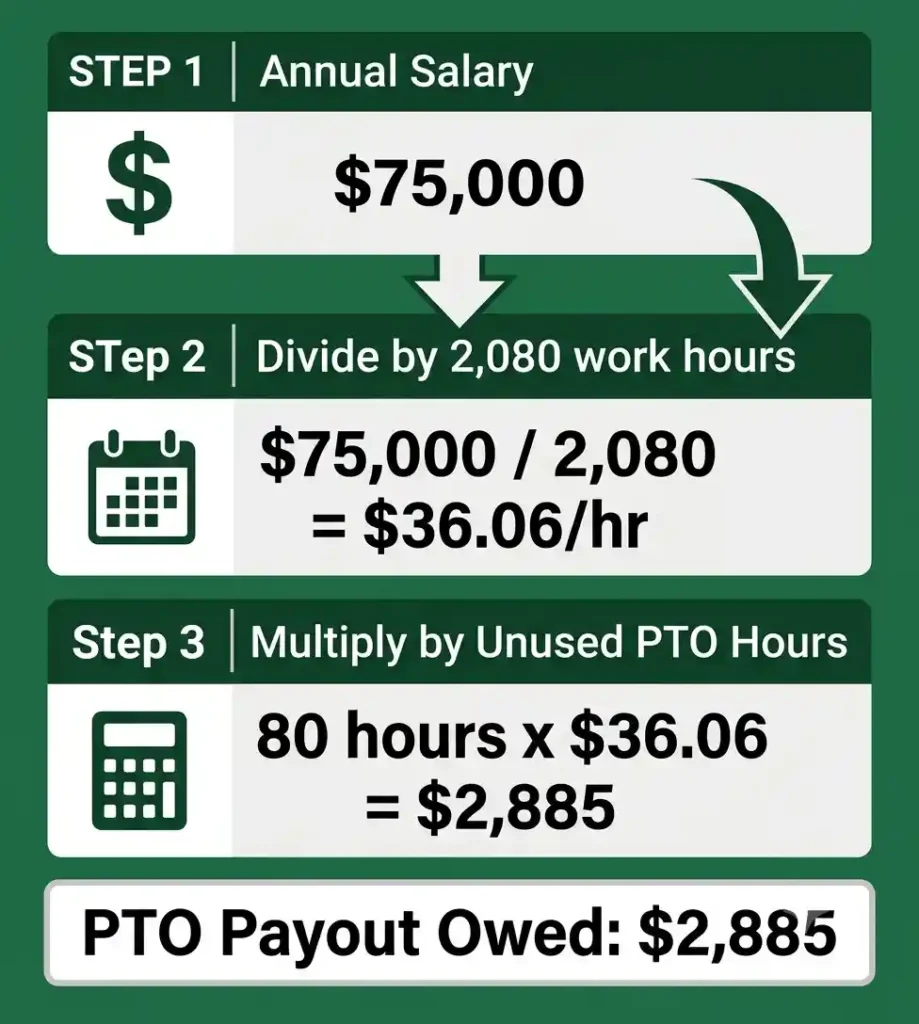
At $75,000 per year, your hourly rate is about $36.06. With 80 unused PTO hours, your employer owes you roughly $2,885. That must be in your final paycheck. It is not discretionary. Those 80 hours equal 80 unpaid hours of work. For perspective on what $75,000 actually takes home in California after all deductions, see 75k after taxes in California.
What Happens to Unused PTO When You Quit, Get Fired, or Are Laid Off?
PTO Payout Rules When You Quit
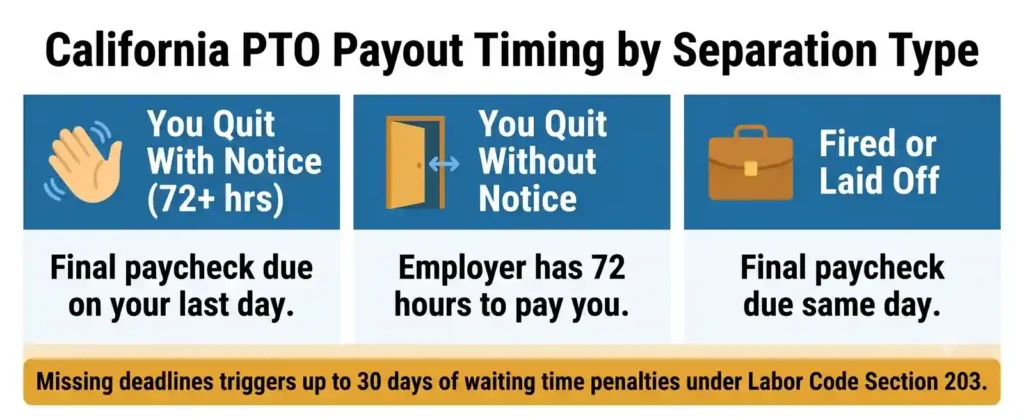
With 72 hours of advance notice, your final paycheck including PTO payout is due on your last day. Without notice, the employer has 72 hours to pay you. Missing those deadlines triggers waiting time penalties under Labor Code Section 203, up to 30 additional days of wages.
PTO Payout Rules After Being Fired or Laid Off
Final paycheck plus all accrued PTO is due on the same day employment ends. No grace period. The reason for termination does not matter. An employer cannot withhold PTO payout because you were fired for cause. For a complete breakdown of what must be included and the exact timing rules, see California final paycheck law.
If your employer offers a severance package, review any separation agreement carefully. Severance is negotiable. Your PTO payout under §227.3 is not, and signing a separation agreement does not waive it unless explicitly and lawfully addressed.
One exception: if you are covered by a collective bargaining agreement (CBA), your union contract may set different rules. Labor Code §227.3 carves out an exception for employees whose PTO terms are governed by a negotiated CBA.
PTO vs Vacation vs Sick Leave: What Actually Gets Paid Out?
PTO and Vacation Time
A combined PTO bank covering vacation and personal time is treated entirely as earned wages under §227.3. All of it must be paid out at termination. Vacation tracked separately gets the same protection. Earned vacation is earned wages. This is one area where many employees are surprised by how much they are actually owed.
California Paid Sick Leave
Sick leave is different. AB 1522 (2015) established California’s paid sick leave requirement at three days per year. SB 616, effective January 1, 2024, expanded that to at least 40 hours or five days per year. Unused sick leave does not have to be paid out at termination unless your employer’s policy says otherwise. For full details on how accrual, carryover, and usage caps work, see our guide on California sick leave laws.
Exception: if sick time is bundled into a combined PTO bank with vacation, the entire balance is treated as vacation wages and must be paid out.
Unlimited PTO Policies
Unlimited PTO is common at Bay Area and LA tech companies. Because there is no accrual, there is no defined balance to pay out at termination. A properly structured unlimited PTO policy generally creates no payout obligation.
But if the policy is unlimited in name only and employees are routinely denied time off, an attorney could argue payout is owed. The written policy alone does not settle it if actual practice tells a different story.
If your company converts from traditional PTO to unlimited PTO, your existing accrued balance must be paid out or cashed out before the conversion. Employers who skip this step create wage liability.
Real-Life California PTO Scenarios Employees Face
Employee Quits With 120 Unused PTO Hours
At $90,000 per year in San Jose, your hourly rate is about $43.27. With 120 unused hours, your employer owes roughly $5,192 in your final paycheck. If they claim the PTO expired or was forfeited, they are violating California law. Use the San Jose paycheck calculator to see what that salary looks like after California taxes.
Employer Changes PTO Policy Mid-Year
Employers can reduce future accrual rates going forward. They cannot eliminate PTO already earned. Hours accrued before the policy change are vested wages. The new policy applies only to hours earned after the effective date.
Employer Refuses PTO Payment
You have real options. Document everything. File a wage claim with the California DLSE at dir.ca.gov. It is free. Willful nonpayment triggers waiting time penalties under Labor Code Section 203, up to 30 days of additional wages.
Employee Reaches the PTO Accrual Cap
Hitting the cap stops new accrual. It does not erase what you have. You resume earning hours once you use some and drop below the cap. The existing balance remains yours as earned wages.
Employee With Unlimited PTO Leaves the Job
No accrual tracking means no defined balance and generally no payout obligation. But if time-off requests were routinely denied or the culture discouraged using it, a payout obligation could still exist. The written policy is only part of the picture.
California PTO Law Compared With Other States
Why California PTO Rules Are Different
Most states treat PTO as a benefit employers can design however they like, including use-it-or-lose-it with no payout at termination. In most other states, employees walk away from jobs every year losing earned time off with no legal recourse. California treats accrued PTO as wages. Withholding it is wage theft. The California Supreme Court established this in Suastez v. Plastic Dress Up (1982), and the DLSE has enforced it ever since.
Remote workers based in California are covered by the same protections regardless of where their employer is headquartered. Both exempt and non-exempt employees are covered under §227.3. The exempt/non-exempt distinction affects overtime, not PTO payout rights. For more on how California overtime rules work for both exempt and non-exempt workers, see California overtime laws.
California PTO vs Federal Law
The Fair Labor Standards Act (FLSA) sets minimum wage and overtime rules but says nothing about paid time off. There is no federal PTO payout requirement. California’s protections come entirely from state law. Workers covered by the paid leaves and benefits category of California employment law enjoy protections that simply do not exist at the federal level.
Common California PTO Myths and Misconceptions
Myth: Employers Can Delete PTO at Year End
They cannot. An employer can pause accrual at a cap, but cannot erase hours already earned. Any policy that wipes your PTO balance at year-end or any other trigger is unenforceable in California.
Myth: Company Handbook Overrides California Law
It does not. California statute takes precedence over any employer-drafted policy. A use-it-or-lose-it clause in a handbook is illegal whether or not you signed it.
Myth: Employees Must Use PTO Before Leaving
No such requirement exists. You have no obligation to use PTO before resigning. Every accrued hour must be paid out at your final rate of pay.
What To Do If Your Employer Refuses to Pay Unused PTO
Step 1: Review Your PTO Records
Pull your most recent pay stubs and check your HR portal. California law requires accurate wage statements that reflect accrued PTO. Know your exact balance and your final hourly rate before contacting anyone. If your paycheck looks wrong in any other way, our guide on why your California paycheck is so low can help identify other deduction issues.
Step 2: Ask HR for Written Explanation
Email HR and ask them to confirm your PTO balance and explain in writing why it was not paid out. Written requests create a record. That documentation matters if you file a claim.
Step 3: File a Wage Claim With California DLSE
File at dir.ca.gov. Free, no lawyer required. The DLSE will investigate and schedule a hearing if needed. An employment attorney can also help, many on contingency. Willful nonpayment can trigger California waiting time penalties under Labor Code Section 203, potentially adding 30 days of wages to what you recover.
Frequently Asked Questions About California PTO Law
Can my employer make me lose unused PTO?
No. Earned PTO is yours. Employers can cap accrual but cannot take away hours already earned.
Does unused PTO expire in California?
No. Accrued PTO carries over indefinitely. A cap freezes new accrual; it does not erase existing hours.
Does California pay out PTO when you quit?
Yes. All accrued unused PTO must be in your final paycheck at your final rate of pay, whether you quit, were fired, or were laid off.
Can my employer refuse PTO payout?
Not legally. Refusal violates Labor Code §227.3. File a wage claim with the DLSE and you may also recover waiting time penalties.
Does sick leave get paid out in California?
Generally no, unless your policy says otherwise. Exception: if sick leave is bundled into a combined PTO bank with vacation, the entire balance must be paid out.
Can employers have unlimited PTO in California?
Yes. A properly structured unlimited PTO policy with no accrual tracking typically creates no payout obligation at termination. If the policy is unlimited in name only, that changes the analysis.
California PTO Law Checklist Before Leaving Your Job
- Review your PTO balance. Confirm accrued hours in your HR portal or on your pay stub.
- Save all PTO-related documents. Accrual history, emails, and the relevant handbook section.
- Confirm final paycheck details. Ask HR in writing how PTO payout will be calculated before your last day.
- Calculate your payout amount. Unused hours multiplied by your current hourly rate.
- Decide whether to use PTO before leaving. Not required, but valid if your employer approves the time.
- Know when to push back. If the policy language looks like forfeiture, ask HR for a written explanation before signing anything.
Final Takeaway: Protect Your Earned PTO Rights in California
Earned PTO belongs to you. It cannot be forfeited, deleted, or expired, and it must be paid out at your final rate when you leave. If your employer withholds it, document everything, request a written explanation, and file a wage claim with the DLSE. The process is free, and the penalties for employers who ignore the law are real. For everything else that affects your California paycheck, visit the California labor laws resource hub.

Yeasin Sorker is the founder of Paycheck Calculator California. He built this tool in 2018 after noticing that most free paycheck calculators missed California-specific rules like daily overtime and the uncapped SDI rate.
He researches California payroll tax updates regularly and keeps this calculator aligned with the latest IRS, FTB, and EDD published rates. All calculations on this site are estimates based on official 2026 government sources. For personalized tax advice, consult a qualified tax professional.