
When a family member dies, the last thing you should worry about is your job. California’s AB 1949 gives most workers the right to take time off, and your employer cannot legally punish you for it. Here is exactly what the law covers, who qualifies, and what to do if your employer says no. For a broader look at leave protections available to California workers, see the paid leaves and benefits resource hub.
Quick Answer: California Bereavement Leave at a Glance
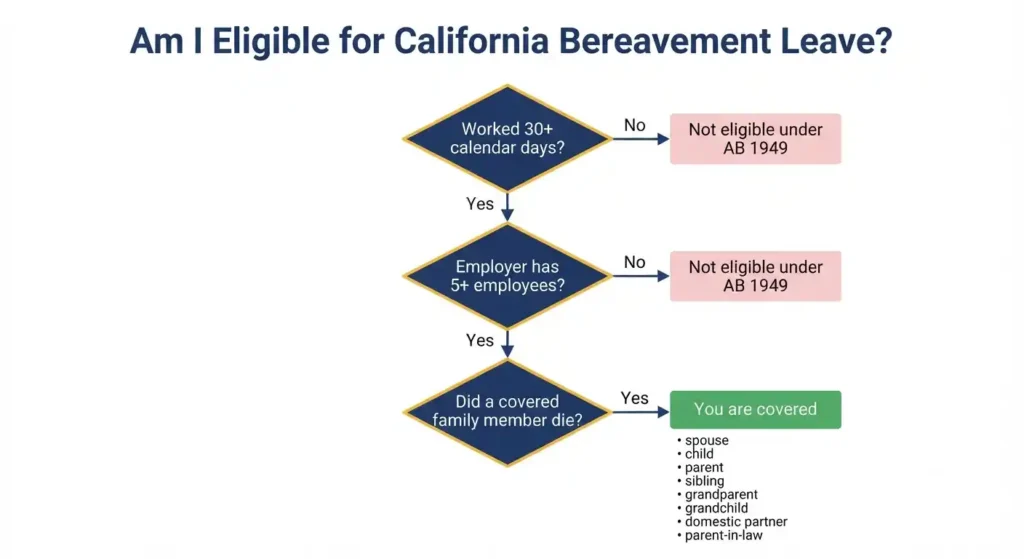
California requires most employers to provide up to five days of bereavement leave after a qualifying family member dies. If you have worked at least 30 days, your employer has five or more employees, and a covered family member died, this leave applies to you. It is job-protected but not automatically paid. Use accrued sick leave, PTO, or vacation to stay paid if your employer has no paid policy.
| Detail | What the Law Says |
|---|---|
| Maximum leave | 5 days per qualifying death |
| Paid or unpaid | Unpaid by law; employer policy or accrued leave may cover pay |
| Minimum employment | 30 days before start of leave |
| Employer size | 5 or more employees |
| Time window | All 5 days within 3 months of death |
Comparison Table
Bereavement Leave vs CFRA vs FMLA vs Sick Leave vs PTO
Understanding how these overlap, and how they do not, prevents costly mistakes when timing matters. California’s sick leave laws and PTO rules each have their own accrual and usage rules that interact with bereavement leave.
Purpose
| Leave Type | Primary Use |
|---|---|
| Bereavement Leave (AB 1949) | Death of a qualifying family member |
| CFRA | Serious illness, new child, bonding, or caregiving |
| FMLA | Serious illness or family caregiving (federal version) |
| Sick Leave | Your own illness or caring for a family member |
| PTO/Vacation | Any personal reason, at employer discretion |
Pay
| Leave Type | Paid or Unpaid |
|---|---|
| Bereavement Leave | Unpaid unless employer policy says otherwise |
| CFRA | Unpaid (SDI or PFL may apply separately) |
| FMLA | Unpaid |
| Sick Leave | Paid (California requires at least 5 paid sick days/year) |
| PTO/Vacation | Paid |
Eligibility
| Leave Type | Requirements |
|---|---|
| Bereavement Leave | 30+ days employed, employer has 5+ employees |
| CFRA | 12 months employed, 1,250 hours worked, employer has 5+ employees |
| FMLA | 12 months employed, 1,250 hours, employer has 50+ employees |
| Sick Leave | After 30 days worked in California |
| PTO/Vacation | Per employer policy |
Job Protection
| Leave Type | Legal Protections |
|---|---|
| Bereavement Leave | Yes, under AB 1949 / Government Code 12945.7 |
| CFRA | Yes, full job protection |
| FMLA | Yes, full job protection |
| Sick Leave | Yes, protected under California law |
| PTO/Vacation | Generally yes, per employer policy |
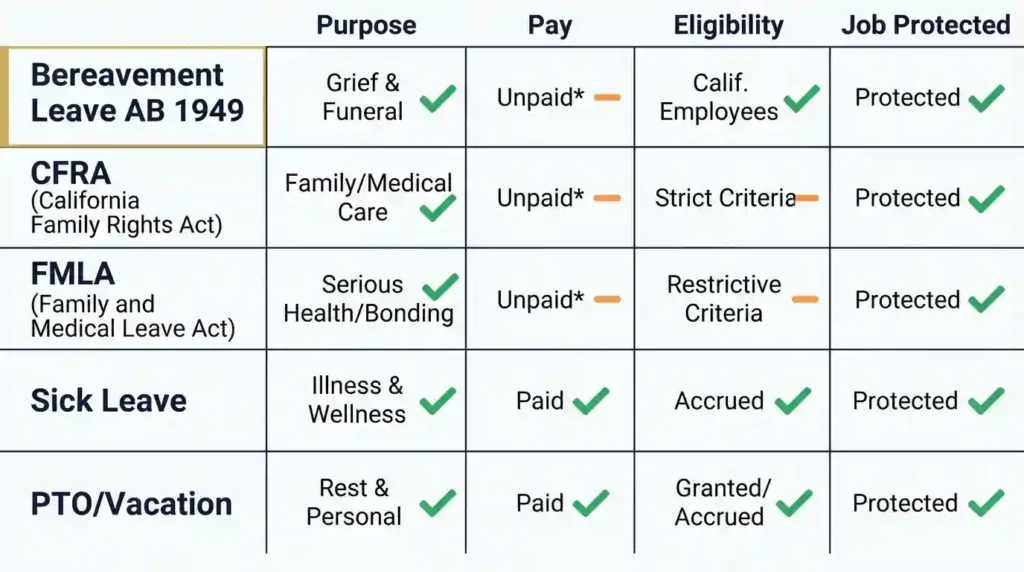
Takeaway: Bereavement leave is completely separate from CFRA and FMLA. Taking five days does not touch your 12 weeks of CFRA leave. If you are also navigating California Paid Family Leave alongside bereavement, they are handled through separate programs under different timelines. All of these fall under California labor laws that set minimum standards every covered employer must follow.
California Bereavement Leave Eligibility
Who Can Take Bereavement Leave?
You qualify if you have worked at least 30 calendar days, your employer has five or more employees, and a covered family member died. This applies to private and public employers alike, and to part-time, full-time, remote, and on-site workers. Probationary employees are not excluded. The 30-day clock is calendar days, not business days.
Who Is NOT Eligible?
Employers with four or fewer employees are exempt from AB 1949. Independent contractors, freelancers, and 1099 workers are not covered. If you are unsure whether you are legally classified as an employee or contractor, California’s ABC test determines your status, and misclassification is common. For a side-by-side breakdown of how 1099 vs W-2 classification affects your workplace rights and take-home pay, that guide covers both angles. Union members under a collective bargaining agreement that already provides at least five days of bereavement leave are also exempt, since their CBA governs instead.
How California Bereavement Leave Works
How Many Days Can You Take?
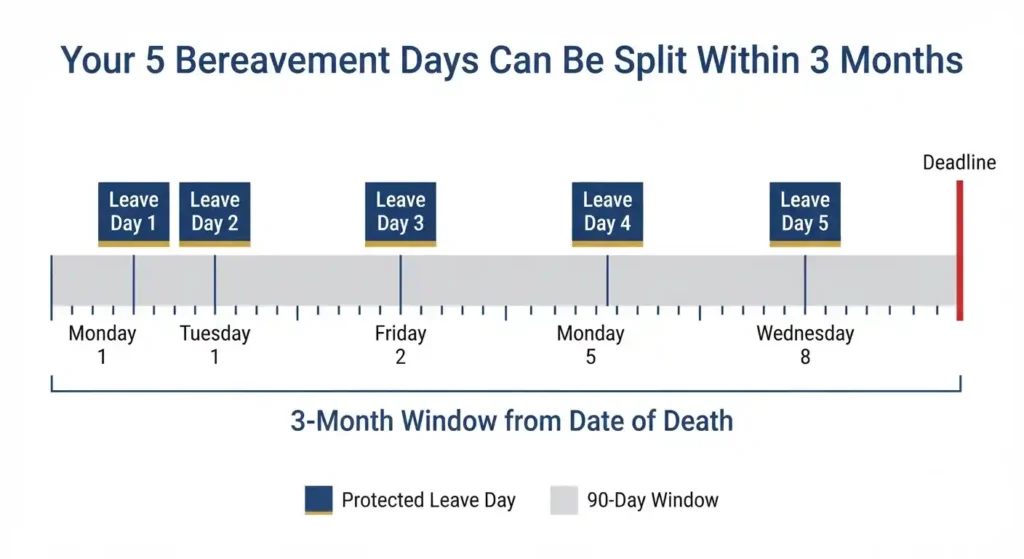
Up to five days per qualifying death, taken consecutively or split across three months. The leave covers funeral attendance, burial logistics, estate administration, and travel to out-of-state or international services. Weekends do not pause the three-month window, but you choose which workdays to designate within it. There is no annual cap. Each qualifying death gives you a separate five-day entitlement.
Is Bereavement Leave Paid?
The law requires your employer to allow the leave, not pay for it. If your employer has a paid bereavement policy, it applies. If not, the days are unpaid. You can substitute accrued sick leave, vacation, or PTO for any unpaid days, and your employer cannot block you from doing so. California’s Employment Development Department (EDD) administers disability and paid family leave benefits that may also apply if your grief leads to a qualifying medical condition. Federal law has no bereavement leave requirement at all. California is among a small group of states with explicit statutory protections for grief leave.
Which Family Members Qualify?
Eligible Family Members
Eight relationships are covered: spouse, child, parent, sibling, grandparent, grandchild, domestic partner, and parent-in-law. “Child” includes biological, adopted, foster, step, and legally custodied children. “Parent” includes stepparents, foster parents, and legal guardians.
Relationships That Usually Do Not Qualify
Cousins, aunts, uncles, friends, fiancés, and sibling-in-laws are not covered under AB 1949. Chosen family members fall outside the statutory definition regardless of closeness. Note: California SB 1149, introduced in February 2026, proposes expanding bereavement leave to include chosen family and extended relatives. As of mid-2026, it is pending in committee and not yet law. Employer policies may voluntarily cover these relationships, but state law does not require it.
Family Relationship Comparison Table
Covered
| Relationship | Notes |
|---|---|
| Spouse | Legal or registered domestic partner |
| Child | Biological, adopted, foster, step, legal custody |
| Parent | Biological, step, foster, legal guardian |
| Sibling | Biological, half, step |
| Grandparent | Both maternal and paternal |
| Grandchild | All grandchildren |
| Domestic Partner | State-registered |
| Parent-in-law | Your spouse’s or domestic partner’s parent |
Not Covered
| Relationship | Notes |
|---|---|
| Cousin | Not in AB 1949 |
| Aunt or uncle | Not in AB 1949 |
| Friend | Not in AB 1949 |
| Sibling-in-law | Not in AB 1949 |
| Niece or nephew | Not in AB 1949 |
Takeaway: If the person is not in the eight covered categories, state law does not protect the leave, but your employer’s policy might still allow it.
How to Request Bereavement Leave
Step 1: Notify Your Employer
Notify your employer as soon as you can. Advance notice is not required since death is unpredictable. Start with a verbal notice if needed, but always follow up in writing by email or text. Verbal-only notification is the most common employee mistake and creates disputes later.
Step 2: Submit Documentation
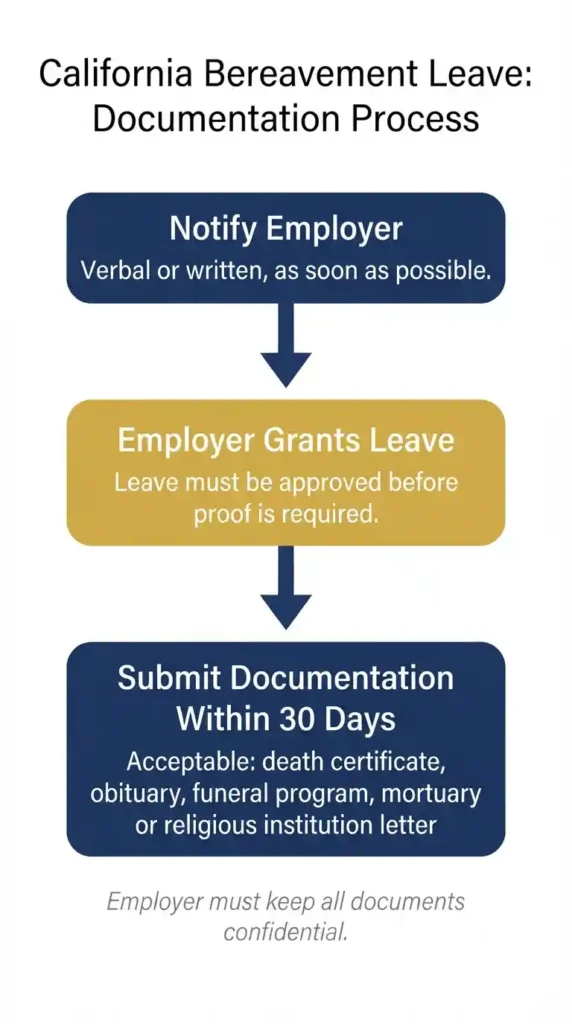
Your employer can request documentation at any point, including when you first notify them. Acceptable documents: death certificate, obituary, funeral program, or written verification from a mortuary, funeral home, crematorium, religious institution, or government agency. You have 30 days from the first day of leave to provide it. The law requires the employer to grant the leave first; documentation follows within that window. All submitted records must be kept confidential. If your bereavement leave appears on your pay stub as an unpaid deduction, the California pay stub guide explains every line item and what each code means.
Step 3: Return to Work
You return to your same or a comparable position. Your employer cannot use bereavement leave against you in any performance review, attendance record, or disciplinary action. You are not required to share the cause of death or any details beyond confirming the relationship.
Can Your Employer Deny Bereavement Leave?
When They Can
Denial is legal if you have worked fewer than 30 days, the deceased is not a covered family member, you cannot provide documentation within 30 days, your workplace has fewer than five employees, or your CBA already covers the leave.
When They Cannot
If you meet all eligibility requirements and the death qualifies, your employer cannot deny, interfere with, or create barriers to your leave. Interference, pressure, or retaliation are unlawful practices under Government Code 12945.7.
If Your Leave Is Denied
Put the request in writing to HR, citing AB 1949. If still denied, file a complaint with California’s Civil Rights Department (CRD) at calcivilrights.ca.gov. You have three years from the violation date to file with the CRD. After the CRD issues a right-to-sue letter, you have one additional year to file a civil lawsuit. Retaliation for asserting your rights is a separate legal claim. Many California counties have worker centers that can connect you with grief support resources and guidance while your complaint is pending.
Real-Life Examples
These scenarios show how AB 1949 works in practice. For more California paycheck scenarios covering taxes, deductions, and income situations, browse the full scenario library.
Parent Passes Away
You have worked at a Los Angeles company for eight months. Your mother dies Monday. You take Tuesday through Thursday, return to work, then use the remaining two days the following week before the burial service. All five days are job-protected under AB 1949 and cannot be counted against your attendance.
Grandparent Dies Out of State
Your grandmother dies in Texas on a Friday. You take three days the following week and one more day later that month for estate paperwork. You still have one protected day remaining to use within three months. Splitting days across weeks is fully legal under AB 1949.
Employer Offers Only Three Days
Your company policy gives three paid days. AB 1949 requires five. Your employer must allow the additional two days, even unpaid. You can use accrued sick leave or PTO to cover them. Refusing the extra days is a violation of California law.
Multiple Deaths in One Year
You lose a sibling in February and a grandparent in August. Each death is a separate event with its own five-day entitlement and three-month window. No annual cap applies. Every qualifying death resets the clock.
Special Situations and Edge Cases
Part-Time, Temporary, Seasonal, and Remote Employees
AB 1949 covers part-time, full-time, temporary, seasonal, hybrid, and remote workers equally. If you have been employed 30 days and your employer has five or more employees, you qualify regardless of classification or where you work. For a detailed look at how paycheck deductions differ by work schedule, see the part-time vs full-time paycheck breakdown for California workers.
Union Employees
Your CBA governs your bereavement leave only if it expressly provides at least five days of leave AND requires a regular hourly rate at least 30% above California’s minimum wage. With the 2026 California minimum wage at $16.50/hour, the threshold is roughly $21.45/hour. If the CBA falls short on either condition, AB 1949 applies in full.
Delayed Memorial Services
Services delayed by weeks due to travel, family logistics, or religious customs are fully covered. You can designate your five workdays anywhere within the three-month window.
Company Offers Better Benefits
The law is a floor, not a ceiling. If your employer offers more days or broader family coverage than AB 1949 requires, you keep the better benefit.
Common Myths About California Bereavement Leave
Myth: Every Employer Must Pay You
False. AB 1949 requires leave, not pay. Pay depends on your employer’s existing policy. You can use accrued PTO or sick leave to stay paid.
Myth: Leave Must Be Taken All at Once
False. Split your five days any way you need within three months of the death.
Myth: Only Immediate Family Counts
Not accurate. The covered list includes grandparents, grandchildren, domestic partners, and parents-in-law, which go beyond most people’s definition of immediate family.
Myth: Company Policy Overrides State Law
The opposite is true. Company policy cannot reduce your AB 1949 rights. If your company offers three days, state law still entitles you to five. Policy can only add to the minimum, never subtract from it. The California Department of Industrial Relations (DIR) enforces workplace rights standards across all covered employers.
Myth: Employers Cannot Ask for Documentation
They can, and commonly do. You have 30 days from the first day of leave to provide it. They must keep it confidential.
Myth: Bereavement Leave Uses CFRA Leave
False. Bereavement leave under AB 1949 is entirely separate from CFRA. Taking five bereavement days does not reduce your 12 weeks of CFRA entitlement by a single day.
Frequently Asked Questions
Is bereavement leave paid in California?
Not automatically. The leave is job-protected but unpaid unless your employer has a paid policy. You can use accrued sick leave, PTO, or vacation to stay paid.
How many days of bereavement leave do I get?
Up to five days per qualifying death, with no annual cap.
Can I split my five days?
Yes. Use them in any combination within three months of the date of death.
Can my employer require proof?
Yes. Acceptable documents include a death certificate, obituary, or funeral notice. You have 30 days from the first day of leave to provide it.
Can I use PTO during bereavement leave?
Yes. You can substitute any accrued PTO, vacation, or sick leave for unpaid days. Your employer cannot block this.
Can my employer deny bereavement leave?
Only if you are ineligible: fewer than 30 days employed, a non-covered relationship, or a workplace with fewer than five employees.
Does the law cover grandparents?
Yes. Grandparents and grandchildren are both explicitly listed in AB 1949.
What if my employer has fewer than five employees?
AB 1949 does not apply. Check your employer’s voluntary policy, if one exists.
Can I take leave for a friend or cousin?
Not under AB 1949. Your employer may allow it voluntarily, but state law does not require it.
Is bereavement leave separate from CFRA?
Yes. Bereavement leave does not count against your 12 weeks of CFRA leave.
Can I take leave for more than one family death?
Yes. Each qualifying death is a separate five-day entitlement with its own three-month window.
What happens if my employer retaliates?
File a complaint with the California Civil Rights Department at calcivilrights.ca.gov. You have three years from the violation to file. After receiving a right-to-sue letter, you have one more year to file a civil lawsuit.
Key Takeaways
AB 1949 gives most California workers up to five protected days off per qualifying death. You qualify with 30 days of employment and an employer with five or more employees. The eight covered relationships are spouse, child, parent, sibling, grandparent, grandchild, domestic partner, and parent-in-law. Leave is job-protected but not automatically paid. Use accrued sick leave, PTO, or vacation to stay paid. Days can be split within three months of the death. Your employer can ask for documentation; you have 30 days to provide it. Bereavement leave does not touch your CFRA entitlement. If you want to understand how unpaid leave days affect your overall take-home pay, use the California paycheck calculator to model your numbers. And if your job ends during or after your leave, review California final paycheck laws to know exactly what you are owed and when.
Quick Eligibility Checklist
- Worked at least 30 calendar days?
- Employer has five or more employees?
- Deceased is one of the eight covered relationships?
- All five days will be used within three months of the death?
If yes to all four, you are covered under California law. If no to any, check your employer’s voluntary policy.

Yeasin Sorker is the founder of Paycheck Calculator California. He built this tool in 2018 after noticing that most free paycheck calculators missed California-specific rules like daily overtime and the uncapped SDI rate.
He researches California payroll tax updates regularly and keeps this calculator aligned with the latest IRS, FTB, and EDD published rates. All calculations on this site are estimates based on official 2026 government sources. For personalized tax advice, consult a qualified tax professional.