
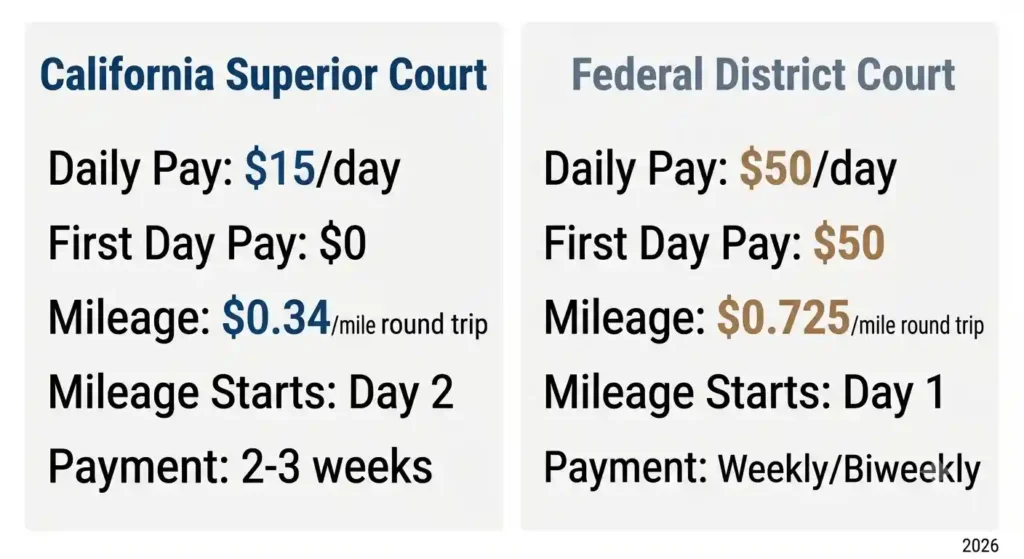
California pays jurors $15 per day, but only starting on day two. Day one is completely unpaid by the court. If you are called to federal court instead, the rate jumps to $50 per day from day one. Most private employers are not legally required to pay your wages while you serve, which means for many workers, the gap between what the court pays and what you actually lose can exceed $500 for a single week. What you receive depends on which court summoned you, where you work, and your company’s voluntary policy.
Quick Answer: California Jury Duty Pay at a Glance
To qualify for jury duty in California, you must be a U.S. citizen, a county resident, at least 18 years old, and able to communicate in English. People on active felony probation or parole are not eligible.
California Jury Duty Pay Comparison Table
State vs Federal
| Court Type | Daily Pay | Starts On | Mileage Rate |
|---|---|---|---|
| California Superior Court | $15/day | Day 2 | $0.34/mile (round trip) |
| Federal District Court | $50/day | Day 1 | $0.725/mile (round trip) |
Day 1 vs Day 2+
| Day | State Pay | Mileage | Transit Option |
|---|---|---|---|
| Day 1 | $0 | None | $12 |
| Day 2 and beyond | $15 | $0.34/mile | $12/day |
Employer Types
| Employer Type | Pay Requirement During Jury Duty |
|---|---|
| Private (hourly) | Not required by law |
| Private (salaried exempt) | Usually continues; depends on policy |
| State/Local Government | Regular salary typically continues |
| Union Employee | Depends on collective bargaining agreement |
Reimbursement Summary
| Type | Amount | When It Starts |
|---|---|---|
| Daily court pay | $15 | Day 2 |
| Mileage | $0.34/mile (round trip) | Day 2 |
| Public transit option | $12/day | Day 1 |
| Federal mileage | $0.725/mile (round trip) | Day 1 |
Jury Duty Pay in California (2026 Rates)
Daily Jury Pay
California Superior Court pays $15/day starting on day two. Day one pays nothing, no matter how long you wait. The $15 juror attendance fee applies statewide for both petit jury (trial jury) and grand jury service in civil and criminal cases. Long trials pay the same rate. California also uses a one-day or one-trial system: if you are not selected after day one, your civic duty is fulfilled for at least 12 months. Keep in mind that any overtime you normally earn is also lost during jury service, and the state provides no supplement for it. For a full breakdown of how California overtime laws work, including daily and weekly thresholds, see our dedicated guide.
Federal court pays $50/day starting on day one, with mileage at $0.725/mile round trip.
Mileage Reimbursement
State courts pay $0.34/mile round trip starting on day two. A 15-mile commute earns $10.20/day (30-mile round trip x $0.34). A 20-mile commute earns $13.60/day. Public transit pays up to $12/day starting on day one instead of mileage. Most courts validate parking in designated juror lots. Private lots, meters, and tolls are generally not reimbursed.
Federal courts reimburse mileage at $0.725/mile round trip, more than twice the state rate.
How and When You Get Paid
State courts mail a check within two to three weeks after your service ends. Some counties offer direct deposit, but mailed payment is the default. You do not need to request payment; the court triggers it from your attendance records. Jury pay is taxable income. Report it as “other income” on your federal return. Courts send a 1099 if you earn $600 or more in a calendar year. Mileage reimbursement is not taxable. For guidance on how this income interacts with your California income tax brackets, see the FTB’s rules or check IRS Publication 525 for federal reporting. Federal courts pay weekly or biweekly depending on the district.
Will Your Employer Pay You During Jury Duty?
California Law
California Labor Code Section 230 requires every employer to give you time off for jury duty, a civic responsibility under state law. Your employer cannot fire, demote, cut hours, or retaliate against you for serving. They must let you go. They do not have to pay you. For a broader look at how these protections fit into California labor laws, including wage claims and employee rights, see our full category guide.
Private Employees
For private workers, whether you get paid depends entirely on your employer’s voluntary policy. The law sets no pay floor during jury service.
Hourly Workers
Private employers are not required to pay non-exempt hourly employees during jury duty. Your wages stop unless your company has a jury leave policy. You can use accrued vacation, sick days, or PTO to cover the gap. If you are unsure how your PTO accrual works, California PTO law sets the rules on what your employer must pay out and when. If you use PTO and also receive the $15/day court check, some employers will ask you to sign it over.
At $22/hour for eight-hour days, a five-day trial without employer pay costs about $880 in lost wages. The state pays you $60. That gap is real. If you want to see exactly how taxes and deductions affect your take-home before and after jury duty, it helps to read your California pay stub line by line.
Salaried Employees
Most companies with formal HR policies continue salary for exempt salaried employees, though the law does not require it. If you work even part of a day that week, federal FLSA rules generally prevent your employer from docking your full salary. If your employer pays you, they may ask for the court check back. Check your employee handbook before your first day.
Government Employees
State and local government workers keep their regular salary during jury duty. Under Government Code Section 481.200, government jurors receiving regular pay must fill out a waiver form so the court does not double-pay them. Mileage reimbursement still applies unless waived.
Union Employees
Your collective bargaining agreement may require the employer to make up the difference between court pay and your regular wages. Check your contract or ask your union rep before your service date. Union jury leave provisions fall under the broader category of paid leaves and benefits in California, which also covers paid family leave, sick leave, and bereavement leave rights in California.
California State Court vs Federal Court Jury Pay
Comparison Table
| Feature | California Superior Court | Federal District Court |
|---|---|---|
| Daily pay | $15/day | $50/day |
| First day pay | $0 | $50 |
| Mileage | $0.34/mile (round trip) | $0.725/mile (round trip) |
| Mileage start | Day 2 | Day 1 |
| Payment timing | 2-3 weeks after service | Weekly or biweekly by district |
| Federal employee pay | Regular salary | Regular salary (off days only) |
Federal court pays more than three times the state rate and starts on day one.
How to Tell Which Court Summoned You
Check the court name at the top of your summons. State summons come from a California Superior Court. Federal summons come from a U.S. District Court with a federal case number. California federal districts: Central (Los Angeles), Northern (San Francisco/San Jose), Eastern (Sacramento/Fresno), Southern (San Diego).
What If Jury Duty Creates Financial Hardship?
Hardship Excuse
Under California Rules of Court, Rule 2.1008, courts can excuse jurors facing extreme financial burden. Simple income loss is not enough. You must show a genuine hardship that cannot be solved by postponing service. Submit your request in writing before your service date through your county’s online juror portal. Include your employer’s name, days they will pay you, household size, and a detailed explanation. Courts deny many of these requests.
Requesting a Postponement
Postponement is easier than an excuse. Courts allow one postponement of up to 90 days. Students and teachers can usually push service to a school break. Caregivers of children under 10 with no substitute care, and jurors with documented medical conditions, may also qualify for an excusal under Rule 2.1008. Request online, by phone, or by mail using your summons response form.
Jury Duty Pay Calculator Examples
Use the examples below to estimate what you will receive from the state. For a more complete picture of your take-home pay before and after jury duty, the California paycheck calculator on our homepage can show you your exact net pay based on your hourly rate or salary.
One-Day Jury Service
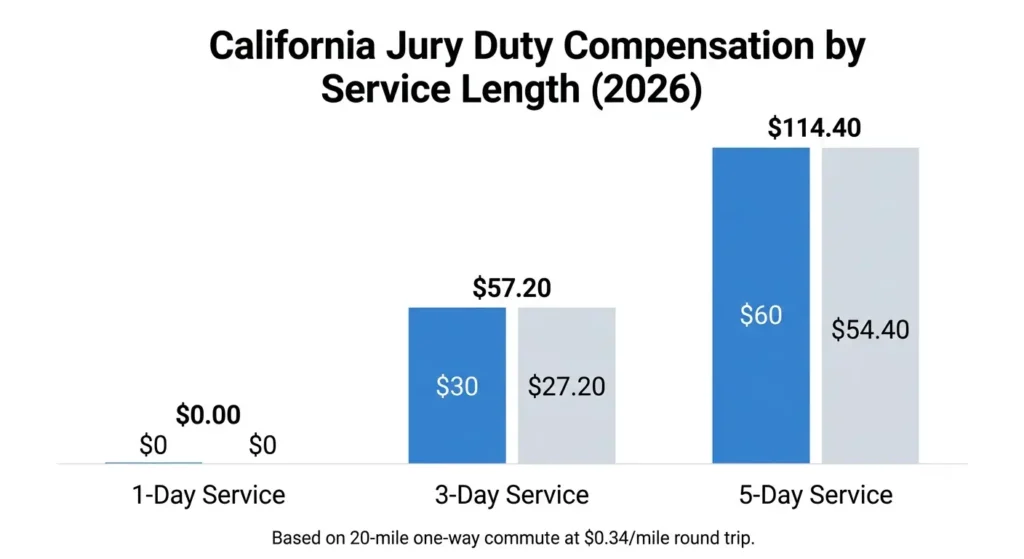
You report, wait all day, get dismissed without being selected. Court pay: $0. Mileage: $0. Total: $0. Day one is always unpaid.
Three-Day Jury Service
Courthouse 20 miles away (40-mile round trip).
| Day | Court Pay | Mileage (40-mile round trip) |
|---|---|---|
| Day 1 (Monday) | $0 | $0 |
| Day 2 (Tuesday) | $15 | $13.60 |
| Day 3 (Wednesday) | $15 | $13.60 |
| Total | $30 | $27.20 |
Total from the state: $57.20.
Five-Day Trial Example
Courthouse 20 miles away (40-mile round trip).
| Days | Court Pay | Mileage (40-mile round trip x $0.34) |
|---|---|---|
| Day 1 | $0 | $0 |
| Days 2-5 (4 days at $15) | $60 | $54.40 |
| Total | $60 | $54.40 |
Total from the state: $114.40. If you earn $25/hour for eight-hour days and your employer does not pay, you lose approximately $1,000 in wages.
How Much Money Will You Actually Lose?
Hourly Employee Examples
At California’s 2026 minimum wage of $16.90/hour, you lose $135.20 per unpaid day. Over five days: $676 in lost wages, offset by $60 in court pay and roughly $54 in mileage. Net loss: over $560.
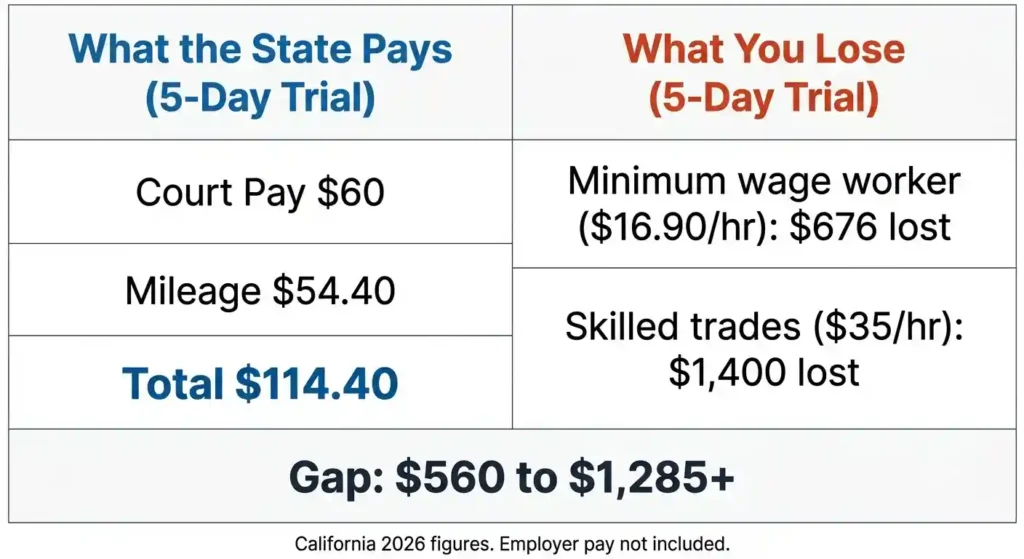
A skilled trade worker at $35/hour loses $280/day and $1,400 for a full week. The court’s $114.40 barely registers. Overtime is also lost. Jury duty cuts it off entirely with no supplement from the state. For real-world take-home comparisons at different wage levels, browse our paycheck scenarios category.
Salaried Employee Examples
If your employer keeps paying you, you may break even. The $15/day court check is a small bonus, though your employer may ask for it back. If your employer does not pay, a salaried worker at $80,000/year loses about $307/day, or $1,535 for a five-day trial.
Self-Employed Examples
Freelancers, gig workers, independent contractors, and small business owners take the hardest hit. No employer, no PTO. A consultant billing $150/hour loses $1,200 per day in court. If you are self-employed, jury duty also means missing estimated quarterly tax deadlines can become a stress point. Our guide to self-employment tax in California explains the full tax burden you carry without an employer. Document specific revenue loss from identified client work if you plan to request a hardship excuse.
Financial Planning Tips
Ask HR exactly what your company’s jury duty policy is before you report. Know your PTO balance and decide whether to use it. If a long trial threatens your income, request a postponement first before filing a hardship excuse. It is faster and more likely to be approved.
Special Situations and Edge Cases
Remote Employees
Remote workers must still report to the courthouse. California has no remote-work exception. Your summons comes from the county where you live, not where your employer is based.
Multiple Jobs
Every employer must give you time off, but each employer’s pay policy is separate. If your second employer does not pay during jury service, you lose those wages. Shift and night-shift workers may also lose scheduled hours if their employer reassigns shifts during service. For a side-by-side look at how jury duty affects part-time vs full-time paychecks in California, the differences go beyond just hours worked.
Students
Request postponement to the next school break. Contact your jury commissioner as soon as you receive your summons.
Retirees
No wages to lose. Social Security is not affected. If you are 70 or older, you can request to be excused under California Rules of Court, Rule 2.1008.
Gig Workers
No employer coverage, no guaranteed income. Every court day is lost earnings. Document your recent earnings history specifically if requesting a hardship excuse. If you work through an app-based platform and are unsure of your legal status, the California ABC test determines whether you are classified as an employee or independent contractor, which affects your rights under Labor Code Section 230.
Part-Time Employees
Same job protection as full-time workers. No state-mandated pay during service unless your employer’s policy covers it. Temporary and seasonal workers are in the same position. Job protection applies under Labor Code Section 230, but most temp agencies do not offer paid jury leave. Check your staffing agency contract.
Common Myths About California Jury Duty Pay
“You Get Paid on Day One”
You do not. State courts pay $15 starting on day two. Day one pays nothing. The only day-one option is the $12 public transit reimbursement.
“Employers Must Pay Your Salary”
False for most private employees. California law requires time off and job protection, not pay. Whether you get your regular wages depends on your employer’s voluntary policy.
“Every Court Pays the Same”
State courts pay $15/day. Federal courts pay $50/day starting on day one with higher mileage. If your summons is from a U.S. District Court, the pay is much better.
“Ignoring Jury Duty Has No Consequences”
Under California Code of Civil Procedure Section 209, failing to respond can result in contempt of court, a fine up to $1,500, jail time, or both.
What to Do Before Reporting for Jury Duty
Notify Your Employer
Notify your employer the day you receive your summons. California law requires reasonable advance notice.
Review Company Policy
Ask HR: Does the company pay during jury duty? For how many days? Do you need to submit court attendance records? Will they require your court check?
Estimate Your Compensation
Use the tables in this guide to calculate your expected court pay and mileage. Subtract from your lost wages. That gap needs to be covered by PTO or savings.
Gather Required Documents
Bring your summons, a valid government-issued ID, and any documentation your employer requires. Pick up a time sheet from the jury assembly room on day one. When service ends, request an official proof of service or jury service certificate from the jury clerk. Your employer may need it to approve jury leave.
Step-by-Step: What Happens From Summons to Payment
Receive Jury Summons
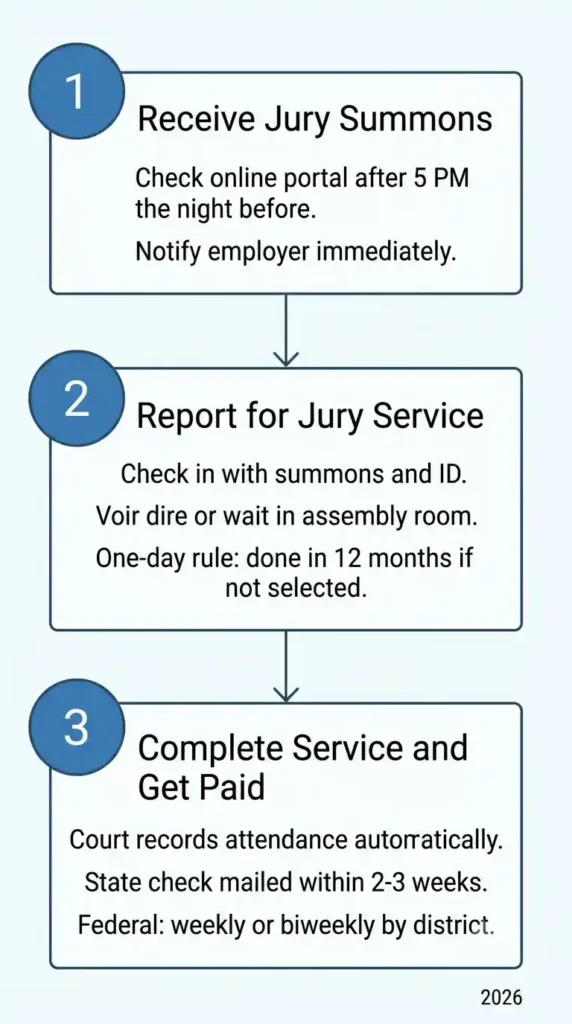
Your summons arrives by mail one to four weeks before your report date. It includes reporting instructions and a phone or online portal number to check your standby jury status after 5 PM the night before. If your group is not called, check again the next evening. Notify your employer immediately.
Report for Jury Service
Check in at the jury assembly room with your summons and ID. You may be sent to voir dire (jury selection) or wait all day. County procedures vary: Los Angeles uses a juror portal for group reporting instructions; San Diego’s Central Courthouse has designated juror parking and transit options; Bay Area courts serve many jurors who arrive by BART or Caltrain. If not selected after one day, your jury compliance obligation is complete for at least 12 months.
Complete Service
The court records your attendance and mails your check within two to three weeks. Federal courts pay weekly or biweekly by district. You do not need to request payment. Keep your summons and attendance records until the check arrives and the amount is confirmed correct. If you were also terminated or left a job around the time of your jury service, know that California final paycheck law sets strict deadlines for when your last wages must be paid.
Frequently Asked Questions
How much does California pay for jury duty in 2026?
State courts pay $15/day starting on day two. Federal courts pay $50/day starting on day one. Mileage is $0.34/mile round trip for state court, $0.725/mile round trip for federal court.
Do you get paid on the first day?
No. State courts pay nothing on day one. The only day-one option is the $12 public transit reimbursement. Federal court pays $50 on day one.
Does my employer have to pay me?
Not if you work for a private employer. They must give you time off and cannot retaliate, but pay is not required. Government employees typically keep their regular salary.
How long does jury duty payment take?
State courts mail checks within two to three weeks. Federal courts pay weekly or biweekly depending on the district. No claim is needed.
What if I’m self-employed?
You must still report. Document your income loss in writing if requesting a hardship excuse. A postponement is easier to get than a full excusal. If you are uncertain whether you qualify as an independent contractor or employee under California law, see our worker classification guide, which covers AB5 and the ABC test in full.
Can I refuse jury duty because of low pay?
No. Low pay is not a legal excuse. You can request a postponement or document extreme financial hardship, but simply not wanting to lose income is not accepted. Non-response can result in fines up to $1,500.
Is federal jury duty paid differently?
Yes. Federal courts pay $50/day from day one versus $15/day from day two for state courts. Federal mileage is $0.725/mile round trip versus $0.34/mile round trip for state courts.
Can I claim financial hardship?
Yes, but courts set a high bar. Submit your request in writing before your service date with documentation on income, household size, and employer pay days. Many requests are denied. Financial inconvenience is not enough.
What happens if I miss jury duty?
Under California Code of Civil Procedure Section 209, non-response can result in contempt of court, a fine up to $1,500, or jail time. If you cannot serve, request a postponement before your report date.
Key Takeaways
The Most Important Pay Rules
State courts pay $15/day starting on day two, plus $0.34/mile round trip also from day two. Federal courts pay $50/day from day one with mileage at $0.725/mile round trip. Private employers are not required to pay hourly workers during service. Government employees typically receive their regular salary.
Employer Rights Summary
Every California employer must allow time off for jury duty under Labor Code Section 230. Retaliation is illegal. But pay during jury service is entirely optional for private employers. Check your policy and use PTO if you have it.
Financial Planning Checklist
- Notify your employer immediately after receiving your summons
- Check your employee handbook for the jury duty pay policy
- Estimate your court compensation using the rates in this guide
- Decide whether to use PTO or take unpaid leave
- If you are self-employed or a gig worker, document your income for a potential hardship request
- Consider postponing to a less financially damaging time of year if eligible
Official Resources for Current Rates
- California Judicial Branch jury information at courts.ca.gov
- Federal court juror pay and mileage at uscourts.gov
- IRS Publication 525: Taxable and Nontaxable Income for jury pay reporting
- California Labor Code Section 230 for employer obligations
- California Rules of Court, Rule 2.1008 for hardship excuse standards

Yeasin Sorker is the founder of Paycheck Calculator California. He built this tool in 2018 after noticing that most free paycheck calculators missed California-specific rules like daily overtime and the uncapped SDI rate.
He researches California payroll tax updates regularly and keeps this calculator aligned with the latest IRS, FTB, and EDD published rates. All calculations on this site are estimates based on official 2026 government sources. For personalized tax advice, consult a qualified tax professional.