
California PFL pays 70% to 90% of your weekly wages, up to $1,765 per week in 2026, for up to 8 weeks when you bond with a new child, care for a seriously ill family member, or assist with a military deployment. Most workers who see a CASDI deduction on their paystub and earned at least $300 in their base period already qualify. One thing the program does not do: protect your job. That requires a separate law, either CFRA or FMLA.
California Paid Family Leave at a Glance
Quick Answer Summary
California PFL gives eligible workers up to 8 weeks of partial wage replacement per 12-month period. In 2026, the program pays 70% to 90% of weekly wages, up to $1,765 per week. To qualify, you must have paid into SDI through your paycheck and earned at least $300 in your base period.
The 4 Things Most People Want to Know
Who qualifies? Most California employees who pay into SDI, including full-time, part-time, and seasonal workers. How much? 70–90% of weekly wages, up to $1,765/week in 2026. How long? Up to 8 weeks per 12-month period. Is your job protected? No. PFL pays you. CFRA and FMLA protect your job.
The Most Important Question: Is Your Job Protected?
Why People Get Confused
PFL is a wage replacement benefit, not a leave protection law. It sends you money. It does not require your employer to hold your position or grant you time off. The benefit and the protection feel like they should come as a package. They do not.
PFL vs CFRA
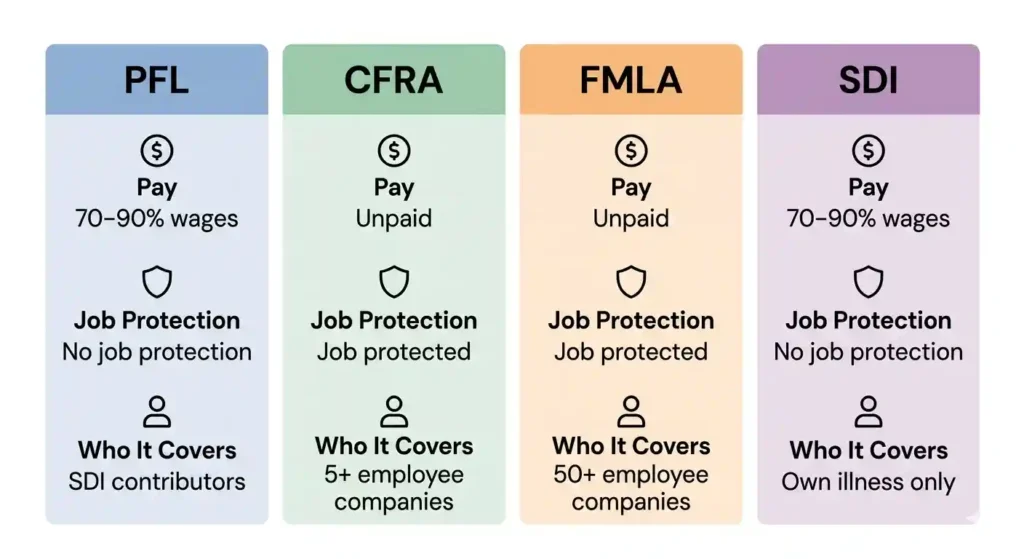
The California Family Rights Act (CFRA) protects your job. It gives eligible employees up to 12 weeks of unpaid, job-protected leave per year. It covers employers with 5 or more employees. PFL and CFRA usually run at the same time, so you collect PFL pay while CFRA protects your position. California’s employee rights under labor law go well beyond what most workers realize.
PFL vs FMLA
FMLA also offers job protection but with stricter rules: 50 or more employees within 75 miles, 12 months of employment, and 1,250 hours worked in the past year. It provides up to 12 weeks of unpaid leave. Like CFRA, it can run concurrently with PFL. The U.S. Department of Labor FMLA overview covers the full federal eligibility criteria.
PFL vs SDI
SDI pays you when you cannot work due to your own illness, injury, or pregnancy. PFL pays you when you take leave for family reasons. Many parents transition directly from SDI into PFL, which can mean 4 to 5 months of paid leave combined.
Pregnancy Disability Leave (PDL) is separate: it is a job-protection law for women disabled by pregnancy or childbirth. SDI provides the income during PDL; PFL provides income during bonding afterward. Employer-paid parental leave is separate from all state programs. Ask HR whether your company’s policy runs alongside PFL or supplements it.
Comparison Table: PFL vs CFRA vs FMLA vs SDI
| Program | Purpose | Pay | Job Protection | Key Eligibility |
|---|---|---|---|---|
| PFL | Family caregiving and bonding | 70–90% of wages, up to $1,765/week | No | SDI contributions, $300 base period earnings |
| CFRA | Job-protected family leave | No (unpaid) | Yes | Employer with 5+ employees, 12 months tenure |
| FMLA | Job-protected family/medical leave | No (unpaid) | Yes | Employer with 50+ employees, 12 months, 1,250 hrs |
| SDI | Your own disability or illness | 70–90% of wages, up to $1,765/week | No | SDI contributions, $300 base period earnings |
What Is California Paid Family Leave?
Purpose of the Program
California PFL is a state-run wage replacement program for workers who take leave to bond with a new child, care for a seriously ill family member, or assist a relative affected by military deployment. California decided workers should not have to choose between family and a paycheck.
What PFL Does and Does Not Do
PFL replaces part of your income for up to 8 weeks. It does not guarantee time off, does not protect your job, and does not cover your own illness. The state’s Employment Development Department (EDD) administers it entirely. Your employer plays no role in paying you. The official program details are published directly by the California EDD Paid Family Leave program.
Who Pays for PFL
You do, through payroll deductions labeled “CASDI” on your paystub. The 2026 SDI contribution rate is 1.3% of all wages with no wage cap. Those contributions fund both SDI and PFL. Employers do not contribute. If you are unsure what each line on your paystub means, the California pay stub guide for 2026 breaks down every deduction.
Who Qualifies for California Paid Family Leave?
Basic Eligibility Requirements
Three requirements: you paid into SDI during your base period (the first four of the last five completed calendar quarters before your claim start date), you earned at least $300 during that period, and you have an actual wage loss. No wage loss means no benefit. Understanding how California payroll taxes work helps clarify exactly what gets withheld and why.
Qualifying Reasons for Leave
Bonding With a New Child
PFL covers bonding with a newborn, adopted child, or foster placement. Leave must happen within the first year of birth, adoption, or placement. Biological parenthood is not required.
Caring for a Family Member
PFL covers care for a family member with a serious health condition, meaning an illness or injury requiring inpatient care or continuing treatment by a provider. Examples: cancer treatment, post-surgery recovery, chronic illness requiring regular medical visits, or dementia requiring ongoing supervision. A routine cold or minor illness does not qualify. Medical certification from the treating doctor is required.
Military Assist Leave
If your spouse, domestic partner, child, or parent receives a military deployment notice, you may qualify. Covered exigencies include childcare, legal matters, and family affairs triggered by active duty orders.
Qualifying Family Members
PFL covers a child (biological, adopted, foster, stepchild, or legal ward), a parent (biological, adoptive, step, or legal guardian), a spouse, or a domestic partner. Same-sex spouses and domestic partners have identical rights. The law looks at legal status, not the nature of the relationship.
Additional Eligible Relatives
PFL also covers grandparents, grandchildren, parents-in-law, siblings, and adult children. Aunts, uncles, cousins, and close friends do not currently qualify. California signed SB 590 in October 2025, which will extend PFL to “designated persons” with a family-like relationship starting July 1, 2028. That change does not apply to 2026 claims.
Who Does Not Qualify?
Common Disqualifying Situations
No SDI withholding on your paycheck, less than $300 in base period earnings, or filing after the 41-day deadline all result in denial. Missing that deadline costs you all benefits, not just the late days.
Situations That Commonly Cause Confusion
Independent contractors and gig workers typically have no SDI deducted, so they do not qualify unless voluntarily enrolled. Taking leave for your own illness is SDI territory, not PFL. Continuing to receive your full salary during leave means no wage loss, so EDD will not pay. If you believe you were misclassified as a contractor when you should be an employee, the California ABC test guide for 2026 explains exactly how worker classification is determined, and resolving that could open PFL eligibility.
On immigration: EDD does not require citizenship or legal residency. Undocumented workers who paid into SDI through wages are eligible. Eligibility is based on contributions, not immigration status.
How Long Can You Receive Benefits?
Maximum Leave Duration
Up to 8 weeks in any 12-month period, regardless of how many qualifying events occur. Use 6 weeks for a newborn and 4 more for an ill parent in the same year, and you only have 2 weeks left, not a fresh 8. Workers at or near California’s 2026 minimum wage typically fall into the 90% replacement tier, making PFL especially valuable at lower income levels.
Taking Leave All at Once
Most people take PFL in one continuous block, right after birth or after transitioning from SDI. It is the simplest approach and easiest to document.
Taking Leave Intermittently
PFL can be taken as individual days or a reduced schedule instead of a full block. EDD pays only for hours or days not worked. Coordinate the schedule with your employer in advance.
How Much Does California Paid Family Leave Pay?
How Benefit Amounts Are Calculated
EDD calculates your Weekly Benefit Amount (WBA) using the highest earning quarter within your base period (the first four of the last five completed calendar quarters). Lower-income workers receive a higher replacement rate than higher earners. The EDD’s PFL benefit payment amounts page shows exactly how the formula is applied.
Minimum and Maximum Benefits
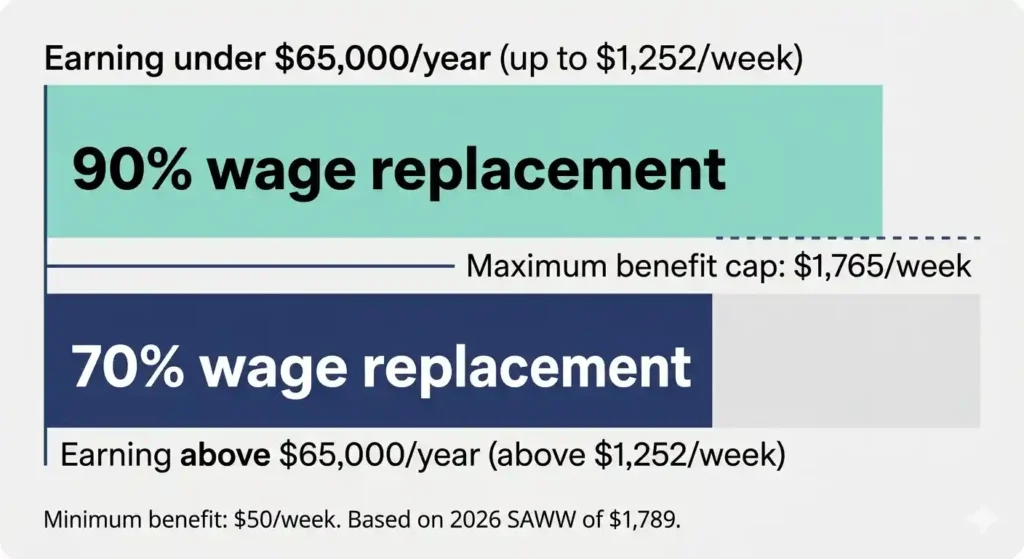
In 2026: minimum $50/week, maximum $1,765/week. Workers with an average weekly wage at or below $1,252 (70% of the $1,789 SAWW) receive 90% replacement, roughly equivalent to earning under $65,000/year. Workers above that threshold receive 70% replacement, up from the pre-2025 floor of 60%. SB 951 made that improvement effective January 1, 2025.
PFL benefits are taxable federally. EDD issues a Form 1099-G for total benefits received. California does not tax PFL at the state level. The IRS guidance on unemployment and other compensation covers how to report 1099-G income on your federal return. For a full picture of how California income tax works on top of these benefits, see the California tax brackets for 2026.
Example Calculation for Low-Income Workers
At $40,000/year ($769/week), your highest quarter is roughly $10,000. At 90% replacement: $692/week. Over 8 weeks: $5,536 total. Low-income workers on PFL may also be eligible for the 2026 California Earned Income Tax Credit when they file taxes after the year ends.
Example Calculation for Average-Income Workers
At $75,000/year ($1,442/week), your highest quarter is roughly $18,750. At 70% replacement: $1,009/week. Over 8 weeks: $8,072 total. Before SB 951, this worker would have received only 60% replacement. To see the full tax picture for a $75K salary in California, the 75K after taxes California breakdown covers every deduction in detail.
Factors That Can Reduce Payments
If your employer pays you sick leave, PTO, or any wage during leave, EDD reduces your benefit accordingly. Returning to part-time work means only non-working days are covered. EDD will demand repayment for overpayments. For a full overview of how California sick leave laws in 2026 interact with PFL, that is covered separately.
Real-Life Leave Timelines
New Mother Timeline
PDL can begin 4 weeks before the due date. SDI covers that period plus 6–8 weeks post-delivery (longer for C-section). After SDI ends, PFL covers up to 8 weeks of bonding. Total possible: 4 to 5 months of paid leave through the SDI-to-PFL pipeline. Use the California paycheck calculator to see exactly how your take-home pay changes during each phase.

New Father Timeline
A father’s leave starts after birth. He files for PFL immediately and can take up to 8 bonding weeks within the first year, split or continuous. Twins or higher-order births still max out at 8 weeks per parent, not per child. A premature birth does not extend the one-year bonding window; it starts from the actual birth date.
Adoption Timeline
The one-year bonding window starts on placement day, not the legal finalization date. File PFL immediately on placement. You still have 41 days to file, but earlier is better. Documentation needed: placement agreement or court order.
Caregiver Timeline
For a sudden hospitalization, file PFL on day one. For ongoing illness, intermittent PFL is often a better fit. Medical certification from the treating doctor is required before EDD approves any caregiving claim. Get that paperwork ready before you need it.
Special Situations and Edge Cases
Part-Time Employees
Part-time, seasonal, and temporary workers qualify on the same terms as full-time workers. Eligibility is about SDI contributions and $300 in base period earnings, not hours worked per week. Benefits will simply be lower because they are based on actual earnings. See how part-time vs full-time paycheck differences in California affect your overall take-home before and during leave.
Multiple Jobs
If you pay into SDI from multiple employers, EDD combines wages from all covered jobs when calculating your base period. Report every employer when filing. Combined wages mean a higher WBA.
Remote Workers
Eligibility is based on where your wages are earned, not where you live. If your paystub shows CASDI deductions, you qualify. No CASDI deduction means no PFL coverage, regardless of where you live in California.
Self-Employed Workers
Self-employed workers are not automatically enrolled in SDI. California’s Disability Elective Coverage (DEC) program lets freelancers and sole proprietors opt in voluntarily. Once enrolled and contributing for the required period, both SDI and PFL eligibility apply. If you are unsure whether you qualify as an employee or contractor, the 1099 vs W-2 tax breakdown for California and the guide on worker classification in California explain the distinction and its payroll implications.
Common Mistakes That Cause Problems
Application Errors
Filing late is the most damaging mistake. The 41-day deadline has little flexibility. File on day one. Other common errors: incorrect dates, missing employer information, and incomplete documentation. An incomplete claim stalls until you provide what is missing.
Benefit Misunderstandings
PFL does not protect your job. Many workers return expecting their position to be waiting. If CFRA or FMLA does not apply, it may not be. If your employer pays you sick time during leave, EDD reduces your benefit. Unreported income leads to overpayment demands. Workers who return to a lower paycheck than expected often find the answer in why your California paycheck is lower than expected or by browsing the California paycheck scenarios category.
If EDD approved your claim and you are then laid off or your company closes, benefits continue until your entitlement is exhausted. If you resign during leave, benefits can continue through the approved period. California law prohibits employer retaliation for taking PFL. If you face adverse action, file a complaint with the California Labor Commissioner’s Office.
Common Myths About California Paid Family Leave
Myth: PFL Protects My Job
It does not. For job protection, you need CFRA (employer with 5+ employees, 12 months of service) or FMLA (employer with 50+ employees, 12 months, 1,250 hours). If neither applies, your employer is not legally required to reinstate you. The California Civil Rights Department CFRA page outlines exactly who qualifies and what protections apply.
Myth: Only New Parents Qualify
Bonding is the most common claim type, but caregiving and military assist claims also qualify. A seriously ill sibling, grandparent, or adult child gives you a valid PFL claim.
Myth: I Must Use PTO First
Not since January 1, 2025. Under AB 2123, employers cannot require you to exhaust vacation before receiving PFL. They can offer to let you supplement PFL with PTO, but it is your choice.
Myth: Part-Time Workers Cannot Qualify
Part-time workers qualify. Eligibility is based on SDI contributions and $300 in base period earnings, not hours worked.
How to Apply for California Paid Family Leave
Information to Gather Before Applying
Have ready: your Social Security number or ITIN, your employer’s name, address, and phone number, your earnings history, and your leave start date. For caregiving claims, add the treating doctor’s contact information.
You notify your employer directly that you are taking leave. EDD handles the claim independently. Your employer does not approve or deny it, and EDD does not share medical details with them.
Required Forms and Documents
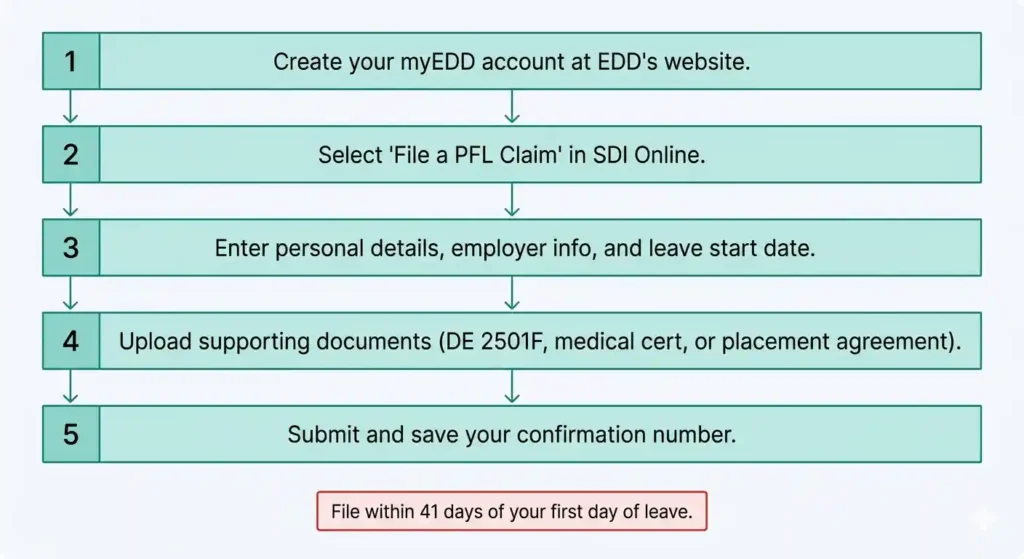
Main form: DE 2501F. Caregiving claims need a completed physician certification. Bonding claims for adoption or foster placement need a placement agreement or court documents. Military assist claims need deployment orders. Complete, clean submissions process faster. On a related note, if you need to update your California withholding during or after leave, the California DE-4 form guide walks through every field.
Step-by-Step Online Application Process
Apply through SDI Online at EDD’s website. Create a myEDD account, select “File a PFL Claim,” enter your details, upload documentation, and submit. Note your confirmation number. File on day one of leave if possible. A paper DE 2501F is available by calling EDD, but online is significantly faster.
New employees: PFL eligibility is not tied to your current job tenure. It is based on SDI contributions in the base period, which can include wages from a prior employer.
Deadlines That Can Cost You Benefits
Filing Deadlines
You have 41 days from your first day of leave to file. Missing it means EDD can deny your entire claim. There is no automatic extension. File early.
Bonding Leave Deadlines
All bonding leave must be used within one year of the child’s birth, adoption, or placement. Unused weeks after the first birthday are forfeited. This applies to both continuous and intermittent leave.
When Will You Get Paid?
Processing Timelines
Most complete claims process within 14 days. Missing documentation causes delays. Filing online through SDI Online is faster than mailing a paper claim.
Payment Methods
EDD pays by direct deposit or the EDD Debit Card. Direct deposit is fastest. Set your preference through your myEDD account. Track claim status anytime by logging in. Paper checks are available but slower.
PFL and workers’ compensation cannot be collected simultaneously. If your employer offers paid parental leave, you can often stack it with PFL or use one after the other, but combined payments cannot exceed your full weekly wage. Confirm the coordination with HR.
Delays and How to Avoid Them
The main causes of delay: missing forms, incomplete physician certification, or unverified wage information. Respond immediately to any EDD follow-up request.
Frequently Asked Questions
Can I receive PFL if I work part-time?
Yes. As long as SDI was deducted and you earned at least $300 in the base period. Your weekly benefit will be lower but you are not excluded.
Can I take PFL intermittently?
Yes. Take individual days or a reduced schedule instead of a full block. EDD pays only for days or hours not worked. Coordinate with your employer before starting.
Can fathers receive California PFL?
Yes. PFL is gender-neutral. Any qualifying parent can take bonding leave within the first year. Both parents can be on PFL at the same time.
Can I get PFL if I live outside California?
It depends on your wages, not your address. CASDI on your paystub means you qualify. No CASDI means you likely do not.
Do I have to use vacation or PTO first?
No. Since January 1, 2025, employers cannot require it. You can voluntarily supplement PFL with PTO, but it is not mandatory.
What happens after my 8 weeks end?
Benefits stop. CFRA or FMLA job protection may still apply if you qualify. Employer-sponsored parental leave may also continue. Confirm both with HR before your leave ends.
Can I receive both PFL and unemployment benefits?
No. They cannot be collected at the same time. PFL is for workers on approved leave. Unemployment is for workers without a job.
What to Do If Your Claim Is Denied
Common Reasons for Denial
Insufficient base period earnings, no SDI withholding, non-qualifying leave reason, filing after 41 days, or incomplete documentation. Read the denial notice for the specific reason.
How the Appeals Process Works
Appeal within 30 days of the denial notice mailing date. File through SDI Online or by mail. Include supporting documentation. EDD will schedule an administrative hearing. Further appeals go to the California Unemployment Insurance Appeals Board.
Final Eligibility and Benefit Checklist
Before You Apply
- CASDI deduction appears on your paystub
- At least $300 earned in the base period
- Claim filed within 41 days of leave start
- Employer contact information gathered
- Supporting documents ready (birth certificate, placement agreement, medical certification, or deployment orders)
After Approval
- Monitor payment amounts against EDD’s calculation
- Report all employer-paid income during leave, including PTO and sick pay
- Track weeks used, especially for intermittent leave
- Confirm return-to-work date and whether CFRA or FMLA job protection applies
- Use the annual salary calculator to model your income for the year once you factor in weeks of reduced PFL pay
- For general payroll questions after returning to work, the paycheck basics resource covers deductions, withholding, and what to expect each pay period

Yeasin Sorker is the founder of Paycheck Calculator California. He built this tool in 2018 after noticing that most free paycheck calculators missed California-specific rules like daily overtime and the uncapped SDI rate.
He researches California payroll tax updates regularly and keeps this calculator aligned with the latest IRS, FTB, and EDD published rates. All calculations on this site are estimates based on official 2026 government sources. For personalized tax advice, consult a qualified tax professional.