
California new hire paperwork covers the federal and state forms and notices employers must complete before an employee’s first paycheck: identity verification, tax withholding, and wage protections, with the exact list varying by headcount and classification.
That list changes with headcount and hiring situation, so treating every hire the same way is where most employers get tripped up.
The catch: missing even one notice can trigger EDD penalties or a wage claim later.
New Hire Paperwork Checklist at a Glance
Use the checklist and timeline below to confirm every required form and deadline before your new hire’s first day.
Quick Checklist for Every California Employer
- Federal: Form I-9, Form W-4
- California: DE 4, the Labor Code section 2810.5 wage notice, the Paid Sick Leave notice, and as of February 2026, the SB 294 Workplace Know Your Rights notice
- Employer side: file the DE 34, keep copies of everything
- Optional: direct deposit form, employee handbook acknowledgment, emergency contact sheet
New Hire Paperwork Timeline
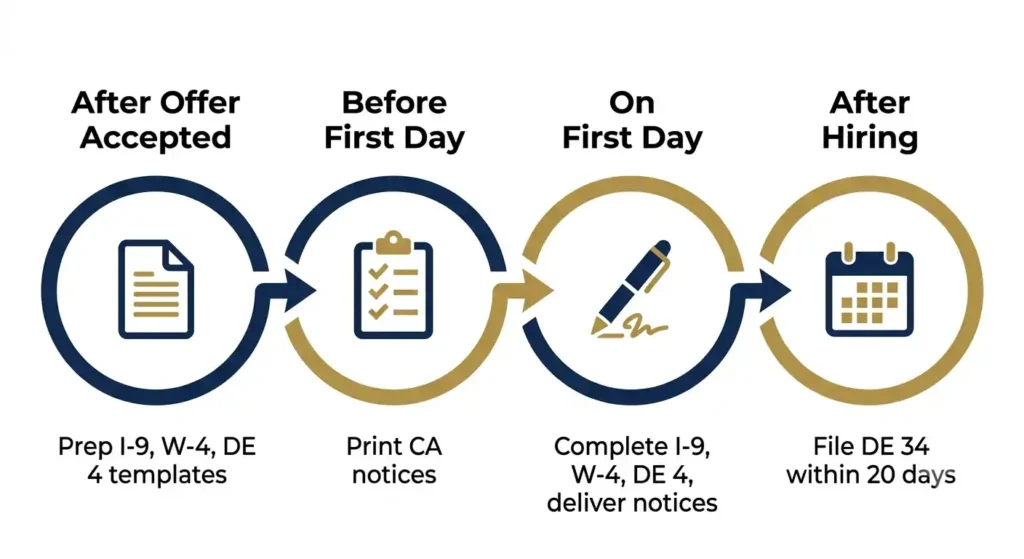
After the offer, prep documents. Before day one, have the I-9 and state notices ready. On day one, the employee completes I-9 Section 1, W-4, and DE 4, and you deliver every mandatory notice. After that: DE 34 within 20 calendar days, DE 2515 disability insurance pamphlet within 5 days.
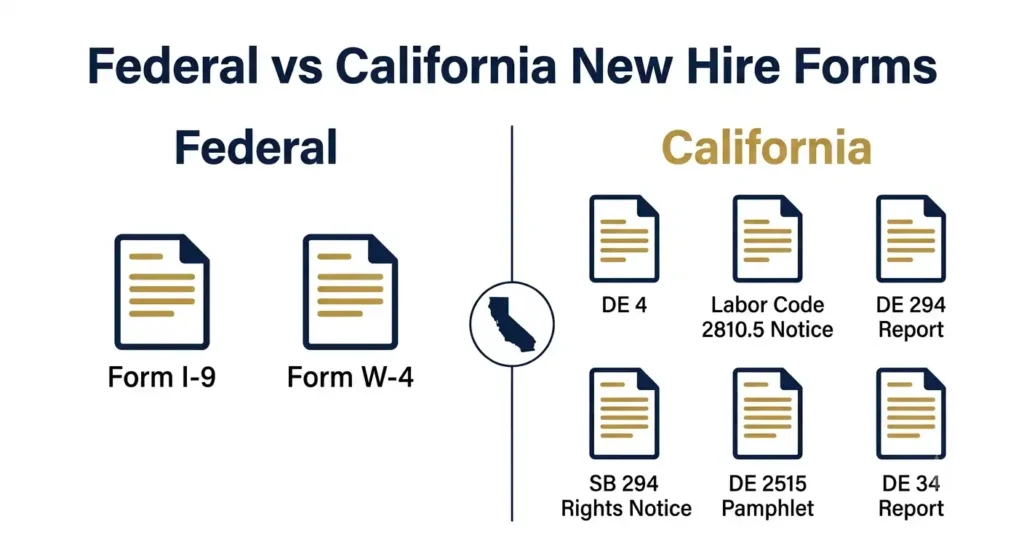
Federal vs California New Hire Forms Comparison
Short answer: California adds its own deadlines and penalties on top of every federal requirement.
Comparison Table
| Requirement | Federal Form | Deadline | Responsible Party | Legal Authority |
|---|---|---|---|---|
| Identity/work eligibility | Form I-9 | Section 1 by first day, Section 2 within 3 business days | Employer + Employee | Immigration Reform and Control Act |
| Federal tax withholding | Form W-4 | First day (before first paycheck) | Employee | IRS |
| State tax withholding | DE 4 | First day | Employee | CA EDD |
| Wage notice | DLSE-NTE (Notice to Employee) | At time of hire | Employer | Labor Code section 2810.5 |
| Rights notice | Workplace Know Your Rights notice | At time of hire | Employer | SB 294 (eff. Feb 1, 2026) |
| Disability insurance info | DE 2515 pamphlet | Within 5 days of hire | Employer | CA Unemployment Insurance Code |
| New hire reporting | DE 34 | Within 20 calendar days of start-of-work | Employer | CA Family Code (EDD-administered) |
What Is New Hire Paperwork?
It’s the forms and notices that make an employee legal, taxable, and protected under the law before their first shift.
Definition
New hire paperwork does four jobs: verifies identity and work eligibility, sets up tax withholding, puts you in compliance with wage and labor notices, and starts payroll. It sits alongside the other paycheck basics every California employer needs to get right. Skip one and you’re exposed to an I-9 audit or a wage claim.
Why California Employers Have Extra Requirements
Federal law gives you two forms: I-9 and W-4. California adds state withholding, a wage theft notice, a paid sick leave notice, a disability insurance pamphlet, and now SB 294’s rights notice. California labor law also layers on local city notices and industry-specific rules, for fields like construction, healthcare, and staffing. None of it is optional.
Federal Forms Every Employer Must Complete
Two federal forms are non-negotiable, the I-9 and the W-4.
Form I-9
Its official name is Employment Eligibility Verification. Employee completes Section 1 by first day; employer completes Section 2 within three business days, after reviewing identity and work authorization documents. A passport, a Permanent Resident Card, or an Employment Authorization Document from U.S. Citizenship and Immigration Services (USCIS) all count as List A documents on their own. List B documents (identity) and List C documents (work authorization) must be paired. No acceptable document means the person can’t legally start work. Keep the I-9 three years after hire, or one year after termination, whichever is later. E-Verify is a separate, optional federal system; California doesn’t require most private employers to use it.
Form W-4
Its official title is the Employee’s Withholding Certificate, issued by the Internal Revenue Service (IRS). It sets federal tax withholding for each paycheck. No W-4 submitted means the IRS default applies: single, no adjustments. Never start payroll before the W-4 and I-9 are both done. If you need a walkthrough, see how to fill out the W-4 form step by step.
California New Hire Forms You Must Provide
This state-specific layer is where most compliance mistakes happen.
DE 4
Its official title is the Employee’s Withholding Allowance Certificate. California’s version of the W-4, required the same day. Skipped DE 4 defaults to single with zero allowances. First-time California employers also need an EDD payroll tax account number before withholding can be reported. For step-by-step help, see how to fill out California Form DE 4, which covers your broader California payroll taxes obligations too.
Notice to Employee (Labor Code 2810.5)
This is the Wage Theft Prevention Act notice, required under Labor Code section 2810.5 for every non-exempt employee at hire. It must state pay rate, pay schedule, hourly or salary status, employer name and address, and workers’ comp carrier. If any of those change, reissue it within 7 calendar days. Provide it in the employee’s own language if the Labor Commissioner has a translated version.
Paid Sick Leave Notice
Required under the Healthy Workplaces, Healthy Families Act, delivered at hire, not buried in a handbook. Keep a signed acknowledgment on file as proof.
Workers’ Compensation Notice
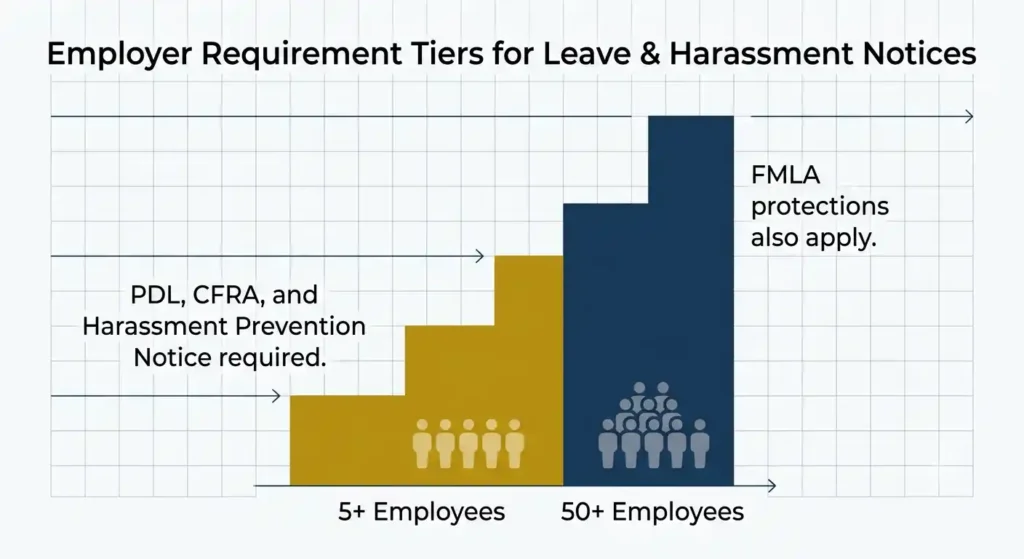
Post the workers’ comp poster and hand new hires the Time of Hire Pamphlet, published by the Division of Workers’ Compensation (DWC) within the California Department of Industrial Relations. The DWC-7 is a separate posting notice, not the hire-time pamphlet itself. Employers with five or more employees must also cover Pregnancy Disability Leave (PDL) and California Family Rights Act (CFRA) rights, part of the broader paid leaves and benefits landscape; employers with 50 or more add Family and Medical Leave Act (FMLA) protections. Every California employer, any size, must distribute the sexual harassment prevention information sheet from the California Civil Rights Department (CRD); only the training itself (one hour non-supervisors, two hours supervisors, every two years) is limited to employers with five or more employees.
New Hire Reporting Requirements
File the DE 34 with the EDD within 20 calendar days of the hire’s start-of-work date, one of the core payroll compliance and reporting duties every employer owes the state.
What Is the DE 34 Report?
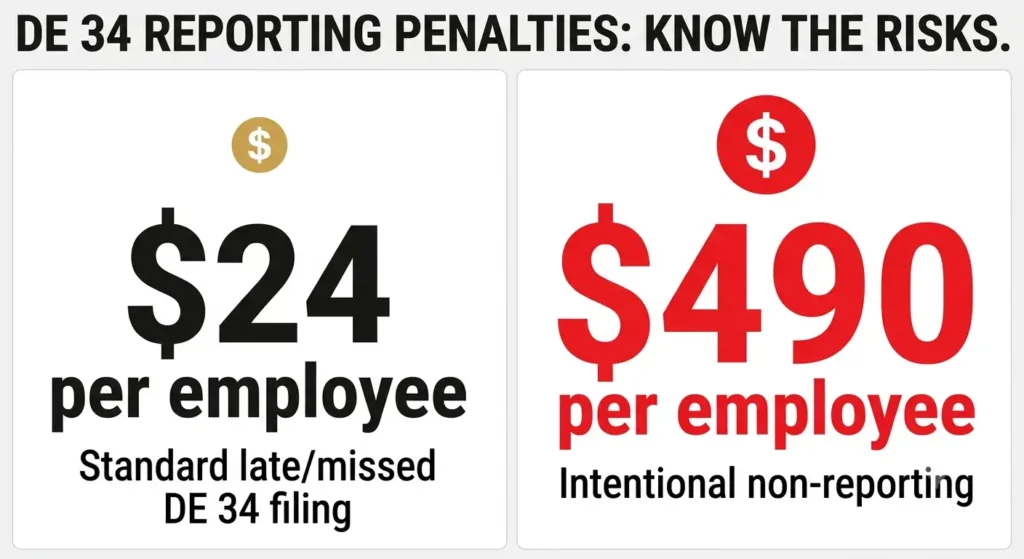
The DE 34, or Report of New Employee(s), goes to the California New Employee Registry, run by the Employment Development Department (EDD), also called the California Employment Development Department. It reports name, Social Security number, and start date. Deadline: 20 calendar days from actual start of work. Penalty: $24 per unreported employee, up to $490 if the EDD finds intentional non-reporting. If the hire never actually works a shift, no reporting applies. If they quit after day one, you still owe the DE 34 and their final paycheck. Independent contractors, once you’ve confirmed their status under California’s ABC test for worker classification, are reported via the DE 542 within 20 days if you’ll file a 1099, not the DE 34, and they skip the I-9, W-4, and wage notice.
How to Report a New Employee
There are two paths here, and one is clearly faster.
Online Filing
File through the EDD’s e-Services for Business portal with your eight-digit EDD account number and Federal EIN. Regular electronic filers submit two monthly transmissions, 12 to 16 days apart.
Mail or Fax
Paper DE 34 works too, same 20-day deadline, slower to process. The EDD goes by postmark date, so keep proof of when you sent it.
Optional Forms That Make Onboarding Easier
None of these are legally required, but skipping them creates more work later.
Payroll and Banking Forms
Direct deposit authorization, address and emergency contact details, and an easy way to estimate the first paycheck before it lands. Benefits enrollment paperwork, like health insurance or retirement forms, also isn’t legally required at hire, though most employers bundle it in anyway, and those without a retirement plan should check the CalSavers mandate.
Company Policy Documents
Employee handbook acknowledgment, confidentiality agreement, at-will employment acknowledgment. Not state-mandated, but they document that the employee knew your policies from day one.
Complete Hiring Timeline
Spread the paperwork across four stages instead of dumping it all on day one.
After the Offer Is Accepted
Confirm the start date, prep I-9, W-4, and DE 4 templates, send welcome materials.
Before the First Day
Print every California notice, set up payroll to receive withholding forms, plan who handles I-9 Section 1. If remote, confirm your verification method in advance.
On the First Day
Employee completes I-9 Section 1, W-4, DE 4. Deliver the Labor Code section 2810.5 wage notice, paid sick leave notice, workers’ comp pamphlet, and starting February 2026, the SB 294 notice. Verify identity documents in person.
After Hiring
File the DE 34 within 20 calendar days. Store signed forms. Hand over the DE 2515 pamphlet within 5 days if not already done.
Common Mistakes Employers Make
Most failures come from onboarding moving faster than the paperwork.
Compliance Errors
Skipping California-specific notices, late I-9 completion, missed 20-day EDD deadline, incomplete personnel files. Catch an error, like a wrong DE 34 date or missing signature, and fix it immediately. A corrected error rarely draws a penalty; an ignored one almost always does.
Payroll Mistakes
Collecting the W-4 but forgetting the DE 4, missing basic employee data, misclassifying exempt versus non-exempt under worker classification rules, which creates a wage notice and risks a waiting time penalty if it drags into a final paycheck dispute.
Special Situations
California doesn’t shrink its paperwork requirements for exceptions, it just adjusts how they’re delivered.
Remote Employees
I-9 verification still applies, either in person through an authorized representative or the remote verification process. Electronic forms are valid under federal e-signature standards. What matters is where the work happens, not where the employee used to live, so someone relocating from another state to work in California follows the same rules as any local hire.
Rehired Employees
Reuse the original I-9 if it’s still within its retention window and authorization hasn’t expired. Gone over a year, or I-9 expired, means a new one. Any rehire after 60+ consecutive days off must be reported to the EDD again.
Temporary and Seasonal Employees
Same required forms as any hire. No exception for how long someone’s expected to stay. Same DE 34 deadline, same withholding setup from shift one.
Minor Employees
Under 18 means a signed school work permit before starting, plus hour and schedule restrictions and parent or guardian consent.
Common Myths About New Hire Paperwork
Federal forms alone are not enough, and no employer size or hiring situation is exempt from California’s requirements.
Myth vs Fact
Generic federal forms aren’t enough, state notices exist because federal law doesn’t cover them. Small businesses aren’t exempt: three employees or three hundred, same checklist. Remote employees need the same forms, just delivered differently. Electronic forms are valid under e-signature standards. First hire, first hire in years, or first California employee for an out-of-state business: same checklist applies in full.
Downloadable New Hire Paperwork Checklist
Keep required forms, deadlines, and recordkeeping rules in one place you’ll actually use.
Printable Checklist
- Forms: I-9, W-4, DE 4, Labor Code section 2810.5 notice, paid sick leave notice, workers’ comp pamphlet, SB 294 notice, DE 2515 pamphlet
- Deadlines: I-9 Section 2 within 3 business days, DE 2515 within 5 days, DE 34 within 20 calendar days
- Recordkeeping: I-9 retained 3 years from hire or 1 year post-termination, whichever is later
For deeper detail, see the EDD’s California Employer’s Guide (DE 44).
Frequently Asked Questions
What paperwork is legally required for every new employee?
Form I-9 and Form W-4 federally; DE 4, the Labor Code section 2810.5 wage notice, and the paid sick leave notice in California.
What California forms are required in addition to federal forms?
DE 4, the Notice to Employee under Labor Code section 2810.5, the paid sick leave notice, the workers’ comp pamphlet, and as of February 1, 2026, the SB 294 Workplace Know Your Rights notice.
When must Form I-9 be completed?
Section 1 by the first day of work. Section 2 by the employer within three business days.
When do I need to report a new hire to the California EDD?
Within 20 calendar days of the start-of-work date, using the DE 34.
Can employees complete paperwork electronically?
Yes, as long as your system meets federal e-signature standards and records are retained properly.
What happens if I miss a required hiring form?
DE 34 penalties start at $24 per employee, up to $490 for intentional violations. Missing state wage notices risks Labor Commissioner claims and back-pay liability.
Do part-time employees complete the same paperwork?
Yes. California doesn’t reduce requirements based on hours worked.
What documents should I keep in the employee personnel file?
Signed I-9, W-4, DE 4, notice acknowledgments, and any offer letter or employment agreement. Keep the I-9 in a separate file.
Final New Hire Compliance Checklist
Confirm every required form, notice, and deadline before calling a hire fully onboarded.
Before Your Employee Starts
- I-9, W-4, and DE 4 completed
- Every California notice delivered and acknowledged
- Payroll set up correctly
- DE 34 filing scheduled before the 20-day deadline
Ongoing Compliance
Retain records for the required period, review your notice packet annually, and track new laws like SB 294. Obligations grow with headcount: cross five employees and harassment prevention and additional leave notices apply.
For more California payroll and labor law guides, browse the full post sitemap, the tools and pages sitemap, or the topic category sitemap.

Yeasin Sorker is the founder of Paycheck Calculator California. He built this tool in 2018 after noticing that most free paycheck calculators missed California-specific rules like daily overtime and the uncapped SDI rate.
He researches California payroll tax updates regularly and keeps this calculator aligned with the latest IRS, FTB, and EDD published rates. All calculations on this site are estimates based on official 2026 government sources. For personalized tax advice, consult a qualified tax professional.