
California’s No Robo Bosses Act (SB 947) stops employers from firing or disciplining a worker based solely on an AI system’s output. Human review is required first. The law becomes operative July 1, 2027.
That human review requirement comes from the statute’s own language, verified against the signed bill text and legislative record, not assumption.
One limit stands out: SB 947 creates no direct right for workers to sue individually.
Can AI Fire You in California Under the No Robo Bosses Act?
No. California Senate Bill 947 (SB 947), the No Robo Bosses Act of 2026, requires an employer to independently verify an AI-driven termination or discipline with real evidence before acting on it. An algorithm can flag a problem; it cannot close the case alone. Governor Gavin Newsom signed the bill on September 30, 2026, and it was chaptered as Chapter 859, Statutes of 2026.
What the No Robo Bosses Act Means for California Workers
Software can suggest things. It cannot decide things alone. SB 947 separates AI assistance, where a tool informs a manager who still decides, from automated decision making, where the output drives action with no real human judgment. The law covers employees, independent contractors, and workers from labor contractors. Employers of every size are covered, including government employers in California.
California No Robo Bosses Act at a Glance
SB 947 becomes operative July 1, 2027. It stops employers from relying primarily on an automated decision system (ADS) to discipline, fire, or deactivate a worker without independent human checking. It bans predicting future behavior from personal data and limits ADS in pay decisions. Workers get written notice when ADS mainly drove a disciplinary or termination call, plus the right to request the data used against them.
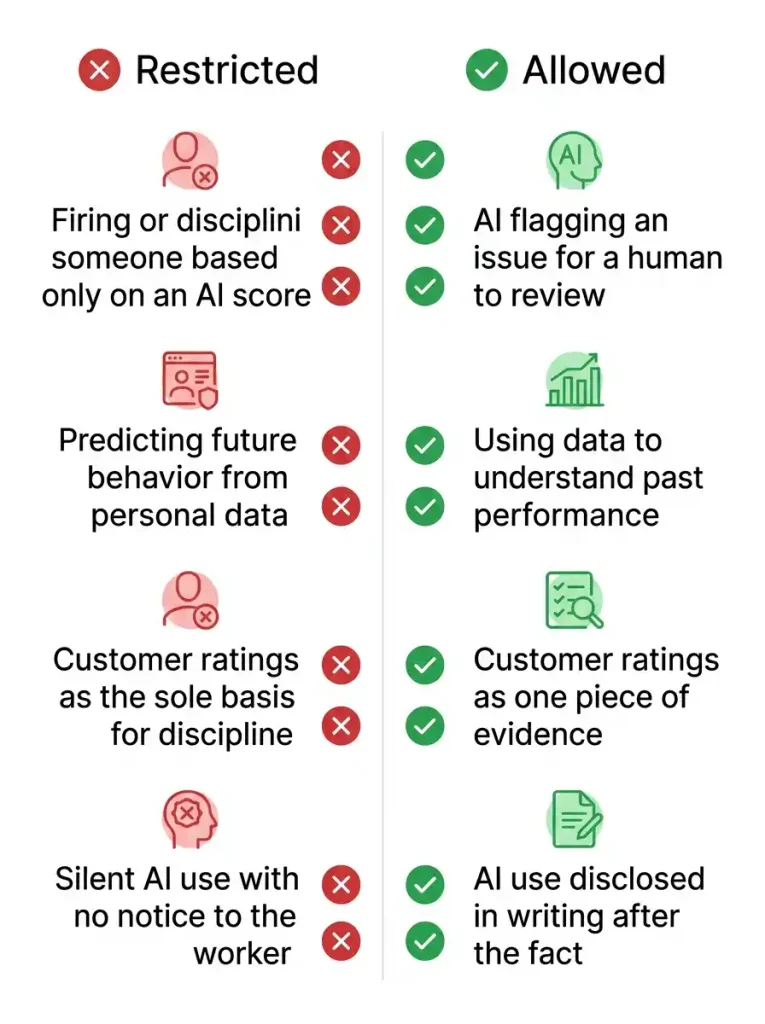
| What the law restricts | What it still allows |
|---|---|
| Firing or disciplining someone based only on an AI score | AI flagging an issue for a human to review |
| Predicting future behavior from personal data | Using data to understand past performance |
| Customer ratings as the sole basis for discipline | Customer ratings as one piece of evidence |
| Silent AI use with no notice to the worker | AI use disclosed in writing after the fact |
The law does not ban workplace AI. It promises a human will review your case before an AI driven decision becomes final.
What Is California’s No Robo Bosses Act (SB 947)?
SB 947 adds Part 5.5.5 to Division 2 of the California Labor Code. When an employer leans mainly on an automated system to discipline or terminate a worker, a human must corroborate that output with real evidence first. State Senator Jerry McNerney wrote the bill, sponsored by the California Federation of Labor Unions, AFL-CIO.
Why California Passed the No Robo Bosses Act
AI systems make mistakes, and algorithms built on messy or biased data can flag the wrong person or punish someone for something outside their control. Senator McNerney said employers were using AI to cut costs with no safeguards for workers. Monitoring software scoring keystrokes, delivery speed, or chat tone means a bad data point can end a career unchecked.
SB 947 vs. the Earlier SB 7 Proposal
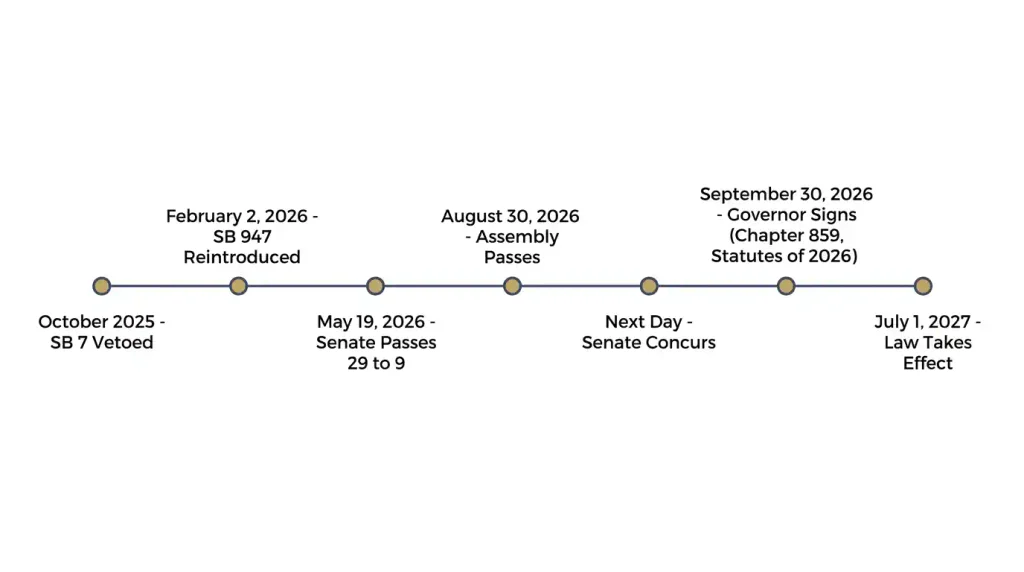
McNerney first introduced SB 7, broader and with no size cutoff, an appeals process, and a 30 day notice requirement. Governor Newsom vetoed it in October 2025, the California SB 7 veto that sent McNerney back to the drawing board. He reintroduced a narrower version on February 2, 2026 as SB 947, swapping pre-action appeals for post-use notice and sharpening which AI uses are off limits. The California Senate first passed it 29 to 9 on May 19, 2026, the Assembly passed it August 30, 2026, the Senate concurred in the Assembly’s amendments the next day, and Newsom signed it about a month later. Track the full history on California Legislative Information, the Legislature’s official bill-tracking site.
When Does the No Robo Bosses Act Take Effect?
Newsom signed SB 947 on September 30, 2026, but it does not kick in until the July 1, 2027 effective date. Signing makes it law on paper; the operative date is when employers must comply and enforcement can begin. Workers see no change yet, but employers should already be building their human review process before that deadline.
What Counts as an Automated Decision System Under SB 947?
An automated decision system (ADS) is any process using machine learning, statistical modeling, data analytics, or AI to produce a score, ranking, classification, or recommendation that materially affects your job.
AI Tools Covered by the Law
The law targets tools that generate a judgment about a person, not tools that just handle data. This includes performance scoring software, productivity trackers that rank workers, scheduling algorithms, and systems that flag workers for discipline from monitoring data. If a tool takes in your information and outputs a decision-shaping result, it likely counts.
Examples of Workplace AI Systems
A warehouse system scoring pickers on speed and flagging the slowest is one example, the kind of tool workers call bossware. A call center tool scoring agent tone and recommending write ups is another. So is scheduling software that cuts hours for workers it labels unreliable, or an AI tool drafting termination recommendations from attendance data. These are exactly the use cases lawmakers had in mind.
What Does Not Count as an ADS?
Not every workplace tool is regulated. A spreadsheet, a payroll calculator, or a database that just stores and displays information without generating a judgment is not an ADS. The test is whether the system produces a decision-type output about a person or just organizes facts. A time clock is not a robo boss. A tool using that data to recommend firing you probably is.
What Employment Decisions Can Employers Not Make With AI?
Employers cannot rely primarily on an ADS to discipline, fire, or deactivate a worker, cannot use ADS to predict future behavior, and face real limits on using it for pay.
AI-Only Firing and Disciplinary Decisions
If a system recommends a warning, suspension, demotion, or termination, a human must independently verify it with real evidence first. No rubber stamping. This applies even when a manager technically signs off: if that decision primarily relies on the AI’s output rather than independent judgment, the law treats it as AI-only, and the same corroboration duty applies before any adverse employment action goes forward.
Other Restricted Uses of Workplace AI
SB 947 blocks employers from using ADS to infer protected characteristics under the California Fair Employment and Housing Act (FEHA), like race, religion, or disability status, from your data. It bans predictive behavior analysis, such as guessing who is about to quit or file a complaint. Compensation decisions tied to individualized worker data face limits too, especially comparing workers doing substantially similar work.
Can Employers Use AI to Make Other Employment Decisions?
Yes, with limits. AI can still touch wages, benefits, scheduling, and performance evaluations. What matters is how the output is used: a scheduling tool suggesting shift swaps is fine, but the same tool automatically docking hours as punishment, with no human sign off, is not.
What Does Meaningful Human Review Require?
Human review under SB 947 means a real, independent check, not a manager glancing at a screen and clicking approve.
How Independent Human Investigation Works
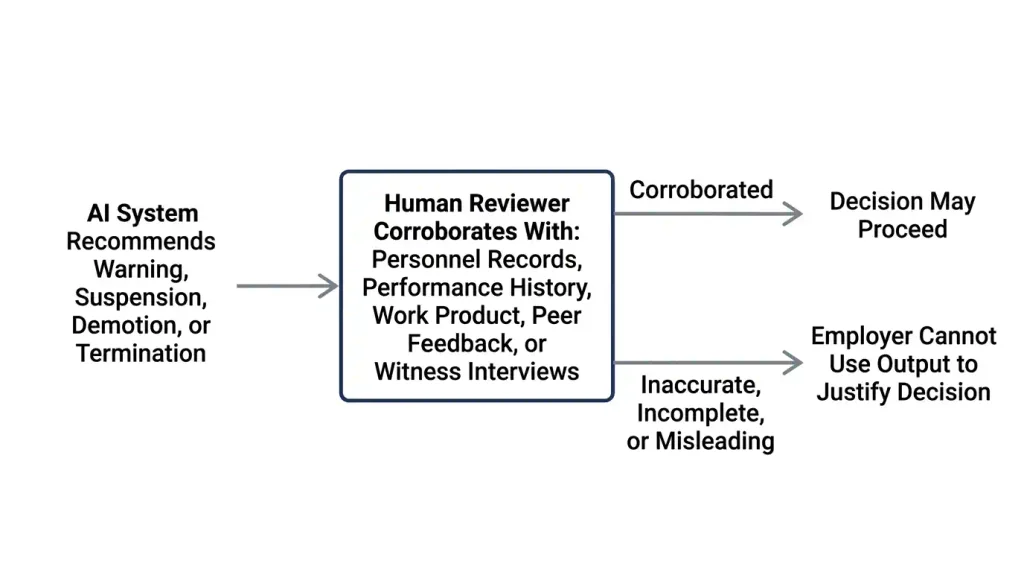
The reviewer must corroborate the ADS output with real evidence, personnel records, performance history, work product, peer feedback, or witness interviews. Trusting the algorithm’s conclusion without checking any of that fails the law. The point is catching errors before they cost someone their job.
What Happens When AI Gets an Employee Decision Wrong?
If the reviewer cannot corroborate the ADS output, or finds it inaccurate, incomplete, or misleading, the employer cannot use it to justify the decision. A flawed algorithm cannot be the deciding factor just because nobody checked its work.
Can Customer Ratings Determine an Employee’s Job?
Not by themselves. Ratings can be biased or wrong, so they cannot be the only or main basis for discipline or termination. Employers must weigh them alongside other evidence, like performance records or direct observation.
What Rights Do Employees Have Under the No Robo Bosses Act?
Four protections apply here: notice once AI primarily drove a decision, access to the data behind it, protection from retaliation, and a path to challenge what happened.
Employee Right to Written Notice
When an employer relies mainly on an ADS to discipline or fire someone, that worker gets a written post-use notice, including contact information for a human to reach with questions. This is notice after the fact, not advance permission to stop the decision.
Can Employees Request the Data Used by AI?
Yes. Workers can request the data primarily used in a covered decision, generally the most recent 12 months, with a cap on how often requests can be made. What comes back must be a meaningful and objective data description, not a vague summary. The law also protects other workers’ privacy: if an ADS output drew on a coworker’s data, that portion gets withheld or anonymized.
Protection Against Retaliation
Employers cannot threaten, suspend, demote, fire, or otherwise punish a worker for asserting rights under SB 947. Retaliation for requesting data or raising a concern is its own violation. Keep records: save emails, screenshot any AI scores you can access, write down dates, and note what changed after you raised the issue.
Can Employees Challenge an AI-Assisted Employment Decision?
Request clarification and the supporting information behind the decision. Ask HR directly: which system flagged you, what data it used, who reviewed it, and what evidence that reviewer checked. If a manager refuses to explain, put the request in writing citing your statutory right to the data; the refusal itself is worth documenting. Gather your written notice, performance history, and manager communications too.
Real-World Examples of the No Robo Bosses Act
An AI Productivity Score Recommends Termination
A delivery company’s software flags a driver as the slowest performer three weeks running and recommends termination. A manager cannot fire based on the score alone. Someone must check the underlying data, maybe the driver’s route changed, or a GPS glitch logged bad timestamps. Unverified or wrong data cannot justify the firing.
An AI System Recommends a Disciplinary Warning
A retail chain’s tool flags an employee for a warning after late clock ins. That is allowed as AI assistance feeding a human decision, but the manager still has to check the actual time records, including whether those clock-ins trace back to protected time off under California’s sick leave laws, before deciding if a warning is fair.
AI Incorrectly Flags an Employee for Poor Performance
A call center tool scores an agent low after misreading sarcasm as rudeness. If that drives discipline without a human catching the error, the employer violates the law. The employee can also request the data behind that score.
An Employer Uses AI to Set Compensation
A company uses an algorithm to set pay by comparing workers in substantially similar jobs. SB 947 limits this when it relies on individualized worker data without accounting for legitimate differences like location cost or task type. Pay decisions still need a defensible, human-checked basis.
An AI System Uses Customer Ratings to Evaluate Workers
A rideshare style platform deactivates a driver after their rating dips below a threshold. If that rating alone is the entire basis, that is exactly what SB 947 targets. The platform needs other evidence, like ride records or complaint history, before deactivation sticks.
Who Is Covered by the No Robo Bosses Act?
The law covers employees, worker classification questions for independent contractors, and employers of essentially any size, including government entities.
Employees, Independent Contractors, and Employers
Worker is defined broadly enough to include independent contractors and people placed through labor contractors. Coverage extends to job applicants too, and to gig-style workers deactivated by an algorithm, treating deactivation the same as termination. Employer is defined just as broadly, closing the loophole of reclassifying workers under California’s ABC test to dodge the law.
Does the Law Apply to Small Businesses and Public Employers?
There is no headcount floor, so a small business is covered the same as a large corporation. Government entities count as employers too. If your job is based in California, protections generally follow you, even in remote arrangements with a California employer.
Collective Bargaining and Federal Government Contracts
Workers under a collective bargaining agreement (CBA) can be exempted from certain provisions, but only if the agreement expressly and clearly waives the protection. Narrow exemptions also apply to work tied to national security, military operations, and certain aviation, space, and defense functions already governed by federal rules. A separate provision addresses federal government contracts or regulations that impose their own algorithmic management requirements.
What Happens If an Employer Violates the No Robo Bosses Act?
Violations can bring citations, civil penalties, and lawsuits from public enforcers.
Who Enforces SB 947?
The California Labor Commissioner, formally the Division of Labor Standards Enforcement (DLSE), sits under the California Department of Industrial Relations and the California Labor and Workforce Development Agency. It holds primary enforcement authority over the state’s broader California labor laws, including investigating complaints and issuing citations here. The California Attorney General and local public prosecutors can also bring civil actions. This is public enforcement, not individual lawsuits.
What Penalties and Remedies May Apply?
The burden is on employers to demonstrate compliance, reversing the usual rule. If an employer claims a manager reviewed a decision but cannot produce records of what was checked, that burden-shifting works against them. SB 947 creates no standalone private right of action for individual workers, relying on public enforcement instead. Employment attorneys are still debating whether the California Private Attorneys General Act (PAGA) could open a separate path, and that question remains unsettled.
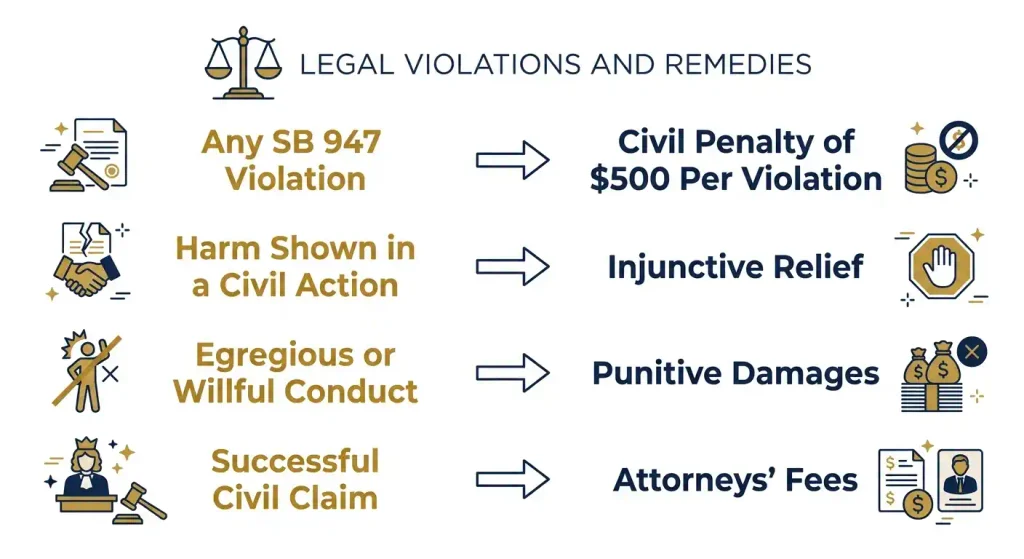
| Violation or claim | Possible remedy |
|---|---|
| Any SB 947 violation | Civil penalty of $500 per violation |
| Harm shown in a civil action | Injunctive relief |
| Egregious or willful conduct | Punitive damages |
| Successful civil claim | Attorneys’ fees |
Other Labor Code penalty schemes work the same way. The California waiting time penalty for unpaid final wages follows a similar per-day logic, just under a different statute.
How Can Employees Report a Potential Violation?
File a complaint with the California Labor Commissioner’s office. Include your written ADS notice, any data you requested, personnel records, and a clear timeline. This is the same office that handles wage theft California complaints, so the process will likely feel familiar. Reporting starts an investigation; it is not the same as proving a violation, which is why documentation matters.
What Should Employers and HR Teams Do Before July 1, 2027?
Review Workplace AI Systems
Inventory every AI tool touching discipline, termination, compensation, scheduling, or performance. Understand what each vendor system outputs and flag anything driving action without human review. SB 947 adds to other California rules, not replaces them: FEHA still governs discrimination, the CCPA still applies to automated-decision-making privacy rules, California AB 1883 bans AI tools that detect or predict emotional state or collect nervous-system data, and California SB 951 expanded the California Worker Adjustment and Retraining Notification Act (Cal-WARN) to require extra disclosure for AI-caused layoffs. Two more 2026 laws sit in the same compliance pile: the California Pay Transparency Law 2026 and the SB 294 Workplace Know Your Rights Act. Compliance with one does not satisfy the others. Employers already tracking California payroll taxes should fold this AI review into the same compliance calendar rather than treating it as a separate project.
Establish Human Review and Documentation Procedures
Build a real process for independent investigation and corroboration, not just a policy on paper. Name responsible reviewers, define what evidence they check, and keep a workplace AI audit trail logging each output and the reviewer’s notes. Reviewers need real authority to reject a flawed AI output.
Prepare Employee Notice and Data-Access Procedures
Set up the written notice process now, with a clear human contact point. Build a workflow for data requests, respecting the 12 month limit and other workers’ privacy.
Train Managers and HR Professionals
Train managers to spot the line between AI-only decisions and proper human-reviewed assistance, and to catch inaccurate or misleading ADS outputs rather than trust them automatically. HR needs a clear process for employee concerns and preventing retaliation.
No Robo Bosses Act Myths and Misconceptions
Myth: California Employers Can Never Use AI to Fire Workers
False. Employers can use AI as part of the process. They just cannot fire someone based solely on AI output without independent human investigation first.
Myth: A Human Manager’s Approval Makes Every AI Decision Legal
Also false. Approval without actual investigation or corroboration is not independent review, and the employer stays exposed if the underlying data is inaccurate or misleading.
Myth: Every AI Tool Used at Work Is Covered
Not every tool qualifies as an ADS. Software that just stores or organizes data without generating a decision-type output falls outside the law.
Myth: Employees Automatically Have a Right to Sue
SB 947 relies mainly on public enforcement through the Labor Commissioner, Attorney General, and local prosecutors, not a direct employee right to sue. Whether PAGA opens that path is still unsettled.
Frequently Asked Questions About California’s No Robo Bosses Act
Can AI legally fire you in California in 2027?
No, not on its own. A human must independently verify and corroborate the AI’s recommendation first.
Does an employer have to tell you when AI is used to fire you?
Yes. If AI primarily drove the decision, you get written notice with a human contact for follow up.
Can a manager simply approve an AI-generated firing decision?
No. Approval without independent investigation does not meet the law’s standard.
Can employees request the data used by an AI system?
Yes, generally the most recent 12 months, with a statutory limit on how often requests can be made.
Does the No Robo Bosses Act protect independent contractors?
Yes. The definition of worker includes independent contractors and labor-contractor placed workers, not just traditional employees.
What should you do if AI unfairly affects your job?
Request your written notice and the underlying data, document everything, and file a complaint with the California Labor Commissioner if the law was violated.
When does California’s No Robo Bosses Act take effect?
It was signed September 30, 2026, and becomes operative July 1, 2027.
Key Takeaways: Your Rights Under California’s No Robo Bosses Act
What Employees Should Remember
AI can flag issues, but it cannot fire or discipline you alone.
- You get written notice when AI primarily drove a decision against you
- You can request the data behind that decision
- You are protected from retaliation for asserting these rights
- Document everything and reach out to the Labor Commissioner if something feels off
What Employers Should Remember
Compliance starts well before July 1, 2027.
- Audit every AI tool touching employment decisions
- Build a documented human review process
- Prepare your notice and data-access systems
- Train managers now, and remember the burden is on you to demonstrate compliance, not on the worker to prove you failed

Yeasin Sorker is the founder of Paycheck Calculator California. He built this tool in 2018 after noticing that most free paycheck calculators missed California-specific rules like daily overtime and the uncapped SDI rate.
He researches California payroll tax updates regularly and keeps this calculator aligned with the latest IRS, FTB, and EDD published rates. All calculations on this site are estimates based on official 2026 government sources. For personalized tax advice, consult a qualified tax professional.