
The typical HVAC technician salary in California is a median of $35.87 an hour, about $74,610 a year (EDD’s first-quarter 2026 estimate), though pay varies by city, experience, and specialty.
That figure rests on May 2025 federal wage data updated by EDD, and this guide checks it against federal percentiles and job postings.
It’s a benchmark, not a promise: your offer, overtime, and local costs can shift real take-home pay.
How Much Does an HVAC Technician Make in California in 2026?
Most California HVAC technicians earn between roughly $60,000 and $93,000 a year, the 25th to 75th percentile range.
Average and Median HVAC Technician Salary
The California Employment Development Department (EDD) reported a mean hourly wage of $37.26 and a median of $35.87 for the first quarter of 2026. Both are estimates, not a new survey or official federal figures.
The median, the middle worker, is a better guide than the mean, which high earners pull up. The job is listed as Heating, Air Conditioning, and Refrigeration Mechanics and Installers, under Standard Occupational Classification 49-9021 (SOC 49-9021).
Indeed averages job postings and shows less: its California HVAC installer page listed $30.59 an hour in July 2026, and the figure varies by job title.
California HVAC Technician Salary at a Glance
The table converts EDD’s first-quarter 2026 hourly wages to gross pay at 40 hours a week for 52 weeks.
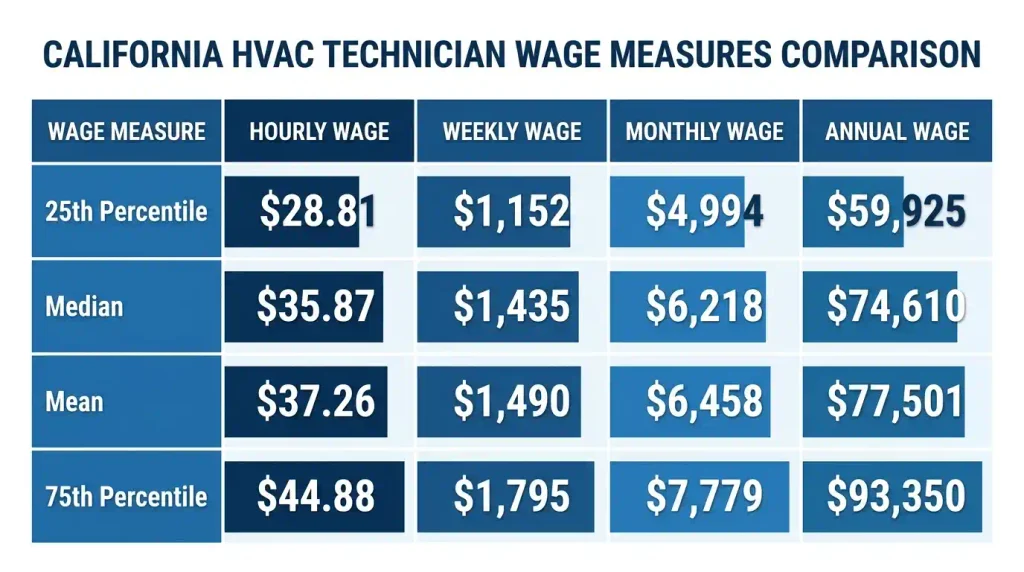
| Measure | Hourly | Weekly | Monthly | Annual |
|---|---|---|---|---|
| 25th percentile | $28.81 | $1,152 | $4,994 | $59,925 |
| Median | $35.87 | $1,435 | $6,218 | $74,610 |
| Mean | $37.26 | $1,490 | $6,458 | $77,501 |
| 75th percentile | $44.88 | $1,795 | $7,779 | $93,350 |
These are reported wages for the whole occupation, not a guarantee for any one job. Your pay depends on employer, city, skills, and hours.
How Much Does an HVAC Technician Make Per Hour and Per Year?
Most California HVAC techs earn about $29 to $45 an hour, a range you can explore further in our $30 an hour is how much a year breakdown. Multiply the hourly rate by 2,080 (40 hours times 52 weeks) for gross annual pay, or use our annual salary calculator to do it instantly. At $35 an hour, that’s $72,800.
HVAC Technician Pay at Different Hourly Rates

| Hourly rate | Weekly | Monthly | Annual (gross) |
|---|---|---|---|
| $20 | $800 | $3,467 | $41,600 |
| $25 | $1,000 | $4,333 | $52,000 |
| $30 | $1,200 | $5,200 | $62,400 |
| $35 | $1,400 | $6,067 | $72,800 |
| $40 | $1,600 | $6,933 | $83,200 |
| $45 | $1,800 | $7,800 | $93,600 |
Real years rarely match the table. Two unpaid weeks off at $35 an hour cost $1,400. Paid time off (PTO), including holidays and sick leave, costs you no pay for those days, so ask how many an employer gives.
Slow seasons cut hours, and heat waves add them. California requires overtime pay for most hourly workers after 8 hours in a day or 40 in a week, and double time after 12 hours in a day. Emergency calls, weekend shifts, and on-call duty can add more, depending on employer policy.
To estimate your year, multiply your hourly rate by your realistic weekly hours and the weeks you expect to work.
What Does HVAC Technician Pay Look Like After Taxes?
Gross pay is on your offer letter. Take-home pay is what reaches your bank. Federal income tax, California income tax, Social Security (6.2%), Medicare (1.45%), and California State Disability Insurance (about 1.3%) come out first.
Using 2026 rates and the federal standard deduction ($16,100), a single filer earning the median $74,610 (similar to the example in our $75,000 after taxes in California breakdown) with no pretax deductions loses about 22% to 24%. That leaves around $57,500 a year, or about $4,800 a month. Filing status, health insurance premiums, and 401(k) contributions change this, so run your offer through a paycheck calculator; our California payroll taxes hub breaks down each deduction in more detail.
A federal deduction for tax years 2025 to 2028, covered in our no tax on overtime guide, lets you deduct up to $12,500 of the extra half of time-and-a-half pay for hours over 40 a week. It lowers federal income tax only, not Social Security or Medicare tax, and it excludes overtime required only by California’s daily rules.
What Is the HVAC Technician Salary by Experience Level?
No official data splits pay by experience, but percentiles (May 2025) show the range: the bottom 10% of California HVAC workers earn $22.57 an hour or less, the top 25% earn $43.65 or more, and the top 10% earn $52.44 or more.
Entry-Level HVAC Technician and Apprentice Pay
The same May 2025 data put the bottom 10% of California HVAC workers at about $46,950 a year. New helpers, trainees, and apprentices are likely near that low end. Registered apprenticeship programs generally raise pay in steps as you log supervised hours.
Trade school can speed hiring but costs money, while an apprenticeship pays you as you learn. Others learn through on-the-job training with a contractor. In April 2026 the state announced $37.2 million to expand apprenticeships, naming HVAC as one of the trades.
If tuition helps you start $3 an hour higher, that’s about $6,240 more per year.
Experienced and Senior HVAC Technician Earnings
No official figure covers one to three years of experience specifically. A tech at that stage often lands in the lower half of the range (10th percentile $22.57, median $34.88 in May 2025 data), and higher if you can run service calls alone.
Mid-career techs sit near the median, about $72,560 (May 2025) to $74,610 (EDD’s 2026 estimate) a year. Senior techs reach the 75th percentile at $90,780 and the 90th at $109,060 (May 2025 federal data). Getting there takes skill: diagnosing problems alone, handling complex commercial repairs, and communicating clearly with customers, since raises are never automatic.
Which California Cities Pay HVAC Technicians the Most?
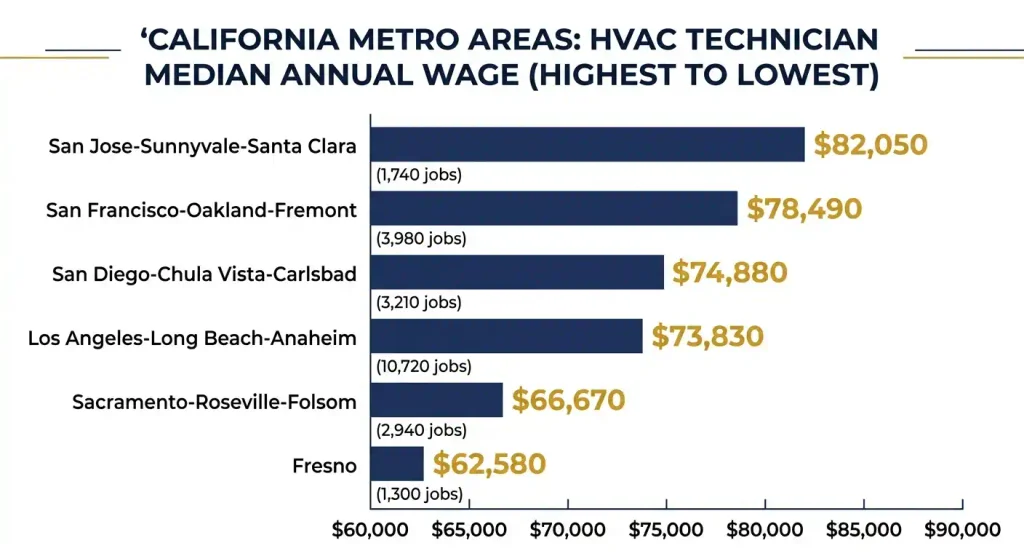
San Jose pays most, with a median of $82,050, then Santa Rosa at $79,510 and San Francisco-Oakland at $78,490. Sacramento and Fresno pay noticeably less.
HVAC Technician Salaries in Major California Cities
The table uses the same federal OEWS occupation and measure (median annual wage) for every metro area, covering whole metro areas, not just city limits. These are May 2025 figures, so they run a bit behind EDD’s 2026 estimates.
| Metro area | Median annual wage | HVAC jobs |
|---|---|---|
| San Jose-Sunnyvale-Santa Clara | $82,050 | 1,740 |
| San Francisco-Oakland-Fremont | $78,490 | 3,980 |
| San Diego-Chula Vista-Carlsbad | $74,880 | 3,210 |
| Los Angeles-Long Beach-Anaheim | $73,830 | 10,720 |
| Sacramento-Roseville-Folsom | $66,670 | 2,940 |
| Fresno | $62,580 | 1,300 |
Los Angeles has by far the most jobs. The Bay Area pays more, partly because of its higher cost of living. San Jose and Fresno have the fewest workers in the wage sample among these cities, so treat their numbers as a guide.
Riverside-San Bernardino-Ontario has about 4,820 HVAC jobs and a median of $64,300, and Bakersfield sits at $66,400, both close to Sacramento.
Does a Higher HVAC Salary Go Further in an Expensive City?
Not always. San Jose’s median is $15,380 above Sacramento’s. If rent and daily costs run $1,300 more per month there, that’s $15,600 a year, and the raise is gone.
Higher pay can also push more income into higher tax brackets. Before moving, compare rent near the shop, commute and gas, car insurance, and groceries, and judge what’s left, not the hourly rate.
Which HVAC Jobs and Specializations Pay the Most?
Commercial, controls, refrigeration, and supervisor roles usually pay the most, though residential service can pay well with overtime.
Residential vs. Commercial vs. Industrial HVAC Pay
National job-posting estimates from Housecall Pro (undated, checked October 2026) show:
- Residential service technicians: $53,000 to $90,000
- Commercial HVAC techs: $55,000 to $85,000
- Controls technicians: $60,500 to $80,000
These are advertised ranges, not wage statistics. Larger systems like rooftop units and chillers pay more because mistakes cost more and fewer people can work on them.
Installation often means steadier hours, and service work means more variety and sometimes on-call shifts. Maintenance techs focus on preventive maintenance, and field service techs on electrical and mechanical troubleshooting.
HVAC/R, Refrigeration, Heat Pumps, and Building Automation
Refrigeration (supermarkets, cold storage), building controls, heat pumps, and advanced diagnostics narrow the pool of qualified workers, which can raise your value. Controls work means programming and troubleshooting the systems that run a building’s equipment. Anyone working on equipment with regulated refrigerants needs EPA Section 608 certification, the first credential to get for refrigeration.
Federal wage data combine HVAC and refrigeration mechanics into one occupation, so no official figure compares their pay.
Union vs. Nonunion HVAC Technician Pay
Union apprenticeships follow a union wage scale that steps up as you complete hours, and the employer pays into health plans and pensions. Public works jobs often pay a prevailing wage, a set rate for each trade. Nonunion pay varies: some employers pay as well or better, others pay less with thinner benefits.
Overtime follows California law for most techs, but a qualifying collective bargaining agreement can set its own overtime terms in place of the state’s daily overtime rules. Compare the whole package, not base wage alone. Employer benefits of $8 an hour are worth $16,640 a year.
Can HVAC Technicians Make $100,000 a Year in California?
Yes, but it isn’t typical. The 90th percentile, from that same May 2025 data, is $109,060, so roughly one in ten California HVAC workers earns more. At straight time, $100,000 equals about $48.08 an hour.
What It Takes to Reach Six-Figure Earnings
A tech at the 75th percentile rate of $44.88 makes $93,350 on 2,080 hours, and about 100 hours of overtime at $67.32 an hour passes $100,000. At the median rate of $35.87, you’d need about 470 overtime hours, roughly 9 extra hours every week.
Commissions, premium shifts, on-call pay, and specialized roles can also fill the gap. Keep steady base pay separate from extras, since overtime depends on the season and your employer’s workload. Part of the overtime premium may qualify for the new federal overtime deduction, which can trim federal income tax.
HVAC Career Paths With Higher Earning Potential
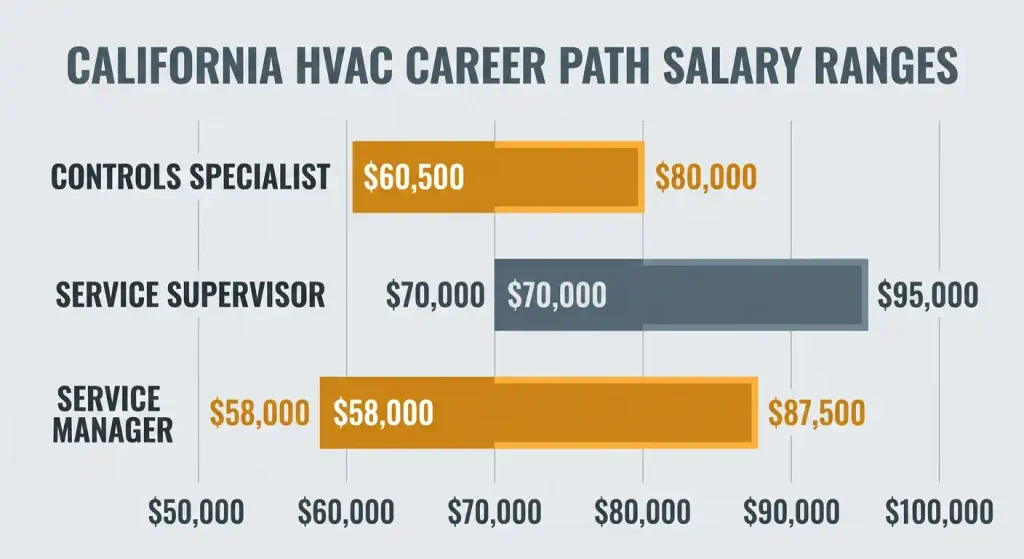
Each step adds duties. National job-posting ranges from Housecall Pro (undated, checked October 2026), where available:
- Senior technician (often a journeyman): takes the hardest service calls.
- Controls specialist: installs and programs building automation. $60,500 to $80,000.
- Service supervisor (supervisors and foremen): schedules and coaches a crew. $70,000 to $95,000.
- Service manager (HVAC managers): runs budgets, customers, and the department. $58,000 to $87,500.
Certifications and experience help, but leadership skills often decide promotions.
What Certifications and Licenses Can Increase HVAC Earning Potential?
EPA Section 608 is the one credential required by law for refrigerant work. Others like NATE are optional, and a California contractor license matters only if you run your own jobs.
EPA Section 608 Certification and Technical Credentials
Technicians working on equipment that can release regulated refrigerants need EPA Section 608 certification. It has four types:
- Type I: small appliances
- Type II: high-pressure systems
- Type III: low-pressure systems
- Universal: covers all three
Because the law requires it, employers usually ask for it before assigning refrigerant work.
North American Technician Excellence (NATE) certification and HVAC Excellence certification are voluntary; HVAC Excellence’s Professional level reportedly asks for at least two years of experience plus an exam (confirm current requirements with HVAC Excellence directly). Employers may prefer them, but the law doesn’t require them.
California HVAC Contractor Licensing and Career Advancement
You don’t need a contractor license to work as an employee under a licensed contractor. You need one for HVAC jobs worth $1,000 or more in labor and materials, and for any job that needs a permit or workers, whatever the price. If you are weighing contract work instead of employment, our 1099 vs W-2 calculator can help you compare pay.
The Contractors State License Board (CSLB) issues the C-20 Warm-Air Heating, Ventilating and Air-Conditioning license and the C-38 Refrigeration license. You generally need four years of journey-level experience within the last ten years and must pass exams on trade skills and business law.
You also post a contractor bond and carry workers’ compensation; C-20 holders need that coverage even with no employees. National Housecall Pro estimates (undated, checked October 2026) put HVAC business owners at $80,000 to $150,000 or more, but owners also bear insurance, marketing, slow months, and unpaid paperwork. Check CSLB for current rules and fees.
Is HVAC a Good-Paying Career in California in 2026?
Yes. California pays HVAC techs more than most states: U.S. Bureau of Labor Statistics (BLS) May 2025 data put the mean annual wage at $75,370, about 16% above the national mean, a pattern that shows up across our California salary guides by job and industry.
California HVAC Job Outlook and Employment Demand
The latest California projections shown on CareerOneStop (2022 to 2032) have HVAC employment growing about 11%, from 38,400 to 42,700 jobs, with about 3,790 openings a year. Nationally, BLS projects 8% growth from 2024 to 2034 and about 40,100 openings a year. Check EDD for the newest state projections.
Retirements, maintenance of older systems, heat pump installs, energy-efficiency upgrades, and hotter summers feed demand. A 2026 community college labor market report, using 2024 to 2029 projections, counted about 4,013 openings a year statewide and 4,296 training awards a year, so entry-level spots can be competitive. Projections cover the whole state, not your town.
HVAC Technician Pay Compared With Electricians and Plumbers
In California, the federal median is about $72,560 for HVAC technicians (May 2025 OEWS), with plumbers and pipefitters at $72,830 and electricians at $76,160. The last two figures come from secondary wage-data sites, not an official table checked directly for this article, so confirm the latest on CareerOneStop or O*NET before citing them elsewhere.
Those come from different releases, so treat HVAC and plumbers as essentially tied and electricians as a bit higher. All three trades train through apprenticeships. Nationally, per the BLS Occupational Outlook Handbook, projected 2024 to 2034 growth is 8% for HVAC, 9% for electricians, and 4% for plumbers.
Pick the trade you can do for 20 years, then compare pay and living costs, or browse the broader construction worker salary in California guide if you are weighing the trades generally.
How to Tell Whether an HVAC Job Offer in California Is Fair
An offer is fair when the rate fits your experience against wage benchmarks, follows California labor laws on hours and overtime, and keeps benefits and extra pay clear. Below $28.81 is low for an experienced tech, and above $44.88 is strong.
Compare Your Offer With Local Wage Benchmarks
Start with EDD’s statewide percentiles ($28.81, $35.87, and $44.88), then check your metro median. A first-year helper should expect to sit below the median, and a tech with five years of commercial service experience should aim near or above it. Night shifts, on-call duty, and harder specialties can justify more.
Employer size and industry also matter, which is why techs with similar experience get different offers. A below-median offer isn’t a red flag for a newer tech, but an experienced tech should ask why. Percentiles are benchmarks, not minimums or caps.
Questions to Ask Before Accepting an HVAC Job
Ask these before you say yes:
- Hours and overtime: How many hours are guaranteed, and who qualifies for overtime?
- On-call and travel: How is on-call time paid, and is drive time between jobs paid?
- Commission: Get any commission formula in writing.
- Benefits: Compare health insurance cost, retirement match, paid leave, and training or certification support.
- Pay type: Is the job hourly or salaried? A salaried tech may not get overtime pay and could earn less in a busy season.
- Tools and training: New graduates should ask who pays for tools, training, and the first certification.
Watch for red flags: “earn up to $100K” with no base rate, unpaid shop time, or pay based only on jobs completed.
Experienced techs weighing a move should compare the full package, including benefits and seniority, with what they have now.
How to Negotiate Better HVAC Technician Pay
Bring numbers: the EDD percentile for your experience, the metro median, your EPA 608 and other credentials, and a list of jobs you’ve handled alone. Set a target wage and a walk-away number. A $1 raise is worth $2,080 a year.
If the base won’t move, ask about a sign-on bonus, a tool or truck allowance, paid training, or a faster path to a raise.
Common Misconceptions About HVAC Technician Salaries
Does the Average Salary Mean Most Technicians Earn That Amount?
No. The mean ($37.26 an hour) is pulled up by high earners, and the median ($35.87) is the middle worker. The 25th percentile of $28.81 means a quarter of techs earn less.
Statewide figures also hide city and specialty differences, and online sources disagree because their data and dates differ. California “averages” on salary sites run from about $58,000 to $77,500.
Does Overtime or Commission Guarantee a Higher Income?
No. Base wage is what your employer promises. Overtime and commissions depend on incoming work, which changes with weather and season.
Commission usually comes from selling repairs or new equipment, so a tech who dislikes sales may see little. Performance bonuses depend on results, not a promise. Some pay plans limit overtime, and the new federal overtime deduction lowers a tax bill without making overtime tax-free.
Six-figure years are real, but they are the high end, not the middle.
Does an HVAC Certification Automatically Increase Your Pay?
No. A certification shows you’re qualified, but your employer decides whether it changes your wage. Pay rises when you use the credential for harder work, like commercial systems or controls. EPA 608 is the entry ticket for refrigerant work, so it rarely brings a raise alone.
Frequently Asked Questions About HVAC Technician Salary in California
Quick answers to the questions techs ask most.
What Is the Average HVAC Technician Salary in California in 2026?
EDD’s first-quarter 2026 mean is $37.26 an hour, about $77,501 a year. The median is $35.87 an hour, about $74,610, a better picture of a typical tech.
How Much Does an Entry-Level HVAC Technician Make in California?
Federal wage data (May 2025) put the 10th percentile at $22.57 an hour, about $46,950 a year. Helpers and apprentices are likely to start near it, and pay moves toward the median with experience.
How Much Is $35 an Hour Annually in California?
$72,800 a year before taxes (40 hours a week, 52 paid weeks). Two unpaid weeks drops it to $70,000. See more paycheck scenario breakdowns for other salary levels.
Which California City Pays HVAC Technicians the Most?
San Jose, at a median of $82,050 in federal metro data. Santa Rosa ($79,510) and San Francisco-Oakland ($78,490) follow. Compare local living costs, and remember San Jose and Fresno have the fewest workers in the data among these cities.
Can HVAC Technicians Make Six Figures in California?
Yes, with overtime, a specialty, or a supervisor role. The 90th percentile is $109,060, but most techs earn less.
Is HVAC Technician Pay Higher Than Electrician or Plumber Pay?
About the same as plumbers and a bit below electricians. California medians are roughly $72,560 for HVAC, $72,830 for plumbers and pipefitters, and $76,160 for electricians.
Does California Require HVAC Technicians to Have a License?
Not a contractor license, if you’re an employee. You do need EPA Section 608 certification for regulated refrigerants. To run your own jobs worth $1,000 or more, or any job that needs a permit or workers, you need a CSLB license, usually the C-20 for HVAC or the C-38 for refrigeration.
Where to Check Current California HVAC Wages and Job Openings
Start with official sources, then compare them with live job postings. Official data show what workers earn; postings show current offers.
Official Wage and Career Resources
The California Labor Market Information Division at EDD (labormarketinfo.edd.ca.gov) lists wages for SOC 49-9021 by county and metro area. The Bureau of Labor Statistics publishes Occupational Employment and Wage Statistics (OEWS) tables at bls.gov/oes, plus the Occupational Outlook Handbook.
O*NET OnLine adds task and skill information, and CareerOneStop, a U.S. Department of Labor site, shows wages and projected job openings by state. Then compare five to ten current local postings with the percentiles to see whether your offer is fair today. For how we source and verify these figures, see our wage data methodology.

Yeasin Sorker is the founder of Paycheck Calculator California. He built this tool in 2018 after noticing that most free paycheck calculators missed California-specific rules like daily overtime and the uncapped SDI rate.
He researches California payroll tax updates regularly and keeps this calculator aligned with the latest IRS, FTB, and EDD published rates. All calculations on this site are estimates based on official 2026 government sources. For personalized tax advice, consult a qualified tax professional.