
California doctor salary usually falls between roughly $200,000 and $500,000 a year before taxes, depending on specialty and the data source.
That range compares federal BLS wage data with 2026 Medscape and Doximity surveys, then applies current tax rules to estimate take-home pay.
One limit: California-only specialty data is thin, and sources measure pay differently, so treat figures as estimates.
How Much Do Doctors Make in California in 2026?
The federal government’s wage data shows a California median of $281,590 for one broad physician category (May 2025). Doximity’s 2026 survey puts average pay in big California metros between $459,691 and $484,817. The two measure different groups in different ways.
Average vs. Median Doctor Salary in California
The median is the middle paycheck. The average gets pulled up by high earners.
The Bureau of Labor Statistics (BLS) reports a California median of $281,590 for “Physicians, All Other,” a catch-all group outside the named specialties (May 2025 state estimate, from BLS-based data). Nationally, the median for all physicians and surgeons is $275,930 (May 2025). These figures come from the Occupational Employment and Wage Statistics (OEWS) program, which surveys employers and leaves out self-employed owners.
Surveys run higher. Medscape’s 2026 report found a $386,000 national average for full-time physicians, and Doximity’s 2026 report, built on more than 23,000 full-time physician surveys from 2025, found California metro averages above $459,000. Surveys ask full-time doctors about total pay with bonuses.
Other benchmarks come from the Medical Group Management Association (MGMA) and the American Medical Group Association (AMGA), which gather pay data from medical groups, and from the Medscape Physician Compensation Report, which surveys individual doctors.
California Doctor Salary at a Glance
| Gross pay | California median (BLS-based, May 2025) | U.S. median (BLS, May 2025) | Los Angeles average (Doximity, 2026) |
|---|---|---|---|
| Annual | $281,590 | $275,930 | $469,047 |
| Monthly | $23,466 | $22,994 | $39,087 |
| Biweekly | $10,830 | $10,613 | $18,040 |
| Hourly (2,080 hours) | $135.38 | $132.66 | $225.51 |
The first two columns cover different physician groups, so treat them as rough markers. For a cleaner comparison, BLS’s May 2025 national median for “Physicians, All Other” is $265,930. California as a whole ($281,590) sits about 6% above it, San Diego ($323,050) about 21% above, Sacramento ($308,280) about 16% above, and San Francisco ($294,360) about 11% above. Los Angeles ($196,760) sits about 26% below. All figures are gross pay. A biweekly check is the annual figure divided by 26 (see paycheck basics). The tax section below shows what you keep. Use the annual salary calculator or gross pay calculator to convert any salary to monthly, biweekly, and hourly pay.
What Do the Lowest- and Highest-Paid Doctors Earn?
BLS metro data shows a wide spread. In Sacramento, the 10th percentile is $110,430, the 25th is $237,290, the 75th is $421,430, and the 90th is $490,350. The 90th percentile reaches $425,070 in San Francisco and $451,010 in Los Angeles (all May 2025). Specialty, experience, city, and employer type all move the number. A percentile is something observed, not something promised.
California Doctor Salary by Medical Specialty
Specialty drives pay most. Surgical and procedural fields lead, and primary care and pediatrics trail. In Doximity’s 2026 national data, neurosurgery averages $829,161 and pediatrics $273,665. The table below mixes California and national sources.
Physician Salary Comparison Table
| Specialty | California figure | National figure |
|---|---|---|
| Family medicine | $345,000 median (SalaryDr, Jun 2026) | $288,000 average (Medscape, 2026) |
| Internal medicine | Not available | $307,000 average (Medscape, 2026) |
| Pediatrics | Not available | $266,000 (Medscape, 2026); $273,665 (Doximity, 2026) |
| Psychiatry | Not available | $331,000 (Medscape, 2026); $341,977 (Doximity 2025 report, 2024 data) |
| Neurology | Not available | $341,000 (Medscape, 2026); $360,519 (Doximity 2025 report, 2024 data) |
| Obstetrics and gynecology | Not available | $420,859 (Doximity, 2026) |
| Emergency medicine | $430,000 median (SalaryDr, Jun 2026) | $421,000 (Medscape, 2026); $411,133 (Doximity 2025 report, 2024 data) |
| Dermatology | Not available | $448,000 (Medscape, 2026); $497,509 (Doximity, 2026) |
| Anesthesiology | Not available | $557,131 (Doximity, 2026) |
| Radiology | Not available | $609,684 (Doximity, 2026) |
| Cardiology | Not available | $575,000 (Medscape, 2026); $604,635 (Doximity, 2026) |
| General surgery | $610,000 median (SalaryDr, Jul 2026) | $501,003 (Doximity, 2026) |
| Orthopedic surgery | Not available | $611,000 (Medscape, 2026); $696,852 (Doximity, 2026) |
| Neurosurgery | Not available | $829,161 (Doximity, 2026) |
| Ophthalmology | $680,000 median (SalaryDr, Jun 2026) | Not available |
California figures come from SalaryDr’s self-reported salaries, each from a small group (8 submissions for family medicine, 16 for emergency medicine, 26 for general surgery, 12 for ophthalmology). Medscape and Doximity are national surveys with different methods, and some Doximity figures are a year older. Do not treat the gap between columns as a California premium. Method matters: BLS’s May 2025 California median for orthopedic surgeons is $253,430 (employed doctors, wages only), far below the survey averages above.
Highest-Paying Medical Specialties in California
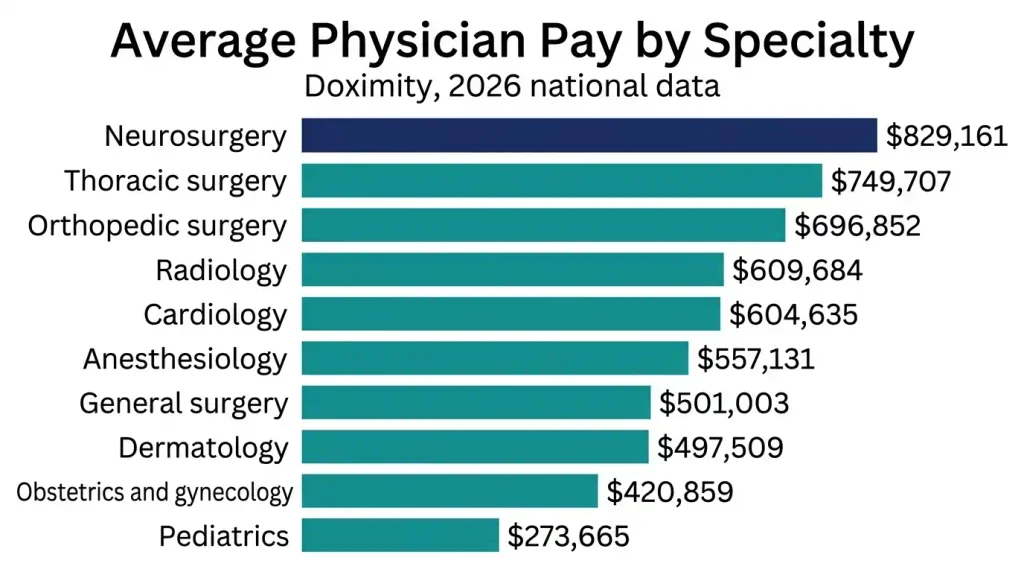
Doximity’s 2026 report ranks neurosurgery first at $829,161, then thoracic surgery at $749,707 and orthopedic surgery at $696,852. Ten specialties average above $600,000. California self-reports agree, with ophthalmology at $680,000 and general surgery at $610,000, though samples are small. Procedures bill at high rates, training takes many years, and productivity bonuses reward volume. These are top-end figures. The average doctor earns about $386,000 (Medscape, 2026), and primary care averages far less.
Primary Care vs. Medical Specialists vs. Surgeons
Primary care doctors average roughly $266,000 to $307,000 nationally (pediatrics, family medicine, and internal medicine, Medscape 2026). Cardiologists average $575,000 and orthopedic surgeons $611,000.
Training explains part of the gap. Primary care residencies run about three years, while surgical residencies are longer and many specialists add fellowships. Surgeons and emergency doctors often carry heavy call and unpredictable hours, while many primary care jobs run steadier. Salary alone is a poor guide. A $300,000 job you can sustain for 30 years can beat a $600,000 job that wears you out in ten.
BLS’s May 2025 national medians are $256,560 for general internal medicine physicians and $210,040 for general pediatricians, lower than survey averages for the reasons above. For context, California nurse practitioners earn a BLS median of $168,520, the highest of any state, national physician assistants earn $135,880, and general dentists in California earn $165,950, about 3% below the national $170,950 (all May 2025).
Related California pay guides cover pharmacists, physical therapists, registered nurses, and attorneys. The California salary by job and industry hub lists more.
Doctor Salary by Career Stage and Experience
Doctors earn least in training and most after years of experience. A California resident makes roughly $75,000 to $100,000, and an attending in the same hospital can make several times that, but only after many years of school and residency.
Resident vs. Fellow vs. Attending Physician
Residents are doctors in training after medical school, fellows are training in a subspecialty after residency, and attendings are fully trained and practicing independently. UCSF’s published scale, housing allowance included, lists $96,953 for a first-year resident, $99,571 for a second-year, and $102,778 for a third-year. Stanford’s first-year pay is $96,949 and UC San Diego’s is $91,211 (SalaryDr, 2025-26 scales). UCSF Fresno pays $75,391 in the first year (2025-26). Fellows are generally paid on the same year-by-year scale. These are training stipends, not what a qualified physician earns.
Starting Salary vs. Experienced Doctor Salary
New attendings often sign contracts with a guaranteed base for the first year or two, then pay may shift toward productivity. Experienced doctors tend to earn more as they build a patient base, earn referrals, work faster, and add leadership roles or ownership. A fixed salary schedule, a low pay rate per unit of work, heavy administrative time, or a part-time schedule can hold income flat. Compare what a contract guarantees with what established doctors in that group take home.
How Long Does It Take to Reach a High Physician Salary?
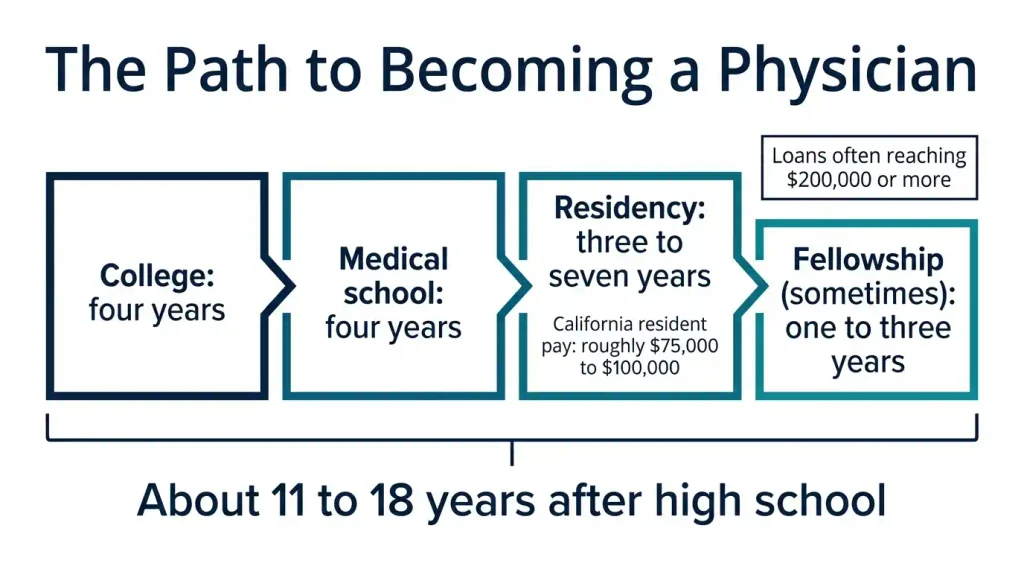
Plan on four years of college, four of medical school, three to seven of residency, and sometimes one to three of fellowship. That is about 11 to 18 years after high school, with loans often reaching $200,000 or more and interest building.
Rough math: four extra training years at about $100,000 a year instead of a $300,000 attending salary means around $800,000 in pre-tax pay not earned. A longer path can still win later, since top surgical specialties far outpay pediatrics at $273,665 (Doximity, 2026), but early cash flow is tight.
AAMC data for the Class of 2025 shows indebted graduates owe an average of $223,130. First-year tuition and fees at a median in-state public school run $43,648 (private schools, $74,661) for 2025-26 (AAMC). Medicine still pays well above average, since even pediatrics averages $266,000 against a $50,980 median wage across all occupations (BLS, May 2025), so the return on investment depends mostly on specialty and how soon you start earning.
International medical graduate (IMG) applicants face extra steps: certification from the Educational Commission for Foreign Medical Graduates (ECFMG), passing scores on the United States Medical Licensing Examination (USMLE), and a US residency spot. The Medical Board of California requires 36 months of approved postgraduate training for a full California physician license, so IMGs should count those years, paid at resident rates, before comparing themselves with these salary figures.
Bill AB 2386 would add a provisional license pathway for internationally trained physicians, but it was held under submission in committee on August 13, 2026, and the Medical Board did not expect it to move this year.
What Determines a Doctor’s Salary in California?
Four things drive pay: specialty, employer, hours, and contract structure. Two doctors in the same specialty and city can differ by six figures because of the last three.
Specialty, Experience, and Employer
Specialty sets the starting range, experience and credentials move you within it, and employer type shifts the structure. Academic hospitals often pay a lower base but offer teaching, research time, and benefits. Community hospitals and private groups may pay more for volume. Doximity’s 2026 report found single-specialty groups paid best, at an average of $480,961. Demand matters too. AMN Healthcare’s recruiting data named family medicine the most in-demand specialty even though its average pay trails most others, so shortages and pay do not always move together.
Work Hours, Call Duties, and Patient Volume
Annual salary hides hourly pay. A $300,000 job is about $144 an hour at 2,080 hours a year, but $100 an hour if nights, weekends, and call push you to 3,000 hours. Call pay and extra coverage may be paid separately or folded into base pay, so ask. Extra shifts may be paid per shift or per hour on top of salary. Many physicians are exempt from overtime rules if they are paid hourly at or above $107.17 an hour in 2026 and mainly do licensed work, and other doctors may qualify under a different exemption, so extra pay usually comes from your contract. Productivity targets matter too. A slow clinic or thin referral base can cut pay even when you work full days.
Benefits, Malpractice Insurance, and Retirement
Cash salary is not the whole offer. Health coverage, a 401(k) or 403(b) match, paid leave, and disability insurance all add value, and an HSA is another option with a qualifying health plan. For example, a 4% match on $300,000 is $12,000 a year, and the 2026 employee deferral limit is $24,500. Occurrence malpractice coverage protects incidents during the policy period no matter when a claim arrives. Claims-made coverage only protects claims filed while the policy is active, so leaving a job requires “tail” coverage. Tail can be costly, so settle who pays before you sign.
Doctor Salary by City and Region in California
Pay differs by region, but the data is messy. Sacramento, Los Angeles, San Francisco, and San Jose rank among the nation’s highest-paying metros in Doximity’s 2026 report, while BLS shows San Diego and Sacramento ahead of Los Angeles. The sources define pay differently, so rank cities cautiously.
Los Angeles vs. San Francisco vs. San Diego vs. Sacramento
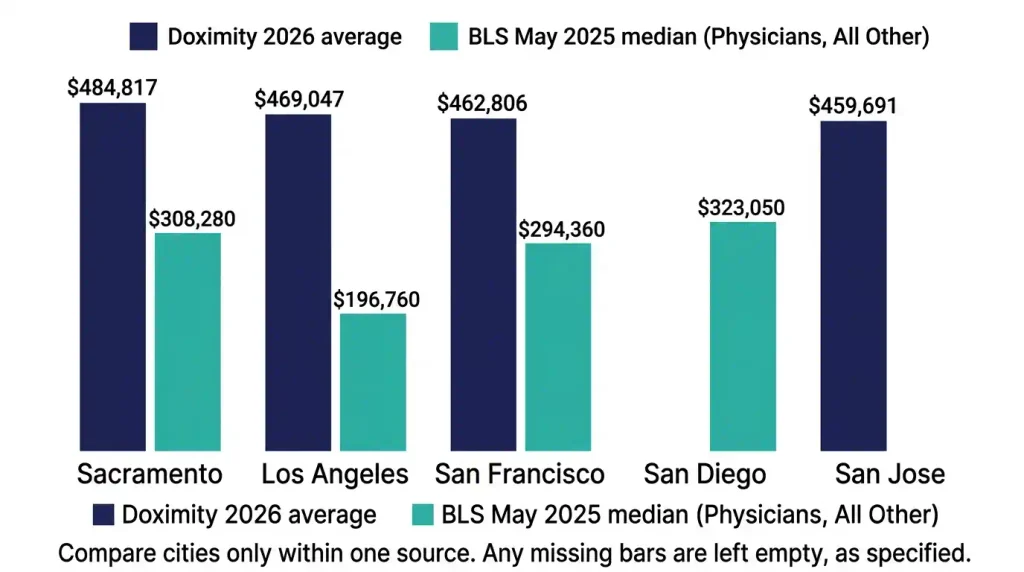
Doximity’s 2026 averages are $484,817 in Sacramento, $469,047 in Los Angeles, $462,806 in San Francisco, and $459,691 in San Jose. BLS’s May 2025 medians for “Physicians, All Other” differ: $323,050 in San Diego, $308,280 in Sacramento, $294,360 in San Francisco, and $196,760 in Los Angeles. The BLS category mixes many roles, so Los Angeles can look low there and high in surveys. Compare cities only within one source. To see take-home pay in each city, try the Los Angeles, San Francisco, San Diego, Sacramento, and San Jose paycheck calculators.
Do Doctors Earn More in Rural California?
The data shows no clean rural premium. BLS’s May 2025 medians for “Physicians, All Other” are $384,990 in Salinas, $273,110 in Merced, and $269,000 in Bakersfield, close to or above the $265,930 national figure, while Vallejo ($194,540) and Oxnard ($193,890) fall well below. Underserved areas offer loan help, such as the National Health Service Corps and the Steven M. Thompson Physician Corps Loan Repayment Program, which repays up to $105,000 for a three-year service commitment. Trade-offs include longer drives, heavier call, less specialist backup, and fewer facilities.
Does a Higher Salary Mean a Better Standard of Living?
Not always. Say a doctor takes home $15,622 a month on $300,000 in a high-cost metro. A mortgage on a roughly $1.2 million home, with taxes and insurance, might run about $7,500 a month. After $2,000 for student loans, $600 for insurance, and $2,000 in savings, about $3,500 is left. At $200,000 in a lower-cost area, take-home is $10,985 a month and housing might be $3,200. After the same loan and insurance costs and $1,000 in savings, about $4,200 is left. This is a hypothetical example, but it shows how a lower-paying location can leave more room.
Hospital Employment vs. Private Practice: Which Pays More?
It depends on who carries the risk. Employed jobs pay steadily with benefits. Owners can earn more but pay overhead, absorb slow months, and are paid last.
Hospital and Health-System Physician Salaries
Hospital and health-system jobs offer predictable pay, built-in patient flow, and benefits such as paid leave, retirement plans, and malpractice coverage, but the system sets pay rates, schedules, and bonus rules. The trade-off is predictability against flexibility. Self-employed physicians tend to out-earn employed ones, but owners carry risk and unpaid time off.
Kaiser Permanente physician salary ranges appear in job postings seen in October 2026. Check current listings, since ranges change. A Sacramento outpatient internal medicine opening at The Permanente Medical Group listed $320,040 to $330,000 plus incentives of up to $44,350, with malpractice and tail coverage included and no RVU targets. A Southern California Permanente Medical Group emergency medicine opening listed $362,375 to $461,055 for full-time work, with pay set by years in the group and schedule.
Public data rarely splits pay by nonprofit or for-profit status, so ask each employer for its pay scale.
Private Practice vs. W-2 Employment vs. 1099 Contracts
A W-2 employee gets wages, benefits, and an employer that pays half of Social Security and Medicare tax. A 1099 contractor gets revenue, not wages, and covers overhead, insurance, retirement, and unpaid time off. A practice owner earns profit after expenses. Self-employment tax on a $350,000 contract comes to roughly $32,000 (12.4% Social Security on up to $184,500 plus 2.9% Medicare on all earnings, both applied to 92.35% of net earnings), so it can leave you with less than a $300,000 W-2 job with benefits. Compare net income, not the headline rate, and the 1099 vs W-2 calculator can help. For more on how California classifies workers, see worker classification.
Base Salary, Bonuses, and Productivity Pay
Many contracts blend base salary, a signing bonus, and productivity pay. Productivity is usually measured in work relative value units (wRVUs), a number Medicare assigns to each service based on the work it takes. Medscape’s 2026 report says RVUs are by far the most common basis for bonuses. For example, $55 per wRVU on 5,000 wRVUs is $275,000. Watch the fine print, because these can shrink what the ad promised:
- Thresholds you must hit before bonuses start
- Pay that resets after the guarantee ends
- Signing bonuses you must repay if you leave early
Benchmarks move slowly. SullivanCotter data, cited in 2026 physician pay coverage, shows overall wRVU output rose about 1.5% year over year, so a target set well above a group’s norm deserves a question.
Bonuses are often withheld at a flat supplemental rate, which can differ from your final tax rate (see how supplemental wage tax works, or try the bonus tax calculator).
California Doctor Salary After Taxes: What Do You Actually Keep?
On $300,000, a single California doctor keeps about $187,000 a year, roughly $15,600 a month, after about 37.5% goes to federal, California, and payroll taxes and disability insurance.
Take-Home Pay on $200,000, $300,000, $400,000, and $500,000
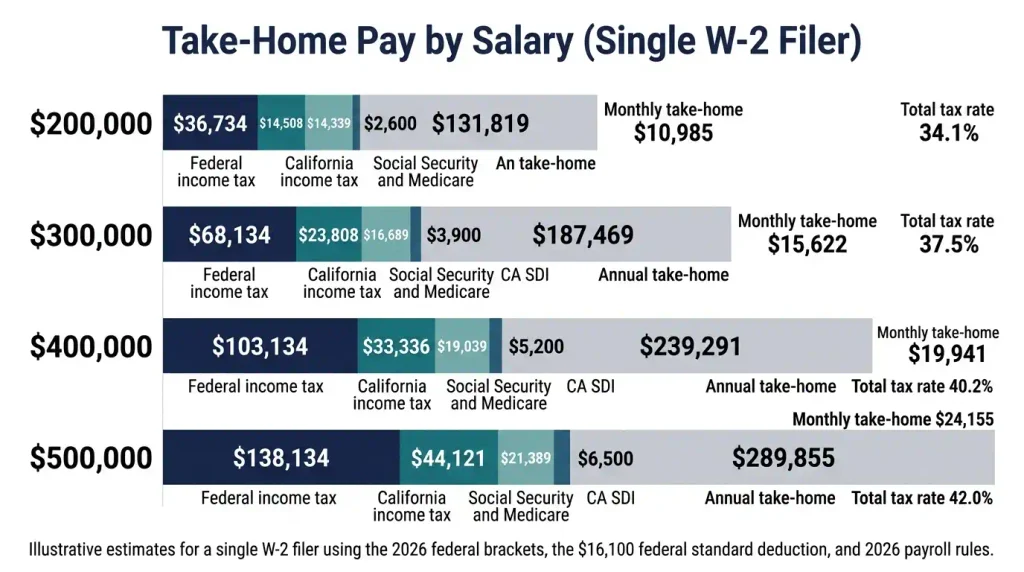
| Gross salary | Federal income tax | California income tax | Social Security and Medicare | CA SDI | Annual take-home | Monthly take-home | Total tax rate |
|---|---|---|---|---|---|---|---|
| $200,000 | $36,734 | $14,508 | $14,339 | $2,600 | $131,819 | $10,985 | 34.1% |
| $300,000 | $68,134 | $23,808 | $16,689 | $3,900 | $187,469 | $15,622 | 37.5% |
| $400,000 | $103,134 | $33,336 | $19,039 | $5,200 | $239,291 | $19,941 | 40.2% |
| $500,000 | $138,134 | $44,121 | $21,389 | $6,500 | $289,855 | $24,155 | 42.0% |
These are illustrative estimates for a single W-2 filer using the 2026 federal brackets, the $16,100 federal standard deduction, and 2026 payroll rules. California figures use the most recent published brackets (tax year 2025) and its $5,706 standard deduction, since 2026 amounts were not yet confirmed. They assume no 401(k) contributions, pre-tax benefits, or other income.
Itemizing can come out ahead at these incomes, since state income and property taxes count toward the 2026 federal SALT cap of $40,400, which the big beautiful bill tax calculator can model, so your federal tax may be lower. Filing status matters too. A married doctor filing jointly with a non-working spouse and no children, on the same $300,000, would keep roughly $210,700 (about $17,600 a month) instead of $187,469, thanks to wider brackets and a larger standard deduction. For comparison, see how a $200,000 salary is taxed in California or browse more paycheck scenarios.
On the same assumptions, $250,000 leaves about $160,774 a year ($13,398 a month) and $350,000 leaves about $213,494 ($17,791 a month). Tax withholding on your paycheck is only an estimate of what you owe, so your final bill can differ. You can adjust it with a new Form W-4 and California’s DE 4 form. For official rules, see the Internal Revenue Service (IRS) for federal tax and the California Franchise Tax Board for state tax.
How California Taxes Affect Physician Income
Federal and California taxes are progressive, so higher slices of income face higher rates. Federal rates run from 10% to 37%. California personal income tax rates run from 1% to 12.3%, plus 1% on income above $1 million for a top rate of 13.3%. The marginal rate is the tax on your next dollar, and the effective rate is total tax divided by total pay. At $300,000, your next dollar loses roughly 48 cents (35% federal, 9.3% California, 2.35% Medicare, and 1.3% SDI), yet your overall rate is 37.5%.
Social Security tax is 6.2% up to $184,500 (an $11,439 maximum), Medicare tax is 1.45% with no cap plus the 0.9% Additional Medicare Tax above $200,000, and California State Disability Insurance (SDI) is 1.3% on all wages in 2026. See the 2026 SDI rate guide for the rate and the CA SDI calculator for what it costs on your pay.
What Can a California Doctor Afford?
Use take-home pay, not salary, to plan, and your pay stub shows the real amount. Run your own numbers in the California paycheck calculator. At $300,000, take-home is about $15,600 a month. After a $7,500 housing payment, $2,000 for student loans, and $600 for insurance, about $5,500 is left for savings, childcare, cars, and daily life. At $200,000 in a lower-cost area, the same loan and insurance costs against a $3,200 housing payment leave about $5,200. Maxing a $24,500 401(k) also cuts taxable income while building wealth. More ideas are in California tax savings planning. These are examples, not personal financial advice.
Locum Tenens and Part-Time Physician Earnings
Locum tenens means short-term assignments covering for other doctors. Daily rates look high, but annual pay depends on days worked and what you pay for yourself.
Locum Tenens Physician Pay
Locum work pays by the hour or day, so compare it with salary on an annual basis. Say an assignment pays $1,800 a day for 15 days a month. That is $27,000 a month, or $324,000 over a full year. If gaps leave you working nine months, the total is $243,000. This example is hypothetical, not a market rate. You may also pay for travel, housing, health insurance, quarterly estimated taxes, and retirement, such as a SEP IRA. Locum doctors are often contractors, so ask who provides malpractice coverage and whether tail coverage is included. Check that contractor status fits the arrangement, since misclassification can cost you benefits. Contract terms often matter more than the daily rate.
Part-Time Physician Salary and Full-Time Equivalent
Full-time equivalent (FTE) is the share of a full-time schedule you work. On a $300,000 full-time base, pro-rated pay would be about $180,000 at 0.6 FTE, about $240,000 at 0.8 FTE, and about $150,000 at 0.5 FTE. Hourly pay may stay the same even as yearly income drops. What changes is benefits. Some employers require a minimum FTE, such as half-time or more, for health coverage or retirement matches (see paid leave and benefits), so check the policy and whether call duties shrink with your schedule.
Common Myths About California Doctor Salaries
Salary headlines make doctors look uniformly rich, but pay is uneven and a few common beliefs mislead.
Every Doctor in California Earns More Than $300,000
Not true. BLS’s California median for its physician group is $281,590 (May 2025), and it covers employed doctors only. Family medicine averages $288,000 nationally and pediatrics $266,000 (Medscape, 2026). Residents make around $75,000 to $100,000, and part-time and locum doctors earn based on days worked. A few high-paying specialties pull the average up, and an average does not describe any one doctor’s paycheck.
The Highest-Paying Specialty Is Always the Best Financial Choice
Salary does not measure lifetime value. Neurosurgery pays the most (Doximity, 2026), but it often takes seven years of residency, long hours, and a late start on saving. A family physician who starts a full salary about 11 years after high school, with less debt interest and a lighter schedule, may feel better off than a surgeon still in training at that age. Fit with the work matters, because staying in a specialty for decades is what builds income.
A Higher Gross Salary Always Means More Take-Home Pay
More pay means more take-home, but not at the same rate. Going from $200,000 to $400,000 doubles gross, yet take-home rises from $131,819 to $239,291, about 1.8 times. Not every dollar hits the top rate, because only income above each bracket threshold is taxed at the higher rate. Location matters too. A high salary in an expensive city can leave less spending room than a lower one elsewhere.
Online Physician Salary Figures Are Directly Comparable
They are not. BLS data covers employer wages only. Medscape and Doximity cover full-time doctors and report total pay, each with its own method and sample. Some figures come from different years, and others, like the California specialty medians above, rest on fewer than 30 responses. Do not mix a 2024 survey with a 2026 one, or a BLS median with a survey average, and call the difference a trend. Some reports also blend residents, new attendings, and late-career doctors into one average. O*NET OnLine, a federal job database, shows BLS wage figures next to job duties, so it carries the same limits.
How to Evaluate a California Physician Job Offer
Judge the whole package, not the base salary. A lower base with a strong guarantee, a clear bonus formula, and paid malpractice coverage can beat a bigger number loaded with conditions.
Compare the Full Compensation Package
Add up what is guaranteed: base salary, signing bonus, and retirement match. Then add the bonus you can reasonably expect from the formula and your likely volume, and subtract costs you pay yourself, like tail coverage or benefit premiums. Review call coverage, productivity thresholds, and termination terms, then estimate after-tax pay against local living costs. An offer that looks $30,000 higher on paper can come out lower after hours, taxes, and expenses. To negotiate, anchor on specialty benchmarks from the sources above and the employer’s posted pay range, and ask for gains in base pay, guarantee length, signing bonus, or protected time.
Questions to Ask Before Accepting an Offer
Ask these before you sign:
- How long is the salary guaranteed, and how are bonuses calculated?
- When is pay reviewed, and what happens to your rate when the guarantee ends?
- Who pays for malpractice and tail coverage, and when do benefits start?
- Must signing bonuses or relocation money be repaid if you leave?
California generally bars non-compete clauses in employment contracts (see California labor laws), but non-solicitation terms and out-of-state agreements can still apply. The American Medical Association (AMA) publishes model guidance on physician employment agreement terms that can help you spot gaps. Have a healthcare contract attorney review the offer before you sign.
Choose the Offer That Fits Your Financial and Career Goals
Weigh income now against growth later. A lower salary with strong mentorship, a good case mix, or a path to partnership may pay more over ten years. Consider location, call tolerance, and how soon you need to pay down loans. Verify the tax estimate, bonus formula, and local housing costs, then choose the offer you could live with if the bonus never arrives.
Frequently Asked Questions About California Doctor Salaries
Pay depends on specialty, employer, and city. At $200,000 to $500,000, taxes take 34.1% to 42.0%.
What Is the Average Doctor Salary in California in 2026?
It depends on the source. Doximity’s 2026 survey shows metro averages of $459,691 to $484,817 in San Jose, San Francisco, Los Angeles, and Sacramento. BLS shows a California median of $281,590 for “Physicians, All Other” (May 2025) and a U.S. median of $275,930 for all physicians and surgeons (May 2025). Surveys give averages and BLS gives medians, so they differ. For a full-time doctor, survey averages are the closer guide.
Which Type of Doctor Makes the Most Money in California?
Surgical specialties. Doximity’s 2026 report ranks neurosurgery first nationally, followed by thoracic surgery and orthopedic surgery. In California, small self-reported samples show ophthalmology at a $680,000 median and general surgery at $610,000. Individual pay varies by employer, experience, and hours.
How Much Does a Doctor Make per Month in California?
On gross pay, $281,590 a year is about $23,466 a month, and $469,047 is about $39,087. Take-home is lower (see why a paycheck comes in lower than expected). A single W-2 doctor earning $300,000 keeps about $15,622 a month after federal, California, and payroll taxes.
Do Doctors Make More in California Than in Other States?
Sometimes. Sacramento, Los Angeles, San Francisco, and San Jose rank among the 10 highest-paying metros in Doximity’s 2026 report, though Oklahoma City is first at $495,617. California taxes and living costs are higher, and specialty mix differs by state, so higher pay does not always mean a higher standard of living.
How Much Does a Doctor Make After Taxes in California?
A single W-2 doctor earning $300,000 keeps about $187,469 a year, or $15,622 a month, after federal tax, California tax, Social Security, Medicare, and SDI. At $200,000 it is about $131,819, and at $400,000 about $239,291. These assume the standard deduction and no 401(k) contributions.
Is California a Good State for Doctors Financially?
It can be. Pay is strong in many metros and demand is real, but taxes (up to 13.3% at the state level) and housing costs eat into it. The answer depends on specialty, debt, and where you want to live, and a doctor in a lower-cost part of the state may keep more. BLS’s Occupational Outlook Handbook projects national physician employment to grow 4% from 2025 to 2035, about as fast as average.
How Much Does a New Doctor Earn After Residency?
Pay jumps sharply. A third-year resident at UCSF makes $102,778, while a new attending in primary care may start around the national average of $266,000 to $307,000 (Medscape, 2026), and procedural specialties start higher. Averages cover all experience levels, so first-year pay can be lower. Many first contracts include a guaranteed base before productivity pay begins. If you move to California partway through the year, see how part-year resident tax works.
Do Doctors in California Earn More in Private Practice or Hospitals?
It depends. Doximity’s 2026 report found single-specialty groups paid the most, at an average of $480,961, and Medscape’s 2026 report says self-employed doctors still out-earn employed ones on average. But owners carry overhead, insurance costs, and unpaid time off, while hospital jobs offer steadier pay and benefits.

Yeasin Sorker is the founder of Paycheck Calculator California. He built this tool in 2018 after noticing that most free paycheck calculators missed California-specific rules like daily overtime and the uncapped SDI rate.
He researches California payroll tax updates regularly and keeps this calculator aligned with the latest IRS, FTB, and EDD published rates. All calculations on this site are estimates based on official 2026 government sources. For personalized tax advice, consult a qualified tax professional.