
Your federal tax bracket for 2026 is the rate band your taxable income reaches after the standard deduction, based on your filing status. Only the income inside that band is taxed at its rate, not your whole income.
Those bands and the 2026 standard deduction come from IRS Revenue Procedure 2025-32, applied below to salaries from $40,000 to $200,000.
Brackets alone do not set your final bill; credits and California tax change it.
What Federal Tax Bracket Am I In for 2026?
The federal tax brackets 2026 use seven rates: 10%, 12%, 22%, 24%, 32%, 35%, and 37%. They are set in Internal Revenue Code Section 1, and the Internal Revenue Service (IRS) raises the thresholds yearly for inflation. These figures cover income earned in 2026, reported when you file in early 2027.
2026 Federal Tax Brackets by Filing Status
These are the federal income tax rates 2026 filers will use, as taxable-income thresholds from IRS Revenue Procedure 2025-32. Qualifying surviving spouse tax brackets match the married filing jointly column.
| Rate | Single | Married Filing Jointly | Married Filing Separately | Head of Household |
|---|---|---|---|---|
| 10% | $0 to $12,400 | $0 to $24,800 | $0 to $12,400 | $0 to $17,700 |
| 12% | $12,401 to $50,400 | $24,801 to $100,800 | $12,401 to $50,400 | $17,701 to $67,450 |
| 22% | $50,401 to $105,700 | $100,801 to $211,400 | $50,401 to $105,700 | $67,451 to $105,700 |
| 24% | $105,701 to $201,775 | $211,401 to $403,550 | $105,701 to $201,775 | $105,701 to $201,750 |
| 32% | $201,776 to $256,225 | $403,551 to $512,450 | $201,776 to $256,225 | $201,751 to $256,200 |
| 35% | $256,226 to $640,600 | $512,451 to $768,700 | $256,226 to $384,350 | $256,201 to $640,600 |
| 37% | Over $640,600 | Over $768,700 | Over $384,350 | Over $640,600 |
The 2026 standard deduction is $16,100 for single filers and married filing separately, $32,200 for married filing jointly and qualifying surviving spouses, and $24,150 for head of household. Subtract it before using this table. The One Big Beautiful Bill Act (OBBBA) set the 2025 amounts at $15,750 for single and $31,500 for joint filers. Estimate your own savings from the law’s changes with the Big Beautiful Bill tax calculator. The IRS ties thresholds to chained CPI, so inflation alone does not push people into higher brackets. For single filers, the 12% bracket now ends at $50,400, up from $48,475 in 2025. The seven rates came from the Tax Cuts and Jobs Act (TCJA), which the OBBBA made permanent.
Quick Examples of Which Tax Bracket Applies
Each row shows the top bracket reached and the lower effective rate that results.
| Filing status | Taxable income | Highest bracket reached | Federal tax | Effective rate (of taxable income) |
|---|---|---|---|---|
| Single | $30,000 | 12% | $3,352 | 11.2% |
| Single | $90,000 | 22% | $14,512 | 16.1% |
| Married filing jointly | $150,000 | 22% | $22,424 | 14.9% |
| Single | $250,000 | 32% | $56,456 | 22.6% |
How Federal Tax Brackets Work
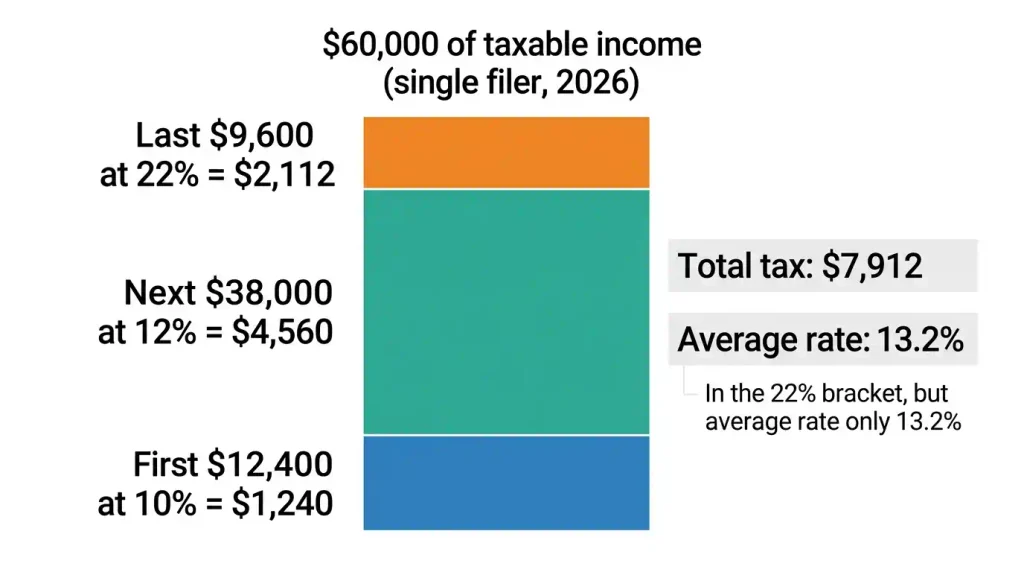
The U.S. uses a progressive system: income is split into slices, each with its own rate. Take a single filer with $60,000 of taxable income in 2026. The first $12,400 is taxed at 10% ($1,240), the next $38,000 at 12% ($4,560), and the last $9,600 at 22% ($2,112). The total is $7,912. That person is “in the 22% bracket” but pays an average of only 13.2%.
Marginal Tax Rate vs. Effective Tax Rate
Your marginal rate is the rate on your next dollar of taxable income. Your effective rate is total federal income tax divided by taxable income. The marginal rate applies only to dollars above the start of that bracket, so the effective rate almost always sits below it.
Does Moving Into a Higher Tax Bracket Reduce Your Take-Home Pay?
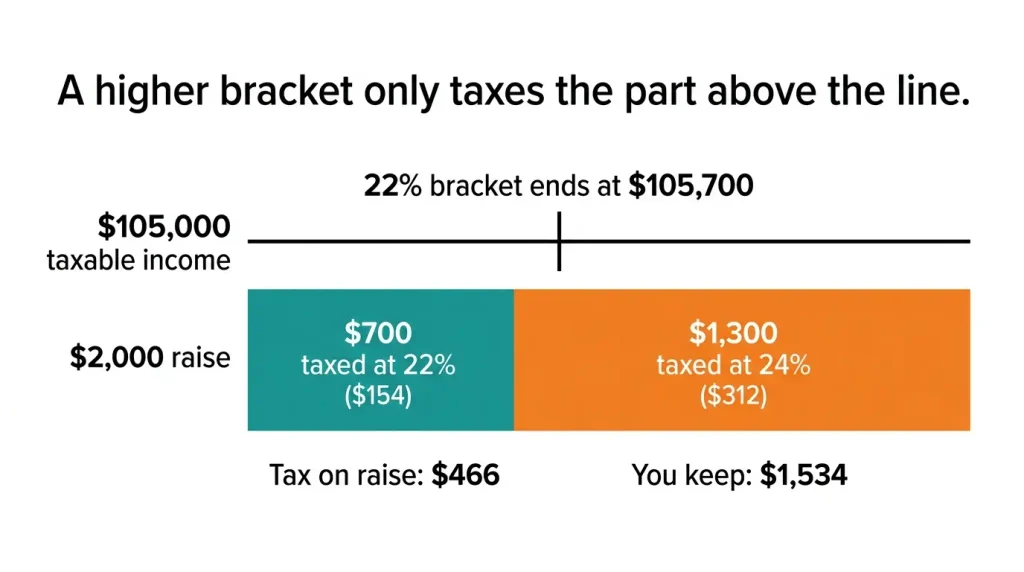
No. Only income above the threshold gets the higher rate. Say a single filer with $105,000 of taxable income gets a $2,000 raise. The 22% bracket ends at $105,700, so $700 is taxed at 22% ($154) and $1,300 at 24% ($312). The tax is $466, and the person keeps $1,534. What can shrink a raise are separate things, such as a phased-out credit, a deduction limit, or a benefit with an income cutoff. For a longer example, see how much of a raise you keep after federal tax.
How to Find Your Federal Tax Bracket Step by Step
Pick your filing status, turn income into taxable income, then find that number in the 2026 table. Salary minus pretax benefits and adjustments gives you AGI. AGI minus your deduction gives taxable income.
Step 1: Identify Your Federal Filing Status
Your options are single, married filing jointly, married filing separately, and head of household. Head of household is for unmarried filers who paid more than half the cost of keeping up a home that a qualifying person lived in for more than half the year. A qualifying surviving spouse (with a dependent child, within two years of the spouse’s death) can still use joint thresholds. Your status on December 31 applies to the whole year.
Step 2: Calculate Your Federal Taxable Income
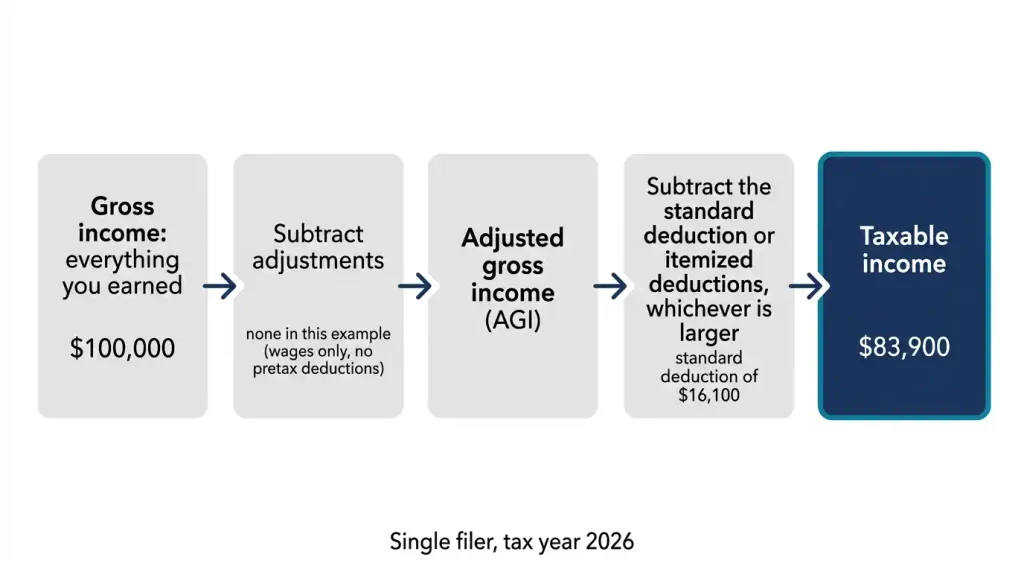
Work down from gross income to taxable income:
- Start with gross income, everything you earned (the gross pay calculator totals it from hourly pay).
- Subtract adjustments (often called above-the-line deductions) such as deductible traditional IRA contributions, HSA contributions, student loan interest (up to $2,500), and half of self-employment tax. The result is your adjusted gross income (AGI).
- Subtract the standard deduction or itemized deductions, whichever is larger. The result is your taxable income.
Traditional 401(k) contributions are already excluded from box 1 of your Form W-2 Wage and Tax Statement. Itemizing pays off mainly when mortgage interest, charitable gifts, and capped state and local taxes exceed your standard deduction. If someone else claims you as a dependent, your standard deduction is limited to the greater of $1,350 or earned income plus $450, up to the regular amount.
Step 3: Match Taxable Income to the 2026 Bracket Table
Find the row holding your last dollar of taxable income. That is your bracket. To get your tax, fill each lower bracket first, then tax only the leftover at your top rate. A single filer with $83,900 of taxable income pays 10% on $12,400, 12% on $38,000, and 22% on $33,500. The IRS prints these bands as a federal income tax rate schedule for each filing status. You report the result on Form 1040 U.S. Individual Income Tax Return.
How Much Federal Income Tax Will You Pay on Your Salary?
It depends on your filing status, deductions, and other income. A single filer earning $100,000 owes about $13,170 (13.2%). The examples below show tax on salary only. Social Security and Medicare are separate, and paycheck withholding is only a prepayment of this bill.
Federal Tax Examples for Common Salaries
Assumptions: tax year 2026, single filer, wages only, no pretax deductions, standard deduction of $16,100.
| Salary | Taxable income | 10% slice | 12% slice | 22% slice | 24% slice | Total federal tax | Effective rate (of salary) |
|---|---|---|---|---|---|---|---|
| $40,000 | $23,900 | $1,240 | $1,380 | n/a | n/a | $2,620 | 6.6% |
| $60,000 | $43,900 | $1,240 | $3,780 | n/a | n/a | $5,020 | 8.4% |
| $75,000 | $58,900 | $1,240 | $4,560 | $1,870 | n/a | $7,670 | 10.2% |
| $100,000 | $83,900 | $1,240 | $4,560 | $7,370 | n/a | $13,170 | 13.2% |
| $150,000 | $133,900 | $1,240 | $4,560 | $12,166 | $6,768 | $24,734 | 16.5% |
A married couple filing jointly would use wider bands and a $32,200 deduction, so their tax on the same combined income would be lower. A $200,000 salary leaves $183,900 of taxable income, about $36,734 of federal tax, and an 18.4% effective rate. For California take-home on these salaries, see the $60,000 salary after taxes, $75,000 salary after taxes, $150,000 salary after taxes, and $200,000 salary after taxes breakdowns. Browse more paycheck scenarios.
How a Raise, Bonus, or Overtime Changes Your Taxes
Extra pay stacks on top of your other income, and only the part above a threshold gets the higher rate.
- Hourly pay: use the same brackets. Multiply your rate by expected yearly hours (the annual salary calculator does this; see what $25 an hour is per year), then follow the steps above.
- Overtime and commissions: ordinary income taxed at your marginal rate, though qualified overtime pay (only the premium portion, for hours over 40 a week) may be deductible, up to $12,500 ($25,000 joint) for 2025 through 2028. Details are in the California comparison below, and the California overtime calculator handles daily overtime.
- Bonuses: employers often withhold a flat 22% federal rate on bonuses and other supplemental wages (37% above $1 million), and California uses its own flat rates. A $5,000 bonus loses about $1,548 to federal withholding, Social Security, Medicare, and SDI alone (roughly 31%), before California income tax, which is why it looks small. Commission checks are often handled the same way. If your real bracket is below 22%, the difference comes back in your refund. Check your own number with the California bonus tax calculator.
- Midyear changes: withholding assumes your current pay lasts all year, because the IRS withholding tables annualize each paycheck. If you start a higher-paying job in July, you may be under-withheld, so recheck your Form W-4. Final tax uses only what you earned in the calendar year, so a midyear raise or part-year job adds less to annual taxable income than full-year pay would suggest.
How Federal and California Tax Brackets Affect Your Take-Home Pay
Federal and California income taxes are separate systems, each with its own brackets, deductions, credits, and taxable income. Payroll taxes come on top. Social Security and Medicare taxes (FICA) come from the Federal Insurance Contributions Act (FICA) and are not part of federal income tax. Social Security is 6.2% up to a $184,500 wage base in 2026, and Medicare is 1.45%. California adds SDI at 1.3% in 2026.
2026 California Income Tax Brackets and Rates
California has nine brackets from 1% to 12.3%, plus an extra 1% California Mental Health Services Tax on taxable income over $1 million, for a top rate of 13.3%. (FTB forms now label it the Behavioral Health Services Tax.) Thresholds rise with inflation each year while rates stay. For 2026, the California Franchise Tax Board (FTB) raised them 3.4% from the 2025 brackets, and the table shows its published 2026 schedules from the October 2026 Tax News. The FTB posts the complete tables in late December.
| Rate | Single / Married Filing Separately | Married Filing Jointly / Qualifying Surviving Spouse | Head of Household |
|---|---|---|---|
| 1% | $0 to $11,456 | $0 to $22,912 | $0 to $22,927 |
| 2% | $11,456 to $27,157 | $22,912 to $54,314 | $22,927 to $54,316 |
| 4% | $27,157 to $42,861 | $54,314 to $85,722 | $54,316 to $70,018 |
| 6% | $42,861 to $59,498 | $85,722 to $118,996 | $70,018 to $86,654 |
| 8% | $59,498 to $75,197 | $118,996 to $150,394 | $86,654 to $102,356 |
| 9.3% | $75,197 to $384,109 | $150,394 to $768,218 | $102,356 to $522,385 |
| 10.3% | $384,109 to $460,927 | $768,218 to $921,854 | $522,385 to $626,864 |
| 11.3% | $460,927 to $768,213 | $921,854 to $1,536,426 | $626,864 to $1,044,771 |
| 12.3% | Over $768,213 | Over $1,536,426 | Over $1,044,771 |
California’s standard deduction is much smaller than the federal one: $5,900 for single filers and $11,800 for joint and head of household filers (2026 amounts). You can itemize instead, as covered in our guide to California itemized deductions. The California State Disability Insurance (SDI) tax is a payroll deduction, not an income tax. It funds disability and Paid Family Leave benefits and has applied to all wages with no cap since January 1, 2024 (EDD payroll tax guide). Estimate yours with the CA SDI calculator.
Federal vs. California Income Tax: Key Differences
| Federal | California | |
|---|---|---|
| Number of brackets | 7 (10% to 37%) | 9 (1% to 12.3%), plus 1% over $1 million |
| Standard deduction (single) | $16,100 (2026) | $5,900 (2026) |
| Capital gains | Lower preferential rates | Taxed as ordinary income (see California capital gains tax) |
| Social Security benefits | Partly taxable | Not taxed |
| HSA contributions | Deductible | Not deductible |
The same salary lands in different brackets because deductions and thresholds differ. A single filer earning $100,000 has $83,900 of federal taxable income (22% bracket) but about $94,100 of California taxable income (9.3% bracket). The next dollar costs roughly 31 cents in income tax plus about 9 cents in payroll tax. California also skips some federal rules, such as HSA treatment and the new federal overtime and tips deductions. Those run from 2025 through 2028: up to $12,500 ($25,000 joint) for qualified overtime pay and up to $25,000 for qualified tips, phasing out above $150,000 ($300,000 joint) of MAGI (IRS guidance). California has not adopted them, so they are added back on your California return (EY Tax News). State-law daily overtime generally does not qualify for the federal deduction, so see California overtime laws. Check FTB guidance for your situation.
From Gross Salary to Estimated Take-Home Pay
Assumptions: single filer, $100,000 salary, wages only, 26 biweekly checks. Federal figures use 2026 rules. California uses the FTB’s 2026 schedule with a $5,900 standard deduction and $158 personal exemption credit, so treat it as an estimate (how we calculate).
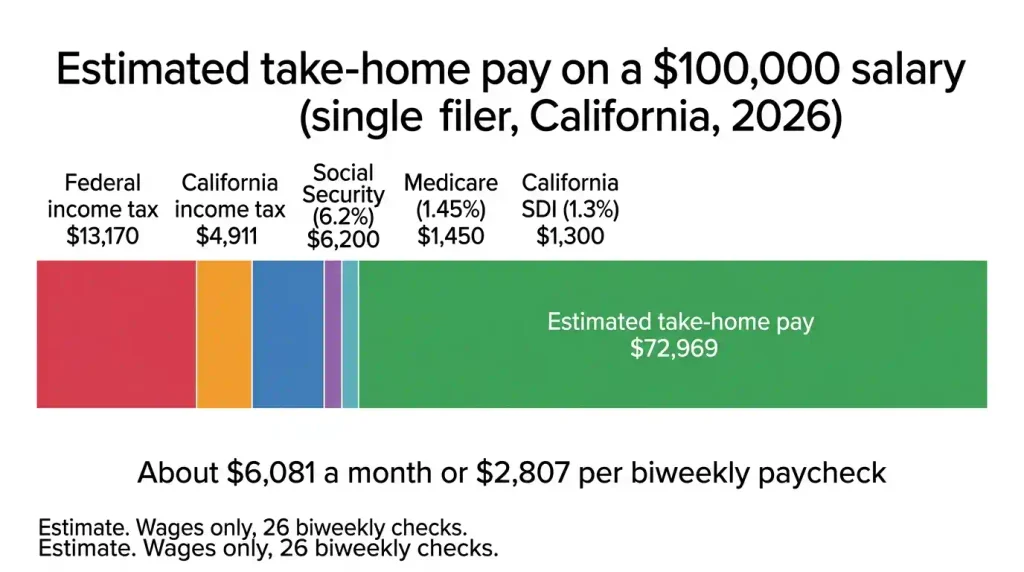
| Item | Annual amount |
|---|---|
| Gross salary | $100,000 |
| Federal income tax | $13,170 |
| California income tax | $4,911 |
| Social Security (6.2%) | $6,200 |
| Medicare (1.45%) | $1,450 |
| California SDI (1.3%) | $1,300 |
| Estimated take-home pay | $72,969 |
That is about $6,081 a month or $2,807 per biweekly paycheck, before health insurance premiums and other benefit deductions. Actual withholding follows the EDD’s Method B formulas (see our Method B guide), so your check can differ slightly. To read each line on your check, see how to read a California pay stub.
With a $6,000 traditional 401(k) contribution, federal income tax falls to $11,850 and California income tax to $4,353, a combined saving of about $1,878. Social Security, Medicare, and SDI stay the same, because 401(k) contributions do not reduce those wages. Take-home becomes $68,847, or about $2,648 per biweekly check, so setting aside $6,000 cuts your pay by only $4,122.
What Can Change Your Federal Tax Bracket or Tax Bill?
Some things move your bracket because they change taxable income. Others, like credits, lower your bill without moving it.
Filing Status, Marriage, and Household Income
Married filing jointly thresholds are exactly double the single thresholds up to the 32% bracket, so two similar incomes pay about what two single filers would. On a joint return, a second income stacks on the first and is taxed at the household’s marginal rate. The joint 35% bracket ends, and the 37% bracket starts, at $768,700, which is less than double the single $640,600, so two high earners can face a marriage tax penalty, while a one-earner couple often gets a marriage bonus. Qualifying dependents can open up credits, and head of household status gives wider low brackets and a larger deduction than single.
Pretax Retirement Contributions and Other Deductions
A traditional 401(k) or deductible IRA contribution lowers taxable income dollar for dollar, which can drop you into a lower bracket. A deduction reduces the income that gets taxed. A credit reduces the tax itself, usually worth more per dollar. Both have eligibility rules and income limits.
- Roth contributions: do not lower taxable income today.
- Traditional IRA deduction: can shrink or disappear if you have a workplace plan and your modified adjusted gross income (MAGI) is high enough.
- HSA and FSA: Health Savings Account (HSA) contributions and Flexible Spending Account (FSA) contributions through payroll skip federal income tax and FICA, though California taxes HSA money.
- Retirees: same brackets. Pensions and traditional 401(k) or IRA withdrawals are ordinary income, and up to 85% of Social Security benefits can be taxable, depending on income.
Tax Credits and Additional Federal Taxes
Credits subtract directly from your tax bill. Some taxes add to it.
- Credits: the Child Tax Credit ($2,200 per qualifying child) and the Earned Income Tax Credit (EITC), which tops out at $8,231 for 2026 with three or more qualifying children. California has its own CalEITC. Lower and middle income savers may claim the Retirement Savings Contributions Credit for 401(k) or IRA contributions.
- Alternative Minimum Tax (AMT): 2026 exemption of $90,100 for single and $140,200 for joint filers.
- Additional Medicare Tax: wages over $200,000 trigger withholding of the 0.9% Additional Medicare Tax.
- Net Investment Income Tax (NIIT): the 3.8% tax can apply once your MAGI passes $200,000 for single or $250,000 for joint filers.
- Investment income: long-term capital gains and qualified dividends are taxed at 0%, 15%, or 20% instead of ordinary income tax rates, stacked on top of your other income, while short-term gains are taxed like wages.
- Self-employment: freelancers owe the 15.3% self-employment tax on 92.35% of net earnings (the Social Security part stops at the $184,500 wage base) on top of income tax, can deduct half of it, and may claim the qualified business income deduction (QBI deduction) of up to 20% of qualified business income, subject to limits.
- 1099 vs W-2: see the 1099 vs W-2 tax breakdown for California and run the 1099 vs W-2 calculator (more in worker classification).
Multiple Jobs, Side Income, and Midyear Job Changes
Each employer withholds as if that job is your only income, so with two jobs your combined pay can land in a higher bracket than either employer assumes, and you may owe at filing time. Side income has no withholding.
- Estimated payments: if you expect to owe $1,000 or more federally, or $500 or more in California ($250 if married filing separately), you may need quarterly estimated payments (Form 1040-ES federally, Form 540-ES in California). The usual safe harbor against an underpayment penalty is paying at least 90% of this year’s tax or 100% of last year’s (110% if your AGI was over $150,000). California bases estimated tax on the current year’s tax if your California AGI is $1,000,000 or more ($500,000 married filing separately).
- Form W-4: update your Form W-4 Employee’s Withholding Certificate after a job change, a second job, or a big income shift. IRS Form W-4 Step 2 covers multiple jobs: use the estimator, the Multiple Jobs Worksheet, or the checkbox if both jobs pay about the same. Step 4(c) adds extra withholding to each paycheck.
- Help: the IRS Tax Withholding Estimator can help, and IRS Publication 505 covers withholding and estimated tax rules.
Common Federal Tax Bracket Myths and Mistakes
Most mistakes come from wrong ideas about marginal rates. They can lead people to turn down raises, skip overtime, or panic over a withholding number.
Common Tax Bracket Misconceptions
- Myth: All your income is taxed at the highest bracket you reach. Only the slice inside that bracket gets that rate.
- Myth: A raise can leave you worse off because of a higher bracket. The extra income is taxed at a higher rate, but you still keep most of it.
- Myth: Your paycheck withholding rate equals your final effective tax rate. Withholding is an estimate based on your W-4. Your real rate is set when you file.
Mistakes That Lead to Inaccurate Tax Estimates
- Using gross salary to find your bracket. Use taxable income, after pretax contributions and the standard deduction.
- Applying federal deductions or rates to California. California has its own brackets, a smaller standard deduction, and different rules.
- Treating a refund or a balance due as a bracket change. A refund only means you withheld more than you owed. Owing at filing time does not mean your return is wrong, only that withholding fell short. Neither says anything about your marginal rate.
How to Estimate Your Taxes and Plan Your Next Paycheck
Find your federal taxable income and tax, then your California taxable income and tax. Subtract both income taxes, Social Security, Medicare, SDI, and any pretax benefits from your salary, then divide by your pay periods. Compare the result to your pay stub and adjust withholding if the gap is large. A paycheck calculator or federal income tax estimator can speed this up and compare gross pay with net pay, but check that it uses 2026 figures and California rules. Bracket math uses yearly income while withholding tables work paycheck by paycheck, so they will not match exactly.
Information You Need for a More Accurate Estimate
- Annual wages and filing status
- Expected deductions and credits
- Pretax contributions (401(k), HSA, health plan)
- Any side or investment income
- Whether you were a California resident all year or only a part-year resident, since residency decides which state rules apply
Official Tax Resources and Next Steps
For federal numbers, use the IRS 2026 inflation adjustments (Revenue Procedure 2025-32), IRS withholding guidance, and the IRS Tax Withholding Estimator. For California, use the FTB’s 2026 indexing announcement, its schedules at ftb.ca.gov/tax-rates, and the EDD’s payroll withholding and SDI information. For planning ideas, browse California tax savings planning, and for pay stub and withholding explainers, start with paycheck basics. Redo your estimate after a raise, job change, marriage, new child, or any major income change. This is general information, not tax advice, so consult a tax professional if your situation is complicated.
Frequently Asked Questions About Federal Tax Brackets in 2026
These answers use the 2026 figures above.
What federal tax bracket am I in if I make $50,000 a year?
It depends on your filing status and deductions, not the $50,000 alone. A single filer taking the standard deduction has $33,900 of taxable income, which is in the 12% bracket. Federal tax is about $3,820, an effective rate of roughly 7.6% on the full salary. See the take-home pay on $50,000 in California.
What is the 22% federal tax bracket in 2026?
It covers taxable income of $50,401 to $105,700 for single filers and married filing separately, $100,801 to $211,400 for married filing jointly, and $67,451 to $105,700 for head of household. The rate applies only to income inside that range.
What is the highest federal income tax rate for 2026?
It is 37%. It starts above $640,600 for single filers and heads of household, $768,700 for married filing jointly, and $384,350 for married filing separately, and applies only to income over that line.
Do federal tax brackets apply to gross income or taxable income?
Taxable income. Brackets apply after adjustments and the standard or itemized deduction. Salary is where the math starts, not the number used in the bracket table.
Are federal and California tax brackets added together?
No. Each system has its own brackets, deductions, and taxable income, and figures tax separately. The rates do stack on your next dollar (22% federal plus 9.3% California, the roughly 31 cents shown above, for a single filer at $100,000). But total tax is not your two top rates added together, because lower slices are taxed at lower rates in both systems.
Why is my paycheck tax withholding different from my final tax rate?
Withholding is a prepayment based on your W-4 or DE 4, your pay schedule, and the assumption that current pay continues all year. Your final rate depends on full-year income, deductions, and credits. After a life or income change, review your Form W-4 or run the IRS Tax Withholding Estimator. If your check looks low, see why your paycheck is so low.

Yeasin Sorker is the founder of Paycheck Calculator California. He built this tool in 2018 after noticing that most free paycheck calculators missed California-specific rules like daily overtime and the uncapped SDI rate.
He researches California payroll tax updates regularly and keeps this calculator aligned with the latest IRS, FTB, and EDD published rates. All calculations on this site are estimates based on official 2026 government sources. For personalized tax advice, consult a qualified tax professional.