
California’s 2025 income tax uses nine marginal brackets from 1% to 12.3%, based on taxable income and filing status, with an extra 1% above $1 million pushing the top rate to 13.3%.
These figures come straight from the Franchise Tax Board’s 2025 rate schedules, verified against the agency’s own worked calculation example.
Still, matching the right schedule to your exact filing status trips up most first-time filers.
California Tax Brackets 2025 at a Glance
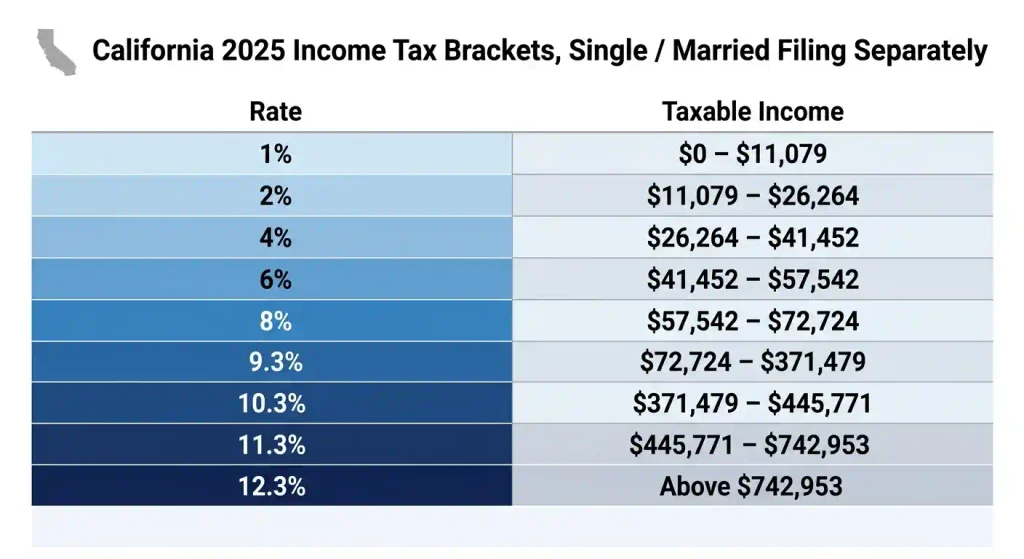
Here’s the 2025 bracket breakdown at a glance, by rate and taxable income for single filers and married filing separately:
| Rate | Taxable Income (Single / MFS) |
|---|---|
| 1% | $0 – $11,079 |
| 2% | $11,079 – $26,264 |
| 4% | $26,264 – $41,452 |
| 6% | $41,452 – $57,542 |
| 8% | $57,542 – $72,724 |
| 9.3% | $72,724 – $371,479 |
| 10.3% | $371,479 – $445,771 |
| 11.3% | $445,771 – $742,953 |
| 12.3% | Above $742,953 |
2025 California Income Tax Rates and Income Ranges
These figures come from the Franchise Tax Board’s 2025 rate schedules, shown in the table above. The 12.3% is the top marginal rate; your effective rate is usually lower, since only your last dollars hit it. These thresholds rose from 2024 under the annual California Consumer Price Index adjustment, so compare 2025 against 2025, not old numbers. California’s top rate still ranks among the highest of any state.
Which California Tax Bracket Applies to You?
Your bracket depends on filing status and taxable income, the amount left after deductions. Find your status (single, married filing jointly, married filing separately, or head of household), then match your taxable income to that schedule. Gross salary isn’t what gets taxed, so don’t compare it directly to the table (the next section breaks down exactly how gross income becomes taxable income). These rates are set under the California Revenue and Taxation Code and republished by the FTB each year, so always use current figures.
How California Income Tax Brackets Work
Each rate in a progressive tax system only applies to the slice of income that falls inside that bracket, not your whole paycheck.
What Is a Marginal Tax Rate?
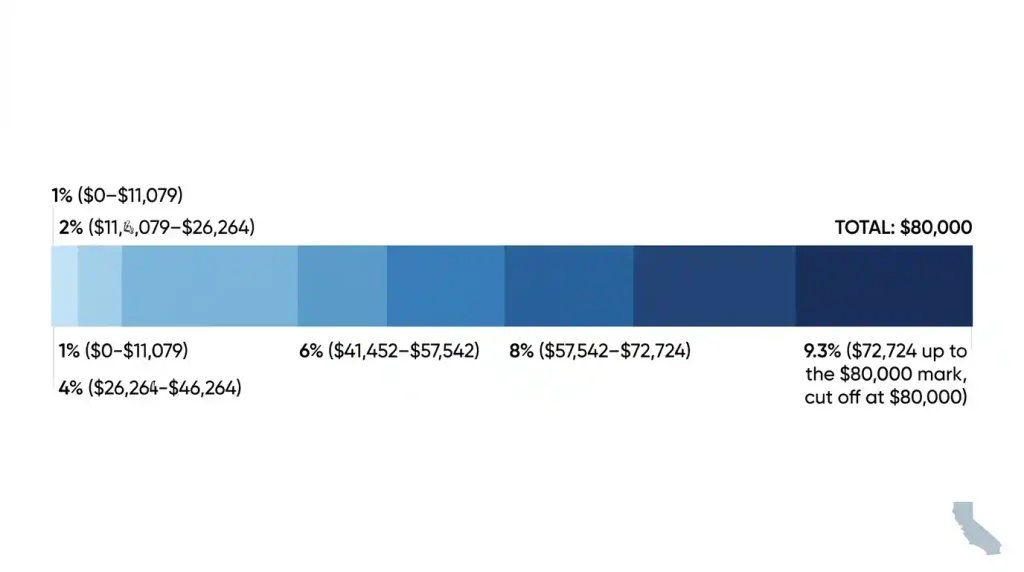
A marginal rate taxes only income within its range. A single filer earning $80,000 doesn’t pay 9.3% on all of it: they pay 1% on the first $11,079, then each higher rate on the next slice, up to the 9.3% bracket. Crossing into a new bracket taxes only your next dollar at the higher rate, not past dollars.
Marginal Tax Rate vs. Effective Tax Rate
Your marginal rate taxes your last dollar earned. Your effective rate is total state tax divided by taxable income, blending every bracket you passed through. A single filer with $100,000 sits in the 9.3% marginal bracket but has an effective rate closer to 5.7%. Two people in the same bracket can still owe different totals after deductions and credits. Even in the 12.3% bracket, nobody pays close to that rate on their whole income, since lower brackets still apply underneath.
Gross Income vs. Adjusted Gross Income vs. Taxable Income
Gross income is everything earned before subtractions. Adjusted gross income (AGI) is gross income after adjustments like retirement contributions. Taxable income is AGI minus your standard or itemized deduction, the figure the brackets actually use. This is the California Form 540 line 19 taxable income, always smaller than your salary.
2025 California Tax Brackets by Filing Status
California uses three rate schedules, X, Y, and Z, based on filing status, each with different income thresholds for the same nine rates.
Single and Married Filing Separately
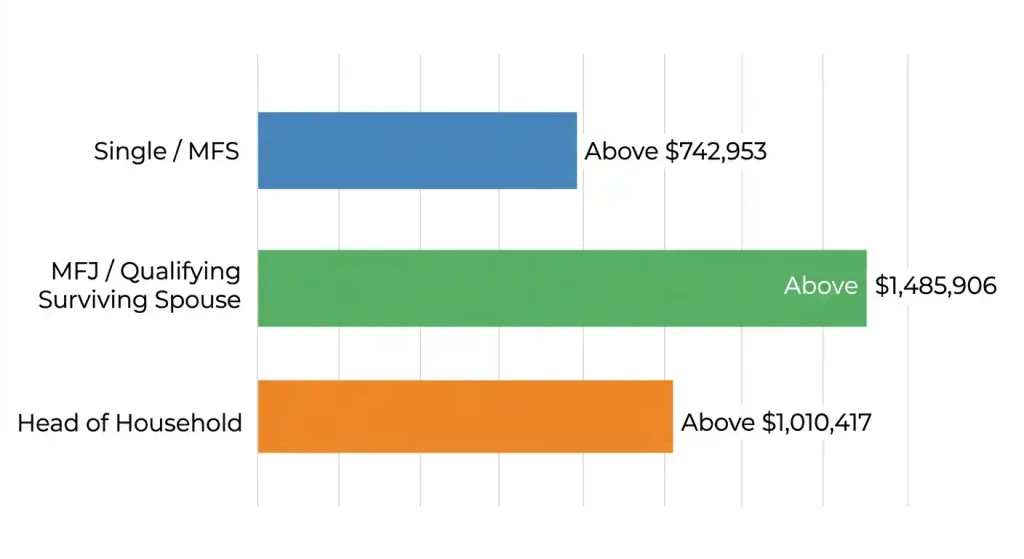
California Schedule X covers single filers and married filing separately: 1% to $11,079, up through 12.3% above $742,953. They share a schedule since the state treats both as a single taxpayer for rate purposes. Your California filing status doesn’t always have to match your federal one, so check which combination lowers your total tax.
Married Filing Jointly and Qualifying Surviving Spouse
California Schedule Y covers married filing jointly and qualifying surviving spouses, with the same nine rates at roughly double Schedule X’s thresholds. Combined household income, not each spouse’s separately, is checked against this schedule. Qualifying surviving spouse status applies for a limited number of years after a spouse’s death, under specific conditions.
| Rate | Taxable Income (MFJ / Qualifying Surviving Spouse) |
|---|---|
| 1% | $0 – $22,158 |
| 2% | $22,158 – $52,528 |
| 4% | $52,528 – $82,904 |
| 6% | $82,904 – $115,084 |
| 8% | $115,084 – $145,448 |
| 9.3% | $145,448 – $742,958 |
| 10.3% | $742,958 – $891,542 |
| 11.3% | $891,542 – $1,485,906 |
| 12.3% | Above $1,485,906 |
Head of Household
California Schedule Z covers head of household. You generally must be unmarried (or considered unmarried) and pay over half the cost of keeping up a home for a qualifying person. Its middle brackets are noticeably wider than single filers’, which usually means lower tax for qualifiers.
| Rate | Taxable Income (Head of Household) |
|---|---|
| 1% | $0 – $22,173 |
| 2% | $22,173 – $52,530 |
| 4% | $52,530 – $67,716 |
| 6% | $67,716 – $83,805 |
| 8% | $83,805 – $98,990 |
| 9.3% | $98,990 – $505,208 |
| 10.3% | $505,208 – $606,251 |
| 11.3% | $606,251 – $1,010,417 |
| 12.3% | Above $1,010,417 |
How to Calculate Your 2025 California Income Tax
Figuring your California tax takes four steps: confirm your filing status, find your taxable income, apply the right table or schedule, then subtract your credits.
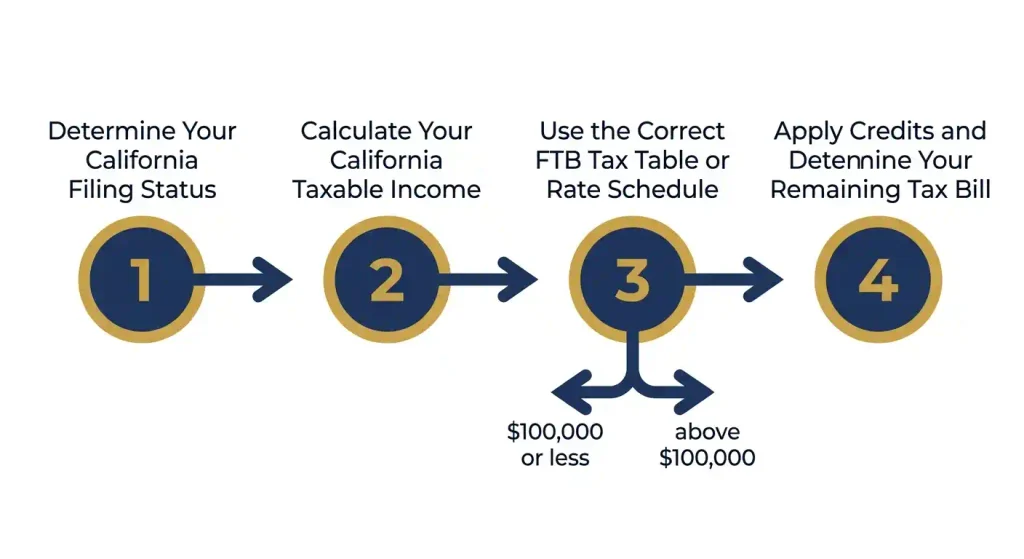
Step 1: Determine Your California Filing Status
Pick the status matching your situation on the last day of the tax year: single, married filing jointly, married filing separately, head of household, or qualifying surviving spouse. Most people match their federal status. Registered domestic partners follow California’s own rules, since the state treats RDPs like married couples even when the IRS doesn’t.
Step 2: Calculate Your California Taxable Income
Start with income reported for California, then subtract your standard deduction or itemized deductions, whichever is higher. California doesn’t mirror every federal deduction, so some items adjust on Schedule CA (540). The result is your California taxable income, the number the brackets apply to.
Step 3: Use the Correct FTB Tax Table or Rate Schedule
Use the California tax table 2025 if your taxable income is $100,000 or less. Above that, use Schedule X, Y, or Z: find your range, subtract where it starts, multiply by the listed percentage, then add the bracket’s base tax. The result becomes your California Form 540 line 31 tax entry. Our California paycheck calculator can run this calculation for you automatically.
Step 4: Apply Credits and Determine Your Remaining Tax Bill
Subtract any credits you qualify for, like the personal exemption credit, to get your final tax liability, a different number than what’s been withheld or paid in estimates. Compare liability to what you’ve paid: overpaid means a refund, underpaid means a balance due.
Tax Deductions, Credits, and Additional Taxes That Can Change Your Result
Your final bill depends on more than the bracket table. Deductions lower the taxable income that sets your bracket; credits reduce your tax bill directly without changing the bracket; a couple of extra taxes apply only in specific situations.
California Standard Deduction for 2025
The California standard deduction 2025 figures are $5,706 for single and married filing separately, and $11,412 for married filing jointly, head of household, and qualifying surviving spouse, up from $5,540 and $11,080 in 2024. Take the standard deduction or itemized deductions, whichever is bigger, not both. Dependents use a different, usually smaller, calculation.
Personal, Senior, and Dependent Exemption Credits
California gives a credit instead of a federal-style exemption deduction. The California personal exemption credit 2025 amounts are $153 for single, married filing separately, and head of household, and $306 for married filing jointly and qualifying surviving spouse. Credits subtract directly from your tax bill, worth more than an equal deduction. Additional credits cover seniors and dependents, including the California dependent exemption credit 2025, each with its own rules and phaseout limits.
California Alternative Minimum Tax
California’s alternative minimum tax (AMT) ensures high earners with large deductions still pay a minimum. It adds back certain deductions and preference items before applying a flat rate. Most taxpayers never hit it, but large itemized deductions, incentive stock options, or certain write-offs warrant checking Schedule P (540).
Mental Health Services Tax on High-Income Taxpayers
Taxable income above $1,000,000 owes an extra 1%, regardless of filing status. This section’s heading uses the tax’s longtime name, Mental Health Services Tax; it was officially renamed the California Behavioral Health Services Tax after Proposition 1, and both names are still used interchangeably. It stacks on top of the 12.3% top bracket, which is why California’s combined top rate is quoted as 13.3%, and it only touches income above $1 million, reported separately as its own California Form 540 line 62 Behavioral Health Services Tax entry.
California vs. Federal Income Tax Brackets in 2025
California and the IRS run completely separate systems, with their own brackets, deductions, and rules, so state and federal bills rarely line up predictably.
How California and Federal Tax Rates Differ
The federal income tax brackets 2025 run seven rates under the Internal Revenue Code; California runs nine under its own statutes. Thresholds, rates, and deductions don’t match between the two. Both are progressive, but you calculate each separately, one for your Internal Revenue Service return and one for the FTB. Treating state tax as a percentage of federal tax doesn’t hold up.
Why Your California Taxable Income May Differ from Federal Taxable Income
California doesn’t fully conform to federal law, so some income and deductions adjust on Schedule CA (540) before reaching state taxable income. Standard deduction amounts differ too. A calculator built around IRS Form 1040 or IRS Form 1040-SR numbers can’t apply California’s brackets, deduction, or credits, so calculate California taxable income separately.
California Tax Calculation Examples for 2025
Seeing bracket math applied to real income levels makes the system click faster than a table alone. Here’s the pattern for a single filer, Schedule X, before credits:
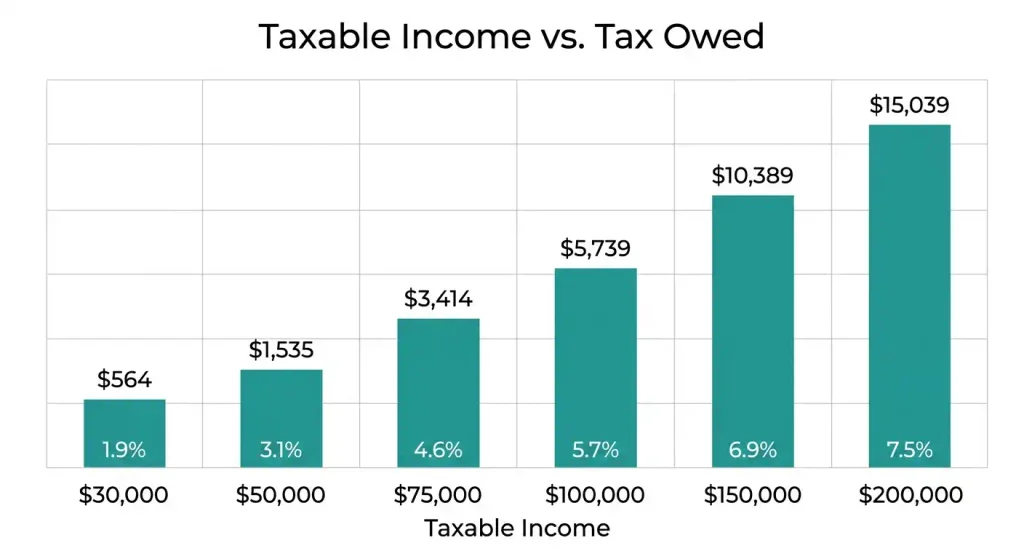
| Taxable Income | Tax Owed (approx.) | Effective Rate |
|---|---|---|
| $30,000 | $564 | 1.9% |
| $50,000 | $1,535 | 3.1% |
| $75,000 | $3,414 | 4.6% |
| $100,000 | $5,739 | 5.7% |
| $150,000 | $10,389 | 6.9% |
| $200,000 | $15,039 | 7.5% |
Single Filer Earning $50,000
Salary and taxable income differ: the $5,706 standard deduction comes off first. A single filer earning roughly $55,706 in salary, with no other adjustments, lands at $50,000 in taxable income, the $50,000 row in the table above (our $50,000 after-tax breakdown covers the take-home side separately). The same pattern holds at $30,000 and $75,000 in taxable income, shown in the table, with the $75,000 after-tax breakdown covering that gross-pay angle too.
Single Filer Earning $100,000
At exactly $100,000, the FTB’s Tax Table applies, not Schedule X. The schedule formula approximates the $5,739 figure above, in the 9.3% bracket; confirm the exact number on the FTB’s table, since it uses smaller increments (our $100,000 after-tax breakdown covers the take-home side separately). This is tax on taxable income, not what’s withheld per paycheck. The $150,000 and $200,000 figures above stay in that same 9.3% bracket, with the $200,000 after-tax breakdown covering that gross-pay comparison too.
Married Couple Filing Jointly
The FTB’s 2025 instructions walk through a married couple at $125,000 in taxable income on Schedule Y. Their income falls in the 8% bracket, starting at $115,084 with a base tax of $3,974.82. Subtracting $115,084 leaves $9,916, times 8% is $793.28, plus the base totals $4,768.10. That’s lower than a single filer at the same income, since Schedule Y’s brackets are wider.
Higher-Income Taxpayer
A single filer at $800,000 falls in the top 12.3% bracket on Schedule X, starting at $742,953 with a base tax of $72,219.84. The $57,047 above that threshold, taxed at 12.3%, adds about $7,017, for roughly $79,237 total. At $1,200,000, the same top bracket applies to a larger slice of income, and the extra 1% California Behavioral Health Services Tax on the $200,000 above $1 million adds about $2,000 on top of that separate, larger calculation.
Special Situations That Can Change Your California Tax Calculation
A handful of situations change how your tax gets calculated, even though the same nine brackets still apply underneath.
Part-Year California Residents and Nonresidents
Moving into or out of California means different tax treatment than a full-year resident. Income earned while a resident, plus California-source income earned elsewhere, both count. Part-year residents and nonresidents file California Form 540-NR, which allocates income by where and when it was earned, rather than applying regular California Form 540 rules to everything.
Bonuses, Capital Gains, Investments, and Retirement Income
Bonuses and commissions count as regular taxable income at filing, even if withheld at a flat rate during the year. California taxes capital gains, interest, dividends, pensions, and most IRA distributions as ordinary income, same bracket schedule as wages. Withdrawing from a retirement account before age 59½ adds a separate 2.5% tax, reported on FTB 3805P, smaller than the federal 10% penalty. Social Security is the exception: California generally doesn’t tax it, even though the federal government sometimes does.
Self-Employment and Multiple Income Sources
Self-employment or multiple income sources, including nonqualified deferred compensation, all combine into total taxable income before brackets apply. California income tax is separate from federal self-employment tax, which covers Social Security and Medicare for those without employer withholding. Quarterly estimated payments to the FTB help avoid a penalty if you expect to owe.
Dependents and Children’s Unearned Income
A child with enough unearned income, like interest or dividends, may need their own California return. Parents can instead report that income using FTB 3803. FTB 3800 taxes a child’s unearned income at the parent’s rate instead of the child’s bracket, to stop income shifting for lower brackets.
Registered Domestic Partners and Special Filing Situations
California treats registered domestic partners like married couples, so RDPs generally file as married filing jointly or separately at the state level. This can mismatch federal filing, since the IRS doesn’t always recognize RDP status the same way. Review current FTB instructions before picking a status.
Common California Tax Bracket Myths and Mistakes
A few bracket misunderstandings show up constantly and lead to bad financial decisions.
“Moving Into a Higher Bracket Means All My Income Is Taxed More”
This is the most common bracket myth, and it’s false. Only income inside the higher bracket gets taxed at that rate; income in lower brackets stays untouched. A raise that pushes you into a new bracket never reduces overall take-home pay.
“My Salary Is My Taxable Income”
Salary is gross pay before deductions. Taxable income is what’s left after your standard or itemized deduction, almost always smaller. Plugging raw salary into a bracket table overstates your tax.
“California Uses the Same Brackets as the IRS”
California and the federal government run separate systems, with different brackets, deductions, and income rules. A 22% federal bracket has nothing to do with a same-numbered California bracket; the dollar ranges don’t align. Check FTB schedules for state tax and IRS brackets for federal, separately.
“My Paycheck Withholding Is My Final Tax”
Withholding, based on your DE 4 form, is an estimate, not your final tax bill. Real liability is calculated when you file. Too little withheld means a balance due, possibly with an underpayment penalty; too much means a refund. Social Security, Medicare, and State Disability Insurance are separate payroll taxes, not part of the California income tax calculation.
Official California Tax Resources and Next Steps
The Franchise Tax Board publishes every official number here; check those sources directly to confirm your own situation, and browse our California tax planning hub for related guides.
California Franchise Tax Board Tax Tables and Calculator
The FTB tax calculator tables and rates page at ftb.ca.gov estimates tax from your income and filing status. The FTB 2025 tax rate schedules and Tax Table both live inside the FTB 2025 Personal Income Tax Booklet, with full Form 540 instructions. Use the Tax Table at $100,000 or less; the rate schedule above that.
Forms and Documents to Check Before Filing
Most residents file California Form 540; simpler returns may qualify for California Form 540 2EZ. Part-year residents and nonresidents use California Form 540-NR. Gather W-2s, 1099s, itemized-deduction records, and estimated payment records. Check eligibility for the California Earned Income Tax Credit (updated annually by the FTB), California Young Child Tax Credit, Foster Youth Tax Credit, or California renter’s credit 2025, easy to miss when self-filing. Eligible taxpayers can e-file free through CalFile California tax filing, which has its own income and filing requirements; track refunds or payments through a MyFTB account.
Final Tax Estimate Checklist
- Confirm 2025 figures, correct filing status, and accurate deductions
- Verify calculated tax and apply eligible credits
- Compare the result to withholding and estimated payments
- If a manual estimate differs from your tax software, trust the software, then cross-check against the California tax rate schedules 2025
- Fix a post-filing error with an amended return
- Cross-check your math against official FTB instructions before submitting
Frequently Asked Questions About California Tax Brackets 2025
What are the California income tax brackets for 2025?
California has nine marginal rates for 2025, 1% to 12.3%, with thresholds varying by filing status. Exact ranges are in the FTB’s Schedule X, Y, and Z.
What is the highest California income tax rate in 2025?
The top marginal rate is 12.3%, above $742,953 for single filers. Income above $1,000,000 also owes an extra 1% California Behavioral Health Services Tax, giving the often-quoted 13.3% top rate.
What is the California tax rate for someone earning $100,000?
There’s no flat answer; gross earnings alone don’t determine tax. It depends on taxable income after deductions and filing status. A single filer with exactly $100,000 in taxable income uses the FTB Tax Table, landing close to the 9.3% marginal bracket.
Does California tax Social Security benefits?
No. California generally exempts Social Security benefits from state income tax, even when the federal government taxes a portion.
Are California tax brackets different for married couples?
Yes. Married filing jointly uses Schedule Y, with wider ranges than Schedule X for single filers and married filing separately. Filing jointly often means lower combined tax than filing separately.
How do I calculate California state income tax for 2025?
Confirm filing status, then subtract deductions from income for taxable income. Apply the FTB Tax Table at $100,000 or less, or the rate schedule above that, then subtract eligible credits. The FTB’s online calculator and tax tables confirm the exact figure.
When is my 2025 California tax return due?
California returns for 2025 are due April 15, 2026, matching the federal deadline. Everyone gets an automatic extension to file until October 15, 2026, no form required, but tax owed is still due April 15, 2026, to avoid penalties and interest.

Yeasin Sorker is the founder of Paycheck Calculator California. He built this tool in 2018 after noticing that most free paycheck calculators missed California-specific rules like daily overtime and the uncapped SDI rate.
He researches California payroll tax updates regularly and keeps this calculator aligned with the latest IRS, FTB, and EDD published rates. All calculations on this site are estimates based on official 2026 government sources. For personalized tax advice, consult a qualified tax professional.