
A California part-year resident pays state tax on worldwide income earned during California residency, plus California-source income earned outside that period. Filed on Form 540NR, the split follows residency dates and income source, not months spent in state.
Having filed Form 540NR for California movers for years, I’ve watched this buckets-not-months rule trip up nearly every part-year filer.
The catch: sourcing rules for equity pay and remote workdays get complicated fast.
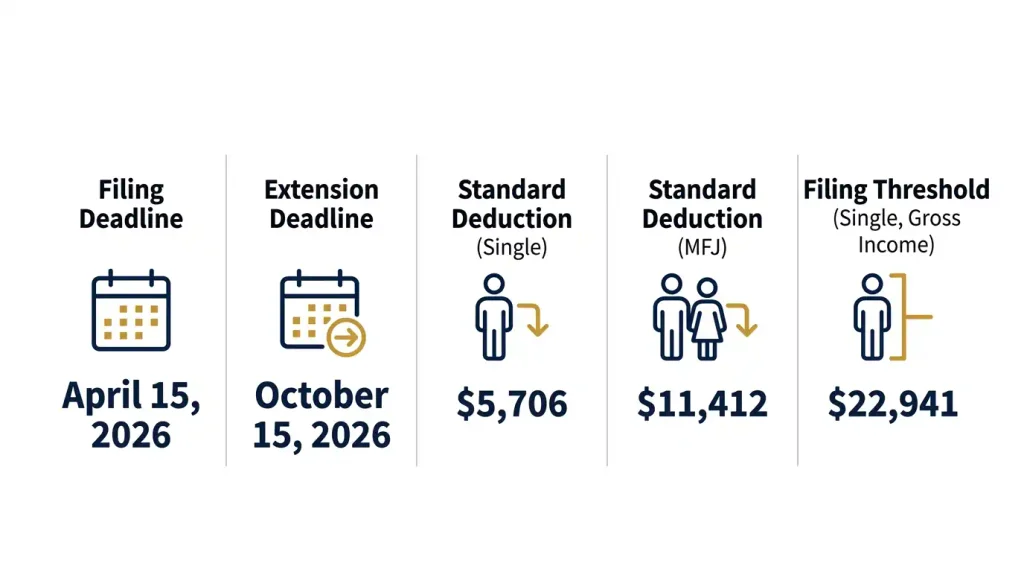
California Part-Year Resident Tax at a Glance
| Aspect | 2025 Figure |
|---|---|
| Filing deadline | April 15, 2026 |
| Extension deadline | October 15, 2026 |
| Standard deduction (single) | $5,706 |
| Standard deduction (MFJ) | $11,412 |
| Filing threshold (single, gross income) | $22,941 |
What a California Part-Year Resident Pays Tax On
California taxes worldwide income earned during your resident period, no matter where it came from. During your nonresident period, it taxes only California-source income, like wages earned here or rent from California property. The split follows residency status and income source, not the number of months you lived here. A bonus paid after you moved to Texas is still fully taxable if you earned it while a California resident.
The Quickest Way to Estimate Your California Tax
Pin down your exact move date first, since everything follows from it. Split your income into two piles: worldwide income earned as a resident, and California-source income earned as a nonresident. California applies an effective tax rate, calculated on Form 540NR, to the California-taxed portion. Subtract withholding, estimated payments, and credits for your final number.
Form 540NR Is Usually the Key Form
If you moved into or out of California in 2025, you likely file Form 540NR, not Form 540. Schedule CA (540NR) separates your total income from your California-taxable income. Form 540 is for full-year residents only. Couples with one full-year and one part-year resident spouse may still need Form 540NR.
Are You Actually a California Part-Year Resident?
When California Considers You a Part-Year Resident
You are a part-year resident if you lived in California for part of 2025 and outside it for the rest, whether you moved in or moved out. A full-year resident lived in California from January 1 through December 31 with no gap, so a move landing exactly on January 1 or December 31 can push you into full-year status instead. Your California residency status decides your form and how much income California can touch.
How California Determines Residency
Residency starts with domicile: your true, fixed home, the place you intend to return to. Physical presence and purpose matter too. Being here for a temporary or transitory reason, like a two-month assignment, may not create residency even with physical presence, under what the FTB calls the temporary or transitory purpose test. That’s why a student in a dorm for the school year isn’t automatically a resident. The FTB also weighs ties like where your car is registered, your doctor, and your kids’ school.
When Moving Out Does Not End California Residency
A new mailing address alone doesn’t make you a nonresident. If your move is temporary and you plan to return, California can treat you as a resident the whole time you were gone. A California driver’s license, bank account, or a spouse who stayed behind all signal continuing ties. There’s a safe harbor for people working abroad under a long-term employment contract, with strict limits on time spent in California. For military members, it cuts the other way: California-domiciled troops stay residents and taxable on military pay no matter where they’re stationed. The federal protection actually shields nonresident servicemembers stationed in California from California tax on military pay. Digital nomads run into this too, since a California address, car, or spouse can keep residency alive no matter how many countries you work from.
When Moving Into California Creates Residency
Residency generally begins the day you arrive with intent to stay, not the day you get a lease or job. A permanent move triggers residency faster than a short trip. Registering to vote or enrolling kids in California schools points to residency starting immediately. This applies the same to college graduates moving here for a first job and retirees relocating after decades elsewhere: domicile and intent decide it, not career stage.
What Income Does California Tax During Each Part of the Year?
Income While You Were a California Resident
Every dollar earned while you lived in California counts, regardless of source. Wages, freelance income, out-of-state dividends, even rental income from another state, all get taxed during your resident period. Moving to California doesn’t shield income from your old out-of-state job.
Income While You Were a California Nonresident
Once you’re a nonresident, California taxes only California-source income: wages for work physically performed here, income from a California business, or rent from California property. Services performed in California count even with an out-of-state employer. One exception: federal law blocks California from taxing pension, retirement account, and Social Security income paid to a nonresident, even if earned while working in California for decades.
Income That Spans the Move Date
Pay covering work before and after your move gets split between the two periods. This comes up often with bonus pay paid weeks or months later. What matters is when you did the work, not when you got paid, so a bonus tied to 2025 performance stays California income even if paid in 2026 after you left. Severance works the same way: it sources to where you earned the right to it, not where you live when the check arrives.
Income California May Still Tax After You Move Away
Moving out doesn’t end California’s claim on certain income. Rental income from a California property stays taxable every year you own it. Selling California real estate triggers California-source gain regardless of where you live at closing. California business income and certain deferred or equity compensation tied to work done here can also follow you for years.
How California Calculates Part-Year Resident Tax
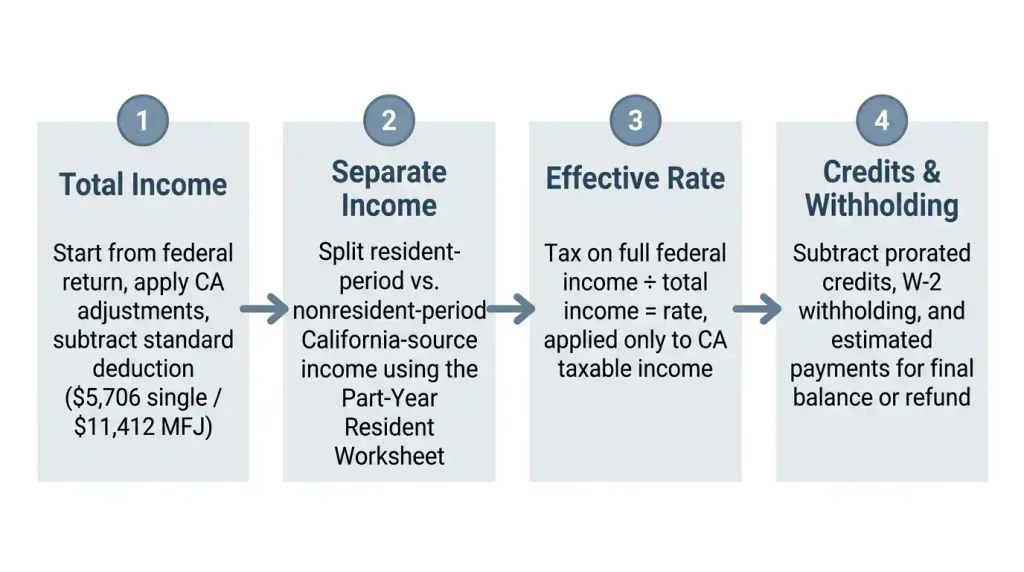
Step 1: Determine Your Total Federal and California Income
Start with your federal return, since Schedule CA (540NR) builds off it. Apply California-specific adjustments to get your California adjusted gross income. Subtract the standard deduction, $5,706 for single filers and $11,412 for married filing jointly, or itemized deductions if higher. Our annual salary calculator can help total up income across multiple pay periods before you begin.
Step 2: Separate California Resident and Nonresident Income
Use the Part-Year Resident Worksheet. Calculate income received while a resident, then California-source income received while a nonresident. The sum is your California taxable income. The rest of your federal return only sets the rate.
Step 3: Apply California’s Effective Tax Rate Method
California taxes your entire federal income as if you were a full-year resident, then divides that tax by total income for an effective rate, based on the same California tax brackets that apply to full-year residents. That rate applies only to your California-taxable income from Step 2, keeping your bracket honest to your full income level.
Step 4: Subtract Applicable Credits and Withholding
Subtract California tax credits, W-2 withholding, and estimated payments from the tax owed. Most credits get prorated, reduced by the ratio of California taxable income to total income. What’s left is your balance due or refund. Watch for employers who keep withholding California tax after you’ve moved, since fixing it usually means submitting a new Form DE 4.
| Step | What It Does |
|---|---|
| 1. Total income | Start from federal return, apply CA adjustments, subtract standard deduction ($5,706 single / $11,412 MFJ) |
| 2. Separate income | Split resident-period vs. nonresident-period California-source income using the Part-Year Resident Worksheet |
| 3. Effective rate | Tax on full federal income ÷ total income = rate, applied only to CA taxable income |
| 4. Credits & withholding | Subtract prorated credits, W-2 withholding, and estimated payments for final balance or refund |
California Part-Year Resident Tax Example
Example: Moving From California to Another State
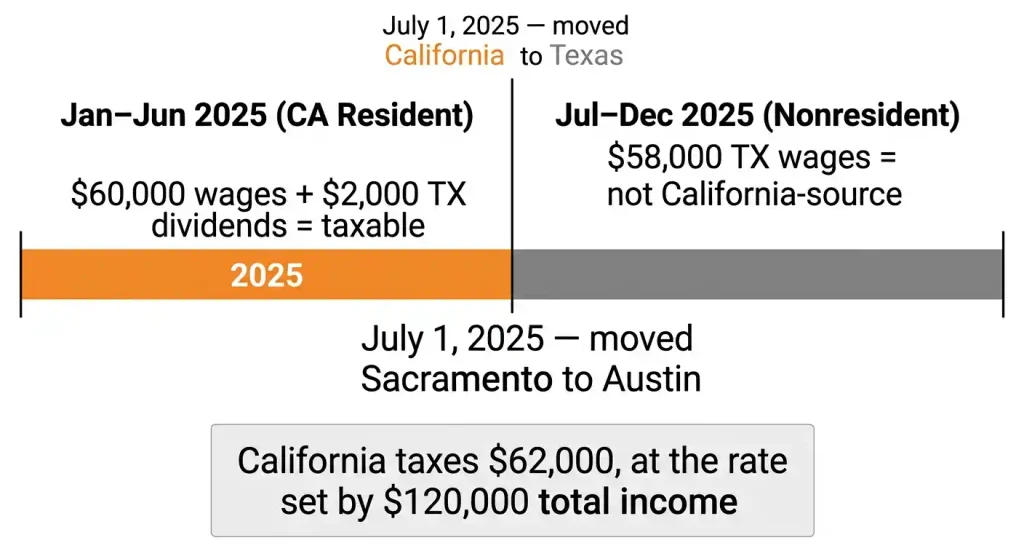
You moved from Sacramento to Austin on July 1, 2025. January through June: $60,000 in wages plus $2,000 in Texas brokerage dividends, all taxable since you were a resident. July through December: $58,000 in Texas wages, not California-source. Your return taxes just the $62,000, at the effective rate calculated on your full $120,000 total income.
Example: Moving Into California Midyear
You moved from Denver to San Diego on September 1, 2025. January through August: $50,000 in Colorado wages, untouched since you weren’t yet a resident. September through December: $30,000 in California wages, fully taxable. A Colorado rental paying $1,500 a month stays outside California’s reach even after the move.
Example: Remote Employee After Leaving California
You worked remotely for a California employer but moved to Nevada in March 2025. Wages after the move aren’t California-source if you never work from a California office again, regardless of the employer’s San Jose headquarters. But two weeks of in-person meetings in October turn a slice of your wages back into California-source income, based on the ratio of California workdays to total workdays.
Example: Independent Contractor With California Customers
You’re a freelance designer who moved from Los Angeles to Phoenix in April 2025. California sources contractor income to where you perform the work, not where clients are based, so Phoenix-based work isn’t automatically California income. But California’s benefit-of-service rule can still pull in income when the benefit is received here, so a California client relationship after your move can still trigger a filing requirement, worth checking with our 1099 vs. W-2 calculator.
Form 540NR: How to File as a Part-Year Resident
What Form 540NR Does
Form 540NR, the California Nonresident or Part-Year Resident Income Tax Return, handles a split year. It reports resident-period and nonresident-period California-source income side by side, tied to the calculation on Schedule CA (540NR).
How Schedule CA (540NR) Works
Schedule CA (540NR) starts with federal income amounts line by line, then applies California-specific adjustments. It separates resident-period from nonresident-period California-source amounts in dedicated columns. The final “California amount” column becomes your taxable income on Form 540NR.
Information You Need Before Completing Form 540NR
Pull your federal Form 1040 first, since Schedule CA (540NR) mirrors it. Gather every W-2 and 1099, checking the state wages box on each. Write down your exact residency start and end dates. Collect your California withholding and estimated tax payment totals.
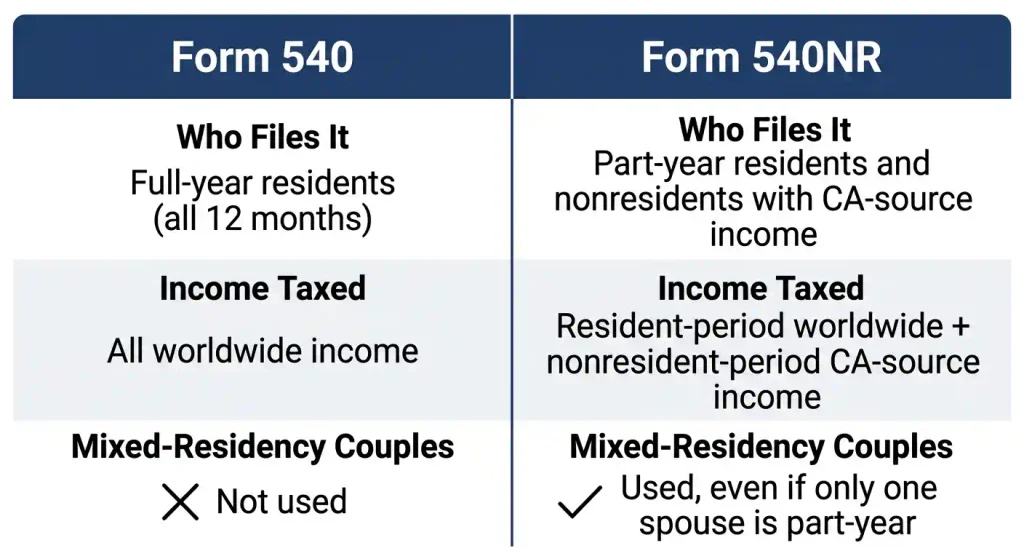
Form 540NR vs. Form 540
If you moved during the year, Form 540NR is almost always correct, even if most of your income ended up being California income. Couples with one full-year and one part-year spouse usually still need Form 540NR.
| Form 540 | Form 540NR | |
|---|---|---|
| Who files it | Full-year residents (all 12 months) | Part-year residents and nonresidents with CA-source income |
| Income taxed | All worldwide income | Resident-period worldwide + nonresident-period CA-source income |
| Mixed-residency couples | Not used | Used, even if only one spouse is part-year |
California Part-Year Resident Filing Requirements
When You Must File a California Return
California requires a return once gross income or AGI crosses a threshold tied to filing status, age, and dependents. A filing requirement isn’t the same as owing tax. You can be required to file and still land at zero balance due.
2025 California Filing Thresholds
For 2025, filed in 2026, a single filer under 65 with no dependents must file once gross income passes $22,941, or AGI passes $18,353. Married filing jointly roughly doubles that, with head of household falling in between. These numbers shift yearly, so check the current FTB threshold table.
California Filing Deadlines and Extensions
The 2025 California return is due April 15, 2026, matching the federal deadline. California grants an automatic six-month extension to file, to October 15, 2026, with no separate extension form required. That extension covers paperwork only; tax owed is still due April 15.
Special Income Situations That Can Change the Answer
Remote Work for a California Employer
Your employer’s address doesn’t decide sourcing; physical work location does. Meetings, training, or client visits back in California convert those specific workdays into California-source income, based on the ratio of California workdays to total workdays applied to your wages.
Stock Options, RSUs, and Deferred Compensation
Equity compensation is one of the trickiest sourcing issues in California tax law. Moving before vesting or exercise doesn’t remove California’s claim; it can tax the portion earned while you worked here, even if paid out years later from another state. FTB Publication 1004 covers the allocation method, worth reading closely for a sizable equity package.
Independent Contractors and Sole Proprietors
Contractor income sources to where you perform the service, a different rule than employee wage sourcing under standard worker classification tests. Keeping California clients after a move can still pull income back into taxability under the benefit-of-service rule. This distinction is covered in more depth in our 1099 vs. W-2 tax guide, including how it differs from ordinary employee sourcing. Maintaining a California office or business license adds exposure. Sole proprietors typically report this on IRS Schedule C, California Profit or Loss from Business, with the California-source portion carried onto Schedule CA (540NR). They also owe California self-employment tax on top of income tax. Business owners operating across multiple states often need to apportion income entirely.
California Rental Property
Rental income from a California property is California-source income no matter where you live, whether full-year resident, part-year resident, or nonresident. Owning California property after you move usually creates an ongoing filing obligation.
Selling California Real Estate
Selling California property generates a California capital gains tax hit as source income, even years after you became a nonresident. California often requires withholding on nonresident sales, handled through escrow at closing, with added reporting depending on the gain’s size.
Moving Between California and Another State: Avoiding Double Tax
When Both States Tax the Same Income
Double taxation happens when your resident state taxes worldwide income while another state taxes the same income as source income. Common for part-year movers, since your old state may still claim part-year residency while California claims the same dollar as source income.
California Other State Tax Credit
California’s Other State Tax Credit, often shortened to OSTC and authorized under California Revenue and Taxation Code Section 18001, prevents that double hit. It applies to income taxed by both California and another state, most often earned elsewhere while still a California resident. The credit amount depends on actual tax paid to the other state, not a flat percentage.
How to Handle Multi-State W-2 Income
Check the state boxes on every W-2 from a move year; employers sometimes keep withholding for the old state out of habit. A mismatch against where you actually worked usually means over-withholding. That money only comes back if you file that state’s return to claim excess California withholding, and you can track it with the California tax refund status tool once filed.
Married Couples, Community Property, and Part-Year Residency
When Spouses Have Different Residency Statuses
It’s common for one spouse to move for a job while the other stays behind temporarily. Form 540NR handles this mixed-residency situation on a single joint return. A joint federal return doesn’t force identical California residency treatment.
California Community Property Rules
California is a community property state, so income earned by either spouse during the marriage is generally treated as owned equally by both. This gets complicated when only one spouse is a California resident, since community property rules can pull part of the nonresident spouse’s income into the calculation. This is a commonly missed step, and getting it wrong tends to understate tax owed.
Registered Domestic Partners
California treats RDPs like married couples for state filing, even though federal law doesn’t. RDPs generally combine federal information manually before filing California, since the IRS doesn’t process RDP returns that way. Form 540NR applies the same as for married couples when one partner is a nonresident. Couples can choose married/RDP filing jointly or married/RDP filing separately, whichever produces the better outcome.
California Part-Year Resident Tax Checklist
Confirm Your Residency Dates
- Write down the exact date you moved into California.
- Write down the exact date you moved out, if applicable.
- Determine whether either move was temporary rather than permanent.
- Document any change in domicile, like a new driver’s license or voter registration.
Separate Your Income
- List worldwide income earned during your California resident period.
- List California-source income earned during your nonresident period.
- Review every W-2 and 1099 for state wage allocations.
- Check rental, business, investment, and equity income for California ties.
Prepare Your California Return
- Confirm whether you meet the filing requirement for your situation.
- Use Form 540NR instead of Form 540 if you had a mixed residency year.
- Complete Schedule CA (540NR) to calculate your California taxable income.
- Apply your deductions, credits, withholding, and estimated payments.
Keep Supporting Records
- Save documentation of your move, like a lease or closing statement.
- Track workday records if you did any remote work across state lines.
- Keep your income-allocation worksheets in case the FTB asks questions later.
- Store copies of your filed returns and every supporting form for at least four years.
- After filing, confirm the FTB received your return and payment.
Takeaway: get your dates and your income split right, and the rest of the checklist falls into place fast.
When California Part-Year Residency Gets Complicated
Situations That Deserve Extra Attention
Multiple moves in and out of California in the same year make allocation math difficult. A temporary relocation with plans to return adds risk, since the FTB may treat you as a resident the entire time. Equity compensation vesting around your move date needs careful sourcing, and married couples with different residency statuses add community property rules on top. If the FTB disputes your claimed move date, the burden falls on you to prove it with real documentation. When two states both claim you as a resident, the Other State Tax Credit usually resolves it, but it takes work.
When Professional Tax Help May Be Worthwhile
A CPA who handles California part-year returns regularly is worth the fee for significant equity compensation, multi-state business income, or a disputed residency claim, especially one that risks an underpayment penalty. I have seen self-prepared returns miss the Other State Tax Credit entirely, costing thousands. Tax software handles a straightforward move reasonably well, but it doesn’t always catch community property adjustments, workday allocations, or equity sourcing correctly.
California Part-Year Resident Tax Misconceptions
“I Lived in California for Six Months, So California Taxes Half My Income”
The most common mistake. California splits income by residency status and source, not time. Earn $80,000 in California during your resident half and $0 after moving, and California taxes the full $80,000, not $40,000.
“My Employer Is in California, So All My Remote Wages Are California Income”
Employer location isn’t the sourcing rule; physical work location is. Move to Colorado and never work from California again, and your wages after the move aren’t California-source, regardless of headquarters address. The exception is equity compensation tied to work done while a California resident.
“Once I Move Out, California Cannot Tax Me”
California can still tax you on California-source income after you leave: rental income, real estate sale gain, and business income all keep flowing through your nonresident return. These ongoing requirements catch former residents off guard years later.
“Federal Residency and California Residency Are the Same”
The IRS has no state residency concept; California’s rules run on domicile and intent, separate from federal law. You can be treated one way federally and differently by California, which is why some taxpayers get caught off guard by the FTB.
| Myth | Fact |
|---|---|
| “Lived here 6 months = taxed on half my income” | Split follows residency status and income source, not time |
| “Employer is in CA, so all remote wages are CA income” | Sourcing follows where you physically worked, not employer address |
| “Once I move out, California can’t tax me” | CA-source income (rentals, real estate sales, business) stays taxable |
| “Federal and California residency rules are the same” | California uses its own domicile-based test, separate from the IRS |
California Part-Year Resident Tax FAQ
How is a part-year resident taxed in California?
California taxes worldwide income during your resident period and California-source income during your nonresident period, both reported on Form 540NR. The final tax depends on total taxable income, deductions, and credits.
Do I pay California tax on income earned before I moved to California?
No, as long as it’s not California-source. Wages earned in Ohio before an October move to California stay outside your California taxable income, though they show up for rate-calculation purposes only.
Do I pay California tax after moving out of California?
Only on California-source income: California workdays, rental income from California property, gain from selling California real estate, and some equity compensation tied to your resident period.
What form does a California part-year resident file?
Form 540NR, with Schedule CA (540NR) separating resident-period from nonresident-period California-source income. Couples with different residency statuses generally still use Form 540NR.
How does California calculate tax on part-year residents?
California taxes your total federal income as if you were a full-year resident, divides by total income for an effective rate, then applies that rate only to your California taxable income. Credits and withholding come off after.
How do I calculate California-source income after moving out?
For employees, it’s a ratio of California workdays to total workdays. Contractors source to where the service was performed, though the benefit-of-service rule can pull in California-client income. Equity compensation follows separate rules under FTB Publication 1004.
Can I owe California tax if I no longer live there?
Yes. California rental income, real estate sale gain, and business income stay taxable regardless of where you live now, generally creating an ongoing nonresident filing requirement.
Can I be a California resident if I temporarily move to another state?
Yes, if the move is temporary and you keep your California domicile, based on intent to return and ongoing ties. A safe harbor exists for long-term overseas work contracts, with strict day-count limits on time in California.
Can I avoid double taxation if another state also taxes my income?
Often, through California’s Other State Tax Credit, which applies to income taxed by both states, most commonly during the resident portion of a move year. The credit is based on actual tax paid to the other state.
Official California Tax Resources and Forms
California Franchise Tax Board Residency Guidance
The FTB’s residency-status page is the starting point for California residency status. FTB Publication 1031, Guidelines for Determining Resident Status, covers the details. FTB Publication 1100, Taxation of Nonresidents and Individuals Who Change Residency, addresses residency changes. The law sits in the California Revenue and Taxation Code, with Section 17014 defining residency and Section 18501 setting the filing requirement.
Current Form 540NR and Instructions
Pull the current-year Form 540NR booklet from ftb.ca.gov, since thresholds and line numbers shift annually. Schedule CA (540NR) and the Part-Year Resident Worksheet come packaged with it. Full-year residents instead use California Form 540 or the simplified Form 540 2EZ. Business owners apportioning income across state lines may also need Schedule R.
California Tax Filing and Payment Resources
The FTB offers e-file and payment options, plus current deadlines. CalFile, the FTB‘s free e-file portal, and the FTB tax calculator help you check numbers before submitting. Estimated tax resources include the current year’s California estimated tax Form 540-ES vouchers. If your income is modest, check the California Earned Income Tax Credit, known as the California EITC. Your filing status, married/RDP filing jointly or married/RDP filing separately, should generally match what you used with the Internal Revenue Service on your federal return. When in doubt, official California Franchise Tax Board forms and publications beat a third-party summary.
California Part-Year Resident Tax Takeaways
The Three Rules to Remember
California taxes worldwide income during your resident period, no exceptions. It taxes only California-source income during your nonresident period. Form 540NR is almost always the correct form for a split residency year.
What to Check Before You File
Confirm your exact residency dates and be honest about domicile intent. Double check every income source for proper sourcing, especially equity compensation and remote work. Verify withholding, credits, and estimated payments against each state’s return. Confirm you’re using the correct tax year’s forms before you file.

Yeasin Sorker is the founder of Paycheck Calculator California. He built this tool in 2018 after noticing that most free paycheck calculators missed California-specific rules like daily overtime and the uncapped SDI rate.
He researches California payroll tax updates regularly and keeps this calculator aligned with the latest IRS, FTB, and EDD published rates. All calculations on this site are estimates based on official 2026 government sources. For personalized tax advice, consult a qualified tax professional.