
The CalEITC is a refundable state tax credit worth up to $3,756 for California workers earning under $32,900. You receive it as a cash refund even if you owe zero state tax, and it stacks with the Young Child Tax Credit and Foster Youth Tax Credit for a combined benefit that can exceed $6,000.
Over eight years of helping low-income California families file, I have guided hundreds of clients through Form FTB 3514. The $12,200 investment income ceiling is the single most overlooked disqualifier I see every season.
One limit matters: federal OBBBA exemptions for tips and overtime do not apply in California. That income adds back to your state total and can push you past the $32,900 threshold unexpectedly.
What Is CalEITC and How Does It Work?
The California Earned Income Tax Credit is a refundable tax credit. That word “refundable” is the key. It means the government sends you a check for the credit amount even if you paid no taxes at all.
Think of it like this. A regular deduction shrinks the amount of income the government can tax. That only helps if you owe taxes in the first place. Understanding California tax brackets for 2026 shows exactly why low-income workers benefit more from a refundable credit than a deduction. A refundable credit is different. It puts real cash back in your pocket. Even if your tax bill is zero, the CalEITC sends you money.
California’s credit is separate from the federal Earned Income Tax Credit. You can claim both at the same time if you qualify. That doubles your refund potential. The California Franchise Tax Board (FTB) administers the state version using Form FTB 3514.
Takeaway: CalEITC is a cash refund you earn through work. Claim it by filing. It costs nothing to apply.
CalEITC at a Glance
Here is your one-screen summary for the 2026 filing season (Tax Year 2025):
| Who Qualifies | Key Requirement |
| Workers with earned income | Up to $32,900 |
| California residents | Must live in CA during tax year |
| Ages 18 and older | No upper age limit |
| ITIN or SSN holders | Both qualify in California |
| Self-employed workers | Net profit counts as earned income |
| Children | Max CalEITC | Max YCTC | Max FYTC | Total Possible |
| 0 | $302 | $0 | $1,189 | $1,491 |
| 1 | $2,016 | $1,189 | $1,189 | $4,394 |
| 2 | $3,339 | $1,189 | $1,189 | $5,717 |
| 3 or more | $3,756 | $1,189 | $1,189 | $6,134 |
Important: The Investment Income Ceiling is $12,200 for 2026. If your investment income goes above this, you lose the entire credit. All figures above are sourced from the official CalEITC eligibility and credit information page published by the California Franchise Tax Board.
Expert Insight: What Most Guides Skip After eight years of helping families file, I found one strategy that almost no competitor explains. It is the “IHSS swing move.” If you provide in-home care for someone you live with and receive IHSS payments, you have a legal choice: include or exclude that income from your earned income calculation. Most filers default to excluding it. But filers in the credit phase-in range who include it can unlock a significantly larger CalEITC. I personally ran both calculations for a caregiver client last year and the “include” choice added $340 to her refund. That is one decision, five minutes of math, and $340 in her pocket. Every situation is different. Run both numbers with a VITA preparer or tax professional before deciding which option applies to your specific household.
Do You Qualify for CalEITC?
CalEITC Eligibility Checklist
Go through each item below. If you check every box, you likely qualify:
- You earned wages, salary, tips, or self-employment income in 2025.
- Your total earned income is at or below $32,900.
- You lived in California for more than half of 2025 (the Half-year Residency Rule).
- You are 18 years old or older (Age Eligibility 18+).
- You did not have investment income above the Investment Income Ceiling of $12,200.
- You have a valid Social Security Number (SSN) or Individual Taxpayer Identification Number (ITIN).
- You are not claimed as a dependent on someone else’s return.
Eligibility Decision Tree
Ask yourself these questions in order:
- Did you work and earn money in 2025? (Yes = keep going. No = stop.)
- Was your total earned income under $32,900? (Yes = keep going. No = stop.)
- Did you live in California for at least six months of 2025? (Yes = keep going. No = stop.)
- Are you 18 or older? (Yes = you likely qualify. No = you may need a qualifying child to claim the credit.)
Takeaway: If you worked in California and earned under $32,900, take five minutes to check your eligibility. You probably qualify.
What Counts as Earned Income?
This is where many people get confused. The CalEITC only looks at earned income. Here is what counts:
- W-2 wages and salaries
- Tips (yes, tip income inclusion is part of the CalEITC calculation)
- Net self-employment income (from Schedule C or 1099-NEC / 1099-MISC work)
- Gig economy earnings from platforms like DoorDash or Lyft
- Employer-paid disability payments received before retirement age
Here is what does not count as earned income:
- Social Security benefits
- Unemployment compensation
- Child support payments
- Pension or retirement income
- Investment gains or dividends
Social Security benefits and pensions are unearned income. They count toward your total income but do not help you qualify. More importantly, investment income above $12,200 will disqualify you entirely. If you are trying to lower your taxable income before calculating your CalEITC eligibility, reviewing the California standard deduction for 2026 is a smart first step.
Can You Qualify Without Children?
Yes. In my experience, this is the most common myth that causes people to miss free money.
Workers without children can claim the CalEITC if they are 18 or older with no upper age limit. The maximum credit without children is $302. That is smaller than the credit for families. But it is real money for zero extra work.
The key rules for childless workers are simple. You must be at least 18. You must not be claimed as someone else’s dependent. And your earned income must fall under the $32,900 Income Processor Limits.
ITIN Filers and Mixed-Status Households
California is one of the only states in the country that allows ITIN holders to claim the EITC. This is a huge deal for undocumented workforce eligibility and mixed-status families.
If you file with an ITIN (Individual Taxpayer Identification Number) instead of a Social Security Number (SSN), you can still claim the CalEITC. Your qualifying children do need valid SSNs to count for the credit. But you as the filer can use your ITIN.
The best resource for ITIN filers is a local VITA (Volunteer Income Tax Assistance) site. Search for free help at ftb.ca.gov/vita. Many VITA sites specialize in ITIN returns and can help you file for free.
CalEITC Income Limits and Credit Amounts
How the Phase-In and Phase-Out Work
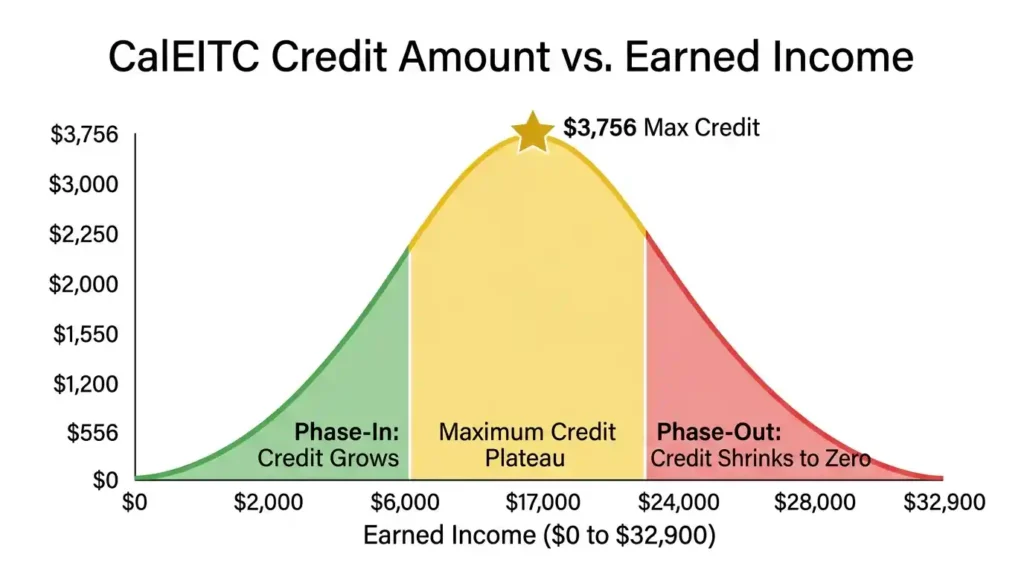
The CalEITC follows a “bell curve” structure. Here is how it flows:
- Phase-In: As your income rises from zero, your credit grows. This rewards work.
- Plateau: At a certain income, you hit the Maximum Credit Output. This is your sweet spot.
- Phase-Out: As income rises further, the credit shrinks until it reaches zero at the $32,900 Earned Income Cap and beyond.
Understanding this curve matters. Small decisions about income reporting can move you toward or away from the maximum credit.
Real Household Examples
Single mother, one child, $22,000 W-2 income: She earns $22,016 in wages. Her CalEITC is approximately $2,016. She also qualifies for the YCTC (Young Child Tax Credit) because her child is under six. Her total state credits stack to over $3,200. She owes no state taxes. The FTB sends her a refund check. If you are unsure what your W-2 earnings look like after deductions, learning how to read your California pay stub helps you confirm the correct income figure before filing.
Roberto’s story, one child, working single father: Roberto is a single dad with one child. He works full time and earns modest wages. He qualifies for both the federal EITC and the California CalEITC. On his federal return, he receives a $4,427 federal credit. On his state return, he receives the CalEITC credit on top. Because both credits are fully refundable, he gets a combined cash refund even though he owes no tax. This is not a loophole. This is exactly what the system was built to do.
Self-employed gig worker, no children, $18,000 net income: He drives for a rideshare company. After deductions, his net self-employment income is $18,000. He qualifies for the childless CalEITC. It is not a huge amount. But it is money he earned and money he deserves.
Takeaway: Your exact credit depends on your income and family size. Use the FTB’s free CalEITC calculator at ftb.ca.gov to get your personal estimate.
Bonus Refund Credits You May Also Qualify For
This is where real money is made. The Stacking Effect is the single biggest opportunity most filers miss.
Young Child Tax Credit (YCTC)
The YCTC adds up to $1,189 to your refund if you have a qualifying child under age 6. You must first qualify for the CalEITC to claim the YCTC. The two credits work together automatically on Form FTB 3514. You do not need to do any extra math. The form handles it.
Foster Youth Tax Credit (FYTC)
The FYTC is a $1,189 credit for people who were in California’s foster care system on or after age 13. You must also be between 18 and 25 years old at the end of the tax year to qualify. Here is the unique part. The FYTC is granted per qualifying taxpayer. This means a married couple where both partners were in foster care can claim up to $2,378. Most competitors do not explain this. It is a commonly missed opportunity.
You must qualify for the CalEITC to claim the FYTC. You also must be 18 or older and have been in foster care while in California’s jurisdiction.
How Credit Stacking Can Increase Refunds

Here is a full stacking example:
A single parent with two children under six qualifies for:
- CalEITC: $3,339
- YCTC: $1,189
- Federal EITC: approximately $6,604 (federal, two children, Tax Year 2025)
Total state credits alone: $4,528. Combined with the federal EITC, this family could receive a combined refund of over $11,000. All because they worked and filed. That is the power of the Stacking Effect.
Pro Tip: Always check all three credits before you finish your return. The FTB automatically calculates your eligibility for YCTC and FYTC when you complete Form FTB 3514. Do not skip this form.
CalEITC vs. Federal EITC
| Feature | CalEITC (State) | Federal EITC |
| Max credit (3+ children) | $3,756 | Approx. $7,830 (subject to annual IRS adjustment) |
| Income limit | $32,900 | Up to ~$68,000 |
| ITIN holders | Allowed | Not allowed |
| Investment income limit | $12,200 | $11,600 (approx.) |
| Refundable | Yes | Yes |
| Administering body | FTB | IRS |
You can claim both credits. A California resident who qualifies for the federal EITC almost always qualifies for the CalEITC too. The state limit is lower and stricter, but the rules largely mirror each other.
Why Federal Denial Does Not Always Mean California Denial
This surprises many people. The federal EITC does not allow ITIN filers. California does. So if you were denied the federal EITC because you file with an ITIN, you can still claim the California version. Do not assume a federal rejection means a state rejection. They are separate credits with separate rules.
The OBBBA and California Non-Conformity: What You Must Know for 2026
This is the biggest tax story of 2026. The federal One Big Beautiful Bill Act (signed July 4, 2025) changed several major rules. But California does not follow federal law enacted after January 1, 2025.
This creates a “compliance gap” that could surprise workers. Here is the plain-language version:
| Federal Rule (OBBBA) | California Follows It? | What It Means for You |
| No tax on tips (up to $25,000) | No | Tips are still taxable in CA. They count toward your CA Adjusted Gross Income (AGI). |
| No tax on overtime | No | Overtime pay is still taxable in CA. It counts toward your CA income limits. |
| Car loan interest deduction | No | You cannot deduct this on Form 540. |
| Increased Child Tax Credit ($2,200) | No | CA uses its own YCTC and Dependent Credit system. |
What this means for the CalEITC: If you earned tips or overtime and excluded them on your federal return, you may need to add that income back on your California state return. This can push your California AGI above the $32,900 threshold and reduce or eliminate your CalEITC.
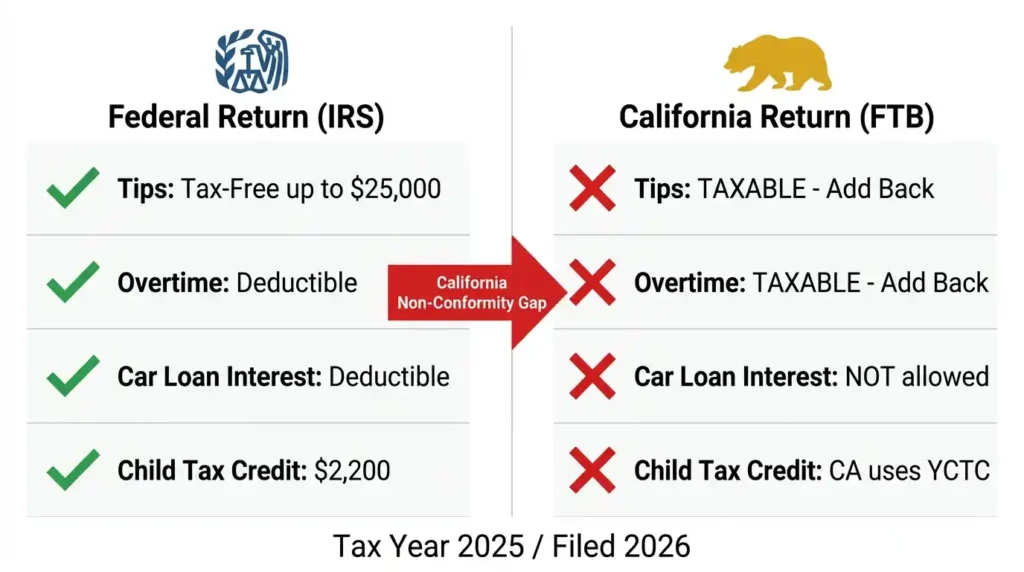
If you work in food service, healthcare, or any industry with regular overtime, this rule is critical for you. California Revenue and Taxation Code does not adopt the OBBBA exemptions. Understanding your rights under California overtime laws in 2026 helps you calculate exactly how much overtime income must be added back to your state return. Plan accordingly.
Takeaway: Federal tax breaks from the OBBBA do not automatically apply in California. Always calculate your state income separately.
Special Situations and Edge Cases
Gig Workers and Freelancers
Gig economy income absolutely qualifies as earned income for the CalEITC. What matters is your net profit, which is what you report on Schedule C after business expenses.
Here is where gig workers often make costly mistakes. They either forget to subtract legitimate expenses (which lowers net income and moves them closer to the credit sweet spot) or they forget to add all income (which creates IRS mismatches). Use your 1099-NEC and 1099-MISC forms as your starting documents. One thing worth knowing: how your work is classified matters. If there is any question about whether you are an employee or independent contractor, the California ABC test guide for 2026 explains exactly how California determines your status. That classification directly affects which income documents you use.
Self-employment income also qualifies for Gig Economy Compatibility with the CalEITC as long as your net loss does not offset your other income. If you have a Net Loss from self-employment, it reduces your total earned income for credit purposes.
IHSS and Medicaid Waiver Income
This is one of the most overlooked edge cases in California tax law. In-Home Supportive Services (IHSS) payments are generally nontaxable. But if you care for a housemate (someone who lives with you), you have a choice: include or exclude this income from your earned income calculation.
Here is the strategic thinking:
- If your income is in the phase-in range of the credit, including IHSS income can increase your credit.
- If your income is near the $32,900 limit, including IHSS income might push you over the phase-out threshold and reduce or eliminate your credit.
This is a real decision with real math behind it. A VITA preparer can run both calculations and tell you which option produces the larger refund. Caregivers and home care workers should also confirm they are receiving all paid leave benefits they are entitled to. California’s sick leave laws for 2026 apply to many IHSS providers, and missed sick pay can affect your total earned income for the year.
Part-Year California Residents
If you moved to California partway through 2025, you may still qualify. The Half-year Residency Rule means you must have lived in California for more than six months of the tax year. If you qualify, you file Form 540NR (non-resident or part-year resident return) and still claim the CalEITC based on your California-sourced income.
The PATH Act: Why Your Refund May Be Delayed
The federal PATH Act requires the IRS to hold all refunds that include the EITC or Additional Child Tax Credit until at least mid-February. For the 2026 season, the IRS typically begins releasing these refunds around February 17.
This delay is not a sign something is wrong. It is federal law designed to prevent fraud. Your refund is simply in a queue.
You can track your California state refund at ftb.ca.gov/refund. For a full walkthrough of what each status message means and how long each stage takes, see our guide on checking your California tax refund status in 2026. California does not have the same mandatory delay as the federal return. State refunds often arrive before federal refunds for EITC claimants.
How to Claim CalEITC Step-by-Step
Forms You Need
- Form 540 (standard California resident return) or Form 540NR (part-year or non-resident)
- Form FTB 3514 (California Earned Income Tax Credit form)
- If you want to reduce future over-withholding so more of your paycheck arrives before tax season, filling out California Form DE-4 correctly for 2026 lets you adjust your state withholding to match your actual tax situation.
For the federal side:
- Schedule EIC (federal Earned Income Credit)
- W-2 (wages), 1099-NEC or 1099-MISC (gig/contract work)
- If your EITC was disallowed in a prior year, you also need Form 8862 before you can claim it again.
Step-by-Step Filing Process

- Gather all income documents (W-2, 1099-NEC, 1099-MISC).
- Download or open Form 540 from the FTB website.
- Complete your total income section, then move to the deductions.
- Complete Form FTB 3514. Answer every question. The form automatically calculates CalEITC, YCTC, and FYTC.
- Enter the credit from FTB 3514 onto your Form 540.
- Submit your return by the Filing Deadline of April 15.
- Track your refund at ftb.ca.gov.
Filing Through Tax Software
Tax software makes filing faster. But it does not make it foolproof.
Where People Miss the Credit
Most software asks about the EITC during the federal interview. It does not always carry that question over to the California state interview. You can finish your state return without ever seeing Form FTB 3514.
Software Prompts to Watch
Look for a screen that asks: “Do you want to check your eligibility for California tax credits?” If you see it, say yes. If you do not see it, navigate manually to the credits section and add FTB 3514 yourself.
Common Entry Errors
The most expensive mistake is entering your net self-employment income incorrectly. Use your Schedule C net profit number, not your gross receipts. Entering gross income overstates your earnings and can push you out of the eligible range entirely.
Free Filing Options
You do not need to pay a tax preparer to claim this credit. California offers:
- CalFile: The FTB’s free online filing tool at ftb.ca.gov/calfile. No income limit.
- VITA Sites: Free in-person help for households earning under $67,000. Find locations at ftb.ca.gov/vita.
- Free File Alliance: Federal filing software available at irs.gov/freefile.
How to Maximize Your Refund Legally
The Sweet Spot Strategy
Every year, I walk clients through what I call the sweet spot calculation. The CalEITC phases out as income rises. If your income is just above the phase-out start, small adjustments to your business expenses or retirement contributions can move you back into a higher credit range. Workers earning near California’s minimum wage in 2026 typically fall well inside the phase-in range, meaning every dollar they earn grows their credit rather than reducing it.
For example, a self-employed worker with $34,000 in gross income can subtract legitimate business expenses on Schedule C to bring their net self-employment income below the $32,900 threshold. Common deductible expenses include mileage, equipment, home office costs, and business software. Lower net profit means lower California earned income. That keeps them in the eligible range and qualifies them for a substantially higher credit. This is legal. This is smart. This is exactly what the credit was designed to reward.
Note: Retirement contributions like a SEP-IRA reduce your federal AGI but do not automatically reduce your California earned income for CalEITC purposes in the same way. Always verify your state earned income figure separately on Form FTB 3514. If your employer offers no retirement plan, California’s CalSavers mandate for 2026 may automatically enroll you in a state-sponsored retirement account, which could have payroll implications worth understanding.
Refund Maximization Checklist
Before you submit your return, confirm all of the following:
- You completed Form FTB 3514.
- You checked eligibility for YCTC (child under 6).
- You checked eligibility for FYTC (former foster youth).
- You reviewed your federal return for OBBBA income add-backs on your state return.
- You verified your investment income is below $12,200.
- You claimed your federal EITC on Schedule EIC.
- You used the federal Look-back Provision if your 2025 income was lower than 2024 (applies to federal EITC only; verify state eligibility separately).
What is the Look-back Provision? At the federal level, the Look-back Provision allows you to use your 2024 earned income instead of your 2025 earned income to calculate your federal EITC if 2024 income was higher. This is helpful if your income dropped due to illness, job loss, or reduced hours. Note that California does not have a confirmed equivalent Look-back Provision for the CalEITC. Apply the Look-back only to your federal EITC calculation and verify your state eligibility separately using your actual 2025 California earned income.
Common Mistakes That Cost Refund Money
These are the errors I see most often. Every single one is avoidable:
- Skipping Form FTB 3514. Tax software sometimes fails to prompt this. Always add it manually.
- Forgetting tip income. Tips count as earned income but must be reported. Do not leave them out.
- Wrong dependency status. Claiming a child who does not meet the qualifying child rules will trigger a denial.
- Skipping YCTC and FYTC. These credits stack automatically, but only if you complete FTB 3514.
- Not amending past returns. You have three years to amend a prior Amended Return. If you missed the credit in 2023 or 2024, file an amended return now.
- Misreading your pay stub. Many filers use the wrong income figure because they do not know which line to look at. Understanding California pay stub codes in 2026 ensures you pull the right gross earned income number for your CalEITC calculation.
Myths About CalEITC That Cause People to Self-Disqualify
Myth 1: “I made too little to qualify.” There is no minimum income floor for CalEITC. Even a small amount of earned income gets you into the phase-in range. The credit starts building from dollar one.
Myth 2: “No kids means no credit.” Workers without children can claim up to $302. You just need to be 18 or older and not claimed as someone else’s dependent. That is it.
Myth 3: “Gig workers don’t qualify.” Self-employment income counts as earned income for this credit. Uber drivers, freelancers, house cleaners, and caregivers all qualify as long as their net profit falls under the $32,900 threshold.
Myth 4: “It will affect my benefits.” CalEITC refunds are not counted as income for Medi-Cal, CalFresh, or similar programs. You have at least 12 months before any benefit impact. You will not lose your benefits by claiming this credit.
Myth 5: “My tax software caught everything.” Tax software misses the CalEITC more often than people realize. ITIN filers and IHSS income recipients are especially at risk of a missed form. Always open Form FTB 3514 yourself and verify every line.
Why Credits Get Reduced, Delayed, or Denied
Most denials are not final. They are fixable. But you need to act fast when you get a notice.
Common Adjustment Triggers
The FTB flags returns that do not match their records. Here are the most common reasons your credit gets reduced:
- Your reported income does not match your W-2 or 1099-NEC on file.
- Your qualifying child was also claimed on another return.
- Your investment income exceeded the $12,200 Investment Income Ceiling.
- You used the wrong filing status. Married Filing Separately disqualifies you for the federal EITC. California applies similar restrictions for the CalEITC, and Registered Domestic Partners (RDPs) filing separately are also disqualified under state rules.
Understanding FTB Notices
The FTB sends written notices by mail. They do not call or text first. If you get a letter, read it carefully. It will tell you exactly which line of your return triggered the review. Most notices give you 30 to 60 days to respond.
Do not ignore FTB mail. A late response turns a fixable problem into a permanent denial.
What to Do If Your Credit Was Disallowed
First, check whether a prior disallowance requires Form 8862. If the IRS or FTB denied your EITC in a prior year for anything other than a math error, you must file Form 8862 before claiming the credit again. Second, gather your documentation. Pay stubs, school records for children, and lease agreements proving California residency are your strongest tools. Third, visit a VITA site. They help with FTB disputes at no cost.
Takeaway: A denial is not the end. Most are reversed with the right documentation and a timely response.
Annual CalEITC Rule Changes and Updates
Tax rules shift every year. The figures in this guide apply to Tax Year 2025 (filed in 2026). For future years, always verify at ftb.ca.gov before filing.
The California Revenue and Taxation Code drives all changes to the CalEITC. The FTB publishes updated income thresholds and Maximum Credit Output values each fall. Legislative changes, like the OBBBA non-conformity decisions, can also affect your California Adjusted Gross Income (AGI) without any direct change to the credit itself.
One habit that protects you every year is checking the FTB’s “What’s New” page each January. It takes five minutes. It can save you hundreds of dollars.
Takeaway: The credit amounts change annually. Verify every figure at ftb.ca.gov before you file each year.
Free Filing Help and Assistance Programs
You should never pay a fee to claim this credit. Here are your free options:
- VITA (Volunteer Income Tax Assistance): Free in-person filing help from IRS-certified volunteers. Find locations at ftb.ca.gov/vita. Many VITA sites also specialize in ITIN returns and complex situations like IHSS income.
- CalFile: The FTB’s direct online filing system. Free for all California residents with no income ceiling.
- Community Outreach events: The FTB and State Controller Malia Cohen partner with local organizations each spring to host free filing events. Check your local library or community center.
One caution. Watch for scams during tax season. The FTB will never text you asking for personal information. If you receive a suspicious message claiming to be from the FTB, call their official verification line: 800-852-5711. Do not click links in unsolicited texts or emails.
“Do I Qualify If…” Scenarios
If I’m self-employed? Yes, if your net self-employment income (after expenses) is under $32,900.
If I have no children? Yes, with a maximum credit of $302.
If I use an ITIN? Yes. California allows ITIN holders to claim the CalEITC.
If my income dropped this year? Use the federal Look-back Provision to calculate your federal EITC using prior year income if it was higher. For the CalEITC, use your actual 2025 California earned income. Verify both separately.
If I already filed without claiming it? File an amended return. You have three years.
If I’m a part-year California resident? File Form 540NR. You may still qualify based on California income.
If I receive IHSS payments? You have a choice on whether to include this income. Run both calculations or ask a VITA preparer.
Frequently Asked Questions
Can I get CalEITC if I owe no taxes?
Yes. The credit is fully refundable. The FTB will send you a check even with zero tax liability.
Can I claim both federal and California EITC?
Yes. They are separate credits with separate forms. Qualifying for one does not affect the other.
What income disqualifies you?
Investment income above $12,200 disqualifies you entirely. Total earned income above $32,900 also eliminates the credit. Note that mandatory payroll deductions like SDI do not reduce your earned income for CalEITC purposes. The California SDI rate for 2026 affects your take-home pay but not your eligibility calculation.
Does CalEITC affect public benefits?
No. CalEITC refunds are not counted as income for most public benefit programs for at least 12 months.
Why is my credit lower than expected?
Common reasons include income increases, incorrect filing status, a child who no longer qualifies, or investment income that is too high.
What is Form FTB 3514 and how do I use it?
It is the official California form for claiming CalEITC, YCTC, and FYTC. Complete it alongside your Form 540. Tax software should generate it automatically, but always verify.
Can I amend past returns?
Yes. You can amend returns for up to three prior years. Use Schedule X (California’s current amended return form, available at ftb.ca.gov).
Final Action Plan: Claim Every Dollar You Qualify For
You have the knowledge. Now take the three steps:
- Check your eligibility. Use the checklist in this guide. If you worked in California and earned under $32,900, you likely qualify.
- Estimate your refund. Visit ftb.ca.gov and use the CalEITC calculator. Run the numbers for CalEITC, YCTC, and FYTC together.
- File and claim all related credits. Use CalFile for free or visit a VITA site near you. Complete Form FTB 3514. Do not leave money on the table.
The people who miss this credit are not lazy. They are busy. They are working two jobs. They are taking care of kids and parents at the same time. The system was not designed to make this easy to find.
That is why you read this guide. Now you know. Go claim what is yours.
One of my clients, a home care worker named Diana, came to me three years ago convinced she did not qualify for anything. She had no children at home. She filed with an ITIN. She thought the credit was “not for people like her.” I sat with her and we walked through every line of Form FTB 3514 together. She walked away with a $302 CalEITC refund that year. The next year, after I helped her include her IHSS income strategically, her credit jumped higher. She told me: “I felt like I had been invisible to the system my whole life. This was the first time it felt like the system actually saw me.”
That is the real goal of this guide. Not just the money, though the money matters. The goal is to make sure you are seen.
Data sourced from the California Franchise Tax Board (FTB), IRS Publication 596, and the 2026 filing season guidelines for Tax Year 2025. Always verify current figures at ftb.ca.gov before filing. For complex situations, consult a VITA volunteer or licensed tax professional.

Yeasin Sorker is the founder of Paycheck Calculator California. He built this tool in 2018 after noticing that most free paycheck calculators missed California-specific rules like daily overtime and the uncapped SDI rate.
He researches California payroll tax updates regularly and keeps this calculator aligned with the latest IRS, FTB, and EDD published rates. All calculations on this site are estimates based on official 2026 government sources. For personalized tax advice, consult a qualified tax professional.