
$65K after taxes in California means what’s left once federal tax, state tax, Social Security, Medicare, and SDI are withheld, for a single filer with no pre-tax deductions in 2026.
These figures come from a full recalculation using our methodology, based on the 2026 IRS brackets, EDD SDI rate, and FTB tax tables, not rounded estimates.
Your exact number shifts with dependents, benefits, or a different filing status.
Quick Answer: How Much Is $65K After Taxes in California?
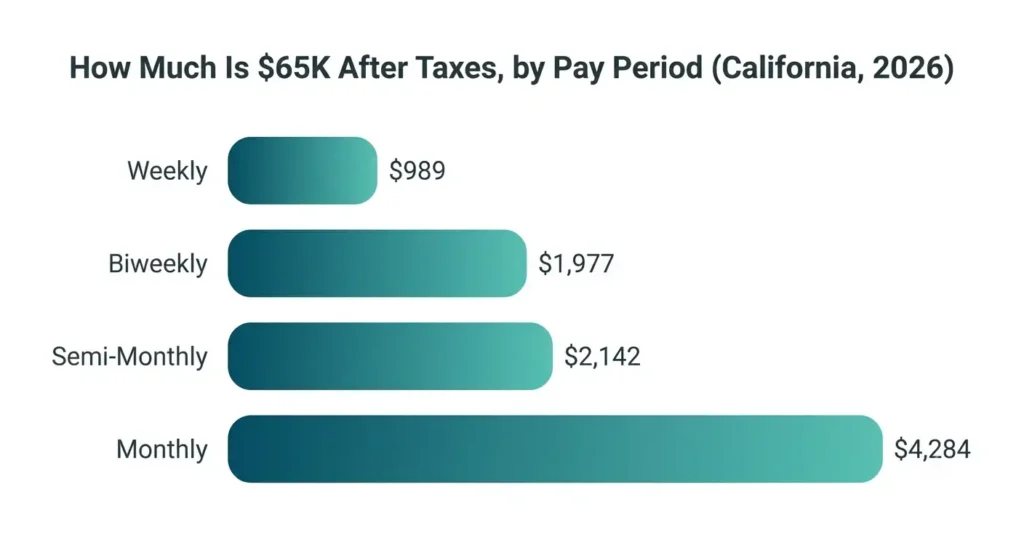
A single filer earning $65,000 in California nets about $51,400 a year in 2026. That is about $4,284 a month.
Estimated Take-Home Pay at a Glance
- Annual take-home: about $51,400
- Monthly net income: about $4,284
- Biweekly paycheck: about $1,977
- Weekly paycheck: about $989
Free California Tax Tool
See How Much of Your $65K You Actually Keep
$65K in California feels like a decent salary — but after federal tax, state tax, and SDI, your real take-home might change how you feel about it.
🧮 See What $65K Really Pays You After TaxesUsed by thousands of California workers · FTB-verified 2026 rates
Quick Salary Breakdown Table
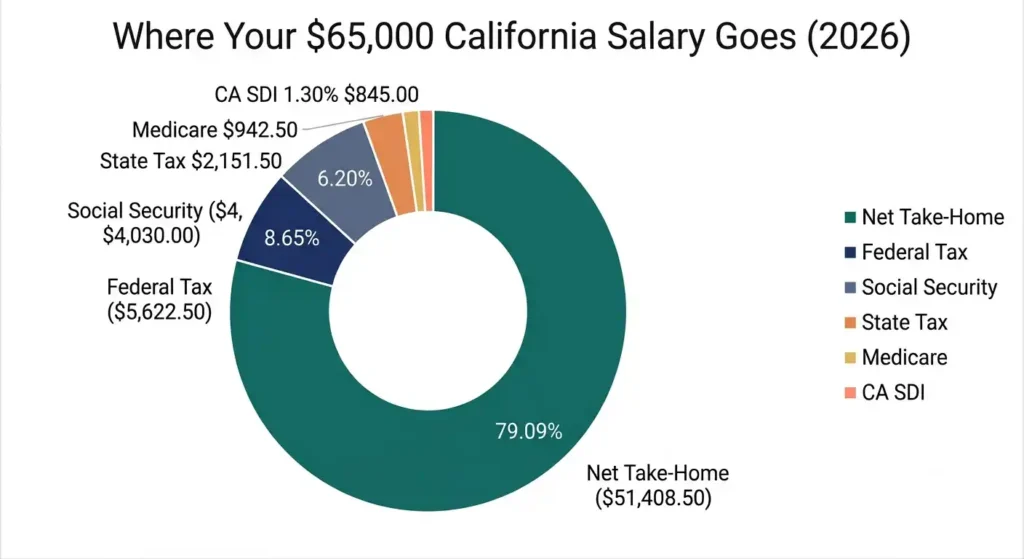
| Item | Amount |
|---|---|
| Gross annual income | $65,000 |
| Federal income tax | $5,620 |
| California state tax | $2,154 |
| Social Security (6.2%) | $4,030 |
| Medicare (1.45%) | $943 |
| CA SDI (1.3%) | $845 |
| Total deductions | $13,592 |
| Estimated net pay | $51,408 |
How Is a $65,000 California Salary Taxed?
Four things hit your $65K: federal tax, state tax, FICA, and California’s SDI program. None are optional.
Federal Income Tax
The Internal Revenue Service (IRS) taxes you on a progressive scale, using IRS tax brackets confirmed for 2026. The 2026 standard deduction for single filers is $16,100, dropping your taxable income to $48,900, close to your adjusted gross income (AGI). Itemized deductions rarely beat this standard deduction. That $48,900 falls across the 10% and 12% brackets, landing you at roughly $5,620 in federal tax. Your employer withholds this based on how you fill out your Form W-4.
California State Income Tax
California runs its own system through the California Franchise Tax Board, using California tax brackets from 1% to 12.3% across nine tiers. The state standard deduction for single filers in 2026 is $5,540. After running $65,000 through the brackets and applying the $144 personal exemption credit, you land at about $2,154 in state tax.
FICA Payroll Taxes
FICA is one piece of your broader California payroll taxes, covering Social Security and Medicare.
Social Security
The Social Security tax takes a flat 6.2% of gross wages, no brackets. On $65,000, that is $4,030 a year. The 2026 wage base is $184,500, so you’re nowhere near the cap.
Medicare
The Medicare tax withholds 1.45% of every dollar, no wage limit. On $65,000, that is $943. The Additional Medicare Tax of 0.9% only starts above $200,000 for single filers.
California SDI
California State Disability Insurance (SDI) funds short term disability and paid family leave. Since 2024, there’s no wage cap, so every dollar gets hit. The SDI rate rose to 1.3% on January 1, 2026, according to the EDD, meaning $845 comes out of your $65K. Our SDI calculator can run this for any salary.
Complete $65K Salary Breakdown
Here is the yearly total split by how you actually get paid. For other salary levels, our annual salary calculator breaks down the same math.
Annual Breakdown
Your $65,000 shrinks to about $51,408 net. Total tax bite: roughly $13,592, or 20.9% of gross pay. You keep about 79% of every dollar.
Monthly Breakdown
Gross pay of $5,417 becomes a net deposit of roughly $4,284, after about $1,133 in deductions.
Biweekly Paycheck
Every two weeks, your $2,500 gross lands at around $1,977 net, across 26 paychecks a year.
Weekly Pay
Weekly gross of $1,250 nets about $989. If paid semi-monthly instead, your gross runs about $2,708 and nets around $2,142. Hourly, $65,000 works out to about $31.25 gross and roughly $24.71 after taxes, based on a 2,080-hour year.
Why Your Take-Home Pay May Be Different
The numbers above assume single filer, no pre-tax deductions, standard W-4. Change any of those and your paycheck moves. If your own check looks smaller than expected, see why your paycheck may be lower than planned for the common causes.
Filing Status
Single filers pay the most per dollar. Married filing jointly splits income across wider brackets, usually lowering the tax bite. Head of household also gets more generous brackets than single. Married filing separately rarely helps in California.
Pre-Tax Deductions
A traditional 401(k) lowers taxable income and tax owed, up to the 401(k) contribution limits set each year. A Roth 401(k) uses after-tax deductions instead, so it won’t shrink this paycheck but grows tax-free. The same idea applies to a Health Savings Account (HSA) with a high deductible plan, and a Flexible Spending Account (FSA) for medical or dependent care. Health insurance runs $150 to $300 a month, with dental and vision adding $15 to $40. Public employees with a pension often see an extra 5% to 8% of gross pay deducted.
W-4 Elections
Your Form W-4 sets federal withholding, and California runs its own DE-4 form for state withholding. Claiming dependents or the Child Tax Credit reduces withholding, meaning a bigger paycheck but a smaller refund. Multiple jobs need careful W-4 coordination to avoid owing at tax time. Extra withholding means a bigger refund instead.
Employer Payroll Differences
Pay frequency changes what one check looks like, though the yearly total stays the same. Union dues, extra retirement contributions, and benefit deductions vary by employer. Overtime is taxed at your normal rate, even though withholding on that check can feel higher. Bonuses often get a flat 22% federal withholding regardless of your bracket. RSUs and stock compensation get taxed as ordinary income the moment they vest.
Is $65K a Good Salary in California?
Depends where you live. $65K in Sacramento stretches much further than in San Francisco.
Cost of Living Reality
Housing often eats 35% to 50% of take-home pay in expensive metros. On $51,400 net, about $4,284 a month, housing alone can claim $1,800 to $2,500 in a mid-size city.
Living Comfortably on $65K
A single adult lives reasonably well on $65K outside the priciest coastal cities. A couple each earning around $65K brings in a combined net of roughly $8,500 a month, comfortable almost anywhere in the state. A small family on one $65K income will feel real pressure in expensive areas. Roommates stretch $65K furthest in cities like Los Angeles or San Diego.
High-Cost vs Affordable Cities
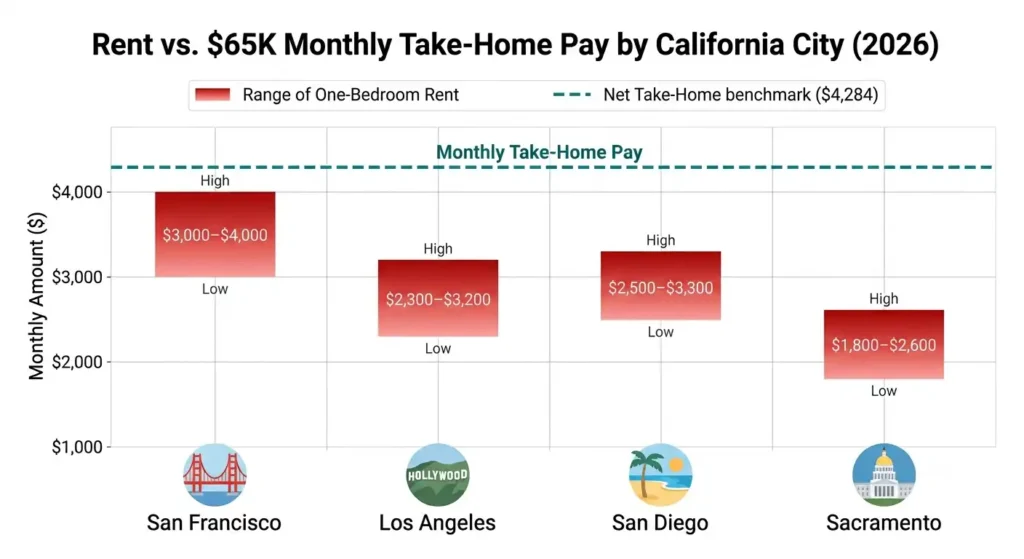
San Francisco averages $3,000 to $4,000 or more for a one-bedroom in 2026, leaving roughly $300 to $1,300 for everything else once utilities and transit are added in. Los Angeles and San Diego run $2,100 to $2,700, leaving roughly $1,600 to $2,200. Sacramento runs $1,500 to $1,700, often $600 to $900 less than the Bay Area, leaving $2,500 or more.
Salary Comparisons
Numbers make more sense side by side.
$60K vs $65K vs $70K
$60K to $65K adds about $5,000 gross but only $3,900 to $4,000 net, since you stay in the same brackets. At $70K, taxable income crosses above $50,400, where the 22% federal bracket begins, so the top slice gets taxed harder. The lifestyle shift across these three is real but modest.
California vs Texas
Texas has no state income tax, keeping a $65K earner roughly $2,150 more per year, landing net pay near $53,500. But California often pays higher gross salaries for the same job, and Texas has tradeoffs like higher property tax.
California vs Florida
Florida also skips state income tax, landing take-home near $53,500 as well. Housing runs lower than coastal California, stretching that extra take-home further. New York, by contrast, also charges state income tax at rates that climb into similar territory for middle incomes, plus a city tax in NYC, often leaving take-home similar to or lower than California outside its priciest metros.
Sample Monthly Budget on a $65K Salary
Where the $4,284 a month actually goes.
Example Budget
Roughly $1,500 to $1,800 to housing, $300 to $400 to transportation, $400 to $500 to food, $300 to $500 to savings.
Fixed Expenses
Insurance runs $100 to $200 a month. Utilities run $100 to $200. Internet averages $50 to $80. Phone runs $40 to $90.
Flexible Spending
Entertainment and dining run $150 to $400 combined. Shopping varies by person. Build an emergency fund, ideally $500 to $1,000 to start. A student loan payment runs $200 to $400. A car payment runs $300 to $500. Childcare is the budget-breaker, often an estimated $1,200 to $2,000 a month depending on provider and region.
Practical Scenarios
Real decisions people face on this salary, part of the broader paycheck scenarios readers ask us about.
Moving to California
Budget $4,000 to $6,000 upfront for first and last month’s rent plus deposit. Keep a cash reserve beyond that. A $1,200 apartment elsewhere often costs $2,000 or more here.
Comparing Two Job Offers
Compare health insurance, 401(k) match, and PTO, not just base pay, since taxes and benefits both shape your real take-home. If one offer is 1099 instead of W-2, or part-time instead of full-time, the tax math changes too. A shorter commute can outweigh a small salary bump.
Renting an Apartment
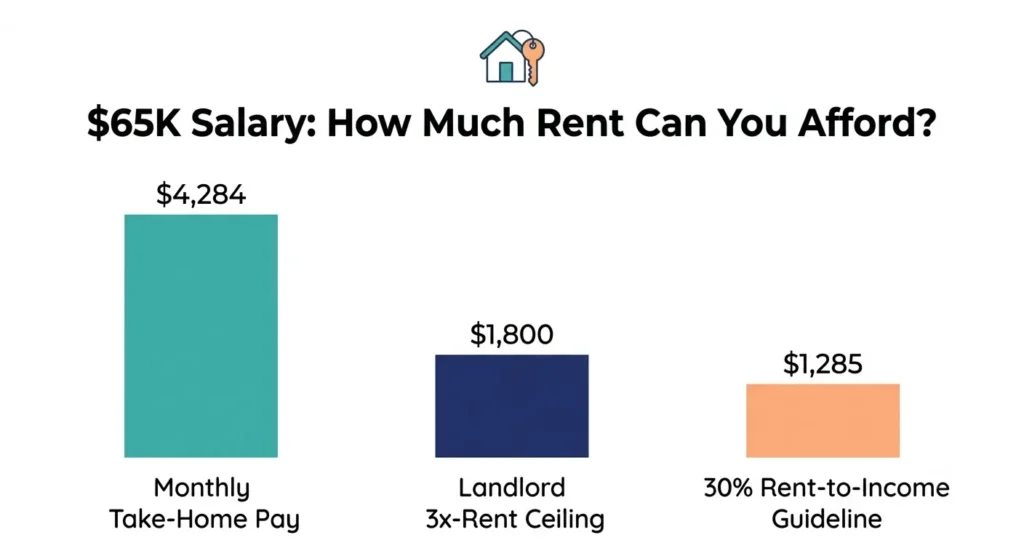
Most California landlords use a common guideline of gross income at roughly three times monthly rent, though this is a preference, not a legal requirement. On $65K, that puts your ceiling around $1,800 a month. A 30% rent-to-income ratio lands closer to $1,285.
Common Myths About a $65K California Salary
Clearing up what trips people up at this income level.
Myth: Taxes Take Half Your Pay
Your effective tax rate on $65K in California is about 20.9%, nowhere close to half. That confuses marginal rate, the rate on your last dollar, with effective rate, your average.
Myth: Everyone Making $65K Takes Home the Same Amount
Filing status alone can shift net pay by over a thousand dollars a year. Add benefits, retirement contributions, and W-4 choices, and identical $65K salaries produce different paychecks. A common mistake is ignoring pre-tax deductions or confusing gross salary with net income.
Myth: Bigger Refund Means Lower Taxes
A big refund just means you overpaid all year. Your tax liability has nothing to do with refund size. Adjusting your W-4 puts that money in your paycheck monthly instead.
How to Increase Your Take-Home Pay
You can’t change the brackets, but you can change how much income they touch.
Reduce Taxable Income
A traditional 401(k) lowers taxable income dollar for dollar while building retirement savings. An HSA does the same if you qualify. FSAs work similarly for eligible expenses.
Optimize Withholding
Review your W-4 after any raise, new job, marriage, or dependent. Use the IRS withholding estimator for a realistic number. Avoid over-withholding if you’d rather have the money now.
Job Offer Decision Guide
Should You Accept a $65K Offer?
Run the monthly numbers for your specific city. Weigh career growth and the full benefits package, not just base pay, over a two to three year horizon.
When to Negotiate
High-cost cities like San Francisco or San Jose give you the strongest case. Specialized skills and a competing offer are your best leverage. Negotiate total compensation, not just base salary.
Frequently Asked Questions
How much is $65K after taxes in California per month?
Roughly $4,284 a month for a single filer in 2026, after federal tax, state tax, Social Security, Medicare, and SDI.
How much is each biweekly paycheck on $65K?
About $1,977, assuming 26 pay periods and no extra benefit deductions.
Is $65K enough to live comfortably in California?
Yes in Sacramento, Fresno, and similar metros. In San Francisco or coastal LA, it takes careful budgeting or a roommate.
Why does my paycheck differ from online calculators?
Your W-4 settings, benefit deductions, and employer payroll factors all shift the number. Learning to read your pay stub makes these differences easier to spot. Every estimate here assumes a single filer with no pre-tax deductions and standard 2026 withholding, so treat it as a starting point. For more on paycheck basics, see our full category guide.
Does a 401(k) increase take-home pay?
Not directly, since the contribution still leaves your paycheck. But it lowers taxable income, so your net paycheck drops by less than the full contribution. The real benefit is tax-deferred growth over time.
How much goes to Social Security and Medicare?
Social Security takes $4,030 and Medicare takes $943, a combined $4,973 a year. Your employer matches both, though that part never shows on your pay stub.
Do California cities charge local income tax?
No. California doesn’t allow city or county income tax on top of state tax, unlike New York.
Can I lower my paycheck taxes legally?
Yes. Traditional 401(k) contributions, HSA and FSA use, and employer health premiums all reduce taxable income immediately.
Final Takeaway
Key Numbers to Remember
A $65,000 California salary nets about $51,400 a year, $4,284 a month, for a single filer in 2026. Total taxes take roughly 20.9% of gross pay. Filing status, 401(k) contributions, and city cost of living move this number most.
Next Steps
Compare job offers using net pay, not gross. Build your budget around your real take-home, starting with housing. Check a personalized estimate if you have dependents, marriage, or heavy pre-tax deductions. Review your W-4 once a year. Working backward from a take-home goal near this income level, aim for gross pay roughly 26% to 27% higher, though that ratio shifts once you cross into a new bracket. Our gross pay calculator can run this in reverse for your own numbers.

Yeasin Sorker is the founder of Paycheck Calculator California. He built this tool in 2018 after noticing that most free paycheck calculators missed California-specific rules like daily overtime and the uncapped SDI rate.
He researches California payroll tax updates regularly and keeps this calculator aligned with the latest IRS, FTB, and EDD published rates. All calculations on this site are estimates based on official 2026 government sources. For personalized tax advice, consult a qualified tax professional.