
A Traditional IRA lets anyone with taxable compensation contribute toward retirement, often earning an upfront tax deduction, while investment growth stays untaxed until withdrawal, subject to income and workplace-plan rules.
That deduction-and-deferral framework reflects the IRS’s 2026 contribution limits, deduction phase-outs, and RMD rules detailed throughout this guide.
The catch: withdrawals get taxed as ordinary income, and early withdrawals before 59½ usually add a 10% penalty.
What Is a Traditional IRA? A Simple Explanation
A Traditional IRA, short for Traditional Individual Retirement Account, is what the Internal Revenue Service (IRS) formally calls an Individual Retirement Arrangement, or simply an Individual Retirement Account (IRA). In 2026, you can contribute up to $7,500, or $8,600 if you’re 50 or older, with the deduction and growth rules the rest of this guide walks through.
How a Traditional IRA Works
You open and own the account at a bank, brokerage, or robo-advisor, funding it from your paycheck or savings. Depositing money doesn’t invest it. You must buy funds, stocks, or bonds yourself, or the cash sits idle. Inside the account, dividends and gains grow tax-free until you withdraw.
The Three Main Tax Benefits and Trade-Offs
The first benefit is an upfront deduction, which can cut your federal tax bill by hundreds or thousands of dollars depending on your bracket (exact math later in this guide). The second is tax-deferred growth, meaning no yearly tax on earnings. The trade-off: deductible contributions and all growth are taxed as ordinary income on withdrawal. Tax-deferred means delayed, not erased, unlike the tax-free growth a Roth IRA offers.
Traditional IRA vs. Roth IRA vs. 401(k)
A Traditional IRA gives a tax break now, a Roth IRA gives tax-free withdrawals later, and a 401(k) is a workplace plan with higher limits and sometimes a match. You can use more than one in the same year.
Traditional IRA vs. Roth IRA: Which Fits Your Situation?
A Traditional IRA lets you deduct now and pay tax later. What a Roth IRA is and how it compares comes down to timing: a Roth taxes you now but pays out tax-free, and lets you pull original contributions early without penalty, unlike a Traditional IRA. Roth contributions phase out at $153,000 to $168,000 (single) and $242,000 to $252,000 (married filing jointly) for 2026; Traditional IRA contributions have no income cap. Expect a higher retirement tax rate, such as early in your career? A Roth often wins. Expect a lower one? The Traditional IRA usually wins. Many people split savings between both since nobody knows future rates.
Traditional IRA vs. 401(k): Key Differences
The 401(k) contribution limits for 2026 top out at $24,500, versus $7,500 for an IRA. Only a 401(k) offers an employer match, free money an IRA can’t match, though an IRA usually has more investment choices and lower fees than your employer’s menu. 401(k) coverage can also shrink your IRA deduction. A simple order: get the full match first, then fund an IRA, then return to the 401(k) if you have more to save.
Quick Comparison Table
| Traditional IRA | Roth IRA | 401(k) | |
|---|---|---|---|
| Tax break now | Possible deduction | None | Pre-tax contributions (traditional option) |
| Withdrawals in retirement | Taxed as ordinary income | Tax-free if rules are met | Taxed as ordinary income (traditional option) |
| 2026 contribution limit | $7,500 ($8,600 if 50+) | $7,500 ($8,600 if 50+), shared with Traditional IRA | $24,500 (higher catch-up amounts for older workers) |
| Who can contribute | Anyone with taxable compensation | Income limits apply | Employees whose employer offers a plan |
| Employer contributions | No | No | Often a match |
| RMDs for the original owner | Yes | No | Yes (traditional option) |
No account fits everyone. The right mix depends on your tax bracket, employer match, and how soon you’ll need the money.
Traditional IRA Rules for 2026: Contribution Limits and Eligibility
For 2026, you can contribute $7,500, or $8,600 if 50 or older, as long as you have taxable compensation like wages or self-employment income. There’s no income cap and no maximum age. The deadline for 2026 contributions is April 15, 2027.
How Much Can You Contribute to a Traditional IRA in 2026?
The limit is $7,500 for 2026, plus $1,100 if you’re 50 or older, for $8,600 total. This covers all your IRAs combined: $4,000 in a Traditional IRA and $3,500 in a Roth works, but $7,500 in each doesn’t. You also can’t contribute more than you earned; a student who earned $3,000 can put in at most $3,000. If you’re unsure what your actual earned income comes to after taxes, an annual salary calculator can help you check it before you set a contribution amount.
Who Can Contribute to a Traditional IRA?
The main rule is taxable compensation, whether that comes from a W-2 job or 1099 self-employment income; anyone with it can contribute, at any income, with no age cutoff since 2020. Married couples filing jointly also get the spousal IRA: if one spouse earns little or nothing, the working spouse’s income can cover both. A couple earning $90,000 on one paycheck can put $7,500 into each spouse’s IRA.
Traditional IRA Contribution Deadline for 2026
You can contribute for 2026 until April 15, 2027, the tax filing deadline; a tax extension doesn’t push this back. Deposits between January 1 and April 15, 2027 can count for either 2026 or 2027, so tell your provider which year you mean. Providers often default to the current year, and a wrong label can cause an excess contribution.
Are Traditional IRA Contributions Tax-Deductible?
Sometimes. Anyone with taxable compensation can contribute, but the deduction depends on your income, your withholding on California payroll taxes, and whether you or your spouse has a workplace retirement plan. Neither of you covered? You get the full deduction at any income.
How Income and Workplace Retirement Plans Affect Your Deduction
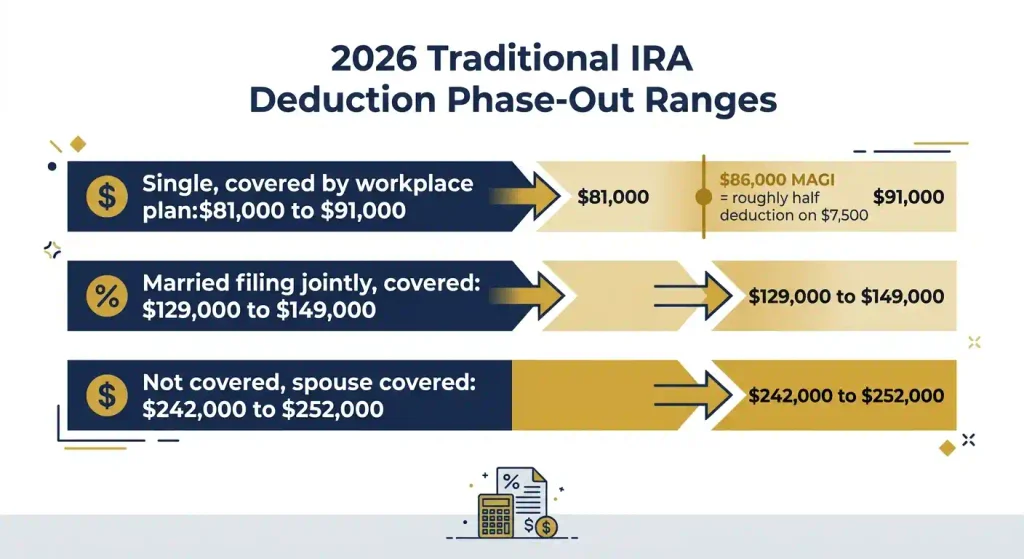
The Internal Revenue Code ties your deduction to filing status, modified adjusted gross income (MAGI), and workplace plan coverage, typically a plan governed by the Employee Retirement Income Security Act (ERISA) like a 401(k). For 2026, single filers get the full deduction below $81,000 and none above $91,000; for married filing jointly, the range is $129,000 to $149,000. A single filer at $86,000 MAGI, halfway through the range, gets roughly half the deduction on a $7,500 contribution. Not covered yourself but your spouse is? Your range jumps to $242,000 to $252,000 for joint filers. Full tables are in IRS Publication 590-A.
Can You Deduct an IRA Contribution If You Have a 401(k)?
Yes, you can contribute with a 401(k), and often deduct too; contributing and deducting are separate questions. Under $81,000 (single) or $129,000 (joint) MAGI, the full deduction is still yours. Above the range, the deduction disappears, but you can still make a nondeductible contribution. The same applies with a 403(b) plan, a SEP IRA, or a SIMPLE IRA, all of which count as workplace coverage; self-employed workers should compare a Traditional IRA against California SEP IRA rules or a SIMPLE IRA for their much higher limits. Married filing separately is harsh: living with your spouse shrinks the range to just $0 to $10,000, so most lose the deduction.
What Happens If Your Traditional IRA Contribution Is Not Deductible?
You can still contribute with after-tax money, called basis, tracked on IRS Form 8606 and filed with your return each year you contribute. Basis comes back tax-free, but earnings don’t, and it’s not all-or-nothing: a $20,000 IRA with $5,000 basis makes only 25% of each withdrawal tax-free. Skip the form, and the IRS can tax all of it.
How Much Can a Traditional IRA Save You in Taxes?
Your savings equal your deductible contribution times your 2026 federal tax bracket, so the exact dollar amount depends on your rate (see the example below). Savings show up on your tax return, not your paycheck.
A Simple Traditional IRA Tax-Savings Example
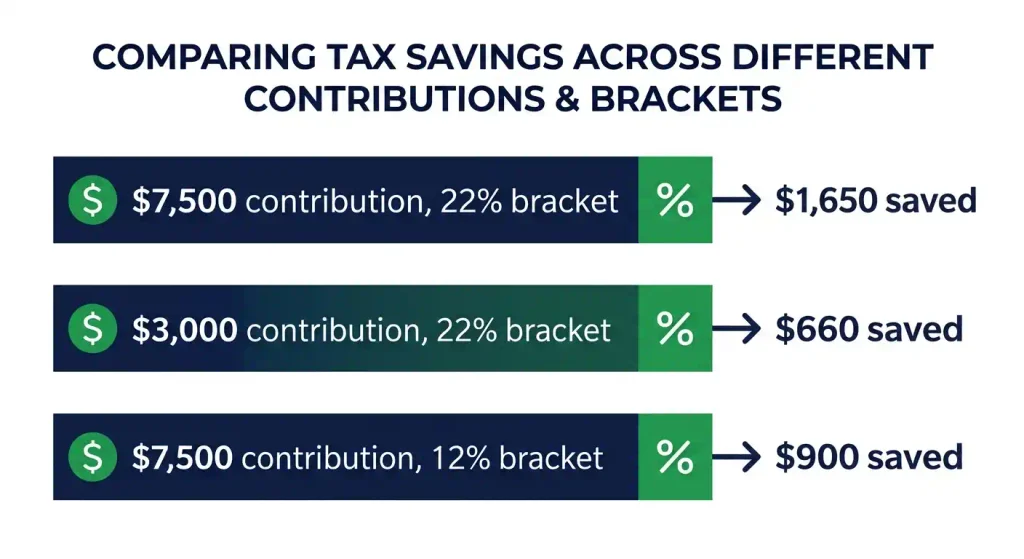
Say you’re single, earn $70,000, and your taxable income after the standard deduction lands in the 22% bracket. A $7,500 Traditional IRA contribution, fully deductible, cuts taxable income by $7,500 and federal tax by about $1,650; a smaller $3,000 contribution saves about $660. In a lower 12% bracket, that same $7,500 contribution would only save about $900, since savings scale directly with your rate. A deduction isn’t a credit: a credit cuts tax dollar for dollar, a deduction only shrinks taxable income. State savings add more; your real number depends on bracket, filing status, and state.
When a Traditional IRA May Offer Less Immediate Tax Benefit
Partial or no deduction means you keep only the tax-deferred growth, so your retirement bracket matters: expect a higher one, a Roth may serve you better; expect a lower one, the Traditional IRA gets stronger. Lower-income savers may also qualify for the Saver’s Credit (the Retirement Savings Contributions Credit), worth 10%, 20%, or 50% of up to $2,000 contributed, stacking on top of the deduction. For 2026, your AGI must fall under $40,250 (single/MFS), $60,375 (head of household), or $80,500 (married filing jointly), and you must be 18 or older, not a full-time student, and not someone’s dependent.
What Investments Can You Hold in a Traditional IRA?
Most IRAs hold stocks, bonds, mutual funds, ETFs, and CDs; the IRA is just the container, and what’s inside decides your returns. Other tax-advantaged containers work the same way, including the 2026 HSA contribution limits for health savings. For retirement money, a Traditional IRA usually beats a plain savings account, a CD, or a taxable brokerage account, since none of those offer a tax break on contributions or growth.
| Traditional IRA | Savings Account / CD | Taxable Brokerage | |
|---|---|---|---|
| Tax break on contributions | Possible deduction | None | None |
| Tax on growth | Deferred until withdrawal | Taxed yearly as interest | Taxed yearly (dividends, capital gains) |
| Access before retirement | Restricted, 10% penalty may apply | Unrestricted | Unrestricted |
Common Traditional IRA Investment Options
Stocks, bonds, mutual funds, ETFs, CDs, and money market funds are the usual picks; some providers also offer self-directed IRAs for real estate, with extra rules. Collectibles and life insurance aren’t allowed, and the tax break doesn’t protect against market risk. A broad index fund, spreading money across hundreds of companies, is the simplest way to diversify. Time horizon matters too: someone 30 years from retirement can hold more stocks than someone five years away.
Account Fees, Cash Balances, and Investment Risks
Watch for trading commissions, fund expense ratios, account maintenance fees, and advisor fees. Many brokerages charge zero commissions, and index ETFs can cost 0.10% a year or less, but a 1% fee on $100,000 still costs $1,000 a year. Uninvested cash earns little and can fall behind inflation, and yes, you can lose money in a tax-advantaged account like an IRA, with no deduction for those losses.
Traditional IRA Withdrawal Rules and Taxes
How much tax you owe on a withdrawal depends on whether the money came from deductible contributions, nondeductible basis, or growth, and on your age when you take it out. Starting at 73 or later, the government forces withdrawals.
How Traditional IRA Withdrawals Are Taxed
Withdrawals are taxed at regular income rates, like wages, not the lower capital gains rates. Deductible contributions and earnings are taxable; basis from nondeductible contributions comes out tax-free, proportionally. A $10,000 withdrawal in the 12% bracket costs about $1,200 in federal tax. State rules differ: California’s state tax brackets for 2026 apply to withdrawals as regular income, while states like Illinois don’t tax them at all. IRS Publication 590-B covers these rules in full.
What Happens If You Withdraw Money Before Age 59½?
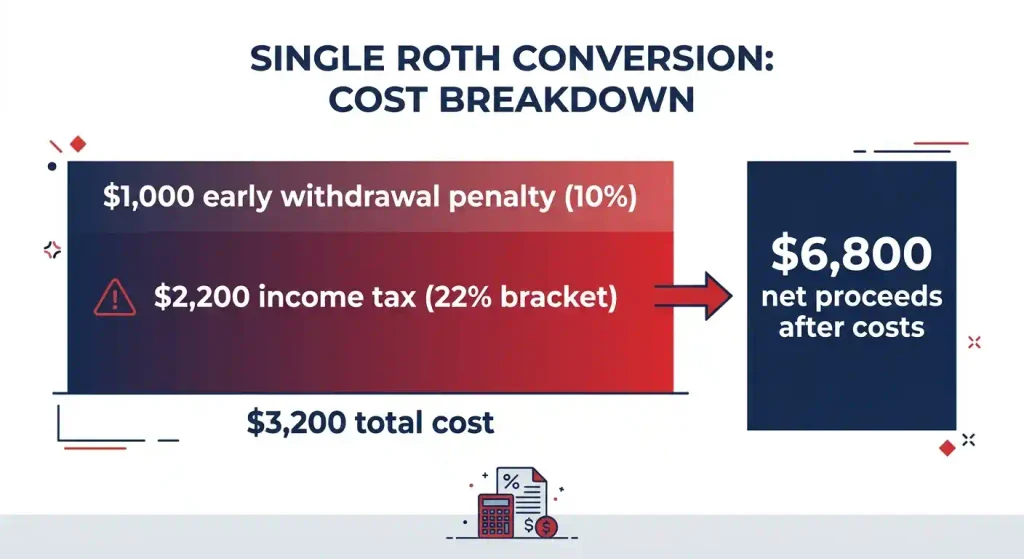
You generally owe a 10% additional tax plus regular income tax: $10,000 withdrawn in the 22% bracket means $2,200 income tax plus $1,000 extra, or $3,200 total. An early distribution exception can remove the 10% for:
- Death or disability
- Medical bills over 7.5% of your Adjusted Gross Income (AGI)
- Health insurance premiums while unemployed
- Birth or adoption expenses (up to $5,000)
- Substantially equal periodic payments
An exception removes only the 10%, not the income tax. California also adds its own 2.5% tax on many early withdrawals.
Can You Use a Traditional IRA for a First Home or Emergency?
For a first home, you can take up to $10,000 over your lifetime without the 10%; “first-time” means no main home owned in the past two years. Qualified higher-education costs for you, your spouse, kids, or grandkids also avoid the 10%, and since 2024, one emergency personal expense distribution of up to $1,000 a year does too. Income tax still applies in every case, and you lose years of growth, so treat your IRA as a last resort.
Required Minimum Distributions (RMDs): When Must You Withdraw?
The IRS makes you start withdrawing at 73, or 75 if born in 1960 or later. The amount comes from your balance and an IRS table, and missing it brings a steep penalty.
When Traditional IRA RMDs Begin
The SECURE 2.0 Act raised the RMD age in stages:
| Birth Year | RMD Starts At |
|---|---|
| 1951–1959 | 73 |
| 1960 or later | 75 |
Your first Required Minimum Distribution (RMD) is due by April 1 of the following year; delay it, and you’ll owe two RMDs that year, by April 1 and December 31, which can push you into a higher bracket. Every later RMD is due by December 31. A Roth IRA’s original owner has no RMDs at all.
How to Calculate a Traditional IRA RMD
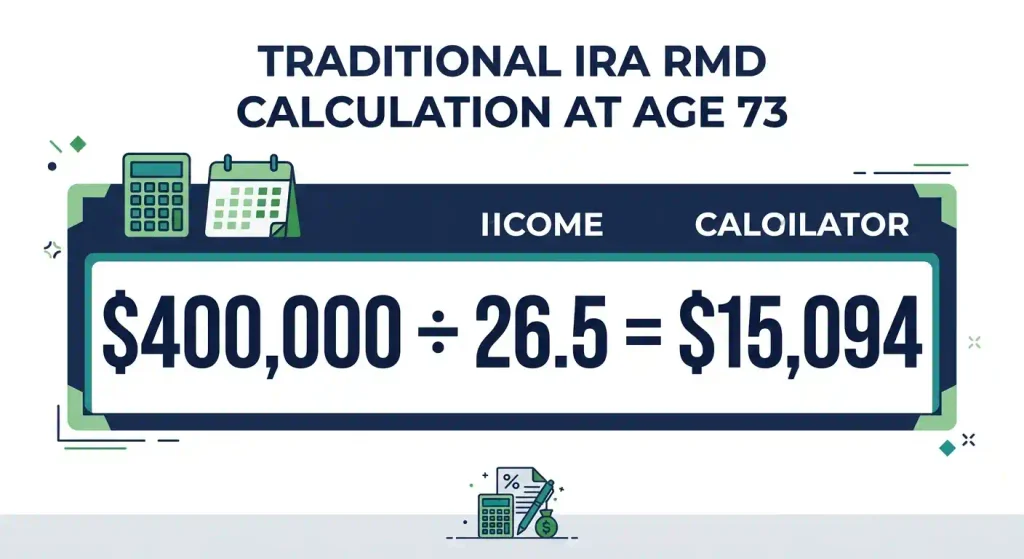
Divide your December 31 balance by the IRS Uniform Lifetime Table factor for your age; at 73, that’s 26.5, so $400,000 gives an RMD of about $15,094. With several Traditional IRAs, calculate each one’s RMD, add them up, and withdraw the total from any account or mix. A 401(k) has its own RMD and doesn’t count toward this.
What Happens If You Miss an RMD?
The excise tax is 25% of the amount missed, dropping to 10% if fixed within two years, so missing that $15,094 RMD could cost about $3,774. Report the shortfall on IRS Form 5329; the IRS may waive it for reasonable cause once you take the missed amount. Check your RMD every year. Providers often calculate it, but the responsibility is yours.
Traditional IRA Rollovers, Transfers, and Roth Conversions
A rollover moves money from a workplace plan into an IRA, a transfer moves it between IRAs, and a Roth conversion moves it from Traditional to Roth, triggering tax.
Moving Money From a 401(k) or Another Retirement Account
The cleanest way is a direct rollover: your old plan sends money straight to your IRA, no tax, no withholding. A trustee-to-trustee transfer between IRAs works the same way. A check made out to you gives 60 days to deposit it, but a 401(k) withholds 20% on those checks, so you must replace that amount yourself or it counts as taxable.
| Method | Tax Withheld | Deadline | Frequency Limit |
|---|---|---|---|
| Direct rollover | None | None | No limit |
| Trustee-to-trustee transfer | None | None | No limit |
| 60-day indirect rollover | 20% (from a 401(k) check) | 60 days to redeposit | One per 12 months |
Miss the 60 days, and the money becomes taxable income plus the 10% extra tax if you’re under 59½. Rollovers don’t count against your $7,500 contribution limit.
Converting a Traditional IRA to a Roth IRA
A conversion makes the converted amount taxable income that year, with no income limit on converting; $20,000 converted in the 22% bracket creates about $4,400 in federal tax. Basis complicates it, since the IRS treats all your Traditional IRAs as one pot: $5,000 basis and $45,000 pre-tax money makes only 10% of any conversion tax-free, tracked on Form 8606. Compare the tax now versus later, and avoid converting so much that you jump brackets.
Traditional IRA Common Myths and Mistakes
Most IRA mistakes come from assuming too much: that the deduction is automatic, that depositing money means it’s invested, or that withdrawals are free.
Traditional IRA Misconceptions That Can Cost You
Myth: every contribution is deductible. It’s not; above the phase-out range with workplace coverage, the deduction is gone. Myth: putting money in an IRA invests it. It doesn’t; cash waits until you pick investments. Myth: tax-deferred means tax-free. It doesn’t; you pay income tax on withdrawals in retirement.
Contribution and Withdrawal Mistakes to Avoid
Contributing more than the limit creates an excess contribution, taxed at 6% yearly until fixed by withdrawing the extra plus earnings by your filing deadline, including extensions. Skipping Form 8606 on a nondeductible contribution carries a $50 penalty and risks double taxation; failing to track basis is another common slip. People also withdraw early without checking exceptions or miss RMD deadlines, so put your dates on a calendar.
How to Open and Fund a Traditional IRA
Pick a provider, open the account online, fund it, then invest. It usually takes about 15 minutes, and it fits naturally into any broader California tax savings planning you’re already doing.
Choose an IRA Provider and Open an Account
Banks offer safe but slow-growing savings and CD IRAs; brokerages offer the widest fund range and lowest fees; robo-advisors manage a portfolio for a small yearly fee. Compare fees, minimums, investment choices, and support. To open the account, you’ll need:
- Your Social Security number
- A photo ID
- Your address
- Employment details
- A beneficiary
- Bank account information
Your beneficiary designation overrides your will, so review it after a marriage, divorce, or new child. An inherited Traditional IRA follows its own distribution rules, separate from the RMD rules that apply while you’re alive, so heirs should check those rules first.
Fund and Invest Your Traditional IRA
Link your bank account and contribute a lump sum or set monthly deposits, choosing the correct tax year if contributing between January and April. Buy investments matching your risk tolerance and timeline; a target-date fund is the hands-off option. Check your confirmation, statements, and fees, and compare your records against Form 5498, sent by your provider each May.
Traditional IRA FAQs
Here are quick answers to the questions people ask most.
Can I contribute to a Traditional IRA if I make too much money?
Yes, there’s no income limit for contributing. High income can reduce or remove the deduction with a workplace plan, but you can still contribute after-tax.
Can I have a Traditional IRA and a Roth IRA at the same time?
Yes. Your $7,500 limit ($8,600 if 50 or older) is shared across both, and Roth eligibility still depends on your income.
Does a Traditional IRA reduce my taxable income automatically?
No. The contribution must qualify for a deduction and be claimed on your tax return; your paycheck withholding won’t change on its own.
Can I contribute to a Traditional IRA if I am over age 70?
Yes, there’s no age limit as long as you have taxable compensation, capped at what you earned for the year, up to the annual limit.
Can I withdraw my original contributions without paying taxes?
Not automatically. Deductible contributions were never taxed, so withdrawals are taxable, plus the 10% extra tax before 59½. Only nondeductible basis comes back tax-free, proportionally to your total balance.
Is a Traditional IRA better than a Roth IRA?
It depends on your tax rate now versus retirement. A higher bracket now favors the Traditional IRA, a lower bracket favors the Roth, and splitting contributions is a reasonable hedge if you’re unsure.
Further Reading and Verified Sources
More retirement, tax, and payroll guides are on our blog, our tools and pages, and our full topic list. Every figure in this guide is drawn from official IRS sources, including IRS Publication 590-A, IRS Publication 590-B, and irs.gov directly.

Yeasin Sorker is the founder of Paycheck Calculator California. He built this tool in 2018 after noticing that most free paycheck calculators missed California-specific rules like daily overtime and the uncapped SDI rate.
He researches California payroll tax updates regularly and keeps this calculator aligned with the latest IRS, FTB, and EDD published rates. All calculations on this site are estimates based on official 2026 government sources. For personalized tax advice, consult a qualified tax professional.