
Anyone with taxable compensation under current IRS income limits can open a Roth IRA, a retirement account where after-tax contributions grow and come out completely tax free once the account meets its holding-period rule.
That $7,500 2026 contribution ceiling, and the five-year, age-59½ rule behind it, reflects current IRS guidance explained in detail below.
The tradeoff: no upfront tax deduction, and income limits can block high earners entirely.
What Is a Roth IRA? A Simple Explanation
The Internal Revenue Service (IRS) formally classifies a Roth IRA as an Individual Retirement Arrangement (IRA); a Roth individual retirement account is simply the after-tax version. It’s not a plain brokerage account either, since a brokerage account gets no special tax treatment.
How a Roth IRA Works in Plain English
A Roth IRA isn’t a bank account or a single investment. It’s a container you fund with after-tax money, then choose what goes inside: stocks, bonds, mutual funds, exchange-traded funds (ETFs), or cash. Follow the rules, and both contributions and earnings come out tax free. One catch: depositing money doesn’t invest it. Left alone, cash often just sits in a low-yield settlement fund. You have to pick investments yourself.
How a Roth IRA Can Grow Over Time
Growth comes from compounding: your returns earn their own returns. Over 10, 20, or 30 years, that can turn modest monthly contributions into a large balance, since the gains aren’t taxed annually like a regular brokerage account, just tax free at a qualified withdrawal. None of this is guaranteed. A 7% or 8% hypothetical return is just that, hypothetical. A 1% fund fee versus 0.05% can cost tens of thousands by retirement, and inflation erodes what your future balance can actually buy. Online Roth IRA compound growth calculators can model scenarios, but can’t predict real returns.
Roth IRA vs. Traditional IRA: Which Is Better for You?
A Roth IRA taxes money now and grows it tax free; a traditional IRA often deducts now and taxes withdrawals later. The better fit depends on whether your tax rate will be higher or lower in retirement.
Roth IRA vs. Traditional IRA at a Glance
| Feature | Roth IRA | Traditional IRA |
|---|---|---|
| Contribution tax treatment | After-tax, no deduction | May be tax-deductible |
| Withdrawals in retirement | Tax free if qualified | Taxed as ordinary income |
| Income limits to contribute | Yes, phases out at higher incomes | No income limit to contribute |
| Deduction limits | Not applicable | Can phase out if covered by a workplace plan |
| Required minimum distributions | None for original owner | Required starting at a set age |
Roth IRA income limits can block direct contributions entirely. Traditional IRA contributions are open to almost anyone with earned income, though deductibility depends on income and workplace coverage.
When Does a Roth IRA Beat a Traditional IRA?
A Roth wins when you expect a higher tax rate later: common for early-career workers, low-income years, or anyone valuing tax-free withdrawals and the flexibility to pull contributions out anytime, tax and penalty free. Age alone doesn’t decide it. A 55-year-old expecting a pension bump could still benefit more than someone in their 20s expecting lower retirement income.
When Might a Traditional IRA Be the Better Choice?
If you’re in a high tax bracket now and expect a lower one later, a traditional IRA’s deduction can beat the Roth’s future tax-free withdrawals. That deduction isn’t automatic: if you or your spouse has a workplace plan, the IRS phases out deductibility once income passes certain thresholds.
Can You Have Both a Roth IRA and a Traditional IRA?
Yes, you can hold both. Regular contributions share one combined annual limit, so you can’t max out $7,500 in each. Splitting between them gives tax diversification: some retirement income taxable, some not.
Roth IRA Rules for 2026: Contribution Limits and Income Eligibility
For 2026, under the IRS’s annual inflation adjustment:
- Under age 50: $7,500 (up from $7,000 in 2025)
- Age 50 or older: $8,600 (up from $8,000 in 2025)
How Much Can You Contribute to a Roth IRA in 2026?
The $7,500 limit is shared across all traditional and Roth IRAs you own; contribute $4,000 to a traditional IRA and you can add only $3,500 more to a Roth that year. You also can’t contribute more than you earned in taxable compensation. Earn only $3,000, and $3,000 is your real cap. SEP or SIMPLE employer contributions and rollovers don’t count against this limit.
Roth IRA Income Limits for 2026
Eligibility depends on modified adjusted gross income (MAGI):
| Filing Status | Full Contribution Below | Phased Out By |
|---|---|---|
| Single / head of household | $153,000 | $168,000 |
| Married filing jointly | $242,000 | $252,000 |
| Married filing separately (lived together) | $0 | $10,000 (fixed, not inflation-adjusted) |
Lower-income contributors may also qualify for the Saver’s Credit, officially the Retirement Savings Contributions Credit, a separate tax credit.
What Counts as Income for Roth IRA Eligibility?
MAGI starts with adjusted gross income plus a few add-backs, like foreign earned income exclusions; for most people it’s close to AGI. Contributing at all requires taxable compensation: wages, salaries, tips, bonuses, or net self-employment income. Investment income doesn’t count. $40,000 in dividends and capital gains alone means zero taxable compensation and no eligibility, regardless of how low that income is.
Can You Contribute If You Are Young, Unemployed, or Married?
No minimum or maximum age applies. A 16-year-old with a summer job can open one; so can a 75-year-old still working part-time. The only requirement is taxable compensation, so minors, students, freelancers, and gig workers qualify if they earn. An unemployed spouse can still contribute through a spousal IRA, based on the working spouse’s compensation, if filing jointly.
When Is the Roth IRA Contribution Deadline?
You have until the federal tax filing deadline, usually April 15 of the next year, to contribute for the prior tax year. Contributions made between January 1, 2026 and April 15, 2027 can count for 2026 or, once that window opens, 2027. Confirm with your provider which year they’re applying your deposit to.
Roth IRA Tax Rules: Contributions, Growth, and Withdrawals
Contributions are never tax-deductible; you pay tax going in. In exchange, qualified withdrawals, both contributions and earnings, come out completely tax free.
Are Roth IRA Contributions Tax-Deductible?
No. A traditional IRA may cut this year’s tax bill through a deduction; a Roth IRA does not. You pay tax up front instead. Contributions are never tax-free going in, but qualified withdrawals are tax-free coming out; mixing those two up is a common mistake.
When Can You Withdraw Roth IRA Money Tax-Free?
Tax-free, penalty-free earnings withdrawals generally require the account to be open at least five tax years and the owner to be at least 59½. This is a qualified distribution. The five-year clock starts January 1 of the tax year of your first contribution, not from each deposit, so a first contribution in December 2022 starts the clock January 1, 2022. Exceptions to the age-59½ rule include disability and certain first-home purchases.
Can You Withdraw Roth IRA Contributions Before Retirement?
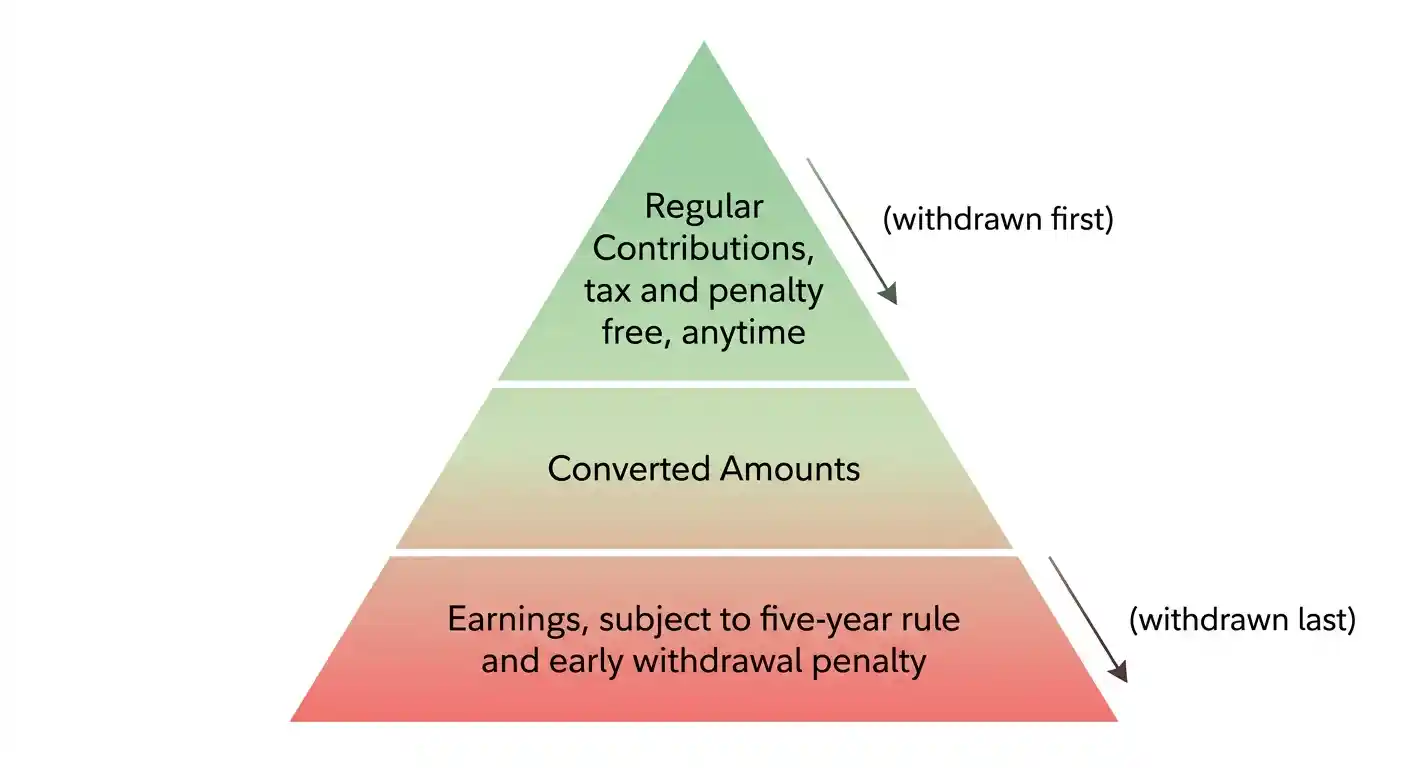
Yes. The IRS uses Roth IRA ordering rules: regular contributions come out first, then converted amounts, then earnings. Since contributions were already taxed, you can withdraw that amount anytime, for any reason, tax and penalty free. Earnings and certain converted funds have their own five-year rules and may trigger an early withdrawal penalty.
What Happens If You Withdraw Earnings Early?
Early earnings withdrawals, before meeting the five-year and age-59½ rules, typically owe ordinary income tax plus the 10% additional tax on early distributions. Exceptions: up to $10,000 of earnings penalty free, over a lifetime, for a first-time homebuyer exception (income tax may still apply if the five-year rule isn’t met), and penalty-free access for permanent disability.
Do Roth IRA Owners Have to Take Required Minimum Distributions?
No, not the original owner; the balance can keep growing tax free for life. That changes for beneficiaries: most non-spouse beneficiaries must empty an inherited Roth IRA within 10 years of the owner’s death, though withdrawals stay tax free.
Roth IRA Example: From Monthly Savings to Retirement
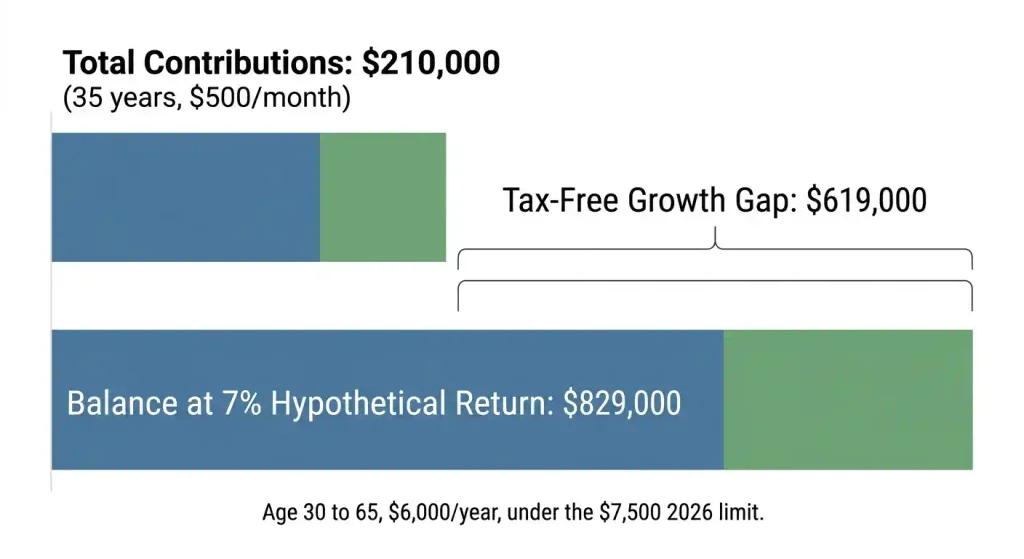
A 30-year-old contributing $500 a month ($6,000 a year, under the $7,500 2026 limit) for 35 years, until age 65, puts in $210,000 total. At a hypothetical 7% average annual return, purely illustrative, that could grow to roughly $829,000. The $619,000 gap between contributions and balance is tax-free compounding at work. Real results will vary with market swings, fees, and contribution consistency.
Roth IRA vs. 401(k): Which Should You Fund First?
A Roth IRA and a 401(k) usually work together: grab any employer match first, fund a Roth IRA, then return to the 401(k) if there’s more to save.
Roth IRA vs. Traditional 401(k) vs. Roth 401(k)

A Roth IRA is self-opened, with no employer involvement, and has income limits. A traditional 401(k) is employer-sponsored, pre-tax now, taxed on withdrawal. A Roth 401(k) blends both: employer-sponsored, after-tax, tax-free qualified withdrawals, and no Roth IRA income limit applies to it. Required minimum distributions (RMDs) used to apply to Roth 401(k)s, but the SECURE 2.0 Act eliminated that starting in 2024, matching Roth IRA treatment. Roth IRAs also offer more withdrawal flexibility on contributions than most 401(k) plans, which restrict access until you leave the job, hit retirement age, or qualify for a hardship exception. One more 2026 change: under SECURE 2.0, workers 50 and older with prior-year wages above $150,000 (updated by IRS Notice 2025-67 from the original $145,000 statutory threshold) can no longer direct catch-up contributions to a pre-tax 401(k); those must go to Roth.
Should You Get Your Employer’s 401(k) Match First?
An employer match is often an instant 50% to 100% return, hard to beat elsewhere, so grab the full match first. Check the vesting schedule. After that, many fund a Roth IRA, then return to the 401(k). An emergency fund and paying down high-interest debt usually come before any of it. California employers without a 401(k) are required to register for CalSavers, which auto-enrolls workers into a Roth IRA by default unless they opt out.
Roth IRA Pros and Cons: What to Consider Before Opening One
A Roth IRA offers tax-free growth and no forced withdrawals, but comes with income limits and no upfront deduction. The right call depends on income, age, and your tax situation now versus later.
The Main Advantages of a Roth IRA
- Tax-free growth: gains come out without owing the IRS anything, if the rules are followed
- No required minimum distributions for the original owner, so the balance can keep compounding
- Contributions stay accessible anytime without penalty
- Can be more tax-efficient to pass to heirs than a traditional IRA, even with a faster inherited-account timeline
- A qualified Roth IRA distribution doesn’t count as income for Social Security benefit taxation or Medicare’s income-related monthly premiums
The Main Disadvantages and Risks
- No upfront tax deduction
- Income limits can block high earners entirely
- The $7,500 2026 cap rules out dumping in a windfall
- Early earnings withdrawals without an exception trigger income tax plus a 10% penalty
- Market risk is real: poor fund choices, high fees, or uninvested cash can erode the tax advantages
Who Should Consider a Roth IRA?
Young workers and new investors often benefit most, since their tax bracket now tends to be lower than later. Mid-career and higher earners can still gain from tax diversification. People nearing retirement may want tax-free income or an estate benefit. High-interest debt, no emergency fund, or an unused 401(k) match should usually come first regardless.
What If Your Income Is Too High for a Direct Roth IRA Contribution?
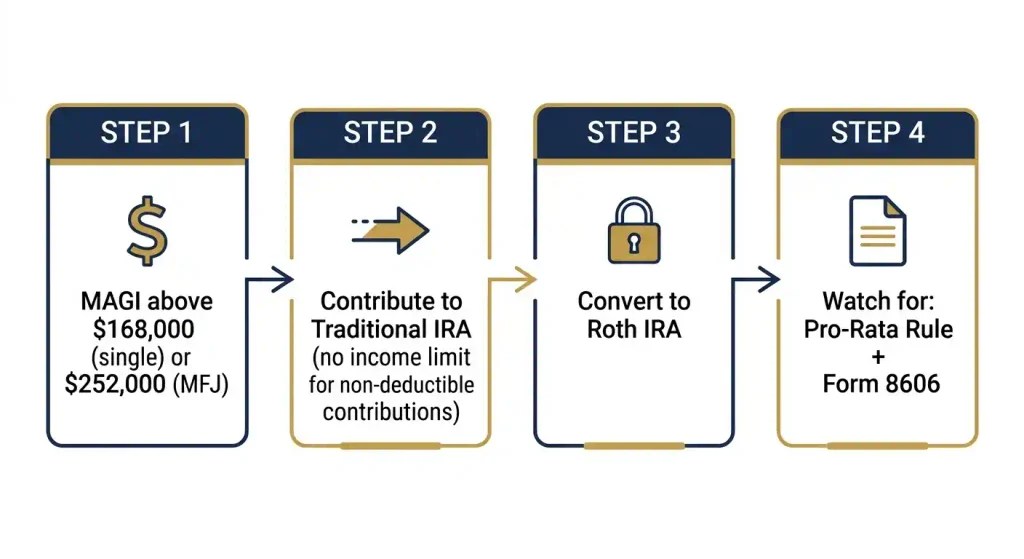
MAGI above $168,000 (single) or $252,000 (married filing jointly) blocks direct contributions. The common workaround is a backdoor Roth IRA.
What If Your Income Is Too High for a Direct Roth IRA Contribution?
A contribution is new money up to the annual limit; a Roth conversion moves existing money, often from a traditional IRA or old 401(k), with no annual cap, though the converted amount is usually taxable that year. A backdoor Roth IRA contributes to a traditional IRA, which has no income limit for non-deductible contributions, then converts it to Roth. The complication: the pro-rata rule. Existing pre-tax money in traditional, SEP, or SIMPLE IRAs makes the IRS treat the conversion as a proportional mix of pre-tax and after-tax dollars, which can trigger an unexpected tax bill. Form 8606 reports the nondeductible contribution and tracks basis. A tax professional is worth consulting once multiple IRAs are involved. The SECURE 2.0 Act also allows a narrower path: leftover money in a 529 plan, a qualified tuition program, can roll into the beneficiary’s Roth IRA if the 529 has been open at least 15 years, excluding contributions (and earnings) from the last 5 years, up to a $35,000 lifetime cap per beneficiary, counted against the annual Roth IRA contribution limit. These Roth IRA transfer and rollover rules carry real fine print, so confirm current requirements first.
How to Open and Fund a Roth IRA
Choose a Roth IRA Provider
Brokerages like Fidelity, Schwab, or Vanguard offer stocks, ETFs, mutual funds, and bonds; banks often limit you to CDs or savings products that grow less over decades. Compare account minimums, often $0 at major brokerages, and trading costs. Account fees and investment expense ratios are different things. SIPC insurance at a brokerage protects against firm failure, not investment losses.
Open the Account and Make Your First Contribution
Opening usually takes about 15 minutes online: identity verification and naming a beneficiary, who inherits the account. Update that beneficiary after marriage or divorce. A Roth IRA can be split between spouses in divorce through a transfer incident to divorce, tax and penalty free. Confirm the correct tax year when funding, especially January through April, and confirm income is under the 2026 limits before contributing.
Choose Investments After Funding the Account
Cash deposited isn’t automatically invested; choose stocks, bonds, mutual funds, ETFs, or cash equivalents. Diversified index funds or ETFs usually beat picking individual stocks for spreading risk. Match choices to risk tolerance and time horizon: someone 35 years from retirement can handle more volatility than someone five years out. Expense ratios quietly reduce returns every year. The account is just the structure; growth comes from what’s inside it.
Build a Sustainable Contribution Plan
Automatic monthly transfers turn saving into a habit, and a California paycheck calculator can show how much take-home pay you actually have to work with before picking that monthly number. Even $200 or $300 a month adds up over 20 or 30 years through compounding. Review contributions once or twice a year against the annual limit and your goals. Returns aren’t guaranteed, so the plan should fit your take-home pay, not compete with rent, groceries, or an emergency fund.
Roth IRA Mistakes and Myths That Can Cost You Money
Common Roth IRA Misconceptions
Not every withdrawal is tax free; earnings pulled before the five-year and age-59½ requirements aren’t. Contributions aren’t tax-deductible, a common mix-up with traditional IRAs. Depositing money doesn’t mean it’s invested; uninvested cash just sits there. A Roth IRA isn’t risk-free either, and no balance is guaranteed.
Excess Contributions and Income-Limit Mistakes
Over-contribute, whether by exceeding the limit or earning too much, and the IRS applies a 6% excise tax on the excess for every year it’s uncorrected. Fix it with a corrective withdrawal of the excess plus earnings before the tax filing deadline, or apply it to a future year if caught late. You can also recharacterize the contribution as if it went into a traditional IRA, sidestepping the tax, though Roth IRA recharacterization rules are narrower than before, so confirm eligibility. Confirm current correction rules with the IRS or a tax professional.
Tax Reporting and Recordkeeping Errors
Form 8606 tracks nondeductible contributions and conversions, key for a backdoor Roth. Form 1099-R shows distributions; Form 5498 reports contributions. Keep your own records of every contribution, conversion, distribution, and inherited-account transaction, since they determine what’s taxable later.
Frequently Asked Questions About Roth IRAs
Is a Roth IRA worth it for someone just starting their career?
Usually yes, since early-career tax brackets tend to be lower than later ones. An emergency fund and any employer 401(k) match should come first.
Can I lose money in a Roth IRA?
Yes. The tax advantage applies to the account, not the investments inside it; a market drop still lowers your balance.
Can I contribute to a Roth IRA if I have a 401(k)?
Yes. What matters is staying under the Roth IRA income limits and having enough taxable compensation.
Can I contribute to a Roth IRA without a job?
Only with taxable compensation from some source, or a working spouse filing jointly. Unemployment benefits and investment income don’t count.
What happens to my Roth IRA if my income increases?
Eligibility is based on that tax year’s MAGI, so a raise can block future direct contributions. Already over the limit and contributed? Correct the excess to avoid the 6% penalty.
Can I use a Roth IRA to buy a house or pay college expenses?
Up to $10,000 of earnings, over a lifetime, can come out penalty free for a first home, though income tax may still apply if the five-year rule isn’t met. A separate exception waives the 10% penalty on earnings used for qualified education costs, but not income tax.
What happens to a Roth IRA when the owner dies?
It passes to the named beneficiary. A surviving spouse has the most flexibility. Non-spouse beneficiaries generally must withdraw the full balance within 10 years, though withdrawals stay tax free.
How do I know whether a Roth IRA or traditional IRA fits my situation?
Compare your current tax bracket to your expected retirement bracket. Expect higher taxes later: lean Roth. Expect lower: lean traditional. Unsure: split contributions between both.
Final Decision: Is a Roth IRA Right for You?
A Simple Roth IRA Decision Checklist
- Confirm your 2026 MAGI is under $168,000 (single) or $252,000 (married filing jointly)
- Confirm taxable compensation covers your intended contribution
- Weigh a traditional IRA’s deduction against the Roth’s future tax-free withdrawals
- Check the basics: emergency fund, employer match, and investment costs that fit your timeline
Official IRS Resources for Verifying Roth IRA Rules
See the IRS Roth IRAs page, IRS Publication 590-A, and IRS Notice 2025-67 for contribution rules and the official 2026 figures. See IRS Publication 590-B for distribution and withdrawal taxation. Check IRS retirement plan contribution limits and IRS retirement account withdrawal rules directly on IRS.gov, since these figures are adjusted yearly.

Yeasin Sorker is the founder of Paycheck Calculator California. He built this tool in 2018 after noticing that most free paycheck calculators missed California-specific rules like daily overtime and the uncapped SDI rate.
He researches California payroll tax updates regularly and keeps this calculator aligned with the latest IRS, FTB, and EDD published rates. All calculations on this site are estimates based on official 2026 government sources. For personalized tax advice, consult a qualified tax professional.